www.scielo.br/zool
Over the last two decades, a number of studies have demon-strated that the mating systems of various birds are more complex than previously believed (reviewed in GRIFFITH et al. 2002). For instance, paternity tests using molecular techniques have docu-mented that different levels of extra-pair paternity (EPP) do occur. EPP can be defined as the proportion of offspring sired by only one social parent, usually the female, or the proportion of broods con-taining at least one extra-pair young (EPY) (WESTNEAT et al. 1990,
LIGON 1999, GRIFFITH et al. 2002, NEODORF 2004). The occurrence of EPP and EPY appear to be widespread among passerine birds (WESTNEAT et al. 1990, GRIFFITHet al. 2002, NEODORF 2004), yet this information is largely biased towards populations from temperate zones (STUTCHBURY & MORTON 2008, MACEDO et al. 2008), since more research on this subject has been conducted in that region. The Neotropical region holds almost half of the world’s avifauna (MYERS et al. 2000, HAWKINS et al. 2003), and Neotropical bird species differ from temperate species in many important aspects. For instance, they present reduced clutch sizes (MARTIN et al. 2000, JETZ et al. 2008), extended breeding seasons (STYRSKY & BRAWN 2011), and
occupy different types of habitats, which could potentially affect the frequencies of this breeding strategy (DAVIES et al. 2003, BRENNAN 2012). A few studies involving parentage analyses carried out in Neotropical passerines have revealed a wide range of EPY levels, from 0% in Dusky Antbird Cercomacra tyrannina (Sclater, 1855) (FLEISCHERet al. 1997) to 67% in Lesser Elaenia Elaenia chiriquensis (Lawrence, 1865) (STUTCHBURY et al. 2007).
As the lack of parentage studies on Neotropical birds limits broad conclusions about passerine social systems, here we used microsatellite molecular markers to perform paternity tests in a population of the White-necked Thrush, Turdus albicollis (Vieillot, 1818), from a well-preserved Brazilian Atlantic Forest area. Our specific objective was to investigate the occurrence of EPY in this Neotropical songbird.
Field work was conducted at Carlos Botelho State Park (24°04’S 47°58’W), São Paulo State, southeastern Brazil. This Park holds 37,644 ha of Atlantic Rain Forest, and together with a set of adjacent conservation units, comprises one of the largest Atlantic Forest remnant in Brazil, with more than 1 million ha.
SHORT COMMUNICATION
Extra-pair paternity in a Neotropical rainforest songbird,
the White-necked Thrush
Turdus albicollis
(Aves: Turdidae)
Carlos Biagolini-Jr
1, Mariellen C. Costa
2, Daniel F. Perrella
2, Paulo V.Q. Zima
2,
Lais Ribeiro-Silva
1& Mercival R. Francisco
3*1Programa de Pós-graduação em Diversidade Biológica e Conservação, Universidade Federal de São Carlos.
Campus de Sorocaba, Rodovia João Leme dos Santos, km 110, 18052-780 Sorocaba, SP, Brazil.
2Programa de Pós-graduação em Ecologia e Recursos Naturais, Universidade Federal de São Carlos. Rodovia
Washington Luís, km 235, 13565-905 São Carlos, SP, Brazil.
3Departamento de Ciências Ambientais, Universidade Federal de São Carlos. Campus de Sorocaba, Rodovia João
Leme dos Santos, km 110, 18052-780 Sorocaba, SP, Brazil.
*Corresponding author. E-mail: [email protected]
ABSTRACT. Over the last two decades, several studies have shown that the mating systems of various birds are more com-plex than previously believed, and paternity tests performed with molecular techniques have proved, for instance, that the commonly observed social monogamy often presents important variations, such as extra-pair paternity. However, data are still largely biased towards temperate species. In our study, at an area of the Brazilian Atlantic Forest, we found broods containing at least one extra-pair young (EPY) in the socially monogamous White-necked Thrush Turdus albicollis (Vieillot, 1818). Paternity tests using six heterologous microsatellite loci revealed that four of 11 broods (36.4%) presented at least one extra-pair young (EPY). This rate of EPY is within the range found for other studies in the tropics. This is one of the few studies that present detailed paternity analyses of a Neotropical rainforest passerine. Our findings corroborate the early insights that breeding strategies involving cheating can also be widespread among Neotropical socially monogamous songbirds.
Altitude varies from 30 to 1,003 m and annual rainfall varies from 777-2,264 mm (average 1,676 mm) (BEISIEGEL & MANTOVANI 2006). We searched for nests from September to February during two breeding seasons, 2013/2014 and 2014/2015, by monitoring approximately 7 km of trails, and 3 km of streams, in a sub-mon-tane area varying in altitude from 680 to 850 m (OLIVEIRA-FILHO &
FONTES 2000). To find the nests we monitored territories defended by males (MARTIN & GEUPEL 1993) in areas of primary forest.
The White-necked Thrush is a socially monogamous passerine (SNOW & SNOW 1963), endemic of the Neotropics, distributed in two disjunct regions: from Mexico to northern Argentina, and from northeastern Brazil to Uruguay (RIDGELY &
TUDOR 1989, COLLAR 2005). Surveys in the Atlantic Forest have shown that this is one of the most abundant species in this biome (SIMPSON et al. 2012, ANTUNES et al. 2013), and the most frequently recorded using mist nets in this forest understory (ALVES 2001). It builds bulky cup-shaped nests, mainly in large tree forks, invaginations of tree trunks, or inside bromeliads (SNOW & SNOW 1963, COLLAR 2005).
Whenever we found a nest we marked its location with a GPS (Garmin 62ST), and when nestlings were about five days old we sampled a drop of blood (10 µL) from each bird through a small incision at the tip of a claw. We also placed one mist net close to each nest to capture the parents when they flew into the nests to feed the nestlings, and blood samples were also obtained from them following the same procedure. Blood was stored in 1.5 ml tubes in 100% ethanol, and each animal received a unique combination of polyetilene colored bands for subsequent identification of adults by visual observations. After blood sampling and marking, nests were monitored by perform-ing daily one hour focal observation sessions to confirm that we had sampled adults that were the social parents of the nestlings, and not individuals that happened to be close to the nests.
The DNA was extracted using a phenol-chloroform-iso-amyl alcohol protocol (SAMBROOK et al. 1989), and animals were sexed by amplification of the homologous copies of the CHD gene (chromo-helicase-DNA-binding) using the primers P2/P8 (GRIFFITHS et al. 1998). We also used the primer (P0) (HAN et al. 2009) in the same PCR reaction. The latter anneal to a unique se-quence of W chromosome, resulting in a third band for females, usually 100 bp longer than CHDW, improving the resolution of sex identification. PCR reactions followed ANCIÃES & DEL LAMA (2002), and were resolved in 3% agarose gels.
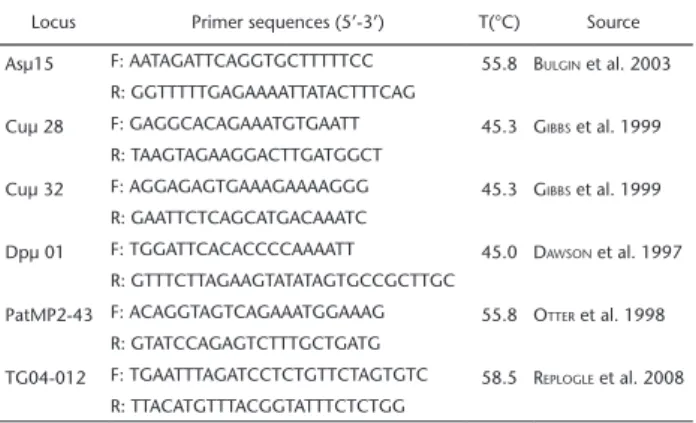
For paternity tests we used six microsatellite loci previ-ously evaluated in Common Blackbird, Turdus merula (Linnaeus, 1758) (SIMEONI et al. 2009), and Forest Thrush, Turdus lherminieri (Lafresnaye, 1844) (ARIAS et al. 2012): Asµ15, Cuµ 28, Cuµ 32, Dpµ 01, PatMP2-43, and TG04-012 (see Table 1). PCR reactions had a final volume of 10 µl, containing 0.2 mM of dNTPs, 1X amplification buffer, 3 mM MgCl2, 0.2 mM of each primer, 1 U Taq polymerase, and 100 ng of DNA. The reactions were per-formed in an Eppendorf thermocycler programmed for an initial denaturation at 94°C for 3 minutes, and 29 cycles of 94°C for 30
seconds, 30 seconds in the annealing temperature (see Table 1), and 72°C for 30 seconds, followed by a final extension at 72°C for 5 minutes. As allelic patterns could be clearly determined, alleles were scored for each locus in 7.5% polyacrylamide gels (SCHWARZOVÁ et al. 2008), run at 47 W during 1:40 hours, and results were visualized by silver staining (COMINCINI et al. 1995). We estimated the observed and expected heterozygosity, proba-bility of heterozygosity deficit, and the probaproba-bility of linkage disequilibrium using the software GENEPOP 4.0 (RAYMOND &
ROUSSET 1995). We also evaluated the possibility of null alleles, allelic dropout, and scoring errors due to stuttering using Mi-cro-Checker (VAN OOSTERHOUT et al. 2004). The accuracy of the loci to perform the paternity tests was estimated by the probability that two random individuals in the population could present identical allelic composition (the probability of identity), and by calculating the probability that the set of loci could not exclude a pair of candidate unrelated parents from an random offspring, using Cervus 3.0 (KALINOWSKI et al. 2007). All the above estimates were performed using only the adult individuals. The identifications of EPY were conducted through direct observa-tion of allele inheritance (FLEISCHER1996, MITRUS et al. 2014), and resulted when at least one young in a nest was sired by at least one extra-pair parent based on at least two loci. This is because mismatching at only one locus can be potentially caused by mutations or null alleles (WESTNEAT & MAYS 2005, LIUet al. 2015).
Table 1. Microsatellite loci used for paternity tests in Turdus albicollis, primer sequences, annealing temperature (T), and source.
Locus Primer sequences (5’-3’) T(°C) Source
Asµ15 F: AATAGATTCAGGTGCTTTTTCC 55.8 BULGIN et al. 2003
R: GGTTTTTGAGAAAATTATACTTTCAG
Cuµ 28 F: GAGGCACAGAAATGTGAATT 45.3 GIBBS et al. 1999
R: TAAGTAGAAGGACTTGATGGCT
Cuµ 32 F: AGGAGAGTGAAAGAAAAGGG 45.3 GIBBS et al. 1999
R: GAATTCTCAGCATGACAAATC
Dpµ 01 F: TGGATTCACACCCCAAAATT 45.0 DAWSON et al. 1997
R: GTTTCTTAGAAGTATATAGTGCCGCTTGC
PatMP2-43 F: ACAGGTAGTCAGAAATGGAAAG 55.8 OTTER et al. 1998 R: GTATCCAGAGTCTTTGCTGATG
TG04-012 F: TGAATTTAGATCCTCTGTTCTAGTGTC 58.5 REPLOGLE et al. 2008 R: TTACATGTTTACGGTATTTCTCTGG
We detected cases of EPY in four of the 11 sampled nests (36.4%), which included one nest with one nestling, two cases in nests with two nestlings, and one case in a nest containing three nestlings. In three of these four nests we confirmed the social parents feeding the offspring. Raw genotypic data and allelic mismatches among nestlings and their social parents are presented in Appendix 1.
Cases of extra-pair mating have been reported for all spe-cies of Turdus studied so far. In a population of Clay-coloured Thrush, Turdus grayi (Bonaparte, 1838), from Panama (09°N), 52.6% of the broods contained EPY (STUTCHBURY et al. 1998), and in a population of the American Robin, Turdus migratorius (Linnaeus, 1766), from Illinois, USA (40°N) this figure was 72% (ROWE & WEATHERHEAD 2007). Although we have analyzed a small-er numbsmall-er of broods, the frequency of EPY (36.4%) found for White-necked Thrush was smaller than these studies. However, this still can be considered high, as in GRIFFITH et al. (2002) review 35% of 34 socially monogamous passerine species have exhibit-ed EPY rates above 36.4%, indicating a potential phylogenetic effect within the Turdus.
A possible explanation for the exceptionally high levels of EPY in American Robin can involve breeding synchrony, a parameter commonly evoked to explain variations of EPY in passerine birds (WESTNEAT et al. 1990, GRIFFITH et al. 2002,
NEODORF 2004). When breeding is synchronic many females in a population are fertile at the same time and males may have limited opportunities to obtain extra-pair females, resulting in lower rates of extra-pair copulations (GRIFFITH et al. 2002, NEODORF 2004). Although synchrony has not been estimated for this set of species, inferences can be made based on the duration of breed-ing seasons, i.e., populations or species with shorter breedbreed-ing seasons should present more synchronic breeding (STUTCHBURY &
MORTON 1995). We have observed active nests of White-necked Thrush during a period of four months and at least one marked pair nested twice in the season. Clay-coloured Thrush breeds during approximately three months in Panama (STUTCHBURY et al. 1998), and they also can nest twice (DYRCZ 1983). The breeding season of American Robin also lasts about four months (ROWE &
WEATHERHEAD 2007), and they typically nest twice in the season (HOWELL 1942, YOUNG 1955). These data do not provide strong support for the idea that longer breeding seasons results in higher EPY rates in tropical species of Turdus.
In conclusion, the percentage of nests of White-necked Thrush in which at least one individual providing parental care have been cheated is within the range found for other Neotropical passerines, e.g. 10% for the Banded Wren Thryotho-rus pleurostictus (Sclater, 1860) (CRAMERet al. 2011), 36.7% for Yellow-shouldered Blackbird Agelaius xanthomus (Sclater, 1862) (LIU 2015), 52.6% for Red-throated Ant-tanager Habia fuscicauda (Cabanis, 1861) (CHIVER et al. 2015), 54.8% for Cherrie’s Tanager Ramphocelus costaricensis (Cherrie, 1891) (KRUEGER et al. 2008), and 67% in Lesser Elaenia (STUTCHBURY et al. 2007). This is one of a few studies that have performed detailed paternity analyses in a Neotropical bird, and our findings add knowledge to the early insights that breeding strategies involving EPY can be dissemi-nated also among Neotropical socially monogamous songbirds.
ACKNOWLEDGMENTS
The authors thank the Brazilian agencies Fundação de Amparo à Pesquisa do Estado de São Paulo (FAPESP, 2010/52315-7), and Conselho Nacional de Desenvolvimento Científico e Tecnológico (CNPq) for financial support, and Instituto Florestal do Estado de São Paulo (IF), and ICMBio for permits for field work at Carlos Botelho State Park (permits ICMBio 41026-1/COTEC 71/2014 D 184/2013 AP). C. Biagolini-Jr received a fellowship from FAPESP (2013/21209-5). We also thank D.F. Westneat, M.A. Pizo, R.H. Macedo, and two anonymous referees for important suggestions in the early versions of this manuscript.
LITERATURE CITED
ALVES MAS (2001) Estudos da ecologia de Aves na Ilha Grande, RJ. In: ALBUQUERQUE JLB, CANDIDO JR JF, STRAUBE FC (Eds.).
Ornitologia e Conservação: da Ciência às Estratégias.
Florianópolis, Unisul, vol. 1.
ANCIÃES M, DEL LAMASN (2002) Sex identification of Pin-tailed Manakins (Ilicura militaris: Pipridae) using the polymerase chain reaction and its application to behavioral studies.
Ornitología Neotropical 13: 159-165.
ANTUNES AZ, SILVA BGD, MATSUKUMA CK, ESTON MRD, SANTOS AMRD
(2013) Aves do Parque Estadual Carlos Botelho-SP. Biota Neotropica 13: 124-140. Available online at: http://www.bi-otaneotropica.org.br/v13n2/pt/fullpaper?bn00513022013+pt
ARIAS MC, ARNOUX E, BELL JJ, BERNADOU A, BINO G, BLATRIX R, et al. (2012) Permanent genetic resources added to Molecular Ecology Resourc-es Database 1 December 2011 – 31 January 2012. Molecular Ecolo-gy Resources 12: 570-572. doi: 10.1111/j.1755-0998.2012.03133.x
BEISIEGEL BM, MANTOVANI W (2006) Habitat use, home range and foraging preferences of the coati Nasua nasua in a pluvial tropical Atlantic forest area. Journal of Zoology 269: 77-87. doi: 10.1111/j.1469-7998.2006.00083.x
BRENNAN PLR (2012) Mixed paternity despite high male parental care in great tinamous and other Palaeognathes. Animal Behaviour 84: 693-699. doi: 10.1016/j.anbehav.2012.06.026 Table 2. Number of alleles per locus (Na), observed (Ho), and
expected (He) heterozigosities, and probability for heterozygote deficit (p).
Locus Na Ho HE p
Asµ15 6 0.545 0.583 0.421
Cuµ 28 5 0.636 0.766 0.108
Cuµ 32 3 0.227 0.210 >0.999
Dpµ 01 3 0.545 0.552 0.577
PatMP2-43 4 1.000 0.612 >0.999
BULGIN NL, GIBBS HL,VICKERY P, BAKER AJ (2003) Ancestral poly-morphisms in genetic markers obscure detection of evo-lutionarily distinct populations in the endangered Florida grasshopper sparrow (Ammodramus savannarum floridanus).
Molecular Ecology 12: 831-844. doi: 10.1046/j.1365-294X.2003.01774.x
CHIVER I, STUTCHBURY BJM, MORTON ES (2015) The function of seasonal song in a tropical resident species, the Red-throated Ant-tanager (Habia fuscicauda). Journal of Ornithology 156: 55-63. doi: 10.1007/s10336-014-1139-4
COLLAR N (2005) White-throated Thrush (Turdus albicollis). In: DEL HOYO J, ELLIOTT A, SARGATAL J, CHRISTIE DA, DE JUANA E (Eds.).
Handbook of the Birds of the World Alive. Barcelona, Lynx Edicions.
COMINCINI S, LEONE P, REDAELLI L, DE GIULI L, ZHANG Y, FERRETI L (1995) Characterization of bovine microsatellites by silver staining.
Journal of Animal Breeding and Genetics 112: 415-420. doi: 10.1111/j.1439-0388.1995.tb00580.x
CRAMER ERA, HALL ML, DE KORT SR, LOVETTE IJ, VEHRENCAMP SL (2011) Infrequent extra-pair paternity in the Banded Wren, a synchronously breeding tropical passerine. The Condor 113: 637-645. doi: 10.1525/cond.2011.100233
DAVIES NB, BUTCHART SMH, BURKE T, CHALINE B, STEWART IRK (2003) Reed warblers guard against cuckoos and cuckoldry. Animal Behaviour 65: 285-295. doi: 10.1006/anbe.2003.2049
DAWSON RJG, GIBBS HL, HOBSON KA, YEZERINAC SM (1997) Isolation of microsatellite DNA markers from a passerine bird, Dendro-ica petechia (the Yellow Warbler), and their use in population studies. Heredity 79: 506-514. doi: 10.1038/hdy.1997.190
DYRCZ A (1983) Breeding ecology of the Clay-coloured Robin Turdus grayi in lowland Panama. Ibis 125: 287-304. doi: 10.1111/j.1474-919X.1983.tb03115.x
FLEISCHER RC (1996) Application of molecular methods to the assessment of genetic mating systems in vertebrates, p. 133-161. In: FERRARIS JD, PALUMBI SR (Eds.). Molecular Zoology: Advances, Strategies, and Protocols. New York, Wiley-Liss.
FLEISCHER RC, TARR CL, MORTON ES (1997) Mating system of the DuskyAntbird, a tropical passerine, as assessed by DNA fin-gerprinting. The Condor 99: 512-514. doi: 10.2307/1369957
GIBBS HL, TABAK LM, HOBSON K (1999) Characterization of micro-satellite DNA loci for a Neotropical migrant songbird, the Swainson’s Thrush (Catharus ustulatus). Molecular Ecology 8: 1551-1561.
GRIFFITH SC, OWENS IPF, THUMAN KA (2002) Extra pair paternity in birds: A review of interspecific variation and adaptive func-tion. Molecular Ecology 11: 2195-2212. doi: 10.1046/j.1365-294X.2002.01613.x
GRIFFITHS R,DOUBLEM C, ORR K, DAWSON JG (1998) A DNA test to sex most birds. Molecular Ecology 7: 1071-1075. doi: 10.1046/j.1365-294x.1998.00389.x
HAN JI, KIM JH, KIM S, PARK SR, NA KJ (2009) A simple and im-proved DNA test for avian sex determination. The Auk 126: 779-783. doi: 10.1525/auk.2009.08203
HAWKINS BA, PORTER EE, DINIZ-FILHO JAF (2003) Productivity and history as predictors of the latitudinal diversity gra-dient of terrestrial birds. Ecology 84: 1608-1623. doi: 10.1890/0012-9658(2003)084[1608:PAHAPO]2.0.CO;2
HOWELL JC (1942) Notes on the nesting habits of the American Robin (Turdus migratorius L.). American Midland Naturalist 28: 529-603. doi: 10.2307/2420891
JETZ W, SEKERCIOGLU CH, BÖHNING-GAESE K (2008) The worldwide variation in avian clutch size across species and space. PLoS Biology 6: e303. doi: 10.1371/journal.pbio.0060303
KALINOWSKI ST, TAPER ML, MARSHALL TC (2007) Revising how the computer program CERVUS accommodates genotyping error increases success in paternity assignment. Molecular Ecology 16: 1099-106. doi: 10.1111/j.1365-294X.2007.03089.x
KRUEGER TR, WILLIAMS DA, SEARCY WA (2008) The genetic mating system of a tropical tanager. The Condor 110: 559-562. doi: 10.1525/cond.2008.8546
LIGON JD (1999) The Evolution of Avian Breeding Systems. New York, Oxford University Press, 528p.
LIU IA, JOHNDROW JE, ABE J, LÜPOLD S, YASUKAWA K, WESTNEAT DF, NOWICKI S (2015) Genetic diversity does not explain variation in extra-pair paternity in multiple populations of a songbird.
Journal of Evolutionary Biology 28: 1156-1169.
MACEDO RH, KARUBIAN J, WEBSTER MS (2008) Extrapair paternity and sexual election in socially monogamous birds: Are Tropical birds different? The Auk 125: 769-777. doi: 10.1525/auk.2008.11008
MARTIN TE, GEUPEL GR (1993) Nest-monitoring plots: Methods for locating nests and monitoring success. Journal of Field Ornithology 64: 507-519.
MARTIN TE, MARTIN PR, OLSON CR, HEIDINGER BJ, FONTAINE JJ
(2000) Parental care and clutch sizes in North and South American birds. Science 287: 1482-1485. doi: 10.1126/ science.287.5457.1482
MITRUS J, MITRUS C, RUTKOWSKI R, SIKORA M (2014) Extra-pair pater-nity in relation to age of the Red-breasted Flycatcher Ficedula parva males. Avian Biology Research 7: 111-116. doi: 10.31 84/175815514X13948188185179
MYERS N, MITTERMEIER RA, MITTERMEIER CG, FONSECA GA, KENT J (2000) Biodiversity hotspots for conservation priorities.
Nature 403: 853-858. doi: 10.1038/35002501
NEODORF DLH (2004) Extrapair paternity in birds: understand-ing variation among species. The Auk 121: 302-307. doi: 10.2307/4090394
OLIVEIRA-FILHO AT, FONTES MAL (2000) Patterns of floristic dif-ferentiation among Atlantic Forests in southeastern Brazil and the influence of climate. Biotropica 32: 793-810. doi: 10.1111/j.1744-7429.2000.tb00619.x
OTTER K, RATCLIFFE L, MICHAUD D, BOAG PT (1998) Do female Black-capped Chickadees prefer high-ranking males as extra-pair partners? Behavioral Ecology and Sociobiology 43: 25-36.
REPLOGLE K, ARNOLD AP, BALL GF, BAND M, BENSCH S, BRENOWITZ EA,
DONG S, DRNEVICH J, FERRIS M, GEORGE JM, GONG G, HASSELQUIST
D, HERNANDEZ AG, KIM R, LEWIN HA, LIU L, LOVELL PV, MELLO
CV, NAURIN S, RODRIGUEZ-ZAS S, THIMMAPURAM J, WADE J, CLAYTON
DF (2008) The songbird neurogenomics (SoNG) initiative: community-based tools and strategies for study of brain gene function and evolution. BMC Genomics 9: 1-20. doi: 10.1186/1471-2164-9-131
RIDGELY RS, TUDOR G (1989) The birds of South America: the
Oscine Passerines. Austin, University of Texas Press, 596p.
ROWE KMC, WEATHERHEAD PJ (2007) Social and ecological factors affecting paternity allocation in American robins with over-lapping broods. Behavioral Ecology and Sociobiology61: 1283-1291. doi: 10.1007/s00265-007-0359-5
SAMBROOK J, FRITSCH EF, MANIATIS T (1989) Molecular cloning: a laboratory manual. Nova York, Cold Spring Harbor Labo-ratory Press, 626p.
SCHWARZOVÁ L, ŠIMEK J, COPPACK T, TRYJANOWSKI P (2008) Male-bi-ased sex of extra pair young in the socially monogamous Red-backed Shrike Lanius collurio. Acta Ornithologica43: 235-239. doi: 10.3161/000164508X395379
SIMEONI M, DAWSON DA, GENTLE LK, COIFFAIT L, WOLFF K, EVANS
KL, GASTON BJ, HATCHWELL KJ (2009) Characterization of 38 microsatellite loci in the European blackbird, Turdus merula (Turdidae, AVES). Molecular Ecology Resources 9: 1520-1526. doi: 10.1111/j.1755-0998.2009.02708.x
SIMPSON R, CAVARZERE V, SIMPSON E (2012) List of documented bird species from the municipality of Ubatuba, state of São Paulo, Brazil. Papéis Avulsos de Zoologia 52: 233-255. doi: 10.1590/ S0031-10492012002100001
SNOW DW, SNOWBK (1963) Breeding and the annual cycle in three Trinidad thrushes. Wilson Bulletin 75: 27-41.
STUTCHBURY BJM, MORTON ES (1995) The effect of breeding syn-chrony on extra-pair mating systems in songbirds. Behaviour 132: 675-690. doi: 10.1163/156853995X00081
STUTCHBURY BJM, MORTON ES (2008) Recent Advances in the be-havioral ecology of tropical birds. The Wilson Journal of Ornithology 120: 26-37. doi: 10.1676/07-018.1
STUTCHBURY BJM, MORTON ES, PIPER WH (1998) Extra-pair mat-ing system of a synchronously breedmat-ing tropical songbird.
Journal of Avian Biology 29: 72-78. doi: 10.2307/3677343
STUTCHBURY BJM, MORTON ES, WOOLFENDEN B (2007) Comparison of the mating systems and breeding behavior of a resident and a migratory tropical flycatcher. Journal of Field Ornithology 78: 40-49. doi: 10.1111/j.1557-9263.2006.00083.x
STYRSKY JN, BRAWN JD (2011) Annual Fecundity of a Neotropical bird during years of high and low rainfall. The Condor 113: 194-199. doi: 10.1525/cond.2011.100051
VAN OOSTERHOUT C, HUTCHINSON WF, WILLS DPM, SHIPLEY P (2004) MICRO-CHECKER: Software for identifying and correcting genotyping errors in microsatellite data. Molecular Ecology Notes 4: 535-538.
WESTNEAT DF, SHERMAN PW, MORTON M (1990) The ecology and evolution of extra-pair copulations in birds. Current Orni-thology 7: 331-369.
WESTNEAT DF, MAYS HL (2005) Tests of spatial and temporal factors influencing extra-pair paternity in red-winged blackbirds.
Molecular Ecology 4: 2155-2167.
YOUNG H (1955) Breeding behavior and nesting of the Eastern Robin. American Midland Naturalist 53: 329-352. doi: 10.2307/2422072
Submitted: 14 April 2016
Received in revised form: 8 May 2016 Accepted: 11 June 2016
Editorial responsibility: Luís Fábio Silveira
Author Contributions: CB and MRF designed the experiment; CB MCC DFP PVQZ LRS and MRF conducted the experiment; CB MCC and MRF analyzed the data; CB MCC DFP PVQZ LRS and MRF wrote the paper.
Competing Interests: The authors have declared that no competing interests exist.
Appendix 1. Raw microsatellite genotypic data for 11 Turdus albicollis families. Discordant alleles among nestlings and both of the social parents are in bold.
Nest # Individual Sex Loci
A5a A5b C28a C28b C32a C32b D1a D1b P243a P243b T412a T412b
Nest 01 Parent M 115 115 168 172 125 125 149 149 147 153 144 144
Parent F 115 115 170 170 125 127 149 149 147 153 144 144
Nestling 115 115 170 170 125 125 149 149 147 153 140 142
Nestling 115 115 164 170 125 125 149 149 147 153 142 144
Nest 02 Parent M 115 115 170 172 125 125 149 149 147 153 144 144
Parent F 115 119 164 170 125 125 149 151 147 153 142 142
Nestling 115 115 164 172 125 125 149 151 147 153 142 144
Nestling 115 115 164 172 125 125 149 149 147 153 142 144
Appendix 1. Continued.
Nest # Individual Sex Loci
A5a A5b C28a C28b C32a C32b D1a D1b P243a P243b T412a T412b
Nest 03 Parent M 109 119 164 164 125 125 149 151 147 153 142 144
Parent F 115 117 168 168 125 127 151 151 143 153 140 144
Nestling 119 119 164 170 125 127 149 151 147 153 142 144
Nest 04 Parent M 115 115 168 172 125 125 149 151 147 153 144 144
Parent F 119 119 170 170 125 125 149 149 147 153 142 144
Nestling 115 119 170 172 125 125 149 151 147 153 142 144
Nestling 115 119 170 172 125 125 149 151 147 153 142 144
Nest 05 Parent M 109 115 164 170 125 125 149 151 151 153 142 142
Parent F 115 115 164 176 125 125 149 151 143 153 142 144
Nestling 115 119 164 176 125 125 149 151 147 153 144 144
Nestling 115 119 164 164 125 125 151 151 147 153 142 142
Nest 06 Parent M 115 117 170 170 125 131 149 151 147 153 144 144
Parent F 115 119 168 172 125 127 149 149 147 153 144 144
Nestling 115 117 168 170 125 131 149 151 147 153 144 144
Nestling 115 119 168 170 127 131 149 149 147 153 144 144
Nest 07 Parent M 115 115 168 170 125 125 149 151 147 153 144 144
Parent F 115 115 168 172 125 125 149 151 147 153 142 144
Nestling 115 115 168 170 125 125 151 151 147 153 144 144
Nest 08 Parent M 115 115 172 172 125 125 149 149 147 153 142 144
Parent F 115 121 168 170 125 125 151 151 147 153 142 142
Nestling 115 121 168 172 125 125 149 151 147 153 142 144
Nestling 115 119 164 170 125 125 149 151 147 153 142 146
Nestling 115 121 168 168 125 125 149 151 147 153 142 146
Nest 09 Parent M 115 115 168 168 125 125 151 153 147 153 142 144
Parent F 117 119 168 172 125 125 149 149 143 153 144 144
Nestling 115 119 168 168 125 125 149 153 147 153 144 144
Nestling 115 119 168 172 125 125 149 151 147 153 144 144
Nest 10 Parent M 115 119 168 176 125 127 149 151 147 151 142 144
Parent F 115 119 170 170 125 125 151 153 147 153 144 146
Nestling 115 115 170 176 125 127 151 153 147 151 142 142
Nestling 115 119 166 170 125 125 149 153 147 153 144 144
Nest 11 Parent M 111 115 168 172 125 125 149 149 147 153 142 144
Parent F 117 119 164 170 125 125 151 153 147 153 144 144
Nestling 111 117 164 172 125 125 149 153 147 153 142 144
Nestling 115 117 164 168 125 125 149 151 147 153 142 144