AR
TICLE
1 Instituto de Pesquisa Econômica Aplicada. SBS/ Quadra 1/Bloco J/Ed. BNDES/Ipea. 70060-900 Brasília DF Brasil. leila. [email protected] 2 Coordenação Geral de Desenvolvimento da Epidemiologia em Serviço, Secretaria de Vigilância em Saúde do Ministério da Saúde.
Epidemiology and Health Services: the trajectory
of the Brazilian National Health System Journal
Abstract Epidemiology and Health Servi-ces – Brazilian National Health System Journal
(Epidemiologia e Serviços de Saúde - RESS)
is a scientific journal published by the Brazilian Ministry of Health. It is the continuation of the Brazilian National Health System Epidemiolo-gical Report (Informe Epidemiológico do SUS
- IESUS), created in 1992. Its name changed to
Epidemiology and Health Services in 2003. RESS is centred on epidemiology in health services. Its mission is to disseminate epidemiological know-ledge applicable to the surveillance, prevention and control of diseases relevant to Public Health, aiming to improve the services offered by the Bra-zilian National Health System. This article des-cribes RESS’ trajectory, right from its creation as IESUS, up until its consolidation as an important Brazilian scientific journal in the Public Health field. Initiatives that have contributed to the jour-nal’s development are highlighted, such as the re-vision and implementation of the plan to streng-then the journal, the growth of its editorial board, actions aimed at promoting publication integrity, as well as activities to disseminate it, including the creation of the RESS Evidencia Prize. As a result, RESS has evolved greatly in terms of its perfor-mance indicators and was indexed in relevant bi-bliographical databases.
Key words Periodicals as topic, Uses of epidemio-logy, Health services epidemioepidemio-logy, Unified He-alth System, Information dissemination
Leila Posenato Garcia 1
Gar
cia LP Introduction
Epidemiology and Health Services – Brazilian
Health System Journal (Epidemiologia e Serviços
de Saúde – revista do Sistema Único de Saúde do Brasil - RESS) is the only scientific journal
pub-lished by the Brazilian Ministry of Health. RESS
is the only Brazilian scientific journal focusing on epidemiology and health services and, more spe-cifically, on the services provided by the Brazilian
National Health System (Sistema Único de Saúde
– SUS). It is also the most widely circulated Bra-zilian scientific periodical, being distributed free of charge in all Brazilian municipalities.
RESS also stands out owing to its wide
audi-ence, given that it reaches not only academics in its study field, but also health workers and
man-agers at a variety of SUS levels. Its main mission
is to disseminate epidemiological knowledge ap-plicable to the surveillance, prevention and con-trol of diseases relevant to Public Health, aiming to improve the services offered by the SUS.
RESS is the continuation of the SUS
Epide-miological Report (Informe Epidemiológico do
SUS - IESUS), created in 1992 and published by the National Epidemiology Centre of the
Brazil-ian National Health Foundation (Centro
Nacion-al de Epidemiologia, Fundação NacionNacion-al de Saúde - CENEPI/FUNASA). Its name changed to “Ep-idemiology and Health Services” in 2003 when
the Health Surveillance Secretariat (Secretaria de
Vigilância em Saúde – SVS) of the Brazilian
Min-istry of Health was created. SVS has been
respon-sible for publishing the journal ever since.
Right from its first edition, RESS has evolved
and changed, without however altering neither its scope – epidemiological surveillance and health surveillance on a broader level – nor its purpose – to contribute to the improvement of services offered by the SUS.
This article describes RESS’ trajectory, right
from its creation as IESUS, up until its
consolida-tion as an important Brazilian scientific journal in the Public Health field.
From SUS Epidemiological Report to Epidemiology and Health Services Journal
IESUS was created in 1992 within CENEPI/
FU-NASA, with the aim of organizing and
dissem-inating, in a wider manner, certain epidemi-ological information that until then had been accumulating separately in different Ministry of
Health departments1.
The foreword to the first edition of IESUS
was written by Dr. Adib Jatene, the then Minister of Health, who presented it as a tool for dissem-inating epidemiological data of public interest, as well as being a space for debating with
soci-ety. The first IESUS editors were: Pedro Chequer,
Maria da Glória Teixeira, Maria Goretti P. F. Me-deiros, Moisés Goldbaum, Euclides Castilho and
Maria Lucia F. Penna.In the years that followed,
these and other editors worked to produce IESUS
and made an important contribution to its de-velopment.
The first editions of IESUS published tables
containing periodically consolidated data on the distribution of mandatory reportable diseases in the Brazilian regions and states. Up until 1995 it
also published data on SUS-funded hospital
ad-missions. Apart from the series of data, articles were also published on issues relevant to epide-miological surveillance, such as the outbreak of
cholera in Brazil referred to in the first edition2 of
the Report, the cover page of which can be seen in Figure 1.
The process of IESUS’ editorial production
during this initial stage was characterized by
Figure 1. Cover of the Brazilian National Health
e C
ole
tiv
a,
20(7):2081-2090,
2015
strong ties with its sponsor, CENEPI/FUNASA,
this being a fundamental factor for its implan-tation.
According to Silva Júnior3, in this first
peri-od of its existence, “IESUS had a hybrid nature, a
mixture of a bulletin publicizing epidemiological data and a journal disseminating articles”.
In 1998, IESUS underwent an important
transformation, whereby its editorial board was enlarged and experts in epidemiology and public health were incorporated, in addition to a new graphic design similar to that which would later
be used by RESS. The position of Editor-in-Chief
was created and taken up by CENEPI’s director at
that time, in addition to now having three execu-tive editors. A “board of rapporteurs” was also set up, comprised of guest experts in the areas cov-ered by the journal and who would later become
CENEPI’s Board of Consultants3.
During this time of transformation, IESUS’
graphic design was revamped, its size was en-larged to A4, its bibliographical references were formatted according to the Vancouver Style and article abstracts were included. The number of copies per edition were increased to 25,000 and distributed in of all Brazil’s municipalities, thus
making IESUS the most widely circulated
scien-tific journal in the country3.
More importantly, IESUS began
publish-ing mostly original articles relatpublish-ing to defined themes which included health situation assess-ments; aetiological studies; epidemiological evaluation of services, epidemiological surveil-lance programmes and technologies, and epide-miological surveillance evaluation. Other article types for publication were also defined: review articles on issues relevant to public health; meet-ing and workshop reports; comments; notes; and article reprints.
In 1999, IESUS published a Portuguese
lan-guage version of the International Committee of Medical Journals Editors (ICMJE) Uniform Requirements for Manuscripts submitted to
Bio-medical Journals4. The recommendations
cur-rent at that time, known as “Vancouver Style”, also became a guide for the editorial process and ethical matters involved in all the stages of this process.
According to Silva Júnior5, during its second
period in which it aimed to reach workers in-volved in the health system and health services,
IESUS “also puts itself forward as a space open to academic production more directed towards the reality of health in Brazil and production coming from professionals working with disease
epide-miology, prevention and control”. At that time,
although IESUS was a “young” journal published
outside the academic world, the expectation was that it would contribute “to encouraging reflec-tion among health workers and increasing the
ability to solve urgent Public Health problems”5.
Forty-nine issues of IESUS were published
between 1992 and 2002. They contain a variety of articles providing an important record of the development of health information systems and the evolution of the analysis of the data produced by these systems. According to Gomes, the dis-semination of themes relating to health
informa-tion systems through IESUS reflected “not only
editorial interest, but also the efforts of qualified professionals working in the sector to improve the quality of information available for public
health actions”6.
In this way, the period prior to the creation
of RESS brought together the conditions
neces-sary for it to be proposed, this time under the re-sponsibility of the Health Surveillance Secretariat
(SVS) of the Brazilian Ministry of Health. IESUS
had become a more consistent and mature publi-cation at the time it stopped being published. Its continuity and the reinforcement of the option for scientific journal were ensured by the creation of Epidemiology and Health Services, The Brazil-ian Unified Health System Journal, in 2003.
SVS was created in the same year and brought
together under single management communica-ble disease surveillance, prevention and control activities under the responsibility of the Feder-al Government which, up until 2002 had been dispersed among different Ministry of Health departments. The actions and programmes
for-merly coordinated by CENEPI/FUNASA were
brought together with the STD and AIDS, tu-berculosis, Hansen’s disease and hepatitis pro-grammes, formerly subordinated to the demised Health Policies Secretariat. In addition, a new Health Situation Assessment Department was
created within the structure of SVS. The General
Coordination for the Development of
Epidemiol-ogy in Health Services (CGDEP), from the Health
Surveillance Management Department (DEGEV),
became responsible for publishing RESS7.
SVS was created with the aim of
strengthen-ing health surveillance actions. Within this
con-text, RESS stood out as one of the instruments to
be used so that the newly created SVS could fulfil
its mission to make epidemiological knowledge
public7.
rap-Gar
cia LP porteurs who had been mainly responsible for
IESUS’ progress since 1999 remained during the
transition from IESUS to RESS. The changes to
the publication’s title and format arose from the need to be brought into line with the journal’s new role which, although it had kept the same
scientific nature and editorial line as IESUS, was
now explicitly directed towards health services7.
Evolution and consolidation of the Epidemiology and Health Services journal
The first edition of the journal bearing the new
name RESS was published at the end of 2003
(volume 12, number 1). Figure 2 shows this edi-tion’s cover page.
The journal’s mission postulated at that time
has remained in place to the present day: “RESS’
main mission is to disseminate epidemiological knowledge applicable to the surveillance, preven-tion and control of diseases relevant to Public Health, aiming to improve the services offered by the SUS.
SVS’ relative institutional stability in the
years that followed, as well as the continued
par-ticipation of most of RESS’ editors and editorial
board members in this period, were important factors for the journal becoming
institutional-ized, whilst RESS also sought to ensure
condi-tions to enable its consolidation as a scientific journal in the area of epidemiology applied to health surveillance. Such conditions achieved in earlier stages therefore needed to be maintained, while new challenges arose, in particular with re-gard to increasing the number of original articles published each year, reducing the time spent on reviewing submitted manuscripts, professional-ization and modernprofessional-ization of the editorial pro-cess, in addition to achieving the highest possible scientific quality of the articles published. All of these were objectives to be pursued, but without straying from the journal’s established mission and purpose. In the period that followed, several additional strategies were implemented, which combined with the efforts made during this
pe-riod, culminated in RESS achieving promising
results.
A new phase of strengthening the journal began in 2011, and this was to consolidate its trajectory. Standing out at the beginning of this period were the creation of the position of Sci-entific Editor and an increase in the number of members of the Editorial Board and the editorial
team8. The plan to strengthen RESS was also
re-viewed, providing for a series of actions aimed at enhancing the journal and bringing it into line with publishing standards to meet the indexation criteria of more far-reaching bibliographical da-tabases.
In an editorial published in the first 2012
edition of RESS (vol. 21, n. 1)9, the journal was
highlighted as one of the three main
publica-tions within SVS’ editorial policy, alongside the
Epidemiological Bulletin – relaunched in March 2012– and the book series entitled Brazilian
Health (Saúde Brasil), the first edition of which
was launched in 2004. Although they have differ-ent formats and objectives, these publications are complementary and offer relevant information
and analyses, principally for SUS workers and
managers. According to Silva Júnior7, these “are
important instruments for the regular dissemi-nation of information, analyses and epidemio-logical studies which can contribute to reflection, enhancement and strengthening of Health Sur-veillance practices, actions and services in Brazil”.
Also as part of the plan to strengthen RESS, a
review was made of the instructions for authors and the journal’s editorial workflow, resulting in the incorporation of new article modalities. Ex-amples of these are research notes and experience
Figure 2. Cover of Epidemiology and Health Services
e C
ole
tiv
a,
20(7):2081-2090,
2015
reports, the latter involving the description of ex-periences in epidemiology, surveillance, preven-tion and control of diseases of interest to Public Health, thus creating a space for publicizing ex-periences selected for presentation at the editions of the National Exhibition of Successful Disease Epidemiology, Prevention and Control
Experi-ences (EXPOEPI).
Still in relation to EXPOEPI, another
initia-tive aimed at strengthening and publicizing the
journal was the creation of the RESS Evidencia
Prize, in recognition of the best original article
published by the journal each year. The RESS
Evi-dencia Prize was implemented by SVS Ordinance No. 25, dated October 1st 2012. Its objectives are to encourage the production of original articles related to health surveillance which contribute to the enhancement of disease surveillance, pre-vention and control of Public Interest, as well as
publicizing the journal10. The first edition of the
RESS Evidence Prize was held in 2012 and
award-ed during the 12th EXPOEPI.
All original articles published by RESS are
au-tomatically candidates for the prize, except when their authors include at least one of the journal’s editors. Articles considered to be eligible for competing for the prize are appraised by a pan-el of specialists which span-elects three finalist arti-cles. These articles are presented at a competitive
presentation during EXPOEPI and the audience
votes to select the best article as the prize-win-ner. In addition to publicizing the journal and valuing the work of the authors, holding the
fi-nal stage of the RESS Evidence Prize at EXPOEPI
consolidates the journal’s participation in this event which is so important for epidemiology in health services in Brazil. The result of the prize
is announced during the EXPOEPI closing
cer-emony. The authors of the prizewinning articles receive a certificate and a “trophy” bearing the
symbol of EXPOEPI.
At the same time as the implementation of
the plan to strengthen the journal, RESS also
un-dertook important initiatives aimed at improv-ing the writimprov-ing skills of potential authors, such as the publication of a thematic series entitled “Scientific Communication”, prepared by Prof.
Mauricio Gomes Pereira11. The seven articles in
this series were published in 2012 and 2013 (vol.
21, n. 2 to vol. 22, n. 4)12-18. Also worthy of note is
the participation of the editorial team in a variety of courses on scientific writing aimed at
improv-ing the skills of SVS professionals.
Actions undertaken by RESS with the aim of
promoting research integrity and ethics in
scien-tific publication are also noteworthy. The train-ing of the editorial team, principally through participation in national and international events on themes related to scientific publication
was fundamental for these initiatives19. In 2013
(vol. 22, n. 4), RESS published the Portuguese
version of the updated ICMJE Uniform Require-ments for Manuscripts submitted to Biomedical
Journals20,21. The following year (vol. 23, n. 1), it
published a Portuguese version of the Montreal Statement on Research Integrity in
Cross-Bound-ary Research Collaborations19,22. With effect from
2013, RESS began providing its ad hoc reviewers
with the Portuguese version of the Committee on Publication Ethics (COPE) guidelines for peer
reviewers23.
Also fundamental to the implementation of
the plan to strengthen RESS was the support of
the Evandro Chagas Institute Documentation
and Information Centre (CEDIM/IEC) and the
partnership with the Brazilian Journal of Epide-miology, edited by the Brazilian Public Health
Association (Associação Brasileira de Saúde
Cole-tiva - ABRASCO).
Indicators demonstrate the progress made in
recent years by RESS as a result of
implement-ing its strengthenimplement-ing plan. There has been an in-crease in the number of articles submitted, the number of articles published, article citations, as well as all subsequent editions of the journal hav-ing been produced and published on time and the incorporation of editorial practices based on the most up to date ethical standards.
Graph 1 illustrates the evolution of the
num-ber of articles published by RESS, according to
article type.
Another important result was RESS being
in-dexed in relevant bibliographical databases, such
as the SciELO Brasil collection (in June 2014) and
the SciELO Public Health (Saúde Pública)
collec-tion in March 2015. The rigorous seleccollec-tion pro-cess used to accept periodicals comprising these
libraries vouches for RESS’ relevance and quality
in being able to satisfy the criteria applied to the main Brazilian public health scientific
periodi-cals24.
Despite being a periodical linked to Federal health administration in Brazil, rather than to a research institution or a professional association,
like the majority of scientific journals, RESS’
ed-itorial process is autonomous and does not dif-fer from that of other Brazilian journals in the Public Health field in the majority of its aspects.
RESS uses the peer review process and follows
Gar
cia LP
the peer review used by RESS are described its
instructions to authors26.
Standing out as an element reinforcing RESS’
autonomy is its low degree of endogeny, i.e., the majority of the Board of Editors, authors and
reviewers are external to SVS, the institution
re-sponsible for publishing RESS. Moreover, since
the elimination of the position of Scientific
Edi-tor in 2014, the position of RESS’ Editor-in-Chief
has been occupied by an epidemiologist belong-ing to an institution external to the Ministry of Health, namely the Institute of Applied
Econom-ic Research (Instituto de Pesquisa Econômica
Apli-cada – IPEA).
In truth, the fact of RESS being linked to the
Ministry of Health and the responsibility for
publishing it lying with CGDEP/SVS has been
an essential factor for ensuring its maintenance during its almost 25 years of existence. Another of
CGDEP/SVS’ attributions is training SUS health surveillance workers and this includes fostering postgraduate specialization and professional master’s degree courses in health surveillance.
RESS is a privileged space for the dissemination
of the products of these courses – final
disserta-tions –, given its outstanding ability to reach SUS
workers and its editorial interest in promoting partnerships between them and members of the academic world. 29 of the 72 original articles, review articles, research notes and experience
re-ports published in RESS in 2014 had at least one
academic author and one health service author. The themes of the majority of the articles
published in RESS reflect Brazil’s
epidemiologi-cal situation. For the most part articles are about communicable diseases, external causes, chron-ic non-communchron-icable diseases, maternal and child health, occupational health, environmental health and oral health. Recently there has been an increase in the number of articles derived from studies evaluating programmes and public policies and these are considered to be extremely pertinent to the journal’s scope.
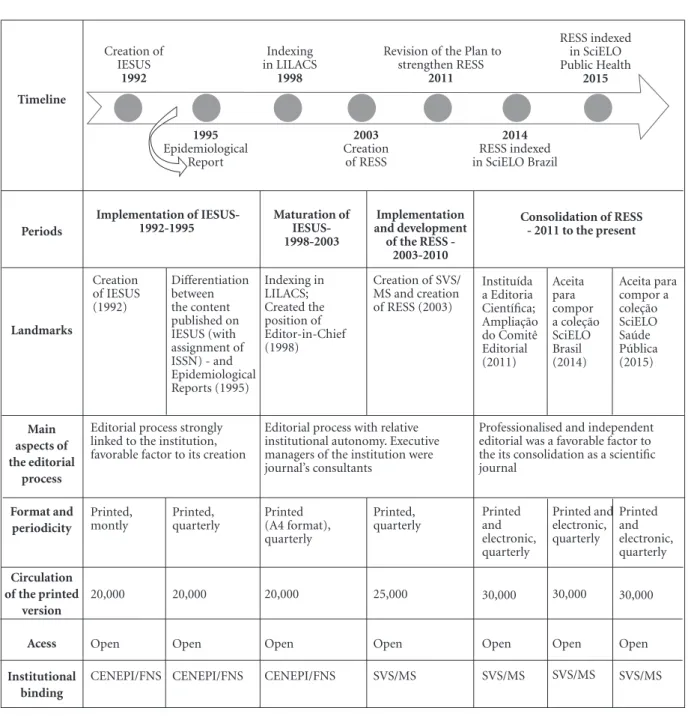
Figure 3 provides a summary of RESS’
trajec-tory from its creation to the present day, high-lighting the main features of its editorial process, by periods and events of relevance to its progress. 80
Graph 1. Number of articles published in Epidemiology and Health Services, according to manuscript type,
2003-2014.
2003 2004 2005 2006 2007 2008 2009 2010 2011 2012 2013 2014
0 10 20 30 40 50 60 70
e C ole tiv a, 20(7):2081-2090, 2015
Epidemiology and Health Services: commitments and perspectives
The process of RESS’ consolidation occurred in
parallel to the development of health surveillance
actions within SUS and also in parallel to the
process of SUS becoming consolidated. IESUS,
the periodical which was the precursor to RESS,
was created only four years after SUS came into
being via the 1988 Federal Constitution27. Since
then RESS has contributed to the transformation
of the role of epidemiology in health services and to disseminating the importance and the usefulness of epidemiological analyses for health services and management, at local primary care centre level, state level and federal level.
Further-Figure 3. Historical evolution of Epidemiology and Health Services – Brazilian National Health System Journal, 1992-2015.
Timeline Periods Landmarks Main aspects of the editorial process Format and periodicity Circulation of the printed
version Acess Institutional binding Differentiation between the content published on IESUS (with assignment of ISSN) - and Epidemiological Reports (1995)
Implementation of IESUS- 1992-1995
Editorial process strongly linked to the institution, favorable factor to its creation
Creation of IESUS (1992)
Printed,
montly Printed, quarterly
20,000 20,000
Open Open
CENEPI/FNS CENEPI/FNS
Editorial process with relative institutional autonomy. Executive managers of the institution were journal’s consultants Maturation of IESUS- 1998-2003 Indexing in LILACS; Created the position of Editor-in-Chief (1998) Printed (A4 format), quarterly Printed, quarterly 20,000 25,000 Open Open CENEPI/FNS SVS/MS Implementation and development of the RESS -
2003-2010
Creation of SVS/ MS and creation of RESS (2003)
Consolidation of RESS - 2011 to the present
Aceita para compor a coleção SciELO Brasil (2014) Instituída a Editoria Científica; Ampliação do Comitê Editorial (2011) Aceita para compor a coleção SciELO Saúde Pública (2015)
Professionalised and independent editorial was a favorable factor to the its consolidation as a scientific journal Printed and electronic, quarterly Printed and electronic, quarterly Printed and electronic, quarterly 30,000 Open SVS/MS 30,000 Open SVS/MS 30,000 Open SVS/MS Creation of IESUS 1992 Indexing in LILACS 1998
Gar
cia LP more, RESS has lived through and recorded the
growth of the presence of epidemiology and the use of epidemiological methods and instruments in public health decision-making. It has also ac-companied the development of health informa-tion systems in Brazil and has published many articles containing analyses of data derived from such systems.
In recent years there has been significant growth in scientific production in the area of public health in Brazil, reflecting the increase in number of postgraduate programmes in this
area. Between 2011 and 2014, SVS alone
support-ed the development of 22 postgraduate special-ization and professional master’s degree courses in health surveillance (involving 2,207 postgrad-uates) and to a certain extent this strengthens in-tegration between academia and health services. At the same time, public health has advanced in that the scientific standards of evidence-based
interventions and actions have been enhanced28.
Within this context RESS has become
consol-idated as an important means for disseminating scientific production in the Public Health field in Brazil. After having achieved indexation in bib-liographic databases that use rigorous criteria for
journal indexing, RESS is now among the main
Brazilian journals in that field.
Notwithstanding the progress achieved, the
RESS team remains committed to the journal’s
constant improvement. Initiatives to achieve this in the near future include an electronic submis-sion system and the publication in English of en-tire articles selected by the editors alongside the original version in Portuguese, in the electronic edition of the journal.
RESS is a privileged medium for
dissemi-nating within SUS scientific contents regarding
epidemiology and will continue to publish all its contents in Portuguese. Its printed version will also continue to be produced and distributed free of charge, although keeping the database of its 30,000 subscribers up to date is a permanent challenge to ensuring that the journal reaches its readers in the different Brazilian municipalities.
Another RESS initiative to strengthen the use
of epidemiology in health services is the publi-cation of the thematic series entitled “Applying Epidemiology”. It began being published in the first edition of 2015 (v. 24, n. 1) with the arti-cle “Translational epidemiology: some
consid-erations”, written by Professor Moyses Szklo29.
Other conceptual and methodological aspects of applied epidemiology, with articles from guest authors, will provide continuity to this initiative.
In the future new challenges will arise, such as indexation in other international scientific litera-ture databases, like Medline, the United States of America National Library of Medicine’s (NLM) premier bibliographic database.
Although RESS has undergone
transforma-tions, it is important to highlight that the jour-nal has not strayed from its mission, nor from its particularity of transiting between health services and academia, seeking to integrate the important contributions of both of them.
In 2016 RESS will commemorate 25 years
of existence. The prospects for the journal are to continue contributing to the development of epidemiology in health surveillance actions, by disseminating useful knowledge to health service
workers and managers at different SUS
e C
ole
tiv
a,
20(7):2081-2090,
2015
Collaborations
LP Garcia and E Duarte took part in the con-ception of the article, gathering and analysis of information and writing the manuscript. Both authors have revised the final version of the man-uscript and declare that they are entirely respon-sible for its contents.
References
Chequer P, Teixeira, MG. Introdução. Inf Epidemiol Sus
1(1):6.
Penna MLF, Silva LP. Algumas considerações sobre a ocorrência de cólera no Brasil. Inf Epidemiol Sus 1(1):7-11.
Silva Junior JB. A trajetória do informe epidemiológico do SUS. Inf Epidemiol Sus [Internet]. 2002 Dez [acessa-do 2015 abr 06]; 11(4):201-202. Disponível em: http:// scielo.iec.pa.gov.br/scielo.php?script=sci_arttext&pid =S0104-16732002000400001&lng=pt.
Requisitos uniformes para manuscritos submetidos a Periódicos Biomédicos Comitê Internacional de Edito-res de Periódicos Médicos. Inf Epidemiol Sus [Internet]. 1999 Jun [acessado 2015 abr 06]; 8(2):5-16. Disponível em: http://scielo.iec.pa.gov.br/scielo.php?script=sci_ arttext&pid=S0104-16731999000200002&lng=pt Silva Junior JB. A utilidade do IESUS para os Serviços de Saúde. Inf Epidemiol Sus [Internet]. 1999 Jun [aces-sado 2015 abr 06]; 8(2):3-3. Disponível em: http:// scielo.iec.pa.gov.br/scielo.php?script=sci_arttext&pid =S0104-16731999000200001&lng=pt
Gomes FBC. Abordagem epidemiológica dos sistemas de informação no Brasil: gerenciamento, rea lização de pes-quisas e divulgação no IESUS. Inf. Epidemiol. Sus [Inter-net]. 2001 Set [acessado 2015 abr 06]; 10(3):109-112. Dis-ponível em: http://scielo.iec.pa.gov.br/scielo.php?script =sci_arttext&pid=S0104=16732001000300001-&lng-pt.
Silva Junior JB. A nova face da vigilância epidemioló-gica. Epidemiol Serv Saude [Internet]. 2003 Mar [aces-sado 2015 jan 06]; 12(1):5-6. Disponível em: http:// scielo.iec.pa.gov.br/scielo.php?script=sci_arttext&pid =S1679-49742003000100001&lng=pt.
Posenato L, Duarte E. Fortalecendo a revista do Sistema Único de Saúde. Epidemiol Serv Saude [Internet]. 2011 Set [acessado 2015 abr 07]; 20(3):273-273. Disponível em: http://scielo.iec.pa.gov.br/scielo.php?script=sci_art text&pid=S1679-49742011000300001&lng=pt. Barbosa J. A política editorial como instrumento de fortalecimento das ações de Vigilância em Saúde do Sis-tema Único de Saúde. Epidemiol Serv Saude [Internet]. 2012 Mar [acessado 2015 abr 07];21(1):05-06. Dispo-nível em: http://scielo.iec.pa.gov.br/scielo.php?script =sci_arttext&pid=S1679=49742012000100001-&lng-pt.
Brasil. Ministério da Saúde (MS). Portaria nº 25, de 1 de outubro de 2012. Diário Oficial da União 2012; 2 out.
Garcia LP. Comunicação e redação científica para a epidemiologia e os serviços de Saúde. Epidemiol Serv
Saude [Internet]. 2012 Jun [acessado 2015 abr 07];
21(2):193-194. Disponível em: http://scielo.iec.pa.gov. br/scielo.php?script=sci_arttext&pid=S1679-4974 2012000200001&lng=pt
Pereira MG. Estrutura do artigo científico. Epidemiol
Serv Saude [Internet]. 2012 jun [acessado 2014 fev
18]; 21(2):351-352. Disponível em: http://scielo.iec. pa.gov.br/scielo.php?script=sci_arttext&pid=S1679 -49742012000200018&lng=pt
Pereira MG. Preparo para a redação do artigo científico.
Epidemiol Serv Saude [Internet]. 2012 jul-set [acessado
2014 fev 18]; 21(3):515-516. Disponível em: http:// scielo.iec.pa.gov.br/scielo.php?script=sci_arttext&pid =S1679-49742012000300017&lng=pt
1. 2.
3.
4.
5.
6.
7.
8.
9.
10.
11.
12.
Gar
cia LP Pereira MG. A introdução de um artigo científico.
Epidemiol Serv Saude [Internet]. 2012 dez [acessado
2014 fev 18]; 21(4):675-676. Disponível em: http:// scielo.iec.pa.gov.br/scielo.php?script=sci_arttext&pid =S1679-49742012000400017&lng=pt
Pereira MG. A seção de método de um artigo científico.
Epidemiol Serv Saude [Internet]. 2013 mar [acessado
2014 fev 18]; 22(1):183-184. Disponível em: http:// scielo.iec.pa.gov.br/scielo.php?script=sci_arttext&pid =S1679-49742013000100020&lng=pt
Pereira MG. A seção de resultados de um artigo cientí-fico. Epidemiol Serv Saude [Internet]. 2013 jun [acessa-do 2014 fev 18]; 22(2):353-354. Disponível em: http:// scielo.iec.pa.gov.br/scielo.php?script=sci_arttext&pid =S1679-49742013000200017&lng=pt
Pereira MG. A seção de discussão de um artigo cientí-fico. Epidemiol Serv Saude [Internet]. 2013 set [acessa-do 2014 fev 18]; 22(3):537-538. Disponível em: http:// scielo.iec.pa.gov.br/scielo.php?script=sci_arttext&pid =S1679-49742013000300020&lng=pt
Pereira MG. O resumo de um artigo científico.
Epi-demiol Serv Saude [Internet]. 2013 dez [acessado
2014 fev 18]; 22(4):707-708. Disponível em: http:// scielo.iec.pa.gov.br/scielo.php?script=sci_arttext&pid =S1679-49742013000400017&lng=pt
Garcia LP. Revisão sistemática da literatura e integrida-de na pesquisa. Epidemiol Serv Saude [Internet]. 2014 Mar [acessado 2015 abr 07]; 23(1):7-8. Disponível em: http://scielo.iec.pa.gov.br/scielo.php?script=sci_art-text&pid=S1679-49742014000100001&lng=pt. Garcia LP, Pereira MG. Normas de Vancouver 2013.
Epidemiol Serv Saude [Internet]. 2013 Dez [acessado
2015 abr 07]; 22(4):555-556. Disponível em: http:// scielo.iec.pa.gov.br/scielo.php?script=sci_arttext&pid =S1679-49742013000400001&lng=pt.
Recomendações para a elaboração, redação, edição e publicação de trabalhos acadêmicos em periódicos médicos. Epidemiol Serv Saude [Internet]. 2013 Dez [acessado 2015 abr 07]; 22(4):709-732. Disponível em: http://scielo.iec.pa.gov.br/scielo.php?script=sci_art-text&pid=S1679-49742013000400018&lng=pt. Declaração de Montreal sobre integridade em pesquisa e colaborações em investigações que cruzam fronteiras.
Epidemiol Serv Saude [Internet]. 2014 Mar [acessado
2015 abr 07]; 23(1):185-186. Disponível em: http:// scielo.iec.pa.gov.br/scielo.php?script=sci_arttext&pid =S1679-49742014000100019&lng=pt.
14.
15.
16.
17.
18.
19.
20.
21.
22.
Committee Publication Ethics. COPE Ethical Guide-lines for peer reviewers. [Internet]. 2013 Mar [acessado 2015 mar 18]; 1. Disponível em: http://publicationethi-cs.org/files/Ethical_guidelines_for_peer_reviewers_0. pdf
Garcia LP, Duarte E. A Revista Epidemiologia e Ser-viços de Saúde ingressa na Coleção SciELO Brasil.
Epidemiol Serv Saude [Internet]. 2014 Set [acessado
2015 Abr 07]; 23(3):387-388. Disponível em: http:// scielo.iec.pa.gov.br/scielo.php?script=sci_arttext&pi-d=S1679-49742014000300001&lng=pt
Committee Publication Ethics. Code of conduct and best practice guidelines for journal editors. [Internet]. 2013 Mar [acessado 2015 mar 18]. Disponível em: http://pu-blicationethics.org/files/Code%20of%20Conduct.pdf Brasil. Ministério da Saúde (MS). Secretaria de Vigilân-cia em Saúde. Coordenação-Geral de Desenvolvimento da Epidemiologia em Serviços. Normas para publicação
[Internet]. Brasília: MS; 2014.[acessado 2015 mar 18]. Disponível em: http://scielo.iec.pa.gov.br/revistas/ess/ pinstruc.htm
Brasil. Constituição da República Federativa do Brasil de 1988. Diário Oficial da União 1988; 5 out.
Victora CG, Habicht JP, Bryce J. Evidence-Based Public Health: Moving Beyond Randomized Trials. Am J Pu-blic Health 2004; 94(3):400-405.
Szklo M. Epidemiologia translacional: algumas consi-derações. Epidemiol Serv Saude [Internet]. 2015 Mar [citado 2015 Maio 11]; 24(1):161-172. Disponível em: http://scielo.iec.pa.gov.br/scielo.php?script=sci_art-text&pid=S1679-49742015000100018&lng=pt
Article submitted 15/04/2015 Approved 23/04/2015
Final version submitted 25/04/2015 23.
24.
25.
26.
27. 28.