TEMAS LIVRES FREE THEMES
1 Programa de Pós-Graduação em Promoção da Saúde, Universidade Luterana do Brasil (Ulbra). Av. Teotônio Segurado, Centro. 77000-000 Palmas TO Brasil.
[email protected] 2 Departamento de Medicina Preventiva, Fundação Universidade Federal de Ciências da Saúde de Porto Alegre.
Attributes of primary health care provided
to children/adolescents with and without disabilities
Atributos da atenção primária prestada
às crianças/adolescentes com e sem deficiência
Resumo Este estudo objetivou comparar os atributos da Atenção Primária à Saúde (APS) prestada pelas equipes da Estratégia Saúde da Família (ESF) às crianças e adolescentes com e sem deficiência física em Palmas (TO). Trata-se de um estudo transversal, descritivo de aborda-gem quantitativa. Para coleta de dados utilizou-se o instrumento PCATool-Brasil (versão criança), aplicado aos cuidadores das crianças e adolescen-tes residenadolescen-tes e cadastradas em equipes de saúde da família. Os atributos da atenção primária foram avaliados através dos escores aferidos de acordo com critérios do instrumento. Os resulta-dos registraram que três atributos apresentaram escores acima do ponto de corte para a população deficiente e dois para a população sem deficiên-cia. Em geral os dados não apresentam diferenças significativas entre crianças com e sem deficiên-cia segundo a visão dos cuidadores. O escore ge-ral também mostrou valor abaixo do satisfatório nos dois grupos. A avaliação dos atributos da APS caracterizou-se como um atendimento de baixa qualidade à população infanto-juvenil, indepen-dente de ter ou não deficiência física, ressaltando que os desafios maiores são a garantia da atenção à saúde para crianças e adolescentes.
Palavras-chave Atenção primária à saúde,
Avaliação dos serviços, Pessoa com deficiência física
Abstract This study sought to compare the attri-butes of the Primary Health Care (PHC) provided by caregivers of the Family Health Strategy (FHS) to children and adolescents with and without physical disabilities in Palmas (State of Tocantins, Brazil). This is a cross-sectional, descriptive study with a quantitative approach. For data collection, the PCA Tool-Brazil (child version) was applied to caregivers of children and adolescents residing and registered in family health teams. The at-tributes of primary care were evaluated through scores measured according to the criteria of the instrument. The results indicated that three at-tributes had scores above the cutoff point for the physically disabled population and two attributes for the population without disabilities. Overall, the data showed no significant differences be-tween children with and without disabilities from the standpoint of caregivers. The general score also showed a below satisfactory score in both groups. The evaluation of the attributes of the PHC was characterized as low-quality care to children and adolescents, be they physically challenged or not, which highlights the fact that the biggest chal-lenges lie in ensuring health care to children and adolescents.
Key words Primary health care, Evaluation of
services, Physically disabled person
Fernando Rodrigues Peixoto Quaresma 1
Quar
esma FRP Introduction
The population of children and adolescents phys-ically challenged represents groups exposed to greater vulnerabilities caused by a context of social inequality, resulting from the historical process of exclusion1. Discrimination based on disability is
shown by a number of barriers that limit access to various services, especially health, including phys-ical barriers, means of transportation2, inadequate
preventive care, dissatisfaction with care3,
profes-sional inadequacy4, miscommunications and
fail-ures of the health care financial systems1,3,5.
Global discussion concerning health needs of populations, including vulnerable groups (impaired people), has been marked by the de-velopment of several healthcare models, such as the premises of PHS that were presented more than 30 years ago at the International Conference on Primary health care in Alma Ata – 1978. The PHS principles aimed at a conceptual alignment to place the PHS as a fundamental device of com-plex gears of integrated health care networks6.
The search for convergent actions to implement PHS principles has become the main strategy for the organization of public health services7.
Since 1980, Brazil has refocused the national health model, historically marked by highly com-plex and costly actions and services, to a health care network based on the principles and recom-mendations of Alma Ata8. The strengthening of
primary care was obtained through major chang-es in the organization, financing and provision of services, which were marked by decentralized actions for health promotion and expansion of health care based on the model of Family Health Strategy (FHS – a program of the Brazilian fed-eral government), chosen as the backbone of the Primary Health Care policy (PHS)8,9.
Studies show that health care systems based on the principles of PHS, structured in accor-dance with its ordering attributes, are more ef-fective, most satisfactory for the population, with lower costs and greater equity, even in a context of great social inequity10,11.
An important instrument to assess the struc-ture and process at PHS was developed11. The
Pri-mary Care Assessment Tool (PCATool) has already been validated in Brazil and it allows to measure the presence and extension of essential and deri-vate attributes of PHS for health care services. It can be applied to professionals in health care or users and it is directed to health actions to adults and children (in distinct version), reflecting the experience of different groups in health care12,13.
For Starfield11, PHS has four essential
attri-butes: first contact, continuity or longitudinality, comprehensiveness and coordination and two derivate attributes: family and community guid-ance.
The first contact implies access and use of services for each new problem or for a routine follow-up of health. Longitudinality shows con-tinual health care, as well as the use of services overtime by the users. Integrality consists of ser-vices offered by caregivers to meet the most com-mon needs of the population. It also establishes the responsibility for other points of health care and adequate recognition of problems that cause diseases. Moreover, integrality offers preventive and care services and warranty of several service types. Coordination refers to the professional/ service of PHS as a regulator for the access to health services at other levels of the health sys-tem, such as diagnostic services and specialized references. Family guidance shows whether the health care considers the family as a subject of attention. Community guidance presupposes the recognition of Family needs in terms of physical, economic, social and cultural contexts where the community is inserted11.
Thus, it becomes important to identify and measure PHS attributes, once the level of orien-tation of a service for PHS contributes to imple-ment effective and equalitarian public policies mainly to the children and adolescents, who face even more evident inequalities when these sub-groups are composed of physically challenged people14,15.
This study aimed to compare the quality of the Primary Health Service (PHS) offered to children/adolescents with or without disabilities in the municipality of Palmas, state of capital of Tocantins, Brazil, based on the evaluation of caregivers.
Method
e C
ole
tiv
a,
20(8):2461-2468,
2015
The target population comprises caregivers of children/adolescents between 12-18 years of age, properly matriculated in the public school system, residing and registered in the regions served by the caregivers of PHS in the munici-pality of Palmas, Tocantins State. We considered losses people that refused to participate in the study and those who were not located after three attempts for an interview at the known address or because of incorrect address.
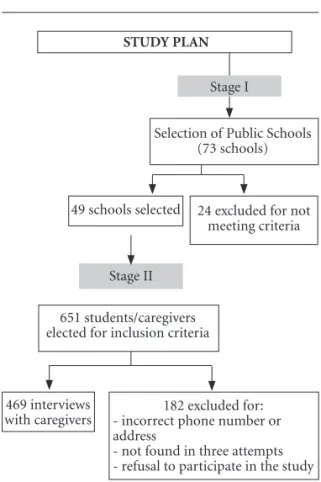
After applying these criteria, we carried out the stages to achieve the proposed objectives. Stage I (Figure 1) corresponded to the selection and contact with schools. The sample was de-fined based on the 73 schools that comprise the public school system of the municipality. We se-lected 49 schools (67%) with students within the age range of the study.
The sample size calculation was performed assuming prevalence of physical disability of 2.88%16, acceptable error 1.5%, confidence
lev-el 95% and design effect 2, with the total sam-ple estimated at 651 individuals. A method of cluster sampling, where each school formed a cluster, was used16. The selection of students was
established proportionally to each school in the sample calculation. For that purpose, attendance
card were arranged in ascending order from 7th grade of elementary school to 3rd year of high school where all the attendance cards were part of a single list. We selected the first student of the attendance card, using a leap of 24 students for the next, according to the selection method. A database was built with information about the stakeholders (name, address and telephone num-ber) to schedule the interviews.
In Stage II (Figure 1), data were collected in two phases: - in the first one, a telephone contact was made to present the purpose of the study and schedule the interview; - in the second one, we collected information at their residence or work, or in some cases at the school of the child/ado-lescent.
This research used the definition “disabled person” to individuals with absence or impair-ment of a body part and/or having difficulty or inability to walk, move or handle objects17. To
facilitate the identification, a folder with figures of the main characteristics or manifestations of physical disabilities was created.
Inclusion criteria involved the connection of children/adolescents with the use of Fami-ly Health Strategy. Exclusion criteria: children with canceled registration that evaded school or was transferred to other schools during the study period. Those who refused to participate in the study, or who were not located after three attempts of the interviewer at the address or be-cause of incorrect address were considered losses. Data collection was performed using the in-strument PCATool - Primary Care Assessment Tool - Brazil Child Version (PCATool-VC), val-idated in Portuguese12, which measures the
ex-tent of the essential and derivate attributes of the PHS in child health care services based on family/ caregiver. Fifty-five items divided into 10 compo-nents compose the extent of attributes measured classified as essential (first contact, coordination, longitudinality, comprehensiveness and coor-dination of care) and derivatives (community and family guidance and cultural competence), investigating the “Affiliation Degree” to the regu-lar source of care. The instrument includes Likert Scale responses with interval from 1 to 4 for each attribute evaluated (4 = definitely yes, 3 = proba-bly yes, 2 = probaproba-bly no, 1 = definitely not, and 9 = do not know / cannot remember)12.
Data on demographic and socioeconomic characteristics of the caregiver (age, gender, social class, income, marital status, employment status, receipt of government benefits) and children/ad-olescents (age and disability) were obtained.
Figure 1. Study plan for sample collection. 49 schools selected
469 interviews with caregivers
STUDY PLAN
Selection of Public Schools (73 schools)
Stage II
24 excluded for not meeting criteria
651 students/caregivers elected for inclusion criteria
182 excluded for: - incorrect phone number or address
- not found in three attempts - refusal to participate in the study
Quar
esma FRP
The statistical analysis was performed using the statistical package SPSS (Statistical Package for Social Sciences) version 18.0 for Windows
to assess the distribution of social, economic and demographic categorical variables between groups of students with and without physical dis-abilities. We used bivariate statistics (chi-square).
To check the quality of care in PHC, scores of each attribute were calculated, obtained from the means of the composing items. All scores of each attribute was transformed into a continuous range between 0-10 using the formula: Adjusted score = [(score obtained -1) / (4-1)] x10 to allow the calculation of “Essential score” and “Overall Score” of PHS12.
The “Essential score” was measured by add-ing the mean scores of components belongadd-ing to the “Essential Attributes” to the value assigned to “Degree of Affiliation” and divided by the num-ber of components. The calculation of the “Main Score”, in turn, followed the same principle, hav-ing increased, however, the mean scores of the three attributes derived from PHS. The cut point for scores ≥ 6.6 indicates adequate presence and satisfactory values of the attributes of PHS12,13.
The study was submitted to the Ethics Com-mitte in Research of the Lutheran University Center of Palmas – CEULP/ULBRA, and was approved. It was also approved by the State and Municipal Departments of Education. Ethical principles were respected at all stages of research in compliance with CNS Resolution No. 466/1218
that regulates research involving human subjects.
Results
Among the 656 eligible according to the inclu-sion criterion, 469 participants were interviewed. Fifty-two people (7%) were not found and were considered a loss because of telephone registra-tion problems, or they were not found at home after three attempts of the interviewer at the ad-dress, or due to incorrect address.
Table 1 shows the main socio-demographic characteristics of the families/caregivers of the children/adolescents with physical disabilities.
The average age was 14.9 (SD ± 1.9) without disabilities, with disabilities 13.2 (SD ± 1.3).
Among the demographic characteristics, women were identified as the main caregivers of children/adolescents accounting for 404 (87%) in the group without disabilities and four (80%) in the physically-challenged group. Of these, the majority of caregivers (335 – 71%) were
stu-dents’ mothers. Regarding the age, stratification per group showed a greater prevalence between 31 and 60 years old (406 – 88.1%) in the group without disabilities and five (100%) in the group with disabilities.
The average per capita income was R$ 2,101.13 (SD ± 1,743.8) for nondisabled and R$ 996.00 (SD ± 319.5) of the disabled population, prevailing in Class C to E for both with 367 (SD ± 79.1%) without disabilities and five (100%) with disabilities. The employment scenario shows that 293 (63.4%) without disabilities are currently employed and two (40%) with disabilities are unemployed.
In terms of benefits granted by the govern-ment, 114 (24.6%) in the group without disabil-ities receive some benefit and no member of the group with disabilities reported receiving.
The average age of children/adolescents was 14.9 (SD ± 1.9) in the group of non-disabled and 13.2 (SD ± 1.3) in the group with disabilities. Re-garding the PHS link with family/caregivers, in the group without disabilities, 260 (56%) took the children/adolescents to FHS, while in the group with disabilities only one family (20%) re-ported taking the children to FHS.
The mean scores of attributes of FHS in PHS regarding caregivers of children/adolescents are shown in Table 2.
The “Affiliation” component had mean scores above the cutoff point for both groups, 9.4 for the group without disabilities and 9.3 for the group with disabilities. The mean score of the “Use” component to people without disabilities showed greater value [7.2 (SD ± 2.2)] than that of the disabled group [5.5 (SD ± 2.8)].
The “Coordination” component had mean scores for the ‘System Information’ attribute of 6.9 (SD ± 2.0) for the non-disabled and 6.6 (SD ± 1.5) for the disabled.
The ‘Use’ attribute of the component “Access First Contact” had scores above the cutoff for the non-disabled [7.2 (SD ± 2.2)] and below the cut-off point [5.5 (SD ± 2.8)] for the disabled.
The average “Essential Scores” was without disabilities 5.6 (SD ± 0.7) and with disability 5.3 (SD ± 0.4). Moreover, the average of “General Scores” was 5.1 without disabilities (SD ± 0.7) and 4.7 (SD ± 0.3) with disabilities.
Discussion
e C
ole
tiv
a,
20(8):2461-2468,
2015
without disabilities, we observe that disabled people have lower income, do not have employ-ment, and receive benefits from the governemploy-ment, that is, they are poorer and have less purchasing power, greatly affecting the children.
Similar studies show inequalities and socio-economic disparities19-21,which are aggravated
when the subjects belong to groups with histor-ical profile of exclusion and discrimination such as the disabled22, indigenous people23,
quilombo-las24, making the inequities in PHC more acute
and hampering their right to health, guaranteed by the Convention on Children’s Rights and, in Brazil, in the Children Statute25.
Children with disabilities require dependence and in our study, the mother was identified as the main caregiver, similar to other studies21,26 that
indicate women as a predisposing factor for care-giving, since women tend to show greater will-ingness to use health care than men do.
Variables
Gender Male Female Age
From 18 to 30 years old From 18 to 60 years old more than 60 years old Economic class (ABEPª)
A1A2 - B1B2 C1C2 - DE Per Capita Income Marital status
Without partner With partner Occupational status
Working Not working Receiving Benefitb
Yes No
Children/adolescents age (years) Essential score of PHS
General score of PHS Link with ESF
Never used PHS > 1 year
≤ 1 year
Without Disabilities [median(dp) / %]
n=464
60 (13%) 404 (87%)
32 (7%) 406 (88%) 26 (5%)
97 (21%) 367 (79%) 2,101.13 (1,743.8)
114 (25%) 350 (75%)
294 (64%) 170 (36%)
114 (25%) 350 (75%) 14.9 (1.9) 5.6 (0.7) 5.1 (0.7)
-204 (44%) 260 (56%)
Table 1. Comparison of demographic socioeconomic characteristics, social support, children/adolescent age, PHS score of attributes and ESF use of students with and without physical disabilities, Palmas/TO, 2013.
With Disabilities [median(dp) / %]
n=5
1 (20%) 4 (80%)
-5 (100%)
-5 (100%) 996.00 (319.5)
-5 (100%)
2 (40%) 3 (60%)
-5 (100%) 13.2 (1.3) 5.3 (0.4) 4.7 (0.3)
-4 (80%) 1 (20%)
ª ABEP: Brazilian Association of Research Companies. b Benefit: (Municipal, State or Federal Government).
Variables
Degree of affiliation Use
accessibility longitudinality Care Integration Information System Available services Rendered Services Family guidance Community guidance
Essential score of PHS General score
Without Disabilities mean (SD ± )
n=464
9.4 (1.4) 7.2 (2.2) 3.6 (1.7) 3.7 (0.9) 6.1 (2.4) 6.9 (2.0) 4.3 (1.2) 3.8 (2.1) 2.3 (2.1) 4.4 (1.7) 5.6 (0.7) 5.1 (0.7)
Table 2. The mean score of attributes of FHS in PHC according to family/guardian of children/adolescents with and without physical disabilities in relation to health services, Palmas/TO, 2013.
With Disabilities mean(SD ± )
n=5
9.3 (1.4) 5.5 (2.8) 4.3 (2.5) 3.5 (0.3) 8.0 (*) 6.6 (1.5) 3.4 (1.3) 4.0 (1.7) 2.2 (0.7) 3.0 (0.7) 5.3 (0.4) 4.7 (0.3)
Quar
esma FRP
The main determinants for the use health care in PHC depend27 on various interrelated
factors such as: (a) need for care - morbidity, seriousness and urgency of treatments; (b) us-ers - demographic characteristics (age, gender), geographic (physical barriers), socioeconomic characteristics (income, education, expenses, occupation), cultural (religion), psychological and physical (disabilities); (c) caregivers - demo-graphic characteristics (age, gender), graduation, professional expectation, professional experi-ence, type of practice, salary; (d) the organization - available resources, structure (availability of doctors, hospitals, clinics), social and geographi-cal access; (e) policies - the type of health care, fi-nancing, health insurance, amount, distribution of resources, laws and professional regulations of the system.
Studies show stagnation of caregivers to in-clude the community into health care actions and a certain inertia at not including actions into services28,29. These studies indicate that the
pro-cess of social participation must be continuously improved.
The results obtained in the study using PCA-Tool regarding the evaluation of health care show that, using a score ≥ 6.6 as a parameter to indicate the presence and extent of PHC attributes, stu-dents are not present in the caregiving process for most attributes.
The scores observed for affiliation degree of students show that the family/guardians identi-fy the FHS as a reference service for their child (children)/ adolescent (s), but the same was not observed in the access attribute of first contact.
The findings of Leão et al.20 indicate that the
use of the health care can be justified by particu-larities in the health at this stage of life character-ized by greater number of acute cases. The use of FHS by children is associated with improvements in some health indicators, such as reducing the number of deaths from diarrheal disease and respiratory tract infection in the post-neonatal period30.
Marques et al.24 studied the characteristics
of 76 families of the quilombola community in Minas Gerais and observed that the recognition of the FHS as well as its use can be justified for being the only access available to the community, far from other public health care.
The low scores found in subsection accessibil-ity to students with physical disabilities take big-ger because it portrays the perverse inequity that children / adolescents are subject to31, indicating
that this attribute is a point on PHC problem.
The lack of observed longitudinality shows weak continuity of health care for schoolchil-dren. The ways of hiring the FHT professionals in Brazil, in general, leads to discontinuity in the composition of teams, a fact that reflects on the care provided or the weak bonding between stu-dents and family/guardians with professionals or caregivers over time32,33. Besides, there are
diffi-culties to attract qualified professionals to work in remote areas of the country, hindering health care to those in great need (Inverse Care Law)33.
The analysis of the completeness attribute registered an unsatisfactory score, which denotes paucity of practical teamwork, reproduction or maintenance of centered model in medical care as well as the fragility to promote health and pre-vent specific diseases to children.
Comprehensiveness and coordination of care, according to Victora et al.31, unfold in
“ser-vices rendered” and “available ser“ser-vices”. In prac-tice, their implementation is the responsibility of the professionals engaged in the purpose of FHS and in the process of construction and improve-ment of SUS (public health care in Brazil). In the health sector, these attributes bring co-responsi-bility, and the government has a central role as well as other stakeholders with relevant roles: caregivers; private sector; universities, training institutions, health councils and researchers; and civil society.
The attribute coordination comprises two sub-items, ‘care integration’, which recorded scores below expectations, and ‘information sys-tem’ with satisfactory scores, results observed in similar studies20,24.
‘Care integration’ shows that ensuring conti-nuity of care to health services at other levels of the system is inadequate, while ‘information sys-tem’ indicates that professionals and users have access to attendance records.
According to Almeida et al.34 PHC users claim
that referrals to other levels of health care are most effective when carried out by professionals of FHS and the waiting time is shorter than when referrals are made by other sources.
of-e C
ole
tiv
a,
20(8):2461-2468,
2015
fered by children health care to family/guardian, the score was insufficient.
For derived attributes, evaluated scores were not satisfactory. Thus, family guidance and com-munity guidance are not recognized by family/ caregiver indicating that the model for the pro-tection of children’s health is not oriented to-wards the primary care guidelines. FHS, as a priority for the organization and expansion of health care, must have solid bases to promote health and quality of life to individuals, families, and communities.
When comparing the PHC attributes of be-tween students with and without physical dis-abilities, this study shows small differences, em-phasizing that the biggest challenges lie in ensur-ing basic health care to children, characterized by fragmented and disjointed care with other levels of care network to children.
Among the limitations observed in this study are: a) difficulty in obtaining the cluster sample
of the resulting sample calculation that, accord-ing to the selection strategy, sometimes resulted in school transfer; b) telephone contacts, in-correct or nonexistent home addresses; c) high number of refusals; difficulty to compare with similar studies due to the lack of studies reported in the literature; e) limited comparison between groups, because there was a smaller number of physically challenged children compared to non-challenged children, which hindered the significance of statistical analyses.
Finally, study draws attention to the challeng-es to be undertaken by PHC profchalleng-essionals and managers to strengthen health care to children with or without disabilities, such as ensuring that policies aimed at these groups take effect promoting improvements of health care, better qualification of caregivers to overcome barriers related to human resources and existing gaps al-ready reported in other studies.
Collaborations
FRP Quaresma and AT Stein participated equally in all stages of the elaboration of this article.
References
Jones LBS, Bellis MA, Wood S, Hughes K, McCoy E, Eckley L, Bates G, Mikton C, Shakespeare T, Officer A. Prevalence and risk of violence against children with disabilities: a systematic review and meta-analysis of observational studies. Lancet 2012;380(3):899-907. Interdonato GC, Greguol M. Qualidade de vida e práti-ca habitual de atividade físipráti-ca em adolescentes com deficiência. Rev. bras. crescimento desenvolv. hum. 2011; 21(2):282-295.
Morrison EH, George V, Mosqueda L. Primary care for adults with physical disabilities: perceptions from consumer and provider focus groups. Fam Med 2008; 40(9):645-651.
Evans SA, Airey MC, Chell SM, Connelly JB, Rigby AS, Tennant A. Disability in young adults following ma-jor trauma: 5 year follow up of survivors. BMC Public Health 2003; 3:8.
Gotler RS. The Science. Art, and Policy of Primary Care. Ann fam med 2009; 7(3):194-195.
Miller WL, Crabtree BF, Nutting PA, Stange KC, Jaén CR. Primary Care Practice Development: A Relation-ship-Centered Approach. Ann fam med 2010; 8(Supl. 13):S68-S79.
Almeida C. Eqüidade e reforma setorial na América Latina: um debate necessário. Cad Saude Publica 2002; 18(Supl.):23-36.
Harris M, Haines A. Brasil’s Family Health Programme. BMJ 2010; 341:c6542.
1.
2.
3.
4.
5. 6.
7.
Quar
esma FRP
Brasil. Ministério da Saúde. Departamento de Atenção Básica. Programa Saúde da Família. Rev Saude Publica 2000; 34(3):316-319.
Van Stralen CJ, Belisário AS, Van Stralen TBS, Lima, AMD, Massote AW, Oliveira CL. Percepção dos usuári-os e profissionais de saúde sobre atenção básica: com-paração entre unidades com e sem saúde da família na Região Centro-Oeste do Brasil. Cad Saude Publica 2008; 24(Supl. 1):148-158.
Starfield B. Atenção Primária: equilíbrio entre necessi-dades de saúde, serviços e tecnologia. Brasília: UNESCO, Ministério da Saúde; 2002.
Brasil. Ministério da Saúde (MS). Secretaria de Atenção em Saúde. Departamento de Atenção Básica. Manual do instrumento de avaliação da atenção primária à saúde: primary care assessment tool - PCAtool. Brasília: MS; 2010.
Harzheim E, Starfield B, Rajmil L, Álvarez-Dardet C, Stein A. Internal consistency and reliability of Prima-ry Care Assessment Tool (PCATool-Brasil) for child health services. Cad Saude Publica 2006; 22(8):1649-59. Starfield B. The hidden inequity in health care. I J Equi-ty Health 2011; 10:15.
Fundo das Nações Unidas para Infância (Unicef). [homepage na internet]. Mainstreaming disability in the development agenda. [acessado 2011 set 1]. Dis-ponível em: http://www.un.org/disabilities/documents /reports/e-cn5-2008-6.doc
Barros FC, Victoria CG. Epidemiologia da saúde infan-til: um manual para diagnósticos comunitários. São Pau-lo: Hucitec, Unicef; 1991.
World Health Organization (WHO). 2001. [homepage na internet]. International Classification of function-ing, disability, and health. [acessado 2011 out 1]. Dis-ponível em: http://www.who.int/classifications/icf Brasil. Ministério da Saúde (MS). Conselho Nacio nal de Saúde. Resolução nº 466, de 12 de dezembro de 2012. Diário Oficial da União 2013;
Pimentel J. Determinantes Sociais da Saúde em de-bate em evento internacional na Fiocruz [homepage na internet].Rio de Janeiro: Portal DSS Brasil. [aces-sado 2013 nov 1]. Disponível em: http://dssbr.org/ site/2013/10/determinantes-sociais-da-saude-em- debate-em-evento-internacional-na-fiocruz/
Leão CDA, Caldeira AP, Oliveira MMC. Atributos da atenção primária na assistência à saúde da criança: avaliação dos cuidadores. Rev Bras Saude Mater Infant 2011; 11(3):323-334.
Sung NJ, Suh SY, Lee DW, Yupahn H, Choi YJ, Lee JH. Patient’s assessment of primary care of medical insti-tutions in South Korea by structural type. Int J Qual Health Care 2010; 22(6):493-499.
Reem M, Ghandour PH, Holly AG, Ashley MA, Schempf H, Bonnie BS, Kogan MD, Jones JR, Nichols D. Healthy people 2010 leading health indicators: how children with special health care needs fared. Am J Pub-lic Health 2013; 103(6):1257-1263.
Coimbra Júnior CEA, Santos RV, Welch JR, Cardoso AM, de Souza MC, Garnelo L, Rassi E, Follér ML, Hor-ta BL. The first national survey of indigenous people’s health and nutrition in Brazil: rationale, methodolo-gy, and overview of results. BMC Public Health 2013; 13:52.
9.
10.
11.
12.
13.
14. 15.
16.
17.
18.
19.
20.
21.
22.
23.
Marques AS, Freitas DA, Leão CDA, Oliveira SKM, Pe-reira, MM. atenção primária e saúde materno-infantil: a percepção de cuidadores em uma comunidade rural quilombola. Cien Saude Colet 2013; 16(7):229-238. Brasil. Lei 8.069, de 13 de julho de 1990. Dispõe sobre o Estatuto da Criança e do Adolescente e dá outras provi-dências. Diário Oficial da União 1990; 16 jul.
Schraiber LB, Figueiredo WS, Gomes R, Couto MT, Pinheiro TF, Machin R, Silva GSN, Valença O. Neces-sidades de saúde e masculinidades: atenção primá-ria no cuidado aos homens. Cad Saude Publica 2010; 26(5):961-970.
Macinko J, Souza M, Guanais F, Simões C. Going to scale with community based primary care an analysis of the family health program and infant mortality in brazil, 1999-2004. Soc Sci Med 2007; 65(10):2070-2080. Leonardo BR, Rachel SBCC, Sampaio KJAJ. Parti-cipação popular e o controle social como diretriz do SUS: uma revisão narrativa. Saúde em Debate 2013; 37(96):139-147.
Malhotra NK. Pesquisa de Marketing: Uma orientação aplicada. 6ª ed. Rio de Janeiro: Bookman; 2010. Aquino R, Oliveira NF, Barreto ML. Impact of the Fam-ily Health Program on infant mortality in Brazilian municipalities. Am J Public Health 2009; 99(1):87-93. Victora CG, Barreto ML, Leal MC, Monteiro CA, Sch-midt MI, Paim J, Almeida CM, Bahia L, Travassos CMR, Reichenheim M, Barros FC. Saúde no Brasil: Condições de saúde e inovações nas políticas de saúde no Brasil: o caminho a percorrer. Lancet 2011; 377(9782):90-102. Medeiros CR, Junqueira AG, Schwingel G, Carreno I, Jungles LA, Saldanha OM. Nurses and doctors turn-over: an impasse in the implementation of the Fam-ily Health Strategy. Cien Saude Colet 2010; 15(Supl. 1):1521-1531.
Gray AM. Inequalities in health. The Black Report: a summary and comment. Int J Health Serv 2012; (12):349-380.
Almeida PF, Giovanella L, Mendonça MH, Escorel S. Desafios à coordenação dos cuidados em saúde: es-tratégias de integração entre níveis assistenciais em grandes centros urbanos. Cad Saude Publica 2010; 26(2):286-298.
Artigo apresentado em 17/06/2014 Aprovado em 18/03/2015
Versão final apresentada em 20/03/2015 24.
25.
26.
27.
28.
29. 30.
31.
32.
33.