Septic Pulmonary Embolism Requiring Critical Care:
Clinicoradiological Spectrum, Causative Pathogens
and Outcomes
Deng-Wei Chou,I,II,* Shu-Ling Wu,IIIKuo-Mou Chung,IVShu-Chen Han,V Bruno Man-Hon CheungIV
ITainan Municipal Hospital, Department of Critical Care Medicine, Tainan/Taiwan.IIChung-Hwa University of Medical Technology, Department of Nursing,
Tainan/Taiwan.IIIChung-Hwa University of Medical Technology, Department of Long Term Care, Tainan/Taiwan.IVTainan Municipal Hospital, Department of Internal Medicine, Tainan/Taiwan.VTainan Municipal Hospital, Department of Radiology, Tainan/Taiwan.
OBJECTIVES: Septic pulmonary embolism is an uncommon but life-threatening disorder. However, data on patients with septic pulmonary embolism who require critical care have not been well reported. This study elucidated the clinicoradiological spectrum, causative pathogens and outcomes of septic pulmonary embolism in patients requiring critical care.
METHODS: The electronic medical records of 20 patients with septic pulmonary embolism who required
intensive care unit admission between January 2005 and December 2013 were reviewed.
RESULTS:Multiple organ dysfunction syndrome developed in 85% of the patients, and acute respiratory failure was the most common organ failure (75%). The most common computed tomographic findings included a feeding vessel sign (90%), peripheral nodules without cavities (80%) or with cavities (65%), and peripheral wedge-shaped opacities (75%). The most common primary source of infection was liver abscess (40%), followed by pneumonia (25%). The two most frequent causative pathogens wereKlebsiella pneumoniae (50%) and Staphylococcus aureus(35%). Compared with survivors, nonsurvivors had significantly higher serum creatinine, arterial partial pressure of carbon dioxide, and Acute Physiology and Chronic Health Evaluation II and Sequential Organ Failure Assessment scores, and they were significantly more likely to have acute kidney injury, disseminated intravascular coagulation and lung abscesses. The in-hospital mortality rate was 30%. Pneumonia was the most common cause of death, followed by liver abscess.
CONCLUSIONS: Patients with septic pulmonary embolism who require critical care, especially those with pneumonia and liver abscess, are associated with high mortality. Early diagnosis, appropriate antibiotic therapy, surgical intervention and respiratory support are essential.
KEYWORDS: Septic Pulmonary Embolism; Intensive Care Unit; Pneumonia; Liver Abscess.
Chou DW, Wu SL, Chung KM, Han SC, Cheung BM. Septic Pulmonary Embolism Requiring Critical Care: Clinicoradiological Spectrum, Causative Pathogens and Outcomes. Clinics. 2016;71(10):562-569
Received for publication onApril 15, 2016;First review completed onMay 30, 2016;Accepted for publication onJuly 1, 2016
*Corresponding author. E-mail: [email protected]
’ INTRODUCTION
Septic pulmonary embolism (SPE) is an uncommon dis-order in which a microorganism-containing thrombus causes an inflammatory reaction and a mechanical obstruction in the pulmonary vasculature (1,2). Typical findings of SPE on computed tomography (CT) include peripheral nodules with or without cavitations, a feeding vessel sign, wedge-shaped peripheral lesions abutting the pleura and abscesses (2–5).
Most patients with SPE are diagnosed on the basis of CT findings and the presence of a primary source of infection (2–4)
because histopathological confirmation is typically unfeasi-ble in clinical practice (2). The clinical presentations of SPE range from insidious illness with mild respiratory symptoms to respiratory failure and septic shock (6). Despite its life-threatening nature, data on patients with SPE who require critical care have not been well reported. Therefore, the aim of this study was to elucidate the clinicoradiological spectrum, causative pathogens, and outcomes of SPE for patients requiring intensive care unit (ICU) admission.
’ MATERIALS AND METHODS
Patient selection
This study was conducted in the ICU (mixed medical-surgical 40-bed unit with approximately 2,300 annual admis-sions) of Tainan Municipal Hospital, a referral teaching hospital in Southern Taiwan. We performed a retrospective computer-aided search to identify the electronic medical
DOI:10.6061/clinics/2016(10)02
Copyright&2016CLINICS–This is an Open Access article distributed under the terms of the Creative Commons License (http://creativecommons.org/licenses/by/ 4.0/) which permits unrestricted use, distribution, and reproduction in any medium or format, provided the original work is properly cited.
records of patients consecutively admitted to the ICU with a diagnosis of SPE between January 2005 and December 2013. Our inclusion criteria for SPE diagnosis were adapted from Cook et al. (2): a CT scan showing multiple nodular opacities or multifocal lung infiltrates compatible with septic embolism to the lung; the presence of a primary source of infection as a potential embolic source; and clinical and radiographic improvement after antibiotic therapy. Patients with a diagnosis of lung tumor, tuberculosis, or possible lung metastasis were excluded from the study. In total, 20 (12 male and 8 female) patients met the study criteria.
Data collection
The following data for the study patients were collected: age, gender, underlying conditions, biochemistry results, causa-tive pathogens, Acute Physiology and Chronic Health Evaluation II (APACHE-II) score at ICU admission, Sequen-tial Organ Failure Assessment (SOFA) score at ICU admis-sion, clinical complications, length of stay in ICU and outcome.
CT examinations
During the 9-year study period, CT scans were obtained using two multidetector CT scanners, namely, a GE Light-Speed VCT 64-slice CT scanner (GE Healthcare, Milwaukee, USA) and a GE BrightSpeed Elite Select 16-slice CT scanner (GE Healthcare, Milwaukee, USA). The CT scanning para-meters were as follows: 120 kV, 100–320 mA, 0.8-second
rotation time, and 5-mm collimation (a feeding vessel sign was obtained with 1.25-mm collimation on a lung window). The images were reviewed at a lung-window setting level of -700 Hounsfield units (HU) with a width of 1500 HU and a mediastinum-window setting level of 40 HU with a width of 350 HU. Thoracic CT examinations were performed within 7 days of admission.
Image interpretation
Two chest physicians (Chou DW and Chung KM with 17 and 22 y of experience in chest CT image interpretation, respectively) independently evaluated the thoracic CT images and follow-up chest radiographs from the 20 patients. The images were assessed for the following radiological pat-terns: a feeding vessel sign, peripheral wedge-shaped opacities, nodules with or without cavities, patchy ground-glass opacities, focal consolidations, lung abscesses and pleural effusions. Discrepancies were resolved by an experienced chest radiologist (Han SC, who has 20 y of experience in chest CT image interpretation).
Statistical analysis
Data were analyzed using SPSS Version 16.0 (SPSS Inc., Chicago, IL, USA). Categorical and continuous variables of survivors and non-survivors were compared using Fisher’s exact test and the Mann-Whitney U test, respectively. All data are expressed as the mean (±SD). For all analyses, po0.05 was considered statistically significant.
Definitions
APACHE-II and SOFA scores at ICU admission were cal-culated as described in the literature (7,8). Acute respiratory failure was defined as an arterial partial pressure of oxygen
o60 mmHg or an arterial partial pressure of carbon dioxide
(PaCO2) 450 mmHg to produce respiratory acidosis
(pHo7.35) while breathing air at normal atmospheric
pres-sure. The diagnostic criterion for acute kidney injury (AKI) was an increase in serum creatinine by at least 0.3 mg/dL within 48 hours (9). The Berlin definition of acute respiratory distress syndrome (ARDS) was employed (10). Disseminated intravascular coagulation (DIC) was diagnosed using a scoring system proposed by the International Society on Thrombosis and Haemostasis (11). Ground-glass attenuation (GGA) was defined as a hazy increase in attenuation without obscuration of vascular markings, and focal consolidation was defined as a localized increase in lung attenuation with obscuration of vascular markings (12).
Ethics
We could not obtain informed consent from the patients due to the use of a retrospective study design. Therefore, we posted an announcement about the study. This study does not present data that could be used to identify the patients and was approved by the Institutional Review Board (SCMH IRB: 1011202) of Tainan Municipal Hospital.
’ RESULTS
The study included 12 male and 8 female patients with a mean age of 56.5±13.0 years (range, 29–80 y). All 20 patients
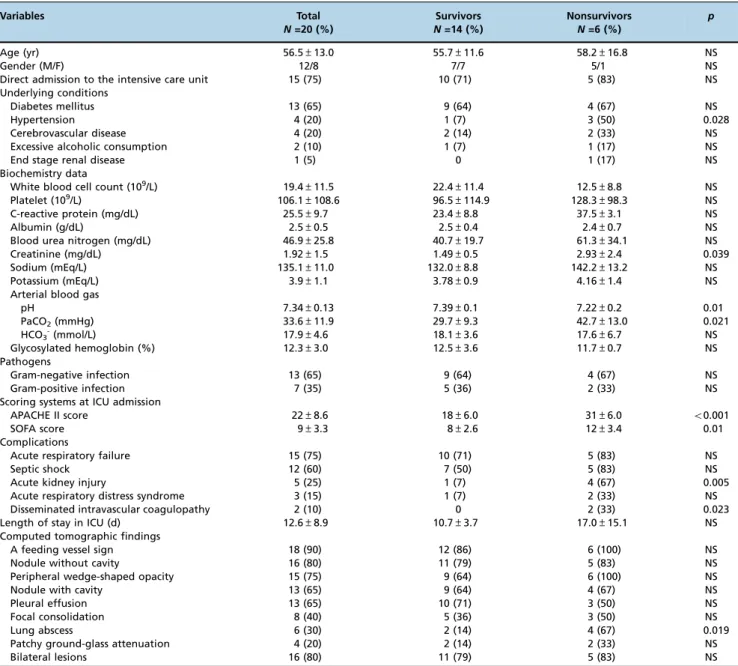
were admitted through the emergency department, and 15 (75%) were directly admitted to the ICU. The diagnosis of SPE was made on the day of admission for 10 (50%) patients and within 7 days of admission for the remaining 10 (50%) patients. Table 1 presents a comparison of the clinicoradio-logical characteristics of the survivors and nonsurvivors. Diabetes mellitus was the major underlying condition (n=13, 65%). Six patients (30%) died during hospitalization, and fourteen patients (70%) recovered from their illness. The survivors and nonsurvivors did not significantly differ in demographic data, pathogens, or length of stay in the ICU. Regarding underlying conditions, a history of hypertension was significantly more common (50% vs. 7%, p=0.028) in the nonsurvivors; however, no significant difference was observed in the incidence of diabetes mellitus, cerebrovas-cular disease, excessive alcoholic consumption or end-stage renal disease. Regarding biochemistry data, the nonsurvivors had significantly higher serum creatinine (2.93±2.4vs.1.49±
0.5,p=0.039) and PaCO2(42.7±13.0vs.29.7±9.3,p=0.021)
levels than the survivors. However, the nonsurvivors had significantly lower arterial pH (7.22±0.2 vs. 7.39±0.1, p=0.01). Serum C-reactive protein and sodium levels were non-significantly higher in the nonsurvivors compared to the survivors (p=0.053 and 0.056, respectively). No differences were seen in white blood cell count, platelets, albumin, blood urea nitrogen, potassium, arterial HCO3-, or glycosylated
hemoglobin. At ICU admission, the nonsurvivors had significantly higher mean APACHE II (31±6.0 vs. 18±6.0, po0.001) and mean SOFA scores (12±3.4vs.8±2.6,p=0.01)
compared to the survivors. The most common complication was acute respiratory failure (n=15, 75%), followed by septic shock (n=12, 60%), AKI (n=5, 25%), acute respiratory distress syndrome (n=3, 15%) and DIC (n=2, 10%). Compared with the survivors, the incidences of AKI (67% vs.7%, p=0.005) and DIC (33% vs. 0, p=0.023) were significantly higher in the nonsurvivors. The mean length of stay in the ICU was 12.6
±8.9 days. Six patients died of multiple organ dysfunction
duration for the 14 survivors ranged from 4 to 48 months; none of the survivors had SPE-related complications.
More than two imaging findings were obtained for each patient. Sixteen (80%) patients exhibited lesions in the bilateral lungs. The CT findings included a feeding vessel sign (90%), nodules without cavities (80%), peripheral wedge-shaped opacities (75%), nodules with cavities (65%), pleural effusions (65%), focal consolidations (40%), lung abscesses (30%), and patchy ground-glass opacities (20%). Compared with the survivors, the nonsurvivors were signi-ficantly more likely to have lung abscesses (67% vs. 14%,
p=0.019). Follow-up chest radiography for the 14 survivors revealed that ill-defined infiltrates and nodular opacities were resolved within 7–14 days and 14–60 days, respectively.
Table 2 shows the causative pathogens, primary sources of infection, and surgical procedures for the 20 patients. All 20 patients had positive blood cultures. The most common
causative pathogen was Klebsiella pneumoniae (n=10, 50%), followed by Staphylococcus aureus (n=7, 35%), Pseudomonas aeruginosa(n=1, 5%),Escherichia coli(n=1, 5%), andSalmonella
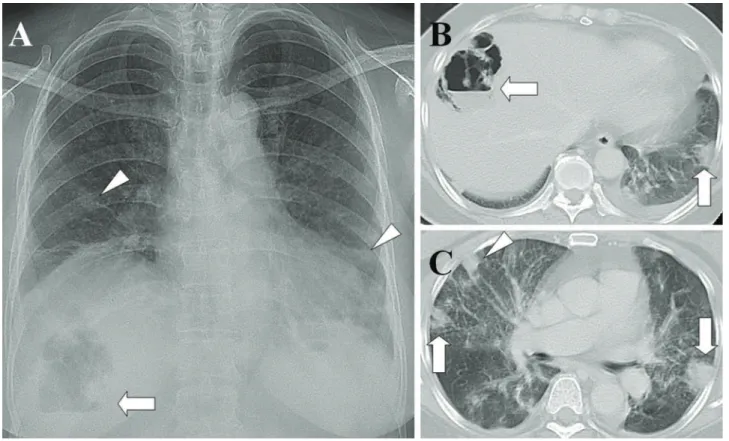
group B (n=1, 5%). The most common primary source of infection was liver abscess (Figure 1) (n=8, 40%), followed by pneumonia (Figure 2) (n=5, 25%), tricuspid valve infective endocarditis (Figure 3) (n=3, 15%), renal abscess (Figure 4) (n=2, 10%), deep neck infection (n=1, 5%) and soft tissue abscess (n=1, 5%). Three, two and one of the nonsurvivors had pneumonia, liver abscess and deep neck infection, respectively. Among the ten patients withK. pneumoniaeas the causative pathogen, eight, one and one patient had liver abscess, deep neck infection and renal abscess, respectively. Among the seven patients with S. aureus as the causative pathogen, four had pneumonia and three had tricuspid valve infective endocarditis. Antibiotic therapy was initiated in all patients on the day of admission and was administered for
Table 1-Comparison of clinicoradiological characteristics between survivors and nonsurvivors.
Variables Total
N=20 (%)
Survivors N=14 (%)
Nonsurvivors N=6 (%)
p
Age (yr) 56.5±13.0 55.7±11.6 58.2±16.8 NS
Gender (M/F) 12/8 7/7 5/1 NS
Direct admission to the intensive care unit 15 (75) 10 (71) 5 (83) NS
Underlying conditions
Diabetes mellitus 13 (65) 9 (64) 4 (67) NS
Hypertension 4 (20) 1 (7) 3 (50) 0.028
Cerebrovascular disease 4 (20) 2 (14) 2 (33) NS
Excessive alcoholic consumption 2 (10) 1 (7) 1 (17) NS
End stage renal disease 1 (5) 0 1 (17) NS
Biochemistry data
White blood cell count (109/L) 19.4±11.5 22.4±11.4 12.5±8.8 NS
Platelet (109/L) 106.1±108.6 96.5±114.9 128.3±98.3 NS
C-reactive protein (mg/dL) 25.5±9.7 23.4±8.8 37.5±3.1 NS
Albumin (g/dL) 2.5±0.5 2.5±0.4 2.4±0.7 NS
Blood urea nitrogen (mg/dL) 46.9±25.8 40.7±19.7 61.3±34.1 NS
Creatinine (mg/dL) 1.92±1.5 1.49±0.5 2.93±2.4 0.039
Sodium (mEq/L) 135.1±11.0 132.0±8.8 142.2±13.2 NS
Potassium (mEq/L) 3.9±1.1 3.78±0.9 4.16±1.4 NS
Arterial blood gas
pH 7.34±0.13 7.39±0.1 7.22±0.2 0.01
PaCO2(mmHg) 33.6±11.9 29.7±9.3 42.7±13.0 0.021
HCO3-(mmol/L) 17.9±4.6 18.1±3.6 17.6±6.7 NS
Glycosylated hemoglobin (%) 12.3±3.0 12.5±3.6 11.7±0.7 NS
Pathogens
Gram-negative infection 13 (65) 9 (64) 4 (67) NS
Gram-positive infection 7 (35) 5 (36) 2 (33) NS
Scoring systems at ICU admission
APACHE II score 22±8.6 18±6.0 31±6.0 o0.001
SOFA score 9±3.3 8±2.6 12±3.4 0.01
Complications
Acute respiratory failure 15 (75) 10 (71) 5 (83) NS
Septic shock 12 (60) 7 (50) 5 (83) NS
Acute kidney injury 5 (25) 1 (7) 4 (67) 0.005
Acute respiratory distress syndrome 3 (15) 1 (7) 2 (33) NS
Disseminated intravascular coagulopathy 2 (10) 0 2 (33) 0.023
Length of stay in ICU (d) 12.6±8.9 10.7±3.7 17.0±15.1 NS
Computed tomographic findings
A feeding vessel sign 18 (90) 12 (86) 6 (100) NS
Nodule without cavity 16 (80) 11 (79) 5 (83) NS
Peripheral wedge-shaped opacity 15 (75) 9 (64) 6 (100) NS
Nodule with cavity 13 (65) 9 (64) 4 (67) NS
Pleural effusion 13 (65) 10 (71) 3 (50) NS
Focal consolidation 8 (40) 5 (36) 3 (50) NS
Lung abscess 6 (30) 2 (14) 4 (67) 0.019
Patchy ground-glass attenuation 4 (20) 2 (14) 2 (33) NS
Bilateral lesions 16 (80) 11 (79) 5 (83) NS
Figure 1 -Liver abscess with septic pulmonary emboli. (A) A chest radiograph shows an air-fluid level in the right upper abdomen (arrow) and multiple nodular opacities in the bilateral lungs (arrowheads). (B) A CT scan shows a gas-forming liver abscess (arrow) and a peripheral wedge-shaped opacity abutting the adjacent pleura (arrow). (C) A lung window of a cross-sectional CT scan shows two peripheral wedge-shaped opacities abutting the adjacent pleura (arrows) and a peripheral nodule with a feeding vessel (arrowhead). The patient was a 61-year-old diabetic woman whose blood and aspirate abscess cultures were positive forKlebsiella
pneumoniae.
Table 2-Causative pathogens, primary sources of infection, and surgical procedures for the 20 patients
No. Pathogen Primary source of
infection
Culture site Procedure Outcome
1 Methicillin-susceptibleS. aureus Tricuspid valve infective endocarditis
Blood TVR Survivor
2 Methicillin-susceptibleS. aureus Tricuspid valve infective endocarditis
Blood VATS Survivor
3 Methicillin-susceptibleS. aureus Tricuspid valve infective endocarditis
Blood Survivor
4 Methicillin-resistantS. aureus Pneumonia Blood, sputum Nonsurvivor
5 Methicillin-susceptibleS. aureus Pneumonia Blood, sputum Nonsurvivor
6 Methicillin-susceptibleS. aureus Pneumonia Blood, sputum VATS Survivor
7 Methicillin-susceptibleS. aureus Pneumonia Blood, sputum Survivor
8 K. pneumoniae Liver abscess Blood, abscess, cerebrospinal fluid PCD Nonsurvivor
9 K. pneumoniae Liver abscess Blood, abscess PCD Nonsurvivor
10 K. pneumoniae Liver abscess Blood, abscess PCD, tube thoracostomy Survivor
11 K. pneumoniae Liver abscess Blood, abscess PCD, tube thoracostomy Survivor
12 K. pneumoniae Liver abscess Blood, abscess PCD, VATS Survivor
13 K. pneumoniae Liver abscess Blood, abscess PCD Survivor
14 K. pneumoniae Liver abscess Blood Survivor
15 K. pneumoniae Liver abscess Blood Survivor
16 K. pneumoniae Deep neck infection Blood Nonsurvivor
17 K. pneumoniae Renal abscess Blood, abscess, urine VATS, PCD Survivor
18 P. aeruginosa Pneumonia Blood, sputum, pleural fluid Tube thoracostomy Nonsurvivor
19 E. coli Renal abscess Blood, abscess, urine PCD Survivor
20 Salmonellagroup B Soft tissue abscess Blood, abscess Incision and drainage Survivor
3–6 weeks in the survivors. Transthoracic (n=7) and
trans-esophageal (n=4) echocardiography were performed in the seven patients whose blood cultures were positive for
S. aureus. Tricuspid valve vegetation was proved in three patients. Overall, six patients underwent percutaneous pigtail catheter drainage of liver abscess, three underwent video-assisted thoracostomy surgery with decortications for loculated pleural effusion, two underwent tube thora-costomy for massive pleural effusions, two underwent percutaneous pigtail catheter drainage of renal abscess, one underwent tube thoracostomy for empyema and one under-went tricuspid valve replacement.
’ DISCUSSION
During the study period, 32 patients were diagnosed with SPE in our institution. Twenty (63%) of these patients required ICU admission; all were admitted through the emergency department. Fifteen (75%) patients were directly admitted to the ICU, indicating that SPEs can occur fulminantly and seriously. MODS developed in 85% (17 of 20) of the patients, and acute respiratory failure was the most common organ failure (75%). Nonsurvivors had signifi-cantly higher serum creatinine and PaCO2 levels as well
as significantly higher APACHE II and SOFA scores. AKI, DIC, and lung abscess were significantly more prevalent in non-survivors.
Historically, the most common primary source of infection has been tricuspid valve infective endocarditis secondary to
intravenous drug abuse (13). However, the epidemiology of SPE has changed over the past 30 years (2). In the current study, liver abscess, pneumonia, and tricuspid valve infective endocarditis were the major primary sources of SPE, and
K. pneumoniaeliver abscess (KPLA) was the most common primary source of SPE (40%, 8 of 20). Taiwan has one of the highest prevalences of KPLA worldwide (14), and the lung is among the most common sites of metastatic infection (15). All our K. pneumoniae bacteremic isolates expressed the hypermucoviscous phenotype, which has been associated with the development of a distinctive type of invasive liver abscess syndrome (16). The hypermucoviscous phenotype of the capsular serotype K1 is a major virulence factor of
K. pneumoniaethat can cause primary liver abscess and cata-strophic septic metastatic complications and is an emerging pathogen (17,18). Physicians should therefore initiate aggres-sive investigations for invaaggres-sive liver abscess syndrome when the hypermucoviscous phenotype is identified. All eight patients with KPLA were diabetic and 90% of them exhibited a glycosylated hemoglobin value exceeding 10%, indicating that poor glycemic control is highly associated with SPE. Strict glycemic control can prevent the development of metastatic complications (19).
In 2007, the first two cases of pneumonia as a primary source of SPE, diagnosed using chest images, were reported (20). However, no related case reports have since been pub-lished, possibly because of the difficulty of distinguishing SPE from pneumonia through imaging. However, in another study based on postmortem examinations, pneumonia was
the most common cause of SPE (34%, 84 of 247) (21). Therefore, the number of patients with pneumonia plus SPE may have been underestimated.
Morikawa et al. reported CT findings, including GGA, centrilobular nodules, consolidations, reticular opacities, nodules, and pleural effusion, from 68 patients with methicillin-resistantS. aureus(MRSA) and 83 patients with methicillin-susceptible S. aureus (MSSA) pneumonia (22). In addition, Nguyen et al. reported CT findings, including consolidations, multiple nodules and GGA, from nine patients with community-acquired MRSA pneumonia (23). SPE can present as consolidations, multiple nodules with cavities and GGA in CT images (6), all of which are present in pneumonia, thus making distinguishing SPE from pneumonia difficult. In the present study, CT examinations showed multiple different sizes of nodules with cavities, as shown in Figure 2, which is suggestive of SPE instead of pneumonia.
The highest mortality (60%, 3 of 5) occurred in patients with pneumonia as a primary source of SPE. Although
S. aureusconstituted only approximately 3% of community-acquired pneumonia (CAP) (12) cases, community-community-acquired necrotizing pneumonia caused by S. aureus can cause a high mortality rate of approximately 40%–50% (24,25). CAP
caused byP. aeruginosais very rare but has been associated with a high mortality rate of approximately 30% (26). Furthermore, in patients with MSSA andP. aeruginosaCAP complicated with bacteremia, the in-hospital mortality rates at day 30 can be as high as 61% and 65%, respectively (27). Because of the high mortality associated with bacteremic CAP complicated with SPE, high clinical suspicion is probably the most crucial factor in obtaining an early and rapid diagnosis, especially for MRSA CAP (28). Some strains of S. aureuscarrying the Panton-Valentine leukocidin gene can cause rapidly progressive and highly lethal necrotizing pneumonia (29). Early and rapid diagnosis using aggressive
diagnostic measures and rapid institution of effective therapy are essential for the treatment of pneumonia with SPE.
In the present study, S. aureus was the major causative pathogen of tricuspid valve infective endocarditis and pneumonia. However, all the patients with tricuspid valve infective endocarditis recovered from the illness, in contrast to the patients with pneumonia. Among the three patients with tricuspid valve infective endocarditis complicated with SPE, one underwent valve replacement because of recurrent sepsis despite appropriate antibiotic therapy, one underwent thoracotomy because of empyema complicated by SPE, and one received antibiotic therapy only. Surgical interventions, such as valve replacement and thoracotomy, can reduce the mortality rate of tricuspid valve infective endocarditis complicated with SPE.
Only three cases of renal abscess as a primary source of SPE have been reported (30–32). In the present study, we
reported two cases of renal abscess as a primary source of SPE. The causative pathogens wereK. pneumoniaeandE. coli. Early treatment of the complications of SPE, including lung abscess and empyema, is imperative. Adequate antibiotic therapy, early treatment of empyema, and renal abscess drainage can reduce morbidity and mortality in patients with renal abscess with SPE.
Two limitations were encountered while conducting this study. First, data were collected retrospectively from a single institution, which may have resulted in a selec-tion bias. Second, we could not identify significant pre-dictors of mortality because of the relatively small patient sample. Despite these shortcomings, our study provides critical information on patients with SPE who require critical care.
The main findings of this study are summarized as follows. First, patients with SPE who require critical care, especially those with pneumonia and liver abscess, are often associated with high mortality. Second, the most common primary source of infection is liver abscess, followed by pneumonia and tricuspid valve infective endocarditis. Therefore, when patients with liver abscess, pneumonia, or tricuspid valve infective endocarditis require critical care, physicians should carefully examine the possibility of SPEs. Third, early diagnosis, appropriate antibiotic therapy, surgi-cal intervention and respiratory support are essential for the treatment of patients with SPE who require critical care.
’ ACKNOWLEDGMENTS
The authors thank Sheng-Kai Lin for assistance with data management.
’ AUTHOR CONTRIBUTIONS
Chou DW designed the study, interpreted the data and wrote the manu-script. Wu SL collected and analyzed the data. Chou DW, Chung KM and Han SC evaluated the chest radiographs and CT scans. Cheung BM interpreted the microbiologicalfindings.
’ REFERENCES
1. Bach AG, Restrepo CS, Abbas J, Villanueva A, Lorenzo Dus MJ, Schöpf R, et al. Imaging of nonthrombotic pulmonary embolism: biological mate-rials, nonbiological matemate-rials, and foreign bodies. Eur J Radiol. 2013;82(3): e120–41, http://dx.doi.org/10.1016/j.ejrad.2012.09.019.
2. Cook RJ, Ashton RW, Aughenbaugh GL, Ryu JH. Septic pulmonary embolism: presenting features and clinical course of 14 patients. Chest. 2005;128(1):162–6, http://dx.doi.org/10.1378/chest.128.1.162.
3. Huang RM, Naidich DP, Lubat E, Schinella R, Garay SM, McCauley DI. Septic pulmonary emboli: CT-radiographic correlation. AJR Am J Roentgenol. 1989;153(1):41–5, http://dx.doi.org/10.2214/ajr.153.1.41.
4. Kuhlman JE, Fishman EK, Teigen C. Pulmonary septic emboli: diagnosis with CT. Radiology. 1990;174(1):211–3, http://dx.doi.org/10.1148/radiology. 174.1.2294550.
5. Iwasaki Y, Nagata K, Nakanishi M, Natuhara A, Harada H, Kubota Y, et al. Spiral CT findings in septic pulmonary emboli. Eur J Radiol. 2001; 37(3):190–4, http://dx.doi.org/10.1016/S0720-048X(00)00254-0. 6. Chou DW, Wu SL, Chung KM, Han SC. Septic pulmonary embolism
caused by aKlebsiella pneumoniae liver abscess: clinical characteristics, imaging findings, and clinical courses. Clinics. 2015;70(6):400–7, http:// dx.doi.org/10.6061/clinics/2015(06)03.
7. Knaus WA, Draper EA, Wagner DP, Zimmerman JE. APACHE II: a severity of disease classification system. Crit Care Med. 1985;13(10): 818–29, http://dx.doi.org/10.1097/00003246-198510000-00009. 8. Ferreira FL, Bota DP, Bross A, Mélot C, Vincent JL. Serial evaluation of the
SOFA score to predict outcome in critically ill patients. JAMA. 2001; 286(14):1754–8, http://dx.doi.org/10.1001/jama.286.14.1754.
9. Mehta RL, Kellum JA, Shah SV, Molitoris BA, Ronco C, Warnock DG, et al. Acute Kidney Injury Network: report of an initiative to improve outcomes in acute kidney injury. Crit Care. 2007;11(2):R31, http://dx.doi. org/10.1186/cc5713.
10. Ferguson ND, Fan E, Camporota L, Antonelli M, Anzueto A, Beale R, et al. The Berlin definition of ARDS: an expanded rationale, justification, and supplementary material. Intensive Care Med. 2012;38(10):1573–82, http://dx.doi.org/10.1007/s00134-012-2682-1.
11. Taylor FB Jr, Toh CH, Hoots WK, Wada H, Levi M; Scientific Sub-committee on Disseminated Intravascular Coagulation (DIC) of the Inter-national Society on Thrombosis and Haemostasis (ISTH). Towards definition, clinical and laboratory criteria, and a scoring system for dis-seminated intravascular coagulation. Thromb Haemost. 2001;86(5):1327–30. 12. Franquet T, Herold CJ. Community-acquired pneumonia. In: Müller NL, Silva CI. 1st ed. Imaging of the chest. Philadelphia: Saunders/Else-viersemi; 2008. pp. 290–321.
13. MacMillan JC, Milstein SH, Samson PC. Clinical spectrum of septic pulmon-ary embolism and infarction. J Thorac Cardiovasc Surg. 1978;75(5):670–9. 14. Tsai FC, Huang YT, Chang LY, Wang JT. Pyogenic liver abscess as endemic
disease, Taiwan. Emerg Infect Dis. 2008;14(10):1592–600, http://dx.doi. org/10.3201/eid1410.071254.
15. Siu LK, Yeh KM, Lin JC, Fung CP, Chang FY. Klebsiella pneumoniae liver abscess: a new invasive syndrome. Lancet Infect Dis. 2012;12(11):881–7, http://dx.doi.org/10.1016/S1473-3099(12)70205-0.
16. Lee HC, Chuang YC, Yu WL, Lee NY, Chang CM, Ko NY, et al. Clinical implications of hypermucoviscosity phenotype in Klebsiella pneumoniae isolates: association with invasive syndrome in patients with community-acquired bacteraemia. J Intern Med. 2006;259(6):606–14, http://dx.doi. org/10.1111/j.1365-2796.2006.01641.x.
17. Fang CT, Lai SY, Yi WC, Hsueh PR, Liu KL, Chang SC. Klebsiella pneu-moniae genotype K1: an emerging pathogen that causes septic ocular or central nervous system complications from pyogenic liver abscess. Clin Infect Dis. 2007;45(3):284–93, http://dx.doi.org/10.1086/519262. 18. Fung CP, Chang FY, Lee SC, Hu BS, Kuo BI, Liu CY, et al. A global
emerging disease of Klebsiella pneumoniae liver abscess: is serotype K1 an important factor for complicated endophthalmitis? Gut. 2002;50(3): 420–4, http://dx.doi.org/10.1136/gut.50.3.420.
19. Lin JC, Siu LK, Fung CP, Tsou HH, Wang JJ, Chen CT, et al. Impaired phagocytosis of capsular serotypes K1 or K2 Klebsiella pneumoniae in type 2 diabetes mellitus patients with poor glycemic control. J Clin Endocrinol Metab. 2006;91(8):3084–7, http://dx.doi.org/10.1210/jc. 2005-2749.
20. Lee SJ, Cha SI, Kim CH, Park JY, Jung TH, Jeon KN, et al. Septic pul-monary embolism in Korea: Microbiology, clinicoradiologic features, and treatment outcome. J Infect. 2007;54(3):230–4, http://dx.doi.org/10.1016/ j.jinf.2006.04.008.
21. Sakuma M, Sugimura K, Nakamura M, Takahashi T, Kitamukai O, Yazu T, et al. Unusual pulmonary embolism: septic pulmonary embolism and amniotic fluid embolism. Circ J. 2007;71(5):772–5, http://dx.doi.org/ 10.1253/circj.71.772.
22. Morikawa K, Okada F, Ando Y, Ishii R, Matsushita S, Ono A, et al. Meticillin-resistantStaphylococcus aureusand meticillin-susceptible S. aureuspneumonia: comparison of clinical and thin-section CT findings. Br J Radiol. 2012;85(1014):e168–75, http://dx.doi.org/10.1259/bjr/ 65538472.
23. Nguyen ET, Kanne JP, Hoang LM, Reynolds S, Dhingra V, Bryce E, et al. Community-acquired methicillin-resistantStaphylococcus aureus pneumo-nia: radiographic and computed tomography findings. J Thorac Imaging. 2008;23(1):13–9, http://dx.doi.org/10.1097/RTI.0b013e318149e698. 24. Kreienbuehl L, Charbonney E, Eggimann P. Community-acquired
nec-rotizing pneumonia due to methicillin-sensitiveStaphylococcus aureus secreting Panton-Valentine leukocidin: a review of case reports. Ann Intensive Care. 2011;1(1):52, http://dx.doi.org/10.1186/2110-5820-1-52. 25. Vardakas KZ, Matthaiou DK, Falagas ME. Comparison of
community-acquired pneumonia due to methicillin-resistant and methicillin-susceptible Staphylococcus aureusproducing the Panton-Valentine leukocidin. Int J Tuberc Lung Dis. 2009;13(12):1476–85.
26. Hatchette TF, Gupta R, Marrie TJ.Pseudomonas aeruginosa community-acquired pneumonia in previously healthy adults: case report and review of the literature. Clin Infect Dis. 2000;31(6):1349–56, http://dx.doi.org/ 10.1086/317486.
27. Melzer M, Welch C. 30-day mortality in UK patients with bacteraemic community-acquired pneumonia. Infection. 2013;41(5):1005–11, http:// dx.doi.org/10.1007/s15010-013-0462-7.
28. Rubinstein E, Kollef MH, Nathwani D. Pneumonia Caused by Methicillin-ResistantStaphylococcus aureus. Clin Infect Dis. 2008;46 Suppl 5:S378–85, http://dx.doi.org/10.1086/533594.
29. Gillet Y, Issartel B, Vanhems P, Fournet JC, Lina G, Bes M, et al. Asso-ciation betweenStaphylococcus aureusstrains carrying gene for Panton-Valentine leukocidin and highly lethal necrotising pneumonia in young immunocompetent patients. Lancet. 2002; 359(9308):753–9, http://dx.doi. org/10.1016/S0140-6736(02)07877-7.
30. Matsumoto H, Ishihara K, Fujii H, Hajiro T, Watanabe I, Nishimura T, et al. Computed tomographic findings in septic pulmonary emboli secondary to renal abscess. Nihon Kyobu Shikkan Gakkai Zasshi. 1996; 34(8):937–42.
31. Günalp M, Gürler S, Polat O, Demirkan A. Septic pulmonary embolism associated with renal abscess: a case report. J Emerg Med. 2012;42(3): e51–3, http://dx.doi.org/10.1016/j.jemermed.2008.11.028.