ORIGINAL ARTICLE
Effectiveness evaluation of mood disorder treatment
algorithms in Brazilian public healthcare patients
Ana F. Lima,
1Sandro R. Miguel,
1Mı´rian Cohen,
1Jacques J. Zimmermann,
1Fla´vio M. Shansis,
2Luciane N. Cruz,
1Patrı´cia K. Ziegelmann,
1,3,4Carisi A. Polanczyk,
1,4Marcelo P. Fleck
51Instituto de Avaliac
¸a˜o de Tecnologia em Sau´de (IATS), Hospital de Clı´nicas de Porto de Alegre (HCPA), Porto Alegre, RS, Brazil.
2Hospital
Psiquia´trico Sa˜o Pedro, Porto Alegre, RS, Brazil.3Departamento de Estatı´stica, Instituto de Matema´tica, Universidade Federal do Rio Grande do Sul (UFRGS), Porto Alegre, RS, Brazil.4Programa de Po´s-Graduac¸a˜o em Cieˆncias da Sau´de: Cardiologia e Cieˆncias Cardiovasculares,
UFRGS, Porto Alegre, RS, Brazil.5Departamento de Psiquiatria e Medicina Legal, Faculdade de Medicina, UFRGS, Porto Alegre, RS, Brazil.
Objective:To assess the effectiveness of three mood disorder treatment algorithms in a sample of patients seeking care in the Brazilian public healthcare system.
Methods: A randomized pragmatic trial was conducted with an algorithm developed for treating episodes of major depressive disorder (MDD), bipolar depressive episodes and mixed episodes of bipolar disorder (BD).
Results: The sample consisted of 259 subjects diagnosed with BD or MDD (DSM-IV-TR). After the onset of symptoms, the first treatment occurredB6 years and the use of mood stabilizers began
B12 years. All proposed algorithms were effective, with response rates around 80%. The majority of
the subjects took 20 weeks to obtain a therapeutic response.
Conclusions: The algorithms were effective with the medications available through the Brazilian Unified Health System. Because therapeutic response was achieved in most subjects by 20 weeks, a follow-up period longer than 12 weeks may be required to confirm adequate response to treatment. Remission of symptoms is still the main desired outcome. Subjects who achieved remission recovered more rapidly and remained more stable over time.
Clinical trial registration:NCT02901249, NCT02870283, NCT02918097
Keywords: Mood disorders; bipolar; mood disorders; unipolar; clinical drug studies; economic issues; epidemiology
Introduction
Mood disorders are highly prevalent and are related to psychological, social and functional impairment. A num-ber of studies have associated mood disorders with high economic costs and public healthcare system overload.1,2 Major depressive disorder (MDD) is one of the main causes of morbidity in the world,3 with lifetime prevalence rates varying from 3% in Japan to 17% in the United States to 18.3% in Brazil.4According to the Global Burden of Disease Study, unipolar depression is currently considered the third leading cause of medical conditions and is predicted to be the leading cause in 2030.3Bipolar disorder (BD) is the eighth leading cause of disability worldwide, with preva-lences of about 3% globally5and 0.9% in Brazil.6
Brazil is the largest country in South America, with a popu-lation of approximately 190 million.7About 70% of the popu-lation uses the public healthcare system, called the Sistema U´ nico de Sau´de (Unified Health System), or SUS, which provides free medical care to all citizens. According to DATASUS, the National Database of Healthcare Services,
health care expenditures have increased significantly in recent years. Between 1995 and 1996 the total cost was R$ 12 billion (BUS$ 7 billion), while in 2006 it reached R$ 40 billion (BUS$ 23 billion).8Despite this growth, the resources devoted to health care are still insufficient for the demands of the population, causing serious equity problems.9 In 2010, only I$ 1.06 million of the I$ 36.7 million spent on healthcare in Brazil, about 3% of the total, went to mental health care.10
In addition to limited financial resources, there are still few treatment guidelines for mood disorders that take the specificities of the Brazilian public health care system into account.11Due to insufficient financial resources, the Brazilian government developed a family health care stra-tegy for primary health care units that provides greater cove-rage for mental health care, reaching 95% of Brazilian municipalities and more than 50% of the population.12 The strategy includes a basic list of free medications that can be prescribed to patients.
A high prevalence of mental disorders has been obser-ved among patients at Brazilian primary health care cli-nics, with around 52% presenting symptoms suggestive of a mental disorder and 25% presenting symptoms sug-gestive of depression, although the recognition of mood disorders is still precarious.12According to Castelo et al., 7.6% of patients seeking primary healthcare at clinics in a large Brazilian city screened positively for BD, although
Correspondence: Ana Fla´via Barros da Silva Lima, Instituto de Avaliac¸a˜o de Tecnologia em Sau´de (IATS), Hospital de Clı´nicas
de Porto Alegre, Rua Ramiro Barcelos, 2350, CEP 90035-903, Porto Alegre, RS, Brazil.
E-mail: [email protected]
Submitted Oct 25 2016, accepted Mar 06 2017, Epub Aug 21 2017.
Brazilian Journal of Psychiatry Brazilian Psychiatric Association
only 3.6% were actually diagnosed the disorder.13There are few guidelines for primary health care practitioners regarding mental health, and no data are available to eval-uate the impact of interventions.14
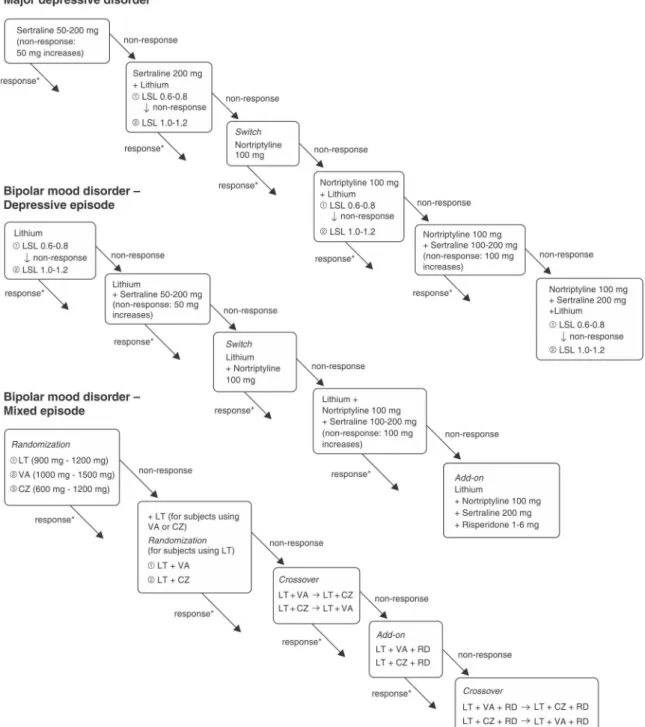
In order to systematically study the effectiveness of treatment choices for patients with mood disorders in the Brazilian public health system, the authors developed phar-macological treatment algorithms for unipolar depressive episodes, bipolar depressive episodes, and mixed epi-sodes based on the list of drugs provided by SUS (Figure 1).
The aim of this study was to verify the effectiveness of these three algorithms for treating mood disorders in a sample of patients seeking care in the Brazilian public health care system.
Methods
A quasi-experimental study design was developed to eval-uate the effectiveness of treatments for mood disorders in a public health care context in the city of Porto Alegre, RS,
southern Brazil. Patients with mood disorders were enrol-led through general practitioner referrals or social media advertisements. The evaluations were performed between October 2010 and October 2014 at a public health outpatient clinic in Porto Alegre (Hospital Psiquia´trico Sa˜o Pedro). Trained medical students and psychiatry residents provided clinical care and conducted the evaluations. Three algorithms were originally developed for treating mood disorders: one each for unipolar depressive epi-sodes, bipolar depressive epiepi-sodes, and mixed episodes. For unipolar and bipolar depressive episodes, a single-group, pretest-posttest trial approach was employed. For mixed bipolar episodes, a multi-arm, randomized, non-blinded, crossover, pragmatic trial was conducted. Following simple randomization procedures (i.e., compu-ter-generated random numbers), mixed bipolar episode patients were assigned to 1of 3 treatment groups in a 1:1:1 allocation ratio to initially receive lithium, valproic acid or carbamazepine. The algorithms were developed by a Delphi panel of experts. The treatment sequence was carried out according to episode status, as described in Figure 1. Only medications available in the Brazilian public health-care system were used: a) sertraline, nortriptyline, and lithium for unipolar depressive episodes; b) lithium (or valproic acid when the use of lithium was contraindica-ted), sertraline, nortriptyline, and risperidone for bipolar depressive episodes; c) lithium, carbamazepine, valproic acid, and risperidone for mixed bipolar episodes (Figure 1). All participants provided written informed consent prior to participation in this study protocol. The institutional ethics committee approved all ethical aspects of this human subject study. The clinical trial registry numbers are NCT02901249, NCT02870283 and NCT02918097.
Sample
The following eligibility criteria applied to all participants: a) aged between 18 and 65 years; b) current acute epi-sode of BD or MDD; c) full capacity to understand and answer self-applied instruments; d) the presence of symp-toms in the last 30 days; e) at least 30 days of abstinence for drug addicts. The exclusion criteria included: a) the presence of organic brain syndrome (OBS); b) pregnancy or lactation; c) fulfilling the criteria for psychiatric hospital-ization.
Procedures and measurements of the study
The study procedures were as follows: 1) sample selec-tion began by referral from primary municipal health care clinics; 2) potential participants were given an informative lecture regarding mood disorders and the parameters of this study, after which the informed consent forms were distributed; 3) screening was conducted for BD or MDD symptoms with the Patient Health Questionnaire (PHQ-9) for depressive symptoms and the Hypomania Symptom Checklist Brazilian Version (HCL-32-BV) for manic/hypo-manic symptoms; 4) diagnostic evaluation was through a Mini International Neuropsychiatric Interview (MINI) and a clinical interview for individuals whose screening results indicated BD or MDD; 5) patients with OBS were excluded
(as recommended by the Mini-Mental State Examination); 6) participants were assigned to a treatment algorithm upon confirmation of diagnosis; 7) mixed-episode BD participants were randomized into one of three treatment alternatives in that algorithm; 8) baseline and demographic assessments were conducted using standardized semi-structured inter-views during the first and second visits; 9) in each clinic visit, the severity of the symptoms were evaluated using the Clinical Global Impression Scale (CGI), the Hamilton Rating Scale for Depression (HRSD), and the Young Mania Rating Scale (YMRS), although individuals diagnosed with MDD were only evaluated with the CGI and HRSD; 10) participants were followed-up biweekly and then monthly after stabilization (the maximum follow-up period was 52 weeks).
The individuals included in the treatment protocols recei-ved medications that were already available in the public healthcare system, obtaining them from the hospital’s dis-pensing pharmacy according to the previously-described algorithms (Figure 1).
Instruments and measures
Patient Health Questionnaire-9 (PHQ-9)
The PHQ-9 is derived from the Primary Care Evaluation of Mental Disorders (PRIME-MD) instrument, which was originally developed to identify five common mental dis-orders in primary healthcare: depression, anxiety, alcohol abuse, somatoform disorders, and eating disorders. The PHQ-9 contains nine self-applied questions and is con-sidered a relatively quick instrument. It has been validated for the Brazilian population with adequate sensitivity and specificity.15
Hypomania Checklist-32 (HCL-32)
The HCL-32, consisting of 32 questions, is a self-admini-stered instrument that screens for symptoms suggestive of lifelong hypomania. It is a widely used tool for research and has demonstrated adequate psychometric character-istics regarding reliability and validity for the Brazilian population.16
Mini-Mental State Examination
This instrument is widely used to assess cognitive impair-ment for clinical and research purposes. The first two sections explore questions regarding orientation, mem-ory, and attention. The second section tests the ability to name objects, follow verbal and written commands, and copy a polygon. This instrument is easily applied, lasting 5-10 minutes. It has demonstrated reliability, validity, and acceptance in the clinical field.17
Mini International Neuropsychiatric Interview (MINI) ver-sion 5.0
Demographic data sheet
The demographic data included age, gender, education (number of years of schooling), and socioeconomic status. To determine the latter, the Crite´rio Brasil economic clas-sification system was used. This system estimates the purchasing power of urban individuals and families based on a socioeconomic survey. It characterizes the physical characteristics of each respondent’s dwelling, the demo-graphics of all residents, the various household goods pos-sessed, the public services available (e.g., sewer, water, power etc.), and household income according to a points system that determines the economic class.19
Hamilton Rating Scale for Depression (HRSD)
This scale was developed to evaluate and quantify depres-sion in patients with mood disorders. Its validity and reli-ability are well established, being of worldwide use. Its abbreviated version, which was used in this study, consists of 17 items. The cutoff points are: 7-17 for mild depression, 18-24 for moderate depression, and 25 or more for severe depression.20
Young Mania Rating Scale (YMRS)
This is the most widely used assessment tool for manic symptoms. The scale consists of 11 items and is based on a patient’s subjective report of his or her clinical condition over the past 48 hours. Additional information is obtained from clinical observations made during the course of the interview. Each item is related to a severity score. Four items are graded 0-8 (irritability, speed/amount of speech, thought contents, and aggressive and disruptive behavior), while the remaining seven items are graded 0-4 (eleva-ted mood, increased activity and energy, sexual interest, sleep, language-thought disorder, appearance, and insight). Although baseline scores can vary, it is assumed that a YMRS score of 12 indicates mania. Clinical trials generally require YMRSX20 for inclusion.21
Outcomes
The main outcomes were response to treatment and remis-sion of symptoms. Treatment response for each diagnostic protocol was measured in aggregate steps; individual steps were not assessed. Response to treatment was defined as a 50% reduction of baseline HRSD results for MDD and BD depressive episodes, and 50% reductions in both scales (HRSD and YMRS) for mixed episode BD. Remis-sion was considered as obtaining three consecutive asymptomatic scores on the HRSD scale (o7 points) for MDD and BD depressive episodes, and on both scales (HRSDo7 points and YMRSo6 points) for mixed bipolar episodes. Participants who remained asymptomatic for 6-8 months were considered to be in remission, in agree-ment with the DSM-IV-TR criteria for partial and complete remission.22
The sample size was calculated to detect a response to pharmacological intervention with a confidence level of 95% and a statistical power of 90%. Power calculations revealed that a minimum sample size of 39 patients was
needed in each drug treatment group (total 117 patients). For mixed bipolar episodes, the expected response rates were 50% in the lithium group, 50% in the valproic acid group, and 20% in carbamazepine group. For bipolar depression treatment, a minimum sample of 93 patients was calculated to provide an expected response rate of B30-40%. For unipolar depression treatment, a minimum sample of 81 patients was calculated to provide an expec-ted response rate of 70%. These expecexpec-ted response rates were based on major clinical trials and diagnostic guidelines. An alpha level of .05 determined significance in all statistical analyses, which were performed in SPSS version 19 for Windows. The chi-square test was used to evaluate categorical variables. Continuous variables were analyzed using Student’st-test or ANOVA. Kaplan-Meier time-event curves were used to analyze response to treatment and remission of symptoms. The response main-tenance and remission results were obtained through intent-to-treat analysis, using a marginal approach for handling missing data through generalized estimating equations. The HRSD and YMRS ratings over time were weighted by the inverse of the estimated probability of being observed. Changes in scores were compared to baseline.
Results
The sample consisted of 259 subjects, the majority of whom were female. The average age was B40 and the average schooling was nine years. The most common marital status was cohabitation and the most prevalent socioeconomic category was class C (lower middle). The diagnostic prevalences were n=68 (26%) for major depres-sion, n=78 (30%) for bipolar depresdepres-sion, and n=113 (44%) for mixed episode BD.
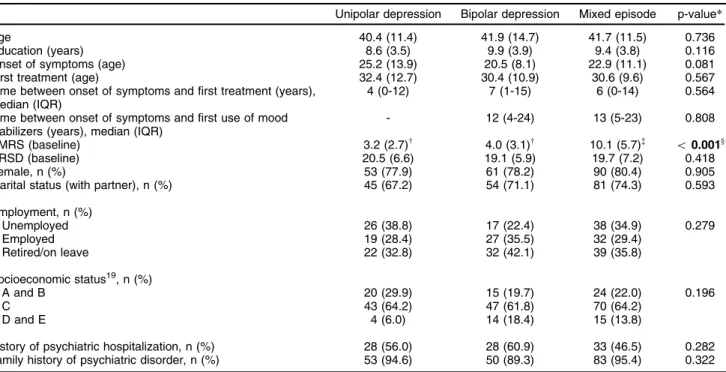
Regarding clinical variables, there was a delay of approx-imately six years between the onset of symptoms and the first treatment. After bipolar symptoms had been identified, there was an additionalB6-year delay until mood stabilizers were used. Although most patients had moderate depres-sive symptoms according to HRSD scores, at least 46% had been hospitalized at least once due to mood symptoms. All subjects were similar in terms of educational level, occupational status, clinical characteristics and baseline symptom scores. These characteristics are described in Table 1.
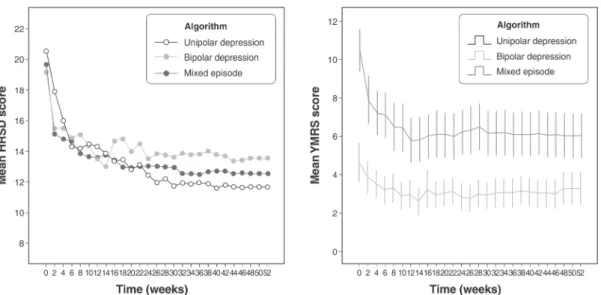
Regarding the response to treatment over time, there was a satisfactory response to the protocols used (Figure 2). By approximately 20-30 weeks, B80% of the mixed epi-sode BD patients, B83% of bipolar depression patients, andB85% of the unipolar depression patients had respon-ded to treatment. The data suggest that patients with mixed episode BD take longer than those with depression to respond. It should be noted that the rates for change in mental state (mood elevation) were around 13% in subjects with bipolar depression.
than those with mixed episode BD (47%) or bipolar depres-sion (66%). There was a statistically significant difference between unipolar and mixed episode BD response main-tenance (chi-square po0.05).
The time-event curves in Figure 4 show the number of weeks required for the subjects to present a single asymp-tomatic measurement on the symptom scales. For the protocols used in this study, this was expected to occur at around 20 weeks for 60% of the subjects. However, regarding the remission maintenance curves (Figure 5), it was evident that subjects who fulfilled the remission criteria did so at around 10 weeks, remaining stable thereafter. Of all the participants in the study, 34.5% achieved complete remission. Of these, 47.1% had MDD, 34.2% had depres-sive episode BD, and 26.9% had mixed episode BD; the difference between MDD and mixed episode BD was stati-stically significant (chi-square po0.05).
Discussion
Our findings show that the proposed treatment algorithms for these three mood disorder subtypes were effective as a whole, with response rates around 80%. This is the first study using Brazilian data to evaluate an algorithm for treating mood disorders with medication available in the public health care system. Although the effectiveness of these medications has already been demonstrated in several studies, it is relevant to search for interventions that are appropriate for Brazil’s economic and social conditions.23-26These data suggest that the public health-care system still has major difficulties in treating these disorders properly, which is probably due to problems of access, equity, and/or identifying such cases. Despite the
Table 1 Clinical and demographic characteristics
Unipolar depression Bipolar depression Mixed episode p-value*
Age 40.4 (11.4) 41.9 (14.7) 41.7 (11.5) 0.736 Education (years) 8.6 (3.5) 9.9 (3.9) 9.4 (3.8) 0.116 Onset of symptoms (age) 25.2 (13.9) 20.5 (8.1) 22.9 (11.1) 0.081 First treatment (age) 32.4 (12.7) 30.4 (10.9) 30.6 (9.6) 0.567 Time between onset of symptoms and first treatment (years),
median (IQR)
4 (0-12) 7 (1-15) 6 (0-14) 0.564
Time between onset of symptoms and first use of mood stabilizers (years), median (IQR)
- 12 (4-24) 13 (5-23) 0.808
YMRS (baseline) 3.2 (2.7)w 4.0 (3.1)w 10.1 (5.7)=
o0.001y
HRSD (baseline) 20.5 (6.6) 19.1 (5.9) 19.7 (7.2) 0.418 Female, n (%) 53 (77.9) 61 (78.2) 90 (80.4) 0.905 Marital status (with partner), n (%) 45 (67.2) 54 (71.1) 81 (74.3) 0.593
Employment, n (%)
Unemployed 26 (38.8) 17 (22.4) 38 (34.9) 0.279 Employed 19 (28.4) 27 (35.5) 32 (29.4)
Retired/on leave 22 (32.8) 32 (42.1) 39 (35.8)
Socioeconomic status19, n (%)
A and B 20 (29.9) 15 (19.7) 24 (22.0) 0.196
C 43 (64.2) 47 (61.8) 70 (64.2)
D and E 4 (6.0) 14 (18.4) 15 (13.8)
History of psychiatric hospitalization, n (%) 28 (56.0) 28 (60.9) 33 (46.5) 0.282 Family history of psychiatric disorder, n (%) 53 (94.6) 50 (89.3) 83 (95.4) 0.322
Data presented as mean (standard deviation), unless otherwise specified.
HRSD = Hamilton Rating Scale for Depression; IQR = interquartile range; SD = standard deviation; YMRS = Young Mania Rating Scale.
*Quantitative variables with symmetrical distribution are described as mean (standard deviation) and compared with ANOVA, followed by the Tukey test. Quantitative variables with asymmetric distribution are described by median (IQR) and compared using the Kruskal-Wallis test. Categorical variables are described by n (%) and compared with the chi-square test.
wNo significant statistical difference between unipolar and bipolar depression YMRS scores.
=
Mixed episode YMRS scores were significantly different from unipolar and bipolar depression YMRS scores.
y
po0.05.
satisfactory results obtained in this study, it was surprising to find that after symptom onset, the subjects had taken an average of six years to begin treatment and an ave-rage of 12 years to begin taking mood stabilizers.
A recent study of 5,037 adult residents of the city of Sa˜o Paulo found that the prevalence of mental disorders in the 12 months prior to the evaluation wasB30%. Mood disorders were the second most frequent type of disorder, affecting 11% of the population. We observed higher pre-valence rates for mood disorders than Andrade et al.27In our study, around 44% of subjects had mixed episode BD, followed by 30% with bipolar depression, and 26% with major depression. This was probably due to the sample type, which was derived from a secondary healthcare service
involving psychiatry specialists. The lower percentages of major depression patients were probably due to the ease of identification and treatment of these subjects in primary healthcare clinics, which is in accordance with previous findings. Castelo et al. observed that doctors more easily recognized depressive symptoms in patients who tested positive on a BD screening at a primary healthcare clinic. Depressive symptoms were observed in 18.1% of the bipolar patients, while symptoms suggestive of BD were recognized in only 2 subjects (3.6%).13It is also surprising that, in spite of the high prevalence of psychiatric dis-orders in big cities like Sa˜o Paulo, healthcare resources are still scarce. According to Andrade et al., only 8.7% of the Brazilian population has ever received treatment for psychiatric disorders, and only 5.3% have received treat-ment from a sector employing treat-mental health experts.27 These data help explain the treatment delay observed in our study.
Regarding the effectiveness of the algorithms, high response rates were found for the different subtypes of mood disorders. However, since the algorithms are sequen-tial interventions, featuring combinations of more than one pharmacological option, the response rates are justified for being as high as 85% for unipolar depressive episodes, 83% for bipolar depressive episodes, and 80% for mixed episode BD. According to the (UK) National Institute for Health and Care Excellence, combining different classes of antidepressants and adjusting doses are effective strategies in depression treatment, with response rates to the first antidepressant ranging from 50 to 75%.28,29 A number of medications are used to treat BD30: ample evidence indicates that lithium is effective in treating acute manic episodes and for preventing relapses, while valproate is becoming more commonly prescribed and also represents an effective treatment.31-33Studies on car-bamazepine, however, suggest that it is less effective in preventing relapse than lithium or valproate.34
The literature on bipolar depressive disorder is still very controversial.35,36Some studies do not recommend using antidepressants, since they do not accelerate recovery
Figure 3 Hamilton Rating Scale for Depression (HRSD) and Young Mania Rating Scale (YMRS) mean scores (follow-up).
time compared to monotherapy and may increase the risk of manic symptom onset.26Several studies have sugges-ted monotherapy treatment with drugs such as lamo-trigine and quetiapine as the first choice for treating bipolar depression.24,37,38On the other hand, The Inter-national Society for Bipolar Disorders (ISBD) set up a task force in 2013 featuring experts on antidepressant use in BD patients, which found that antidepressants can bring some benefit to patients who have responded to them previously during the acute phase of treatment.39,40 For the purposes of our study, however, given that neither of these medications are made available by SUS, we star-ted patients on lithium. If they were unresponsive after 8 weeks, lithium was associated with sertraline and so forth, as described above. The mood symptom change rate was around 13% in subjects with bipolar depression. This finding is similar to those described by the ISBD, in which changes in mood state due to antidepressant use ranged from 3.7 to 29%. According to the consensus, the tri- or tetracyclic classes, as well as the use of venlafaxine, are most associated with changes in mood state.40
Another important finding was the time necessary to obtain a therapeutic response. Our findings indicate that most subjects responded by the 20th weeks of treatment. Since this was a sample of individuals who had under-gone previous treatment, the results may be due to their more chronic profile, in which an association of different pharmacological strategies was necessary. Subjects with mixed bipolar episodes took longer than subjects with major depression to respond to the treatment algorithms. Most obtained a response within 30 weeks. This could be because the response to treatment was only considered valid if there was a 50% reduction in both the HRSD and YMRS scales. No other study with this criterion could be found in the literature. Thus, the response may seem
delayed in comparison to studies that assessed only manic or depressive symptoms.
In addition to the response to therapy, our findings suggest that obtaining complete remission is an important outcome for individuals with mood disorders. In our study, the complete remission rates were not high (47.1% of MDD, 34.2% of depressive episode BD, and 26.9% of mixed episode BD, with significant differences between MDD and mixed episode BD). These data are similar to those found in the literature.23,24,38 Nonetheless, partici-pants who achieved complete remission did so in approxi-mately 10 weeks and were more stable over time than those whose symptoms did not go into remission.
Our findings should be considered in light of the study limitations: i) the study design did not provide compar-isons with a control or placebo group; ii) neither the inter-ventions nor the outcomes were blinded; iii) the study protocol was developed so that only the entire algorithm could be evaluated rather than individual steps; iv) due to missing cases , there is a level of uncertainty about longi-tudinal data; v) there were no dose-dependent or side effect evaluations. Despite these limitations, as a real-life assessment, many of the challenges found in clinical mental health practice were present, and the limited therapeutic choices provided by SUS were addressed. Hence, the results could contribute to the body of knowledge on public health and mental disorders, especially regarding mood disorder treatments for primary care providers.
In conclusion, great strides have recently been made in understanding mood disorders. Since these disorders have extremely heterogeneous presentations, identifying cases and prescribing appropriate treatment can still be a challenge. Our study showed response rates around 80%, suggesting that treatments can be more effective if they are coupled with longer follow-up periods. The
remission of symptoms is still the main desired outcome. In our findings, participants who achieved remission recov-ered more rapidly and remained more stable over time. In a country of continental dimensions such as Brazil, in which at least 11% of the population is affected by mood dis-orders, the development of guidelines to assist in obtaining proper treatment for these symptoms should be highly beneficial and could provide better quality of life for these people. It is our expectation that the findings of this prag-matic trial could facilitate the development of future studies and guidelines, providing useful hypotheses toward the implementation of mental health policies for SUS users.
Acknowledgements
The study was part of a postdoctoral fellowship funded by Coordenac¸a˜o de Aperfeic¸oamento de Pessoal de Nı´vel
Superior (CAPES; project no. 017/2009).
Disclosure
The authors report no conflicts of interest.
References
1 Parker G, McCraw S, Hadzi-Pavlovic D, Fletcher K. Costs of the principal mood disorders: a study of comparative direct and indirect costs incurred by those with bipolar I, bipolar II and unipolar dis-orders. J Affect Disord. 2013;149:46-55.
2 Ekman M, Granstrom O, Omerov S, Jacob J, Landen M. The societal cost of bipolar disorder in Sweden. Soc Psychiatry Psychiatr Epide-miol. 2013;48:1601-10.
3 Vos T, Flaxman AD, Naghavi M, Lozano R, Michaud C, Ezzati M, et al. Years lived with disability (YLDs) for 1160 sequelae of 289 diseases and injuries 1990-2010: a systematic analysis for the Global Burden of Disease Study 2010. Lancet. 2012;380:2163-96. 4 Kessler RC, Berglund P, Demler O, Jin R, Merikangas KR, Walters
EE. Lifetime prevalence and age-of-onset distributions of DSM-IV disorders in the national comorbidity survey replication. Arch Gen Psychiatry. 2005;62:593-602.
5 Merikangas KR, Jin R, He JP, Kessler RC, Lee S, Sampson NA, et al. Prevalence and correlates of bipolar spectrum disorder in the world mental health survey initiative. Arch Gen Psychiatry. 2011;68: 241-51.
6 Dell’Aglio JC Jr, Basso LA, Argimon II, Arteche A. Systematic review of the prevalence of bipolar disorder and bipolar spectrum disorders in population-based studies. Trends Psychiatry Psychother. 2013;35: 99-105.
7 Instituto Brasileiro de Geografia e Estatı´stica (IBGE). Censo 2010 [Internet]. 2010 [cited 2015 Feb 12]. censo2010.ibge.gov.br/ 8 Brasil, Ministe´rio da Sau´de, Departamento de Informa´tica do SUS
(DATASUS). Informac¸o˜es de Sau´de (TABNET) [Internet]. 2009
[cited 2015 May 29]. http://www2.datasus.gov.br/DATASUS/index. php?area=02
9 Banta D, Almeida RT. The development of health technology asses-sment in Brazil. Int J Technol Assess Health Care. 2009;25:255-9. 10 Brasil, Ministe´rio da Sau´de, Secretaria de Atenc¸a˜o a` Sau´de,
Departamento de Ac¸o˜es Programa´ticas Estrate´gicas, Coordenac¸a˜o
Geral de Sau´de Mental, A´ lcool e Outras Drogas. Sau´de mental em dados 8 [Internet]. 2011 [cited 2015 May 29]. http://bvsms.saude.gov. br/bvs/periodicos/saude_mental_dados_v8.pdf
11 Brasil, Ministe´rio da Sau´de (MS). Consulta pu´blica no
24, de 16 de dezembro de 2014 [Internet].16 Dec 2014 [cited 2015 May 29]. http:// portalarquivos.saude.gov.br/images/pdf/2014/dezembro/18/con-sulta-publica-sas-ms-24-2014-trans-afetivo-bipolar.pdf
12 Goncalves DA, Mari Jde J, Bower P, Gask L, Dowrick C, Tofoli LF, et al. Brazilian multicentre study of common mental disorders in pri-mary care: rates and related social and demographic factors. Cad Saude Publica. 2014;30:623-32.
13 Castelo MS, Hyphantis TN, Macedo DS, Lemos GO, Machado YO, Kapczinski F, et al. Screening for bipolar disorder in the primary care: a Brazilian survey. J Affect Disord. 2012;143:118-24.
14 Mateus MD, Mari JJ, Delgado PG, Almeida-Filho N, Barrett T, Gerolin J, et al. The mental health system in Brazil: policies and future chal-lenges. Int J Ment Health Syst. 2008;2:12-12.
15 Santos IS, Tavares BF, Munhoz TN, Almeida LS, Silva NT, Tams BD, et al. [Sensitivity and specificity of the Patient Health Questionnaire-9 (PHQ-9) among adults from the general population]. Cad Saude Publica. 2013;29:1533-43.
16 Soares OT, Moreno DH, Moura EC, Angst J, Moreno RA. Reliability and validity of a Brazilian version of the Hypomania Checklist (HCL-32) compared to the Mood Disorder Questionnaire (MDQ). Rev Bras Psiquiatr. 2010;32:416-23.
17 Folstein MF, Folstein SE, McHugh PR. ‘‘Mini-mental state’’. A prac-tical method for grading the cognitive state of patients for the clinician. J Psychiatr Res.1975;12:189-98.
18 Amorim P. Mini International Neuropsychiatric Interview (MINI): vali-dac¸a˜o de entrevista breve para diagno´stico de transtornos mentais.
Rev Bras Psiquiatr. 2000;22:106-15.
19 Associac¸a˜o Brasileira de Empresas de Pesquisa (ABEP). Crite´rio de
classificac¸a˜o econoˆmica Brasil [Internet]. 2009 [cited 2015 May 29].
http://www.abep.org/Servicos/Download.aspx?id=04
20 Hamilton M. Development of a rating scale for primary depressive illness. Br J Soc Clin Psychol. 1967;6:278-96.
21 Young RC, Biggs JT, Ziegler VE, Meyer DA. A rating scale for mania: reliability, validity and sensitivity. Br J Psychiatry. 1978;133: 429-35.
22 American Psychiatric Association. Diagnostic and Statistical Manual of Mental Disorders, Fourth Edition, Text Revision (DSM-IV-TR). Arlington: American Psychiatric Publishing; 2000.
23 Trivedi MH, Rush AJ, Wisniewski SR, Nierenberg AA, Warden D, Ritz L, et al. Evaluation of outcomes with citalopram for depression using measurement-based care in STAR*D: implications for clinical prac-tice. Am J Psychiatry. 2006;163:28-40.
24 Yatham LN, Kennedy SH, Schaffer A, Parikh SV, Beaulieu S, O’Donovan C, et al. Canadian Network for Mood and Anxiety Treatments (CANMAT) and International Society for Bipolar Dis-orders (ISBD) collaborative update of CANMAT guidelines for the management of patients with bipolar disorder: update 2009. Bipolar Disord. 2009;11:225-55.
25 Lam RW, Kennedy SH, Grigoriadis S, McIntyre RS, Milev R, Ramasubbu R, et al. Canadian Network for Mood and Anxiety Treatments (CANMAT) clinical guidelines for the management of major depressive disorder in adults. III. Pharmacotherapy. J Affect Disord. 2009;117:S26-43.
26 Goldberg JF, Perlis RH, Ghaemi SN, Calabrese JR, Bowden CL, Wisniewski S, et al. Adjunctive antidepressant use and symptomatic recovery among bipolar depressed patients with concomitant manic symptoms: findings from the STEP-BD. Am J Psychiatry. 2007;164: 1348-55.
27 Andrade LH, Wang YP, Andreoni S, Silveira CM, Alexandrino-Silva C, Siu ER, et al. Mental disorders in megacities: findings from the Sao Paulo megacity mental health survey, Brazil. PloS One. 2012;7: e31879.
28 Leucht C, Huhn M, Leucht S. Amitriptyline versus placebo for major depressive disorder. Cochrane Database Syst Rev. 2012;12: CD009138.
29 Bipolar disorder: the management of bipolar disorder in adults, chil-dren and adolescents, in primary and secondary care. national institute for health and clinical excellence.Leicester: Guidance; 2006. 30 Geddes JR, Miklowitz DJ. Treatment of bipolar disorder. Lancet.
2013;381:1672-82.
31 Brown KM, Tracy DK. Lithium: the pharmacodynamic actions of the amazing ion. Ther Adv Psychopharmacol. 2013;3:163-76.
32 Cipriani A, Hawton K, Stockton S, Geddes JR. Lithium in the pre-vention of suicide in mood disorders: updated systematic review and meta-analysis. BMJ. 2013;346:f3646.
33 Rapoport SI, Basselin M, Kim HW, Rao JS. Bipolar disorder and mechanisms of action of mood stabilizers. Brain Res Rev. 2009;61: 185-209.
35 Gijsman HJ, Geddes JR, Rendell JM, Nolen WA, Goodwin GM. Antidepressants for bipolar depression: a systematic review of randomized, controlled trials. Am J Psychiatry. 2004;161: 1537-47.
36 Sidor MM, Macqueen GM. Antidepressants for the acute treatment of bipolar depression: a systematic review and meta-analysis. J Clin Psychiatry. 2011;72:156-67.
37 Suppes T, Dennehy EB, Hirschfeld RM, Altshuler LL, Bowden CL, Calabrese JR, et al. The Texas implementation of medication algo-rithms: update to the algorithms for treatment of bipolar I disorder. J Clin Psychiatry. 2005;66:870-86.
38 McElroy SL, Weisler RH, Chang W, Olausson B, Paulsson B, Bre-cher M, et al. A double-blind, placebo-controlled study of quetiapine and paroxetine as monotherapy in adults with bipolar depression (EMBOLDEN II). J Clin Psychiatry. 2010;71:163-74.