ISSN 1806-3713 © 2016 Sociedade Brasileira de Pneumologia e Tisiologia
http://dx.doi.org/10.1590/S1806-37562016000000296
Randomization: beyond tossing a coin
Juliana Carvalho Ferreira1,2, Cecilia Maria Patino1,31. Methods in Epidemiologic, Clinical and Operations Research–MECOR–program, American Thoracic Society/Asociación Latinoamericana del Tórax. Montevídeo, Uruguay. 2. Divisão de Pneumologia, Instituto do Coração – InCor – Hospital das Clínicas, Faculdade de Medicina, Universidade de São Paulo, São Paulo, Brasil.
3. Department of Preventive Medicine, Keck School of Medicine, University of Southern California, Los Angeles, CA, USA.
INTRODUCTION
Randomization is a research strategy used in order to increase the validity of clinical trials evaluating the effect of interventions (e.g., drugs or exercise). It involves the random allocation of participants to either intervention or control groups and requires that participants have an equal chance of being allocated to either group. When properly implemented, randomization prevents selection bias and produces comparable study groups in terms of known and unknown baseline risk factors. For randomization to work, investigators and participants must be unable to predict to which group each of the participants will be allocated—this is called allocation concealment; in addition, investigators must be unable to change the allocation of any participant after randomization.
COMMONLY USED RANDOMIZATION STRATEGIES
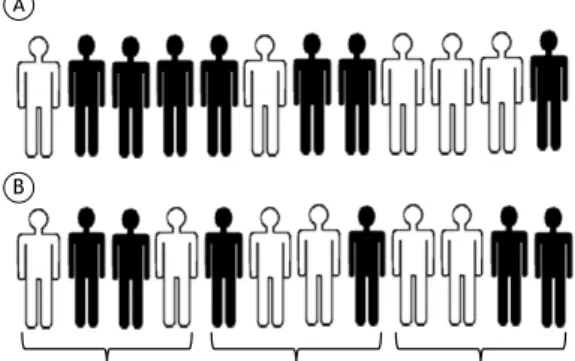
Simple randomization is equivalent to tossing a coin: a new participant has an equal chance of being assigned to intervention or control groups, independently of previous assignments. Instead of tossing a coin, however, a randomization list is generated by a computer and used to prepare sequentially numbered, sealed envelopes, or, preferably, that list is administered by a central telephone service or website. The advantages of simple randomization are that it is inexpensive and easy to implement. The disadvantages include the risk of producing imbalances in the number of participants in the groups, as well as in the distribution of baseline risk factors, in studies with small sample sizes (N < 100; Figure 1).
In block randomization, the randomization list is a random sequence of blocks of participants instead of individual participants. The blocks have a pre-determined size; for example, four participants in one block, with six possible intervention and control sequences. This strategy ensures that intervention and control groups are balanced in terms of the number of participants (Figure 1). To ensure allocation concealment using this method, random variation of block sizes should be used (four to eight participants per block).
Stratiied randomization is an alternative when balance for key baseline risk factors is desired. Each new
partic-ipant is irst classiied into strata according to baseline
characteristics (e.g., age or disease severity), and each stratum has a separate randomization list. Thereafter,
once the participants are categorized into their stratum, they are randomized to either the intervention or the
control groups. Stratiication should be carried out using few relevant strata in order to work well. Stratiied and
block randomization strategies can be combined so that
patients are irst categorized into a stratum and then
randomized in blocks.
Adaptive randomization uses computer algorithms that take into consideration baseline risk factors and the allocation of previous participants to allocate the next participant. The advantage of this method is that it
accommodates more baseline risk factors than stratiication
and produces optimized group balance at the same time. However, it is more complex and requires a web-based randomization center available 24 h a day.
HOW TO CHOOSE
Simple randomization is easy to implement, is inex-pensive, and can be a good option for large trials (N > 200). Block randomization is a good option when balance in the number of participants in each group is desired.
Stratiication is a good option to provide balance for
important covariates. Adaptive randomization methods may be a good option when the trial structure includes statisticians and information technology support. For all methods, adequate implementation is paramount to ensure allocation concealment and to prevent manipulation and selection bias.
Figure 1. A) Simple randomization of 12 participants (black for intervention, white for control). This random sequence resulted in 7 subjects assigned to intervention and 5 to the control group; B) Block randomization of 12 participants with blocks of 4, resulting in 6 participants in each group.
A
B
REFERENCES
1. Kang M, Ragan BG, Park JH. Issues in outcomes research: an overview of randomization techniques for clinical trials. J Athlc Train. 2008;43(2):215-21. http://dx.doi.org/10.4085/1062-6050-43.2.215
2. Vickers AJ. How to randomize. J Soc Integr Oncol. 2006;4(4):194-8. http://dx.doi.org/10.2310/7200.2006.023
J Bras Pneumol. 2016;42(5):310-310
310