Yuki Miyazaki1,2*
1School of Psychology, Chukyo University, Nagoya-shi, Aichi, Japan,2Research Institute of Visual Sciences, Kanagawa University, Yokohama-shi, Kanagawa, Japan
Abstract
In daily life, huge costs can arise from just one incorrect performance on a visual search task (e.g., a fatal accident due to a driver overlooking a pedestrian). One potential way to prevent such drastic accidents would be for people to modify their decision criterion (e.g., placing a greater priority on accuracy rather than speed) during a visual search. The aim of the present study was to manipulate the criterion by creating an awareness of being watched by another person. During a visual search task, study participants were watched (or not watched) via video cameras and monitors. The results showed that, when they believed they were being watched by another person, they searched more slowly and accurately, as measured by reaction times and hit/miss rates. These findings also were obtained when participants were videotaped and they believed their recorded behavior would be watched by another person in the future. The study primarily demonstrated the role of being watched by another on the modulation of the decision criterion for responding during visual searches.
Citation:Miyazaki Y (2013) Increasing Visual Search Accuracy by Being Watched. PLoS ONE 8(1): e53500. doi:10.1371/journal.pone.0053500 Editor:Francesco Di Russo, University of Rome, Italy
ReceivedOctober 13, 2012;AcceptedNovember 29, 2012;PublishedJanuary 2, 2013
Copyright:ß2013 Yuki Miyazaki. This is an open-access article distributed under the terms of the Creative Commons Attribution License, which permits unrestricted use, distribution, and reproduction in any medium, provided the original author and source are credited.
Funding:The author has no support or funding to report.
Competing Interests:The author has declared that no competing interests exist. * E-mail: [email protected]
Introduction
In daily life, huge costs can arise from just one failing performance during what is essentially a visual search task (e.g., a fatal accident due to a driver overlooking a pedestrian, or an airline hijacking resulting from overlooking dangerous materials during baggage screening). A potential way to prevent such drastic costs would be to shift the decision criterion during the visual search. In the car driving situation, for example, the potential for an accident could be decreased by making a slower, more careful search in favor of speed or quickness. The principal aim of the present study was to manipulate the decision criterion for responding during visual searches by creating an awareness of being watched by another person.
People are highly sensitive to the signals of being watched [1–6], which affect their attention [7–10] and cognition ([11–13], for reviews, [14], [15]). Further, it has been reported that an awareness (or subawareness) of being watched (or observed: e.g., [16]) affects the perceiver’s criteria for a making decisions regarding cooperative or prosocial behavior [17–28].
To date, no study has investigated the role of the being watched by another person on the modulation of a decision criterion in a non-social context. This study examines whether an awareness of being watched affects participants’ performances during visual searches. There are two plausible hypotheses as to the criterion shift during visual searches with reference to a speed-accuracy tradeoff [29], [30]. First is that participants will search quickly but inaccurately (that is, priority is placed on speed). In contrast, second is that they will search slowly and accurately (that is, priority is placed on accuracy).
In summary, the present study examines the effect of being watched by another person during visual searches. If the first hypothesis is supported, reaction times (RT) will be faster and errors more frequent under the condition of being watched (watched condition) than the condition of being unwatched
(unwatched condition). If the second hypothesis is supported, RTs will be longer and errors fewer under the watched than the unwatched condition.
Participants
Seventy-three paid graduates and undergraduates participated in the present experiments. There were 24 participants in Experiment 1 (10 males and 14 females; mean age = 20.88 years,SD= 2.59), 24 different participants in Experiment 2 (8 males and 16 females; mean age = 20.21 years,SD = 1.59), and 25 different participants in Experiment 3 (9 males and 16 females; mean age = 20.28 years,
SD = 1.93). All participants were unaware of the purpose of the experiment, and had normal or corrected to normal eyesight.
Ethical approval for this study was obtained from the Research Ethics Committee of the School of Psychology in Chukyo University. All participants provided written informed consent. They gave permission to use their data in the analysis.
Experiment 1
Methods
Design. There were two within-participant factors: being watched (watched condition, unwatched condition) and target presence on the visual search task (target present trials, target absent trials), which were crossed to yield four conditions.
In the watched condition (top on Figure 1A), participants were watched by the experimenter (who was the author) through the DV cameras on the LCDs. One DV camera was positioned on the right front side of the participants and the other was to the left side behind them (the distance from the participants to each of the DV cameras was 65 cm). The participants were instructed that the experimenter would watch and analyze their behavior during the sessions in the next booth (however, they were watched but their behavior was not being analyzed). They were not able to see the experimenter because each booth was separated by partitions.
In the unwatched condition (bottom on Figure 1A), the two DV cameras were covered by opaque fabrics. The participants were provided the instruction that they would need to tell the experimenter after finishing the session.
Stimuli. The search display consisted of 16 stimuli, a central fixed indicator (a cross), and salt-and-pepper visual noise (Figure 1B). The stimuli were dark-gray (approximately 13.73 cd/m2) rotated Ts (0u, 90u, 180u, and 270u) and similarly rotated offset Ls (0u, 90u, 180u, and 270u) with a visual angle of 0.9560.95 degrees, presented on a mid-gray (approximately
23.95 cd/m2) background with a visual angle of 25.39619.04
degrees. The stroke width was 0.13 degrees. The Ts and the offset Ls were targets and distracters, respectively. The stimuli were presented on an imaginary 866 grid except for the four cells
around the center of the grid. Each cell size was 3.1763.17
degrees. Each stimulus was centered within the cell and randomly jittered from 0 to 0.79 degrees. In the target present trials, a single target and fifteen distracters were presented. In the target absent trials, only sixteen distracters were presented. A dark-gray fixed cross (0.3260.32 degrees) was used to indicate the center of the display. The black (approximately 9.02 cd/m2) salt-and-pepper noise (proportion of noise density was 0.4) was superimposed on the display to reduce the visibility of the stimuli and to induce inaccurate performance.
Procedure. The experiment was composed of four sessions (two watched and two unwatched conditions). To counterbalance the order of the being watched or not, 12 participants had sessions in the following order: watched–unwatched–watched–unwatched, and then the remaining 12 participants experienced the reverse order. The first and second sessions were practice sessions and were not included in the statistical analyses. Each session began with 18 practice trials with correct/incorrect feedback after each response prior to 72 test trials, half of which were target present trials. In order to induce inaccurate performances, the participants were not provided feedback during the 72 test trials, and the preceding 18 practice trials were excluded from statistical analysis. Each session started when participants pressed a response button on an instruction screen. After a fixed cross was presented on the center of the display for 1,000 ms, the search display appeared, and remained until a response was made or for 10,000 ms. The participants were instructed to make a target present or absent judgment by using two response buttons, as quickly and accurately as possible. Twelve participants were required to press the left button for a target present judgment, and
the right button for target absent; the remaining twelve participants had the reverse setup (left button for target absent and right button for target present). After the response selection or 10,000 ms, the next trial began. In the preceding 18 practice trials, visual correct/incorrect feedback was provided at the center of the display after the response selection or 10,000 ms. The participants were instructed to maintain the viewing distance (57 cm), although they were free to move their heads. The experiment was conducted in a well-lighted room (horizontal illuminance on the desk was approximately 620 lx).
Results
Trials in which the participants did not make a response for 10,000 ms were removed from the statistical analyses (0.52% of trials were removed). Errors during visual searches were divided into groups: ‘‘miss’’ (target absent judgment when target present) and ‘‘false-alarm’’ (target present judgment when target absent).
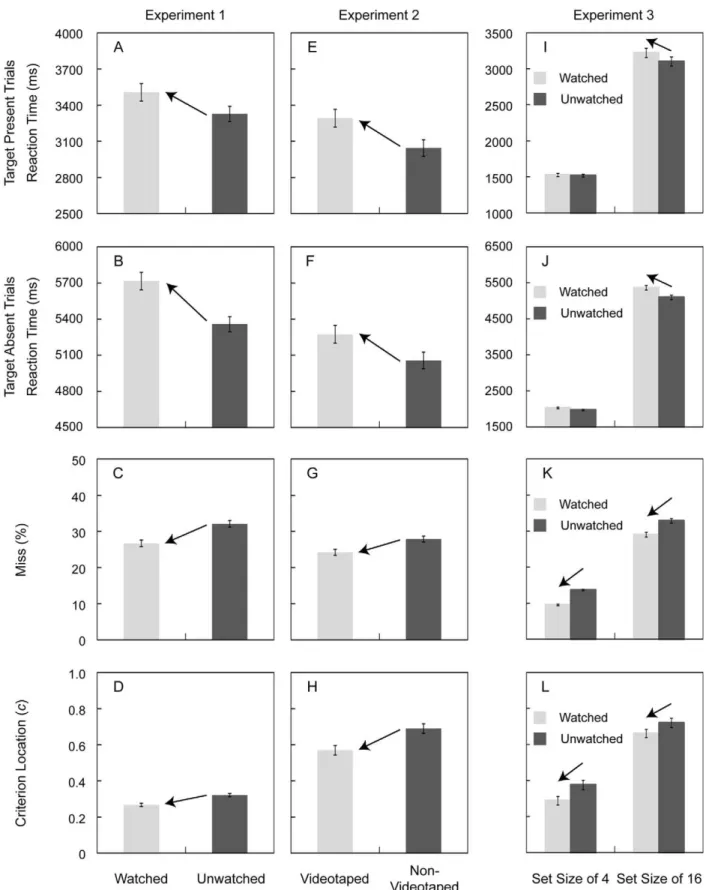
Reaction Times. Trials on which the participants made an error were discarded from RT analysis. Means of RTs under the target present and absent trials are shown in Figures 2A and 2B. A two-way repeated measures analysis of variance (ANOVA) revealed a significant main effect of being watched (F(1, 23) = 15.94,p,.001, gp
2
= .41) and that of target presence (F(1, 23) = 270.61,p,.001, gp
2
= .92). Since there was a significant difference in the interaction between the factors (F(1, 23) = 4.38, p,.05, gp
2
= .16), tests of simple main effect were conducted to confirm the influence of being watched on the RT. The tests revealed a significant difference between the watched and unwatched conditions in the target present trials (F(1, 23) = 5.55,p,.03,gp2= .19), and in the target
absent trials (F(1, 23) = 18.58, p,.001, gp2= .45). These results
indicate that the reaction times under the watched condition were slower than the unwatched condition. To confirm that outliers did not cause the differences in RT (which was defined as RT.mean +2SD, or as RT , mean – 2SD), the statistical analyses were repeated using the trimmed means of RTs. Since the overall patterns of statistical results were similar to the results using non-trimmed RT means, we rejected the possibility that outliers influenced the differences in RTs.
Accuracy. Since the means of false-alarm rates (number of false-alarm trials divided by the total number of the target present trials) were extremely low and did not vary much between conditions (2.18% of watched and 1.68% of unwatched), we focused only on the miss rates.
The means of miss rates (number of miss trials divided by the total number of the target absent trials) are shown in Figure 2C. A paired t-test was applied to the miss rates after an arc-sine transformation, and the result revealed a significant difference in the main effect of the being watched (t(23) =22.91, p,.01,
r= .52). The results showed that the miss rates under the watched condition were lower than the unwatched condition.
Sensitivity and Criterion Location. For each participant and for each condition, d’ (sensitivity) and c (criterion location) parameters were calculated from hit (target present judgment when target was present) and false-alarm rates on the basis of signal detection theory. Where necessary, the proportions of 1 and 0 (i.e., perfect accuracy) were adjusted to avoid infinite values ([34], p.8). For the means ofc(Figure 2D), a pairedt-test revealed a significant main effect of being watched (t(23) =22.54, p,.02,
r= .47), showing thatcwas negatively shifted under the watched condition compared to the unwatched condition (a negative direction represents a tendency to respond ‘‘target present’’). For the means ofd’, the t-test did not reveal a significant difference between the conditions (t(23) = 1.69,p..10,r= .33). The mean6
SD of d’ in the watched condition was 2.6860.61 and in the unwatched condition 2.5260.37.
Discussion
The results indicated that the participants searched more slowly and accurately when they thought they were being watched by another person, supporting the second hypothesis: the participants prioritized accuracy. In addition, with reference to signal detection theory, it found that the effect of being watched did not alter the sensitivity (d’) but only the criterion (c) during visual searches.
To further test the effect of being watched during visual searches, in Experiment 2 we set up the condition that the participants were being videotaped by DV cameras during visual searches. Participants were instructed that the videotaped data would be used for behavioral analyses after finishing the experiment (that is, we created an awareness of ‘‘being watched in future’’). This experiment was conducted to examine whether participants would search slowly and accurately while being watched in non-real (future) time.
Experiment 2
Methods
Apparatus. The apparatus was identical to Experiment 1 except we removed the two LCD monitor displays and their associated cables and equipment.
Design. There were two within-participant factors: being videotaped (videotaped condition, non-videotaped condition) and target presence on the visual search task (target present trials, target absent trials), which were crossed to yield four conditions.
In the videotaped condition, participants were videotaped by the DV cameras during the session. In the non-videotaped condition, the two DV cameras were covered by opaque fabrics and were not operated. The locations of the DV cameras were the same as for Experiment 1. In both conditions, the experimenter stayed in the separate booth (same location as unwatched condition in Experiment 1, see the bottom on Figure 1A). The participants were required to tell the experimenter when they had finished their session. In the videotaped condition, they were further provided the instruction that the experimenter would analyze the participants’ behaviors after finishing the experiment, on the basis of the videotaped data (however, the experimenter did not do that).
Stimuli. The stimuli were identical to Experiment 1. Procedure. The procedure was almost identical to Experi-ment 1. To counterbalance the order of the being videotaped or not, 12 participants completed sessions in the following order: videotaped–non-videotaped–videotaped–non-videotaped condi-tions, and then the remaining 12 participants completed the sessions in the reverse order.
Results
Trials on which the participants did not make a response for 10,000 ms were removed from the statistical analyses (0.75% of trials were removed).
Reaction Times. Trials in which the participants made an error were discarded from RT analysis. The means of RTs for the target present (or absent) trials are shown in Figures 2E and 2F). A two-way repeated measures ANOVA revealed a significant main effect of being videotaped (F(1, 23) = 12.01, p,.01, gp2= .34) and that of target
presence (F(1, 23) = 211.06, p,.001, gp2= .92). There was no
significant difference in the interaction between the factors (F(1, 23) = 0.14, p..71, gp2= .01). These results showed that reaction times
condition. To confirm that outliers did not cause the differences in RT (which was defined as RT.mean+2SD,or as RT,mean – 2SD), the statistical analyses were repeated using the trimmed means of RTs.
Since the overall patterns of statistical results were similar to the results using non-trimmed RT means, we rejected the possibility that outliers influenced the differences in RTs.
Figure 2. Results in this study.(A)–(D) Results in Experiment 1. (E)–(H) Results in Experiment 2. (I)–(L) Results in Experiment 3. Error bars represent the within-participant standard error of mean [37].
Accuracy. The means of false-alarm rates were extremely low and did not vary systematically with each condition (2.63% for the watched condition and 3.31% for the unwatched condition).
The means of miss rates are shown in Figure 2G. A pairedt-test was applied to the miss rates after an arc-sine transformation, and the test revealed a significant main effect of being videotaped (t(23) =22.22,
p,.04,r= .42). The results showed that the miss rates in the videotaped condition were lower than the non-videotaped condition.
Sensitivity and Criterion Location. Where necessary, the proportions of 1 and 0 were adjusted to avoid infinite values. For the means of c(Figure 2H), a pairedt-test revealed a significant main effect of being videotaped (t(23) =22.27, p,.04, r= .43), suggesting that c was negatively shifted under the videotaped condition compared to the non-videotaped condition. For the mean ofd’, thet-test did not reveal a significant difference between both conditions (t(23) = 1.23,p..23,r= .25). The mean6SDofd’
in the videotaped condition was 2.7360.75 and in the non-videotaped condition it was 2.6160.60.
Discussion
The results indicated that the participants searched more slowly and accurately when they were being videotaped and they believed their behavior would be watched in future. Results also indicated that the non-real-time signals of being watched also affected the decision criterion during visual searches. Taken together, the results of Experiments 1 and 2 showed that the signals of being watched by another person, whether in real time or in the future, contribute significantly to a decision criterion shift of prioritizing accuracy over speed during visual searches.
However, these conclusions have one caveat: The slower RTs and fewer misses under the watched (or videotaped) condition might be a part of the post-search process rather than the search process (i.e., the participants were careful in making their response selection, after the visual search). The next experiment was conducted to examine this possibility. In Experiment 3, we manipulated the number of stimuli on the search display (i.e., the set size) and measured RTs as a function of set size. Changes in the slope of the RT 6set size search function would reflect an increment in RT caused by adding a stimulus to the search display (see, e.g., [35]). Whereas, the changes in the ‘‘y-intercept’’ of the search function reflect the increment in RT under pre-/post-search process (e.g., [36]).
If the finding that participants searched more slowly and accurately when they were being watched was derived from the change in the search process, then the slope of the search function would be steeper under the watched condition compared to the unwatched condition.
Experiment 3
Methods
Apparatus. The apparatus was identical to Experiment 1. Design. There were three within-participant factors: being watched (watched condition, unwatched conditions), set size (stimulus search set size of 4, 16), and target presence on visual search task (target present trials, target absent trials), which were crossed to yield eight conditions.
Stimuli. The stimuli were identical to Experiment 1. In the condition with a set size of 4, a single target and three distracters (or only four distracters) appeared on the target present (or absent) trials. The condition with a set size of 16 was the same as Experiment 1.
Procedure. The procedure was identical to Experiment 1 except for the number of sessions and trials. This experiment was
composed of three sessions. To counterbalance the order of the being watched or not, 12 participants completed the sessions in the following order: watched–unwatched–watched, and then the remaining 13 participants completed the sessions in the order: unwatched–watched–unwatched. The first session was a practice session and was not included in the statistical analyses. Each session started with 16 practice trials with correct/incorrect feedback for each response prior to 128 test trials (half of which had target present). The 16 practice trials were excluded from the statistical analyses.
Results
As before, trials on which the participants did not make a response for 10,000 ms were excluded from statistical analyses (0.17% of trials were removed).
Reaction Times. Trials in which participants made an error were discarded from RT analysis. The means of RTs in the target present (or absent) trials are shown in Figures 2I and 2J).
A three-way repeated measures ANOVA revealed a significant main effect of being watched (F(1, 24) = 7.38,p,.02,gp2= .24),
that of set size (F(1, 24) = 454.19,p,.001,gp 2
= .95), and that of target presence (F(1, 24) = 313.11,p,.001,gp2= .93). There were
significant differences in the interactions between the being watched condition6set size (F(1, 24) = 4.90,p,.04,gp2= .17),
and between set size6target presence (F(1, 24) = 360.27,p,.001, gp2= .94). No other significant interaction was found. Tests of
simple main effects were conducted to confirm the influence of being watched on RT in each set size. The tests revealed a significant difference between the watched and unwatched conditions with the set size of 16 (F(1, 24) = 6.70, p,.02, gp2= .22), whereas there was no significant difference between
both conditions with the set size of 4 (F(1, 24) = 2.05, p..16, gp2= .08). The lack of the significant difference in the set size of 4
may be explained by the following analysis of the search function’s slope andy-intercept.
The slope andy-intercept were calculated for each participant and in each condition. For the means of the slope (Figures 3A, 3B), a two-way repeated measures ANOVA revealed a significant main effect of being watched (F(1, 24) = 4.90,p,.04,gp2= .17) and of
target presence (F(1, 24) = 360.27,p,.001,gp2= .94). There was
no significant difference in the interaction between those factors (F(1, 24) = 0.44,p..51,gp2= .02). These results suggested that the
slope in the watched condition was steeper than in the unwatched condition. For the means of they-intercept (Figures 3C, 3D), no significant main effects or interactions were obtained by a two-way repeated measures ANOVA (being watched condition: F(1, 24) = 0.37,p..54,gp
2
= .02; target presence:F(1, 24) = 2.46,p..12, gp2= .09; interaction:F(1, 24) = 0.02,p..88,gp2= .001).
Finally, to confirm that outliers did not cause the difference in RTs and the slope, the statistical analyses were also conducted by using the trimmed means of RTs. Since the overall patterns of statistical results were similar to the results using non-trimmed RT means, we rejected the possibility that outliers influenced the differences in RTs.
Accuracy. The means of false-alarm rates were extremely low and did not vary systematically with each condition (2.13% and 2.38% for set sizes of 4 and 16, respectively, in the watched condition, and 1.88% and 2.57% for set sizes of 4 and 16 in the unwatched condition).
There was no significant difference in the interaction between the factors (F(1, 24) = 0.0004,p..98,gp2= .00002). In agreement with
Experiment 1, these results suggested that the miss rates in the watched condition were lower than the unwatched condition.
Sensitivity and Criterion Location. Where necessary, the proportions of 1 and 0 were adjusted to avoid infinite values. For the means of c (Figure 2L), a two-way repeated measures ANOVA revealed a significant main effect of being watched (F(1, 24) = 5.91,
p,.03,gp2= .20) and that of set size (F(1, 24) = 160.77,p,.001,
gp2= .87). There was no significant difference in the interaction
between the factors (F(1, 24) = 0.50,p..48,gp2= .02). These results
suggested thatcwas negatively shifted under the watched condition. For the means ofd’, an ANOVA revealed a significant main effect of set size (F(1, 24) = 86.03,p,.001,gp2= .78), and then no other
significant interaction was found. The means6SDofd’in the set sizes of 4/16 in the watched condition were 3.2660.72/2.5760.65, and in the unwatched condition 3.2160.63/2.4160.69.
Discussion
The results showed that the slope of the search function was steeper for the watched condition than the unwatched condition, but they-intercept remained constant between the two conditions. These results indicated that the decision criterion shift during visual searches induced by the signal of being watched occurred in the search process. In addition, the results of Experiment 1 were replicated; the trends of the parameters (RT, misses, false-alarms,
d’, andc) were consistent with those in Experiment 1. The results of Experiment 3 emphasize the contention that participants search more slowly and accurately when they are being watched by another person.
General Discussion
The overall aim of the present study was to manipulate the decision criterion during visual searches by making participants aware of being watched by another person. Experiments 1 and 3 showed that participants searched more slowly and accurately when they were being watched (compared to when they were unwatched) by another person. Although it has already been shown that the signals of being watched (or observed) affect participants’ criteria for making a decision on social tasks (e.g., [23]), the present study demonstrated for the first time that those signals can also affect the decision criteria on non-social visual search tasks. These findings suggest possibility that decision criteria under all contexts (social or otherwise) could be influenced by signals about being watched by another person. It would be interesting to investigate the effect of being watched during other non-social tasks, such as object recognition tasks.
Experiment 2 showed that participants searched more slowly and accurately when they were being videotaped, and they believed their recorded behavior would be watched by another person in the future. Also, a decision criterion shift during visual searches was induced by non-real-time signals of being watched. The results of Experiment 2 have significant implications with regard to the car driving example, given above; installing in-vehicle cameras and being videotaped at all times during driving could contribute to a driver’s more careful visual searching. Although this most likely would be considered impractical on a widespread basis, it may be of interest to transportation companies, i.e., employers of truck drivers, bus drivers, etc.
In comparison to the present study using video-monitoring setups for the condition of being watched, more subtle cues of being watched (e.g., eye-like paintings or dots: [23–28], photo-Figure 3. Results in Experiment 3.(A) Means of search function’s slope (in ms/item) in the target present trials. (B) Means of the slope in the target present trials. (C) Means of search function’sy-intercept (in ms) in the target present trials. (D) Means of the intercept in the target present
copied eyes: [17], [18], [20–22]) have been used in previous studies. This difference leads to a possibility that participants might also search more slowly and carefully when the eye-like paintings or photocopied eyes are superimposed on the background of the search display. It is worth considering the application possibilities in daily life because the cost and inconvenience of such an approach would be much smaller than with videotape-monitoring equipment.
Finally, three potential problems in the present study need to be mentioned. Firstly, we imposed a considerably difficult search task on the participants; salt-and-pepper visual noise was superimposed on the search display and knowledge of results feedback was not provided after each response during test trials to induce inaccurate performance. Therefore, the decision criterion shift during visual searches when the participants were being watched by another might be limited to the difficultly of the search task (e.g., similar to searching for a man wearing a dark suit while driving a car in the rain). It is suggested that future studies should investigate this issue by manipulating the level of task difficulty. Next, in the visual search task in Experiment 3, we only used two set sizes (set size of 4 and 16), whereas most previous visual search studies have manipulated more than three set sizes. It is suggested that in order to assure the robustness of the finding indicating that the slope of the search function is steeper in the watched than in the the unwatched condition, additional studies of visual search using over three set sizes should be undertaken. Finally, there is the possibility that the results were influenced by the social status (or
power) difference between the experimenter and the participants. All the participants in this study were undergraduate, or graduate students at the institute where the experimenter was an assistant professor. Moreover, some participants were the experimenter’s students. Therefore, the experimenter’s social status could have been higher than that of the participants. This difference in social status might have enhanced the effect of being watched. It is suggested that control studies with using participants and experimenters with equal status, such as by hiring undergraduate students to be experimenters for example, should be undertaken in the future.
In conclusion, the present study primarily demonstrated the role of being watched on the modulation of a decision criterion during visual searches. Of course, the author does not suggest that people need to perform searches slowly and accurately in all circum-stances. However, some visual searches ideally should be performed as carefully as possible to prevent fatal accidents and huge costs associated with possible visual search failures. The results of this study could have a significant impact under the condition that people should search carefully.
Author Contributions
Conceived and designed the experiments: YM. Performed the experiments: YM. Analyzed the data: YM. Contributed reagents/materials/analysis tools: YM. Wrote the paper: YM.
References
1. Conty L, Tijus C, Hugueville L, Coelho E, George N (2006) Searching for asymmetries in the detection of gaze contact versus averted gaze under different head views: A behavioural study. Spat Vis 19: 529–545. doi: 10.1163/ 156856806779194026.
2. Doi H, Ueda K (2007) Searching for a perceived stare in the crowd. Perception 36: 773–780. doi: 10.1068/p5614.
3. Palanica A, Itier RJ (2011) Searching for a perceived gaze direction using eye tracking. J Vis 11: 1–13. doi: 10.1167/11.2.19.
4. Senju A, Hasegawa T (2006) Do the upright eyes have it? Psychon Bull Rev 13: 223–228.
5. Senju A, Hasegawa T, Tojo Y (2005) Does perceived direct gaze boost detection in adults and children with and without autism? The stare-in-the-crowd effect revisited. Vis Cogn 12: 1474–1496. doi: 10.1080/13506280444000797. 6. von Gru¨nau M, Anston C (1995) The detection of gaze direction: A
stare-in-the-crowd effect. Perception 24: 1297–1313. doi: 10.1068/p241297.
7. Conty L, Gimmig D, Belletier C, George N (2010) The cost of being watched: Stroop interference increases under concomitant eye contact. Cognition 115: 133–139. doi:10.1016/j.cognition.2009.12.005.
8. Miyazaki Y, Ichihara S, Wake H, Wake T (2012) Attentional bias to direct gaze in a dot-probe paradigm. Percept Mot Skills 114: 1007–1022. doi: 10.2466/ 21.07.24.PMS.114.3.1007–1022.
9. Senju A, Hasegawa T (2005) Direct gaze captures visuospatial attention. Vis Cogn 12: 127–144. doi: 10.1080/13506280444000157.
10. Yokoyama T, Ishibashi K, Hongoh Y, Kita S (2011) Attentional capture by change in direct gaze. Perception 40: 785–797. doi: 10.1068/p7003. 11. George N, Driver J, Dolan RJ (2001) Seen gaze-direction modulates fusiform
activity and its coupling with other brain areas during face processing. NeuroImage 13: 1102–12. doi:10.1006/nimg.2001.0769.
12. Mason MF, Hood BM, Macrae CN (2004) Look into my eyes: gaze direction and person memory. Memory 12: 637–643. doi: 10.1080/09658210344000152. 13. Vuilleumier P, George N, Lister V, Armony J, Driver J (2005) Effects of perceived mutual gaze and gender on face processing and recognition memory. Vis Cogn 12: 85–102. doi: 10.1080/13506280444000120.
14. George N, Conty L (2008) Facing the gaze of others. Neurophysiol Clin 38: 197– 207. doi: 10.1016/j.neucli.2008.03.001.
15. Senju A, Johnson MH (2009) The eye contact effect: mechanisms and development. Trends Cogn Sci 13: 127–134. doi: 10.1016/j.tics.2008.11.009. 16. Wedekind C, Milinski M (2000) Cooperation through image scoring in humans.
Science 288: 850–852. doi: 10.1126/science.288.5467.850.
17. Bateson M, Nettle D, Roberts G (2006) Cues of being watched enhance cooperation in a real-world setting. Biol Lett 2: 412–414. doi: 10.1098/ rsbl.2006.0509.
18. Bourrat P, Baumard N, McKay R (2011) Surveillance cues enhance moral condemnation. Evol Psychol 9: 193–199.
19. Burnham TC, Hare B (2007) Engineering human cooperation. Does involuntary neural activation increase public goods contributions? Hum Nat 18: 88–108. doi: 10.1007/s12110-007-9012-2.
20. Ekstro¨m M (2012) Do watching eyes affect charitable giving? Evidence from a field experiment. Exp Econ 15: 530–546. doi: 10.1007/s10683-011-9312-6. 21. Ernest-Jones M, Nettle D, Bateson M (2011) Effects of eye images on everyday
cooperative behavior: a field experiment. Evol Hum Behav 32: 172–178. doi: 10.1016/j.evolhumbehav.2010.10.006.
22. Francey D, Bergmu¨ller R (2012) Images of eyes enhance investments in a real-life public good. PLoS One 7: e37397. doi: 10.1371/journal.pone.0037397. 23. Haley KJ, Fessler DMT (2005) Nobody’s watching? Subtle cues affect generosity
in an anonymous economic game. Evol Hum Behav 26: 245–256. doi: 10.1016/ j.evolhumbehav.2005.01.002.
24. Keller J, Pfattheicher S (2011) Vigilant self-regulation, cues of being watched and cooperativeness. Eur J Pers 25: 363–372. doi: 10.1002/per.797. 25. Mifune N, Hashimoto H, Yamagishi T (2010) Altruism toward in-group
members as a reputation mechanism. Evol Hum Behav 31: 109–117. doi: 10.1016/j.evolhumbehav.2009.09.004.
26. Oda R, Niwa Y, Honma A, Hiraishi K (2011) An eye-like painting enhances the expectation of a good reputation. Evol Hum Behav 32: 166–171. doi: 10.1016/ j.evolhumbehav.2010.11.002.
27. Powell KL, Roberts G, Nettle D (2012) Eye images increase charitable donations: evidence from an opportunistic field experiment in a supermarket. Ethology 118: 1–6. doi: 10.1111/eth.12011.
28. Rigdon M, Ishii K, Watabe M, Kitayama MS (2009) Minimal social cues in the dictator game. Journal of Economic Psychology 30: 358–367. doi: 10.1016/ j.joep.2009.02.002.
29. Schouten JF, Bekker JAM (1967) Reaction time and accuracy. Acta Psychol 27: 143–153. doi: 10.1016/0001-6918(67)90054-6.
30. Wickelgren WA (1977) Speed-accuracy tradeoff and information processing dynamics. Acta Psychol 41: 67–85. doi: 10.1016/0001-6918(77)90012-9. 31. Li X, Liang Z, Kleiner M, Lu ZL (2010) RTbox: a device for highly accurate
response time measurements. Behav Res Methods 42: 212–225. doi: 10.3758/ BRM.42.1.212.
32. Brainard DH (1997) The Psychophysics Toolbox. Spat Vis 10: 433–436. doi: 10.1163/156856897X00357.
33. Pelli DG (1997) The VideoToolbox software for visual psychophysics: Transforming numbers into movies. Spat Vis 10: 437–442. doi: 10.1163/ 156856897X00366.
34. Macmillan NA, Creelman CD (2005) Detection Theory: A User’s Guide 2nd ed. Mahwah NJ: Lawrence Erlbaum Associates.
36. Woodman GF, Vogel EK, Luck SJ (2001) Visual search remains efficient when visual working memory is full. Psychol Sci 12: 219–274. doi: 10.1111/1467-9280.00339.