Long-stay patients in a
psychiatric hospital in
Southern Brazil
Pacientes de longa permanência em
um hospital psiquiátrico no sul do
Brasil
ABSTRACT
OBJECTIVE: To describe the demographic profile, social functioning, and quality of life of a population of long-stay care patients in a psychiatric hospital.
METHODS: A study was carried out in Porto Alegre, Southern Brazil, in 2002. A total of 584 (96%) long-stay patients were assessed by means of the following instruments: the World Health Organization Quality of Life, the Social Behavior Schedule, the Independent Living Skills Survey, the Brief Psychiatric Rating Scale and another instrument for assessing disability (Questionnaire for Assessing Physical Disability).
RESULTS: The average hospital stay was 26 years (SD: 15.8) and 46.6% of inpatients had no physical disability. Patients had their social functioning skills and autonomy largely impaired. Few of them (27.7%) answered the instrument for assessing quality of life, and showed significant impairments in all domains. The Brief Psychiatric Rating Scale evidenced a low prevalence of positive symptoms in this population.
CONCLUSIONS: The institutionalized population studied presented significantly impaired social functioning, autonomy, and quality of life. These aspects need to be taken into consideration while planning for their deinstitutionalization.
KEYW O RD S: Inpatients. M entally ill persons. H ospitals, psychiatric. H ealth care reform. Q uestionnaires, utilization. Cross-sectional studies.
RESU M O
OBJETIVO: Descrever as características demográficas, funcionamento social e qualidade de vida de uma população de pacientes recebendo cuidados de longa duração em hospital psiquiátrico.
MÉTODOS: O estudo foi realizado em Porto Alegre, RS, em 2002. Foram avaliados 584 (96%) indivíduos sob hospitalização de longa duração usando quatro questionários validados (World Health Organization Quality of Life - Brief Social Behaviour Schedule, the Independent Living Skills Survey, the Brief Psychiatric Rating Scale) e um outro (Questionnaire for assessing Physical Disability Degree) para avaliar grau de incapacidade.
RESULTADOS: O tempo médio de hospitalização foi de 26 anos (DP: 15,8) e 46,6% dos indivíduos não apresentavam incapacidade física. Os pacientes tiveram suas habilidades de funcionamento social e autonomia acentuadamente afetados. Poucos (27.7%) conseguiram responder o questionário de avaliação de qualidade de vida, M arcelo Pio de Almeida FleckI
Luciane WagnerII
M ário WagnerI
M iriam D iasIII
I Faculdade de Medicina. Universidade
Federal do Rio Grande do Sul. Porto Alegre, RS, Brasil
I I Hospital Psiquiátrico São Pedro. Porto
Alegre, RS, Brasil
I I IUniversidade do Vale do Rio dos Sinos.
São Leopoldo, RS, Brasil
Correspondence:
Marcelo Pio de Almeida Fleck Departamento de Psiquiatria e Medicina Legal
Universidade Federal do Rio Grande do Sul Rua Ramiro Barcelos, 2350 4º andar 90035-003 Porto Alegre, RS, Brasil E-mail: [email protected]
apresentando importante comprometimento em todos os domínios. A Brief Psychiatric Rating Scale evidenciou prevalência baixa de sintomas positivos na população estudada.
CONCLUSÕES: Os achados revelaram haver importante grau de comprometimento no funcionamento social, nível de autonomia e qualidade de vida dos idosos. Tais aspectos devem ser considerados no planejamento da internação de longa duração de pacientes idosos.
D ESCRITO RES: Pacientes internados. Pessoas mentalmente doentes. H ospitais psiquiátricos. Reforma dos serviços de saúde.
Q uestionários, utilização. Estudos transversais.
INTRODUCTION
Mental health care has improved over the last century due to advancements in many fields. The progress in scientific knowledge, development of psychotropic drugs, replacement of the hospital-centered model by community care aiming at patients’ comprehensive care, and their social reinsertion are factors that should be stressed. Among the numerous consequences this “revolution” has lead to, there were changes in pa-tients’ profiles, and goals and length of
hospitaliza-tion.22 Consequently, old psychiatric hospitals have
become general hospitals or, inversely, psychiatric
wards were created inside general hospitals.12
However, some chronic patients were unable to so-cially interact again. This problem is particularly important in countries with lack of investments in alternative treatment proposals. Therefore, worldwide, either in small or large scale, there are still institu-tions similar to the old-style psychiatric hospitals.
Most of the studies designed to assess the population profile of psychiatric institutions and the deinstitu-tionalization process were carried out in
industrial-ized countries.4,11,14,18 Little is known about these
insti-tutions and their residents in Latin American coun-tries. For this reason, the World Health Organization (WHO) is encouraging investments for assessing this information. Therefore, a project has been developed to assess the profile of long-stay inpatients of two Bra-zilian psychiatric hospitals: one in the city of Porto Alegre, Southern Brazil, and the other in the city of Rio de Janeiro, Southeastern Brazil.
The aim of the present study was to describe the demographic and symptom profile, social function-ing, autonomy and quality of life of the inpatient population of these hospitals.
M ETH O D S
During the recruitment period (from March to No-vember 2002), there were 608 individuals in the hos-pital studied. Among them, five died, two were dis-charged, one refused to participate, five were not able to undergo the assessment, and 11 had been living in the institution for less than a year. A total of 584 (96%) subjects who had been confined for a long period of time (over one year) were studied.
The assessed sociodemographic and symptom data were: gender; educational level; employment situa-tion; income; origin; service unit where he/she is an intern; starting date of present confinement; psychi-atric diagnosis according to the International Classi-fication of Diseases (ICD-10); clinical diagnosis; number of visitors over the last six months; type of visitors; legal confinement and restraint. This infor-mation was obtained from medical records, social work registers and interviews with the technical team. The variables quality of life, autonomy, social function-ing and psychopathology were assessed by means of the following instruments:
World Health Organization Quality of Life
(WHOQOL-Bref),21 a questionnaire about quality of life, used to
assess four domains: psychological, psychical, social relations, and environment, and was adapted to the
Portuguese language.7,8 Although it is a
self-adminis-tered instrument, it can be adminisself-adminis-tered by an inter-viewer if the patient has reading or visual impairment.
• Independent Living Skills Survey (ILSS)26 –
application (interview with a formal carer).13
• Social Behavioral Schedule(SBS)24 – assessment
of limitations in the social behavior of long-term patients, raising issues in order to evaluate social withdrawal, embarrassing social behavior, depres-sion and anxiety, hostility and violence, among others. A version adapted to and validated in the Portuguese language was used for indirect appli-cation (interview with a formal carer).*
• Brief Psychiatric Rating Scale (BPRS)1,16 – an
instrument for assessing general psychopathology of psychiatric patients, adapted to the Portuguese
language.19 The Structured Interview Guide for
the Brief Psychiatric Rating Scale (SIG-BPRS)
was used to apply the scale.1
• Questionnaire for assessing Level of Physical
Disability(LPD)5 – an instrument used to classify
patients’ physical conditions into four levels: none, mild, moderate or severe disability.
The interviewers were six senior psychology students and four senior occupational therapy students, previ-ously trained by two psychiatrists knowledgeable of the instruments used. They were responsible for ob-taining the sociodemographic and symptom data, and the application of the WHOQOL-Bref, ILSS, SBS and LPD. The information needed for filling out indirect assessment instruments (ILSS, SBS) were obtained in interviews with formal caretakers who had wider knowledge of their patients’ routine, mostly high school professionals (nursing technicians).
Another group, consisting of 20 mental health
pro-viders, was trained to apply the BPRS.
Descriptive statistical analysis was reported in tables for every variable in the sample. For each instrument, except the LPD, the five-item Likert scales were
trans-formed into a dichotomic scale (absent vs present)
using a methodology already used in other studies.9
Outcomes were expressed in percentage of individu-als presenting both levels of impairment, quantita-tive variables were expressed as averages and stand-ard deviations. The data were processed and analyzed using the SPSS software, version 10.
RESU LTS
Among 584 inpatients assessed, the average hospi-talization length of stay was 26 years (SD: 15.8), and the longest confinement period was 67 years. Ap-proximately 60% of the inpatients have been in the hospital for longer than 15 years and 24% of them for longer than 40 years. Fifty-four percent of them were
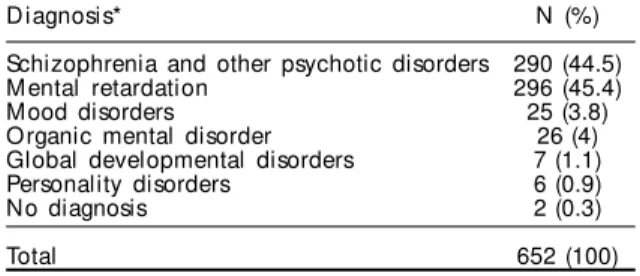
female. The average age was 55 years (SD: 16.0); 59% aged between 35 and 65 years and 27% were older than 65. Eighty-one percent were functionally illit-erate, 8.6% had complete elementary school, 1% had complete high school and only one subject was an undergraduate. There was no information available on the educational level of 10% of the population. Around 8% had regular jobs, mostly through reha-bilitation programs inside the hospital itself. As to personal income, 277 subjects (47.5%) earned some, most of them (n=255) through benefits (pension or disability welfare). Over the six months prior to this study, 474 inpatients (81.2%) had no visitors. Only nine subjects (1.5%) had weekly visitors along this period. Diagnostic distribution is shown on Table 1. Around 12% inpatients were diagnosed with more than one psychiatric disorder.
As to inpatients’ level of disability, 272 (46.6%) sub-jects showed no deficit which might impair their physical integrity. Of the remaining subjects, 112 (19.2%) had mild, 139 (23.8%) moderate and 61 (10.4%) severe physical disabilities.
Assessment of social functioning, by means of the SBS scale, showed that the study population had signifi-cant impairments in this area (Table 2). There was a trend showing a high percentage of impaired subjects expressed by items assessing social behaviors related to negative symptoms. This is opposed to what we it was observed regarding positive symptoms in inpa-tients’ social behavior. The items indicating higher impairment were looks and personal hygiene, commu-nication, concentration, social interaction, and idle-ness. Among items revealing the least degree of inpa-tients’ impairments were: panic attacks and phobias, depression, destructive behavior, improper sexual be-havior, ideas and behavior indicating suicide risk or self-aggression, and realization of bizarre thoughts.
Overall the studied population showed strong
impair-Table 1 - Distribution of diagnoses in the institutionalized population of the psychiatric hospital. Porto Alegre, Southern Brazil, 2002.
D iagnosis* N (%)
Schizophrenia and other psychotic disorders 290 (44.5)
M ental retardation 296 (45.4)
Mood disorders 25 (3.8)
Organic mental disorder 26 (4)
Global developmental disorders 7 (1.1)
Personality disorders 6 (0.9)
No diagnosis 2 (0.3)
Total 652 (100)
*Some patients presented more than one diagnosis
ment of their autonomy according to the ILSS, see Figure. Their performance was better only in feeding. In domains related to money management, leisure, cooking, employment, domestic chores, and trans-portation, more than 70% of the population presented moderate to severe impairments.
In regard to quality of life, assessed through the WHOQOL, a low proportion of subjects was able to answer to all 26 items of this instrument. Response rate ranged from 21.4 to 31.7% (average 27.7%). The reasons for unanswered questionnaires were patients who had problems in understanding the questions, and hearing and/or visual impairments.
Due to the small number of subjects who were able to
answer WHOQOL, it was decided to calculate scores per domain for subjects who scored 50% or more in the 26-item instrument (respondents). This subpopulation comprised 153 (26%) subjects (Table 3).
Psychiatric symptoms were assessed by means of the BPRS. Due to the characteristics of the population studied, it was not possible to assess every item in all subjects. The items requiring objective assessment from the interviewer had more responses, e.g., social withdrawal, motor disorders, hostility, lack of coop-eration, numbness, and psychomotor restlessness. In all items mentioned above, the number of respond-ents was over 400, meaning that more than 70% sub-jects were prone to be assessed. As to items demand-ing subjective assessment, like feeldemand-ings of guilt, ex-aggerated self-esteem, and hallucinations, the response rate was around 30%.
In Table 4, BPRS items are presented in fre-quency order. Disorientation and confusion stood out as the most frequent item among this population. Items of intermediate preva-lence include those related to negative symp-toms (emotional withdrawal, lack of coop-eration, psychomotor retardation, and numb-ness, conceptual disorganization, and motor disorders). There was a small prevalence of positive symptoms in this population.
D ISCU SSIO N
The main global result of the present study is that the population of the hospitals stud-ied had significant impairments in most of the different dimensions assessed,
particu-SBS: Social Behavioral Schedule
Table 2 - Proportion of subjects showing moderate to severe impairment of their social functioning (scoring two or higher in SBS items) in the psychiatric hospital. Porto Alegre, Southern Brazil, 2002.
SBS item Percentage
17. Looks and personal hygiene 59.2
1. Communication: taking the lead 53.1
20. Concentration 48.1
4. Social interaction: appropriate social contacts 46.7
19. Idleness 42.7
2. Conversation: incoherence 37.5
13. Habits or socially accepted manners 32.1
10. Laughing and talking by oneself 30.8
18. Slow ness 29.3
5. Social interaction: ratio of hostile social contacts 29.1
9. Restlessness and hyperactivity 26.3
21. Behavior not specified elsewhere which prevents progress 23.2
12. Stereotypies and idiosyncratic behavior 23.0
3. Conversation: eccentricity/inappropriateness 21.4
6. Social interaction: provocative behavior 18.1
8. Panic and phobic attacks 10.6
15. D epression 10.2
14. D estructive behavior 8.3
16. Improper sexual behavior 7.1
7. Suicidal ideas or behavior or self-aggression 2.6
11. Realization of bizarre thoughts 2.4
Figure - Proportion of subjects showing moderate to severe impairment of their autonomy (scores lower than 2 in ILSS items) in a psychiatric hospital. Porto Alegre, Southern Brazil, 2002.
ILSS (Independent Living Skills Survey) items: FD: Feeding; PC: Personal care; DC: D omestic chores; FPS: Food preparation and storage; H T: H ealth; M M : M oney management; TR: Transportation; LE: Leisure; EM: Employment.
0 10 20 30 40 50 60 70 80 90 100
FD PC DC FPS HT MM TR LE EM
larly in respect to their autonomy. Although this find-ing was expected, its importance lies in the fact that it was based on a systematic assessment of the total population of inpatients in a century-old public Bra-zilian institution, designed for long-term care of psy-chiatric patients. There are no similar studies on this
subject in Latin American literature.6,10
The demographic data of the population studied mostly show long hospital stays, high level of illit-eracy, poor engagement in occupational/job activi-ties, and situations where familial bonds had been cut off (assessed through the presence of family visi-tor within the last six months).
The average stay rate exceeded the average rate es-tablished by some authors when referring to
“long-stay”. Cyr et al,2 in Canada, assessed a long-stay
popu-lation after 3.06 years from their last admission. How-ever, these average rates are quite similar to those found in some British psychiatric hospitals in the so-called British project, Team for the Assessment of
Psy-chiatric Services (TAPS).14
A comparison between findings of the present study and those described in the TAPS project is worth
men-tioning.14 The demographic profile of the population
studied showed a prevalent female distribution (54%), opposed to the prevalent male population in the TAPS project findings (57% at Friern and 56% at Claybury). The average age in the psychiatric hospital studied was lower (55 years) compared to 60 at Friern and 61 at Claybury. As to psychiatric diagnoses, more than 90% of the patients were schizophrenic in the British study, while in the Brazilian sample case diagnoses of schizophrenia and mental disorder were almost equally distributed, both accounting for 90% of all diagnoses. Differences in these sociodemographic profiles could be explained by historical issues lead-ing to the creation of health policies in both coun-tries, as well as the gap in the availability of alterna-tive resources for these patients.
In regard to the level of physical disability, in the present study, 53.4% of the population had some level of disability, which corroborates data in the
litera-ture.15 On the other side, 10.4% of the patients had
severe physical disability, similar to the 10% found at Friern and 9% at Claybury. The prevalence of physi-cal disability is a critiphysi-cal factor to select the type of the alternative resource a long-stay inpatient must be exposed to in a policy towards deinstitutionalization.
Social behavior, measured by the SBS scale, showed impairment mainly in domains related to damage to or lack of important attributes in social life (e.g. looks and personal hygiene, start of a conversation, con-centration, interaction, idleness). Those domains as-sociated to symptoms of acute mental illness were the least prevalent (e.g. realization of bizarre thoughts, suicidal behavior, improper social behavior, destruc-tive behavior, and depression). The present study SBS findings were similar to the those of British patients
in the TAPS project.14 Among 10 items stating the
poorest performances, nine items are identical in both studies, revealing that long stays in hospital are asso-ciated to similar social behavior problems, despite demographic, diagnostic, and cultural differences.
Assessment of inpatients’ autonomy showed a sig-nificant proportion of moderate to severe impairment
(over 50%) in all dimensions but “feeding”.The
de-gree of autonomy measured by the ILSS has never been used before for assessing long-stay inpatients. Scores obtained in the present study, especially in the domains related to “money management” and
“personal care”, differ from those found in a
Cana-dian study2 in elderly living in the community.
How-ever, this latter study utilized a self-administered in-strument, which makes it difficult to compare the re-sults. The autonomy degree is undoubtedly an im-portant variable in planning the course of treatment for psychiatric long-stay inpatients. As the present
Table 3 - Average and standard deviation of scores in the W H O Q O L domains from respondents in the psychiatric hospital. Porto Alegre, Southern Brazil, 2002.
D omai n Average Standard deviation
Physical 55.2 14.6
Psychological 56.4 16.0
Social interaction 62.9 20.2
Environment 53.8 17.1
WHOQOL: World Health Organization Quality of Life
Table 4 - Proportion of subjects showing moderate to severe impairment due to psychiatric symptoms (scores equal or higher than two in BPRS items) in the psychiatric hospital. Porto Alegre, Southern Brazil, 2002.
BPRS item Percentage
18. Disorientation and confusion 78.2
3. Emotional w ithdraw al 48.6
4. Conceptual disorganization 44.1 16. Numbness or improper behavior 43.6
13. Psychomotor retardation 37.2
7. Specific movement disorders 35.3
14. Lack of cooperation 31.4
12. H allucinations 25
15. Bizarre thoughts 22.5
11. Suspiciousness 16.7
1. Somatic concerns 15.3
17. Psychomotor restlessness 15.3
2. Psychical anxiety 12.9
9. Depressive mood 12.7
10. Hostility 12.2
5. Self-depreciation and guilt 8.3
6. Somatic anxiety 7.5
8. Exaggerated sel f-esteem 6.7
study had a cross-sectional design, a cause-effect re-lationship between long-stay hospitalization and autonomy cannot be established. There is likely a mixture of both factors and in some dimensions (e.g. transportation) long-term stay in hospital might have prevented inpatients from increasing their autonomy. On the other hand, dimensions like personal care might be more often influenced by variables internal to the patient and be partially affected on a long-stay in a psychiatric institution. Nevertheless, a plan for long-stay inpatients’ deinstitutionalization will cer-tainly require rehabilitation actions aimed at devel-oping inpatients’ abilities which have been lost or not even attained during long-term hospitalization. Concomitantly, establishing a support network con-sisting of health providers and within the community is necessary in order to restore the dimensions of au-tonomy impaired by the disease.
The quality of life assessment, although potentially important, poses particular methodological chal-lenges when its target population is formed by sub-jects suffering from serious mental illnesses and go-ing through long-term stays in institutions. The sub-jective perception is a key element in the concept
known as “quality of life”.21 Researchers studying
subjects who experience serious and enduring men-tal illnesses have emphasized the importance of the subjective aspect, besides recognizing the importance
of including objective aspects.17 However, the
inclu-sion of objective aspects in qualify of life concept tarnishes its limits, making its distinction very diffi-cult from neighboring concepts, such as standard of living, quality of services indicators, among others. WHOQOL is a generic instrument of quality of life and has not been designed or validated for use with
severe psychiatric patients.20 The present study is the
first one in the literature using a generic instrument of quality of life for a population of long-stay psy-chiatric inpatients. It was noticed that it was very difficult for severely impaired inpatients to answer to the WHOQOL questions, even when they were administered by an interviewer. Only 26% of the pa-tients were able to answer at least 50% of the instru-ment. It is remarkable that the scores in the WHOQOL domains are very low, compared to the those from the original paper on the validation of the WHOQOL in Brazil. Although the respondents represent a small and non-significant percentage of the inpatient popu-lation in the psychiatric hospital, it can be assumed that they are precisely the ones who have higher de-gree of autonomy and better social relationships, since they constitute the group of patients able to answer to an instrument composed of predominantly subjec-tive questions. Thus, it can be inferred that their scores
in quality of life instrument are even higher to those from non-respondent inpatients.
Scores in the BPRS scale indicated a higher
preva-lence of negative symptoms (e.g. emotional
with-drawal, numbness, psychomotor retardation) than
positive symptoms (e.g.delusions, hallucinations)or
even acute non-psychotic symptoms (e.g. anxiety,
depressed mood). The initial study in the TAPS
Project14 obtained similar results by using the Present
State Examination instrument. These findings are consistent with the profile of chronic psychiatric pa-tients under antipsychotic psychiatric medication.
Although almost all hospitalized patients were in-cluded in the study, the severity of cognitive impair-ment in this population made data collection, espe-cially subjective information, difficult. Thus, the main sources of information were formal caregivers, usually nursing assistants directly in charge of patient care. A likely setback of these providers would be overesti-mating patients’ abilities, as they perceive the study as an indirect form of assessing their professional per-formance. Such setback, however, would make the present study findings more conservative, that is, the actual dysfunction of these inpatients would be even more serious than that found. Another limitation refers to the methodology applied for establishing a psychi-atric diagnosis: hospital records, instead of structured diagnostic interviews. However, and for this reason, variables strictly related to a stratification based on diagnoses were avoided. It is worth stressing that other important studies in this area also used hospital records
to carry out a diagnosis process.14
In spite of these limitations, a study on the character-istics of a long-stay population of psychiatric hospi-tals stands out as an important contribution to the study of the necessary measures to meet the purpose of improving the existing conditions for health treat-ment of this population due to at least two reasons: 1) it allows for managing interventions concerning spe-cific aspects (e.g. autonomy); 2) it establishes stand-ard measurements for this population so that the im-pact of future interventions can be estimated.
However, there are further challenges in the search for successful alternatives for the deinstitutionaliza-tion of inpatients, especially in developing countries. The inexistence of a theoretical model of “social
in-clusion,”3 which is not based on a radical dichotomy
This work is part of the project for “ Follow-up and Assessment of the Psychiatric Reform at Hospital Psiquiátrico São Pedro” , which is financed by the “ Ministério da Saúde” - REFORSUS.
REFEREN CES
1. Crippa JA, Sanches RF, Hallak JE, Loureiro SR, Zuardi AW. A structured interview guide increases Brief Psychiatric Rating Scale reliability in raters with low clinical experience. Acta Psychiatr Scand. 2001 2. Cyr M, Toupin J, Lesage AD, Valiquette CA.
Assessment of independent living skills for psychotic patients: further validity and reliability. J Nerv Ment Dis. 1994;182:91-7.
3. Davidson L, Stayner DA, Nickou C, Styron TH, Rowe M, Chinman ML. Simply to be let in: inclusion as a basis for recovery. Psychiatr Rehabil J. 2001;24:375-88.
4. Dayson D. The TAPS Project 12: crime, vagrancy, death and readmission of long-term mentally ill during their first year of local reprovision. Br J Psychiatry Suppl. 1993;162(19):40-4.
5. Desviat M. Criterios de invalidez física de la residencia asistida del Instituto Psiquiátrico José Germain. Madrid: Leganés; 2002.
6. Fakhouri W, Priebe S. The process of
desinstitucionalization: an international overview. Curr Opin Psychiatry. 2002;15:187-92.
7. Fleck MPA, Leal OF, Louzada S, Xavier M, Chachamovich E, Vieira G, et al. Desenvolvimento da versão em português do instrumento de avaliação de qualidade de vida da Organização Mundial da Saúde (WHOQOL-100). Rev Bras Psiquiatr. 1999;21:19-28.
8. Fleck MPA, Louzada S, Xavier M, Chachamovich E, Vieira G, Santos L, et al. Aplicação da versão em português do instrumento abreviado de avaliação da qualidade de vida “ W HOQOL-bref” . Rev Saúde Pública. 2000;34:178-83.
9. H arvey CA. The Camdem schizophrenia surveys. I. The psychiatric, behavioural and social
characteristics of the severely mentally ill in an inner London health district. Br J Psychiatry. 1996;168:410-7.
10. Larrobla C, Botega NJ. Psychiatric care policies and deinstitutionalization in South America. Acta Esp Psiquiatr. 2000;28:22-30.
11. Leff J, Trieman N, Gooch C. Team for the Assessment of Psychiatric Services (TAPS). Project 33: prospective follow-up study of long-stay patients discharged from two psychiatric hospitals. Am J Psychiatry.
1996;153:1318-24.
12. Lelliott P, Wing J. A national audit of new long-stay psychiatric patients. II. impact on services. Br J Psychiatry. 1994;165:170-8.
13. Lima LA, Bandeira M, Gonçalves S. Validação transcultural do Inventário de Habilidades de Vida Independente (ILSS-BR) para pacientes psiquiátricos. J Bras Psiquiatr. 2003;52:143-58.
14. O’Driscoll C, Wills W, Leff J, Margolius O. The TAPS Project 10: the long-stay populations Friern and Claybury hospitals. The baseline survey. Br J Psychiatry Suppl. 1993;162(19):30-5.
15. Osborn DPJ. The poor physical health of people with mental illness. West J Med. 2001;175:329-32. 16. Overall JE, Gorham DR. The brief psychiatric rating
scale. Psychol Rep. 1962;10:799-812.
17. Prince PN, Prince CR. Subjective quality of life in the evaluation of programs for people with serious and persistent mental illness. Clin Psychol Rev. 2001;21:1005-36.
18. Pryce IG, Griffiths RD, Gentry RM, Hughes IC, Montaque RL, Watkins SE, et al. The nature and severity of disabilities in long-stay psychiatric in-patients in South Glamorgan. Br J Psychiatry. 1991;158:815-21.
19. Romano F, Elkis H. Tradução e adaptação de um instrumento de avaliação psicopatológica das psicoses: a Escala Breve de Avaliação Psiquiátrica -versão Ancorada (BPRS-A). J Bras Psiquiatr. 1996;45:43-9.
20. The Whoqol Group. The World Health Organization Quality of Life assessment (WHOQOL): position paper from the World Health Organization. Soc Sci Med. 1995;41:1403-9.
21. The Whoqol Group. Development of the World Health Organization W HOQOL-BREF Quality of Life Assesment . Psychol Med. 1998;28:551-8.
22. Thornicroft G, Bebbington P. Deinstitutionalisation: from hospital closure to service development. Br J Psychiatry. 1989;155:739-53.
23. Wallace CJ. Functional assessment in rehabilitation. Schizophr Bull. 1986;12:604-30.
24. World Health Organization. The ICD Classification of M ental and Behavioural Disorders. Geneva: W HO; 1992.