http://dx.doi.org/10.1590/0037-8682-0353-2015
Major Article
INTRODUCTION
Corresponding author: Prof. Francisco Chiaravalloti-Neto. e-mail: [email protected]
Received 25 October 2015 Accepted 29 January 2016
Occurrence of
Lutzomyia longipalpis
and
human
and canine cases of visceral leishmaniasis and
evaluation of their expansion in the Northwest
region of the State of São Paulo, Brazil
Agda Maria Oliveira
[1], Marluci Monteiro Guirado
[2], Margareth Regina Dibo
[3],
Lilian Aparecida Colebrusco Rodas
[4], Monica Regina Bocchi
[5]and Francisco Chiaravalloti-Neto
[6][1]. Programa de Pós-Graduação em Saúde Pública, Faculdade de Saúde Pública da Universidade de São Paulo, São Paulo, São Paulo, Brasil. [2]. Laboratório de Vetores de São José do Rio Preto, Superintendência de Controle de Endemias, São José do Rio Preto, São Paulo, Brasil. [3]. Laboratório de Bioquímica e Biologia Molecular, Superintendência de Controle de Endemias, São Paulo, São Paulo, Brasil. [4]. Serviço Regional 9, Superintendência de Controle de Endemias, Araçatuba, São Paulo, Brasil. [5]. Grupo de Vigilância Epidemiológica XXIX, Centro de Vigilância Epidemiológica Alexandre Vranjac, Coordenação de Controle de Doenças. São José do Rio Preto, São Paulo, Brasil. [6]. Departamento de Epidemiologia, Faculdade de Saúde Pública da Universidade de São Paulo, São Paulo, São Paulo, Brasil.
ABSTRACT
Introduction: This paper aims to describe the dispersion of Lutzomyia longipalpis and the autochthonous occurrence of visceral leishmaniasis (VL) in the Northwest region of the State of São Paulo between 2007 and 2013 and to analyze their expansion. Methods: Information about the vector and associated cases was described using maps. The incidence, mortality, and lethality of human visceral leishmaniasis (HVL) were calculated. In municipalities in which more than one HVL case occurred, incidences were calculated according to census sector, and spatial and spatiotemporal clusters were identifi ed. Results: The fi rst case of HVL was reported in the municipality of Jales in 2007. By 2013, the vector and the disease had expanded from west to east, with the vector being detected in 29 municipalities. A total of 11 municipalities had cases of canine visceral leishmaniasis (CVL), and six had cases of HVL. Vector expansion occurred by vicinity with previously infested municipalities, and the expansion of VL was related to the major highways and the capital municipalities of the micro-regions in the study area. The highest incidence of HVL occurred in children between 0-4 years old, and the highest mortality and lethality occurred among persons aged 60 and older. The occurrence of HLV was more intense in the peripheral areas of municipalities with the disease. Conclusions: The fi ndings of this study may be useful for improving VL surveillance and control activities by slowing VL expansion and/or mitigating VL effects when they occur.
Keywords:Lutzomyia longipalpis. Visceral leishmaniasis. Spatial analysis. Brazil.
Leishmaniasis can manifest in visceral or cutaneous form. The visceral form, if left untreated, can lead to death in most cases and is endemic in several countries, including Brazil, where it is present in all major regions(1) (2) (3).
Visceral leishmaniasis (VL) has been characterized in Brazil as a typically rural zoonosis. However, the disease vector, Lutzomyia longipalpis, is eclectic in its feeding habits and also anthropophilic, indicating that it has found breeding sites in the urban environment and adapted to anthropogenic areas. Since the
urbanization of the vector, VL is currently most active in urban centers of the country, and it continues to expand(1) (4) (5) (6) (7).
In the State of São Paulo, L. longipalpis had previously been identifi ed only in rural areas of municipalities located in the eastern part of the state(8) (9) (10); the fi rst detection of this vector
in an urban area occurred in 1997 in Araçatuba, which is in the western region of the state(11). This occurrence was followed
by the fi rst reports of autochthonous cases of canine visceral leishmaniasis (CVL) and human visceral leishmaniasis (HVL), also occurring in Araçatuba, with the disease expanding later to other municipalities of this region and the regions of Bauru, Marília, Presidente Prudente, and São José do Rio Preto(12).
METHODS
included in the work of Cardim et al.(12), Antonialli et al.(13),
Martins-Melo et al.(14), and Guimarães et al.(15).
The present study aimed to describe the dispersion of L. longipalpis and the occurrence of the fi rst autochthonous HVL and CVL cases in the municipalities of the São José do Rio Preto region, São Paulo, and to evaluate their expansion in space and space-time.
Study type, area, and population
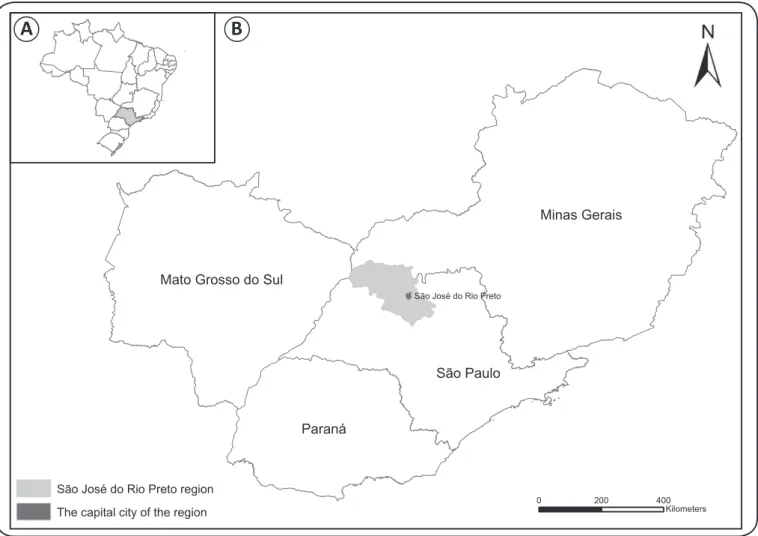
According to the 2010 census of the Brazilian Institute of Geography and Statistics [Instituto Brasileiro de Geografi a e Estatística (IBGE)], the São José do Rio Preto region has a population of 1,309,239 inhabitants. It comprises 102 municipalities; is located in the Northwestern area of the State of São Paulo; and is bordered by the States of Minas Gerais, Paraná, and Mato Grosso do Sul (Figure 1). The region is traversed by three major radial highways (connecting the state capital): Euclides da Cunha, Feliciano Salles Cunha, and Washington Luiz.
São José do Rio Preto is its capital municipality, which is located 454km from the São Paulo state capital. The region comprises the micro-regions of Catanduva, São José do Rio Preto, Votuporanga, Fernandópolis, Jales, and Santa Fé do Sul, the capitals of which are the municipalities of the same name and are characterized as poles of attraction and dispersion of the fl ow of people, goods, and services.
The center of the region is located at latitude 20°37'25"S and longitude 49°47'51"W, with an average altitude of 489m. The predominant climate type in the region is Aw, according to Koeppen classifi cation(16), which is characterized as tropical
rainy with a dry winter.
Source of data and variables
Information provided by the Superintendence of Endemic Disease Control [Superintendência de Controle de Endemias (SUCEN)] regarding the year of L. longipalpis detection and fi rst autochthonous CVL case(s) was used. Information regarding autochthonous HVL cases was obtained from the Notifi able Diseases Information System [Sistema de Informações de
São Paulo
São José do Rio Preto
Paraná Mato Grosso do Sul
Minas Gerais
0 200 400 Kilometers
A
B
São José do Rio Preto region
The capital city of the region
FIGURE 1 - A). Map of Brazil denoting the State of São Paulo. B). Map denoting the São José do Rio Preto region with its capital city and its location within the State of São Paulo and in relation to the States of Minas Gerais, Mato Grosso do Sul, and Paraná, Brazil.
RESULTS Agravos de Notifi cação (SINAN)]. These data were obtained
between 2007 and 2013 for each of the municipalities in the study region in which the vector's presence or the autochthonous canine and/or human case was detected.
For HVL cases, data on the fi rst date of symptoms, age, sex, municipality and address of the probable infection site, case outcome (cure/death by VL), and year of death were collected. Information regarding the number, age, and sex of the inhabitants according to census tract and municipality was obtained from the IBGE.
Data analysis
To describe the dispersion of L. longipalpis and the autochthonous occurrence of CVL and HVL in the municipalities, thematic maps were constructed to show the paths followed by the vector and the disease in their expansion across the study region. These maps were used to evaluate the degree of contiguity of the infestation's evolution and of the occurrence of CVL and HVL and the degree of neighborhood shown by the distributions of affected municipalities in the region.
From the perspective of the detection time of L. longipalpis infestation, a municipality was considered contiguous to an already infested municipality if it bordered the municipality and if infestation was detected at a later date. The infestation degree of a neighborhood was obtained by counting. For example, for each of the infested municipalities, the number of neighboring municipalities, i.e., those with common borders, also infested was counted. The degree of contiguity and neighborhood for CVL and HVL was determined by similar procedures to those used for infestation but also considered the autochthonous occurrence of these diseases. The degree of contiguity was measured as a percentage, and the degree of neighborhood was measured as the average number of neighbors.
The relationship between the region’s radial highways and the presence of the vector and CVL and HVL occurrence in the municipalities was evaluated by calculating the ratio of affected municipalities traversed by highways. The proportion of micro-region capital municipalities among those infested by L. longipalpis and those with CVL and HVL occurrence was also calculated.
Incidence, mortality, and lethality rates, both total and by sex and age, were calculated for the entire period and study area. Incidence and mortality rates, both total and by sex, were also calculated according to the year. Total and single-sex rates were grouped by age.
For the municipalities with more than one autochthonous HVL case, the cases were geocoded based on the municipality's street layer and by probable infection site address; they were also grouped by urban census tracts. Thematic maps were constructed to represent the distribution of cases and HVL incidence rates. In these municipalities, the aim was to identify spatial and spatiotemporal clusters using scanning statistics(17) in a discrete
Poisson model. The following criteria were adopted: period of time between 2007 and 2013 and maximum cluster size equal to 30% of each municipality’s total population.
The thematic maps were developed using ArcGIS 10.2 software(18), and the cluster detection analysis was performed
using SaTScan 9.3 software(19).
Ethical considerations
This project was approved by the Ethics Committee of the School of Public Health of the University of São Paulo (Universidade de São Paulo) through the Brazil Platform, CAAE: 14107313.3.3333.5421, protocol number: 257,511, on 26/4/2013.
Figures 2A, 2B and 2C show the expansion of the L. longipalpis vector (29 municipalities) and the autochthonous o c c u r r e n c e o f C V L ( 11 m u n i c i p a l i t i e s ) a n d H V L (six municipalities) for the study area between 2007 and 2013 according to the detection year and municipality. A total of 50% of the municipalities with HVL are capitals of their micro-region, and among those with CVL and presence of the vector (36.4% and 13.8%, respectively), four are micro-region capitals (Fernadópolis, Jales, Santa Fé do Sul, and Votuporanga). Notably, the expansion of HVL, CVL, and vector presence occurred from west to east.
The fi rst autochthonous case of HVL in the study area was confi rmed in 2007 in the municipality of Jales, with vector presence and autochthonous CVL occurrence confi rmed only in the following year. Similar situations occurred in Urânia and Santa Albertina, where presence of the vector was detected after the disease occurred in a dog. Moreover, in General Salgado, there was a confi rmed case of HVL without prior detection of the vector or CVL (Figure 2).
The degree of contiguity in relation to the fi rst vector detection was 86.2% (25 out of 29 municipalities), i.e., infestation occurred in a municipality neighboring a municipality already infested by the vector more than 86% of the time. In relation to CVL, the degree of contiguity was 54.5% (among the 11 affected municipalities, six neighbored municipalities with previously detected autochthonous canine cases), and in relation to HVL, the degree of contiguity was 33.3% (among the six affected municipalities, two neighbored municipalities with previously detected autochthonous human cases).
The degree of neighborhood in relation to vector presence was 3.8; i.e., each municipality with the vector had an average of four infested neighbors by 2013. With regard to the occurrence of CVL and HVL, the degrees of neighborhood were 1.5 and 0.7, respectively.
Among the 29 municipalities with the presence of L. longipalpis, 15 are traversed by radial highways (51.7%). Among the 11 municipalities with CVL cases and the six with HVL cases, eight (72.7%) and fi ve (83.3%), respectively, are also traversed by this type of highway (Figure 2).
A)Lutzomyia longipalpis
0 50 100
Kilometers C Human visceral leishmaniasis (HVL))
B Canine visceral leishmaniasis (CVL))
Year
2007
2008
2009
2010
2011
2012
2013
Roads
Euclides da Cunha
Feliciano Salles Cunha
Washington Luiz
Municipalities
São José do Rio Preto - The capital city ot the region
1 - Aparecida D'Oeste 2 - Fernandópolis 3 - Jales
4 - Meridiano 5 - Palmeira D'Oeste 6 - Rubinéia
7 - Santa Albertina 8 - Santa Fé do Sul
9 - Santanta da Ponte Pensa 10 - Urânia
11 - Votuporanga
Municipalities with CVL
1 - Aparecida D'Oeste 2 - Jales
3 - General Salgado 4 - Santa Fé do Sul 5 - Urânia
6 - Votuporanga
Municipalities with HVL
3
6 2
5 4
1
2 3
5 7
4 11 6
8
1 9 10
-2,66E-15 0,6 1,2 1,8 2,4
2007 2008 2009 2010 2011 2012 2013
C
a
s
e
s
o
r
d
e
a
th
s
/
1
0
0
,0
0
0
in
h
a
b
it
a
n
t-y
e
a
rs
Mortality - Males Mortality - Females Mortality - Overall
Incidence - Males Incidence - Females Incidence - Overall
FIGURE 3 - Human visceral leishmaniasis incidence and mortality rates by year and sex, São José do Rio Preto region, State of São Paulo, Brazil, 2007 to 2013.
detection of the fi rst case and 2013. These rates were higher for men (Figure 3, Figures 4A and 4B). The highest incidence rates were in the 0-4-year age group, followed by the 60 and older group, which also had the highest mortality rate (Figures 4A and 4B). Between 2007 and 2013, the highest lethality occurred among those aged 60 and older, reaching 34.5% in this age group and 17.9% overall (Figure 4C).
In terms of incidence and mortality, the municipality of Votuporanga is noteworthy because it had the highest number of cases and deaths of all of the municipalities in the São José do Rio Preto region. Between 2010 (the year the fi rst autochthonous HVL case was detected) and 2013, 46 cases and eight deaths were reported.
Figures 5A, 5B and 5C show HVL incidence rates for the municipalities of Jales, Santa Fé do Sul, and Votuporanga, according to census tracts, for the entire study period. In general, the tracts with the highest rates were located in the more peripheral areas of the cities. A spatial cluster of HVL cases in Jales and a spatio-temporal cluster in Votuporanga could be identifi ed; these clusters were also located on the outskirts of these cities. No clusters were detected in Santa Fé do Sul (Figures 5D, 5E and 5F).
DISCUSSION
The expansion of the disease and vector presence in the São José do Rio Preto region followed the same pattern that was detected in the State of São Paulo by Cardim et al.(12),
i.e., an expansion from west to east. The spatial pattern of vector infestation in the municipalities was more aggregated
(with higher degrees of contiguity in infestation occurrence in municipalities not previously infested by L. longipalpis and higher degrees of neighborhood between infested municipalities) than that of CVL and HVL occurrence. The latter two, by contrast, showed a stronger relationship with the radial highway routes and micro-region capitals than with vector presence in the municipalities.
Virtually all types of transport between the region's municipalities and between neighboring regions travel along radial and transverse highways (the links between the municipalities that do not lead to the state capital, which are generally vicinal highways in the study area); thus, both passive vector dispersion and the expansion of CVL and HVL occurrence must be related to these highways, making it important to discuss the role they play in such processes.
The relationship between major highways and HVL expansion has been discussed by Antonialli et al.(13) and Cardim
et al.(12). The former showed the role of the BR-262 (the highway
linking Corumbá to the state capital of Mato Grosso do Sul and the state capital to Três Lagoas, on the State of São Paulo border) in HVL expansion in the State of Mato Grosso do Sul (MS)(13). The latter group of authors showed the role of the
Marechal Rondon Highway (a radial highway that crosses the regions of Araçatuba, Marília, and Bauru, connecting MS and the State of São Paulo capital) in HVL expansion in the State of São Paulo(12).
0 0 ,7 1 ,4 2 ,1 2 ,8 3 ,5
C
as
es
/100
,000
in
ha
bi
ta
nt
-y
ea
rs
0 ,0 0 ,2 0 ,4 0 ,6 0 ,8 1 ,0
0 ,0 9 ,0 1 8 ,0 2 7 ,0 3 6 ,0 4 5 ,0
/100
,
000
in
ha
bi
ta
nt
-y
ea
rs
Deaths
Lethality (%)
0 to 4 5 to 19 20 to 39 40 to 59 60 and more Total
0 to 4 5 to 19 20 to 39 40 to 59 60 and more Total
0 to 4 5 to 19 20 to 39 40 to 59 60 and more Total Male Female Total
Male Female Total
Male Female Total
A
B
C
A) Jales B) Santa Fé do Sul C) Votuporanga
D) Jales E) Santa Fé do Sul* F) Votuporanga Standardized incidence rate
(cases/100,000 inhabitant-years)
0.0 0.1 - 24.3 24.4 - 56.3 56.4 - 1204.0
0.0 0.1 - 23.4 23.5 - 27.4 27.5 - 46.6
Standardized incidence rate (cases/100,000 inhabitant-years)
Standardized incidence rate (cases/100,000 inhabitant-years)
0.0 0.1 - 17.9 18.0 - 26.5 26.6 - 89.1
Spatial clusters of HVL cases
RR=6.4; p=0.030; 8 cases RR=17.6; p=0.08; 3 cases HVL cases
Census tracts
*Clusters were not detected
HVL cases
Census tracts Spatiotemporal cluster of HVL cases
Sep/2012 to Aug/2013: RR= 7.1; p=0.037; 12 cases HVL cases
Census tracts
0 1.5 3Km 0 1 2Km 0 2 4Km
N
FIGURE 5 - Human visceral leishmaniasis incidence rates according to census tracts for Jales (A), Santa Fé do Sul (B), and Votuporanga (C); HVL cases in Jales and spatial clusters (D); HVL cases in Santa Fé do Sul (E); HVL cases in Votuporanga and spatiotemporal clusters, São José do Rio Preto region, State of São Paulo, Brazil, 2007 to 2013 (F). HVL: human visceral leishmaniasis; RR: relative risk.
Feliciano Salles Cunha highway). Among the roles played by these highways in the expansion of the disease is the channeling of migratory fl ows from other states for the sugarcane harvest. At the beginning of the new millennium, Barata(20) noted that
the increase in sugarcane cultivation areas in the state's western region could be a risk factor for the increased incidence of infectious diseases including leishmaniasis.
Moreover, these highways are also responsible for the large movement of people in the region and between its neighboring regions(12) (21) (22). The fact that half of the municipalities with
Furthermore, the movement of people via these highways is also associated with the movement of their animals, resulting in the migration of dogs with CVL or those infected by the parasite. Again, this phenomenon highlights the role of the micro-region capitals, because more than one-third of municipalities with CVL are such capitals(21) (23) (24).
The aggregate spatial pattern of vector presence in the region may be related to the ways in which the vector can be passively dispersed, such as via transport over short and medium distances; through materials and products that can be infested with its eggs, larvae, and pupae (such as soil, grasses, organic fertilizers, and other gardening products, or in animal feces, particularly that of chickens, by their transportation, among other possibilities)(7); or by adults, which can be transported in
cars or trucks (during the movement of household items, for example)(25). This transportation, given the degree of contiguity
and neighborhood found, could occur via both radial and transverse highways.
The strong relationship between vector occurrence and presence within the municipalities’ local neighborhood and the association of CVL and HVL expansion with major highways and micro-region capitals could be used to identify priority municipalities for the early adoption of surveillance and control measures, with the aim of mitigating or delaying the occurrence of the problem. Marzochi & Marzochi(25) noted that
municipalities close to major highways deserve more attention from health authorities.
In the cities considered most at risk, education and environmental management activities should be developed; professionals in veterinary clinics should be prepared to deal properly with CVL; and there should be investments in the care, diagnosis, and treatment infrastructure so that HVL can be diagnosed early and appropriate treatment can be given to prevent deaths(26) (27).
Votuporanga, which is the capital of the micro-region of the same name and is traversed by the Euclides da Cunha highway, is an example of a priority municipality where the development of surveillance and control actions could have minimized the occurrence of cases and, more importantly, deaths. Examples of municipalities in a similar situation to Votuporanga, but still without autochthonous HVL occurrence, include Fernandópolis, São José do Rio Preto, and Catanduva, which are also micro-region capitals traversed by one of the micro-region's radial highways. These municipalities should be prioritized to avoid the fatalities that occurred in Votuporanga.
Contrary to what occurred in other State of São Paulo regions(11) (12) (28), in the Jales region, HVL was detected before
vector presence or CVL occurrence. Similar situations occurred in General Salgado, Urânia, and Santa Albertina. For operational reasons, vector surveillance activity may not always occur throughout the year, which is a possible explanation for canine and/or human cases being detected prior to the confi rmation of vector presence(29).
Moreover, vector detection after the detection of human and/or canine cases can also be related to the type of trap used to catch sandfl ies (luminous CDC), which may have reduced
capturing effi ciency in urban areas that are generally very bright (due to the competition with artifi cial lighting), particularly in low-vector-density situations. In addition, other possibilities can be considered, such as the involvement of other sandfl y species in the VL transmission cycle such as Nyssomyia whitmani and Migonemyia migonei (EAB Galati: personal communication), which are present in the study area(30) (31).
Luz et al.(26) and Barbosa et al.(27) identifi ed diffi culties faced
by health professionals in detecting and treating people with HVL, particularly when there are no confi rmed cases and in locations where the vector's presence and/or canine cases have not been confi rmed, which may have an effect on the disease’s expansion speed and interfere with incidence, mortality, and lethality. The high lethality rates among HVL cases in the region, particularly among the elderly, may be explained by this scenario, because the observed values for this group were much higher than the national average (approximately 7%)(32).
The fi nding of the present study that there was a higher incidence in males, children under fi ve years of age, and adults aged 60 or older corroborated those performed in other regions of the state and country. This result may be related to the incomplete development of the immune system in the children the comorbidity of HVL with chronic diseases, and the decline of the immune system in the elderly(33) (34) (35) (36). The higher
incidence in males is consistent with the literature(33) (34) (36) (37).
The mortality rate was also higher in males and those aged 60 and older, which may also be related to immune factors and complications from pre-existing conditions.
Along with their critical role in the characterization of the expansion process and disease dissemination across the region, the use of GIS and spatial analysis enabled the identifi cation of spatial clusters on the outskirts of the Cities of Jales and Votuporanga and the identifi cation of major incidents on the outskirts of Santa Fé do Sul. The peripheral areas of cities lack adequate infrastructure (absent or inadequate basic sanitation, unpaved streets, etc.). These areas are also typifi ed by the presence of chicken coops next to homes, abundant trees, concentrations of animals in and around the home and overcrowding under conditions of inequality, all of which favor the expansion of the vector and the disease(13) (22) (34) (38) (39) (40) (41) (42). This fi nding may
prove useful in improving control and surveillance measures, because the prioritized development of these activities in the city’s periphery could render VL control programs more effective.
The main limitation of the present study is the use of information from epidemiological surveillance to characterize the occurrence of HVL, CVL, and vector presence due to possible underreporting of canine and human cases and a delay in vector detection.
upward trend and were higher for men and for the 0- to 4-year-old age group; mortality and lethality were higher for people aged 60 and older; and among the municipalities, HVL had a higher incidence and case clustering in peripheral urban areas. These fi ndings may be useful for improving the surveillance and control of VL in the study area as well as in similar regions of the State of São Paulo and Brazil.
ACKNOWLEDGMENTS
The authors declare that there is no confl ict of interest. CONFLICT OF INTEREST
FINANCIAL SUPPORT
REFERENCES
The authors would like to thank the Superintendência de Controle de Endemias (SUCEN) and Centro de Vigilância Epidemiológica Alexandre Vranjac (CVE) for providing information.
Fundação de Amparo à Pesquisa do Estado de São Paulo (FAPESP), granted regular assistance to the research (Process: number 2010/20279-1) to FCN; the Coordenação de Aperfeiçoamento de Pessoal de Nível Superior (CAPES) granted a scholarship to AMO.
1. Madalosso G, Fortaleza CM, Ribeiro AF, Cruz LL, Nogueira PA, Lindoso JAL. American visceral leishmaniasis: factors associated with lethality in the state of São Paulo, Brazil. J Trop Med 2012; article ID 281572: 8 pages.
2. Nascimento BWL, Saraiva L, Teixeira-Neto RG, Serra e Meira
PCL, Sanguinette CC, Tonelli GB, et al. Study of san fl ies (Diptera:
Psychodidae) in visceral and cutaneous leishmaniasis áreas in central western of Minas Gerais State, Brazil. Acta Trop 2013; 125: 262-268.
3. Karagiannis-Voules DA, Scholte RGC, Guimarães LH, Utzinger J, Vounatsou P. Bayesian geostatistical modeling of leishmaniasis incidence in Brazil. PLOS NTD 2013; 7:1-13.
4. Costa CHN, Tapety CMM, Werneck GL. Controle da leishmaniose em meio urbano: estudo de intervenção randomizado fatorial. Rev Soc Bras Med Trop 2007; 40:415-419.
5. Harhay MO, Olliaro PL, Costa DL, Costa CHN. Urban parasitology: visceral leishmaniasis in Brazil. Trend Parasitol 2011; 27:403-409.
6. Vilela ML, Azevedo CG, Carvalho BM, Rangel EF. Phlebotomine fauna (Diptera: Psychodidae) and putative vectors of leishmaniases in impacted area by hydroelectric plant, State of Tocantins, Brazil. PLOS ONE 2011; 6:e27721, 2011.
7. Brazil RP. The dispersion of Lutzomyia longipalpis in urban areas. Rev Soc Bras Med Trop 2013; 46:263-264.
8. Forattini OP, Rabello EX, Pattoli DGB. Sobre o encontro de
Lutzomyia longipalpis (Lutz & Neiva, 1912) no estado de São Paulo, Brasil. Rev Saude Publica 1970; 4:99-100.
9. Forattini OP, Rabello EX, Galati EAB. Novos encontros de
fl ebotomíneos no estado de São Paulo, Brasil, com especial
referência à Lutzomyia longipalpis. Rev Saude Publica 1976; 10:125-128.
10. Gomes AC. Galati EAB. Casanova C, Domingos MF, Marques GRAM, Camargo-Neves VLF. Analysis of the geographical distribution of leishmaniasis vectors in the state of São Paulo, Brazil. Bol Dir Malariol y San Amb 1995; 1:143-146.
11. Costa AIP, Casanova C, Rodas LAC, Galati EAB. Atualização
da distribuição geográfi ca e primeiro encontro de Lutzomyia longipalpis em área urbana no Estado de São Paulo, Brasil. Rev Saude Publica 1997; 31:632-633.
12. Cardim MFM, Rodas LAC, Dibo MR, Guirado MM, Oliveira AM, Chiaravalloti-Neto F. Introdução e expansão da leishmaniose visceral americana em humanos no estado de São Paulo, 1999-2011. Rev Saude Publica 2013; 47:691-700.
13. Antonialli SAC, Torres TG, Paranhos-Filho AC, Tolezano JE. Spatial analysis of american visceral leishmaniasis in Mato Grosso do Sul State, Central Brazil. J Infection 2007; 54:509-514.
14. Martins-Melo FR, Lima MS, Ramos-Junior AN, Alencar CH, Heukelbach J. Mortality and Case Fatality Due to Visceral Leishmaniasis in Brazil: A Nationwide Analysis of Epidemiology, Trends and Spatial Patterns. PLoS ONE 2014; 9:e93770.
doi:10.1371/journal.pone.0093770
15. Guimarães AGF, Alves GBM, Pessoa AM, Silva Junior NJ. Spatial analysis of visceral leishmaniasis in the municipality of Rondonópolis, in the Brazilian State of Mato Grosso, from 2003 to 2012: human, canine and vector distribution in areas of disease transmission. Rev Soc Bras Med Trop 2015; 48:291-300.
16. Rolim GS, Camargo MBP, Lania DG, Moraes JFL. Classifi cação climática de Koppen e de Thornthwaite e sua aplicabilidade na determinação de zonas agroclimáticas para o estado de São Paulo. Bragantia 2007; 66:711-720.
17. Kulldorff M, Heffernan R, Hartman J, Assunção R, Mostashari F. A space-time permutation scan statistic for disease outbreak detection. PLOS Med, 2005; 2:216-224.
18. ESRI. ArcGIS 10.2 for Desktop. . ESRI, Redlands, 2013.
19. Kulldorff M. and Information Management Services, Inc. SaTScan™ v9.0: Software for the spatial and space-time scan statistics. [www.satscan.org], 2009.
20. Barata RB. Cem anos de endemias e epidemias. Cienc Saude Coletiva 2000; 5:333-345.
21. Mestre GLC, Fontes CJF. A expansão da epidemia da leishmaniose visceral no estado de Mato Grosso, 1998-2005. Rev Soc Bras Med Trop 2007; 40:42-48.
22. Ximenes MFFM, Silva VPM, Queiroz PVS, Rego MM, Cortez AM, Batista LMM, et al. Flebotomíneos (Dipters:Psychodidae) e leishmanioses no Rio Grande do Norte, Nordeste do Brasil –
refl exos do ambiente antrópico. Neotrop Entomol 2007; 36:128-137.
23. Thomaz-Soccol V, Castro EA, Navarro IT, Farias MR, Souza LM, Carvalho Y, et al. Casos alóctones de leishmaniose visceral canina no Paraná, Brasil: implicações epidemiológicas. Rev Bras Parasitol Vet 2009; 18:46-51.
24. Scandar SAS, Silva RA, Cardoso-Júnior RP, Oliveira FH. Ocorrência de leishmaniose visceral americana na região de São José do Rio Preto, estado de São Paulo, Brasil. BEPA 2011; 8:13-22.
25. Marzochi MCA, Marzochi KBF. Leishmanioses em áreas urbanas. Rev Soc Bras Med Trop 1997; 30:162-164.
intervention to improve diagnosis and treatment. Cad Saude Publica 2009; 25:1177-1184.
27. Barbosa MN, Carmo RF, Oliveira DCD, Silva GC, Luz ZMP. Atenção aos casos humanos de leishmaniose visceral no âmbito da atenção primária à saúde em município da região metropolitana de Belo Horizonte. Rev APS 2013; 16:234-241.
28. Camargo-Neves VLF, Gomes AC. Controle da leishmaniose visceral americana no estado de São Paulo, Brasil. Rev Soc Bras Med Trop 2002; 35: 90-97.
29. Silva AVM, Magalhães MAFM, Brazil RP, Carreira JCA. Ecological study and risk mapping of leishmaniasis in an endemic area of Brazil based on a geographical information systems approach. Geospat Health 2011; 6:33-40.
30. Shimabukuro PHF, Silva TRR, Fonseca FOR, Baton LA, Galati EAB. Geographical distribution of american cutaneous leishmaniasis and its phlebotomine vectors (Diptera: Psychodidae) in the state of Sao Paulo, Brazil. Paras & Vectors 2010; 3:121.
31. Shimabukuro PHF, Galati EAB. Lista de espécies de Phlebotominae (Diptera, Psychodidae) do Estado de São Paulo, Brasil, com comentários
sobre sua distribuição geográfi ca. Biota Neotrop 2011; 11:1-20.
32. Ministério da Saúde, Secretaria de Vigilância em Saúde. Letalidade de Leishmaniose Visceral. Brasil, Grandes Regiões e Unidades Federadas. 2000 a 2013; 2015. (Acessed 2015 October
13). Available at http://portalsaude.saude.gov.br/index.php/o-ministerio/principal/secretarias/svs.
33. Queiroz MJA, Alves JGB, Correia JB. Leishmaniose visceral: características clínico-epidemiológicas em crianças de área endêmica. J Pediat 2004; 80:141-146.
34. Oliveira JM, Fernandes AC, Dorval MEC, Alves TP, Fernandes TD, Oshiro ET, et al. Mortalidade por leishmaniose visceral:
aspectos clínicos e laboratoriais. Rev Soc Bras Med Trop 2010; 43:188-193.
35. Barata RA, Peixoto JC, Tanure A, Gomes ME, Apolinário EC, Bodevan EC, et al. Epidemiology of visceral leishmaniasis in a reemerging focus of intense transmission in Minas Gerais State, Brazil. BioMed Res Int 2013, article ID 405083: 6 pages.
36. Barbosa IR, Costa ICC. Aspectos clínicos e epidemiológicos da leishmaniose visceral em menores de 15 anos no estado do Rio Grande do Norte, Brasil. Scientia Med 2013; 23:5-11.
37. Alvarenga DG, Escalda PMF, Costa ASV, Monreal MTFD. Leishmaniose visceral: estudo retrospectivo de fatores associados à letalidade. Rev Soc Bras Med Trop 2010; 43:194-197.
38. Galimbertti MZ, Katz G, Camargo-Neves VLF, Rodas LAC, Casanova C, Costa IP, et al. Leishmaniose visceral americana no Estado de São Paulo. Rev Soc Bras Med Trop 1999; 32:217-218.
39. Cesse EAP, Carvalho EF, Andrade PP, Ramalho WM, Luna L. Organização do espaço urbano e expansão do calazar. Rev Bras Saude Matern Infant 2001; 1:167-176.
40. Gontijo CMF, Melo MN. Leishmaniose visceral no Brasil:
quadro atual, desafi os e perspectivas. Rev Bras Epidemiol 2004;
7: 338-349.
41. Caiaffa WT, Almeida MCM, Oliveira CDL, Friche AAL, Gesteira e Matos S, Dias MAS, et al. The urban environment from the health perspective: the case of Belo Horizonte, Minas Gerais, Brazil. Cad Saude Publica 2005; 21: 958-967.