Sabrina Joany Felizardo NevesI Ana Paula de Oliveira MarquesII Márcia Carrera Campos LealII Alcides da Silva DinizIII Tibério Silva MedeirosIV Ilma Kruze Grande de ArrudaIII
I Programa de Pós-Graduação em Nutrição. Departamento de Nutrição. Universidade Federal de Pernambuco. Recife, PE, Brasil II Departamento de Medicina Social. Centro
de Ciências da Saúde. Universidade Federal de Pernambuco. Recife, PE, Brasil III Departamento de Nutrição. Centro de
Ciências da Saúde. Universidade Federal de Pernambuco. Recife, PE, Brasil
IV Programa de Pós-Graduação em Ciências da Saúde. Instituto de Ciência Biológicas e da Saúde. Universidade Federal de Alagoas. Maceió, AL, Brasil
Correspondence:
Sabrina Joany Felizardo Neves
Rua Deputado José Lages, 1230 apto. 1001 - Ponta Verde
54035-330 Maceió, AL, Brasil E-mail: [email protected] Received: 9/24/2011
Approved: 3/4/2013
Article available from: www.scielo.br/rsp
Epidemiology of medication use
among the elderly in an urban
area of Northeastern Brazil
ABSTRACT
OBJECTIVE: To analyze medication use and associated factors among the elderly.
METHODS: A population-based cross-sectional study was carried out with a sample of 400 elderly people aged over 60 living in the urban area covered by the Family Health Strategy program in Recife, Northeastern Brazil in 2009. Individuals were selected by systematic random sampling and household data were collected. Demographic, socio-economic, lifestyle factors including nutrition practices and health variables were evaluated. Medication use was the independent variable. Univariate and multivariate statistical analysis were performed.
RESULTS: The prevalence of medication use was 85.5%. Polypharmacy (> 5 drugs) occurred in 11% of cases. Of the 951 drugs reported, 98.2% were prescribed by doctors and 21.6% were considered unsafe for the elderly. The most commonly prescribed groups were: cardiovascular drugs (42.9%), central nervous system agents (20.2%) and drugs with an effect on the digestive tract and metabolism (17.3%). The use of polypharmacy was associated with education (p = 0.008), self-reported health (p = 0.012), self-reported chronic disease (p = 0.000) and the number of doctor appointments per year (0.000).
CONCLUSIONS: The results of this study indicate a high proportion of medication use among the elderly, including of those considered unsuitable, and inequality among groups of elderly individuals regarding the use ofmedication, when education, number of doctor appointments and self-reported health are considered .
Changes in quality of life, health care, patterns of consumption and behavior linked to fertility and mortality in the last century have led to an increase in longevity. Ageing populations have become a global pehnomenon.18,22,25 In Brazil, the population structure
is considered aged, as the elderly make up 10.7% of the population (around 19 million people).a
The ageing process leads to a progressive reduction in the organism’s active tissue, a loss of functional capa-city and signifi cant changes in metabolic functions.17
Consequently, there is increased incidence of chronic disease, hospital admissions and medication use.16,22,b
High levels of medication use by the elderly population, in Brazil and worldwide, has been described.7,9,15,16,20
Biologically, the elderly have less capacity to meta-bolize medication, they suffer adverse effects more frequently and effi cacy of the treatment is reduced. This is due to a combination of factors: higher preva-lence of chronic illness, polypharmacy and, often, malnutrition.4,10,21
There is no consolidated definition of the term polypharmacy. Bushardt et al,3 in a revision of the
literature, identifi ed a number of concepts; among the most commonly found were ”taking medication inappropriate to the diagnosis”, “taking multiple medi-cations”, “duplicating drugs and/or taking potentially inappropriate medication”. In this study, polyphar-macy is defi ned as taking fi ve or more medications simultaneously.12
Polypharmacy linked to physiological and clinical conditions which are specifi c to the elderly makes taking medication a cause of concern for the health care sector.8,9,21,26 It is important to understand this
population’s patterns of medication use in order to esta-blish rational use, improve quality of life and maintain functional capacity.
This study aimed to analyze medication use and asso-ciated factors among the elderly.
METHODS
A cross-sectional study with 432 elderly individuals aged 60 and over, living in the community, of both sexes, capable of communication, responsible for their own medication and living in areas covered by the Family Health Care Strategy (ESF) in Recife, PE,
Northeastern Brazil between April and September 2009. The research took place in Health Care district IV, located in the west of Recife, micro region 4.2, with a registered population of 2,796 elderly individuals in the ESF.c
Sample size was determined based on an 80% preva-lence of “taking medication”, with a variability of 5%, resulting in 246 individuals. In order to correct for potential losses and allow greater breakdown of independent variables, 432 elderly individuals were contacted, of which 27 refused to participate in the study (refusal rate of 6.2%) and fi ve were withdrawn as, after three attempts, they could not be contacted, giving a sample of 400 eligible elderly individuals.
This tracking enabled the prevalence of medication use in the population in question to be estimated, as well as characterizing this use and associated factors.
Individuals were recruited using probabilistic alloca-tion, based on a list of names and addresses of elderly individuals registered with the ESF. Names were drawn to select the individual when there were two or more individuals fulfi lling the criteria in the same residence. Data, including a questionnaire and height and weight measurements, was collected by two interviewers in the individuals’ homes.
Participants were questioned about what medication they had taken on the day of the interview. The inter-viewers asked to see prescriptions and packets to ensure the names of the medications were recorded accurately and to avoid any medications being forgotten and thus omitted. The name and dose of the medication was used in the identifi cation. The active ingredients were classifi ed according to the Anatomical-Therapeutical-Chemical Classifi cation System (ATC).d
The dependent variable was the number of medications taken on the day of the interview. This variable was categorized into two groups: taking fewer than fi ve medications; taking fi ve or more medications (classifi ed as polypharmacy).12
Medications taken were classified as: prescribed (prescribed by a doctor, including repeat prescriptions authorized by a nurse); non-prescribed (taken on the individual’s own initiative, or recommended by a third party, not of the medical profession); medications unsafe for use by the elderly (should be avoided irrespective of
a Instituto Brasileiro de Geografi a e Estatística. Censo demográfi co 2010: resultados preliminares. Rio de Janeiro; 2010.
b Veras RP, Lourenço R, Martins CSF, Sanchez MA, Chaves PH. Novos paradigmas do modelo assistencial no setor saúde: consequência da explosão populacional dos idosos no Brasil. In: Veras RP, organizador. Terceira idade: gestão contemporânea em saúde. Rio de Janeiro: Relume Dumará; 2002. p.11-79.
c Secretaria Municipal de Saúde do Recife. Sistema de Informação da Atenção Básica. Recife; 2009.
d WHO Collaborating Centre for Drug Statistics Methodology. ATC/DDD Index 2010. Oslo; 2010 [cited 20 May 2010] Available from: http:// www.whocc.no/atc_ddd_index/
dose, duration of treatment or clinical circumstances, either because ineffective or because they present an unacceptably high risk for the elderly – risk exceeds benefi t – according to the Beers-Fick criteria).6
Independent variables included: socio-demographic characteristics (age, sex, schooling – in completed years, marital status, family arrangements and monthly income – in national minimum wage at time of writing); health (perception of own health; self-reported chronic illness);11 health related behavior (doing physical
acti-vity); use of health care services (number of doctor’s appointments in the last 12 months); nutritional state (Body Mass Index, classifi ed according to the cutoff points adopted by Lipschitz).13
Height and weight were measured according to recom-mendations by Lohman et al.14 Weight was measured
using a Marte scale, capacity of 150 kg, and height was measured using an Alturaexata portable stadio-meter, with a maximum extension of 2.00 m, divided into centimeters.
Data were entered twice and checked using the “vali-date” module of the EpiInfo program, version 6.04 (WHO/CDC; Atlanta, GE, USA), in order to identify any inconsistencies. Statistical Package for Social Sciences (SPSS) for Windows software, version 12.0 was used to analyze the data.
Uni-variate analysis was conducted in order to verify the link between characteristics of the study population and polypharmacy. The following tests were used: Kolmogorov-Sminorv to estimate the normal range for continuous variables, Pearson’s Chi-squared test for categorical variables; and the Kruskal-Walis H test for the continuous variables. Multiple analysis (logistical regression) was used to identify factors associated with polypharmacy. The Wald test for trend and heteroge-neity was used in the unadjusted analysis. Variables which had significance ≤ 0.20 in the unadjusted uni-variate analysis were considered when building the model. The stepwise method (variables selected in steps) with retrograde elimination was used in the adjusted analysis. Variable linked to p < 0.05 remained in the fi nal model. The level of signifi cance used was defi ned as α = 0.05 bi-caudal.
The research protocol was approved by the research ethics committee of the Universidade Federal de Pernambuco (Process No. 0388.0.172.000-08 and Protocol No. 396/08). Participants signed a consent form.
RESULTS
The majority of the elderly individuals (75.5%, 95%CI 70.9;79.6) were female. Age varied between 60 and 101 years old, with a mean age of 69 (64.00:75.75);
Table 1. Demographic, socio-economic, lifestyle and health characteristics of elderly individuals living in the community. Recife, PE, Northeastern Brazil, 2009.
Variable Elderly
n %
Sex
Female 302 75.5
Male 98 24.5
Age group (years)
60 to 69 205 51.3
70 to 79 134 33.5
80 and over 61 15.4
Schooling (years of study)
Illiterate 146 36.6
1 to 4 87 21.9
5 to 9 62 15.5
10 or more 104 26.1
Marital status
Living with a partner 147 36.8
Not living with a partner 252 63.2
Individuals per residence
Up to 3 228 57.0
4 or more 142 43.0
Income (MW)
< 1 60 15.1
1 to 2 310 78.1
> 2 27 6.8
Health
Excellent. very good and good 24 6.0
Regular or very bad 376 94.0
Reported illness
None 48 12.0
One chronic illness 137 34.2
Two or more chronic illnesses 215 53.8
Physical activity
No 98 24.5
Yes 302 75.5
Nutritional status (BMI)
< 22 kg/m2 50 13.7
22 to 27 kg/m2 140 38.5
> 27 kg/m2 174 47.8
Doctor’s appointments per year
Up to 4 257 64.3
5 or more 143 35.8
the 60 to 69 years old age group was the most frequent (51.3%) (Table 1).
Low levels of schooling were common, and the sample was predominantly illiterate (36.6%). The highest percentage of the elderly individuals had a monthly income of two minimum wages (78.1%); 63.2% lived alone and the median number of individuals per family was 3.0 (2.00:5.00).
The majority of elderly individuals classifi ed their own health as very bad. Most of those interviewed (88%) reported having one or more chronic disease; of these 53.8% reported having two or more. The most commonly reported diseases were high blood pres-sure (47.6%), arthritis/rheumatism (21.3%), diabetes (13.3%), heart disease (6.3%), stroke (5.7%), chronic pulmonary disease (3.8%) and cancer (2.0%). Mean BMI was 27.9 kg/m2 (SD = 5.4) and the predominant
nutritional state was overweight (47.5%).
There were 83.5% of the elderly individuals who reported making use of the Brazilian Unifi ed Health System (SUS); of these, 64.5% had used the ESF exclusively in the last 12 months. The median number of appointments was 4 (2.00: 6.00) for the same period. Hospitalization in the four months preceding the interview was reported by 24.5% of the elderly individuals (Table 1).
The prevalence of taking medication was 85.5%. Of these, the proportion of elderly individuals who took at least one prescribed medication was 98.2%, and the proportion taking at least one non-prescribed medica-tion was 6.7%. Polypharmacy occurred in 11.0% of cases. The use of at least one medication judged unsafe for use by the elderly occurred in 21.6% of cases. The most commonly used were: diazepan, digoxin, and mineral oil.
At the time of the interview, 951 medications, made up of 739 different drugs were being taken. The mean number of medications being taken by the elderly indi-viduals at the time of the interview was 2.4 (SD = 1.78) and the median was 2.0 (1.00: 3.00), varying between zero and ten medications. The median was 2.0 (1.00: 3.00) in prescribed medication, varying between zero and ten, and 0 (0.00: 0.00), varying between 0 and 3 medications for non-prescribed medications. Men had a median of 2.0 (0.75: 3.00), whereas for women it was 2.0 (1.00: 3.00) (p = 0.001).
The medications most commonly taken by the elderly individuals were cardiovascular drugs, followed by medicine used for the central nervous system (Table 2).
Of the most commonly taken medications, hydrochlo-rothiazide 25 mg, Captopril 25 mg and AAS 100 mg stand out (Table 3).
Polypharmacy proved to be linked to lower levels of schooling (p = 0.008), to poor self-reported health (p = 0.012), to two or more self-reported chronic diseases (p = 0.000) and to the number of doctor’s appointments per year (0.000). The other variables were not linked to polypharmacy (Table 4).
Table 3. Medications taken by elderly individuals in the community. Recife, PE, Northeastern Brazil, 2009.
Medication n %
Hydrochlorothiazide 25 mg pill 153 16.1 Captopril 25 mg pill 102 10.8
ASA 100 mg pill 66 6.9
Metformin 850 mg pill 42 4.4
Propranolol 40 mg pill 42 4.4 Glibenclamide 5 mg pill 36 3.8 Simvastatin 40 mg pill 30 3.1 Diazepam 10 mg pill 21 2.2
Atenolol 50 mg pill 15 1.6 Furosemide 40 mg pill 12 1.3
Other 432 45.4
Total 951 100.0
Table 2. Medications taken by the elderly individuals living in the community according to therapeutic group and pharmacological group. Recife, PE, Northeastern Brazil, 2009. (N = 951)
Group and subgroup n %
Cardiovascular drugs 408 42.9
Diuretics 124 13.0
Drugs active in the renin angiotensin system 107 11.2 Calcium channel blockers 37 3.9
β-blockers 19 2.0
Cardiac therapy 14 1.5
Hipolipermiantes 4 0.4
Other 103 10.9
Medicines for central nervous 192 20.2
Analgesics 80 8.4
Psycholeptics 26 2.7
Psychoanaleptics 20 2.1
Antiparkinsonian 6 0.6
Antiepileptic 4 0.4
Other 6 0.6
Medicines for the alimentary tract and metabolism 165 17.3
Antidiabetic 65 6.8
Mineral supplements 18 1.9 Antacids, anti-ulcer and antifl atulents 14 1.5
Vitamins 5 0.5
Other 3 0.3
Table 4. Link between taking medication, sociodemograohic characteristics, health related aspects, and use of health care services among elderly individuals in the community. Recife, PE, Northeastern Brazil, 2009.
Polypharmacy
Variable Yes No pa
n % n %
Sex 0.302
Female 8 8.2 90 91.8
Male 36 11.9 266 88.1
Age group (years) 0.097
60 to 69 29 14.15 176 85.9
70 to 79 9 6.7 125 93.3
80 and over 6 9.8 55 90.2
Schooling (years of study) 0.008
Illiterate 20 19.2 84 80.8
1 to 4 7 11.3 55 88.7
5 to 9 9 10.3 78 89.7
10 or more 8 5.5 138 94.5
Marital status 0.688
Living with a partner 15 10.2 132 89.8
Not living with a partner 29 11.5 223 88.5
Individuals per residence 0.535
Up to 3 27 11.8 201 88.2
4 or more 17 9.9 155 90.1
Income (MW) 0.416
< 1 3 9.4 29 90.6
1 to 2 1 3.7 26 96.3
> 2 40 11.8 300 88.2
Health 0.012
Excellent, very good and good 6 5.0 114 95.0
Regular or very bad 38 13.6 242 86.4
Reported illness 0.000
None – – 48 100.0
One chronic illness 5 3.7 129 96.3
Two or more chronic illnesses 39 17.9 179 82.1
Physical activity 0.183
No 30 9.8 275 90.2
Yes 14 14.7 81 85.3
Nutritional status (BMI) 0.663
< 22 kg/m2 19 9.9 173 90.1
22 to 27 kg/m2 16 13.1 106 86.9
> 27 kg/m2 6 12.2 43 87.8
Doctor’s appointments per year 0.000
Up to 4 16 6.2 241 93.8
5 or more 28 19.6 115 80.4
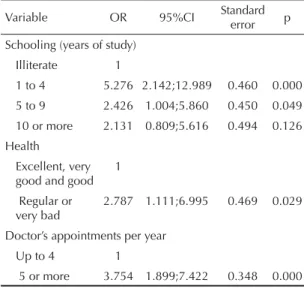
Three variables remained in the model after adjustment for potential risk factors for polypharmacy, showing an independent association with polypharmacy. Having between one and four years of schooling was the factor most strongly linked to polypharmacy (OR = 5.276 95%CI2.142;12.989) (p = 0.000).
DISCUSSION
The high prevalence of medication use among the elderly individuals (85.5%) concords with the lite-rature and is within the expected range, with values close to those found in Fortaleza, CE, Northeastern Brazil (80.3%),6 the South Region (82.0%)7 and Belo
Horizonte, MG, Southeastern Brazil (86.2%15 and
89.6%).20
The mean number of medications being taken at the time of the interview was lower than that observed in Rio de Janeiro, RJ,16 in the South Region7 and in Belo
Horizonte, MG.15,20 However, it was higher than that
found in Fortaleza,5 the population which is closest to
the population of this study, which suggests regional differences in the intensity of medication use.
Sex, age and access to health care services are highli-ghted as predictive factors for medication use among the elderly.9,21,22 In this study, women tended to take
more medications than men, although the difference in prevalence of polypharmacy was not statistically signifi cant between the sexes. In general, women made more use of health care services and were better at reporting their conditions;1 thus, they are more likely
to take medication. This trend of taking larger quan-tities of medications is consistent with the results of other epidemiological investigations.5,7,15,20 However,
this difference was not refl ected in the occurrence of polypharmacy. Likewise, there was no link between polypharmacy and age group. Elderly individuals recei-ving care from an ESF team makes access to medica-tions linked to prescripmedica-tions based on standardized lists free, which results in smaller quantities of medications being taken as well as encouraging more rational use. This may mean that polypharmacy in all age groups and both sexes is reduced. The fi ndings here do not agree with those of studies conducted in Belo Horizonte.15,20
However, these studies were carried out with elderly individuals in the general population, irrespective of registration with the ESF, suggesting that health teams monitoring the elderly tends to reduce polypharmacy in all age groups.
The most frequently used drugs were similar to those found in other research.5,7,15 Cardiovascular medication
were the most commonly used, which agrees with the national epidemiological profi le,e and hypertension was
the most commonly self-reported chronic condition.
A signifi cant proportion of the elderly individuals were taking prescribed medications and this reached a higher proportion than that found in research on elderly individuals in the general population.5,6,15 On
the other hand, the proportion of elderly individuals using non-prescribed medication was lower than that reported in the literature.5,6,15,16 This may be linked
to the fact that this study dealt with a population dependent on the SUS and therefore needing a pres-cription for any kind of medication. The frequency with which medications judged unsafe for use by the elderly3 were found was greater than that found
in Rio de Janeiro16 and in Fortaleza,5 but the values
were lower than those obtained for elderly individuals not dependent on the SUS.19 Even so, it was observed
that 2.2% of the elderly individuals took diazepam. This was a higher prevalence than that found by Bushardt et al,3 although lower than that found in
Fortaleza.5 According to the Beers-Fick6 criteria and
a panel of specialists, diazepam is judged to be not recommendable for use by the elderly, irrespective of diagnosis and clinical condition, as it has a long half-life, producing prolonged sedation and increased risk of falls and fractures.
The current practice of standardization of medicines in the SUS and dispensing drugs linked to prescription may be related to the increased use of prescription medi-cation and the reduction in prescription medimedi-cation that are unsafe for the elderly and the use of non-prescribed medications. The current ESF practice seems to have
e Ministério da Saúde. Saúde Brasil 2009: uma análise da situação de saúde e da agenda nacional e internacional de prioridades em saúde. Brasília (DF): 2010.9.
Table 5. Final model of the multivariate analysis for polypharmacy among elderly individuals living in the community. Recife, PE, Northeastern Brazil, 2009.
Variable OR 95%CI Standard error p
Schooling (years of study) Illiterate 1
1 to 4 5.276 2.142;12.989 0.460 0.000 5 to 9 2.426 1.004;5.860 0.450 0.049
10 or more 2.131 0.809;5.616 0.494 0.126 Health
Excellent, very good and good
1
Regular or very bad
2.787 1.111;6.995 0.469 0.029
Doctor’s appointments per year Up to 4 1
positive effect, given the low prevalence of elderly individuals using unsafe and non-prescribed medica-tion, reducing the risk of iatrogenic effects, adverse reactions and drug interactions.4,10
Of the socio-economic variables, only the level of schooling was directly linked to taking medication. Polypharmacy was more prevalent among elderly individuals with lower levels of schooling. Low levels of schooling is a predictive factor for the increase in chronic morbidities,2 which may, in turn, be linked to
increased medication use.
Frequency of doctor’s appointments was higher among elderly individuals who practiced polypharmacy, rein-forcing the importance of qualifying clinical protocols and the continuous professional development of health care professionals who prescribe medications, as primary care services were reported to be the main type of access to the health care system. Lebrão & Laurenti,11
researching elderly individuals in the community, irres-pective of access to the ESF, found a higher percentage of individuals seeking hospital care. This difference in access to the system shows the importance of esta-blishing the ESF in order to facilitate access to health care services for the elderly, to educate and encourage continuous monitoring.
Negative perception of own health was linked to polypharmacy, as seen in other epidemiological studies.11,15,20 There was a high prevalence of
nega-tive self-evaluated health. In contrast to this study, in the studies by Lebrão & Laurenti11 and Paskulin
& Vianna the elderly individuals tended to rate their own health positively.18 However, such studies were
carried out in the Southeast and South of the country, and regional differences may have infl uenced this result. More studies in the Northeast are necessary to confi rm this trend.
The prevalence of chronic illness was close to that observed by other authors.11,18 High blood pressure
was the most commonly reported disease, as in the Brazilian epidemiological profile and as seen in other studies.5,7,11,18 The VI Brazilian Hypertension
Guidelines23 highlight how. In spite of the high
preva-lence of hypertension, there are low levels of control. It is considered one of the principal modifi able risk factors for mortality related to cardiovascular disease, which in turn has been one of the main causes of death in Brazil over the last few years.f
Taking medication, albeit necessary, constitutes a risk for elderly individuals, especially polypharmacy or taking medications judged unsafe.6
Polypharmacy is linked to worsening physical and mental health among the elderly.10 Access to
medi-cation should be viewed as an achievement by the SUS, as prescription should be based on elderly patients’ overall health conditions and not solely on the treatment for a specific disease, adopting standards that minimize polypharmacy and use of unsafe medications.
The low percentage of losses is one of the positive aspects of this study, as it helps to reduce the possi-bility of selection bias and contributes to the study’s internal validity. Limitations inherent to the cross-sectional design stand out: diffi culty identifying the chronological relationship of the events, reduced by using a previously validated questionnaire; data on current exposure do not represent data of past exposure, minimized for some variables in which the elderly individual was asked about the chronic nature of their condition; and interpretation complicated by the presence of confounding variables, outlined in the statistical analysis, adjusted to minimize the infl uence of these variables.
As there are multiple, unknown risk factors linked to polypharmacy, using only the usual indicators may not be the most appropriate way of investigating causality of polypharmacy in the context in question. It is diffi cult to determine the isolation from the envi-ronment, personality and age (memory bias), as it is a phenomenon which includes a complex network of causal determinants. Other risk factors which were not analyzed but should have been, in this investigation, may play a crucial role in the prevalence of medication use. Investigating psychological stress and of the use of specifi c medications is worth investigating, together with physiological changes due to senescence.
The data in this study indicate a high percentage of medication use among the elderly, including medica-tions judged unsafe, and inequality in medicine use between groups of elderly individuals when schooling, doctor’s appointments and self-reported health are taken into account. The proportion of elderly indi-viduals taking prescribed medications was higher than that found in other studies of the elderly with populations not registered with the ESF. The fact that around 11% of the population practice polypharmacy, linked to the ageing population in Brazil, is a cause for concern, considering the potential risks of medi-cation use for the elderly. Broad discussion on the need to adopt measures for encouraging the rational use of medication in this segment of the population is needed, as is the continuous professional development of health care professional prescribing medications, qualifying the health care systems in order to provide
permanent education and appropriate information at the correct moment, the adoption of measures in the area of pharmaceutical care, drawing up and estab-lishing lists of medications and clinical protocols appropriate to the needs of the elderly population. The high prevalence of taking medication, mainly for
REFERENCES
1. Barreto SM, Figueiredo RC. Doença crônica, auto-avaliação de saúde e comportamento de risco: diferença de gênero. Rev Saude Publica. 2009;43(Supl 2):38-47. DOI:10.1590/S0034-89102009000900006
2. Barros MBA, Cesar CLG, Carandina L, Torre GD. Desigualdades na prevalência de doenças crônicas no Brasil, PNAD – 2003. Ciências & Saúde Coletiva. 2006;11(4):911-6
3. Bushardt RL, Massey EB, Simpson TW, Ariail JC, Simpson KN. Polypharmacy: misleading, but manageable. Clin Interv Aging. 2008;3(2):383-9. DOI:10.2147/CIA.S2468
4. Campos MTFS, Monteiro JBR, Ornelas APRC. Fatores que afetam o consumo alimentar e a nutrição do idoso. Rev Nutr. 2000;13(3):157-65. DOI:10.1590/S1415-52732000000300002
5. Coelho Filho JM, Marcopito LF, Castelo A. Perfi l de utilização de medicamentos por idosos em área urbana do Nordeste do Brasil. Rev Saude Publica. 2004;38(4):557-64. DOI:10.1590/S0034-89102004000400012
6. Fick DM, Cooper JW, Wade WE, Waller JL, Maclean JR, Beers MH. Updating the Beers criteria for potentially inappropriate medication use in older adults: results of a US consensus panel of experts. Arch Intern Med. 2003;163(22):2716-24. DOI:10.1001/archinte.163.22.2716
7. Flores LM, Mengue SS. Uso de medicamentos por idosos em região do sul do Brasil. Rev Saude Publica. 2005;39(6):925-9. DOI:10.1590/S0034-89102005000600009
8. Helling DK, Lemke JH, Semla TP, Wallace RB, Lipson DP, Cornoni-Huntley J. Medication use characteristics in the elderly: The Iowa 65+ Rural Health Study. J Am Geriatr Soc. 1987;35(1):4-12.
9. Junius-Walker U, Theile G, Hummers-Pradier E. Prevalence and predictors of polypharmacy among older primary care patients in Germany. Fam Pract. 2007;24(1):14-9. DOI:10.1093/fampra/cml067
10. Kadam UT. Potential health impacts of multiple drug prescribing for older people: a case-control study. Br J Gen Pract. 2011;61(583):128-30. DOI:10.3399/bjgp11X556263
11. Lebrão ML, Laurenti R. Saúde, bem-estar e envelhecimento: o estudo SABE no Município de São Paulo. Rev Bras Epidemiol. 2005;8(2):127-41. DOI:10.1590/S1415-790X2005000200005
12. Linjakumpu T, Hartikainen S, Klaukka T, Veijola J, Kivelä SL, Isoaho R. Use of medications and polypharmacy are increasing among the elderly. J Clin Epidemiol. 2002;55(8):809-17.
13. Lipschitz DA. Screening for nutritional status in the elderly. Prim Care. 1994;21(1):55-67.
14. Lohman TG, Roche AF, Martorell R. Anthropometric standardization reference manual. Champaign, Ill: Human Kinetics; 1988.
15. Loyola Filho AI, Uchoa E, Lima-Costa MF. Estudo epidemiológico de base populacional sobre uso de medicamentos entre idosos na Região Metropolitana de Belo Horizonte, Minas Gerais, Brasil. Cad Saude Publica. 2006;22(12):2657-67. DOI:10.1590/S0102-311X2006001200015
16. Monsegui GBG, Rozenfeld S, Veras RP, Vianna CMM. Avalição da qualidade do uso de medicamentos em idosos. Rev Saude Publica. 1999;33(5):437-44. DOI:10.1590/S0034-89101999000500002
17. Papaléo Netto M, Borgonovi N. Biologia e teorias do envelhecimento. In: Papaléo Netto M, organizador. Gerontologia. São Paulo: Atheneu; 1997. p.44-59.
18. Paskulin LMG, Vianna LAC. Perfi l sociodemográfi co e condições de saúde autorreferidas de idosos de Porto Alegre. Rev Saude Publica. 2007;41(5):757-68. DOI:10.1590/S0034-89102007000500010
19. Pereira LRL, Vecchi LUP, Baptista MEC, Carvalho D. Avaliação da utilização de medicamentos em pacientes idosos por meio de conceito de farmacoepidemiologia e farmacovigilância. Cienc Saude Coletiva. 2004;9(2):479-81. DOI:10.1590/S1413-81232004000200023
20. Ribeiro AQ, Rozenfeld S, Klein CH, César CC, Acucio FA. Inquérito sobre uso de medicamentos por idosos aposentados, Belo Horizonte, MG. Rev Saude Publica. 2008;42(4):724-32. DOI:10.1590/S0034-89102008005000031
21. Rozenfeld S. Prevalência, fatores associados e mau uso de medicamentos entre idosos: uma revisão. Cad Saude Publica. 2003;19(3):717-24. DOI:10.1590/S0102-311X2003000300004
22. Ruzicka LT. The use of mortaliy and morbidy statistics for national health promotion. London: WHO; 1990.
23. Tavares EL, Anjos LA. Perfi l antropométrico da população idosa brasileira: resultados da Pesquisa Nacional sobre Saúde e Nutrição. Cad Saude Publica. 1999;15(4):759-68. DOI:10.1590/S0102-311X1999000400010
24. Veras R. Envelhecimento populacional
contemporâneo: demandas, desafi os e inovações. Rev Saude Publica. 2009;43(3):548-54.
DOI:10.1590/S0034-89102009005000025
25. Zhan C, Sangl J, Bierman AS, Miller MR, Friedman B, Wickizer SW, et al. Potentially inappropriate medication use in the community-dwelling elderly: fi ndings from the 1996 Medical Expenditure Panel Survey. JAMA. 2001;286(22):2823-9. DOI:10.1001/jama.286.22.2823
The study was subsidized by the Conselho Nacional de Desenvolvimento Científi co, Edital MCT/CNPq 15/2007 – Universal (Process No. 475725/2007-7).
Study based on the doctoral thesis of Neves S.J.F., entitled: “Estado nutricional e uso de medicamentos em idosos assistidos pela Estratégia Saúde da Família”, presented to the Universidade Federal de Pernambuco, in 2011.
HIGHLIGHTS
The ageing population is a challenge for the Brazilian Unifi ed Health System (SUS), as a more elderly population means an increase in chronic diseases, a higher rate of hospitalizations, increased use of medications, and other care requirements. This situation leads to increased spending on health care as well as requiring services and health care professionals better qualifi ed to deal with this “new clientele”. The increased use of medications by the elderly has other implications, such as: adverse reactions, harmful drug interactions, overdoses or lack of therapeutic effi cacy, partly due to aspects specifi c to metabolism in the elderly and partly due to lack of knowledge of these aspects on the part of the prescriber.
The article presents the results of a cross-sectional study with a probabilistic sample of Estratégia Saúde da Família (Family Health Care Strategy) clientele in the city of Recife, CE, Northeastern Brazil. The results are representative of elderly individuals who only make use of services offered by the SUS, preferentially primary care, a population which generally has precarious socio-economic (low levels of income and schooling) and health (high proportion of individuals with regular, bad or very bad health and of individuals with at least one chronic disease) conditions.
A high prevalence of medication use (85%) was observed in this clientele, with a median of two medications per individual, and 11% using more than fi ve medications concurrently. Although 98% of the medications used had been prescribed, 22% of them were unsafe (inappropriate for the elderly, or without proven effi cacy). Excessive use of medications has been associated with poorer health, higher number of medical appointments in the period and lower levels of schooling.
The results may guide health care managers and those responsible for the Estratégia Saúde da Família aim to prescribe more responsibly, increasing the safety of elderly patients.