Pseudothrombocytopenia: incidence and strategy
for resolution in clinical laboratory
Pseudotrombocitopenia: incidência e estratégia para
resolução em laboratório de análises clínicas
Romário F. Prates1; Robson C. Viana2; Márcio V. Oliveira1; Claudio L. Souza1
1. Universidade Federal da Bahia (UFBA), campus Anísio Teixeira, Bahia, Brazil. 2. LABO, Laboratório de Análises Clínicas, Bahia, Brazil.
First submission on 10/07/17; last submission on 05/12/17; accepted for publication on 05/12/17; published on 20/12/17
ABSTRACT
Introduction: Pseudothrombocytopenia is an important source of pre-analytical problems in clinical laboratory; therefore it must
be correctly evaluated. Low spurious platelet counts can lead to misdiagnosis. Objective: This study aims to study the resolution of
pseudothrombocytopenia in the laboratory routine of clinical laboratory by standardizing the use of vortexer. Methods: This is a
cross-sectional, analytical, quantitative study based on experimental approach, involving 45 pseudothrombocytopenia samples divided into three
groups and submitted to vortexing for 1, 2 and 3 minutes. Results: During the study, 28,435 blood counts were performed, and 56 (0.196%)
of these samples conirmed platelet aggregates. The 2 and 3 minute times normalized the platelet count (greater than 150,000/µl) in two thirds of the samples tested. Platelets, hemolysis index, platelet distribution width (PDW) and mean platelet volume (MPV) presented
statistically signiicant mean difference (MD) (p < 0.05) after vortexing at all times. Conclusion: The 2 and 3-minute times were the
most effective in the resolution of pseudothrombocytopenia, however, the 2 minutes time should be preferred because it produced fewer effects on the erythrocyte membrane.
Key words: thrombocytopenia; platelets counting; clinical laboratory techniques; laboratory automation.
INTRODUCTION
Platelets are igurative elements of the circulating blood of granular and discoid aspects, arising from the fragmentation of megakaryocytes. An individual under normal physiological conditions which has a mean blood count of 223,000 platelets/µl, and values between 150,000/µl and 400,000/µl are considered normal(1, 2). Low platelet count or thrombocytopenia can be
deined as platelet counts less than 150,000/µl, applicable for healthy individuals in all age groups, as well as those having different etiopathogenesis, such as insuficient production (aplasia or chemotherapy), excessive consumption (disseminated intravascular coagulation) and destruction or increased splenic sequestration (viruses with antiplatelet antibodies)(2, 3).
Several preanalytical or analytical conditions and factors may lead to falsely reported thrombocytosis or thrombocytopenia,
so-called pseudothrombocytopenia(2). The Brazilian Society of
Clinical Pathology and Laboratory Medicine [Sociedade Brasileira de Patologia Clínica e Medicina Laboratorial (SBPC/ML)] presents several situations that promote overestimation of platelet counts, such as hemolysis, cryoproteins and the presence of fungi and/or bacteria; and underestimation, due to the formation of platelet aggregates, platelet satellites and inappropriate collections(4).
Platelet counts may still be affected by in vitro or in vivo
hemolysis, which generates erythrocytes fragments that may have platelet-like dimensions and are sometimes mistaken for platelets, which leads to an overestimation of their count when performed by the electrical impedance method. Some hemocytometers equipped with luorescence or optical channel for platelet counting are not subject to interference from fragmented red blood cells (RBC) due to the use of optical scanning method. Among the markers of hemolysis, the Determination of Lactate Dehyfrogenase (HDL) activity, the evaluation of the presence of schistocytes in a peripheral blood smear and increased indirect bilirubin, can be used, and the latter should not be used as a marker of in vitro hemolysis(2, 5, 6).
In vitro platelet aggregation is a great example of pseudothrombocytopenia. Although it is dificult to estimate, studies that considered all possible forms of pseudothrombocytopenia show incidence between 0.1 % and 2% in outpatients and 1.9% in intensive care unit (ICU) patients. In a study conducted in Brazil with 56,337 samples, 117 presented pseudothrombocytopenia, corresponding to 0.2%(3, 7-9).
In addition to venipuncture accidents that cause platelet aggregates, there is also ethylenediamine-tetraacetic acid (EDTA)-induced pseudothrombocytopenia. However, it has been related to the production of antibodies that bind to antigens present in the platelet membrane, which are modiied or exposed by the action of this anticoagulant. It is believed that these antibodies are directed against GPIIb/IIIa complex in up to 83% of cases, and immunoglobulin class M (IgM) or G (IgG). Although it is called EDTA-induced pseudothrombocytopenia, this phenomenon can occur in the presence of other anticoagulants, such as citrate and oxalate(3, 4, 10).
Pseudothrombocytopenia is an important source of pre-analytical problems in the clinical laboratory, so it is always necessary to raise suspicions about its possibility and to use correction methods. Repeated releases of platelet results below the reference value have led to misdiagnosed suspicion of disease, and may subject the patient to investigations, procedures and even to unnecessary treatments(2, 9).
Platelet indices such as mean platelet volume (MPV) may help in the deinition of true thrombocytopenia. MPV is calculated by dividing the plateletcrit (PCT) by the total number
of platelets(11) and represents their mean size, while the platelet
distribution width (PDW) indicates a mean variation in their size. With the dissolution of the aggregates, the MPV and the PDW tend to decrease, since this process will directly decrease the mean platelet size and smaller size variation, as in cases of Von Willembrand’s disease(10); and will be increased in true
thrombocytopenia, in which there is consumption or sequestering, and in several other inlammatory conditions, such as ankylosing spondylitis and rheumatoid arthritis(12). It is important to note that
in platelet aggregates due to pseudothrombocytopenia, the MPV will also be falsely elevated.
Once identiied in the laboratory, a low platelet count requires the use of some methods to establish the correct diagnosis. Guidelines recommend heating for ten minutes at 37ºC, performing a new blood collection using anticoagulant different from the one that generated the event and using a vortex mixer
to attempt dissolution of platelet aggregates(4). Platelet aggregates
are lagged by automated blood counters through speciic alerts.
SBPC/ML considers as the gold standard for conirmation of pseudothrombocytopenia the observation of the stained blood smear, evidencing the presence of isolated and/or clustered platelet aggregates in several regions of the slide(4, 13).
The literature is scarce on the subject of pseudothrombocytopenia and diverges in terms of the standardization of time and speed variables necessary and suficient for the use of vortex for dissolution of the aggregates, without this implying greater erythrocyte fragmentation and falsely elevated results. SBPC/ML recommends a time of three minutes (without speed setting), whereas in a study conducted by the hematology group of Fleury laboratory, a two minutes time of agitation was enough to solve 85.5% of the cases. None of the studies estimated the speed used in the device or considered the consequence of this agitation on the erythrocyte membrane
and the generation of hemolysis and schistocytes(4, 9).
OBJECTIVES
This study aims to study the resolution of pseudothrombocytopenia in the routine of the clinical laboratory by standardizing the use of vortex in a controlled experiment.
METHOD
This is a cross-sectional, analytical and quantitative study, presenting an experimental approach based in analysis of blood samples with decreased platelet counts with microscopic evidence of platelet aggregates. The study was carried out in the LABO® Análises Clínicas, a private clinical laboratory, based in
the city of Vitória da Conquista, Bahia, Brazil. The sampling of this study consisted of whole blood samples collected in EDTA from patients with complete blood count (CBC) and/or platelet count ordering, who had pseudothrombocytopenia conirmed by blood smear and who had suficient volume for analysis.
After pseudothrombocytopenia conirmation in the slide and demonstration of platelet aggregates, platelet counts were performed using the Fonio method, and the samples were
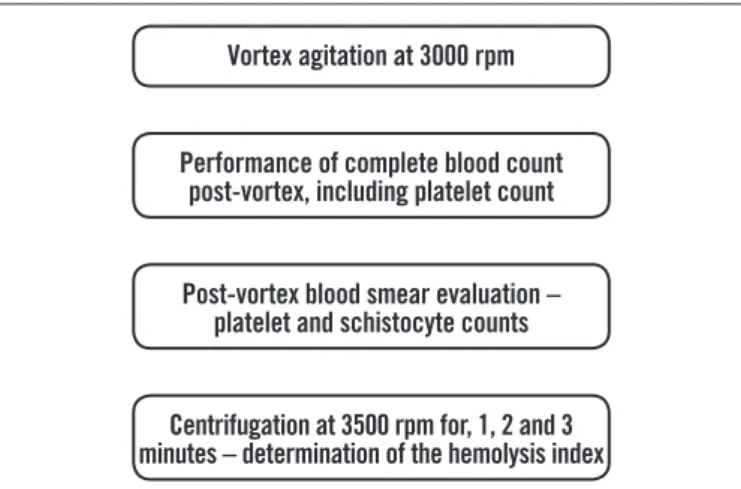
submitted to the following analyzes, according to Figure.
order to control the increase in platelet count due to erythrocyte fragmentation.
The vortex device was calibrated using a tachometer, having the speed established and set at 3000 rpm. Platelet counts and
other hematological parameters were measured on Cell Dyn Rubi,
Abbott Diagnostics®. The hemolysis index (HI) was determined by
the VITROS® 4600 Ortho Clinical Diagnostics integrated system,
through a solid-state spectrophotometer that uses dissonant diffraction to determine the HI, using the derivative of the absorption spectra.
The variables used for analysis of vortex eficiency and their effects on the erythrocyte membrane were: platelet count, percentage of schistocytes, MPV, PDW, hemoglobin, RBC, plateletcrit (PCT) and HI. All parameters were determined before and after vortex use. HI pre-vortex was determined in patient serum samples from the same venous puncture. The variables used in the control group were platelets, MPV, PDW, RBC and hemoglobin.
The percentage of schistocytes was determined by the smear
count stained by standardized technique in the SlideInk® device
brand Hemogram, which uses the Wright dye. The schistocyte count was performed by optical microscopy, and the results presented according to the formula: PS = NS*100/1000, where PS is the percentage of schistocytes and NS the number of schistocytes in 1000 red blood cells.
For statistical analysis, the Microsoft Ofice Excel® 2011 and
the Statistical Package in Social Science® [(SPSS) version 21]
programs were used. The variables were evaluated through mean difference and 2-tailed paired Student’s t-test. A value of p < 0.05
was adopted for statistical signiicance and considered 95% of conidence interval (CI).
Vortex agitation at 3000 rpm
Performance of complete blood count post-vortex, including platelet count
Post-vortex blood smear evaluation – platelet and schistocyte counts
Centrifugation at 3500 rpm for, 1, 2 and 3 minutes – determination of the hemolysis index
FIGURE − Flowchart showing methodological aspects of the experiment rpm: revolutions per minute.
The study was approved by the Research Ethics Committee of the Health Multidisciplinary Institute (Instituto Multidisciplinar de Saúde) of the Universidade Federal da Bahia (UFBA) under number 1.839.064, dated November 28, 2016. All ethical precepts in the research were respected in the present study.
RESULTS
During the study 28.435 CBC were performed, of which 56 (0.196%) were conirmed with the presence of platelet aggregates.
From these, 45 were selected for analysis and compose the n of
this study. The remaining samples were excluded because they had insuficient volume or had no other serum or plasma samples. The 2 and 3 minute times were the most effective in normalize the platelet counts (greater than 150.000/µl) in 10 samples (66.6%). However, the two minutes time was able to completely solve the aggregates (absence of aggregates in stained slide) in eight (53.3%) samples, while the three minutes time solved six samples (40%).
The pre-vortex platelet count had the lowest mean in the two minutes time (Table 1); the highest post-vortex mean for the
platelet variable was also observed in the two minutes time. The HI and the schistocyte count had a higher post-vortex mean in the three minutes time. The HI showed a statistically signiicant difference (p < 0.05) in all times studied. These observations
demonstrate the eficiency of vortex mechanical agitation in increasing platelet counting and their correction to normal levels. The increase in platelets was accompanied by a decrease in MPV and PDW which also showed signiicant differences. This difference corroborates the identiication of the resolution of the platelet aggregates.
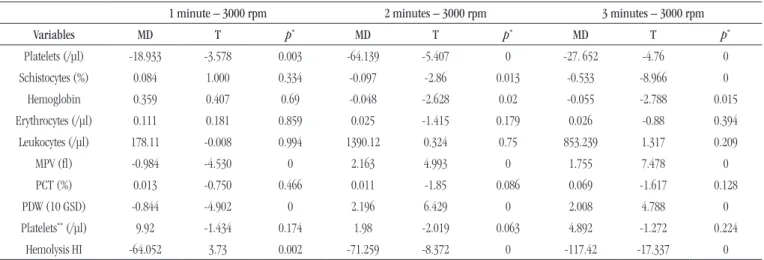
Among the studied variables, platelet, HI, PDW and MPV
presented a statistically signiicant mean difference (p < 0.05)
after vortexing at all times tested (Table 2). The difference in
the mean of the schistocyte count was statistically signiicant only in the three minutes time. However, there is a tendency to increase the count of schistocytes when increasing time. The other variables did not show statistical signiicance for
p value < 0.05.
TABLE 2 − Statistical evaluation of vortex eficiency in the dissolution of platelet aggregates and alteration of constants and hematimetric indices
1 minute – 3000 rpm 2 minutes – 3000 rpm 3 minutes – 3000 rpm
Variables MD T p* MD T p* MD T p*
Platelets (/µl) -18.933 -3.578 0.003 -64.139 -5.407 0 -27. 652 -4.76 0
Schistocytes (%) 0.084 1.000 0.334 -0.097 -2.86 0.013 -0.533 -8.966 0
Hemoglobin 0.359 0.407 0.69 -0.048 -2.628 0.02 -0.055 -2.788 0.015
Erythrocytes (/µl) 0.111 0.181 0.859 0.025 -1.415 0.179 0.026 -0.88 0.394
Leukocytes (/µl) 178.11 -0.008 0.994 1390.12 0.324 0.75 853.239 1.317 0.209
MPV (l) -0.984 -4.530 0 2.163 4.993 0 1.755 7.478 0
PCT (%) 0.013 -0.750 0.466 0.011 -1.85 0.086 0.069 -1.617 0.128
PDW (10 GSD) -0.844 -4.902 0 2.196 6.429 0 2.008 4.788 0
Platelets** (/µl) 9.92 -1.434 0.174 1.98 -2.019 0.063 4.892 -1.272 0.224
Hemolysis HI -64.052 3.73 0.002 -71.259 -8.372 0 -117.42 -17.337 0
MPV: mean platelet volume; PCT: plateletcrit; PDW: platelet distribution width; HI: hemolysis index; rpm: revolutions per minute; MD: mean difference; T: Student-t test.
*:statistical signiicance p < 0.05; **: platelet counting by the Fonio method.
TABLE 1 − Analysis of central tendency and dispersion of pre- and post-vortexing studied variables
Before vortexing After vortexing
1 minute 2 minutes 3 minutes 1 minute 2 minutes 3 minutes
Variables AM SD AM SD AM SD AM SD AM SD AM SD
Platelets (/µl) 119.9 28.42 78.41 34.12 110.9 22.92 167.2 54.85 184.72 85.57 161.2 34.93
Schistocytes (%) 0.01 0 0 0 0 0 0.03 0.12 0.38 0.52 0.7 0.3
Hemoglobin 13.51 1.85 13.51 1.79 12.83 1.2 13.45 1.96 13.73 1.8 13.07 1.19
Erythrocytes (/µl) 4.76 0.69 4.81 0.77 4.47 0.38 4.77 0.73 4.85 0.84 4.48 0.34
MPV (l) 9.89 2.19 9.98 1.54 9.64 1.78 8.03 2.02 8.47 1.27 8.27 1.87
PCT (%) 0.12 0.04 0.11 0.04 0.128 0.01 0.12 0.03 0.18 0.14 0.15 0.02
PDW (%) 22.03 1.24 22.99 1.03 21.5 1.2 20.52 1.26 21.34 1.77 20.11 1.55
Platelets* (/µl) 248.4 79.7 230.1 39.08 187.8 28.65 268.4 83.97 262 67.86 194.93 23.61
Hemolysis HI 26 19.96 19.73 9.13 15.8 1.82 66.66 35.66 115.53 41.52 149.8 29.75
MPV: mean platelet volume; PCT: plateletcrit; PDW: platelet distribution width; HI: hemolysis index; AM: arithmetic mean; SD: standard deviation.
*: platelet counting by the Fonio method.
time. The three minutes time presented a signiicant increase in the HI and in the statistically signiicant schistocyte count
(p < 0.05). This result indicates the occurrence of mechanical
hemolysis(6).
The HI presented a statistically signiicant mean difference in all the times tested, behaving linearly, which shows a tendency to increase with increasing vortex time. The fact that it is signiicant already in one minute and the appearance of schistocytes in a slide in only three minutes is related to the sensitivity of the method used,
derived spectrophotometry, available in the VITROS® 4600 Ortho
Clinical Diagnostics device. It is a technique with high sensitivity in the detection of hemolysis and high selectivity through signal increase and noise reduction(14).
In the control experiment there was no statistically signiicant mean difference for the parameters considered in
this study, including the platelet count, which presented a mean difference of 9,167 platelets/µl. It can be inferred, from this data, that, although the production of schistocytes occurs, the erythrocyte fragments did not interfere statistically in the mean platelet count.
DISCUSSION
The prevalence of pseudothrombocytopenia in this study is
in line with a previous study by Mourad et al. (2011)(9), which
In the present study, the two minutes time at 3000 rpm solved
a lower proportion of cases compared to the Mourad et al. (2011)(9)
study. However, limiting the lack of control between collection time and sample analysis and failure to evaluate other of thrombocytopenia causes, such as that induced by anticoagulants
with IgG or IgM antibodies that may have strong binding(10), may
have underestimated the effectiveness of the method.
It should be pointed out that the thrombocytopenia not resolved by vortexing agitation were not evaluated or investigated as to their origin or pathophysiology due to the objective of the study to constitute only the vortex methodology analysis. This fact may have underestimated the resolution percentage of pseudothrombocytopenia cases, since additional resolution techniques can be used to resolve pseudothrombocytopenia, such as heating the sample for 10 minutes at 37ºC and ordering a new collection in anticoagulant different from the one that generated the disturbance.
It is still listed as a limitation the schistocytes counting, which, since it is a manual technique, is subject to the observer bias. Nevertheless, the high HI in three minutes time corroborates greater damage to the erythrocyte by mechanical agitation. It is also worth mentioning the existence of haemocytometers equipped with optical laser channel that do not suffer interference from the presence of schistocytes, so they would not suffer interference from the speed or the vortex agitation time for correction of platelet counting, even though it has a higher cost.
This study was carried out in relation to the possible spurious increase in platelet count due to the counting of erythrocytes
fragments, which was conirmed by the lack of signiicant differences between the variables studied in the control experiment.
CONCLUSION
The development of the present study allowed the determination of a standardized and controlled procedure for the use of vortex in the dissolution of platelet aggregates, recommending the use of the equipment at 3000 rpm for two minutes. In addition, it has been shown that vortex use has an impact on the membrane, and the time and rpm variables should be controlled for satisfactory results. The recommended time and the rpm in this study were the ones that caused less impact on the erythrocyte Erytrocyte membrane and the dissolution of platelet aggregates in most cases. It is also worth noting the need for periodic calibration of vortex device, as well as other laboratory instruments, according to legal requirements.
The results obtained in this work present a fast, controlled and effective method for the dissolution of platelet aggregates, which allows laboratory workers greater support for results release, avoiding unnecessary collection and preventing the patient from undergoing unnecessary medical ivestigations and procedures.
ACKNOWLEDGEMENTS
To the LABO® Análises Clínicas for allowing this study to be
carried out in its premises.
RESUMO
Introdução: A pseudotrombocitopenia constitui importante fonte de problemas pré-analíticos no laboratório clínico, por isso
deve ser corretamente avaliada. Baixas contagens de plaquetas espúrias podem levar a suspeitas diagnósticas equivocadas.
Objetivo: Este estudo se propôs a estudar a resolução da pseudotrombocitopenia na rotina de laboratório de análises clínicas pela
padronização do uso de vortex. Métodos: Trata-se de um estudo transversal analítico e quantitativo, apresentando-se dentro de uma abordagem de cunho experimental, o qual envolveu 45 amostras pseudotrombocitopênicas divididas em três grupos e submetidas a agitação com vortex nos tempos de 1, 2 e 3 minutos. Resultados: Durante a realização do estudo, foram realizados 28.435 hemogramas, sendo 56 (0,196%) amostras conirmadas com a presença de agregados plaquetários. Os tempos de 2 e 3 minutos normalizaram a contagem de plaquetas (maior que 150.000/µl), em dois terços das amostras testadas. Plaquetas, índice de hemólise, amplitude de distribuição das plaquetas (PDW) e volume plaquetário médio (VPM) apresentaram diferença de média estatisticamente signiicativa (p < 0,05) após o tratamento com vortex em todos os tempos testados. Conclusão: Os tempos de 2 e 3 minutos foram os mais eicazes na resolução da pseudotrombociopenia, contudo, o tempo de 2 minutos deve ser utilizado por ter produzido menores efeitos sobre a membrana eritrocitária.
REFERENCES
1. Castro HC, Ferreira BLA, Nagashima T, et al. Plaquetas: ainda um alvo terapêutico. J Bras Patol Med Lab. 2016 out; 42(5): 321-32.
2. Failace R. Hemograma: manual de interpretação. 2 ed. Porto Alegre, Brasil: Artmed; 2009.
3. Maya GC. Evaluación del paciente com trombocitopenia. Med Lab. 2007; 13(9): 411-29.
4. Sociedade Brasileira de Patologia Clínica/Medicina Laboratorial. Recomendações da Sociedade Brasileira de Patologia Clínica/Medicina Laboratorial (SBPC/ML): coleta e preparo da amostra biológica. Barueri, Brasil: Minha Editora; 2014.
5. Menegazzo ABBR. Determinação do valor da hepatoglobina sérica para diagnóstico de hemólise na síndrome HELLP [dissertation]. Botucatu: Universidade Estadual Paulista, Faculdade de Medicina de Botucatu; 2014.
6. Silva RFN, Resende LSR, Cardoso BR, Abbade JF, Peraçoli JC. Signifcado da presença de esquizócitos no sangue periférico de gestantes com pré-eclâmpsia. Rev Bras Ginecol Obstet. 2008; 30(8): 406-12.
7. Cohen AM, Cycowitz Z, Mittelman M, Lewinski UH, Gardyn J. The incidence of pseudothrombocytopenia in automatic blood analyzers. Haematologia. 2000; 30(8): 117-21.
8. Dusse LMS, Vieira LM, Carvalho MG. Pseudotrombocitopenia. J Bras Patol Med Lab. 2004 out; 40(5): 321-4.
9. Mourad SC, Sandes AF, Takih IIY, Pacheco LZC, Chauffaille ML, Rizzatti EG. Fluxo especíico na rotina laboratorial detecta e soluciona os casos de pseudoplaquetopenia. Fleury Medicina e Saúde. 2011 Dez. [access in: 2016 Jun 8]. Available at: http://www.leury.com.br/ medicos/educacao-medica/revista-medica/materias/Pages/fluxo- especifico-na-rotina-laboratorial-detecta-e-soluciona-os-casos-de-pseudoplaquetopenia.aspx.
10. Tan GC, Stalling M, Dennis G, Nunez M Kahwash SP. Pseudothrombocytopenia due to platelet clumping: a case report and brief review of the literature. Case Rep Hematol. 2016; 2016: 3036476. 11. Farias MG, Bó SD. Importância clínica e laboratorial do volume plaquetário médio. J Bras Patol Med Lab. 2010; 46(4): 275-81.
12. Budak YU, Polat M, Huysal K. The use of platelet indices, plateletcrit, mean platelet volume and platelet distribution width in emergency non-traumatic abdominal surgery: a systematic review. Biochemia Medica. 2016; 26(2): 178-93.
13. Bandeira R, Magalhães AF, Aquino HBS. Interpretação dos critérios de liberação dos resultados de hemograma através de contadores automatizados em laboratório de urgência. Rev Saúde e Pesquisa. 2014; 7(3): 403-8.
14. Donato EM, Canedo NAP, Adams AIH, Fröehlich PE, Bergold AM. Espectrofotometria derivada: uma contribuição prática para o desenvolvimento de métodos. Rev Ciênc Farm Básica Apl. 2010; 31(2): 125-30.
CORRESPONDING AUTHOR
Claudio Lima Souza