Submitted on: 08/18/2009 Accepted on: 12/07/2009
Corresponding author: Luis Alberto Batista Peres Rua São Paulo, 469, apt. 901 Cascavel – Paraná – Brasil CEP: 8580-1020
Phone: (45) 3224-4744 E-mail: [email protected]
We declare no confl ict of interest.
Authors
Luis Alberto Batista Peres1
Rubia Biela Michelle Herrmann Tiemi Matsuo2 Hi Kyung Ann
Maurício T. A. Camargo Noris R. S. Rohde Vanessa S. M. Uscocovich
1Universidade Estadual do
Oeste do Paraná - UNIOESTE
2Universidade Estadual de
Londrina - UEL
Epidemiological study of end-stage renal disease in
western Paraná. An experience of 878 cases in 25
years
A
BSTRACTIntroduction: The incidence and
preva-lence of treated end-stage chronic kidney disease (CKD) patients continue to grow throughout the world. Renal transplanta-tion remains the preferred form of renal substitutive therapy, but given the limited number of donors, dialytic therapies are the most common modalities. Objectives:
To assess a registry of patients admitted for renal substitutive therapy at a single centre from 1984 to 2009. Methods: This is a retrospective epidemiological study. The following were analyzed: demogra-phic and clinical characteristics; incidence of CKD; underlying renal disease; dialysis modalities; mortality; and causes of dea-th. The variables were compared by using the chi-square test, Student t test, ANO-VA, and Tukey test. Kaplan-Meier curves were used to estimate patient’s survival. A p value < 0.05 was considered statis-tically significant. Results: In the period studied, 878 patients were admitted to dialysis. Their mean age was 47.0 ± 16.2 years, 549 (62.5%) were males, and 712 (81.1%) were white. The major cause of CKD was hypertension in 351 (40.0%) patients, diabetic nephropathy in 174 (19.8%), and chronic glomerulonephritis in 180 (20.5%) patients. The main dialytic modality was hemodialysis. The one-year mortality rate was 10.4%. The most com-mon cause of death was cardiovascular, affecting 126 (34.6%) patients. Conclu-sions: The cohort of patients studied had a low mortality rate. Cardiovascular di-sease remains the most common cause of death in end-stage chronic renal disease. Screening for cardiovascular disease is hi-ghly recommended for those patients.
Keywords: chronic kidney disease, renal substitutive therapy, hemodialysis
[J Bras Nefrol 2010;32(1):49-54]©Elsevier Editora Ltda.
I
NTRODUCTIONChronic kidney disease (CKD) relates to a syndromic diagnosis of progressive and irreversible loss of renal function. It is characterized by deterioration of the biochemical and physiological functions of all body systems secondary to the ac-cumulation of catabolites (uremic to-xins), alterations in the hydroelectrolytic and acid-base balances, hypervolemia, hyperkalemia, hyperphosphatemia, ane-mia, hyperparathyroidism, etc.1
Chronic kidney disease is a problem of public health and its incidence and preva-lence significantly increase in the popula-tion on dialysis programs.2 The modalities of renal replacement therapy (RRT) avai-lable are as follows: hemodialysis (HD); continuous ambulatory peritoneal dialy-sis (CAPD); and renal transplantation. In Brazil, the prevalence of patients on dialy-sis programs has considerably increased in the past years, since the number of re-nal transplantations does not accompany that growth.2,3 Recent data have shown an overall prevalence of patients on RRT, in-cluding transplantations, of 518 patients per million inhabitants. Approximately 90% of the patients on dialysis programs in Brazil undergo HD, and the remaining undergo CAPD.4
The major causes of CKD are as follows: hypertension (AH); chronic glomerulonephri-tis (CGN); and diabetes mellitus (DM).5,6,7 In recent years, DM has become the major cause of end-stage CKD, mainly due to the increase in the incidence of type 2 DM.8
R
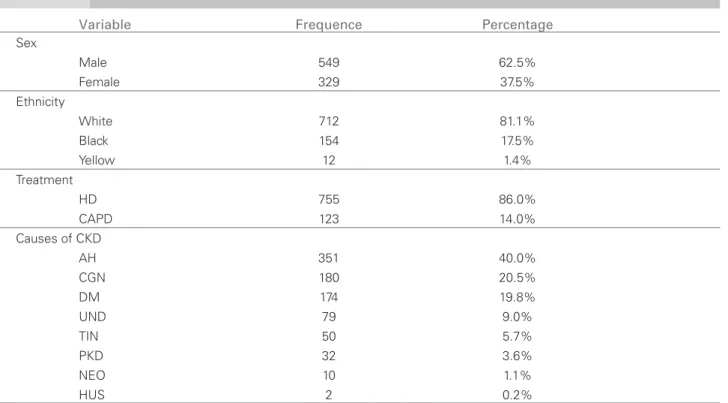
ESULTSFrom 1984 to 2009, 878 patients were admitted for dialytic treatment, 549 (62.5%) of whom were males, and their ages ranged from 2 to 90 years (mean of 47.0 ± 16.2 years). Regarding ethnicity, 712 (81.1%) patients were white. The predominant dialysis moda-lity at admission was HD (752 patients, representing 85.6%). Regarding the etiology of the CKD, AH was the most frequent, affecting 351 (40.0%) patients. Table 1 shows the demographic characteristics, types of dialytic treatments used, and etiology of CKD. When assessing the etiologies of CKD over time, an increase in the incidence of DM and AH and a decre-ase in the incidence of CGN were observed. Figure 1 shows the evolution of the three main causes of CKD (DM, CGN and AH) over 25 years, divided into five subperiods (1984 to 1990, 1991 to 1995, 1996 to 2000, 2001 to 2005, and 2006 to 2009).
A progressive increase in the incidence of patients admitted to RRT has been observed. When dividing the time period analyzed into the above-mentioned five subperiods, the number of patients admitted per year was, on average, 18.6, 23.4, 35.2, 42.2, and 44.6, respectively. The current prevalence of patients on dialysis program is 344 per million inhabitants.
In the time periods of 1984 to 1990, 1991 to 1995, 1996 to 2000, 2001 to 2006, and 2007 to 2009, the mean ages at admission were 40.9, 43.9, 45.7, 50.3, and 52.6 years, respectively, which shows an increase over time and a statistically significant difference.
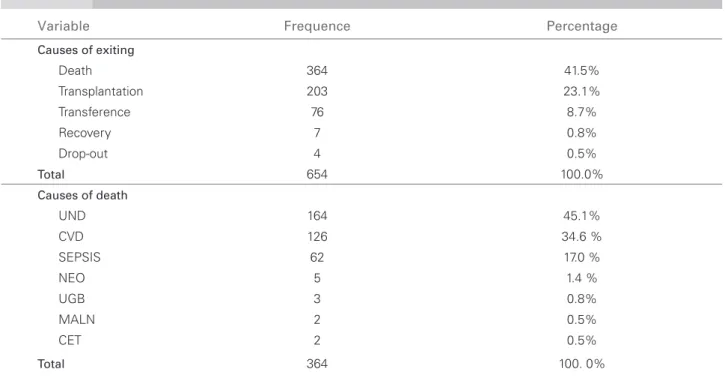
Regarding the reasons for exiting the program, death prevailed in 364 (41.5%) patients, followed by renal transplantation in 203 (23.1%) patients. Regarding the causes of death, the cardiovascular was the most frequent, affecting 126 (34.6%) patients. Table 2 shows the reasons for exiting the program and the causes of death in that population.
When comparing the patients who died with the survivors, no statistically significant difference was observed in regard to sex and ethnicity between both groups (p > 0.05). However, in regard to the type of treatment, patients on CAPD died more than those on HD (p < 0.0001). Regarding the other variables, the statistical analysis could not be performed because of the small number of patients in the subgroups.
The current situation of the patients on RRT is as follows: 133 transplanted patients with functioning kidneys; 172 patients on dialysis, 12 (7%) on CAPD and 160 (93%) on HD.
Figure 2 depicts Kaplan-Meier survival curve of the overall analysis of all patients in the period studied. 20 times greater when compared to that of the general
population, even when adjusting for other risk factors, such as age, ethnicity, sex, and presence of DM.9
This study aimed at assessing the profile of pa-tients with end-stage CKD, incidence of CKD, etio-logy of the underlying disease, dialysis modality, sur-vival in dialytic treatment, and the causes of death in western Paraná, comprising 25 municipalities and an estimated population of approximately 500,000 inha-bitants, in the past 25 years.
M
ETHODSWe reviewed the medical records of all patients un-dergoing dialysis (HD or peritoneal dialysis) in the past 25 years, in the city of Cascavel, State of Paraná, Brazil, available at the dialysis center Renalclin Oeste Ltda, which serves patients of an area of the State of Paraná comprising 25 municipalities. The population estimated in 2007 was approximately 500,000 inha-bitants. The following data were collected: sex; eth-nicity; age; dates of entering and exiting the dialysis program; dialysis modality; reason for exiting; and, in case of death, cause of death. The present study was approved by the Committee on Ethics and Research in Human Beings of the Universidade Estadual do Oeste do Paraná (157/2009-CEP).
The dialysis modality chosen was conventional HD, three sessions per week, each session lasting three to four hours. Continuous ambulatory peritone-al diperitone-alysis was indicated when vascular access lacked or when patients had better socioeconomic conditions and a profile adequate for the procedure.
Data were stored in a Microsoft Excel database and were analyzed by use of descriptive statistics as follo-ws: arithmetic mean; standard deviation; minimum and maximum values; and gross and percentage fre-quency. The differences between continuous variables with parametric distribution were analyzed by using the Student t test. Categorical variables were analyzed by use of the Chi-square test or Fisher exact test, ac-cording to the size of the sample. The mean ages at the different periods studied were compared by using analysis of variance (ANOVA) and Tukey test.
Annual mortality was 10.4%. When dividing the pe-riod studied into two subpepe-riods, no statistically sig-nificant difference was observed between both curves (p > 0.05) (Figure 3).
D
ISCUSSIONWe assessed a retrospective cohort of patients with CKD on dialysis, admitted at a single dialysis center over 25 years. The study assessed the profile of those patients, incidence of CKD, etiology of the underlying disease, survival of patients on dialysis, and causes of death.
A progressive increase in the incidence of patients admitted for RRT was observed and was dispropor-tional to the population increase, probably due to the better structuration of the health system. The inciden-ce in the literature varies from 18 per million inha-bitants in Ukraine to 213 per million inhainha-bitants in Germany. The prevalence of patients on RRT in this study was 344 per million inhabitants, while in 2006, in Europe, that prevalence was 630 per million inhabi-tants.10 We hypothesize whether the elevated number of renal transplantations performed in our region has contributed to that lower prevalence. Data referring to renal transplantation at our service were assessed
in another publication.11 In our study, the male sex prevailed, which is in accordance with the literature, where some series have reported a predominance of up to 70%.6
When assessing the etiology of the underlying dise-ase, a progressive increase in DM has been observed, as previously reported by our group.12 Those data are in accordance with those of other studies, which show
Table 1 DEMOGRAPHICCHARACTERISTICS, TYPESOFDIALYSISTREATMENT, ANDCAUSESOF CKD
Variable Frequence Percentage
Sex
Male 549 62.5%
Female 329 37.5%
Ethnicity
White 712 81.1%
Black 154 17.5%
Yellow 12 1.4%
Treatment
HD 755 86.0%
CAPD 123 14.0%
Causes of CKD
AH 351 40.0%
CGN 180 20.5%
DM 174 19.8%
UND 79 9.0%
TIN 50 5.7%
PKD 32 3.6%
NEO 10 1.1%
HUS 2 0.2%
AH: hypertension; DM: diabetes mellitus; CGN: chronic glomerulonephritis; UND: undetermined;
TIN: tubulointerstitial nephropathy; PKD: polycystic kidney disease; NEO: neoplasia, HUS: hemolytic-uremic syndrome.
DEMOGRAPHICCHARACTERISTICS, TYPESOFDIALYSISTREATMENT, ANDCAUSESOF CKD
Table 1
Figure 1. Evolution of the three major causes (DM, AH, and CGN) over 25 years, divided into fi ve subperiods (1984 to 1990, 1991 to 1995, 1996 to 2000, 2001 to 2005, and 2006 to 2009).
60
50
40
30
20
10
0
1984-1990 1991-1995 1996-2000 2001-2005 2006-2009
Period
Incidence
DM
CGN
that diabetic nephropathy is currently the major cause of starting RRT.13 A limitation regarding the assess-ment of the diagnosis of the underlying disease is the late presentation of patients at services of nephrology, usually already at an advanced stage of renal disease.
The most frequently used modality of dialysis has been conventional HD, three times per week. The CAPD has been reserved for patients with better
Table 2 CAUSESOFEXITINGTHEPROGRAMANDOFDEATHINTHEPOPULATIONSTUDIED
Variable Frequence Percentage
Causes of exiting
Death 364 41.5%
Transplantation 203 23.1%
Transference 76 8.7%
Recovery 7 0.8%
Drop-out 4 0.5%
Total 654 100.0%
Causes of death
UND 164 45.1%
CVD 126 34.6 %
SEPSIS 62 17.0 %
NEO 5 1.4 %
UGB 3 0.8%
MALN 2 0.5%
CET 2 0.5%
Total 364 100. 0%
UND = undetermined; CVD = cardiovascular disease; NEO = neoplasia; UGB = upper gastrointestinal bleeding; MALN = malnutrition; CET = cranioencephalic trauma
CAUSESOFEXITINGTHEPROGRAMANDOFDEATHINTHEPOPULATIONSTUDIED
Table 2
Figure 2. Kaplan-Meier survival curve of the overall analysis of all patients in the period studied.
Figure 3. Kaplan-Meier survival curve dividing the period studied into two subperiods.
socioeconomic conditions, or for those with no vascu-lar access.14,15 Thus, it is difficult to compare evolution data of patients treated with those modalities. Renal transplantation has better results in selected popula-tions, such as those lacking significant comorbidities, and at some age ranges.16,17 In our study, HD was the initial treatment in most patients, who had access to renal transplantation in 23.1% of the cases. There are several studies indicating a greater cardiovascular risk
100
80
60
40
20
0
Probability of accumulated survival (%)
Time (years)
0 5 10 15 20 25
100
80
60
40
20
0
Probability of accumulated survival (%)
Time (years)
0 5 10 15 20 25 Period
--- 1983-1999
for patients on peritoneal dialysis,18,19,20 and our da-ta have shown an increase in morda-tality for those pa-tients. Nevertheless, a study showed no difference in survival between both methods.21
The age of entering the dialytic program has be-en increasing over time. Jager et al.22 have shown that the percentage of elderly patients (≥ 65 years) on RRT was 22% in 1985 and 48% in 1999. Rayner
et al.23 have reported that approximately 50% of the patients admitted for dialysis are over the age of 65 years. Those are preoccupying data, because with the increase in prevalence in the elderly, comorbidi-ties and the cardiovascular risk also increase.24
The annual mortality in that group of patients was 10.4%. When assessing if an alteration in sur-vival has occurred over the years, no difference was observed. In our interpretation, this is positive, be-cause, despite the increase in the diabetic popula-tion, with lower survival as already shown by our group12, and an increase in the age of patients at ad-mission, a decrease in survival would be expected. However, an improvement in the quality of dialysis and availability of new medications (erythropoie-tin, sevelamer) has occurred in the last period stu-died, as shown in Figure 3. The annual mortality in patients on HD in other studies has varied from approximately 10% in Japan,25 16.3% in Italy26 to over 20% in Mexico.27
Regarding the causes of death in patients on RRT, the cardiovascular cause has been the most common.28 When assessing the causes of death in the elderly, no difference exists as compared with the general population on dialysis.22 Mechanisms have been proposed to explain that elevated cardio-vascular mortality in individuals on dialysis, such as accelerated atherogenesis, dyslipidemia, endothelial dysfunction, and inflammation.29,30 Patients over the age of 75 years have an increased risk of death due to cardiovascular cause of up to five times, and it may reach 375 times for patients aged from 25 to 35 years.24 Those data are preoccupying and may be even more alarming, considering that undetermined causes may comprise cases of cardiovascular cause.
One limitation of this study is its retrospective characteristic, but data were collected by the same team caring for the patients for over 25 years. As in any epidemiological study, in regard to the etio-logy of CKD, AH may be overestimated and CGN may be underestimated as its cause, because of the admission of many end-stage renal disease patients for dialysis, many of whom without undergoing re-nal biopsy.
C
ONCLUSIONSIn this study, this cohort of patients showed low mor-tality. Cardiovascular disease remains the major cau-se of death in the population with end-stage CKD. Screening for cardiovascular disease is highly recom-mended for those patients.
We hope to have contributed to the better unders-tanding of end-stage CKD and of RRT among us. Despite all difficulties found in approaching those patients, we conclude that we provide quality heal-th care wiheal-th satisfactory survival rates in all dialysis modalities available for patients with chronic disease. New strategies have been implemented to enable early diagnosis and referral to a nephrologist at earlier sta-ges of the disease.
R
EFERENCES1. Riella MC. Princípios de nefrologia e distúrbios hidro-eletrolíticos. 4 ed. Rio de Janeiro: Guanabara Koogan, 2003, pp. 649-60.
2. McDonald SP, Russ GR, Kerr PG, Collins JF. ESRD in Australia and New Zealand at the end of the millen-nium: A report from the ANZ-DATA registry. Am J Kidney Dis 2002; 40:1122-31.
3. Oliveira MB, Romão Junior JE, Zatz R. End-stage renal disease in Brazil: epidemiology, prevention, and treat-ment. Kidney Int 2005; 68:S82-6.
4. Sesso R, Gordan P. Dados disponíveis sobre a doença renal crônica no Brasil. J Bras Nefrol 2007; 29:9-12. 5. Makekmakan L, Haghpanah S, Pakfetrat M,
Makekmakan A, Khajehdehi P. Causes of chronic renal failure among Iranian Hemodialysis patients. Saudi J Kidney Dis Transpl 2009; 20:501-4.
6. Agarwal SK, Srivastava RK. Chronic kidney disease in Índia: challenges ans solutions. Nephron Clin Pract 2009; 111:c197-c203.
7. Wakai K, Nakai S, Kikuchi K et al. Trends in inci-dence of end-stage renal disease in Japan, 1983-2000: age-ajusted and age-specific rates by gender and cause. Nephrol Dial Transplant 2004; 19:2044-52. 8. García RP, Benítes PR, Dall C, Gómez AP, Valderrabano
CF. Preocupante incremento de la diabetes como causa de insuficiência renal terminal. Evaluación del trata-miento sustitutivo. An Med Int 2001; 18:175-80. 9. Foley RN, Parfrey PS, Sarnak MJ. Clinical
epidemio-logy of cardiovascular disease in chronic renal disease. Am J Kidney Dis 1998;32(Suppl 3):S112-9.
10. Stel VS, Kramer A, Zoccali C, Jager KJ. The 2006 ERA-EDTA Registry annual report:a précis. Nephrol 2009; 22:1-12.
11. Peres LAB, Ann HK, Camargo MTA et al. Análise da sobrevida de enxertos e receptores de 188 transplan-tes renais realizados na cidade de Cascavel, PR. J Bras Nefrol 2003; 25:133-41.
13. Locatelli F, Pozzoni P, Vecchio LD. Renal replacement therapy in patients with diabetes and end-stage renal disease. J Am Soc Nephrol 2004; 15:S25-9.
14. Nesrallah G, Mendelssohn DC. Modality options for renal replacement therapy: the integrated care concept revisited. Hemodialysis International 2006; 10:143-51. 15. Farrington K, Rao R, Stenkamp R, Ansell D, Feest T.
All patients receiving renal replacement therapy in the United Kingdom in 2005. Nephrol Dial Transplant 2007; 22:30-50.
16. Kalo Z, Jaray J, Nagy J. Economic evaluation of kidney transplantation versus hemodialysis in patients with end-stage renal disease in Hungary. Prog Transplant 2001; 11:88-93.
17. Winkelmayer WC, Weinstein MC, Mittleman MA, Glynn RJ, Pliskin JS. Health economic evaluations: the special case of end-stage renal disease treatment. Med Decis Making 2002; 22:417-30.
18. Wang AY. Cardiovascular risk factors in perito-neal dialysis patients revisited. Perit Dial Int 2007; 27:S223-7.
19. García-López E, Carrero JJ, Suliman ME, Lindholm B, Stenvinkel P. Risk factors for cardiovascular disease in patients undergoing peritoneal dialysis. Perit Dial Int 2007; 2:S205-9.
20. Fassett RG, Driver RG, Healy H, Coombes JS. Cardiovascular disease in peritoneal dialysis patients. Panminerva Med 2009; 51:151-61.
21. Huang CC, Cheng KF, Wu HDI. Survival analysis: com-paring peritoneal dialysis and hemodialysis in Taiwan. Perit Dial Int 2008; 28:S15-S20.
22. Jager KJ, van Dijk PCW, Dekker FW, Stengel B, Simpson K, Briggs JD. The epidemic of aging in renal replacement therapy: an update on elderly patients and their outcomes. Clinical Nephrology 2003; 60:352-60.
23. Rayner HC, Pisoni RL, Bommer J et al. Mortality and hospitalization in hemodialysis patients in five European countries: results from the Dialysis Outcomes and Practice Patterns Study (DOPPS). Nephrol Dial Transplant 2004; 19:108-120.
24. Vanholder R, Massy Z, Argiles A, Spasovski G, Verbeke F, Lameire N. Chronic kidney disease as cause of car-diovascular morbidity and mortality. Nephrol Dial Transplant 2005; 20:1048-56.
25. Ajiro J, Alchi B, Narita I et al. Mortality predictors af-ter 10 years of dialisys: A prospective study of Japanese hemodialysis patients. Clin J Am Soc Nephrol 2007; 2:653-60.
26. Brunori G, Viola BF, Maiorca P, Cancarini G. How to manage elderly patints with chronic renal failure: conservative management versus dialysis. Blood Purif 2008; 26:36-40.
27. Garcia-Garcia G, Briseño-Rentería G, Luquín-Arellano VH et al. Survival among patients with kidney failure in Jalisco, Mexico. J Am Soc Nephrol 2007; 18:1922-7. 28. Bloembergen WE, Port FK, Mauger EA, Wolfe RA.
Causes of death in dialysis patients: racial and gender differences. J Am Soc Nephrol 1994; 5:1231-42. 29. Ganesh SK, Hulbert-Shearon T, Port FK, Eagle K, Stack
AG. Mortality differences by dialysis modalities among incident ESDR patients with and without coronary ar-tery disease. J Am Soc Nephrol 2003; 14:415-24. 30. Razeghi E, Omati H, Maziar S, Khashayar P,