Psychological factors and the
incidence of temporomandibular
disorders in early adolescence
Abstract: The purpose of the present study was to evaluate the relation-ship between psychological variables and the clinical diagnosis of tem-poromandbular disorders (TMD) in 12-year-old adolescents. TMD pain was assessed by RDC/TMD examination (Research Diagnostic Criteria for Temporomandibular Disorders) (Axis I and II). Five-hundred and ifty-eight subjects (330 girls and 228 boys) were examined. Bivariate analyses were performed using the Chi-square test (χ2). The logistic re-gression models were adjusted estimating the Odds Ratios (OR), their 95% conidence intervals (CI), and signiicance levels. Only 2.19% of the boys and 8.18% of the girls presented one of the Axis I categories. All variables from axis II were related to TMD diagnosis (p < 0.001). Gen-der was signiicantly related to TMD diagnosis (p = 0.0028). The risk of TMD incidence for girls was 3.5 times higher than that for boys (Odds Ratio = 3.52, Conidence Interval 1.31-9.43). The individuals who pre-sented the variable “characteristics of pain intensity” (CPI) higher than 0 had 31 times more risk of TMD incidence (Odds Ratio = 31.361, Con-idence interval 6.01-163.5). We concluded that psychological variables and female gender are important risk indicators related to TMD inci-dence, even in adolescents.
Descriptors: Temporomandibular joint disorders; Adolescent psychology; Pain.
Luciano José Pereira(a)
Tatiana Pereira-Cenci(b)
Stela Márcia Pereira(c)
Altair Antoninha Del Bel Cury(d)
Glaucia Maria Bovi Ambrosano(e)
Antônio Carlos Pereira(e)
Maria Beatriz Duarte Gavião(f)
(a) PhD, Professor, Clinical Dentistry Graduate
Program, Oral Diagnosis Area, Vale do Rio Verde University (UNINCOR), Três Corações, MG, Brazil.
(b) PhD, Professor, Department of
Prosthodontics, Federal University of Pelotas, RS, Brazil.
(c) PhD, Professor, Department of Social
Dentistry and Collective Health, Lavras University Center (UNILAVRAS), MG, Brazil.
(d) PhD, Professor, Prosthodontics and
Periodontology Department, Piracicaba Dental School, University of Campinas, Piracicaba, SP, Brazil.
(e) PhD, Professor, Social and Public Health
Department, Piracicaba Dental School, University of Campinas, Piracicaba, SP, Brazil.
(f) PhD, Professor, Pediatric Dentistry
Department, Piracicaba Dental School, University of Campinas, Piracicaba, SP, Brazil.
Corresponding author: Luciano José Pereira
Rua Horácio de Carvalho, 125 Lavras - MG - Brazil
CEP: 37200-000
E-mail: [email protected]
Introduction
Temporomandibular disorder (TMD) is a col-lective term embracing a number of clinical condi-tions involving the temporomandibular joint (TMJ), masticatory muscles and/or associated structures.1 It has generally been presumed to be a condition affecting adults; however, epidemiological studies have reported the presence of signs and symptoms in children.2-7 The prevalence is low in young chil-dren but increases with age in adolescence up to young adulthood.8
Presence of pain elsewhere in the body, female gender and perhaps pre-existing depressive symp-toms are associated with the onset and maintenance of temporomandibular pain in adults.9 Epidemio-logic studies have also found a higher prevalence of these conditions, and back pain as well,10 among teenage girls compared to boys.11 The fact that some women are more susceptible to musculoskeletal pain than men, even in the early stages of puberty, is still unknown.
Female reproductive hormones are known to be associated with increased risk of TMD pain.12 Like-wise, pubertal development is more associated with pain than age. As the presence of reproductive hor-mones increases the risk of developing pain, TMD pain prevalence should increase throughout puberty in girls.11 If gender is related to TMD onset, this factor may begin to play a role during the adoles-cent period.
Biopsychosocial models emphasizing the multi-factorial nature of TMD and considering the role of cognitive, social, and biological factors in the aetiol-ogy of TMD have also been considered.13,14 There is a consensus among researchers and clinicians about the importance of assessing and managing both phys-ical and psychologphys-ical factors in TMD patients. The most widely studied measurement method for these variables is the Research Diagnostic Criteria (RDC/ TMD),15,16 which established a dual diagnosis that recognizes not only the physical conditions (Axis I), including muscle disorders, disc displacements and other types of joint conditions that may contribute to the pain disorder, but also the psychosocial issues (Axis II) that contribute to the suffering, pain be-havior, and disability associated to the patient’s pain
experience,17 including self-report measurements of pain,18 depression and somatization.
Thus, the aim of the present study was to evalu-ate the association between gender and psychologi-cal variables (RDC/TMD Axis II) and temporo-mandibular disorder diagnosis (RDC/TMD Axis I) in 12-year-old children.
Material and Methods
Ethical aspects
This study was approved by the Research Ethics Committee of the Piracicaba Dental School, State University of Campinas. An Informed Consent Form containing information about the clinical examina-tion that would be carried out as well as the ben-eits and possible risks for participants was obtained from parents prior to the survey. The children were also formally informed about the study procedures and assented to participate.
Study sample and data collection procedures
par-ticipated in the calibration process, which was divid-ed into theoretical discussions on codes and criteria for the study, and practical activities. Subjects meet-ing the criteria for myofascial pain with or without limited opening (Axis I, Group 1a or 1b disorders) and/or for disc displacement with reduction, without reduction with limited opening or without reduction without limited opening (Axis I, Group 2a, 2b or 2c) or for arthralgia or arthritis (Axis I, Group 3a or 3b) were considered to have an RDC/TMD pain diag-nosis. The exclusion criteria were facial traumatism, neurological or psychiatric disorders, use of dental prosthesis, previous or present orthodontic treat-ment and other orofacial pain conditions, which could interfere in RDC/TMD diagnosis.
All subjects were submitted to the RDC/TMD Axis II self-report measurements, in portuguese.19 These included the Graded Chronic Pain Scale (GCPS) and depression and somatization measure-ments. The GCPS includes measurements of the characteristics of pain intensity (CPI), pain related interference and number of disability days (disabili-ty). CPI is the average of three 0 to 10 numeric rating scales, asking subjects to report on average, worst, and present facial pain levels. Pain interference or disability is the average of three 0 to 10 numeric rat-ing scales, where subjects were asked to report on interference with daily, recreational/social/family and work-related activities.
Statistical analysis
The prevalence of TMD according to RDC/TMD was calculated for the entire sample. The dependent variable (TMD diagnosis) was dichotomized ac-cording to “yes” or “no”. Bivariate analyses were performed to test the inluence of independent vari-ables (behavioral varivari-ables related to RDC Axis II) on dependent variable TMD, using the Chi-square test (χ2) at the 5% signiicance level. Then multiple logistic regression analysis using the stepwise pro-cedure was performed in order to identify the as-sociated factors for TMD. Only the independent variables that showed signiicant association (on the univariate analysis) at p < 0.05 were selected for the regression analysis in order to eliminate variables that would make little contribution to the model.20
The logistic regression models were adjusted esti-mating the Odds Ratios (OR), their 95% conidence intervals (CI), and signiicance levels. All statistical tests were performed using the SAS software (SAS Institute Inc. 9.1, 2003; Cary, NC, USA) at the 5% signiicance level.
Results
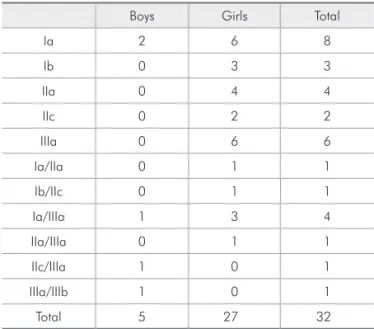
The prevalence of TMD pain diagnosis among 12-year-old children according to the RDC/TMD protocol applied in the present study was low. Only 2.19% of the boys and 8.18% of the girls presented one of the Axis I categories. The TMD subdiagnosis distribution is shown in Table 1.
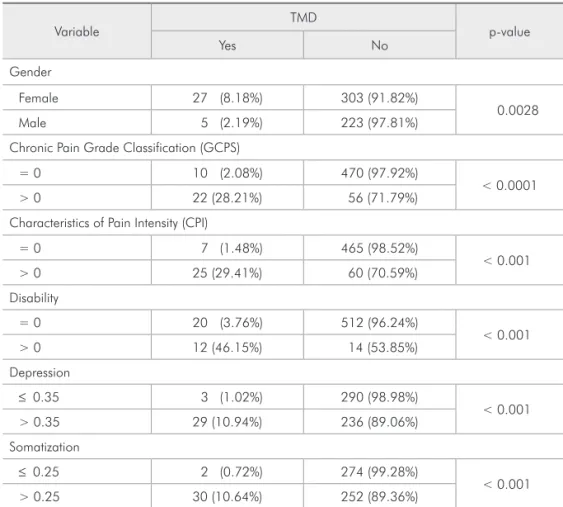
Table 2 shows the association between the inde-pendent variables and TMD diagnosis as revealed by the bivariate Chi-square test. The bivariate anal-ysis showed that gender was signiicantly related to TMD diagnosis (p = 0.0028). All variables from Axis II were related to TMD diagnosis (p < 0.001).
The multivariate stepwise logistic regression (Ta-ble 3) with “TMD” as dependent varia(Ta-ble showed that “gender” and “characteristics of pain inten-sity” (CPI) were associated factors for temporo-mandibular disorder diagnosis. The risk of TMD for girls was 3.52 times higher than for boys (Odds Ratio = 3.52, Conidence Interval 1.31-9.43). Indi-viduals who presented the variable “characteristics
Table 1 - RDC/TMD subdiagnosis distribution in both gen-ders (Total n = 558; Total TMD = 32).
Boys Girls Total
Ia 2 6 8
Ib 0 3 3
IIa 0 4 4
IIc 0 2 2
IIIa 0 6 6
Ia/IIa 0 1 1
Ib/IIc 0 1 1
Ia/IIIa 1 3 4
IIa/IIIa 0 1 1
IIc/IIIa 1 0 1
IIIa/IIIb 1 0 1
of pain intensity” (CPI) higher than 0 had 31 times more risk of TMD incidence (Odds Ratio = 31.361, Conidence interval 6.01-163.5).
Discussion
The purpose of the present study was to evaluate the relationship between RDC/TMD Axis I and II in adolescents. An additional aim was to investigate risk factors for speciic TMD subdiagnoses. This, however, was not done because of the small number of young individuals with TMD. The prevalence of TMD in children is expected to be low. In the pres-ent research the mean prevalence was around 6%, which is similar (6.8%) to that found previously in
a sample of 1,996 children with the same age, us-ing RDC/TMD.9 Studies have reported that severe disorder at a young age is rare,1 corroborating the present results.
In the sample of 558 boys and girls evaluated in the present study, 2.19% of the boys and 8.18% of the girls met the RDC/TMD criteria when exam-ined. In the multivariate analysis, gender was an important risk indicator for TMD. The role of gen-der in pain is extensively discussed in literature,21 suggesting that TMD is considered to be 1.5-2 times more prevalent in women than in men, and that 80% of the patients treated for this disorder are women.22 However, the most prominent gender
TMD – yes Odds ratio Odds ratio (CI) p-level
Gender Female 27 (8.18) 3.52 1.31-9.43 0.011 Male 5 (2.19%) Reference
Characteristics of Pain Intensity (CPI)
> 0 25 (29.41%) 31.361 6.01-163.5 < 0.0001
= 0 7 (1.48%) Reference
CI: Confidence interval.
Table 3 - Multivariate stepwise forward proceeding analysis for TMD and independent variables.
Variable
TMD
p-value
Yes No
Gender
Female 27 (8.18%) 303 (91.82%)
0.0028
Male 5 (2.19%) 223 (97.81%)
Chronic Pain Grade Classification (GCPS)
= 0 10 (2.08%) 470 (97.92%)
< 0.0001 > 0 22 (28.21%) 56 (71.79%)
Characteristics of Pain Intensity (CPI)
= 0 7 (1.48%) 465 (98.52%)
< 0.001 > 0 25 (29.41%) 60 (70.59%)
Disability
= 0 20 (3.76%) 512 (96.24%)
< 0.001 > 0 12 (46.15%) 14 (53.85%)
Depression
≤ 0.35 3 (1.02%) 290 (98.98%)
< 0.001 > 0.35 29 (10.94%) 236 (89.06%)
Somatization
≤ 0.25 2 (0.72%) 274 (99.28%)
< 0.001 > 0.25 30 (10.64%) 252 (89.36%)
differences have been found in women aged 20-40 years, and the lowest among children, adolescents and the elderly.23
Axis II RDC questions involving depression and somatization are subscales from the SCL-90. The SCL-90 is designed to be administered to subjects aged 13+ with at least a 6th grade reading level. In Brazil, however, 6th grade students are 12 years old which could justify its use at this age. Besides, ques-tions regarding sexual behavior were excluded to avoid embarrassment.
The results of the present study demonstrated that all variables in RDC/TMD Axis II were cor-related to TMD diagnosis, which was expected. Psychological disturbances are common in patients with signs and symptoms of TMD, even for adoles-cents3, and depressive behavior is commonly asso-ciated with chronic pain. Chronic pain severity in RDC/TMD diagnosed patients has demonstrated signiicant correlation with depression levels.24 In this study, higher disability, depression and soma-tization scores can be important risk indicators of TMD diagnosis, especially CPI. Considering that the diagnosis, assessment and management of TMD must include both physical (e.g. TMJ, occlusion, muscles) and psychological (e.g. personality, affec-tive states, distress) factors, it is suggested that
psy-chological measurement can be an effective tool in the current integrated approach with regard to the biopsychosocial model of TMD. The Axis II vari-ables in the present study were dichotomized by the median value, since the sample was comprised of young subjects, and severe psychological alteration is rare. Although the RDC/TMD scales of depres-sion and somatization have considerable data in sup-port of reliability, validity and clinical utility when compared with other measurements of psychological status and psychosocial functioning,16 they merely provide an assessment of clinical characteristics and are not a diagnosis. The results could be more signiicant in individuals with clinically diagnosed TMD, which will be the focus of our future studies.
Conclusion
Psychological variables and gender are important risk indicators for TMD diagnosis incidence, even in adolescents.
Acknowledgments
The irst author wishes to thank the CNPq (Bra-zilian Council for Scientiic Research and Devel-opment, grant #151940/06-1) for the Postdoctoral scholarship provided for the undertaking of this research.
References
1. Thilander B, Rubio G, Pena L, de Mayorga C. Prevalence of temporomandibular dysfunction and its association with malocclusion in children and adolescents: an epidemiologic study related to specified stages of dental development. Angle Orthod. 2002 Apr;72(2):146-54.
2. Bonjardim LR, Gaviao MB, Carmagnani FG, Pereira LJ, Cas-telo PM. Signs and symptoms of temporomandibular joint dysfunction in children with primary dentition. J Clin Pediatr Dent. 2003;28(1):53-8.
3. Bonjardim LR, Gaviao MB, Pereira LJ, Castelo PM. Anxi-ety and depression in adolescents and their relationship with signs and symptoms of temporomandibular disorders. Int J Prosthodont. 2005 Jul-Aug;18(4):347-52.
4. Kritsineli M, Shim YS. Malocclusion, body posture, and tem-poromandibular disorder in children with primary and mixed dentition. J Clin Pediatr Dent. 1992 Winter;16(2):86-93. 5. Morinushi T, Ohno H, Ohno K, Oku T, Ogura T. Two year
longitudinal study of the fluctuation of clinical signs of TMJ
dysfunction in Japanese adolescents. J Clin Pediatr Dent. 1991 Summer;15(4):232-40.
6. Sonmez H, Sari S, Oksak Oray G, Camdeviren H. Preva-lence of temporomandibular dysfunction in Turkish children with mixed and permanent dentition. J Oral Rehabil. 2001 Mar;28(3):280-5.
7. Wahlund K. Temporomandibular disorders in adolescents. Epidemiological and methodological studies and a random-ized controlled trial. Swed Dent J Suppl. 2003;(164):inside front cover, 2-64.
8. Egermark I, Carlsson GE, Magnusson T. A 20-year longitu-dinal study of subjective symptoms of temporomandibular disorders from childhood to adulthood. Acta Odontol Scand. 2001 Feb;59(1):40-8.
10. Wedderkopp N, Andersen LB, Froberg K, Leboeuf-Yde C. Back pain reporting in young girls appears to be puberty-related. BMC Musculoskelet Disord. 2005 Nov;1(6):52. 11. LeResche L, Mancl LA, Drangsholt MT, Saunders K, Korff
MV. Relationship of pain and symptoms to pubertal develop-ment in adolescents. Pain. 2005 Nov;118(1-2):201-9. 12. LeResche L, Saunders K, Von Korff MR, Barlow W, Dworkin
SF. Use of exogenous hormones and risk of temporomandibu-lar disorder pain. Pain. 1997;69(1-2):153-60.
13. Sherman JJ, LeResche L, Huggins KH, Mancl LA, Sage JC, Dworkin SF. The relationship of somatization and depression to experimental pain response in women with temporoman-dibular disorders. Psychosom Med. 2004 Nov-Dec;66(6):852-60.
14. Suvinen TI, Reade PC, Kemppainen P, Kononen M, Dworkin SF. Review of aetiological concepts of temporomandibular pain disorders: towards a biopsychosocial model for integration of physical disorder factors with psychological and psychosocial illness impact factors. Eur J Pain. 2005 Dec;9(6):613-33. 15. Dworkin SF, LeResche L. Research diagnostic criteria for
temporomandibular disorders: review, criteria, examina-tions and specificaexamina-tions, critique. J Craniomandib Disord. 1992;6(4):301-55.
16. Dworkin SF, Sherman J, Mancl L, Ohrbach R, LeResche L, Truelove E. Reliability, validity, and clinical utility of the research diagnostic criteria for temporomandibular disorders
axis II scales: depression, non-specific physical symptoms and graded chronic pain. J Orofac Pain. 2002;16(3):207-20. 17. Sipilä K, Zitting P, Siira P, Laukkanen P, Jarvelin MR,
Oikar-inen KS et al. Temporomandibular disorders, occlusion, and neck pain in subjects with facial pain: a case-control study. Cranio. 2002;20(3):158-164.
18. Von Korff M, Ormel J, Keefe FJ, Dworkin SF. Grading the severity of chronic pain. Pain. 1992 Aug;50(2):133-49. 19. Lucena LB, Kosminsky M, Costa LJ, Góes PSA. Validation
of the Portuguese version of the RDC/TMD Axis II question-naire. Braz Oral Res. 2006 Oct-Dec;20(4):312-7.
20. Lucas SD, Portela MC, Mendonça LL. Variations in tooth de-cay rates among children 5 and 12 years old in Minas Gerais, Brazil. Cad Saude Publica. 2005 Jan-Feb;21(1):55-63. 21. Dao TT, LeResche L. Gender differences in pain. J Orofac
Pain. 2000 Summer;14(3):169-84.
22. LeResche L. Epidemiology of temporomandibular disorders: implications for the investigation of etiologic factors. Crit Rev Oral Biol Med. 1997;8(3):291-305.
23. Meisler JG. Chronic pain conditions in women. J Womens Health. 1999 Apr;8(3):313-20.