360
Sleep bruxism and temporomandibular disorders: systematic review*
Bruximo do sono e disfunções temporomandibulares: revisão sistemática
Rafael Schlogel Cunali
1, Danielle Medeiros Veiga Bonotto
1, Eduardo Machado
1, Priscila Brenner
Hilgenberg
2, Daniel Bonotto
3, Aguinaldo Coelho de Farias
4, Paulo Afonso Cunali
5* Received from the Specialization Course, Temporomandibular Disorders and Orofacial Pain, Federal University of Paraná (UFPr). Curitiba, PR.
1. Specialists in Temporomandibular Disorders and Orofacial Pain, Federal University of Paraná (UFPr). Curitiba, PR, Brazil. 2. Master in Oral Rehabilitation, Dentistry School of Bauru, University of São Paulo (FOB/USP); Specialist in Dental Pros-thesis, FOB/USP. Curitiba, PR, Brazil.
3. Professor of the Positivo University; Master in Sciences, Catholic University of Paraná (PUCPr); Specialist in Temporo-mandibular Disorders and Orofacial Pain, Federal University of Paraná (UFPr). Curitiba, PR, Brazil.
4. Professor, Federal University of Paraná; Doctor in Orthodon-tics, Paulista State University (UNESP); Specialist in Temporo-mandibular Disorders and Orofacial Pain, Federal University of Paraná (UFPr). Curitiba, PR, Brazil.
5. Professor, Federal University of Paraná; Coordinator of the Specialization Course, Temporomandibular Disorders and Pain, UFPr; Doctor in Sciences, Federal University of São Pau-lo (UNIFESP); Specialist in Temporomandibular Disorders and Orofacial Pain. Curitiba, PR, Brazil.
Correspondence to:
Rafael Schlogel Cunali, M.D. Rua Padre Agostinho, 805 80430-050 Curitiba, PR. Phone: +55 (41) 3322-12134 E-mail: [email protected]
SUMMARY
BACKGROUND AND OBJECTIVES:
Epidemiolog-ic studies of temporomandibular disorders (TMD) bring general understanding of the role of sleep bruxism (SP) as TMD triggering and/or perpetuating factor. To date, studies on this association have not shown conclusive
results. A reason for the low speciicity level of this asso -ciation is the different diagnostic methodology, both for TMD and SB. This study aimed at evaluating the possi-ble cause and effect ratio between SB and TMD.
CONTENTS: Systematic literature review of research databases Medline, Cochrane, EMBASE, Pubmed, LILACS and BBO. Eligible criteria were papers pub-lished between January 2000 and August 2012, using the Research Diagnostic Criteria (RDC/TMD) for TMD
diagnosis and polysomnography (PSG) for SB evalu-ation. Nine studies were selected by crossing chosen keywords. After applying inclusion criteria, four studies
were selected. From ive discarded studies, two were pi -lot studies, one was a review article, one case report and one comparative study not using RDC/TMD.
CONCLUSION:Evaluated studies were unable to
es-tablish a positive relationship between SB and TMD when keywords sleep bruxism, temporomandibular dis-orders and polysomnography were crossed; however they reinforce the need for referring TMD patients with sleep disorders to polysomnographic evaluation.
Keywords: Polysomnography, RDC/TMD, Sleep
brux-ism, Temporomandibular disorder.
RESUMO
JUSTIFICATIVA E OBJETIVOS: Os estudos
epide-miológicos das disfunções temporomandibulares (DTM) trazem compreensão geral a respeito do papel que o bruxismo do sono (BS) tem como fator do desencadea-mento e/ou da sua perpetuação. Até o modesencadea-mento, estudos a respeito dessa associação, não mostraram resultados conclusivos. Uma das causas responsáveis pelo baixo
grau de especiicidade dessa associação é a diferente
metodologia de diagnóstico, tanto para as DTM como para o BS. O objetivo deste estudo foi avaliar a possível relação de causa e efeito entre o BS e a DTM.
CONTEÚDO: Revisão sistemática da literatura nas
bases de pesquisas Medline, Cochrane, EMBASE, Pub-med, LILACS e BBO. Foram considerados trabalhos publicados entre janeiro de 2000 e agosto de 2012, que utilizaram o Reseach Diagnostic Criteria (RDC/TMD)
para diagnóstico de DTM, e a polissonograia (PSG) para
Dos cinco estudos descartados, dois eram estudos piloto, um era artigo de revisão, um relato de caso, e outro um estudo comparativo que não utilizou o RDC/TMD.
CONCLUSÃO: Os trabalhos avaliados não permitem
estabelecer relação positiva entre o BS e a DTM, quando se cruzam os descritores bruxismo do sono, disfunção temporomandibular e PSG, porém reforçama necessi-dade de encaminhar pacientes de DTM com queixas de
distúrbios do sono para avaliação polissonográica.
Descritores: Bruxismo do sono, Disfunção
temporo-mandibular, Polissonograia, RDC/TMD.
INTRODUCTION
Temporomandibular disorders (TMD) are functional changes of temporomandibular joints (TMJ) and/or mas-ticatory muscles. Its etiology is multifactorial. TMD trig-gering and perpetuation are conditioned to the interaction of factors such as trauma, ligament laxity, parafunctional habits, stress and systemic changes, among others1. The American Academy of Orofacial Pain deines brux -ism as a parafunctional diurnal or nocturnal activity which includes tooth grinding and clenching2. According to the International Classiication of Sleep Disorders3,
sleep bruxism (SB) is the oral activity characterized by tooth grinding or clenching during sleep, in general as-sociated to micro arousals. So, there are SB and vigil bruxism. Among undesirable effects of this disorder, there are teeth wear, dental sensitivity to thermal stimu-lations, orofacial pain and temporal headache.
Currently, SB is considered a movement disorder3 and
no longer parasomnia. When there are no evident sys-temic or psychiatric medical causes, SB is considered primary SB. When associated to clinical, neurological or psychiatric disorders, or related to drug and/or substance use or withdrawal, it is considered secondary SB4-6.
SB is being studied as risk and/or perpetuation factor of TMD7-14; however, there are few studies with adequate
methodological criteria evaluating the association of SB
and TMD. The lack of standardization of diagnostic meth-ods, both for TMD and SB, explains why this association has not yet been proven or discarded. Although to date the best tools for SB and TMD research diagnosis are respectively polysomnography (PSG) and the Research Diagnostic Criteria (RDC/TMD), even studies simultane-ously applying these two tools have not concluded that
SB identiied by PSG is a major risk factor for TMD. So,
recent studies13,14 have used, respectively, the collection of
self-reports and clinical criteria of the American Academy of Sleep Medicine3 to diagnose and relate SB to TMD.
O objetivo deste estudo foi avaliar a associação entre o BS e a DTM.
This study aimed at evaluating the association between SB and TMD.
METHOD
A systematic review contemplating studies with the best methodological criteria is interesting to unveil the cur-rent level of evidence to associate SB to TMD.
Pubmed, Medline, LILACS and BBO databases were queried. Keywords were “sleep bruxism”, “polysomnog-raphy”, “temporomandibular disorders” and RDC/TMD, which were crossed in search mechanisms. Initial list of articles was reviewed by two evaluators, who applied
in-clusion criteria to determine the inal sample of articles.
Selection criteria were:
a) Studies published from January 2000 to August 2012; b) Diagnostic criteria: use of PSG or portable and vali-dated electromyography (Bite Strip) to evaluate SB, and RDC/TMD to evaluate the presence or absence of TMD; c) Articles written in English, Spanish or Portuguese; d) Pilot studies, case reports and simple literature re-views were excluded.
RESULTS
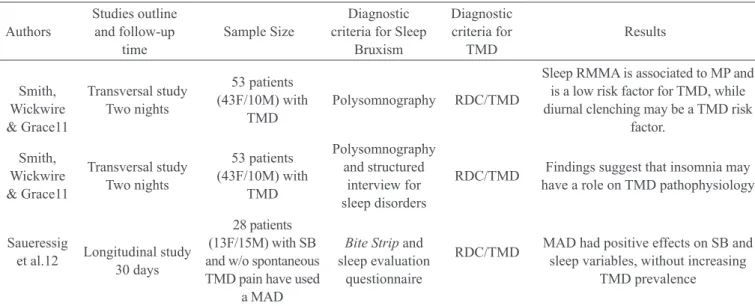
Nine studies were selected by crossing above-mentioned
Table 1 – Characteristics of included studies.
Authors Studies outline and
follow-up time Sample Size
Diagnostic criteria for Sleep Bruxism
Diagnostic criteria for
TMD
Results
Camparis et al.9
Transversal study One night
Group A: Bruxism with TMD (n =
20: 17 F/3M)
Polysomnography and questionnaire
RDC/TMD and interview
Without statistically signiicant
differences between groups with regard to bruxism and evaluated sleep variables
Rossetti e col.10
Transversal study Two nights
Group with TMD (n = 30: 24F/6M)
Control group (n = 30: 24F/6M)
Polysomnography
and questionnaire RDC/TMD
Sleep RMMA is associated to MP and is a low risk factor for TMD, while diurnal clenching may be a TMD risk factor.
keywords. After applying inclusion criteria, four stud-ies were selected (Table 1), with Kappa agreement index
between reviewers of 1.00. From ive discarded studies,
two were pilot studies, one was simple review article, one was a case report and one was a comparative study, however not using RDC/TMD.
DISCUSSION
It was very dificult to search the scientiic literature to
study any SB-related subject because there is a huge number of studies. Pubmed has 2389 publications about bruxism. How to select what to study? Determining key-words is critical, altough this limits the study. To
scien-tiically meet such limitation in a study model looking
for causal relationship, diagnostic criteria are of major importance. They will be the basis of the sample to be studied and compared. If this was a study aiming at com-paring treatments, randomized double blind studies with control groups would be preferred.
SB may be clinically diagnosed when there are typi-cal signs such as abnormal dental wear, tooth grinding sounds during sleep and mandibular muscle discomfort3.
Since clinical SB diagnosis by history has its limitations, the ideal is that all possible bruxists be submitted to PSG test15. This test is important to conirm SB diagnosis,
discarding other orofacial movements during sleep, such as swallowing, coughing, grunting or alternating mouth opening and closing, which may be mistaken for SB16.
Diagnostic criteria for TMD by RDC/TMD17 are
cur-rently being considered more reliable, being validated in
several languages in an attempt to standardize research in this area. With RDC/TMD, joint and muscle TMD may be diagnosed in subgroups and their impact on pain may be objectively measured.
All four selected studies of this systematic review have used RDC/TMD to evaluate and diagnose TMD. Even so, the name TMD is still erroneously interpreted. In the study11, the title suggests that the objective was
to evaluate the association between sleep disorders and sensitivity to laboratory pain in temporomandibular joint disorders, however TMD pain evaluated was miofascial pain, that is, a muscular pain. This problem is again ob-served when the methodology for dental assessment was evaluated, where the TMJ (Temporomandibular Joint) acronym is used in place of TMD (Temporomandibu-lar Disorder), and this is repeated throughout the article. Since the focus of this study was sensitivity to provoked pain in a group of patients with miofascial pain, a group of patients without TMD pain and without SB should have been comparatively evaluated. Clinical SB diagno-sis was done according to ICSD-23 and those described
in the study15 were used in PSG. Sample size was not
big, but the higher number of females (43 X 10) is in
line with other literature inding when TMD and sleep
disorders were evaluated18. It is interesting the inding
that 75% of the sample met the bruxism self-report crite-ria, but only 17% met PSG criteria for active SB. Other
important inding was the relationship of general hyper -algesia in patients with primary insomnia.
It is hypothetically expected that patients with miofas-cial pain will have more SB than those who are pain free.
Smith, Wickwire & Grace11
Transversal study Two nights
53 patients (43F/10M) with
TMD
Polysomnography RDC/TMD
Sleep RMMA is associated to MP and is a low risk factor for TMD, while diurnal clenching may be a TMD risk
factor.
Smith, Wickwire & Grace11
Transversal study Two nights
53 patients (43F/10M) with
TMD
Polysomnography and structured
interview for sleep disorders
RDC/TMD Findings suggest that insomnia may have a role on TMD pathophysiology
Saueressig
et al.12 Longitudinal study 30 days
28 patients (13F/15M) with SB and w/o spontaneous TMD pain have used
a MAD
Bite Strip and sleep evaluation
questionnaire
RDC/TMD MAD had positive effects on SB and sleep variables, without increasing
TMD prevalence
MP = miofascial pain; F = females; M = males; RDC/TMD: Research Diagnostic Criteria for TMD; RMMA = rhythmic muscular masticatory activity; SB = sleep bruxism; TMD = temporomandibular disorder; MAD = mandibular advancement device.
Table 1 – continuance
Authors
Studies outline and follow-up
time
Sample Size
Diagnostic criteria for Sleep
Bruxism
Diagnostic criteria for
TMD
A very well designed study using RDC/TMD to deine
groups with and without masticatory miofascial pain,
and PSG to conirm the presence of SB, has proven the
opposite. Participated in this study 20 patients with mio-fascial pain, being 3 males and 17 females, with 20 pain free patients, being 5 males and 15 females, submitted to one PSG night9, who were evaluated and compared. Results have not shown statistically signiicant differ -ences in sleep variables and bruxism for both groups. With these observations it is possible to conclude that polysomnographic characteristics of bruxism patients with and without orofacial pain are similar.
In the attempt to associate SB and TMD, the question is: those with SB have higher chances of having TMD pain? This question seems to be answered by a study10 where
au-thors have evaluated 30 patients with masticatory miofas-cial pain diagnosed by RDC/TMD, and 30 asymptomatic individuals who made up the control group. All patients were submitted to polysomnography. This study has not
shown signiicant differences between groups with regard to other sleep variables, but SB was signiicantly associated
to miofascial pain. For the authors, SB was a minor risk for masticatory miofascial pain. On the other hand, according to the authors, diurnal clenching is probably a more impor-tant risk factor and should always be considered.
PSG is still expensive. It depends on a structured sleep
laboratory, on qualiied technicians and on patients’ dis -placement. The portable Bite Strip device is an alternative to diagnose SB. The only study selected for this review which has not used PSG12, has used this portable device to
evaluate the effectiveness of a mandibular advancement device (MAD) to improve sleep and SB scores. The au-thors have used previous studies which have compared this device to PSG, validating it in some studies20-22.
Twenty-eight individuals with SB complaints were evaluated and treated with MAD. Adaptation period to the device was waived. SB scores were recorded at baseline and 30 days after using MAD. Participants of this study, 13 females and 15 males had clinical SB history, but had no TMD pain according to RDC/TMD.
It was possible to conirm clinical SB diagnosis, both
moderate and severe, by using Bite Strip in baseline conditions. RDC/TMD was applied before and 30 days after using MAD to check possible side effects. Data
have shown statistically signiicant improvement in
sleep and SB scores by Bite Strip and SQA. The use of
MAD has signiicantly decreased joint sounds, as well
as sensitivity to masseter and temporal muscles
palpa-tion. Conirming data of a different study, MAD had
positive effects on sleep and SB scores, measured by Bite Strip and SQA, respectively, and has not worsened
TMD signs and symptoms during a 30-day period22.
There are many publications on SB and TMD, but due to the subjectivity of diagnostic criteria and to methodo-logical limitations of clinical studies, conclusive results still cannot be obtained, however studies with represent-ative samples, long follow up time and adequate meth-odological criteria are needed to more accurately explain the relationship between SB and TMD using PSG and RDC/TMD.
CONCLUSION
Evaluated studies do not allow a positive relationship between SB and TMD when keywords sleep bruxism, temporomandibular disorders and polysomnography are crossed, however they reinforce the need to refer TMD patients with sleep disorder complaints to polysomno-graphic evaluation.
REFERENCES
1. Okeson JP, de Leeuw R. Differential diagnosis of tem-poromandibular disorders and other orofacial pain disor-ders. Dent Clin North Am. 2011;45(1):105-20.
2. American Academy of Orofacial Pain: Guidelines for assessments, diagnosis and management. Chicago: Quintessence, 1996.
3. American Academy of Sleep Medicine. The
Interna-tional classiication of sleep disorders, 2nd ed. Diagnostic
and coding manual. American Academy of Sleep Medi-cine: Westchester, IL; 2005.
4. Kato T, Rompré P, Montplaisir JY, et al. Sleep brux-ism: an oromotor activity secondary to micro-arousal. J Dent Res. 2001;80(10):1940-4.
5. Kato T, Thie NM, Montplaisir JY, et al. Bruxism and orofacial movements during sleep. Den Clin North Am. 2001;45(4):657-84.
6. Bader G, Lavigne G. Sleep bruxism; an overview of an oromandibular sleep movement disorder. Sleep Med. 2000;4(11):27-43.
7. Velly AM, Grornitsky M, Philippe P. Contributing factors to chronic miofascial pain: a case-control study. Pain. 2003;104(3):491-9.
8. Glaros AG, Williams K, Lausten L. The role of par-afunctions, emotions and stress in predicting facial pain. J Am Dent Assoc. 2005:136(4):451-8.
9. Camparis CM, Formigoni G, Teixeira MJ, et al. Sleep bruxism and temporomandibular disorder: Clini-cal and polysomnographic evaluation. Arch Oral Biol. 2006;51(9):721-8.
PH, et al. Association between rhythmic masticatory muscle activity during sleep and masticatory myofas-cial pain: a polysomnographic study. J Orofac Pain. 2008;22(3):190-200.
11. Smith MT, Wickwire EM, Grace EG. Sleep disor-ders and their association with laboratory pain sen-sitivity in temporomandibular joint disorder. Sleep. 2009;32(6):779-90.
12. Saueressig AC, Mainieri VC, Grossi PK, et al.
Anal-ysis of the inluence of a mandibular advancement de -vice on sleep and sleep bruxism scores by means of the BiteStrip and the Sleep Assessment Questionnaire. Int J Prosthodont. 2010;23(3):204-13.
13. Manfredini D, Winocur E, Guarda-Nardini L, et al. Self-report bruxism and tempromandibular disorders:
indings from two specialised centres. J Oral Rehabil.
2012;39(5):319-25.
14. Fernandes G, Franco AL, Siqueira JT, et al. Sleep bruxism increases the risk for painful
temporoman-dibular disorders, depression and non-speciic physical
symptoms. J Oral Rehabil. 2012:39(7):538-44.
15. Lavigne GJ, Rompré PH, Montplaisir JY. Sleep bruxism: validity of clinical research diagnostic crite-ria in a controlled polysomnographic study. J Dent Res. 1996;75(1):546-52.
16. Aloé F, Gonçalves LR, Azevedo A, et al. Bruxismo
durante o sono. Rev Neurociências. 2003:11(1):4-17. 17. Dworkin SF, Leresche L. Research diagnostic cri-teria for temporomandibular disorders: review, cricri-teria,
examinations and speciications, critique. J Craniomand
Disord. 2002;6(4):1-55.
18. Cunali PA, Almeida FR, Santos CD, et al. Prevalence of temporomandibular disorders in obstructive sleep ap-nea patients referred for oral appliance therapy. J Orofac Pain. 2009;23(4):339-44.
19. Shocat T, Gavish A, Arons E, et al. Validation of the BiteStrip screener for sleep bruxism. Oral Surg Oral Med Oral Pathol Oral Radiol Endod. 2007;104(3):32-9. 20. Ahlberg K, Savolainen A, Paju S, et al. Bruxism and
sleep eficiency measured at home with wireless devic -es. J Oral Rehabil. 2008;35(8):567-71.
21. Makino M, Masaki C, Tomoeda K, et al. The re-lationship between sleep bruxism behavior and salivary stress biomarker level. Int J Prosthodont. 2009;22(1):43-8.
22. Landry-Schonbeck A, de Grandmont P, Rompré PH, et al. Effect of an adjustable mandibular advancement appliance on sleep bruxism: a crossover sleep laboratory study. Int J Prosthodont. 2009;22(3):251-9.
Submitted in June 26, 2012.