The impact of speech rate on sentence recognition by elderly
individuals
Abstract
Alexandre Hundertmarck Lessa1, Maristela Julio Costa2
1 MSc. in Human Communicaions Disorders, Federal University of Santa Maria (Ph.D Student, Human Communicaion Disorders, Federal University of Santa Maria; Scholarship Holder, FAPERGS/CAPES).
2 PhD in Human Communicaion Disorder Sciences, Federal University of São Paulo (Adjunct Professor, Department of Speech and Hearing Therapy, Federal University of Santa Maria; Research Scholarship Holder - Level 2, CNPq).
Federal University of Santa Maria - UFSM.
Send correspondence to: Alexandre Hundertmarck Lessa. Rua Conde de Porto Alegre, nº 961, apto. 801. Centro. Santa Maria - RS. Brasil. CEP: 97015-110. E-mail: [email protected]
CAPES.
Paper submited to the BJORL-SGP (Publishing Management System – Brazilian Journal of Otorhinolaryngology) on May 16, 2013; and accepted on August 27, 2013. cod. 10913.
D
ifficulty understanding speech, particularly in situations unfavorable to communication, is a common complaint among elderly individuals.Objective: to verify the variables connected to hearing loss and stimulus presentation rate and their impact on the speech recognition skills of elderly subjects in quiet and noisy environments.
Method: this case-control study included two groups of subjects (31 elderly subjects with normal hearing and 26 with hearing loss) exposed to the List of Sentences in Portuguese and the Slowed List of Sentences in Portuguese tests. Sentence recognition indices were calculated for tests done against noisy and quiet backgrounds at a normal and reduced speech rate. Data sets were submitted to statistical analysis.
Results: elderly subjects from both groups had better test results when sentences were played at a slower rate. Statistically significant difference was seen for both groups when the tests were carried out on a quiet background and for the group with hearing loss when tested on a noisy background.
Conclusion: regardless of their peripheral hearing, the elderly subjects included in this study were more able to recognize speech when sentences were played at a slower rate against a quiet background. When sentences were played against a noisy background, the elderly subjects with hearing loss had more significant performance improvements than the ones with normal hearing when sentences were played at a slower rate.
ORIGINAL ARTICLE Braz J Otorhinolaryngol.
2013;79(6):745-52.
BJORL
Keywords: auditory perception; elderly;
hearing;
speech discrimination tests;
speech perception.
INTRODUCTION
Interest has grown around the issues connected to aging and temporal auditory processing. Elderly subjects without hearing loss have reported difficulty detecting lower intensity sound stimuli and understanding spee-ch, particularly in situations in which competing sound stimuli are present, while others with hearing loss so-metimes fail to present similar complaints1.
The rapid sequence of connected sound stimuli characteristically seen in speech may be overwhel-ming to subjects with impaired temporal auditory processing, who end up missing brief but relevant bits of acoustic information required for effective communication to occur2. In addition to hearing loss,
diminished temporal auditory processing capability is believed to be one of the factors involved in the difficulty understanding speech experienced by elderly individuals2.
Difficulty understanding speech is a common complaint among elderly subjects, particularly in con-texts unfavorable to communication, such as when spe-ech is delivered at a faster rate3,4. Speech recognition in
noise4-6 also ranks as one of the most significant barriers
to communication faced by the elderly.
Communication deficits have been reported by elderly individuals with and without hearing loss4.
However, evidence indicates that speech recognition performance may be diminished in elderly individuals with hearing loss7.
Traditional tests used to evaluate temporal au-ditory processing skills resort to non-verbal stimuli; however, these tests are known for not completely assessing one’s ability to understand speech. Sentence--based speech recognition tests, by their turn, closely emulate situations of everyday life8. The joint
appli-cation of the List of Sentences in Portuguese - LSP9
and the Slowed List of Sentences in Portuguese tests - SLSP10 can be performed to investigate sentence
re-cognition skills in the absence and presence of noise. The comparison between the results of both tests also allows the production of inferences on temporal auditory function.
This study aimed to determine the influence of variables hearing loss and speech rate in the elderly, against quiet and noisy backgrounds.
METHOD
This study is linked to project ‘Sentence recogni-tion at different speech rates’ registered in the Project Department of the Center for Health Sciences under nº.
029 457. The study was approved by the Research Ethics Committee of an institution of higher education and given permit 0098.0.243.000-11. The study was carried out in the Laboratory for Hearing Aids of the Speech and Hearing Therapy Service of a higher education institution.
All subjects were informed of the objectives, rationale, benefits, risks, and research procedures; participants were given access to ample clarification; participant identities and data were guarded by the researcher and treated confidentially; participants were given permission to leave the study at any time for any reason; participants were offered direct access to the examiner in person or by phone when they thought necessary.
Data was contained in the informed consent term, which was duly read and signed by those who agreed to participate in the study.
The group of elderly subjects with normal hearing (control group) was made up of individuals coming from associations of seniors, while the group of sub-jects with hearing loss (case group) had elderly citizens awaiting for hearing aids granted by a federal program managed by the Institution and some individuals from associations of seniors.
The enrollment criteria included: age over 60 years (the World Health Organization’s definition for elderly subjects in developing countries); having a Percentage Speech Recognition Index (PSRI) of 72% or above; no outer ear involvement; no history of altera-tions or deficits that could compromise the execution of the test procedures (neurological, psychological, mental or cognitive involvement); and/or noticeable speech disorders.
Additionally, subjects in the control group had to have auditory thresholds within normal limits - tritone average equal to or less than 25 dB11. Individuals in
the case group had to have mild to moderately severe sensorineural hearing loss11 without ever having worn
hearing aids.
Sample selection
Composition of groups
The group of normal hearing elderly (control group) consisted of 31 subjects, six males and 25 females, aged between 61 and 81 years. The group of elderly people with hearing loss (case group) had 26 subjects, 12 males and 15 females, aged 60 to 84 years. Fourteen subjects in the case group had mild sensorineural hearing loss in the better ear and 12 had moderate sensorineural hearing loss.
Data collection
After the subjects were split in groups, their Per-cent Sentence Recognition Indices in Silence (PSRIS) and Percent Sentence Recognition Indices in Noise (PSRIN) were obtained through the application of the List of Sentences in Portuguese - LSP9; Speech Recognition
Thresholds of Slowed Sentences in Silence (SRTSSS), Percent Sentence Recognition Indices of Slowed Senten-ces in Silence (PSRISSS), Speech Recognition Thresholds of Slowed Sentences in Noise (SRTSSN), Percent Sen-tence Recognition Indices of Slowed SenSen-tences in Noise (PSRISSN) were obtained through the application of the Slowed List of Sentences in Portuguese test - SLSP10.
The LSP9 test consists of a book and a Compact
Disc featuring a list of 25 sentences in Brazilian Portu-guese, called List 1A12, seven lists of 10 sentences each,
from 1B to 7B13, noise in the spectrum of speech14, and
a pure tone used for calibration.
The SLSP10 is a development from the LSP9. It
includes the same sentences, modified by professionals from the areas of physics, electrical engineering and acoustic engineering. Changes were made so that all sentences were 25% longer and the spectral content of the materials were minimally altered. An algorithm was used to introduce a pattern of modification that does not generate musical-subjective alteration. This algorithm is included in Steinberg/Yamaha’s software Cubase SX/SL 3.
A new CD was produced to contain the eight tracks with the list of sentences from the original LSP, however with speech rate decreased beyond the range of the calibration pure tone, and background noise wi-thin the spectrum of speech included in the original CD9.
Test measurements were made in a sound-proof booth with the two-channel digital audio-meter described above, in addition to an amplifier equipped with Iridium PA100 speakers for free field measurements.
The calibration of the equipment for free field measurements was carried out on the place where the patients would be positioned, i.e., one meter away from the speakers at 0°, 0° azimuth, by a trained expert
registered at Inmetro São Paulo. Sound pressure level (SPL) measurements were made using the meter’s fast--response A scale, as it is the one that most closely matches the human auditory response, in addition to being used by most researchers in this area.
Open field measurements were monitored throughout the study by the examiner with the aid of a RadioShack digital sound pressure meter, considering the characteristics of the test signal and the need to always maintain the same acoustic conditions in the environment.
The reference pure tone present in the first track of the CD was used to establish the calibration parameters of the channel in which the sentences were played, thus ensuring consistent speech stimuli reproduction.
Noise was used as the reference in the calibration of the noise present in the other channel of the CD, as it is a continuous sound. The output of each channel was calibrated using the audiometer’s VU-meter. The pure tone in channel one and the noise in channel two were set at zero.
The sentences and noise recorded on the CD in independent channels were played on a Toshiba 4149 CD player coupled to the described audiometer and speakers.
Sentence Recognition measurement acquisition
Measurements were made in the following order: SRTSSS, PSRISSS, PSRIS, SRTSSN, PSRISSN , and PSRIN. Patients were trained to become fami-liarized with the test protocol before measurements were made.
Training
Sentences 1 to 5 on slowed sentence list 1A were played against a quiet background to capture SRTSSS, PSRISSS and PSRIS.
In addition to familiarizing subjects with the test, training also served to determine the necessary initial intensity of sentence presentation so that the subjects could understand the first sentence on each of the test lists15. The test was repeated, and then
the measurements against a background of noise at 65 dB SPL (A) were made, this time with sentences 6 to 10 on list 1A, to capture SRTSSN, PSRISSN, and PSRIN.
Sentence recognition threshold acquisition
Recognition Thresholds of Slowed Sentences in Noise (SRTSSN) were obtained using list 4B from the SLSP against a background of noise.
A sequential/adaptive or ascending/descending strategy was used in the verification of speech recogni-tion thresholds of slowed sentences16. This allows the
measurement of the level required for the individual to correctly identify about 50% of the speech stimuli presented in a given signal-to-noise ratio (SNR).
In this strategy, when subjects correctly recogni-zed the speech stimuli, the intensity of presentation of the next sentence was reduced; and when they failed to recognize the speech stimuli, the intensity of pre-sentation was increased. A response was considered correct only when the subject was able to repeat the entire sentence, without error or omissions.
Stimuli were presented in intervals of 4 dB until the first change in the type of response; then the inter-vals were decreased to 2 dB until all sentences were played, as recommended in the literature16.
Noise intensity was kept at a constant 65 dB SPL (A) during the acquisition of SRTSSN.
The acquired thresholds were used to determine the sentence list presentation parameters for the acqui-sition of percent sentence recognition indices.
Percent Sentence Recognition Index acquisition
First, the Percent Sentence Recognition Index of Slowed Sentences in Silence (PSRISSS) was determined using list 2B from the set of slowed sentences (SLSP), followed by the Percent Sentence Recognition Index in Silence (PSRIS) assessed using list 3B of sentences played at a normal rate (LSP). The PSRISSN was obtai-ned using list 5B in the SLSP, and the PSRIN was tested using list 6B in the LSP.
The stimulus intensities found in the SRTSSS and SRTSSN tests were used to set up the sentence presen-tation parameters in the percent sentence recognition index tests in silence and noise, respectively. Noise intensity was kept at a constant 65 dB SPL (A) during the acquisition of SRTSSN and PSRIN.
Indices were calculated based on word scores17.
This calculation method was chosen for offering a more precise analysis of what the patient is able or not to recognize during a conversation, without neglecting right responses.
In this calculation method, two points are awar-ded for each content word (nouns, adjectives, verbs, adverbs, and numbers) and one point for each functio-nal word (articles, prepositions, conjunctions, pronouns, and interjections) correctly repeated. At the end of the presentation of the list, the total score is multiplied
by a preset factor to yield the percent rate of correct responses, which will make up the individual’s Percent Sentence Recognition Index.
Statistical analysis
The Lilliefors test was used to verify the nor-mality of the variables; the t-test was used to analyze the significance of dependent variables with a normal distribution; the Wilcoxon signed-rank test was used to treat variables that did not follow a normal distribution.
A level of statistical significance of 5% was con-sidered (p < 0.05).
RESULTS
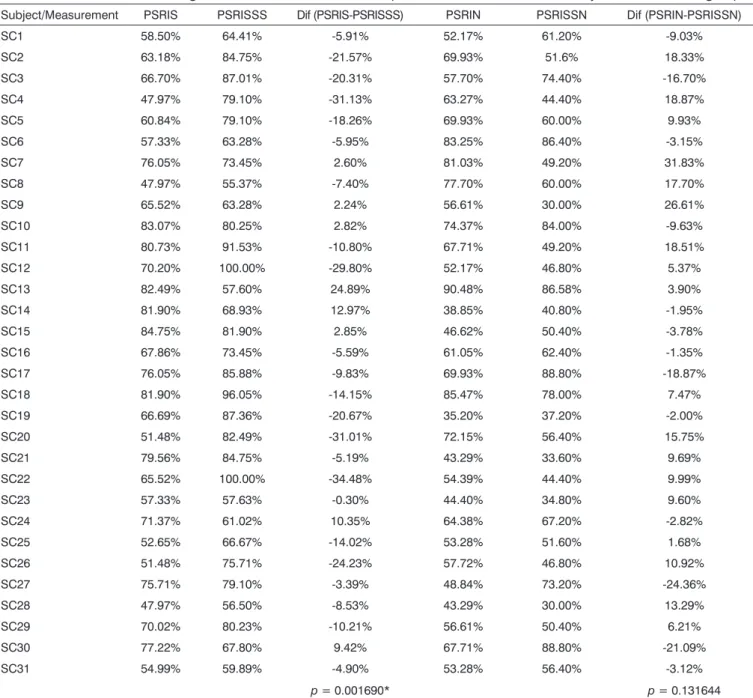
In the case group, the values obtained for PSRIS, PSRISSS, PSRIN and PSRISSN had a normal distribu-tion, according to the Lilliefors test. Table 1 shows that subjects in the control group performed better when presented with slowed sentences; statistically significant difference was observed for tests done against a back-ground of silence, but not in noise.
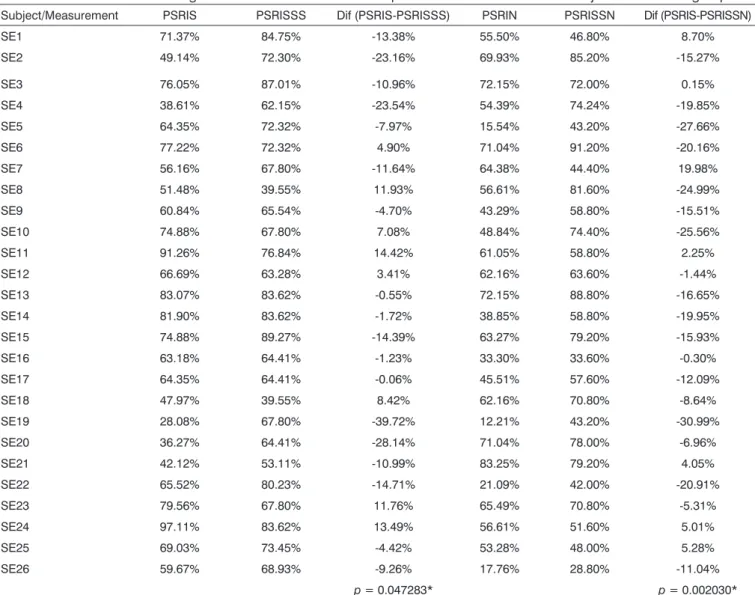
According to the Lilliefors test, the values seen in PSRIS, PSRISSS, and PSRISSN in the case group followed a normal distribution. Table 2 shows that case group subjects performed statistically better in either noise or silence when sentences were played at a slower speech rate.
DISCUSSION
The interest around variables hearing loss and rate of stimuli in speech recognition in the tests of elderly individuals arose because of claims that time affects one’s ability to recognize speech4,18 and of the
observation that elderly subjects with hearing loss19,20
may have difficulty understanding what is said to them. Memory and attention deficits and general pro-gressive reductions in brain function are present in most of the issues faced by aging individuals21. Additionally,
auditory processing impairments and their impact upon speech recognition further contribute to the challenges faced by the elderly22.
Accurate interpretation of speech requires fo-cused attention by the listener. Given that cognitive impairments reduce the ability of the elderly to manage and integrate information, fast-paced speech poses addi-tional challenges to the perception of elderly subjects22.
Table 1. Percent Sentence Recognition Indices and differences in performance on both tests of subjects in the control group.
* Statistically signiicant difference. SC: Subject on Control Group; PSRIS: Percent Sentence Recognition Indices in Silence; PSRISSS: Percent
Sentence Recognition Indices of Slowed Sentences in Silence; Dif: Difference; PSRIN: Percent Sentence Recognition Indices in Noise; PSRISSN: Percent Sentence Recognition Indices of Slowed Sentences in Noise; p: signiicance level (t-test for dependent variables).
Subject/Measurement PSRIS PSRISSS Dif (PSRIS-PSRISSS) PSRIN PSRISSN Dif (PSRIN-PSRISSN)
SC1 58.50% 64.41% -5.91% 52.17% 61.20% -9.03%
SC2 63.18% 84.75% -21.57% 69.93% 51.6% 18.33%
SC3 66.70% 87.01% -20.31% 57.70% 74.40% -16.70%
SC4 47.97% 79.10% -31.13% 63.27% 44.40% 18.87%
SC5 60.84% 79.10% -18.26% 69.93% 60.00% 9.93%
SC6 57.33% 63.28% -5.95% 83.25% 86.40% -3.15%
SC7 76.05% 73.45% 2.60% 81.03% 49.20% 31.83%
SC8 47.97% 55.37% -7.40% 77.70% 60.00% 17.70%
SC9 65.52% 63.28% 2.24% 56.61% 30.00% 26.61%
SC10 83.07% 80.25% 2.82% 74.37% 84.00% -9.63%
SC11 80.73% 91.53% -10.80% 67.71% 49.20% 18.51%
SC12 70.20% 100.00% -29.80% 52.17% 46.80% 5.37%
SC13 82.49% 57.60% 24.89% 90.48% 86.58% 3.90%
SC14 81.90% 68.93% 12.97% 38.85% 40.80% -1.95%
SC15 84.75% 81.90% 2.85% 46.62% 50.40% -3.78%
SC16 67.86% 73.45% -5.59% 61.05% 62.40% -1.35%
SC17 76.05% 85.88% -9.83% 69.93% 88.80% -18.87%
SC18 81.90% 96.05% -14.15% 85.47% 78.00% 7.47%
SC19 66.69% 87.36% -20.67% 35.20% 37.20% -2.00%
SC20 51.48% 82.49% -31.01% 72.15% 56.40% 15.75%
SC21 79.56% 84.75% -5.19% 43.29% 33.60% 9.69%
SC22 65.52% 100.00% -34.48% 54.39% 44.40% 9.99%
SC23 57.33% 57.63% -0.30% 44.40% 34.80% 9.60%
SC24 71.37% 61.02% 10.35% 64.38% 67.20% -2.82%
SC25 52.65% 66.67% -14.02% 53.28% 51.60% 1.68%
SC26 51.48% 75.71% -24.23% 57.72% 46.80% 10.92%
SC27 75.71% 79.10% -3.39% 48.84% 73.20% -24.36%
SC28 47.97% 56.50% -8.53% 43.29% 30.00% 13.29%
SC29 70.02% 80.23% -10.21% 56.61% 50.40% 6.21%
SC30 77.22% 67.80% 9.42% 67.71% 88.80% -21.09%
SC31 54.99% 59.89% -4.90% 53.28% 56.40% -3.12%
p = 0.001690* p = 0.131644
A protocol comprised by sentence recognition tests was chosen to that end, as it closely emulates communication situations to which the subjects are exposed in their daily lives8.
Initially, the analysis of the measurements obtai-ned against a quiet background made it clear that the groups of elderly subjects with normal hearing (control group) and elderly individuals with hearing loss (case group) showed statistically significant improvements in test scores when presented with slowed sentences, which showed that speech recognition in the subjects
of both groups was improved when speech was pro-duced at a lower rate.
Our findings were compared against those of studies in which temporal auditory processing was mostly assessed through non-verbal stimuli, due to the difficulty finding studies in which speech stimuli were used to investigate the correlations between temporal auditory processing and speech recognition.
Some authors2,23 have looked into the influence
Table 2. Percent Sentence Recognition Indices and differences in performance on both tests of subjects in the case group.
* Statistically signiicant difference. SE: Subjects in the Case Group; PSRIS: Percent Sentence Recognition Indices in Silence; PSRISSS: Percent
Sentence Recognition Indices of Slowed Sentences in Silence; Dif: Difference; PSRIN: Percent Sentence Recognition Indices in Noise; PSRISSN: Percent Sentence Recognition Indices of Slowed Sentences in Noise; p: Signiicance level (t-test for dependent variables and Wilcoxon).
Subject/Measurement PSRIS PSRISSS Dif (PSRIS-PSRISSS) PSRIN PSRISSN Dif (PSRIS-PSRISSN)
SE1 71.37% 84.75% -13.38% 55.50% 46.80% 8.70%
SE2 49.14% 72.30% -23.16% 69.93% 85.20% -15.27%
SE3 76.05% 87.01% -10.96% 72.15% 72.00% 0.15%
SE4 38.61% 62.15% -23.54% 54.39% 74.24% -19.85%
SE5 64.35% 72.32% -7.97% 15.54% 43.20% -27.66%
SE6 77.22% 72.32% 4.90% 71.04% 91.20% -20.16%
SE7 56.16% 67.80% -11.64% 64.38% 44.40% 19.98%
SE8 51.48% 39.55% 11.93% 56.61% 81.60% -24.99%
SE9 60.84% 65.54% -4.70% 43.29% 58.80% -15.51%
SE10 74.88% 67.80% 7.08% 48.84% 74.40% -25.56%
SE11 91.26% 76.84% 14.42% 61.05% 58.80% 2.25%
SE12 66.69% 63.28% 3.41% 62.16% 63.60% -1.44%
SE13 83.07% 83.62% -0.55% 72.15% 88.80% -16.65%
SE14 81.90% 83.62% -1.72% 38.85% 58.80% -19.95%
SE15 74.88% 89.27% -14.39% 63.27% 79.20% -15.93%
SE16 63.18% 64.41% -1.23% 33.30% 33.60% -0.30%
SE17 64.35% 64.41% -0.06% 45.51% 57.60% -12.09%
SE18 47.97% 39.55% 8.42% 62.16% 70.80% -8.64%
SE19 28.08% 67.80% -39.72% 12.21% 43.20% -30.99%
SE20 36.27% 64.41% -28.14% 71.04% 78.00% -6.96%
SE21 42.12% 53.11% -10.99% 83.25% 79.20% 4.05%
SE22 65.52% 80.23% -14.71% 21.09% 42.00% -20.91%
SE23 79.56% 67.80% 11.76% 65.49% 70.80% -5.31%
SE24 97.11% 83.62% 13.49% 56.61% 51.60% 5.01%
SE25 69.03% 73.45% -4.42% 53.28% 48.00% 5.28%
SE26 59.67% 68.93% -9.26% 17.76% 28.80% -11.04%
p = 0.047283* p = 0.002030*
ordering and resolution, and found no differences in performance between groups with normal hearing and hearing loss. This finding suggests that aging is a much bigger factor in the decline in performance experienced by the elderly. Our findings also indicated that elderly subjects, regardless of peripheral hearing, performed better when presented with speech at a lower rate against a background of silence.
Evidence that the rate of speech affects the per-formance of elderly individuals has been reported in a study24 in which the subjects had inferior performance
when exposed to compressed sentences presented at a faster rate. Our study adds that in addition to speech recognition being deteriorated as the rate of speech increases, it can also be improved when the speech rate is decreased.
The analysis of the measurements carried out against a noisy background showed that control group subjects had no statistically significant differences in performance when test speech rates were changed. Nonetheless, significant improvement was observed in case group individuals performance when slowed sentences were played. This shows that being spoken to slowly is important for the elderly, particularly for individuals with hearing loss.
Our results also serve as a warning to health care workers, so that they can modulate their speech rate to meet the needs of elderly patients.
Although the degree of audibility strongly influen-ces speech recognition, some elderly subjects seem to face more difficulties than expected from the analysis of audiometric configurations. One of the difficulties in speech recognition of the elderly derives from the age--related decline in cognitive skills, changes in auditory processing, or the combination of both19.
Authors26 have reported that, in addition to hearing
loss, other changes are observed in the cognitive function of elderly subjects. These changes in the elderly are characte-rized by slowness, suggesting the existence of transmission deficits in the temporal processing of these individuals.
The results of speech recognition tests in noise showed clear improvements in the performance of elderly subjects with hearing loss as the rate of speech was decreased, even in the absence of expected into-nations or visual cues relied on by individuals to better understand what they hear in noisy environments. This shows how decreases in speech rate are really important for the elderly to better understand what they are being told in noisy environments.
Although positive quantitative results in the SLSP do not necessarily reflect positive auditory performance in tested subjects, this test is an additional tool health care workers can use to obtain objective data to advise elderly patients fitted with hearing aids who still expe-rience communication difficulties.
Thus, it is possible to quantify and demonstrate to elderly subjects that it may take more than hearing aids for them to see significant improvements in com-munication skills.
Guidance on communication strategies will pos-sibly be better understood and internalized by patients and their families and generate interest and greater com-pliance to auditory rehabilitation programs when special attention is given to temporal auditory processing and the benefits it brings to one’s communication ability.
Hearing aids alone cannot address all patient auditory complaints. Good auditory performance is the outcome of a summation of factors involved in the hearing aid selection and fitting process, including auditory temporal processing.
CONCLUSION
The findings of this study show that elderly sub-jects, regardless of peripheral hearing, performed better in speech recognition tests when sentences were played at a lower speech rate against a quiet background.
As for speech in noise, the study suggested that elderly individuals with hearing loss had more signifi-cant improvements in speech recognition than subjects with normal hearing when sentences were presented at a lower speech rate.
REFERENCES
1. Neves VT, Feitosa MAG. Controvérsias ou complexidade na relação entre processamento temporal auditivo e envelhecimento? Rev Bras Otorrinolaringol. 2003;69(2):242-9. DOI: http://dx.doi.org/10.1590/ S0034-72992003000200015
2. Liporaci FD, Frota SMMC. Resolução temporal auditiva em idosos. Rev Soc Bras Fonoaudiol. 2010;15(4):533-9. DOI: http://dx.doi. org/10.1590/S1516-80342010000400010
3. Calais LL, Borges ACLC, Baraldi GS, Almeida LC. Queixas e preocu-pações otológicas e as dificuldades de comunicação de indivíduos idosos. Rev Soc Bras Fonoaudiol. 2008;13(1):12-9. DOI: http://dx.doi. org/10.1590/S1516-80342008000100005
4. Gordon-Salant S, Fitzgibbons PJ, Yeni-Komshian GH. Auditory tem-poral processing and aging: implications for speech understanding of older people. Audiol Res. 2011;1(1):e4.
5. Helfer KS, Freyman RL. Aging and speech-on-speech masking. Ear Hear. 2008;29(1):87-98.
6. Wong PC, Ettlinger M, Sheppard JP, Gunasekera GM, Dhar S. Neu-roanatomical characteristics and speech perception in noise in older adults. Ear Hear. 2010;31(4):471-9.
7. Caporali SA, Silva JA. Reconhecimento de fala no ruído em jovens e idosos com perda auditiva. Rev Bras Otorrinolaringol. 2004;70(4):525-32. DOI: http://dx.doi.org/10.1590/S0034-72992004000400014 8. Theunissen M, Swanepoel de W, Hanekom J. Sentence recognition
in noise: Variables in compilation and interpretation of tests. Int J Audiol. 2009;48(11):743-57. PMID: 19951143 DOI: http://dx.doi. org/10.3109/14992020903082088
9. Costa MJ. Lista de sentenças em português: apresentação e estratégias de aplicação na audiologia. Santa Maria: Pallotti; 1998. p.26-36. 10. Costa MJ, Lessa AH, Arzeno LP, Santos SN. Proposta de teste para
avaliar a interferência da velocidade da fala na comunicação. In: 26º Encontro Internacional de Audiologia; 2011 Apr 17-20. Maceió. Proceedings.
11. Lloyd LL, Kaplan H. Audiometric interpretation: a manual of basic audiometry. Baltimore: University Park Press; 1978.
12. Costa MJ, Iório MCM, Mangabeira-Albernaz PL. Reconhecimento de fala: desenvolvimento de uma lista de sentenças em português. Acta AWHO. 1997;16(4):164-73.
13. Costa MJ, Iorio MCM, Albernaz PLM. Desenvolvimento de um teste para avaliar a habilidade de reconhecer a fala no silêncio e no ruído. Pró-Fono. 2000;12(2):9-16.
14. Costa MJ, Iorio MCM, Mangabeira-Albernaz PL, Cabral Jr EF, Magni AB. Desenvolvimento de um ruído com espectro de fala. Acta Awho. 1998;17(2):84-9.
15. Freitas CD, Lopes LFD, Costa MJ. Reliability of the recognition thresholds of the sentence in the quiet and the noise. Braz J Otorhi-nolaryngol. 2005;71(5):624-30.
16. Theunissen M, Swanepoel de W, Hanekom J. Sentence recognition in noise: Variables in compilation and interpretation of tests. Int J Audiol. 2009;48(11):743-57. PMID: 19951143 DOI: http://dx.doi. org/10.3109/14992020903082088
17. Costa MJ, Santos SN, Mezzomo CL, Lessa AH. Índice percentual de reconhecimento de sentenças calculado por palavras. In: IX Jornada Acadêmica do Curso de Fonoaudiologia da ULBRA; 2011 Sep 22-23. Canoas. Proceedings.
18. Shinn JB. Temporal processing: the basics. Hear J. 2003;56(7):52. 19. Martin JS, Jerger JF. Some effects of aging on central auditory
pro-cessing. J Rehabil Res Dev. 2005;42(4 Suppl 2):25-44.
21. Pichora-Fuller MK, Singh G. Effects of age on auditory and cogni-tive processing: implications for hearing aid fitting and audiologic rehabilitation. Trends Amplif. 2006;10(1):29-59. DOI: http://dx.doi. org/10.1177/108471380601000103
22. Pickora-Fuller MK. Processing speed and timing in aging adults: psychoacoustics, speech perception, and comprehension. Int J Audiol. 2003;42 Suppl 1:S59-67.
23. Azzolini VC, Ferreira MIDC. Processamento auditivo temporal em idosos. Arq Int Otorrinolaringol. 2010;14(1):95-102.
24. Gordon-Salant S, Fitzgibbons PJ. Effects of stimulus and noise rate variability on speech perception by younger and older adults. J Acoust Soc Am. 2004;115(4):1808-17. PMID: 15101658 DOI: http://dx.doi. org/10.1121/1.1645249
25. Ruschel CV, Carvalho CR, Guarinello AC. The efficiency of an auditory rehabilitation program in elderly people with presbycusis and their family. Rev Soc Bras Fonoaudiol. 2007;12(2):95-8. DOI: http://dx.doi. org/10.1590/S1516-80342007000200005