DISTRIBUTION OF Oikopleura dioica (TUNICATA, APPENDICULARIA)
ASSOCIATED WITH A COASTAL FRONTAL SYSTEM (39°- 41°S) OF THE SW
ATLANTIC OCEAN IN THE SPAWNING AREA OF Engraulis anchoita ANCHOVY
Mariela Spinelli1,2,*, Raúl Guerrero3, Marcelo Pájaro3 and Fabiana Capitanio1,2 1Universidad de Buenos Aires (DBBE- FCEN- UBA)
Departamento de Biodiversidad y Biología Experimental, Facultad de Ciencias Exactas y Naturales (Intendente Güiraldes 2160 - Ciudad Universitaria - C1428EG, Argentina)
2Instituto de Biodiversidad y Biología Experimental Aplicada, Consejo Nacional de Investigaciones Científicas y Técnicas, Universidad de Buenos Aires (IBBEA, CONICET- UBA)
(Intendente Güiraldes 2160 - Ciudad Universitaria - C1428EG, Argentina) 3Instituto Nacional de Investigación y Desarrollo Pesquero (INIDEP)
(Paseo Victoria Ocampo Nº1, Escollera Norte B7602HSA Mar del Plata, Buenos Aires, Argentina) *Corresponding author: [email protected]
A
BSTRACTAmong tunicates, the small planktonic appendicularians generally comprise a significant fraction of the mesozooplankton in frontal systems. The summer 2011 distribution (vertical and spatial) of Oikopleura dioica was studied in terms of abundance, biomass, estimation of egg production and population structure in the different sectors of the El Rincón coastal front, in the light of thermal and salinity gradients. Peaks of abundance of Engraulis anchoita larvae were compared to O. dioica patterns. Samples were collected with plankton nets of 67 µ m and 200 µm at two layers, below and above the thermocline depth. CTD data profiles were also recorded. During this campaign high salinity waters were predominant in the estuarine area. Conversely, a thermal stratification was found, being more marked at the external stations of the front where the highest densities and biomass of O. dioica coincided with the highest E. anchoita larvae densities. The size structure of O. dioica was also associated with the thermal gradient. The smaller sizes were found in the homogeneous area at the coast where the temperature was higher around 22ºC. This front constitutes a suitable environment for O. dioica reproduction enhancing the survival rate and growth of several small pelagic fishes such as E. anchoita.
R
E S U M OEntre os tunicados, as pequenas apendiculárias planctônicas geralmente compreendem uma fração significativa do mesozooplâncton nos sistemas frontais. Foi estudada a distribuição (vertical e espacial) durante o verão de 2011 de Oikopleura dioica, em termos de abundância, biomassa, estimativa da produção de ovos e estrutura da população em diferentes setores da frente costeiro de El Rincón, segundo os gradientes de temperatura e salinidade. Picos de abundância de larvas de Engraulis anchoita foram comparados com os padrões de O. dioica. As amostras foram coletadas com redes planctônicas de 67 e 200 µm em duas profundidades, acima e abaixo da termoclina. Também foram registrados perfis de dados obtidos com CTD. Durante essa campanha, aguas de alta salinidade foram predominantes na área estuarina. No entanto, foi encontrada uma estratificação térmica, sendo mais acentuado nas estações externas da frente, onde as maiores densidades e biomassa de O. dioica foram registradas, coincidindo também com as maiores densidades de larvas de E. anchoita. A distribuição de tamanhos de O. dioica também foi associada ao gradiente térmico. Os menores tamanhos foram encontrados na região mais homogênea da costa, onde a temperatura apresentou cerca de 22ºC. Essa frente é um ambiente propício para a reprodução de O. dioica o que favorece também o aumento da sobrevivência e o crescimento de muitas espécies de pequenos peixes pelágicos, tais como E. anchoita.
Descriptors: Engraulis anchoita, Oikopleuridae, Frontal systems. Descritores: Engraulis anchoita, Oikopleuridae, Sistemas frontais.
I
NTRODUCTIONFronts are zones of increased mixing, both laterally and vertically, between water masses of different properties, likely to be characterized by high phytoplankton biomass and in many cases, enhanced
promoting secondary production. Marine fronts must, therefore, be recognized as key oceanographic structures for the understanding of the feeding, reproductive strategies and migratory patterns of local populations (ACHA et al., 2004).
Various coastal frontal systems can be identified in the Argentine Sea, El Rincón (39°- 41°S) being one of them. This front receives continental contributions from both the Negro and Colorado rivers and, in its outer zone, is influenced by the water entering by advection from the San Matías Gulf, with maximum salinity values (GUERRERO; PIOLA, 1997; ACHA et al., 2004). Three oceanographic saline regimes were defined in the El Rincon area by Lucas et al. (2005): 1) an estuarine regime lying on the coast, 2) a maximum salinity system connected to San Matías gulf and 3) an outer mid-shelf regime with an intermediate salinity concentration. During spring-summer, a vertical thermal stratification was also detected and the position of the front was only evident at the bottom layers where a homogeneous coastal area, mixed by wind and tides, was distinguished from a stratified outer area. This front is characterized by a high concentration of plankton and ichthyoplankton and by the intense reproductive activity of pelagic, demersal and coastal fishes of economic interest such as anchovies (PERROTA et al., 1999; PERROTA et al., 2003; HOFFMEYER et al., 2009).
Engraulis anchoita is the main pelagic
species in the Argentine Sea and its range extends from southern Brazil (22°S) to Patagonia (48°S). During its lifespan, it feeds mostly on zooplankton (ANGELESCU, 1982; VIÑAS; RAMIREZ, 1996; PÁJARO, 2002) by biting larger and filtering smaller prey (LEONG; O’CONNELL, 1969). South of 34°S, at least two populations of E. anchoita occur
separately at approximately 41ºS: the northern and the southern populations (HANSEN et al., 1984). The northern stock undertakes annual migrations: during winter it is found in the northern part of its distribution area, whereas in spring, massive spawning occurs in coastal sectors off the Buenos Aires Province, mostly in waters shallower than 50 m (SÁNCHEZ; CIECHOMSKI, 1995; PÁJARO et al., 2009). The southern stock spawns during late spring and summer in association with the Peninsula Valdes (42º- 44ºS) tidal front (SÁNCHEZ; CIECHOMSKI, 1995).
Among mesozooplankters, Oikopleura dioica is a small euryhaline appendicularian found in all the oceans of the world. These organisms are filter- feeders which actually ingest food particles of less than 1 μm and occupy an important trophic position in food webs, allowing a rapid energy transfer from phytoplankton primary producers to zooplanktivorous predators such as fish (GORSKY; FENAUX, 1998).
The distribution pattern of O. dioica has
been closely studied in the northern Argentine sea (eg.
CAPITANIO et al., 2008 and DI MAURO et al., 2009) where the highest densities and biomasses have been observed at the estuarine front of the “La Plata” River (34ºS) during spring-summer. To date, this kind of study on the El Rincón frontal system has been rare. During winter, Viñas et al. (1999) found a higher biomass of zooplankters near the 50m isobath, associated with salinity values between 33.1 and 33.5, the small copepod, appendicularian and lamellibranch larvae predominating. During spring, Di Mauro et al. (2009) reported a minimum salinity value of 33 near the coast, followed by an area of highly saline waters around 33.8 near the 50 m isobath where O. dioica
was predominant. The vertical and spatial distributions of O. dioica, in terms of abundance, biomass and
population structure in the different sectors of El Rincon frontal system, were studied in relation to thermal and salinity gradients. As it is well known that this species is one of the main food items of E. anchoita in many coastal sectors of the Argentine Sea (VIÑAS; RAMIREZ, 1996; CAPITANIO et al., 1997; SPINELLI et al., 2012), the distribution of O. dioica at this front was analyzed in relation to the northern anchovy larvae peaks of abundance.
M
ATERIAL ANDM
ETHODSZooplankton samples were taken during summer (February) 2011 along one transect near Bahia Blanca (Fig. 1) by the Argentinian Instituto Nacional de Investigación y Desarrollo Pesquero. Six samples were collected with a Small Bongo plankton net of 67 µm (0.22 m mouth diameter) by vertical hauls at two depth layers: from the bottom to below the thermocline and from the thermocline up to the surface. At the three former coastal stations, samples were taken from the bottom to the surface. A Pairovet net with a mouth diameter of 0.225 m and 220 μm mesh size was used for the anchovy larvae sampling. A mechanical flowmeter (Hydrobios) was used to measure the volume of water filtered. At all stations, continuous conductivity-temperature-depth (CTD) profiles were recorded with a Searbid 19. Temperature and salinity gradients along the section were analyzed to assess the stratification of the water column.
The appendicularians were separated in the laboratory with the help of a stereoscopic microscope, and those samples with more than 300 specimens were fractionated into from three to six aliquots of 20 ml each. All the specimens were identified as of the
Oikopleura dioica species. Density, biomass, egg
production, and degree of population maturity, were estimated. The sizes (TL, trunk length) were measured using an ocular micrometer and total biomass of O. dioica(µg C m-3) was estimated from trunk length –
juvenile and mature, in accordance with Capitanio et al. (1995) and organized in 100 µm TL size intervals. The number of O. dioica eggs was estimated using the trunk length measurements given by Lombard et al. (2009). All anchovy larvae specimens were also identified and counted under a binocular-dissecting microscope.
Fig. 1. Location of the sampling stations.
Differences in O. dioica size structure in homogeneous and stratified sections of the front were analyzed using the chi-square test to compare the surface and bottom layers. A Spearman Correlation test was used to study the relationship between O. dioica and E. anchoita abundance distribution and
temperature, trunk length and egg production.
Statistica 6.0 and InfoStat packages were used for data analysis.
R
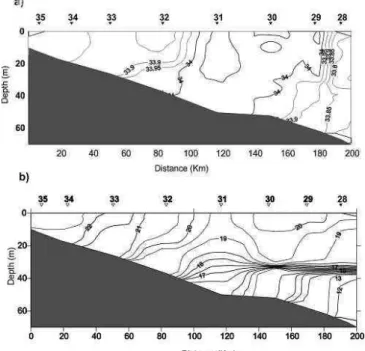
ESULTSThe oceanographic characteristics of the El Rincon frontal system during this summer are shown in Figure 2a, b. The estuarine area in this campaign was defined by a salinity value below 33.85, which is low when compared to historical data. It corresponded to stations 35, 34, 33 and 32, extending seaward for 60-80 km. A zone with high salinity (33.95- 34.05) waters was observed at stations 31, 30 and 29 while for station 28, an external zone with diluted continental shelf waters was observed which presented a salinity value of 33.8. No vertical salinity stratification was present. Regarding temperature, there was a vertically homogeneous area at the coast (stations 35, 34, 33 and 32), with temperatures of about 22°C corresponding to the estuarine area mentioned above, a transitional area (st. 31) and an external stratified one (stations 30 and 29) with a well- marked thermocline at 35m depth. Temperature varied, from transitional to stratified stations, from 20 to 19ºC in surface layers and from 18 to 12ºC below the thermocline depth. The thermocline was defined from stations 32-31 to station 28, with a gradient of 7°C/ 100 km.
The distribution of E. anchoita larvae was related to the thermal stratification of the front (Fig. 3, stations 29 to 31). Higher abundances were registered at stations with stratified waters near the 50 m isobath (5 - 8 larvae m-3), mainly at the surface layers above
the thermocline depth, while at the homogeneous stations larval densities were much lower (3 larvae m -3). Similarly, the greatest density of
O. dioica was
found at stratified stations though higher in surface samples, mainly at stations 30 and 29, with values of 1137 ind. m-3 and 1338 ind. m-3 respectively, in
contrast with the lowest density found at the stations closest to the coast (50 ind. m-3 at st.34) (Fig. 4a).
Biomasses were higher, coincidentally, at the stratified stations but no marked differences were found between surface and bottom layers (Fig. 4b). In the transitional area (st. 31) densities were similar in both layers but biomasses were higher in the surface layer. A strong correlation between O. dioica and E. anchoita larvae distributions along the front (Spearman correlation: 0.94, p<0.005) was detected.
The population sizes of O. dioica are shown in Figure
5 and their size structures are compared as between stations in Table 1. At the surface levels of the homogeneous and stratified stations, the size structure was statistically different, the smallest organisms (mainly TL <600 μm) being predominant in homogeneous coastal waters, and the largest ones (TL >900 μm) in the external stratified ones. In the latter, no significant differences in the size structure distribution between surface and bottom layers whether at station 29 or station 30 were detected, while at station 31 larger sizes (TL >800-1000 μm) were found in the bottom layers (see Fig 5; Table 1). As a whole, juvenile stages of this species predominated (ca. 90%) along transect of this front, and the mature ones were mainly found at stratified stations in both surface and bottom layers. Mature females had sizes between 900 and 1000 µm with an estimated egg production of 97 eggs/female (mean standard deviation: 72.5 +/- 12.02), temperature being inversely correlated to the trunk length and to egg production (Spearman correlation: -0.70 and -0.68,
p<0.005 in both cases).
Fig. 3. Density of Engraulis anchoita larvae at El Rincón frontal system.
Fig. 5. Size structures of O. dioica in homogeneous and stratified stations of El Rincón coastal front.
Table 1. Comparasion of O. dioica size structure using Chi-square test X2: statistic values; values in bold indicated significante difference.
D
ISCUSSIONThe distribution patterns of zooplankton in the water column have been well studied, particularly in coastal and estuarine systems, as they are subject to great fluctuations in the hydrological parameters. In small scale frontal systems such as the El Rincon coastal front, the variability in river discharges can affect the distribution of salinity. During the period of this study, high salinity waters were predominant as the estuarine area was weakly manifested during this campaign as compared the situation depicted by the historical data (LUCAS et al., 2005). These latter authors mention that a large discharge from the Negro and Colorado rivers, attaining over 1200 m3/s, usually
occurs in the spring-summer period; however, from October 2010 to January 2011 the discharge was only of about 680m3/s (http://www.coirco.com.ar/;
http://aic.gov.ar), thus presenting an almost 50% decrease as compared with the historical average (LUCAS et al., 2005). This significant decrease in the continental run off was probably the cause of the high salinity signal in the estuarine regime.
The year 2010 was characterized by “La Niña”, which could explain the decrease in the river's flow as this event generates lower rainfall
(http://www.cpc.ncep.noaa.gov/). According to Spinelli et al. (2009), in the estuarine front of the La Plata River (34ºS) the salinity was the main factor driving the species composition of appendicularians, but in this study of the El Rincon coastal front only O. dioica was found and no salinity gradient was
detected.
The appendicularians live within mucosal structures commonly called “houses” that are used to filter food particles. That is why they have little mobility and are strongly affected by oceanographic fluctuations (GORSKY et al., 2005). It is known that the house renewal rate of appendicularians increases linearly as salinity decreases; an increment of from 46 to 53 houses per animal corresponds to a 35 to 25 salinity decline. As a consequence, the daily house production, which corresponds to 130 – 290% of the appendicularians’ biomass, is favored in estuarine environments (SATO et al., 2001). According to Gorsky; Fenaux (1998), discarded appendicularian houses are a significant source of macroscopic aggregates or marine snow, in which bacteria, cyanobacteria, ciliates and flagellates are embedded.
A thermal stratification was found in this study, being more marked at the external stations of the front where the highest densities and biomass of O. dioica were recorded. Their size structure is also
and trunk length (WYATT, 1973; LOMBARD et al., 2009). For semelparous organisms with a short life cycle, such as O. dioica, the mechanisms that coordinate the production of mature gametes are closely related to environmental conditions. With a relatively fixed generation time at a given temperature, the response of O. dioica has evolved in the regulation of the numerical production of oocytes over two orders of magnitude (DEIBEL; LOWEN, 2012). Hence, appendicularians are among the greatest adepts to the clutch size manipulator strategy that has evolved to minimize generation time (TROEDSSON et al., 2002), which is both strongly temperature-dependent and heritable (LOBON et al., 2011). In this study, mature females were more predominant at surface and bottom stratified stations with lower temperatures than at the homogeneous ones, reaching sizes between 900 and 1000 µm and an average estimated egg production of 72.5 eggs/female. In the Peninsula Valdes coastal front, (CAPITANIO; ESNAL, 1998) found the same pattern, as the highest densities of O. dioica in in the
transitional/stratified area were found to coincide with the highest chlorophyll a concentrations, but
mature stages were detected mainly at thermocline depth.
Temperature also produces an impact on other trophic levels, and it does so in the physiology and primary productivity of phytoplankton, which indirectly impact the feeding rates of zooplankton. Positive interactions have been reported between phytoplankton production and zooplankton abundance and metabolism (PARK; MARSHALL, 2000; ADOLF et al., 2006). In the same campaign as this study, Negri et al. (2012) registered high values of total chlorophyll a in the most coastal
station and in the most external one below the thermocline, but lower values at the remaining stations (Fig. 6). The authors quoted noted that the ultraphytoplankton fraction (<5 um) was the most important component with percentages higher than 60% of the total chlorophyll, except at station 29 where it only reached 15% below the thermocline. The dominance of this small fraction coincides with other template regions such as the EPEA coastal station (38°28´S, 57°41´W) in the Argentine sea during the summer (FOGG, 1986; STOCKNER, 1988). In this study the prevalence of O. dioica juveniles (90%) around the front indicates pulse breeding, favored by the availability of small food particles, as about 60% of the total phytoplankton fraction corresponded to ultraphytoplankton. In Tokio Bay Sato et al. (2008) found that the primary productivity is high and phyto- and zooplankton size spectra are skewed to smaller size fractions; also in the Sea of Japan, Nakamura et al. (1997) suggest the ecological importance of O. dioica as a consumer of picoplankton.
Fig. 6.Total Chlorophyll and percentage of Chlorophyll a <5 μm. Data modified from Negri et al. (2012).
Anchovy is characterized by high fertility and is a multiple spawners (CIECHOMSKI; WEISS, 1973; PÁJARO et al., 1997). Their eggs and larvae are observed throughout the year, with maximum abundance during spring. Their reproductive season finishes in late summer, the intensity of spawning decreasing in this season (SANCHÉZ; CIECHOMSKI;, 1995). Although this study at the El Rincon frontal system was carried out in summer, a high abundance of northern anchovy larvae was detected, mainly in the stratified waters near the 50 m isobath, coincidentally with the highest density and biomass of O. dioica. Thus the dominance of the
ultraphytoplankton fraction in this front constitutes a suitable environment for O. dioica reproduction in
summer, thus enhancing the survival and growth of several small pelagic fishes such as E. anchoita.
Frontal zones play a key role in ecological processes in the ocean, allowing an exceptionally large primary production, offering adequate feeding and reproductive habitats for planktivorous species and acting as retention areas for larvae.
A
CKNOWLEDGMENTSenvironmental data. This study was partially supported by UBACYT 20020100200048 grants to F. Capitanio. We would also like to thank two anonymous reviewers for their critical review of the manuscript.
R
EFERENCESACHA, E. M.; MIANZAN, H. W.; GUERRERO, R. A.; FAVERO, M.; BAVA, J. Marine fronts at the continental shelves of austral South America: physical and ecological processes. J. Mar. Syst., v. 44, n. 1/2, p. 83– 105, 2004.
ADOLF, J. E.; YEAGER, C. L.; MILLER, W. D.; MALLONE, M. E.; HARDING, L. W. Environmental forcing of phytoplankton floral composition, biomass and primary productivity in Chesapeake Bay, USA.
Estuar. Coast. Shelf Sci.,v. 67, p. 108-122, 2006.
ANGELESCU, V. Ecología trófica de laanchoítadel Mar Argentino (Engraulidae, Engraulis anchoita): Parte II.
Alimentación, comportamiento y relaciones tróficas enelecosistema. ar del Plata inisterio de Econom a,
Subsecretar a de ntereses ar timos, Subsecretar a de
Pesca, nstituto Nacional de nvesti aci n y DesarrolloPesquero, INIDEP, 1982. 83 p. (Contribuci n
( nstituto Nacional de nvesti aci n y
DesarrolloPesquero (Argentina), n. 409).
CAPITANIO, F.; ESNAL, G. B. Vertical distribution of the maturity stages of Oikopleura dioica (Tunicata, Appendicularia) in the frontal system off Valdés Peninsula, Argentina. Bull. Mar. Sci., v. 63, p. 531-539, 1998.
CAPITANIO, F.; MARSCHOFF, E. R.; ESNAL, G. B. Distribution and characterization of the maturity stages of Oikopleura dioica(Tunicata, Appendicularia) in the area of Peninsula Valdés, Argentina. Iheringia, Sér. Zool., v. 79, p. 59-66, 1995.
CAPITANIO, F.; PÁJARO, M.; ESNAL, G. Appendicularians (Chordata, Tunicata) in the diet of anchovy (Engraulis anchoita) in the Argentine Sea. Sci. Mar., v. 61, n. 1, p. 9-15, 1997.
CAPITANIO, F. L.; CURELOVICH, J.; TRESGUERRES, M.; NEGRI, R.; VIÑAS, M. D.; ESNAL, G. Seasonal cycle of Appendicularians at a coastal station (38º28´S, 57º41´W) of the SW Atlantic Ocean. Bull. Mar. Sci., v. 82, p. 171-184, 2008.
CIECHOMSKI, J. D.; WEISS, G. Desove y fecundidad de la anchoíta argentina (Engraulis anchoita) Hubbs y Marini.
Physis, Secc. A, v. 32, n. 84, p. 137-153, 1973.
DI MAURO, R.; CAPITANIO, F. L.; VIÑAS, M. D. Capture efficiency for small dominant mesozooplankters (Copepoda, Appendicularia) off Buenos Aires Province (34ºS-41ºS), Argentine Sea, using two plankton mesh sizes. Braz. J. Oceanogr., v. 57, n. 3, p. 205–214, 2009.
DEIBEL, D.; LOWEN, B. A review of the life cycles and life-history adaptations of pelagic tunicates to environmental conditions. ICES J. Mar. Sci., v. 69, p. 1-12, 2012.
FOGG, G. E. Review lecture: Picoplankton. Proc. R. Soc. London, Ser. B., v. 228, p. 1-30, 1986.
GORSKY, G.; FENAUX, R. The role of Appendicularia in Marine Food Webs. In: BONE, Q. (Ed.). The biology of pelagic tunicates. Oxford: University Press, 1998. p. 161-169.
GORSKY, G.; YOUNGBLUTH, M. J.; DEIBEL, D.
Response of marine ecosystems to global change: ecological impact of appendicularians. Paris: Contemporary Publishing International, 2005. 437p. GUERRERO, R. A.; PIOLA, A. R. Masas de agua en la
plataforma continental. In: BOSCHI, E. E. (Ed.).
Antecedentes históricos de las exploraciones em el mar y las características ambientales. Mar del Plata: Instituto Nacional de Investigación y DesarrolloPesquero, 1997. p. 107-118. (El mar Argentino y sus recursos pesqueiros; 1).
HANSEN, J. E.; COUSSEAU, M. B.; GRU, D. L. Características poblacionales de la anchoíta (Engraulis anchoita) del Mar Argentino. Parte I. El largo medioal primer año de vida, crecimiento y mortalidad. Rev. Invest. Desarr. Pesq., v. 4, p. 21-48, 1984.
HOFFMEYER, M. S.; MENÉNDEZ, M. C.; BIANCALANA, F.; NIZOVOY, A. M.; TORRES, E. R. Ichthyoplankton spatial pattern in the inner shelf off Bahía Blanca Estuary, SW Atlantic Ocean. Estuar. Coast. Shelf Sci.,v. 84, n. 3, p. 383–392, 2009.
LARGIER, J. L. Estuarine fronts: how important are they?
Estuaries, v. 16, n. 1, p. 1–11, 1993.
LE FÉVRE, J. Aspects of the biology of frontal systems.
Adv. Mar. Biol., v. 23, p. 163–299, 1986.
LEONG, R. J. H.; O’CONNELL, C. P. A laboratory study of particulate and filter feeding of the northern anchovy (Engraulis mordax). J. Fish. Res. Board Can., v. 26, p. 557-582, 1969.
LOBON, C. M.; ACUÑA, J. L.; LOPEZ-ALVAREZ, M.; CAPITANIO, F. L. Heritability of morphological and life history traits in a pelagic tunicate. Mar. Ecol. Prog. Ser., v. 422, p. 145–154, 2011.
LOMBARD, F.; RENAUD, F.; SAINSBURY, C.; SCIANDRA, A.; GORSKY, G. Appendicularian ecophysiology. I. Food concentration dependent clearance rate, assimilation efficiency, growth and reproduction of Oikopleura dioica. J. Mar. Sys., v. 78, p. 606-616, 2009.
LUCAS, A. J.; GUERRERO, R. A.; MIANZÁN, H. W.; ACHA, E. M.; LASTA, C. A. Coastal oceanographic regimes of the Northern Anchovy Continental Shelf (34-43°S). Estuar. Coast. Shelf Sci.,v. 3, p. 405-420, 2005. MANN, K. H.; LAZIER, J. R. N. Dynamics of marine
ecosystems: biological–physical interactions in the oceans. 2. ed. Boston: Blackwell Scientific Publication, 1996. 394 p.
NAKAMURA, Y.; SUZUKI, K.; SUZUKI, S.; HIROMI, J. Production of Oikopleura dioica (Appendicularia) followin a picoplankton ‘bloom’ in a eutrophic coastal area. J. Plankton Res., v. 19, n. 1, p. 113–124, 1997. NEGRI, R. M.; SILVA, R. I.; SEGURA, V.;
CUCHI-COLLEONI, D. Estructura de la comunidad de fitoplancton em el área de El Rincon (febrero 2011).
Rev. Invest. Desarr. Pesq., 2012.
OLSON, D. B.; BACKUS, R. H. The concentrating of organisms at fronts: a coldwater fish and a warm-core Gulf Stream ring. J. Mar. Res., v. 43, p. 113– 137, 1985. PÁJARO, M.; MACCHI, G. J.; SANCHEZ, R. P. Fecundidad y frecuencia reproductiva de los stocks bonaerense y patagónico de anchoíta argentina (Engraulis anchoita). Rev. Invest. Desarr. Pesq., v. 11,
PÁJARO, M. Alimentación de la anchoíta argentina (Engraulis anchoita Hubbs y Marini, 1935) (Pisces: Clupeiformes) durante la época reproductiva. Rev. Invest. Desarr. Pesq., v. 15, p. 111-125, 2002. PÁJARO, M.; MACCHI, G. J.; LEONARDUZZI, E.;
HANSEN, J. E. Spawning biomass of Argentine anchovy (Engraulis anchoita) from 1996 to 2004 using the Daily Egg Production method. J. Mar. Biol. Assoc. U. K., v. 89, n. 4, p. 829-837, 2009.
PARK, G. S.; MARSHALL, H. G. Estuarine relationship between zooplankton community structure and trophic gradients. J. Plankton Res., v. 5, p. 15-33, 2000.
PERROTA, R. G.; MADIROLAS, A.; VIÑAS, M. D.; AKSELMAN, R.; GUERRERO, R.; SÁNCHEZ, F.; LÓPEZ, F.; CASTRO MACHADO, F.; MACHI, G. La caballa (Scomber japonicus) y las condiciones ambientales en el área bonaerense de ‘‘El Rincon’’
(39º40’300’’S). Agosto, 1996. Mar del Plata:Secretaría de Agricultura, Ganadería, Pesca, y Alimentación, Instituto Nacional de Investigación y Desarrollo Pesquero, 1999. 29 p. (INIDEP - Informe Técnico; 26). PERROTA, R. G.; VIÑAS, M. D.; MADIROLAS, A. O.;
RETA, R.; AKSELMAN, R.; CASTRO MACHADO, F. J.; DAVID GARCIARENA, A.; MACCHI, G. J.; MORIONDO DANOVARO, P.; LLANOS, V.; URTEAGA, J. R. La caballa (Scomber japonicus) y las condiciones ambientales en el área ‘‘El Rincón’’
(39º40’-41º30’S) del Mar Argentino, Septiembre,
2000. Mar del Plata: Secretaría de Agricultura, Ganadería, Pesca, y Alimentación, Instituto Nacional de Investigación y Desarrollo Pesquero, 2003. p. 25. (INIDEP -InformeTécnico; 54).
SÁNCHEZ, R. P.; CIECHOMSKI, J. D. Spawning and nursery grounds of pelagic fish species in the sea-shelf off Argentina and adjacent areas. Sci. Mar., v. 4, p. 455-478, 1995.
SATO, R.; TANAKA, Y.; ISHIMARU, T. House production by Oikopleura dioica (Tunicata, Appendicularia) under laboratory conditions. J. Plankton Res., v. 23, p. 415– 423, 2001.
SATO, R.; ISHIBASHI, Y.; TANAKA, Y.; ISHIMARU, T.; DAGG, M. J. Productivity and grazing impact of Oikopleura dioica (Tunicata, Appendicularia) in Tokio Bay. J. Plankton Res., v. 30, n. 3, p. 299-309, 2008. SPINELLI, M.; MARTOS, P.; ESNAL, G.; CAPITANIO, F.
Appendicularian assemblages and their space–time variability off the La Plata River, SW Atlantic Ocean.
Estuar., Coast. Shelf Sci., v. 85, p. 97–106, 2009.
SPINELLI; M.; PAJARO, M.; MARTOS, P.; ESNAL, G.; SABATINI, M.; CAPITANIO, F. Potential zooplankton preys (Copepoda and Appendicularia) for Engraulis anchoita in relation to early larval and spawning distributions at the Patagonian frontal region (SW Atlantic Ocean). Sci. Mar., v. 76, p. 39–47, 2012.
STOCKNER, J. G. Phototrophic picoplankton: an overview from marine and freshwater ecosystems. Limnol. Oceanogr., v. 33, p. 765-775, 1988.
TROEDSSON, C.; BOUQUET, J. M.; AKSNES, D. L.;THOMPSON, E. M. Resource allocation between somatic growth and reproductive output in the pelagic chordate Oikopleura dioica allows opportunistic response to nutritional variation. Mar. Ecol. Prog. Ser., v. 243, p. 83–91, 2002.
UYE, S.; ICHINO, S. Seasonal variations in abundance, size composition, biomass and production of Oikopleura dioica (Tunicata: Appendicularia) in a temperate eutrophic inlet. J. Exp. Mar. Biol. Ecol., v. 189, p. 1-11, 1995.
VIÑAS, M. D.; RAMÍREZ, F. C. Gut analysis of first-feeding anchovy larvae from Patagonian spawning area in relation to food availability. Arch. Fish. Mar. Res., v. 43, p. 231-256, 1996.
VIÑAS, M. D.; SÁNCHEZ, F.; MARRARI, M.; ABACHIAN, V.; MARTOS, P.; PERROTTA, R. G. Zooplancton, hidrografía y ecología trófica de La caballa (Scomber japonicus) em el área de El Rincón (39°- 41°S). In: CONGRESO LATINOAMERICANO DE CIENCIAS DEL MAR (COLACMAR), 8., 1999, Trujillo. Resumen extendido,Trujillo, 1999. Tomo 2, p. 215-218.
WYATT, T. The biology of Oikopleura dioica and Fritillaria borealis in the Southern Bight. Mar. Biol., v. 22, p. 137– 158, 1973.