Revista Brasileira de Ciências Farmacêuticas Brazilian Journal of Pharmaceutical Sciences vol. 40, n. 3, jul./set., 2004
Optimization of biomass and astaxanthin production by the yeast
Phaffia rhodozyma
Danilo Gomes Moriel
1, Iara Maria Pereira Machado
1, José Domingos Fontana
2,
Tania Maria Bordin Bonfim
1*
1 Laboratório de Enzimologia e Tecnologia das Fermentações, 2 Biomass Chemo/Biotechnology Laboratory, Departamento de Farmácia, Universidade Federal do Paraná
The combination of fed-batch processes and low cost substrates (sugar cane juice and urea) was studied in view of the optimization of biomass and astaxanthin production by the yeast Phaffia rhodozyma ATCC 24202. In the optimized process, a biomass and astaxanthin productivity of 0.327 g/l/h and 0.124 mg/l/h was achieved, respectively. Compared to the batch process studied, an increase of approximately 4.55-fold in the biomass productivity and 4.73-fold in the astaxanthin productivity was found.
*Correspondência:
T. M. B. Bonfim
Laboratório de Enzimologia e Tecnologia das Fermentações,
Departamento de Farmácia, Universidade Federal do Paraná Rua Lothário Meissner, 3400 80210-170, Curitiba, Paraná, Brasil e-mail: [email protected]
Uniterms:
• Astaxanthin • Biomass
• Fed-batch processes • Low cost substrates • Phaffia rhodozyma
INTRODUCTION
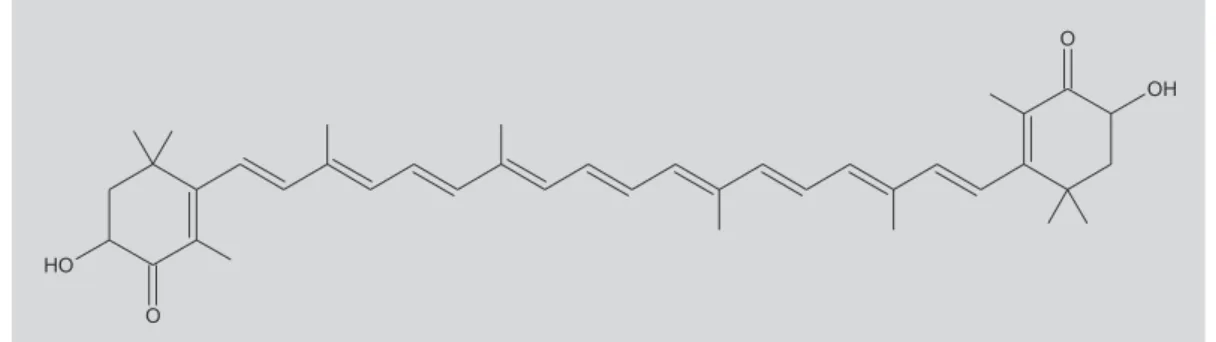
Astaxanthin (3,3'-dihydroxy-β,β ’-carotene-4,4'-dione, Figure 1) is a carotenoid widely distributed in nature, being found as the main pigment in some crustaceans (shrimp and lobster), fish (trout and salmon), birds (flamingo and scarlet ibis) and microorganisms (the yeast
Phaffia rhodozyma and the algae Haematococcus
pluvialis) (Johnson, An, 1991).
Astaxanthin is mainly used in the trout and salmon farming. Since these animals can not synthesize carotenoids, pigments must be supplemented to their feeds, allowing their assimilation and providing the characteristic pigmentation of these fish, increasing the quality and consumer acceptance in the marketplace (Johnson, An, 1991).
Because of the increasing worldwide market, the high cost of synthetic astaxanthin and the need of astaxanthin obtained from natural sources, in scaled-up
D. G. Moriel, I. M. P. Machado, J. D. Fontana, T. M. B. Bonfim 422
processes, at low cost and high productivity, several low cost substrates have been used as substrate for the cultivation of the yeast P. rhodozyma, like peat hydrolysate (Acheampong, Martin, 1995), wood hydrolysates (Cruz, Parajó, 1998; Parajó et al., 1997; Parajo, Santos, Vazquez, 1998; Vazquez, Santos, Parajo, 1998), corn wet-milling co-products (Hayman, Mannarelli, Leathers, 1995) and even sugar cane juice (Chociai et al., 2002). In this way, the aim of this work is to optimize the biomass and astaxanthin production by the yeast P. rhodozyma, using fed-batch fermentation processes and low cost substrates (sugar cane juice and urea) as substrates.
MATERIAL AND METHODS
Microorganism
The microorganism used was the wild strain Phaffia
rhodozyma ATCC 24202.
Inoculum
The inoculum was grown on a medium consisting of 20 g sucrose/L, 1 g yeast extract/L and 5 g peptone/L. The inoculum was cultivated in 250 mL erlenmeyer flasks in a rotatory shaker at 150 rpm, 24 oC for 48 h. This culture was
used to inoculate the batch and fed-batch processes in order to produce an initial absorbance in the fermentation medium of about 0.200 (650 nm).
Bioreactor set-up
Batch and fed-batch cultures were grown in a 2 l B.
Braun Biotech B bioreactor. The initial composition of the fermentation medium was sugar cane juice (20 g total carbohydrates/L) and urea (1 g/L). The pH was controlled at pH 6.0 ± 0.2 by the automatic addition of 1 M NaOH and 1 M H2SO4. The aeration was maintained in 1 vvm and the agitation was manually controlled in order to maintain the dissolved oxygen concentration above 40%. The temperature was controlled at 24 ± 0.5 oC. In the fed-batch
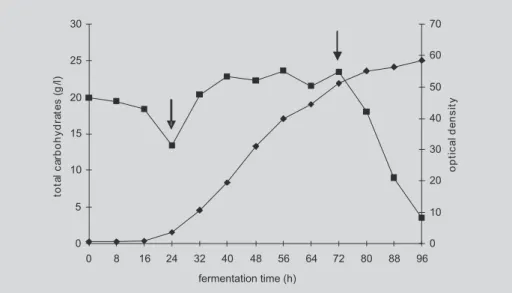
process, feeding was done continuously between 24 and 72 h of the process, with sugar cane juice (250 g total carbohydrates/L), in order to keep the concentration of total carbohydrates in the fermentation medium of about 20 g/L during the feeding. All experiments were done in duplicate and the average values of the results are shown.
Analytical methods
Total carbohydrates were measured by the phenol-sulfuric method (Dubois et al., 1956). The biomass concentration was measured as optical density (OD) using spectrophotometry at 650 nm in all fermentation samples. At the end of the processes, biomass was determinated by freeze-drying the sample until constant weight. The astaxanthin content was determinated by the method described by Bonfim (1999).
RESULTS AND DISCUSSION
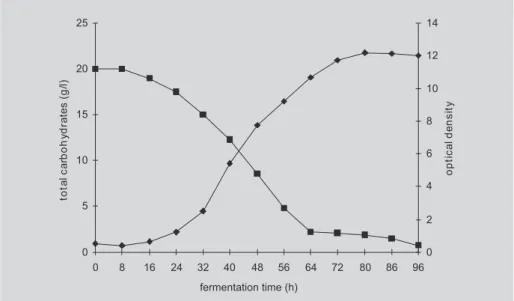
In order to increase the astaxanthin and biomass productivities, the yeast P. rhodozyma was cultivated in fed-batch process. Figures 2 and 3 show the substrate variation and biomass formation in the batch and fed-batch cultivation of the yeast P. rhodozyma, respectively.
Optimization of biomass and astaxanthin production 423
Table I shows the results obtained in these two cultures. Comparing the fed-batch process to the batch process studied, the biomass (Px) and astaxanthin productivity (Pp) increased approximately 4.55 and 4.73-fold, respectively, without losses in Yx/s and Yp/s (biomass and astaxanthin yield from total carbohydrates consumed, respectively), indicating that the substrate consumed by the yeast was not being used for ethanol production.
CONCLUSIONS
The use of a fed-batch fermentation is an important tool in process optimization and allows the establishment of high biomass and astaxanthin productivity processes. In this work, we optimized the production of biomass and astaxanthin productivities by fed-batch fermentation. Once this process is associated to low cost substrates, it could arouse interest to the industrial production, leading to a cost of about $0.53/g astaxanthin based on the carbon source price.
RESUMO
Otimização da produção de biomassa e astaxantina pela levedura Phaffia rhodozyma
A combinação de processos descontínuo alimentado e matérias-primas de baixo custo (caldo de cana-de-açúcar e uréia) foi estudada a fim de otimizar a
pro-dução de biomassa e astaxantina pela levedura Phaffia
rhodozyma ATCC 24202. No processo otimizado, pro-dutividades em biomassa e astaxantina de 0,327 g/L/ h e 0,124 mg/L/h foram obtidas, respectivamente. Comparadas com o processo descontínuo estudado, verificou-se aumento de 4,55 vezes na produtividade em biomassa e 4,73 vezes na produtividade em astaxantina.
UNITERMOS:Astaxantina. Biomassa.
Matérias-pri-mas de baixo custo. Processo descontínuo alimentado. Phaffia rhodozyma.
FIGURE 3 - Substrate variation and biomass formation in the fed-batch process. () total carbohydrates; (¡) optical density; the arrows indicate the start and the end of the feeding.
TABLE I - Batch and fed-batch process results
PROCESS X P Pp/x Px Pp Yx/s Yp/s
Batch 6.9 2.52 364.59 0.072 0.026 0.36 1.31 x 10⁻⁴
Fed-batch 31.4 11.91 379.18 0.327 0.124 0.39 1.46 x 10⁻⁴
D. G. Moriel, I. M. P. Machado, J. D. Fontana, T. M. B. Bonfim 424
REFERENCES
ACHEAMPONG, E. A., MARTIN, A. M. Kinetic studies on the yeast Phaffia rhodozyma. J. Basic Microbiol.,v. 35, p. 147-155, 1995.
BONFIM, T. M. B. Produção de astaxantina pela
levedura Phaffia rhodozyma (Xanthophyllomyces
dendrorhous) a partir de meios de cultura de baixo
custo. Curitiba, 1999. 159 p. [Tese de doutorado:
Universidade Federal do Paraná].
CHOCIAI, M. B.; MACHADO, I. M. P.; FONTANA, J. D.; CHOCIAI, J. G.; BUSATO, S. B.; BONFIM, T. M. B. Cultivo da levedura Phaffia rhodozyma
(Xanthophyllomyces dendrorhous) em processo
descontínuo alimentado para produção de astaxantina.
Rev. Bras. Cien. Farm., v. 38, p. 457-462, 2002.
CRUZ, J. M.; PARAJO, J. C. Improved astaxanthin production by Xanthophyllomyces dendrorhous
growing on enzymatic wood hydrolysates containing glucose and cellobiose. Food Chem., v. 63, p. 479-484, 1998.
DUBOIS, M.; GILLES, K. A.; HAMILTON, J. K.; REBERS, P. A.; SMITH, F. Colorimetric method for determination of sugars and related substances.
Anal.Chem., v. 28, p. 350-356, 1956.
HAYMAN, G. T.; MANNARELLI, B. M.; LEATHERS, T. D. Production of carotenoids by Phaffia rhodozyma
grown on media composed of corn wet-milling coproducts.
J. Ind. Microbiol., v. 14, p. 389-395, 1995.
JOHNSON, E. A.; AN, G. H. Astaxanthin from microbial sources. Critical Rev. Biotechnol., v. 11, p. 297-326, 1991.
PARAJO, J. C.; SANTOS, V.; VÁZQUEZ, M.; CRUZ, J. M. Production of carotenoids by Xanthophyllomyces
dendrorhous growing on enzymatic hydrolysates of
prehydrolysed wood. Food Chem., v. 60, p. 347-355, 1997.
PARAJO, J. C.; SANTOS, V.; VAZQUEZ, M. Production of carotenoids by Phaffia rhodozyma growing on media made from hemicellulosic hydrolysates of Eucalyptus globulus wood. Biotechnol. Bioeng., v. 59, p. 501-506, 1998.
VAZQUEZ, M.; SANTOS, V.; PARAJO, J. C. Fed-batch cultures of Phaffia rhodozyma in xylose-containing media made from wood hydrolysates. Food Biotechnol., v. 12, p. 43-55, 1998.