Arq Neuropsiquiatr 2007;65(3-B):800-802
C3c INTRATHECAL SYNTHESIS EVALUATION
IN PATIENTS WITH MULTIPLE SCLEROSIS
Bárbara Padilla-Docal, Alberto J Dorta-Contreras,
Hermes Fundora-Hernández, Elena Noris-García, Raisa Bu-Coifiu-Fanego,
Marlen González-Hernández, Alexis Rodríguez-Rey
ABSTRACT - Introduction: Multiple sclerosis (MS) is a chronic, inflammatory and progressive disease of the central nervous system in which local inflammatory injuries of the brain white matter appears, being the most outstanding feature the myeline loss (demyelination). Objective: To determine if the complement system might be involved in the MS immunopathogeny favouring the mechanism intervening in the my-elin destruction. Method: Samples of sera and CSF from twelve patients with a diagnosis of MS obtained at the moment of the admission to the hospital at the beginning of the break out, were collected. Lev-els of C3c and albumin in sera and in CSF were quantified using radial immunodiffusion plates. Results: High values over 80% of intrathecal synthesis were obtained except in one of the patients. Conclusion: Intrathecal synthesis of C3c and its liberation to the CSF means that the activation of the complement sys-tem in any of the two ways has taken place, and that once performed its biological functions, has suffered a degradation process
KEY WORDS: cytotoxicity, complement, multiple sclerosis, hypersensibility, immunopathogenicity, reibergram.
Evaluación de la síntesis intratecal de C3c en pacientes con esclerosis múltiple
RESUMEN - Introducción: La esclerosis múltiple (EM) es una enfermedad crónica, inflamatoria y progresi-va del sistema nervioso central que cursa con la aparición de lesiones inflamatorias focales en la sustan-cia blanca cerebral, en las que lo más llamativo es la pérdida de mielina (desmielinización). Objetivo: Co-nocer si el sistema de complemento puede estar involucrado en la inmunopatogenia de la EM favorecien-do los mecanismos que median la destrucción de la mielina. Método: Se colectaron muestras de suero y LCR de doce pacientes con diagnóstico de EM obtenidas en el momento del ingreso al inicio del bro-te. Se cuantificaron los niveles de C3c y albúmina en suero y en LCR en placas de inmunodifusión radial. Resultados: Se obtuvieron altos valores que superan el 80% de síntesis intratecal, menos en uno de los pacientes. Conclusion: La síntesis intratecal de C3c y su liberación al LCR significa que ha sucedido la ac-tivación del sistema de complemento en alguna de las dos vías y que una vez cumplidas sus funciones bio-lógicas, ha sufrido un proceso de degradación y liberación al LCR en forma de C3c.
PALABRAS-CLAVE: citotoxicidad, complemento, esclerosis múltiple, hipersensibilidad, inmunopatogenia, reibergrama.
Laboratorio Central de Líquido Cefalorraquídeo (LABCEL), Facultad de Ciencias Médicas “Dr. Miguel Enríquez”, Instituto SuperiorFacultad de Ciencias Médicas “Dr. Miguel Enríquez”, Instituto Superior de Ciencias Médicas de La Habana.
Received 16 January 2007, received in final form 21 May 2007. Accepted 29 June 2007.
Dra. Bárbara Padilla Docal - Laboratorio Central de Líquido Cefalorraquídeo (LABCEL) / Facultad de Ciencias Médicas “Dr. Miguel Enríquez” / Instituto Superior de Ciencias Médicas de La Habana - Apartado 10049 - CP 11000 Ciudad Habana - Cuba. E-mail: [email protected]
Multiple sclerosis (MS) is a chronic, inflammatory and progressive disease of the central nervous sys-tem (CNS) in which local inflammatory injuries of the brain white matter appears, being the most out-standing feature the myeline loss (demyelination), with a relative preservation of the axons in the pre-cocious phase, although it may be very affected in the final phases1. It is more frequent in young adults,
although it can appear at any age. Female sex is pre-dominant, 60% of women and 40% of men2,3.
Now-adays little is known about the etiology and patho-genicity of this disease. Many authors suggested that the immune system deregulation has an important paper in the mediation of the inflammatory injuries, in the central scope. The immune misbalance in MS has been demonstrated in the cellular immune re-sponse as well as in the humoral4,5
Arq Neuropsiquiatr 2007;65(3-B) 801
It is known that the MS diagnosis is based main-ly in the clinical characteristics8
. Cerebrospinal flu-id (CSF) is normal in MS. Nevertheless, the molecu-lar analysis shows a relative rise of the immunoglob-ulines, mainly the IgG. The most characteristic find-ings are, in frequency order: the appearance of the local IgG synthesis and the presence of oligoclonal bands in 90% of the cases, the raise of IgG in 80%, a discrete rise of gammaglobulines in 70% of the cas-es, and a moderate rise of cells and tubular proteins in 40% of the patients9,10
.
C3c is a degradation product of C3 factor of the complement system; its formation has two impor-tant biological features. One of them is that for be-ing a product of a C3 degradation, is a measure of its concentration and, on the other hand, indicates that all C3c produced in the CNS is a product of the sys-tem biological activation in any of its ways. This last assertion means that the system has been activated and that we are in the presence of an immunolog-ical event associated to a type II or citotoxic hyper-sensibility. C3c intrathecal synthesis helps us to un-derstand the physiopathological mechanisms when we are in the presence of infectious or autoimmune neurological diseases as MS11.
The objective of the present study is to know if the complement system might be involved in the multiple sclerosis immunopathogeny favoring the mechanism intervening in the myeline destruction.
METHOD
Sera and CSF samples were collected from 12 patients diagnosed with MS received in LABCEL between 2004 and 2006.
Samples were obtained at the time of the admission, at the beginning of the break out, kept at –80oC until the moment of its use in small portions.
C3c levels in sera were quantified in radial immunodi-fussion plates NOR Partigen from Dade-Behring (Marburg) and in CSF in plates LC Partigen of the same brand.
To discriminate if there is C3c intrathecal synthesis and to know the situation of the blood-CSF barrier, albumin in sera was quantified in radial immunodifussion plates NOR Partigen and in CSF in LC Partigen plates, dade Behring (Marburg).
The results obtained were placed in the Reibergram de-signed for C3c12.
RESULTS
The review of the clinical files of these patients main showed that the relapsing remitting pattern was the main form of presentation of the disease and only one patient showed the primary progres-sive form.
Out of the 12 patients, four were classified as MS clinically defined, six as MS defined with laborato-ry support, one as clinically probable MS and one as probable MS with laboratory support according Pos-er critPos-eria for the MS diagnosis13
Regarding sex, 10 patients correspond to females (83.3%) and 2 to males (16.7%). All the patients were between 33 and 57 years old for an average of 46.8 years.
Table shows C3c intrathecal synthesis and time of evolution of the disease per patient.
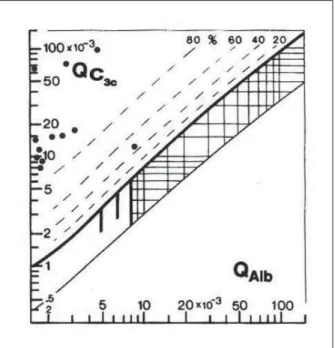
Figure shows the graph of Reiber ratios or Reiber-gram for the evaluation of the C3c intrathecal syn-thesis evaluation. High values over 80% of intrathe-cal synthesis were obtained in all but one of the pa-tients.
DISCUSSION
Samples used in this study come from patients di-agnosed as having MS, according to the Poser criteria for the diagnosis of the disease13. C3c is a polypeptide
structure produced by the activation and later deg-radation of the C3 complement factor. Antigen-anti-body complex (Ag-Ab) initiates the activation of the classic way, whereas the alternative way and the leci-thin are independently activated from Ab through the complement interaction with specific carbohy-drates groups and lypopolysaccharides present in the pathogen surface. The complement functions as a cascade through the proteolysis of a series of pro-teins that take to the generation of active propro-teins that mediate various biological functions.
Table. C3c Intrathecal synthesis and time of evolution of the disease per patient.
Patient C3c intrathecal synthesis (%)*
Evolution time
1 89.3 2 months
2 89.5 1 year
3 87.9 3 months
4 36.5 7 months
5 93.3 4 months
6 91.2 3 years
7 92.4 18 years
8 90.1 2 years
9 83.6 5 months
10 98.7 2 years
11 96.3 15 years
12 97.4 5 years
802 Arq Neuropsiquiatr 2007;65(3-B)
In the studied patients an intense intrathecal syn-thesis and C3c liberation to CSF occurred. Intrathecal synthesis of C3c and its liberation into cerebrospinal fluid means in first place that an activation of the complement system, in some of the ways it medi-ates, has occurred and also that a biological use of this protein took place and that after it has fulfilled its biological functions, has suffered a degradation process and liberation to CSF in form of C3c.
This allows us to sustain that a type II hypersensi-bility process has occurred mainly from the synthesis of IgG that activated the complement system as part of the cytotoxicity against the myelin in the immuno-pathogenic mechanisms of this entity14. In this
reac-tion; the IgG type antibodies are bonded to myelin antigens causing its destruction. These antibodies cause sickness through three principal mechanisms: opsonization and phagocytosis, antibody dependent cellular cytoxicity and injuries mediated by the com-plement system. This triggers the lysis through the formation of a membrane attack complex (MAC), the attraction of the macrophages (chymiotaxis) that liberate toxic substances, develop inflammato-ry responses and opsonization with the consequent phagocytosis15-17
.
It has been pointed out that the complement cas-cade activation during the multiple sclerosis attacks seems to be reserved for the patients with the dis-ease in advanced stages and is correlated in a signifi-cative way with the neurological incapacity of these patients16
. In our study we appreciate C3c intrathe-cal synthesis in more than 80%, the same in patients with only few months of the disease evolution as well as in patients suffering it for several years (Ta-ble). Out of the 12 studied patients, four of them had neurological incapacity being coincident with more than 80% of C3c intrathecal synthesis.
These results allow to suggest that the comple-ment system is envolved in the immunopathogeny of MS and it will help to know much in depth the mechanisms of the myelin destruction.
REFERENCES
1. Esclerosis múltiple. Bases clínicas y patológicas. In Raine CS, McFar-land F, Tourtellotte WW (Eds). Madrid: Edimsa, 2000:12-18.
2. Mc Farlin DE, Mc Farland HF. Multiple sclerosis. Part 1. N Engl J Med 1982;307:1183-1188.
3. Mc Farlin DF, Mc Farland HF. Multiple sclerosis. Part 2 . N Engl J Med 1982;307:1246-1251.
4. Lassmann H. Pathology of multiple sclerosis. In Campston A, Ebers G, Lassman H, McDonald I, Matthews B, Weckerle H (Eds). McAlpine multiple sclerosis. London: Churchill Livingstone, 1998:323-358. 5. Swanson JW. Multiple sclerosis, update in diagnosis and review of
prognostic factors. Mayo Clin Proc 1989;64:577-586.
6. Rudick RA, Ransohoff R. Cytokine secretion by multiple sclerosis monocytes. Arch Neurol 1992;49:265-270.
7. Hartung HP. Immune-mediated demyelination. Ann Neurol 1993; 33: 563-567.
8. Abers GC. Genetics and multiple sclerosis: an overview. Ann Neurol 1994;36(Suppl):S12-S14.
9. Rao SM, Gary JL, Bernandin L, Unverzagt. F. Cognitive dysfunction in multiple sclerosis. I. Frequency, patterns and prediction. Neurology 1991;41:685-691.
10. Andersson M, Alvarez-Cermeño J, Bernardi G, et al. Cerebrospinal lu -id in the diagnosis of multiple sclerosis: a consensus report. J Neurol Neurosurg Psichiatry 1994;57:897-902.
11. Dorta-Contreras AJ. Reibergrama para la evaluación de la síntesis in-tratecal de C3c. Barrera sangre-líquido cefalorraquídeo. La Habana: Ed-itorial Academia, 2006:69-67.
12. Dorta-Contreras AJ, Noris-García E, Padilla-Docal B, et al. Reibergrama para la evaluación de la sintesis intratecal de C3c. Arq Neuropsiquiatr 2006;64:585-588.
13. Poser CM, Paty DW, Scheinberg L et al. New diagnostic criteria for mul-tiple sclerosis: guidelines for research protocols. Ann Neurol 1983;13: 227-231.
14. Stangel M, Compston A, Scolding NJ. Oligodendroglia are protected from antibody-mediated complement injury by normal inmunoglobu-lins. J Neuroimmunol 2000;103:195-201.
15. Lucchinetti C, Brück W, Noseworthy J. Multiple sclerosis: recent devel-opments in neuropathology, pathogenesis, magnetic resonance imag-ing studies and treatment. Curr Opin Neurol 2001;14:259-269. 16. Rodríguez-Sainz MC, Sánchez-Ramón S, de Andrés C, Rodríguez-
Ma-hou M, Muñoz-Fernández MA. Th1/Th2 cytokine balance and nitric oxide in cerebrospinal luid and serum from patients with multiple scle -rosis. Eur Cytokine Netw 2002;13:110-114.
17. Sellebjerg F, Jaliashvili I, Christiansen M, Garred P. Intrathecal activa-tion of the complement system and disability in multiple sclerosis. J Neurol Sci 1998;157:168-174.
1284
CORREÇÃO / CORRECTION
C3c intrathecal synthesis evaluation in patients with multiple sclerosis
B Padilla-Docal, A J Dorta-Contreras, H Fundora-Hernández, E Noris-García, R Bu-Coifiu-Fanego, M González-Hernández, A Rodríguez-Rey
Arq Neuropsiquiaatr 2007;65(3B):800-802
Figure of this article is wrong. Correct Figure is
Figure. C3c Reibergram for the MS patients studied. Q C3c and Q Albumin values are shown. Observe that there is a pronounced intrathecal synthesis in the ma-jority of these patients because they are placed in the nearby zones to the percentile line corresponding to the 80%.
The Editor presents to the Authors the excuses for this distressing mistake.