Arq Bras Cardiol 2002; 78: 385-7.
Cunha et al Heart weight and heart weight/body weight coefficient
385 385
Faculdade de Medicina do Triângulo Mineiro, Uberaba
Mailing address: Daniel Ferreira da Cunha - Nutrologia - Faculdade de Medicina do Triângulo Mineiro - Av. Getúlio Guaritá, 130 - 38025-180 - Uberaba, MG, Brazil - E-mail: [email protected]
English version by Stela Maris C. e Gandour
Objective - To compare the heart weight and the heart weight/body weight coefficient of adults with and without chronic malnutrition.
Methods - In an initial case series of 210 autopsies performed in adults, we recorded body and heart weights and calculated the heart weight/body weight coefficients (HW/BW x 100). The exclusion criteria were as follows: po-sitive serology for Chagas’ disease, edema, obesity, heart diseases, hepatopathies, nephropathies, and systemic ar-terial hypertension. Malnutrition was characterized as a body mass index <18.5kg/m2. Differences with p<0.05
we-re considewe-red significant.
Results - Individuals in the malnourished (n=15) and control (n=21) groups were statistically different, respectively, in regard to body mass index (15.9±1.7 versus 21.3±2.5kg/m2), heart weight (267.3±59.8 versus
329.1±50.4g), and the HW/BW coefficient (0.64±0.12 ver-sus 0.57±0.09%). A positive and significant correlation was observed between heart weight and body mass index (r=0.52), and between heart weight and body weight (r=0.65).
Conclusion - Malnourished individuals have lighter hearts and a greater HW/BW coefficient than non-malnouri-shed individuals do. These findings indicate a possible pre-servation of the myocardium in relation to the intensity of weight loss associated with the probable relative increase in cardiac connective tissue and heart blood vessels.
Key words: heart, cardiac hypotrophy, nutrition, protein-calorie malnutrition
Arq Bras Cardiol, volume 78 (nº 4), 385-7, 2002
Daniel Ferreira da Cunha, Selma Freire de Carvalho da Cunha, Marlene Antônia dos Reis,
Vicente de Paula Antunes Teixeira
Uberaba, MG - Brazil
Heart Weight and Heart Weight/Body Weight Coefficient
in Malnourished Adults
Original Article
Chronic malnutrition results from the inadequate in-take of nutrients, with the predominance of catabolic processes over the anabolic ones, and the progressive wasting of fat and muscle protein body reserves. In adult individuals, chronic protein-calorie malnutrition man i-fests as progressive weight loss with hypofunction and hy potrophy of organs, such as the spleen, intestines, and kidneys 1. Experiments with animals 2 and autopsies
of malnourished children show that the heart undergoes hy potrophy proportional to the degree of weight loss 3,4.
Even though studies on heart morphometry and function of malnourished adults are rare 5, experiments with
ani-mals suggest that the myocardium undergoes a milder wasting than striated skeletal muscles do, possibly due to the relative increase in vascularization and oxygena -tion of the myocardiocytes 6. However, patients quite
frequen tly develop tachycardia, hydric retention, and cardiac decompensation during nutritional therapy, and this phenomenon has been attributed to myocardial d y sfunction associated with cardiac hypotrophy secon-dary to malnutrition 7.
The heart weight/body weight (HW/BW) coefficient, whose normal value is around 0.5±0.02, has been used for characterizing myocardial hypertrophy 8 and could be used
for assessing myocardial hypotrophy. A study carried out by our group 8, even though with other objectives, showed
that individuals dying with cachexia had a HW/BW coeffi-cient greater than normal. However, the relations between the HW/BW coefficient and other parameters of nutritional assessment, such as body weight, height, and body mass index, have not yet been established.
386 386
Cunha et al
Heart weight and heart weight/body weight coefficient
Arq Bras Cardiol 2002; 78: 385-7.
Methods
The study was carried out in the departments of nutri-tion and general pathology of the Medical School of Triân-gulo Mineiro (FMTM), in the city of Uberaba, State of Mi-nas Gerais, after approval by the Committee on Medical Ethics of the university-affiliated hospital. In the first phase, of a total of 315 autopsies performed at the university-affilia-ted hospital from December 1986 to January 1998, we selec-ted 210 reports of complete autopsies performed in adults ol-der than 21 years.
The major diagnoses established on autopsy and the general data of the patients, such as sex, color, age, height, body and cardiac weights, were stored in an electronic da-tabase. Later, patients with chagasic, hypertensive, ischemic, rheumatic, and pulmonary heart disease were exclu -ded from the study. Due to the influence of edema on body weight, patients with anasarca or localized nonin -flammatory edema were excluded, as were patients with signs of chronic hepatopathy (viral hepatitis, alcoholic hepatitis, or cirrhosis), glomerulopathy, and with obesity
de fined as a body mass index greater than 27kg/m2.
Positive serological reactions for Chagas’ disease and the presence of intracardiac thrombosis or pericarditis were also considered exclusion criteria, as was the presence of morphological renal signs suggestive of chronic renal insufficiency, which is a condition frequently associated with cardiomegaly 9.
The nutritional status was characterized by body mass index, which was calculated by dividing body weight in kilos by height in square meters (kg/m2); individuals with
bo-dy mass index <18.5kg/m2 were considered malnourished 10.
The HW/BW coefficient [heart weight (g)/body weight (g) x 100] was calculated in all cases 8. After verifying the
sta-tistical normality of the numerical continuous data obtai-ned, the malnourished and control groups were compared using the Student t test. The chi-square test and Fisher exact test were used for comparing proportions. Pearson correlation coefficient was used to assess the correlations between body weight and heart weight, and between body mass index and heart weight. Differences with p<0.05 were considered significant.
Results
We analyzed 36 patients, 15 of whom had protein-ca-lorie malnutrition and 21 were control individuals. Malnou-rished patients and control patients did not statistically differ in regard to, respectively, age (42.3±18.3 versus 44.7±21.8 years), sex proportion (male:female = 11:4 versus 18:5), and color (white:nonwhite = 10:5 versus 16:5). Likewi-se, the percentages of the most common diagnoses on auto-psy for malnourished and control patients were similar and as follows, respectively: bronchopneumonia (40 versus 38.1), gastritis (40 versus 28.6), acquired immunodeficiency syndrome (26.7 versus 19.9), malignant neoplasias (13.3 versus19), chronic pancreatitis (13.3 versus 33.3), and sepsis
(13.3 versus 19). No gross or microscopic cardiac alterations compatible with the diagnoses of degeneration, necrosis, inflammatory infiltrate, or presence of parasites were observed.
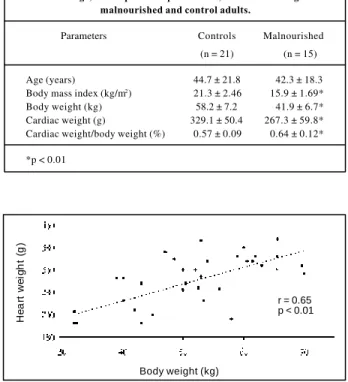
The patients in the malnourished and control groups had similar heights, 1.62±0.12 meters versus 1.65±0.08 me-ters, respectively. Malnourished patients, however, had lo-wer body weight and body mass index than those of the control group (p<0.05) (tab. I). Heart weight was lower in the malnourished patients (267.3±59.8g) as compared with tho-se in the control patients (329.1±50.4g), but the HW/BW re-lation was greater in the malnourished group (0.64±0.12%) than in the control group (0.57±0.09%). The correlations between body weight and heart weight (fig. 1) and between body mass index and heart weight (fig. 2) were positive and significant (p<0.05).
Discussion
In our study, we observed that the heart is proportio-nally heavier in malnourished adults than in non-malnouri-shed control individuals. This phenomenon may be inter-preted as a manifestation of relative heart preservation in regard to the intensity of body weight loss. This interpreta-tion is in accordance with the report of greater HW/BW coef-ficients in thinner individuals as compared with those in in-dividuals with a greater body weight 11 and also with the
observance of HW/BW coefficients of 0.60±0.13% in indivi-duals dying due to diseases accompanied by cachexia 8.
The exclusion of obese individuals, individuals with heart diseases and with systemic diseases, such as
syste-Table I - Age, anthropometric parameters, and cardiac weight in malnourished and control adults.
Parameters Controls Malnourished (n = 21) (n = 15)
Age (years) 44.7 ± 21.8 42.3 ± 18.3 Body mass index (kg/m2) 21.3 ± 2.46 15.9 ± 1.69*
Body weight (kg) 58.2 ± 7.2 41.9 ± 6.7* Cardiac weight (g) 329.1 ± 50.4 267.3 ± 59.8* Cardiac weight/body weight (%) 0.57 ± 0.09 0.64 ± 0.12*
*p < 0.01
Fig. 1 – Correlation between body weight (kg) and cardiac weight (g) in malnouri-shed and control adults.
H
e
a
rt
w
e
ig
h
t
(g
)
Body weight (kg)
Arq Bras Cardiol 2002; 78: 385-7.
Cunha et al Heart weight and heart weight/body weight coefficient
387 387 mic arterial hypertension or chronic renal insufficiency,
re-duced the possibility of the concomitance of conditions causing myocardial hypertrophy or cardiac dilation 12.
Li-kewise, the exclusion of patients with edema or cavitary ef-fusions also increased the reliability of the anthropometry in assessing nutritional status 10.
According to the criteria used in this study, which did not include individuals with protein malnutrition of the kwashiorkor type 1, we can state that a predominance of
individuals with malnutrition of the marasmus type occur-red. This malnutrition results from prolonged negative calo-rie balance, characterized by a marked wasting of body fat reserves and a relative preservation of muscle mass. Even though the type of malnutrition is rarely detailed in studies performed with adults 1, the heart has been reported to be
relatively spared in prolonged malnutrition 1,3,4, which
sup-ports the finding of a greater heart weight/body weight coefficient observed in the present study.
However, we also observed a positive and significant correlation between body weight and heart weight (r=0.65), and also between heart weight and body mass index (r=0.52), which indicates that the thinner the individual, the lower his heart weight is. Likewise, according to morpho-metric studies on myocardiocytes 5, individuals with
ad-vanced malnutrition have greater degrees of heart hypotro-phy 13. This fact may have clinical repercussions, such as a
prolonged QTc interval on the electrocardiogram 14, a lower
cardiac output 2, and a higher risk of developing the
refeeding syndrome, a condition in which cardiac decom-pensation would result from myocardial dysfunction associated with cardiac hypotrophy secondary to malnutri-tion 7. These data indicate that if myocardium undergoes
hypotrophy, the same seems not to happen to the connecti-ve tissue in the heart 3,5, a fact supported by the greater
tor-tuosity of the coronary vessels and the disproportion bet-ween the size of the hypotrophic heart and the great ves-sels, which are not affected by malnutrition.
In conclusion, even though a relative preservation of cardiac weight in adults with marasmus has been reported, the results of our study also show cardiac hypotrophy associated with severe chronic malnutrition. Further studies may clarify whether at least part of the maintenance of the cardiac weight results from the relative increase in the con-nective tissue, which would be more preserved than the muscular one during prolonged starvation.
1. McMahon MM, Bistrian BR. The physiology of nutritional assessment and therapy in protein-calorie malnutrition. Dis Mon 1990; 36: 373-417. 2. Alden PB, Madoff RD, Stahl TJ, Lakatua DJ, Ring WS, Cerra FB. Left ventricular
function in malnutrition. Am J Physiol 1987; 253: H380-7.
3. Webb JG, Kiess MC, Chan-Yan CC. Malnutrition and the heart. Can Med Assoc J 1986; 135: 753-8.
4. Freeman LM, Roubenoff R. The nutrition implications of cardiac cachexia. Nutr Rev 1994; 52: 340-7.
5. Cunha DF, Pedrini CH, Sousa JC, et al. Estudo morfométrico do miocárdio em adultos com subnutrição protéico-energética. Arq Bras Cardiol 1998; 71: 677-80. 6. Vandewoude MF. Morphometric changes in microvasculature in rat myocardium
during malnutrition. J Parenter Enteral Nutr 1995; 19: 376-80.
7. Brooks MJ, Melnik GM. The refeeding syndrome: an approach to understanding its complications and preventing its occurence. Pharmacotherapy 1995; 15: 713-26. 8. Almeida HO, Teixeira VPA, Araújo WF. Comportamento do peso do coração e do corpo em chagásicos crônicos com e sem “megas”. Rev Soc Bras Med Trop 1979; 13: 85-9.
References
9. Suzuki H, Schaefer L, Ling H, et al. Prevention of cardiac hypertrophy in experi-mental chronic renal failure by long-term ACE inhibitor administration: poten-tial role of lysosomal proteinases. Am J Nephrol 1995; 15: 129-36. 10. James WP, Ferro-Luzzi A, Waterlow JC. Definition of chronic energy deficiency
in adults: report of a working party of the International Dietary Energy Consul-tative Group. Eur J Clin Nutr 1988; 42: 969-81.
11. Hanzlick R, Rydzewski D. Heart weights of white men 20 to 39 years of age: an analysis of 218 autopsy cases. Am J Forensic Med Pathol 1990; 11: 202-4. 12. Warnes CA, Roberts WC. The heart in massive (more than 300 pounds or 136
ki-lograms) obesity: analysis of 12 patients studied at necropsy. Am J Cardiol 1984; 54: 1087-91.
13. Vandewoude MF, Cortvrindt RG, Goovaerts MF, Van Paesschen MA, Buyssens N. Malnutrition and the heart: a microscopic analysis. Infusionstherapie 1988; 15: 217-20.
14. Cunha DF, Cunha SFC, Ferreira TPS, et al. Prolonged QTc intervals on the electro-cardiograms of hospitalized malnourished adults. Nutrition 2001; 17: 370-2. Fig. 2 - Correlation between body mass index (BMI) and heart weight in
malnouri-shed and control adults.
H
e
a
rt
w
e
ig
(
g
)
BMI (kg/m2)