Nursing practice in home care: an integrative literature review
Atuação do enfermeiro na atenção domiciliar: uma revisão integrativa da literatura
Actuación del enfermero en atención domiciliaria: una revisión integrativa de la literatura
Angélica Mônica Andrade
I,II, Kênia Lara Silva
I,II, Clarissa Terenzi Seixas
II,III, Patrícia Pinto Braga
II,IVI Universidade Federal de Minas Gerais, School of Nursing,
Postgraduate Program in Nursing. Belo Horizonte, Minas Gerais, Brazil.
II Universidade Federal de Minas Gerais, Study and Research Center for
Nursing Teaching and Practice. Belo Horizonte, Minas Gerais, Brazil.
III Universidade do Estado do Rio de Janeiro, Biomedical Center, Nursing College. Rio de Janeiro, Brazil.
IV Universidade Federal de São João Del-Rei, Nursing Course. Divinópolis, Minas Gerais, Brazil.
How to cite this article:
Andrade AM, Silva KL, Seixas CT, Braga PP. Nursing practice in home care: an integrative literature review. Rev Bras Enferm [Internet]. 2017;70(1):199-208. DOI: http://dx.doi.org/10.1590/0034-7167-2016-0214
Submission: 05-19-2016 Approval: 8-24-2016
ABSTRACT
Objective:analyze scientifi c production on nursing practice in home care. Method: integrative review employing databases LILACS, BDENF, IBECS, and MEDLINE. Studies in Spanish, English, and Portuguese were included, regardless of publishing date. Results:after analyzing 48 articles, it was found that nursing practice in home care is complex, employing a multitude of actions by using three technologies: soft; soft-hardespecially; and hard. Challenges related to the home-care training process are reported in the literature. Nurses use knowledge from their experience and scientifi c recommendations in conjunction with their refl ections on the practice. Conclusion: home nursing practice is fundamental and widespread. Relational and educational actions stand out as necessary even in technical care, with a predominant need for home-care training.
Descriptors:Nurse’s Role; Home Care Services; Home Care Services, Hospital-Based; Home Health Nursing; Nursing.
RESUMO
Objetivo:analisar a produção científi ca acerca da atuação do enfermeiro na atenção domiciliar em saúde. Método: realizou-se uma revisão integrativa da literatura por meio de consulta às bases de dados LILACS, BDENF, IBECS e MEDLINE. Foram incluídos estudos em espanhol, inglês e português, não delimitando data de publicação. Resultados:analisados 48 artigos, identifi cou-se que a atuação do enfermeiro na atenção domiciliar possui complexidade e diversidade de ações com uso de tecnologias leves, leve-durasespecialmente, e duras. Destaca-se que desafi os relacionados ao processo formativo para a atenção domiciliar estão relatados na literatura. O enfermeiro utiliza conhecimento experiencial e recomendações científi cas aliados à refl exão na prática. Conclusão: a atuação do enfermeiro no espaço domiciliar é fundamental e ampla. As ações relacionais e educacionais se destacam, sendo necessárias inclusive nos cuidados técnicos, predominando a necessidade de formação para a atenção domiciliar.
Descritores:Papel do Profi ssional de Enfermagem; Serviços de Assistência Domiciliar; Serviços Hospitalares de Assistência Domiciliar; Enfermagem Domiciliar; Enfermagem.
RESUMEN
Objetivo: analizar la producción científi ca sobre la actuación del enfermero en atención domiciliaria de salud. Método: se realizó revisión integrativa de la literatura mediante consulta de las bases de datos LILACS, BDENF, IBECS y MEDLINE. Fueron incluidos estudios en español, inglés y portugués, sin delimitar la fecha de publicación. Resultados: analizados 48 artículos, se identifi có que la actuación del enfermero en atención domiciliaria posee complejidad y diversidad de acciones, con uso de tecnologías blandas, blandas-duras (especialmente) y duras. Se destaca que los desafíos relacionados al proceso formativo para atención domiciliaria están narrados en la literatura. El enfermero utiliza conocimiento empírico y recomendaciones científi cas, aliados a la refl exión en la práctica.
INTRODUCTION
Home care (HC) is a type of health care that favors the actu-alization of new forms of care production and interdisciplinary practice, and it is in expansion in Brazil and worldwide(1). It is an alternative to hospitalization that decreases both the demand for it and length-of-stay. As a consequence, it reduces the costs and complication risks related to the hospital environment(2). More-over, the home has been recognized as a favorable environment for innovative and unique care, with the potential to offer care centered on users’ demands and needs(1).
It is necessary to consider that home care is a healthcare intervention that requires qualified professionals, because it is known that this type of care demands the use of specific competencies, mainly linked to interpersonal relationships, in order to work with users, family members, and multi-profes-sional teams. It also demands autonomy, responsibility, and technical and scientific knowledge that are inherent to the field. Thus, it is understood that HC work has a multitude of actions and specific complexities that demand professional experience and the search for home practice qualification(3).
Studies reveal that the nurses’ focus when administering home care is in both managing services and in direct care(4). Another important factor is that these professionals perform a crucial role, both in coordinating health plans at homes and in the links they establish with users and family members(5). Furthermore, this central role is even more evident when it is observed that it brings together families and multi-professional teams because, in general, nurses must train family caregivers, supervise nurs-ing technicians and identify the need for other professionals(4-5). Thus, for home-care practice, nurses must present both basic and advanced abilities. Competencies for this practice need to be investigated, disseminated, and systematized(4).
However, there is strong evidence that Brazilian nursing training does not include the requirements for HC work, be-cause there is a prevalence of curative training, centered on diseases and not on subjects, with a predominance of hospi-tal-focused actions(3,6). It can be noticed that nursing under-graduate education today has little space for concepts, indi-vidualities, and the necessary profile for home care.
Considering this gap in the learning process, in general, it is worth noting that home-care knowledge results, above all, from experience, learned from various daily HC situations. Thus, this process is somewhat unpredictable, because profes-sionals may not have previously experienced this type of care during their undergraduate nursing learning process(4). In this investigation, the authors believe that the acquisition of com-petencies resulting from handling unpredictable events is a rich specific feature of nursing practice at home.
With these consideration in mind, we ask: How is nurs-ing practice in home-care services established? This study’s
Angélica Mônica Andrade E-mail: [email protected]
CORRESPONDING AUTHOR
Descriptores: Rol de la Enfermera; Servicios de Atención de Salud a Domicilio; Servicios de Atención a Domicilio Provisto por Hospital; Cuidados de Enfermería en el Hogar; Enfermería.
objective was to analyze scientific production on nursing practice in home care.
METHOD
An integrative review of the literature was chosen. This is a research method frequently employed in evidence-based practice. Its aim is to gather and synthesize prior results in order to formulate a comprehensive explanation for a specific phenomenon. Therefore, conclusions are established by criti-cal assessment of various methodologicriti-cal approaches(7).
This integrative review was conducted following these stages: creation of a guiding question; definition of databases and inclusion and exclusion criteria for studies/samples or searches in the literature; a definition of the information to be extracted from the studies selected; assessment of studies in-cluded in the integrative review; interpretation of results; and, lastly, presentation of review/synthesis of knowledge(7).
Articles were identified through bibliographical searches conducted between January and July, 2015, in the follow-ing databases: the Medical Literature Analysis and Retrieval System Online (MEDLINE), searched through PubMed; Base de Dados Específica da Enfermagem (Specific Nursing Data-base—BDENF); the Índice Bibliográfico Espanhol de Ciências da Saúde (Spanish Bibliographical Index of Health Sciences— IBECS); and Literatura Latino-Americana e do Caribe em Ciên-cias da Saúde (Latin American and Caribbean Literature on Health Sciencies Information —LILACS), consulted through the Biblioteca Virtual em Saúde (Virtual Library on Health— BVS); and the Cumulative Index to Nursing and Allied Health Literature (CINAHL), accessed through the CAPES portal.
Articles published in English, Spanish, and Portuguese were included, with no limitations as to publishing dates, when presenting abstracts and information on nursing prac-tice in home care.
Search strategy in the PubMED base used the following terms: (“Home Nursing”[Mesh]) OR (“Home Health Nursing”[Mesh]) OR (“Home Care Services”[Mesh]) OR (“Home Care Services, Hospital-Based”[Mesh]) OR (“Homebound Persons”[Mesh]) OR (“Home Nursing”[Title/Abstract]) OR (“Home Health Nursing”[Title/Abstract]) OR (“Home Care Services”[Title/ Abstract]) OR (“Homebound Persons”[Title/Abstract]) AND (“Nurse’s Role”[Mesh]) OR (“Nurse’s Role”[Title/Abstract]). Equivalent strategies were adopted for the other bases.
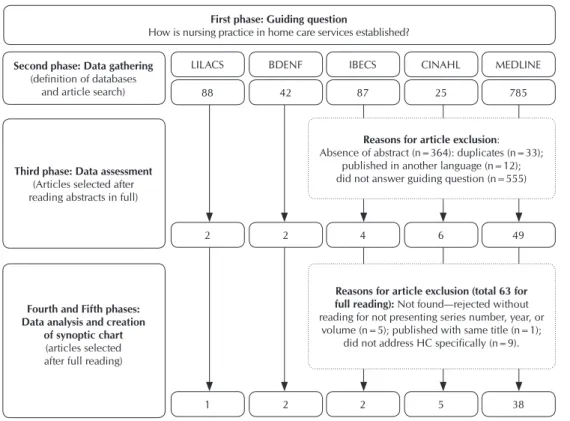
for not presenting serial number, year, or volume. One article with a repeated name was found and discarded. Thus, of the 57 articles read in full, 48 answered the guiding question, so they were the final sample in this review (Figure 1).
In order to validate the selection of publications for analy-sis, articles in the fourth phase were assessed by two reviewers from the team comprising four researchers. With their exper-tise in the area, they independently selected articles based on inclusion and exclusion criteria and guided by the research question. Each reviewer recorded their assessment and reason for inclusion or exclusion of articles in an instrument that con-tained their titles, abstracts, and databases.
The fourth phase’s results were compared and disagree-ments were resolved through consensus between reviewers or with the inclusion of a third reviewer, when necessary. Among the 57 publications assessed in this stage, 48 were selected by both reviewers and included and four were not selected by either reviewer, being automatically excluded. There was a total of five disagreements (8.7%) among reviewers and, after reassessment, these articles were excluded for not address-ing HC directly. This process to validate the selection of final samples allowed the inclusion of studies that were consistent, that contributed to reaching the objective and to the exclusion of others that did not meet the requirements.
In the research’s fifth phase, publications were analyzed and data interpreted in an organized way and synthesized by creating a synoptic chart containing the following items: identification, authors, year and journals where the publi-cations were published, location (country/city), objectives,
methodological design, main results, and description of nurs-ing practice in HM.
Study quality was assessed based on the levels of evidence (LoE)(8) classification. Publications were grouped as follows: level I - evidence obtained from results of meta-analysis of controlled clinical trials and with randomization; level II - evidence tained from experimental design studies; level III - evidence ob-tained from quasi-experimental researchers; level IV - evidence obtained from descriptive studies or with qualitative approach; level V - evidence obtained from case reports or experience re-ports; level VI - evidence based on specialist opinions or based on standards or legislation. This classification made it possible to identify the profile of studies on the investigated theme.
Research observed the ethical aspects of research, respect-ing authors of the ideas, concepts, and definitions presented in the articles included in the review.
RESULTS
It was possible to select 48 articles that met the inclusion cri-teria to reach the proposed objective(9-56). The greatest number of publications came from MEDLINE (79%) and CINAHL (10%). There was a predominance of the English language (87.5%) in 42 publications, followed by four articles in Portuguese, and two in Spanish. The 48 selected articles were published between 1989 and 2014; 19% were dated 2006, 10.4% dated 2014, and 10.4% dated 2002, with a predominance of American (31.2%) and Ca-nadian (23%) studies. The other articles come from the following countries: Brazil (8.3%); Japan (6.3%); Norway (4.2%); the
Neth-erlands (4.2%); Sweden (4.2%); the UK (4.2%); Aus-tralia (4.2%); Spain (4.2%); Denmark (2%); Ireland (2%); and Iceland (2%).
Regarding types of studies included, level of evidence IV was present in 86% of the selected sample (18 qualitative studies, 18 literature reviews, and one experience report), level V in 8% (three reflection studies and one experience report), level of evidence I in 4% (two randomized studies), and level VI in 2% (standards guide).
When analyzing studies, it was found that nursing practice in HC is complex and has a variety of actions that enabled the construc-tion of two thematic cat-egories: “nursing actions in home care” and “neces-sary knowledge for nursing practice in home care.” First phase: Guiding question
How is nursing practice in home care services established?
LILACS BDENF IBECS CINAHL MEDLINE
88 42 87 25 785
2 2 4 6 49
1 2 2 5 38
Reasons for article exclusion: Absence of abstract (n=364): duplicates (n=33);
published in another language (n=12); did not answer guiding question (n=555)
Second phase: Data gathering
(definition of databases and article search)
Third phase: Data assessment
(Articles selected after reading abstracts in full)
Fourth and Fifth phases: Data analysis and creation
of synoptic chart
(articles selected after full reading)
Reasons for article exclusion (total 63 for full reading): Not found—rejected without reading for not presenting series number, year, or
volume (n=5); published with same title (n=1); did not address HC specifically (n=9).
Nursing actions in home care
Analysis of the articles shows that nurses have a central role in HC(13,25,27,33,40,46). The relevance of their practice is in the fact that they are considered clinical specialists(11,27,34,56), coordinators of care(12,15,27,34,40,43), and case managers(15,40,43), responsible for offering various care practices to patients(40) and also for performing important leadership roles(27,40). In this regard, nurses have been portrayed in the literature as crucial professionals in the construction of this type of care(13).
Nursing practice in HC is influenced both by patient profile and by the logic peculiar to homes. In HC, nurses offer care to a diverse profile, with a predominance of patients under palliative care (12-13,22,27,33,50,52,55) and the elderly(16,28-29,35) being noticed in this review, although analyzed articles have also reported care actions for children(11,19,25) and young individuals(28) with com-plex needs, as well as mentally challenged persons(14,27).
Review of the articles revealed that nurses conduct vari-ous actions in HC, such as: interpersonal support; health education for patients, family members; and caregivers; per-formance of technical procedures; and clinical and adminis-trative supervision, as demonstrated in Chart 1.
Interaction among nurses and patients, family members, and/or caregivers is a fundamental aspect of the home con-text, being mentioned in 31 publications, as shown in Chart 1. Articles indicate that nurses must be able to construct effec-tive relationships with patients. Negotiation and nurse-patient interaction stand out as care mediated by dialog(16,26). The way roles and relationships are built, negotiated, and experienced
shows the relevance of the relationship between nurses and patients when defining their experiences and perceptions of the quality of care in general(16).
A large part of nursing care in HC is dedicated to active lis-tening to patients, in an effort to comfort them(18). In one of the studies, nurses were named as the professionals most sensitive to patient demands, which turns the acts of being polite and offering dialog into care strategies, in tandem with conscience and responsibility(20).
Interpersonal interaction has a special place in home pallia-tive care(22,52), a context in which nurses focus continuous efforts on preparing families for the patients’ evolution and for their re-sponsibilities, facilitating care and offering emotional support(22).
In the relationship with caregivers, nurses act as facilitators, encouraging them to express their worries and experiences with patient care while searching for physical, emotional, and mental comfort for patients and caregivers(48). Moreover, in interperson-al relationships, nurses present themselves as open to others(10) and are considered capable of caring with love, compassion, and confidence, acting as “counselors” because they listen and welcome families with their worries and fears(11).
Results of this review indicate that nurses are essential in home care, both for their specific knowledge of therapeutic projects and for being at the forefront when teaching patients and families necessary precautions, for example, when han-dling equipment safely and efficiently(11). Thus, nurses in HC conduct clinical and educational activities(25), being viewed as “technical experts.”
Chart 1 – Characteristics of Activities Conducted by Nurses in Home Care, Belo Horizonte, State of Minas Gerais, Brazil, 2016
Interactive actions Relationship of help/Interaction(14,17-20,24-25,29-30,35,42,44,46,48-49,54)
Emotional, mental, or psychological support(37,40,42,46,51,55)
Communication(12,18,21,51,56)
Relationship of trust(10,22,26,42,56)
Negotiation(16,21,26,52)
Respect(11,41,56)
Dialog(20,26) and listening(18)
Educational actions Guidelines for families, caregivers, and/or patients(13,19,25,27,29,32,36-40,44-46, 48,51,53)
Development of teaching strategies(48)
Learning about social resources(51)
Training of patients, family, and neighbor network and other sectors
for risk prevention in emergencies(38)
Guidelines for other nurses(40)
Care actions Medication management or infusion(12,27-28,30,44-45,53-54)
Acute care at home(15,17, 23,27,31,46,54)
Clinical handling of wounds(9,28,46,51)
Pain management(29,44,46)
Precautions in parenteral nutrition, peritoneal dialysis, and
oxygen therapy(54)
Home visits(14,37,41,50)
Risk assessment and prevention of complications(19,45)
Technical procedures: physical assessment(37,46-47); personal hygiene(27-28,51); enemas(27,51); verification of
vital signs(51); bed care(27); walking exercises(51); assistance for activities of daily living(27); mouth
treat-ment(27); attention in emergency cases(27)
Administrative actions Clinical and administrative supervision(43)
Planning and organization of Home Visits(12,37,41)
Care coordination(12,15,27,34,40,43)
Various studies show that health education administered by nurses can improve knowledge for patients, caregivers, and family members in different situations of home care. This is an important aspect, and was mentioned in 21 articles, according to Chart 1.
In this context, it must be emphasized that these profes-sionals must offer information in a timely and adequate man-ner, while considering the different skills, ages, cultures, languages, and preferences of patients, family members, and caregivers. This task demands high quality communication and knowledge translation(56), as well as creative strategies for a creative and efficient teaching process(48).
Some studies point to the role of nurses in the experience of patients and their families(12). Furthermore, care education for patients and caregivers is a strategy for the maintenance of care(34). However, it must be emphasized that although teach-ing materials for nurses are plentiful, not all of them feel com-fortable teaching in the home environment(48).
Results indicate that while some HC nurses basically per-form patient visits and predefined care, or perper-form care in association with clinical supervision, others, described as ad-ministrative nurses, primarily conduct clinical and administra-tive supervision(43).
Home visits were mentioned as important aspects of this professionals practice(14,37,41,50), requiring planning(37) and orga-nization(41), for example, when making decisions on the ideal moment for the next visit to patients and families, a process that is difficult for both novice and veteran nurses(50). Care planning in the home context is defined as a complex practice with various goals, including the relationship and assessment of demands and capacities of patient and family, workload, and resources for home care(13).
As managers of care, home nurses assess patient demands in all aspects of health (physical, mental, social) and build care plans. Thus, they provide or organize services for pre-vention of increasing vulnerability or for avoiding increases in health problems(27).
Nurses are considered sources of expertise in clinical and technical actions(11). In the process of medication man-agement, they must follow the preparation, verification, and administration of medication; update knowledge on medica-tion; monitor treatment efficacy; and notify of adverse reac-tions(53). Special attention should be given to careful monitor-ing, which, if conducted in HC, has the potential to decrease the impact of adverse effects of medication(43). Moreover, the importance of standardizing practices for drug administration in home care is emphasized(45). Regarding wound handling, this action is a challenge in home care, and HC nurses have more knowledge than nurses from other care sectors(9,28).
When it comes to pain management in home care, chronic pain is a widespread, complex problem, viewed as difficult to treat adequately and permeated by many challenges(29). Nursing interventions that help patients take control of their pain are considered useful. Among these actions, therapeutic shock(29), epidural analgesia handling(44) (United States), em-ployment of non-invasive pain management techniques(44), and control and assessment(46) enable significant decreases in pain and anxiety for patients.
Nurses are considered responsible for acute care de-mands(28), such as post-surgery home care for myocardial re-vascularization(46). Another action that stands out in analyzed articles refers to the assessment and management of clinical risks at home as an action for decreasing problems(19). Devel-opment and use of governing structures and clinical risk man-agement are part of care for children with complex needs and their families(19), of intercurrence cases in home care(38), and of the assessment of suspicion of biological agents(39).
Necessary knowledge for nursing practice in home care
Articles analyzed in this review demonstrate that nurses have to be prepared to practice under the unpredictable con-ditions(13,15,30,41) that are inherent to home care. The HC space requires highly qualified nurses, with various abilities and commitment(33), who possess a wide range of clinical and care competencies and a high degree of autonomy to conduct their work, performing continuous monitoring of their patients, in chronic or acute conditions, in the family and community spheres, and who employ a balance of curative and preven-tive actions(33). In addition, their role in the practice of home care is based on the recognition of their competence regard-ing their skills, abilities, aptitudes, and experiences(18).
However, concerning challenges inherent to the complex-ity of nursing practice in home care, it was possible to verify that insufficient training or little experience in HC services(19) and lack of ability and knowledge(28-29) can negatively influ-ence home care. Analysis of the articles also indicated that these professionals work in environments that are completely different from the environments where they were trained(49). However, some of these challenges can be overcome by strengthening initiatives for professional training, for example, through adapting the curricula of nursing colleges and schools with the goal of training students in environments more ad-equate for home care(49).
In the home environment, it was possible to find various types of required skills employed by nurses(13,23,30,35). An HC-ex-pert nurse is capable of interacting with patients and families us-ing technical and scientific, sociocultural, ethical and aesthetic knowledge, and also intuitive knowledge in a unique way, being capable of feeling and perceiving situations peculiar to home care and employing them for the common good(35).
Furthermore, nurses’ actions in HC involve reflective, not mechanistic, practice(35). Thus, the need for reflection on the development of work in the home environment was identi-fied(10,14-15,20,35). Reflection is essential for recognizing weakness-es and/or limits in situations that demand rweakness-esignification of work in home care. As an example, it was observed that nurses’ ac-tions in the field of mental health and reflection on them enable nurses to acquire skills that help clients with mental illness(14).
Reflective practice is important for developing competent work in the home context, which makes it impossible for nurses to work with strictly mechanized actions in this con-text, with no qualification and little humanization(35). Recom-mendations for practice involve ethical and critical reflection, professional autonomy, self-affirmation, and organizational support(20). Nurses’ experiences and reflection on these expe-riences enable the adoption of effective actions in their HC practice(14-15) and reinforce the need for spaces for reflection on care practices(15).
DISCUSSION
Analysis of the methodological descriptions of the selected studies and their respective levels of evidence reveal that, when it comes to the theme of nursing practice in HC, there is a predominance of qualitative studies, literature reviews, and descriptive studies (86%), which makes it possible to infer that it is not a well-explored theme when developing studies such as meta-analyses and experimental studies. Most research has a low level of evidence(8), an aspect that demonstrates that nursing still has to advance its clinical research.
In this review, it was possible to verify that actions con-ducted by nurses in the home context are defined by the employment of various technologies(57). The term “technol-ogy,” adopted for the analysis of articles, was divided into: soft technology; soft-hard technology; and hard technology(57). Soft technologies are those employed to establish relations when workers deal with users, through hearing, establishing bonds, and trust. Soft-hard technology expresses the organi-zation of structured skills through protocols, manuals, flows, and specific knowledge. Hard technologies include equip-ment, machines, instruments and laboratories, imagery, and drug exams.
Review demonstrated that actions performed by nurses in homes employ soft, soft-hard, and hard technologies. In the field of soft technologies, interaction between nurses and patients, family members, and/or caregivers is an important action in HC. Thus, soft care technologies are employed in actions such as active listening, support, comfort, respect, the relationship between help and dialog, effective communica-tion, and establishment of a relationship of confidence with users and family members, which is a fundamental part of these professionals’ practice in HC(58-60).
Analysis reveals that this process of bonding and inter-personal relationships favors the development, in nurses, of skills and professional competencies adjusted to the needs, demands, and unexpected outcomes that arise in the daily practice of HC.
In the sphere of soft-hard technologies, results reveal the frequent need to teach necessary care actions to patients and families. Nurses that practice in-home care must be sensitive to client demands and, more so, demonstrate a willingness to teach and an interest in seeking well-being for those un-der their care. Thus, to take the most advantage of the home environment of patient learning, nurses must assess, project, develop, and implement teaching plans that are unique to each situation(61). Moreover, health education is noted in this review as an important practice of HC nurses, a practice that helps patients, families, and caregivers to build knowledge and skills(58-63), thus ensuring their understanding of the ther-apy project(5) and continuity of care when the team is absent. Health education is, thus, a technology that must be explored and valued in home-care services so that it is effective.
Analysis revealed that home visits are soft-hard technolo-gies that require planning, organization, and decision-making. Other actions carried out by nurses in home care that incorpo-rate soft-hard technologies are: patient care; clinical supervi-sion; and administrative supervision(58). It is also possible to notice that, in home care, the nursing professional is consid-ered a source of specialized clinical and technical procedure knowledge. Thus, in the home context, handling of wounds(6), risk management(58), and pain management stand out in the list of their specific knowledge, among those considered soft-hard technologies unto themselves.
Hard technologies are employed especially when conduct-ing some specific care actions, especially intravenous antibi-otic therapy, parenteral nutrition, peritoneal dialysis, and oxy-gen therapy. Medication administration, as a hard technology, requires standardization(59). It should be noticed that even in actions based on essentially hard technologies, in HC nurses also employ soft and soft-hard technologies. From this per-spective, their actions in the home context are permeated by bonds, dialog, negotiation, support, and comfort for patients and families and health education aimed at improvements in home care.
Thus, nursing practice in home care incorporates these dif-ferent and complementary types of technologies. They carry out care, educational, and care management actions and qual-ify attention through technological innovation, prioritizing the use of soft and soft-hard technologies. Moreover, the nurses’ ability to reflect during their HC practice, which is permeated by listening, support, and knowledge-centered interpersonal relationships, varied skills, experiences and responsibilities contributes for their practice to be considered central to the development of complex action in home care.
Analysis of the articles also made it possible to learn that HC has specific aspects because of unexpected circumstances that take place in homes. It must also consider the daily lives of families in their domain, customs, and culture, with a sen-sibility and resolution in a variety of situations that arise in the home context(2-3).
Considering the specificity and complexity of home care, HC practice requires nurses to be qualified and have unique competencies, because lack of those can cause negative interference(58). Home-care practice also requires the use of specific competencies, such as skills related to interpersonal relationships, in order to work with patients, families, and multi-professional teams, in addition to tech-nical and scientific knowledge(3). This results in the need for specialized training to respond to the increasing complex-ity of the HC field.
However, in nursing education there is a predominance of the biomedical teaching model - in other words, disease-centered care, not subject-disease-centered, with a focus on hos-pital care(3,6). This makes it possible to recognize that the home environment presents specific aspects that must be considered during the educational process(64).
For HC practice, it is crucial that nurses have technical and scientific knowledge, as well as sociocultural, ethical, aesthetic, and intuitive knowledge, in a constant search to remain up to date. Such knowledge can be acquired through experience exchange, learning through experi-ence, and intuition, as well as through studies focused on evidence-based practice. It should be stressed that use of knowledge needs to be adjusted to home care, given its singular nature. Knowledge employed in home care results, above all, from experience, including learning how to re-spond to unforeseen situations, a particular aspect of home care(4). Home-care nursing thus involves complex aspects and requires flexibility, creativity, and adjustment to the re-alities of environmental, cultural, and social differences(65). Furthermore, home care enables reflecting on the relation-ships among health workers, patients, and families from a more horizontal perspective(3).
With this in mind, it can be concluded that nursing practice in homes demands the use of various areas of knowledge and
elements of innovation that must be incorporated into these professionals’ training.
CONCLUSION
Studies selected for this review demonstrated that nursing actions in HC go beyond clinical and administrative supervi-sion and care mediated by relational, educational, and techni-cal procedures, requiring different technologies to be used in the home context. Nurses perform crucial roles in HC, both in coordinating care plans at home and in the bonds they estab-lish with users, families, and caregivers.
It is worth noting that these characteristics can also be present in health work in other contexts. However, there is the additional fact that HC is a non-traditional health care space, in which professionals perform care in homes, i.e., the patients’ domain. Furthermore, such care goes beyond a variety of practices and technologies. It is unique, espe-cially when it comes to the central role of users and fami-lies in structuring and managing therapeutic roles.
Analysis of the articles made it possible to learn that the role of nurses in homes has unique features and, as consequence, work process is influenced by the profile of the individual patient and by the logic that organizes their homes.
It was also possible to learn that insufficient training or little experience with HC and lack of preparation and knowledge can influence HC, generating challenges for practicing nursing, which can be alleviated by strengthen-ing initiatives for professional trainstrengthen-ing.
It became clear that, in the context of homes, various kinds of knowledge are necessary, with the interaction between theory and practice being crucial, in a constant improvement of actions based on a political stance when practicing in homes. Knowledge is acquired through shar-ing peer experiences and also learnshar-ing from one’s own experience.
The need for reflexive practice in nursing work in this type of care is also clear, because in it there are events that can bring challenges to these workers’ daily lives. Some difficulties can be overcome through improving profes-sional training, while others require intuition and reflec-tion on care.
Therefore, home nursing practice is fundamental and widespread. Relational and educational actions stand out as necessary even to technical care. The review evidences that nurses use a variety of technologies in the HC context, especially soft and soft-hard.
It must be emphasized that this study’s evidence does not represent a guarantee of the feasibility of all actions in all HC scenarios, because such activities are considered complex and present unique features case by case. Fur-thermore, it is relevant to conduct research that describes nursing practice and the training process for HC, with the aim of analyzing these workers’ potential for responding to demands for complex care by their patients.
Experiential Reflection
Knowledge
Knowledge
REFERENCES
1. Silva KL, Sena RR, Seixas CT, Feuerwerker LCM, Merhy EE. Home care as change of the technical-assistance model. 2010[cited 2015 Mar 14];44(1):166-76. Available from: http://www.scielo.br/pdf/rsp/v44n1/en_18.pdf 2. Feuerwerker LCM, Merhy EE. A contribuição da atenção
domiciliar para a configuração de redes substitutivas de saúde: desinstitucionalização e transformação de práticas. Rev Panam Salud Publica [Internet]. 2008[cited 2014 Mar 14];24(3):180-8. Available from: http://www.scielosp.org/ pdf/rpsp/v24n3/a04v24n3.pdf
3. Silva LK, Sena RR, Silva PM, Souza CG, Martins ACS. The nurse’s role in home care: its implications for the traning process. Cienc Cuid Saude [Internet]. 2014[cited 2015 Apr 26];13(3):503-10. Available from: http://www.periodi cos.uem.br/ojs/index.php/CiencCuidSaude/article/ viewFile/19227/pdf_334
4. Furåker C. Registered Nurses’ Views on Competencies in
Home Care. Home Health Care Manag Pract [Internet].
2012[cited 2015 Jun 10];24(5):221-7. Available from: http://hhc.sagepub.com/content/24/5/221.abstract 5. Silva KL, Sena RR, Silva PM, Braga PP, Souza CG.
Supplemen-tary home health care services and the inclusion of nursing in Belo Horizonte / Minas Gerais (Brazil). Acta Paul Enferm [Internet]. 2012[cited 2015 Jun 02];25(3):408-14. Available from: http://www.scielo.br/pdf/ape/v25n3/en_v25n3a14.pdf 6. Andrade AM, Brito MJM, Von Randow RM, Montenegro
LC, Silva KL. Singularidades do trabalho na atenção do-miciliar: imprimindo uma nova lógica em saúde. R. Pesq: Cuid Fundam [Internet]. 2013[cited 2015 Jul 08];5(1):3383-93. Available from: http://www.seer.unirio.br/index.php/ cuidadofundamental/article/view/2025/pdf_698
7. Souza MT, Silva MD, Carvalho R. Integrative review: what is it? how to do it? Einstein [Internet]. 2010[cited 2015 Jan 06];8Pt1:102-6. Available from: http://www.scielo.br/pdf/ eins/v8n1/1679-4508-eins-8-1-0102.pdf
8. Stetler CB, Brunell M, Giuliano KK, Morsi D, Prince L, New-ell-Stokes V. Evidence-based practice and the role of nurs-ing leadership. J Nurs Adm [Internet]. 1998[cited 2015 Jun 10];28(7-8):45-53. Available from: https://www.ncbi.nlm. nih.gov/pubmed/9709696
9. Zarchi K, Latif S, Haugaard VB, Hjalager IR, Jemec GB. Sig-nificant differences in nurses’ knowledge of basic wound management: implications for treatment. Acta Derm Venere-ol [Internet]. 2014[cited 2015 Jun 10];94(4):403-7. Available from: https://www.medicaljournals.se/acta/content/abstract/ 10.2340/00015555-1770
10. Devik SA, Enmarker I, Hellzen O. When expressions make impressions - Nurses’ narratives about meeting se-verely ill patients in home nursing care: a phenomenolog-ical-hermeneutic approach to understanding. Int J Qual Stud Health Well-being [Internet]. 2013[cited 2015 Jun 10];17;8:21880. Available from: https://www.ncbi.nlm. nih.gov/pmc/articles/PMC3800125/.
11. Doyle C, Buckley S. An account of nursing a child with complex needs in the home. Nurs Child Young People
[Internet]. 2012[cited 2015 Jun 10];24(5):19-22. Available from: https://www.ncbi.nlm.nih.gov/pubmed/22774661 12. Brinkkemper T, Klinkenberg M, Deliens L, Eliel M, Rietjens
JA, Zuurmond WW, et al. Palliative sedation at home in the Netherlands: a nationwide survey among nurse. J Adv Nurs [Internet]. 2011[cited 2015 Jun 10];67(8):1719-28. Available from: https://www.ncbi.nlm.nih.gov/pubmed/21382079 13. Stajduhar KI, Funk L, Roberts D, McLeod B, Cloutier-Fisher
D, Wilkinson C, et al. Home care nurses’ decisions about the need for and amount of service at the end of life. J Adv Nurs[Internet]. 2011[cited 2015 Jun 10];67(2):276-86. Avail-able from: http://www.eolcaregiver.com/media/4839/Sta jduhar-et-al-2011-Home-care-nurses-decisions-about-th e-need-for-and-amount-of-service-at-the-end-of-life.pdf 14. Katakura N, Yamamoto-Mitani N, Ishigaki K. Home-visit
nurs-es’ attitudes for providing effective assistance to clients with schizophrenia. Int J Ment Health Nurs [Internet]. 2010[cited 2015 Jun 10];19(2):102-9. Available from: http://onlinelibr ary.wiley.com/doi/10.1111/j.1447-0349.2009.00641.x/ abstract
15. Skott C, Lundgren SM. Complexity and contradiction: home care in a multicultural area. Nurs Inq [Internet]. 2009[cited 2015 Jun 10];16(3):223-31. Available from: http://onlineli-brary.wiley.com/doi/10.1111/j.1440-1800.2009.00454.x/ abstract
16. McGarry J. Defining roles, relationships, boundaries and participation between elderly people and nurses within the home: an ethnographic study. Health Soc Care Community [Internet]. 2009[cited 2015 Jun 10];17(1):83-91. Available from: http://onlinelibrary.wiley.com/doi/10.1111/j.1365-25 24.2008.00802.x/abstract
17. Porter EJ. The personal impact of home-care nursing: an al-ternative perspective to home-care satisfaction. Res Gerontol Nurs [Internet]. 2008[cited 2015 Jun 10];1(2):105-15. Avail-able from: https://www.ncbi.nlm.nih.gov/pubmed/20078023 18. Williamson KM. Home health care nurses’ perceptions
of empowerment. J Community Health Nurs [Internet]. 2007[cited 2015 Jun 10];24(3):133-53. Available from: http://www.tandfonline.com/doi/abs/10.1080/07370010 701429512?mobileUi=0&journalCode=hchn20 19. Lewis M, Noyes J. Risk management and clinical
gover-nance for complex home-based health care. Paediatr Nurs [Internet]. 2007[cited 2015 Jun 10];19(6):23-8. Available from: https://www.ncbi.nlm.nih.gov/pubmed/17694890 20. Schoot T, Proot I, Legius M, Meulen R, Witte L.
Client-centered home care: balancing between competing re-sponsibilities. Clin Nurs Res [Internet]. 2006[cited 2015 Jun 10];15(4):231-54; 255-7. Available from: http://cnr.sagepub. com/content/15/4/231.long
22. Stoltz P, Lindholm M, Udén G, Willman A. The meaning of being supportive for family caregivers as narrated by reg-istered nurses working in palliative homecare. Nurs Sci Q [Internet]. 2006[cited 2015 Jun 10];19(2):163-73. Available from: https://www.diva-portal.org/smash/get/diva2:837023/ FULLTEXT01.pdf
23. Duke M, Street A. Tensions and constraints for nurses in hospital-in-the-home programmes. Int J Nurs Pract [Internet]. 2005[cit-ed 2015 Jun 10];11(5):221-7. Available from: http://onlinelibr ary.wiley.com/doi/10.1111/j.1440-172X.2005.00527.x/ abstract
24. Lacerda MR, Oliniski SR. Family members interacting with the nurse within the home context. Rev Gaucha Enferm [Internet]. 2005[cited 2015 Jun 10];26(1):76-87. Available from: https://www.ncbi.nlm.nih.gov/pubmed/16130680 Portuguese.
25. Navaie-Waliser M, Misener M, Mersman C, Lincoln P. Evalu-ating the needs of children with asthma in home care: the vital role of nurses as caregivers and educators. Public Health Nurs [Internet]. 2004[cited 2015 Jun 10];21(4):306-15. Avail-able from: http://onlinelibrary.wiley.com/doi/10.1111/j.0 737-1209.2004.21303.x/abstract
26. Spiers JA. The interpersonal contexts of negotiating care in
home care nurse: patient interactions. Qual Health Res [In-ternet]. 2002[cited 2015 Jun 10];12(8):1033-57. Available from: http://qhr.sagepub.com/content/12/8/1033.long 27. Murashima S, Nagata S, Magilvy JK, Fukui S, Kayama M.
Home care nursing in Japan: a challenge for providing good care at home. Public Health Nurs. 2002;19(2):94-103. 28. Johansen E, Fagerström L. An investigation of the role nurses
play in Norwegian home care. Br J Community Nurs [In-ternet]. 2010[cited 2015 Jun 10];15(10):497-502. Available from: https://www.ncbi.nlm.nih.gov/pubmed/20966846 29. Dewar A. Assessment and management of chronic pain
in the older person living in the community. Aust J Adv Nurs. 2006;24(1):33-8.
30. Purkis ME, Bjornsdottir K. Intelligent nursing: account-ing for knowledge as action in practice. Nurs Philos. 2006;7(4):247-56.
31. Duke M, Street A. Hospital in the home: constructions of the nursing role: a literature review. J Clin Nurs. 2003; 12(6):852-9.
32. Bocchi SCM. O papel do enfermeiro como educador jun-to a cuidadores familiares de pessoas com AVC. Rev Bras Enferm [Internet]. 2004[cited 2015 Jun 10];57(5):569-73. Available from: http://www.scielo.br/pdf/reben/v57n5/ a11v57n5.pdf
33. Corrales-Nevadoa D, Palomo-Cobos L. La importancia de la longitudinalidad, integralidad, coordinación y continuidad de los cuidados domiciliarios efectuados por enfermería. Enferm Clin [Internet]. 2014[cited 2015 Jun 10];24(1):51-8. Available from: https://medes.com/publication/88044 34. Sánchez-Martín CI. Cronicidad y complejidad: nuevos
roles en Enfermería. Enfermeras de Práctica Avanzada y paciente crónico. Enferm Clín [Internet]. 2014[cited 2015 Jun 10]; 24(1):79-89. Available from: http://fulltext.study/ preview/pdf/2647939.pdf
35. Catafesta F, Lacerda MR. Competências do enfermeiro
necessárias para o desenvolvimento do cuidado domi-ciliar: reflexão. Online Braz J Nurs [Internet]. 2008[cited 2015 Jun 10];7:1-10. Available from: http://www.objnurs-ing.uff.br/index.php/nursing/article/view/1302/345 36. Gomes IM, Kalinowski LC, Lacerda MR, Ferreira RM. A
at-enção domiciliar à saúde e seu estado da arte: Estudo bibli-ográfico. Online Braz J Nurs [Internet]. 2008[cited 2015 Jun 10];7(3). Available from: http://www.objnursing.uff.br/ind ex.php/nursing/article/view/j.1676-4285.2008.1781/411 37. Ervin NE, Chen SP, Upshaw HS. Nursing care
qual-ity: process and outcome relationships. Can J Nurs Res.2006;38(4):174-90.
38. Rodriguez D, Long CO. Emergency preparedness for the home healthcare nurse. Home Healthc Nurse [Internet]. 2006[cited 2015 Jun 10];24(1):20-7. Available from: https://www.ncbi.nlm.nih.gov/pubmed/16394819 39. Sawyer PP. Bioterrorism: are we prepared? Home Healthc
Nurse. 2003;21(4):220-3.
40. McWilliam CL, Godfrey B, Stewart M, Sangster J, Mitchell J, Cohen I. Evolving the delivery of acute care services in the home. Home Health Care Serv Q. 2003;22(1):55-74. 41. Pardue KT. Illuminating the experience of student pre-cepting: insights and narratives from home care nurses. Home Healthc Nurse. 2002;20(3):163-7.
42. Hughes LC, Robinson LA, Cooley ME, Nuamah I, Grobe SJ, McCorkle R. Describing an episode of home nursing care for elderly postsurgical cancer patients. Nurs Res. 2002;51(2):110-8.
43. Landry MT, Landry HT, Hebert W. A tool to measure nurse ef-ficiency and value. Home Healthc Nurse. 2001;19(7):445-9. 44. Blue CL, Purath J. Continuing education. Home care of
the epidural analgesia patient: the nurse’s role. Home Healthc Nurse. 1989;7(4):23-32.
45. Gorski LA. Integrating standards into practice. Revised stan-dards for home care infusion: what has changed? Home Healthc Nurse [Internet]. 2006[cited 2015 Jun 10];24(10): 627-31. Available from: https://www.ncbi.nlm.nih.gov/ pubmed/17135838
46. Frantz AK, Walters JI. Recovery from coronary artery by-pass grafting at home: is your nursing practice current? Home Healthc Nurse. 2001;19(7):417-24.
47. Langan JC. Abdominal assessment in the home: from A to Zzz. Home Healthc Nurse. 1998;16(1):50-7.
48. Duffy B. Using a creative teaching process with adult pa-tients. Home Healthc Nurse. 1997;15(2):102-8.
49. Klug RM. Clarifying roles and expectations in home care. Pediatr Nurs. 1993;19(4):374-6.
50. Roberts D, McLeod B, Stajduhar KI, Webber T, Milne K. Applying research into practice: a guide to determine the next palliative home care nurse visit. Home Healthc Nurse [Internet]. 2014[cited 2015 Jun 10];32(2):88-95. Available from: https://www.ncbi.nlm.nih.gov/pubmed/24492266 51. Ogata Y, Kobayashi Y, Fukuda T, Mori K, Hashimoto M,
Otosaka K. Measuring relative work values for home care nursing services in Japan. Nurs Res. 2004;53(3):145-53. 52. Ward-Griffin C, McWilliam C, Oudshoorn A. Negotiating
[Internet]. 2012[cited 2015 Jun 10];28(2):97-104. Available from: https://www.ncbi.nlm.nih.gov/pubmed/22860382 53. Kovner C, Menezes J, Goldberg JD. Examining nurses’
de-cision process for medication management in home care. Jt Comm J Qual Patient Saf. 2005;31(7):379-85.
54. Lehoux P, Richard L, Pineault R, Saint-Arnaud J. Delivery of high-tech home care by hospital-based nursing units in Quebec: clinical and technical challenges. Nurs Leadersh (Tor Ont). 2006;19(1):44-55. Available from: http://www. longwoods.com/content/18048
55. Davies B, Oberle K. Dimensions of the supportive role of the nurse in palliative care. Oncol Nurs Forum. 1990;17(1):87-94.
56. Giesbrecht MD, Crooks VA, Stajduhar KI. Examining the lan-guage–place–healthcare intersection in the context of Cana-dian homecare nursing. Nurs Inq [Internet]. 2014[cited 2015 Jun 10];21(1):79-90. Available from: http://onlinelibrary.wiley. com/doi/10.1111/nin.12010/epdf
57. Merhy EE, Onocko R. Agir em Saúde: um desafio para o público. São Paulo: Hucitec; 1997.
58. Valle ARMC, Andrade D. Skills and attitudes of nurses in home care: bases for prevention of risk of infection. Rev Min Enferm [Internet]. 2015[cited 2016 Jan 05];19(2):67-72. Avail-able from: http://www.reme.org.br/artigo/detalhes/1006 59. Sousa JM, Alves ED. Nursing competencies for palliative care
in home care. Acta Paul Enferm [Internet]. 2015[cited 2016 Mar 05];28(3):264-9. Available from: http://www.scielo.br/ pdf/ape/v28n3/en_1982-0194-ape-28-03-0264.pdf
60. Queiroz ACCM, Mota DDCF, Bachion MM, Ferreira ACM. Pressure ulcers in palliative home care patients: prevalence
and characteristics. Rev Esc Enferm USP [Internet]. 2014[cited 2015 Nov 10]; 48(2):264-71. Available from: http://www.scielo.br/pdf/reeusp/v48n2/0080-6234-re eusp-48-02-264.pdf
61. Oliveira ARC, Araujo TL, Costa AGS, Morais HCC, Silva VM, Lopes MVO. Evaluation of patients with stroke moni-tored by home care programs. Rev Esc Enferm USP [Internet]. 2013[cited 2016 Jan 05]; 47(5):1147-53. Available from: http://www.scielo.br/pdf/reeusp/v47n5/0080-6234-ree usp-47-05-1143.pdf
62. Campos CVS, Silva K. Cateterismo vesical intermitente re-alizado pelos cuidadores domiciliares em um serviço de atenção domiciliar. Rev Min Enferm [Internet]. 2013[cited 2016 Jan 05];17(4):753-62. Available from: http://www. reme.org.br/artigo/detalhes/885
63. Machado ALG, Silva MJ, Freitas CHA. Assistência do-miciliária em saúde: um olhar crítico sobre a produção científica de enfermagem. Rev Bras Enferm [Internet]. 2011[cited 2016 Jan 12];64(2):365-9. Available from: http://www.scielo.br/pdf/reben/v64n2/a23v64n2.pdf 64. Braga PP, Sena RR, Seixas CT, Castro EAB, Andrade AM,
Silva YC. Oferta e demanda na atenção domiciliar em saúde. Ciênc Saúde Colet [Internet]. 2016[cited 2016 Jan 05];21(3):903-12. Available from: http://www.scielo.br/ pdf/csc/v21n3/1413-8123-csc-21-03-0903.pdf