24
II Forum of the “End of Life Study Group of
the Southern Cone of America”: palliative care
deinitions, recommendations and integrated actions
for intensive care and pediatric intensive care units
II Fórum do “Grupo de Estudos do Fim da Vida do Cone Sul”:
deinições, recomendações e ações integradas para cuidados
paliativos na unidade de terapia intensiva de adultos e pediátrica
INTRODUCTION
Although intensive care units (ICUs) are intended to manage potentially recoverable clinically unstable patients, many ICU patients eventually die from multiple organ failure. In addition, some patients with chronic-degenerative diseases are admitted to ICU due to acute intercurrences of their underlying diseases. This raises ethical issues related to both the appropriate care of terminal critically ill patients and to resource allocation policies. In 2009, aiming to optimize the care of terminal critically ill patients, members of the Argentinean, Uruguayan and Brazilian Intensive Care Associations developed a algorithm (Figure 1).(1)
Although most patients and their family members say that interdisciplinary cooperation is essential for appropriate end-of-life care, treatment decisions are, mostly, made by physicians in a paternalist doctor-patient relationship model. Cultural aspects influence these decision-making processes.(2) However, more debate on this subject is
being stimulated, with growing importance attributed to the patient’s autonomy, from a legal (Brazilian Civil Code, article 15), ethical(3) or
practical/cultural(4,5) point of view; pre-established concepts therefore
become dynamic. This statement is corroborated by the recent Brazilian
Rachel Duarte Moritz1, Alberto
Deicas2, Mônica Capalbo3, Daniel
Neves Forte1, Lara Patrícia Kretzer1,
Patrícia Lago1,Raquel Pusch1, Jairo
Othero1, Jeferson Piva1, Newton
Brandão da Silva1, Nara Azeredo1,
Raphaella Ropelato1
1. Associação de Medicina Intensiva Brasileira – AMIB – Brazil. 2. Sociedade Uruguaia de Medicina Intensiva – SUMI – Uruguay. 3. Sociedade Argentina de Terapia Intensiva – SATI – Argentina.
ABSTRACT
Palliative care is aimed to improve the quality of life of both patients and their family members during the course of life-threatening diseases through the prevention, early identiication and treatment of the symptoms of physical, psychological, spiritual and social sufering. Palliative care should be provided to every critically ill patient; this requirement renders the training of intensive care practitioners and education initiatives fundamental.
Continuing the Technical Council on End of Life and Palliative Care of the Brazilian Association of Intensive Medicine activities and considering previously established concepts, the II Forum of the End of Life Study Group of the Southern Cone of America was conducted in October 2010. he forum aimed to develop palliative care recommendations for critically ill patients.
Keywords: Hospice care; Intensive care units; Critical illness
Conlicts of interest: None.
Submitted on November 15, 2010 Accepted on December 16, 2010
Corresponding author:
Patricia Miranda Lago
Rua Furriel Luis Vargas 238/238 Zip Code: 90470-130 - Porto Alegre (RS), Brazil
E-mail: [email protected]
Medical Ethics Code changes.(3) Its last review states,
as fundamental principle XXI, “For professional decision-making processes, respecting his/her own dictates of conscience and legal injunctions, the physician shall accept the patient’s expressed diagnostic and therapeutic choices, since appropriate to the case and scientifically
acknowledged,” and principle XXII: “In irreversible
and terminal circumstances, the doctor should refrain from conducting unnecessary diagnostic and therapeutic measures, and provide every appropriate palliative care
to his/her patients.”Additionally, in chapter V, with
respect to the medical relationship with patients and family members, Article 41 says that a doctor should not “Abbreviate the patient’s life, even if requested by the patient him/herself or his/her legal representative,”
adding, “In cases of incurable and terminal disease, the doctor should provide all available palliative care, and refrain from useless or obstinate diagnostic or therapeutic measures, always considering the expressed patient’s will or, if incapable, his/her legal representative’s.”(3)
Article 15 of the new Brazilian Civil Code states that “nobody can be constrained to undergo to life-threatening medical therapy or surgical intervention.”
As a consequence, it is clear that physicians must inform their patients of treatment risks and of their disease course and consequences. Therefore, the patient is entitled to refuse a treatment, choosing the risk of dying from the disease instead of the risk of dying from the therapy.
There is evidence that the way in which family members are given information about ICU end-of-life conditions influences decision-making, satisfaction, conflict resolution, and family members’ health for up to 90 days after the patient’s death.(6-8) For both
ICS and non-ICU patients, communication about life-limiting diseases and therapy should not be associated with stress but with the reduction of the use of futile treatments and consequently improved quality of life and the conservation of health care resources.(9)
he World Health Organization describes palliative care as an approach aimed to improve the quality of life in patients with life-threatening conditions and for their family members through the early prevention and treatment of the symptoms of physical, psychological, spiritual and social sufering.(10)
Are emphasized: ⇒ Support for the patient, their family members and the multidisciplinary team should be assured during the entire process ⇒ Any decision may be reevaluated at any time
⇒ he time required for patients and their family members to understand the process should be respected
26 Moritz RD, Deicas A, Capalbo M, Forte DN, Kretzer LP, Lago P et al.
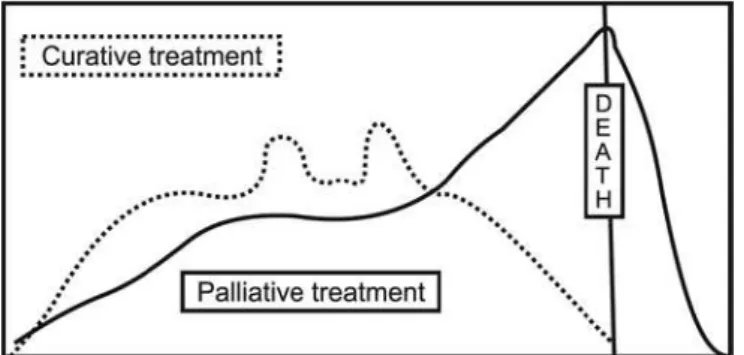
The main treatment focus is the patient’s quality of life. During the 1990s, palliative care focused only on end-of-life care. However, since 2002, this definition was extended, and the current trend is that all patients with life-threatening diseases receive early and integrated curative and palliative care, with its intensity customized according to the patients and family members’ needs and wishes (Figure 2).(11)
These modalities of care are not incompatible and may complement the patient and family members’ care in life-threatening situations. The main question for the assisting team, the patient and family members is not “if ” the patient is a candidate for palliative care but the treatment priority, either cure or comfort and quality of life. For this, both biological (disease severity, prognosis and available therapies) and ethical (e.g., autonomy and beneficence balance) issues, in addition to personal or cultural aspects (e.g., death-related values and preferences or willingness to participate in the decision-making process). In the ICU, the importance of the integration of palliative and curative care, starting from admission, is increasingly emphasized, aiming to provide better quality care.(1,9-15) It should be emphasized that in
outpatients, early palliative care integrated with disease-modifying therapies are associated both with better quality of life and higher survival rates.(16)
Figure 2 – Curative and palliative therapy phases.
Progressively more targets are being identified to reduce the ethical tensions associated with terminal illnesses, with special emphasis on comfort-aimed therapy. Promotion of better communication and ICU palliative care knowledge may prevent conflicts and improve therapy for critically ill patients. The respect of the patients’ and families’ social-cultural values, the evaluation of the ethical and practical
consequences of the refusal or suspension of futile therapies and the administration of sedation/ analgesia and non-pharmacological therapies are advised to reduce the suffering of all parties.(9,10,14,17)
The ability and the education and training of the ICU palliative care professionals to reduce the length of stay and improve the quality of provided care are not doubted.(9) Different models were
proposed to improve ICU palliative care. Two of them should be emphasized: integrative, aimed to incorporate palliative care and interventions into the daily practice of intensive care practitioners, and consulting, involving consultations with palliative care teams and including these practices in regular ICU care.(15) Again, we emphasize that care should
be provided to every single ICU patient and his/her family members.
METHODOLOGY AND OBJECTIVE
Proceeding with the Technical Council of End of Life and Palliative Care of the Brazilian Association of Intensive Medicine (AMIB) plans and considering the previously established concepts and the need for the palliative care of all critically ill patients, the II Forum of the End of Life Study Group of the Southern Cone of America was conducted. This forum aimed to develop recommendations for palliative care for critically ill patients.
The Forum was held during the XV Brazilian Intensive Care Medicine Congress, on October 15, 2010, in Brasilia, DF, Brazil. Members of the Intensive Care Medicine Societies of Brazil (AMIB), Uruguay (SUMI) and Argentina (SATI) were involved. Participated: Alberto Deicas (physician/ SUMI), Daniel Neves Forte (physician/AMIB), Jairo Othero (physician/AMIB), Jefferson Piva (physician/AMIB), Mônica Capalbo (physician/ SATI), Newton Brandão (physician/AMIB), Lara Patrícia Kretzer (physician/AMIB), Nara Azeredo (nurse/AMIB), Patrícia Lago (physician/AMIB), Rachel Duarte Moritz (physician/AMIB), Raphaella Ropelato (psychologist/AMIB) and Raquel Pusch (psychologist/AMIB).
Chart 1 – Palliative care deinitions
Deinitions
Palliative care An approach aimed to improve the quality of life in patients and their family members during life-threatening illnesses by means of early prevention and the treatment of the symptoms of physical, psychological, spiritual and social sufering. his care should be provided to every patient, concomitantly with curative care, and its intensity should be customized to the patient and family members’ needs and wishes and the progression of individual illnesses.
Palliative care in the inten-sive care environment
Care to be provided to every patient with a life threatening illness with symptoms that impair the quality of life.
Chart 2 – Recommendations for the palliative care of critically ill patients
Recommendations
1. Palliative care should be provided to every patient admitted to an intensive care unit (ICU). 2. Intensive care phases should be clariied:
First phase – a condition for which the team anticipates better outcomes (recovery versus death or irreversibility). It is judged, respecting beneicence and autonomy, that priority should be given to cure/recovery-focused measures. Palliative care will be provided to relieve the discomfort caused by the illness and the intensive therapy. (Death unlikely).
Second phase – a condition for which the team perceives a lack of or an insuicient response to the interventions, with a growing trend to a fatal outcome or irreversibility. A consensus is established among the team, patient and family members, and priority is given to the best possible quality of life; disease-modifying interventions can be provided when considered by the team and the patient/family to be proportional (Death anticipated within days, weeks or months).
hird phase – a condition for which the team acknowledges the disease irreversibility and imminent death, accepting the fatal outcome. Palliative care is now the exclusive type of care provided, and all measures are aimed to improve the quality of life and the patient/family members’ comfort. (Death anticipated within hours or days).
3. In all phases, customized care should be provided, suicient to assure physical, psychological/ emotional, and social-cultural care for the patient and their family, respecting bioethical, deontological and legal perspectives.
4. In all phases, previous guidelines should be veriied, as well as interdisciplinary diagnosis, prognosis and therapy evaluations, family members’ understanding and the identiication of potential conlicts.
5. During the irst phase, the care emphasis is placed on the support of the patient’s vital systems and on full recovery, but the psychological/emotional comfort of the patient/family should never be neglected.
6. During the second phase, emphasis is shifted to ofering and maintaining a set of measures aimed to ensure the physical and psychological/emotional comfort of the patient/family.
7. During the third phase, the emphasis is focused on ofering physical and psychological/emotional comfort measures to the patient/family. he importance of the avoidance of starting and/or maintaining unnecessary and futile actions should be emphasized, privileging communication and better conditions for the family to stay with the patient and get prepared for death.
8. During palliative care, preferential emphasis should be focused on the patient’s welfare, especially regarding symptom control (pain, discomfort, dyspnea, dry mouth, noisy breathing, etc.).
28 Moritz RD, Deicas A, Capalbo M, Forte DN, Kretzer LP, Lago P et al.
Chart 3 – Suggested actions for the implementation of palliative care in critical environments
Integrated palliative action suggestions
• Provide communication skills training
• Diferentiate between planned conferences (information and veriication of the understanding of the diagnosis, prognosis and therapy; evaluation of potential conlicts/satisfaction/trust) and medical reports (daily information on the patient’s development)
• Verify and promote Previous Guidelines documentation
• Check the parties’ wishes regarding decision-making participation
• Provide multidisciplinary meetings
• Schedule reevaluation meetings for diicult cases
• Develop protocols to handle conlicts
• Establish protocols for quality assurance and compliance with palliative actions
For all phases, Prioritize
• Individual decision-making
• Symptoms control (pain, discomfort, dyspnea, dry mouth, noisy breathing, etc.)
In all phases: Provide psychological and spiritual support
• Respect the existing beliefs/disbeliefs
• Allow farewell ceremonies (appropriate to the environment) • Provide psychological support for:
• Patient/family/team
Phase II
Death anticipated within days, weeks or months
Associated with the pathophysiological condition, chronic technological and/ or therapeutic dependence
• Stimulate empathic communication measures • Stimulate solidarity attitudes
• Ease family members’ presence
• Evaluate the best site for providing palliative care • Allow ICU discharge
• Establish priorities between palliative and/or curative cares • Prioritize the patient’s comfort
• Avoid futile interventions
• Appropriate sedation-analgesia, ventilation support and nutrition measures • Appropriate monitoring and multi-professional care
Phase III
Death anticipated within hours or days
• Intensify empathic communication measures • Intensify solidarity measures
• Permanently ease family members’ presence • Prioritize the patient’s comfort
• Remove futile therapies (nutrition, vasoactive drugs, dialysis methods, etc.)
• Appropriate measures (sedation-analgesia, ventilation support, etc.)
• Appropriate monitoring and multi-professional care
ICU – intensive care unit.
Figure 3 – Intensive care unit palliative care lowchart.
CONCLUSION
Palliative care should be included in good ICU practices, both for adults and for children. Aiming to improve the care of critically ill patients, recommendations focused on the qualiications of medical and multidisciplinary teams were developed.
RESUMO
Cuidado paliativo é uma forma de abordagem que visa a melhoria da qualidade de vida de pacientes e seus familiares que enfrentam doenças ameaçadoras à vida, através da prevenção, da identiicação e do tratamento precoces dos sintomas de
sofrimen-to físico, psíquico, espiritual e social. Todo paciente criticamente enfermo deve receber cuidados paliativos desde a internação, o que torna de primordial importância a educação e o treinamento dos intensivistas para a implantação destes cuidados nas unida-des de terapia intensiva, tanto para atendimento de adultos como pediátrico. Em continuidade aos planos da Câmara Técnica de Terminalidade e Cuidados Paliativos da Associação de Medicina Intensiva Brasileira e, levando em consideração o conceito pre-viamente apontado, foi realizado em outubro de 2010, durante o Congresso Brasileiro de Terapia Intensiva, o IIo Forum do “Grupo
de Estudos do Fim da Vida do Cone Sul”, com o objetivo de ela-borar recomendações pertinentes aos cuidados paliativos a serem prestados aos pacientes críticamente enfermos.
Descritores: Cuidados paliativos; Unidades de terapia intensiva; Estado terminal
REFERENCES
1. Curtis JR, Vincent JL. Ethics and end-of-life care for adults in the intensive care unit. Lancet.2010;376(9749):1347-53. 2. Moritz RD, Lago PM, Deicas A, Nilson C, Machado FO,
Othero J, et al. 1o Forum do Grupo de Estudos do Fim da
Vida do Cone Sul: proposta para atendimento do paciente portador de doença terminal internado em UTI. Rev Bras Ter Intensiva. 2009;21(3):306-9.
3. Conselho Federal de Medicina. Código de Ética Médica. Disponível em: http://www.portalmedico.org.br/ novocodigo/integra_1.asp
4. Moritz RD, Pamplona F. Avaliação da recusa ou suspensão de tratamentos considerados fúteis ou inúteis em UTI. Rev Bras Ter Intensiva. 2003;15(1):40-4.
5. J, LagoP, Othero J, Garcia PC, Fiori R, Fiori H, et al. Evaluating end of life practices in ten Brazilian paediatric and adult intensive care units. J Med Ethics. 2010;36(6):344-8.
6. McDonagh JR, Elliott TB, Engelberg RA, Treece PD, Shannon SE, Rubenfeld GD, Patrick DL, Curtis JR. Family satisfaction with family conferences about end-of-life care in the intensive care unit: increased proportion of family speech is associated with increased satisfaction. Crit Care Med. 2004;32(7):1484-8.
7. Azoulay E, Pochard F, Kentish-Barnes N, Chevret S, Aboab J, Adrie C, Annane D, Bleichner G, Bollaert PE, Darmon M, Fassier T, Galliot R, Garrouste-Orgeas M, Goulenok C, Goldgran-Toledano D, Hayon J, Jourdain M, Kaidomar M, Laplace C, Larché J, Liotier J, Papazian L, Poisson C, Reignier J, Saidi F, Schlemmer B; FAMIREA Study Group. Risk of post-traumatic stress symptoms in family members of intensive care unit patients. Am J Respir Crit Care Med. 2005;171(9):987-94.
8. Lautrette A, Darmon M, Megarbane B, Joly LM, Chevret S, Adrie C, et al. A communication strategy and brochure for relatives of patients dying in the ICU. N Engl J Med. 2007;356(5):469-78. Erratum in: N Engl J Med. 2007;357(2):203.
9. Kuschner WG, Gruenewald DA, Clum N, Beal A, Ezeji-Okoye SC. Implementation of ICU palliative care guidelines and procedures: a quality improvement initiative following an investigation of alleged euthanasia.
Chest. 2009;135(1):26-32.
10. World Health Organization. WHO deinition of palliative care, 2005. [cited 2010 Jan 12]. Available at: http://www. who.int/cancer/palliative/deinition/en/
11. Lanken PN, Terry PB, Delisser HM, Fahy BF, Hansen-Flaschen J, Hefner JE, Levy M, Mularski RA, Osborne ML, Prendergast TJ, Rocker G, Sibbald WJ, Wilfond B, Yankaskas JR; ATS End-of-Life Care Task Force. An Oicial American horacic Society clinical policy statement: palliative care for patients with respiratory diseases and critical illnesses. Am J Respir Crit Care Med. 2008;177(8):912-27.
12. Truog RD, Campbell ML, Curtis JR, Haas CE, Luce JM, Rubenfeld GD, Rushton CH, Kaufman DC; American Academy of Critical Care Medicine. Recommendations for end-of-life care in the intensive care unit: a consensus statement by the American College [corrected] of Critical Care Medicine. Crit Care Med. 2008;36(3):953-63. Erratum in: Crit Care Med. 2008;36(5):1699.
13. Curtis JR, Treece PD, Nielsen EL, Downey L, Shannon SE, Braungardt T, et al. Integrating palliative and critical care: evaluation of a quality-improvement intervention. Am J Respir Crit Care Med. 2008;178(3):269-75.
14. Mularski RA. Deining and measuring quality palliative and end-of-life care in the intensive care unit. Crit Care Med 2006;34(11 Suppl):S309-16.
15. Nelson JE, Bassett R, Boss RD, Brasel KJ, Campbell ML, Cortez TB, Curtis JR, Lustbader DR, Mulkerin C, Puntillo KA, Ray DE, Weissman DE; Improve Palliative Care in the Intensive Care Unit Project. Models for structuring a clinical initiative to enhance palliative care in the intensive care unit: a report from the IPAL-ICU Project (Improving Palliative Care in the ICU). Crit Care Med. 2010;38(9):1765-72.
16. Temel JS, Greer JA, Muzikansky A, Gallagher ER, Admane S, Jackson VA, et al. Early palliative care for patients with metastatic non–small-cell lung cancer. N Engl J Med. 2010;363(8):733-42