ABSTRACT:Objective: To investigate polypharmacy among the elderly living in the urban area of Florianopolis, in the state of Santa Catarina, Brazil, estimating the prevalence and associated factors. Methods: This is a cross-sectional population-based study with a sample of 1,705 individuals aged 60 years old or older, between 2009 and 2010. The dependent variable was polypharmacy (deined as “use of ive or more medications”). The following exploratory variables were utilized: sociodemographic data, use of health services and self-rated health status. Prevalence ratios (PR) were estimated by multivariate analysis using the Poisson regression. Results: The mean for the medications used by the elderly population was 3.8 (ranging from 0 to 28). The prevalence of polypharmacy was 32%, with 95% conidence interval (95% CI) 29.8 – 34.3. The characteristics presenting a positive association with polypharmacy were: female gender (PR = 1.27; 95%CI 1.03 – 1.57), increasing age (PR = 1.38; 95% CI 1.08 – 1.77), negative self-rated health status (PR = 1.99; 95% CI 1.59 – 2.48) and medical appointments in the 3 months prior to the interview (PR = 1.89; 95% CI 1.53 – 2.32). The groups of medication most utilized by the elderly individuals in polypharmacy were those indicated for the cardiovascular system, digestive tract and metabolism, as well as the nervous system. Conclusion: The pattern of medication use among this elderly population is within the national average. The prevalence of polypharmacy and the characteristics associated with it were similar to those found in other regions of Brazil.
Keywords: Polypharmacy. Medication use. Elderly individuals. Cross-sectional study. Pharmacoepidemiology. Aging.
Polypharmacy among the elderly:
a population-based study
Polifarmácia em idosos: um estudo de base populacional
Karine Gonçalves PereiraI, Marco Aurélio PeresI,II, Débora IopIII, Alexandra Crispim BoingI,
Antonio Fernando BoingI, Marina AzizI, Eleonora d’OrsiI
IPhD Program for Collective Health, Health Sciences Center, Universidade Federal de Santa Catarina – Florianopolis (SC), Brazil. IIAustralian Research Centre for Population Oral Health, University of Adelaide – Adelaide, Australia.
IIIBachelor in Pharmacy, Health Sciences Center, Universidade Federal de Santa Catarina – Florianopolis (SC), Brazil.
Corresponding author: Eleonora d’Orsi. Collective Health PhD Program. Health Sciences Center, Universidade Federal de Santa Catarina. University Campus, Trindade, CEP: 88010-970, Florianopolis, SC, Brazil. E-mail: [email protected]
Conlict of interests: nothing to declare – Financial support: Conselho Nacional de Desenvolvimento Cientíico e Tecnológico
(CNPq), process nº 569834/2008 2.
INTRODUCTION
During the 20th century, signiicant changes were observed worldwide in the demo-graphic and morbidity and mortality proiles, although at diferent magnitudes1. Mortality rates due to infectious diseases and fertility reduced, and there was an increase in life expec-tancy and in deaths caused by chronic diseases2. In Brazil, the elderly population increased from 4.7%, in 1960, to 10.8%, in 2010, of the total population. In absolute numbers, this represents a growth from 3.3 million3 to 20.5 million elderly people4.
This epidemiologic and demographic context has led to long pharmacological treat-ments5, higher use of medication and higher occurrence of polypharmacy, that is, the simultaneous use of multiple medications5,6. These situations are common in the elderly population, which presents the highest prevalence of chronic diseases and uses health services the most2,7,8.
An elevated number of prescription medications and a higher load of diseases have also increased the unnecessary consumption of medication9, whose pharmaceutical combina-tions represent potential dangers for adverse reaccombina-tions and drug interaccombina-tions, which are not indicated for the patient’s clinical state10. This can increase the risk of iatrogenic efects5,9, hospitalizations11 and even death10. In this same context, studies have demonstrated that the physiological variations regarding aging tend to signiicantly change the pharmacokinetics and pharmacodynamics of medications12,13. Therefore, elderly people are more sensitive to the therapeutic and adverse efects of pharmaceuticals, which, in many cases, can be more damaging than beneicial to patients12,14,15.
RESUMO:Objetivo: Investigar a polifarmácia em idosos residentes na área urbana de Florianópolis, Santa Catarina, Brasil, estimando a prevalência e os fatores a ela associados. Métodos: Foi realizado um estudo transversal de base populacional em uma amostra de 1.705 idosos, entre 2009 e 2010. A variável dependente foi polifarmácia (deinida como “uso de cinco ou mais medicamentos”). Utilizaram-se variáveis sociodemográicas, uso de serviços de saúde e autoavaliação de saúde como exploratórias. Foram estimadas razões de prevalência (RP) por meio de análise multivariada utilizando-se da regressão de Poisson. Resultados: A média do uso de medicamentos por idosos foi de 3,8 (variando entre 0 e 28). A prevalência de polifarmácia foi de 32%, com intervalo de coniança de 95% (IC95%) 29,8 – 34,3. As características que apresentaram associação positiva com polifarmácia foram: sexo feminino (RP = 1,27; IC95% 1,03 – 1,57), aumento da idade (RP = 1,38; IC95% 1,08 – 1,77), autoavaliação de saúde negativa (RP = 1,99; IC95% 1,59 – 2,48) e realização de consulta médica nos últimos 3 meses anteriores à entrevista (RP = 1,89; IC95% 1,53 – 2,32). Os grupos de medicamentos mais utilizados pelos idosos na polifarmácia foram os indicados para o sistema cardiovascular, trato alimentar e metabolismo e sistema nervoso. Conclusão: O padrão de uso de medicamentos por idosos está dentro da média nacional. A prevalência de polifarmácia e as características a ela associadas foram semelhantes aos achados em outras regiões do Brasil.
In Brazil, some population-based studies have described the prevalence of polyphar-macy in the elderly population (from 25 to 35%), and its positive association with the female sex7,8,14-17, people aged 75 years old or older8,14,15,17,18, low schooling level7,14,widowhood15,17, regular7,14 or negative8,15,17 self-rated health status, living with a companion8,14, having private health insurance8,14 and having been hospitalized in the 12 months prior to the interview8. Thus, investigating the occurrence of polypharmacy and its associated factors is essential to subsidize actions that promote the rational use of medication, providing more safety to the pharmacotherapy used by the elderly population. Therefore, the objective of this study is to investigate polypharmacy in the elderly population of a state capital in the South of Brazil, estimating the prevalence and the factors associated with it.
METHODS
This is a population-based cross-sectional study, conducted in the city of Florianopolis, the capital of the state of Santa Catarina, Brazil. In 2009, the city had a population of 408,163 inhabitants, of which 10.8% were aged 60 years old or older. Life expectancy for those born in the city, in 2010, was 77.4 years of age19.
The present study is part of the Epiloripa Idoso 2009/2010, a population-based survey investigating the health conditions of the elderly population (people aged 60 years old or older), of both sexes, in Florianopolis, between September 2009 and June 2010. More details about this study can be found in Confortim et al.20.
The sample size was calculated using the software Epi-Info, version 6.04. A total of 44,460 elderly people was considered as the reference population, with an unknown prevalence of 50%, 95% conidence level, 4% sample error and design efect (def ) of 2. To compensate pos-sible expected losses and to control confounding factors, 20% and 15% were added, respectively, resulting in a minimum sample of 1,599 elderly people. Because of the inancial availability and with the objective of increasing its power, the sample was expanded to 1,911 elderly individuals.
The two-stage cluster sampling was used. The primary sampling unit was the census tract, and the secondary unit, the household. A municipal grid from the 2000 Census was used as base, stratifying 420 residential urban census tracts of the city, according to the mean decile income of the head of the family. Eight of these tracts were selected from each income decile to compose the present study. After deining each of the census tracts, the number of households was updated, since the most recent count was made in the 2000 Census. There was a wide gap between the number of households per census tract (from 61 to 725), therefore, the units with less than 150 households were grouped and the tracts with over 500 households were divided. The groupings respected the income decile and geographic proximity. After this procedure, the variation coeicient per census tract was reduced to 35.2%, and 83 census tracts, made up of 22,846 households, were obtained.
survey, it was answered by the person responsible for them, except for the question regarding self-rated health status. Elderly individuals not found in their homes, after four attempts, were considered as losses, whereas individuals who refused to participate were considered a refusal. The attempts included at least one weekend and one evening visit. The data were obtained by interviews. Researchers used a standardized questionnaire for data collection, which was applied in person by a previously trained interviewer, using a Personal Digital Assistant (PDA). Quality control was conducted every week for the data, by telephone, with the application of a reduced questionnaire on 10% of the sample. The reproducibility of the questions in the study was considered satisfactory, with Kappa values between 0.6 and 0.9 for the selected variables, such as diabetes, number of teeth, tobacco use, health insurance, and self-reported skin color. Information was collected regarding the use of medication in the 30 days prior to the interview. Interviewees were asked to present to the interviewer all of the package inserts, packages, blister packs or prescriptions of the medication used in the last 30 days, and their commercial names and dosages were recorded. When the material did not exist, the infor-mation provided by the interviewee was recorded21.
Polypharmacy — considered to be the “concomitant use of five or more medica-tions”6-9,16-18,22,23 — consumed within the 30 days prior to the interview was considered a dependent variable. The medication was classiied according to the pharmacological class or the chemical group (level 3) of the Anatomical Therapeutic Chemical (ATC) Classiication System, created by the World Health Organization Collaborating Centre for Drug Statistics Methodology.
The following independent variables were analyzed: sex, age (60 to 69; 70 to 79; 80 years old or older), education level (0 to 4; 5 to 8; 9 to 11 and 12 schooling years or more), self-rated health status [positive (good or very good) and negative (regular, poor or very poor)], per cap-ita income in quartiles (income was the sum of inancial gain including salary, retirement and pension received in the last month), medical appointment in the last 3 months (yes or no), private health insurance (yes or no) and hospitalization within the last 6 months (yes or no).
Unadjusted and adjusted multivariate analyses were conducted using the Poisson regres-sion in order to test the association between the outcome and the independent variables. Prevalence ratios (PR) were estimated along with their respective 95% conidence intervals (95% CI). The stepwise-forward method was used to include the variables in the multiple mod-els. The inclusion criteria for the adjusted analysis was p < 0.200. The maintenance criteria for the variables in the multiple models was p < 0.05. The analyses were conducted using the software Stata 9.0, with the svy command to consider the design efect and the sample weights.
The study was approved by the Research Ethics Committee from Universidade Federal de Santa Catarina, protocol nº 352/2008.
RESULTS
Most of the sample was composed of female participants (63.9%), aged between 60 and 69 years old (50.1%) and presenting 8 schooling years (63.0%). Regarding medical appoint-ments, 72% of the elderly individuals reported having attended one in the last 3 months, and 7.9% had been hospitalized in the last 6 months. In addition, almost two thirds (63.8%) of the individuals had private health insurance.
The mean use of medication in the 30 days prior to the interviews was 3.8 medications (ranging between 0 and 28). The prevalence of polypharmacy was 32.0% (95% CI 29.8 – 34.3), being higher for women, people aged 80 years old or older, with negative self-rated health status, those who had attended a medical appointment within the last 3 months, the ones who had been hospitalized in the 6 months prior to the interview; and lower for the elderly individuals who had a higher level of education (12 years or more) (Table 1).
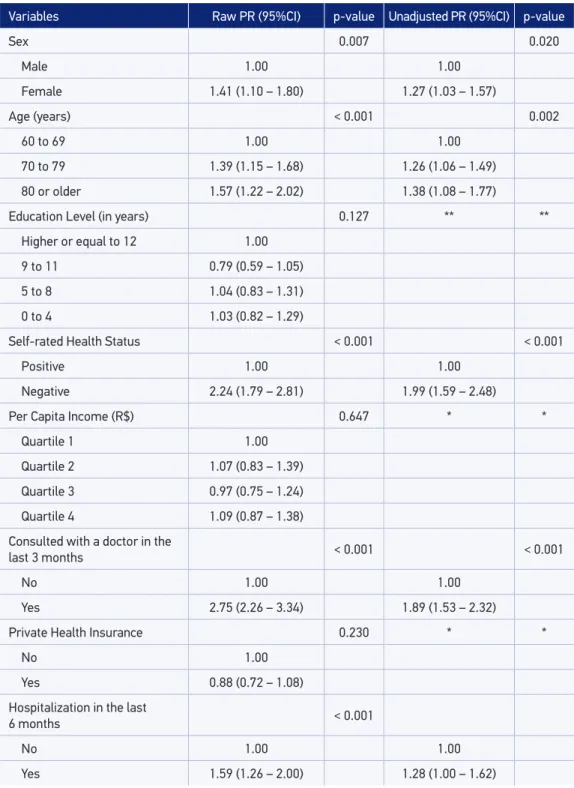
In the unadjusted analysis, the prevalence of polypharmacy was associated with the female sex, increasing age (70 to 79 years old, 95%CI 1.15 – 1.68; 80 years old or older, 95%CI 1.22 – 2.02), negative self-rated health status, medical appointment within the last 3 months and hospitalization in the last 6 months (Table 2).
In the adjusted analysis, the following variables were related to the outcome: female sex (PR = 1.27; 95%CI 1.03 – 1.57), older individuals (70 to 79 years old, PR = 1.26; 95% CI 1.06 – 1.49; 80 years old or older, PR = 1.38; 95%CI 1.08 – 1.77), negative self-rated health status (PR = 1.99; 95%CI 1.59 – 2.48) and medical appointment in the last 3 months (PR = 1.89; 95%CI 1.53 – 2.32) (Table 2).
According to the pharmacological classiication or chemical group (level 3) of the ATC, the groups of medications most used by the elderly population, in polypharmacy, were those indicated for the cardiovascular system, digestive tract and metabolism, as well as the nervous system.
DISCUSSION
The results from this study demonstrate that the pattern of medication use in Florianopolis is within the national mean7,8,14-16. This can be explained by studies showing that the higher the use of health services8,14,24,25 the higher the use of medications. Another factor that can explain this phenomenon is the repetition of prescriptions resulting from being treated by diferent specialists or health care professionals, at diferent moments. However, the impli-cations of this intake need to be reassessed regarding the risk/beneits, and should be fre-quently monitored. It is important to remember that the practice of polypharmacy is often really necessary for the elderly person, especially when there is a clear indication, when it is well tolerated and in case there is a good cost-eicacy relationship.
Table 1. Sample characteristics and prevalence of polypharmacy according to the demographic, socioeconomic and behavioral variables, as well as variables pertaining to the use of health
services. Epiloripa Idoso Study, Florianópolis, 2009/2010.
Variables Sample
n (%)
Prevalence of Polypharmacy (95%CI)
Sex
Female 1089 (63.9) 35.8 (33.0 – 38.7)
Male 616 (36.1) 25.3 (21.9 – 28.8)
Age (years)
60 to 69 854 (50.1) 25.5 (22.6 – 28.5)
70 to 79 612 (35.9) 37.3 (33.4 – 41.1)
80 or older 239 (14.0) 42.0 (35.6 – 48.1)
Education Level (in years)
0 to 4 745 (44.0) 34.4 (31.0 – 37.8)
5 to 8 321 (19.0) 33.3 (28.2 – 38.5)
9 to 11 234 (13.8) 34.2 (28.1 – 40.3)
Higher or equal to 12 394 (23.26) 25.4 (21.1 – 29.7)
Self-rated Health Status
Positive 860 (51.2) 20.0 (17.3 – 22.7)
Negative 821 (48.84) 44.2 (40.8 – 47.6)
Per Capita Income (R$)
Quartile 1 427 (25.0) 31.2 (26.8 – 35.6)
Quartile 2 435 (25.5) 32.4 (28.0 – 36.8)
Quartile 3 425 (24.9) 31.8 (27.3 – 36.2)
Quartile 4 418 (24.5) 32.8 (28.3 – 37.3)
Consulted with a doctor in the last 3 months
No 481 (28.2) 14.8 (11.6 – 17.9)
Yes 1224 (71.8) 38.8 (36.1 – 41.6)
Private Health Insurance
No 618 (36.25) 30.3 (26.6 – 33.9)
Yes 1087 (63.75) 33.0 (30.2 – 35.8)
Hospitalization in the last 6 months
No 1.570 (92.1) 30.1 (27.8 – 32.5)
Yes 135 (7.9) 54.8 (46.5 – 63.2)
PR: prevalence ratio; 95%CI: 95% conidence interval; *not included in the multivariate analysis because p value was > 0.20 in the raw analysis; **removed from analysis due to signiicant statistical loss in the adjusted analysis p > 0.05.
Table 2.Association between polypharmacy and demographic, socioeconomic and behavioral variables, as well as variables pertaining to the use of health services. Epiloripa Idoso Study, Florianopolis, 2009/2010.
Variables Raw PR (95%CI) p-value Unadjusted PR (95%CI) p-value
Sex 0.007 0.020
Male 1.00 1.00
Female 1.41 (1.10 – 1.80) 1.27 (1.03 – 1.57)
Age (years) < 0.001 0.002
60 to 69 1.00 1.00
70 to 79 1.39 (1.15 – 1.68) 1.26 (1.06 – 1.49)
80 or older 1.57 (1.22 – 2.02) 1.38 (1.08 – 1.77)
Education Level (in years) 0.127 ** **
Higher or equal to 12 1.00
9 to 11 0.79 (0.59 – 1.05)
5 to 8 1.04 (0.83 – 1.31)
0 to 4 1.03 (0.82 – 1.29)
Self-rated Health Status < 0.001 < 0.001
Positive 1.00 1.00
Negative 2.24 (1.79 – 2.81) 1.99 (1.59 – 2.48)
Per Capita Income (R$) 0.647 * *
Quartile 1 1.00
Quartile 2 1.07 (0.83 – 1.39)
Quartile 3 0.97 (0.75 – 1.24)
Quartile 4 1.09 (0.87 – 1.38)
Consulted with a doctor in the
last 3 months < 0.001 < 0.001
No 1.00 1.00
Yes 2.75 (2.26 – 3.34) 1.89 (1.53 – 2.32)
Private Health Insurance 0.230 * *
No 1.00
Yes 0.88 (0.72 – 1.08)
Hospitalization in the last
6 months < 0.001
No 1.00 1.00
the risk of adverse reactions increases exponentially, around 50%, when 5 medications are used, and surpasses 95% when 8 or more are used5,6. In some cases, these adverse reactions present severe consequences, which can be minimized by adequately monitoring the cor-rect adherence, prescription, dose and duration of treatment. In this study, polypharmacy was also related to hospitalization (55%), suggesting worse health status8,14. In Canada, it is estimated that one out of ive hospital admissions of elderly individuals are owed to poly-pharmacy related to iatrogenics5.
The analysis between polypharmacy and sociodemographic characteristics revealed a con-nection with the female sex7,8,14-17 and the age of 80 years old or older15,17. Regardless of the socioeconomic variables, studies found a higher prevalence of polypharmacy in the female sex7,14-16,23,26,27; the potential explanations for this are: women have higher life expectancy in relation to men, and thus deal with chronic processes for a longer period of time; women are more afected by non-fatal health problems and are more aware of their health, report-ing more signs and symptoms to health professionals, often resultreport-ing in prescriptions24,25; women are responsible for the family and, therefore, are more familiarized with medication and better cared for by public health policies, being subject to medicalization25-27, corrob-orating the results from this study. As for the association between polypharmacy and age, the most accepted hypotheses are that it can be associated with the increase in the number/ severity of diseases among the elderly, as well as the wider use of health services by this age group, rather than due to aging.
According to Santos etal.15, Linjakumpu et al.17, Rozenfeld et al.8, Silveira et al.23 and Loyola et al.25, the lower self-rated health status is often related to polypharmacy, as observed in this study. This relationship is expected since elderly individuals who perceive to be sick try to solve their problems by seeking health services, getting medication prescriptions or even by self-medicating25. This variable (which is subjective) was not considered for the elderly individuals who had their questionnaire answered by an informant (n=54).
Regarding health services, a strong association between medical appointments and poly-pharmacy became clear, which proves the increasing access of the population to health ser-vices, similarly to what was observed in Tubarão7, Porto Alegre16, Rio de Janeiro8, Bambuí24, Santa Rosa26, and in the metropolitan area of Belo Horizonte25, reinforcing the importance of medication in caring for one’s health and the need to guarantee that elderly people, as much as possible, have eicient and high-quality pharmaceutical care, in order to reduce possible complications due to polypharmacy. Even though the exposure to polypharmacy is not a synonym of inadequate use, the lucrative character of these private services, the ideological approach and the interaction of doctors with the pharmaceutical industry can explain the quality and quantity of inadequate medications consumed by elderly individ-uals, as well as the health care model, which has been its main form of intervention13,27.
important that public policies providing medication be aware of the peculiarities that involve the aging organism, so that this group’s access to medication could be safe and eicient, considering that the medications that work on the nervous system are the ones that cause the most adverse efects.
Among the limitations of this study are the diiculties to establish a cause-and-efect rela-tionship because of the cross-sectional design and the self-reported measurements. In order to minimize a possible recall bias, the strategy was for the interviewer to adopt standard-ized procedures during data collection, such as requesting to see the prescription, package, or package inserts of the reported medication21.
The strong features of this study are its sample size, the fact that it is a population-based study and the rigor in collecting data. Regarding the medications, it is important to note the highly complete and comprehensive information registered about them, due to careful data collection and analysis. As this is not the objective of this study, self-medication was not contemplated in the analysis.
FINAL CONSIDERATIONS
The pattern of medication use among the elderly population in Florianópolis is within the national mean. The prevalence of polypharmacy and the characteristics associated with it are similar to indings from other regions in Brazil, suggesting there is a certain unifor-mity to the practice of polypharmacy and to its determiners, among diferent populations. It is possible that the lack of clinical protocols and easy access to medication, through the Uniied Health System(SUS), as well as through private pharmacies, can contribute with the practice of the elderly population’s regarding polypharmacy.
This habit is often necessary, since a large portion of the elderly population has multi-ple comorbidities and requires the use of various medication to control and prevent their conditions. This practice does not necessarily indicate that the prescription and/or use of medication is incorrect, but that a more critical approach and close monitoring of this pro-ile of elderly individuals is necessary.
1. Yunes J. A dinâmica populacional dos países desenvolvidos e subdesenvolvidos. Rev Saúde Pública 1971; 5: 129-50.
2. Veras R. Envelhecimento populacional contemporâneo: demandas, desaios e inovações. Rev Saúde Pública 2009; 43(3).
3. Instituto Brasileiro de Geografia e Estatística. Departamento de Estatísticas de População. VII Recenseamento Geral do Brasil. Censo Demográico de 1960. Brasil: IBGE; 1960. Série Nacional, v. I.
[Internet]. Disponível em: http://biblioteca.ibge.gov. br/visualizacao/periodicos/68/cd_1960_v1_br.pdf (Acessado em: dezembro de 2013).
4. Instituto Brasileiro de Geograia e Estatística. Sinopse dos Resultados do Censo 2010. Distribuição da população por sexo, segundo os grupos de idade. Brasil: IBGE; 2010. [Internet]. Disponível em: http:// www.censo2010.ibge.gov.br/sinopse/webservice/ (Acessado em: dezembro de 2013).
5. Wyles H, Rehman HU. Inappropriate polypharmacy in the elderly. European J Intern Med 16(5): 311-3.
6. Fulton MM, Allen ER. Polypharmacy in the elderly: a literature review. J Am Acad Nurse Pract 2005 Apr; 17(4): 123-32.
7. Galato D, Silva ES, Tiburcio LS. Estudo de utilização de medicamentos em idosos residentes em uma cidade do sul de Santa Catarina (Brasil): um olhar sobre a polimedicação. Ciênc Saúde Coletiva 2010; 15: 2899-905.
8. Rozenfeld S, Fonseca MJM, Acurcio FA. Drug utilization and polypharmacy among the elderly: a survey in Rio de Janeiro City, Brazil. Rev Panamericana Salud Pública 2008; 23: 34-43.
9. Gorard DA. Escalating polypharmacy. QJM 2006 Nov; 99(11): 797-800.
10. Tulner LR, Kuper IMJA, Frankfort SV, van Campen JPCM, Koks CHW, Brandies DPM, et al. Discrepancies in Reported Drug Use in Geriatric Outpatients: Relevance to Adverse Events and Drug-Drug Interactions. Am J Geriatr Pharmacother 2009 Apr; 7(2): 93-104.
11. Passarelli MCG, Jacob W, Figueras A. Adverse drug reactions in an elderly hospitalised population - Inappropriate prescription is a leading cause. Drugs Aging 2005; 22(9): 767-77.
12. Martins GA, Acurcio FA, Franceschini SCC, Priore SE, Ribeiro AQ. Uso de medicamentos potencialmente inadequados entre idosos do Município de Viçosa, Minas Gerais, Brasil: um inquérito de base populacional. Cad Saúde Pública 2015; 31: 2401-12.
13. Silva RD, Schmidt OF, Silva SD. Polifarmácia em geriatria. Polypharmacy in geriatrics. Rev AMRIGS 2012; 56(2): 164-74.
14. Carvalho MFC, Romano-Lieber NS, Bergsten-Mendes G, Secoli SR, Ribeiro E, Lebrão ML, et al. Polifarmácia entre idosos do Município de São Paulo – Estudo SABE. Rev Bras Epidemiol 2012; 15: 817-27.
15. Santos TRA, Lima DM, Nakatani AYK, Pereira LV, Leal GS, Amaral RG. Consumo de medicamentos por idosos, Goiânia, Brasil. Rev Saúde Pública 2013; 47: 94-103.
16. Flores LM, Mengue SS. Uso de medicamentos por idosos em região do sul do Brasil. Rev Saúde Pública 2005; 39: 924-9.
17. Linjakumpu T, Hartikainen S, Klaukka T, Veijola J, Kivela SL, Isoaho R. Use of medications and polypharmacy are increasing among the elderly. J Clin Epidemiol 2002 Aug; 55(8): 809-17.
18. Veehof LJG, Stewart RE, Haaijer-Ruskamp FM, Meyboom-de Jong B. The development of polypharmacy. A longitudinal study. Family Practice 2000 Jun; 17(3): 261-7.
19. Programa das Nações Unidas para o Desenvolvimento. Atlas do Desenvolvimento Humano no Brasil. 2013. [Internet]. Disponível em: http://www.atlasbrasil.org. br/2013/pt/peril_m/lorianopolis_sc#idh (Acessado em: 30 de julho de 2016).
20. Confortin SC, Schneider IJC, Antes DL, Cembranel F, Ono LM, Marques LP, et al. Condições de vida e saúde de idosos: resultados do estudo de coorte EpiFloripa Idoso. Epidemiol Serv Saúde 2017; 26(2): 305-17.
21. Aziz MM, Calvo MCM, d’Orsi E. Medicamentos prescritos aos idosos em uma capital do Sul do Brasil e a Relação Municipal de Medicamentos. Cad Saúde Pública 2012; 28: 52-64.
22. Viktil KK, Blix HS, Moger TA, Reikvam A. Polypharmacy as commonly deined is an indicator of limited value in the assessment of drug-related problems. Brit J Clin Pharmacol 2007; 63(2): 187-95.
23. Silveira EA, Dalastra L, Pagotto V. Polypharmacy, chronic diseases and nutritional markers in community-dwelling older. Rev Bras Epidemiol 2014; 17: 818-29.
24. Loyola Filho AI, Uchoa E, Firmo JOA, Lima-Costa MF. Estudo de base populacional sobre o consumo de medicamentos entre idosos: Projeto Bambuí. Cad Saúde Pública 2005; 21: 545-53.
25. Loyola Filho AI, Uchoa E, Lima-Costa MF. Estudo epidemiológico de base populacional sobre uso de medicamentos entre idosos na Região Metropolitana de Belo Horizonte, Minas Gerais, Brasil. Cad Saúde Pública 2006; 22: 2657-67.
26. Flores VB, Benvegnú LA. Perfil de utilização de medicamentos em idosos da zona urbana de Santa Rosa, Rio Grande do Sul, Brasil. Cad Saúde Pública 2008; 24: 1439-46.
27. Rozenfeld S. Prevalência, fatores associados e mau uso de medicamentos entre os idosos: uma revisão. Cad Saúde Pública 2003; 19: 717-24.
Received on: 05/17/2016