A
R
T
IG
O
A
R
T
IC
L
E
1 Núcleo de Estudos
Político-Sociais em Saúde, Departamento de Administração e Planejamento em Saúde, Escola Nacional de Saúde Pública Sérgio Arouca, Fundação Oswaldo Cruz. Av. Brasil 4036/1001, Manguinhos. 21045-210 Rio de Janeiro RJ. [email protected]
2 Centro de Estudos Sociais
Aplicados, Universidade Federal Fluminense.
3 Escola Nacional de Saúde
Pública, Fundação Oswaldo Cruz.
4 Secretaria Municipal de
Saúde de Mesquita, Rio de Janeiro.
5 Núcleo de Estudos
Político-Sociais em Saúde, Escola Nacional de Saúde Pública, Fundação Oswaldo Cruz.
Family health: limits and possibilities
for an integral primary healthcare approach in Brazil
Saúde da família: limites e possibilidades
para uma abordagem integral de atenção primária à saúde no Brasil
Resumo O artigo analisa a implementação da
Es-tratégia Saúde da Família (SF) e discute suas poten-cialidades em orientar a organização do SUS no Bra-sil, a partir da análise da integração da SF à rede assistencial e atuação intersetorial, aspectos cruciais de uma atenção primária abrangente. Foram reali-zados quatro estudos de caso de municípios com ele-vada cobertura por SF (Aracaju, Belo Horizonte, Florianópolis e Vitória) tendo como fontes: entre-vistas semi-estruturadas com gestores e inquéritos com profissionais de saúde e de famílias cadastradas. A análise da integração destacou a posição da Estra-tégia SF na rede assistencial, os mecanismos de inte-gração e a disponibilidade de informações para con-tinuidade da atenção. A intersetorialidade foi pes-quisada quanto aos campos de atuação, abrangên-cia, setores envolvidos, presença de colegiados, e ini-ciativas das equipes. Os resultados apontam avanços na integração da SF à rede assistencial, propiciando o fortalecimento dos serviços básicos como serviços de procura regular e porta de entrada preferencial, todavia permanecem dificuldades de acesso à aten-ção especializada. As iniciativas intersetoriais foram mais abrangentes quando definidas como politica integrada do governo municipal para a construção de interfaces e cooperação entre os diversos setores.
Palavras-chave Atenção primária à saúde,
Inte-gração, Intersetorialidade Abstract The article analyzes the implementation of
the Family Health Strategy (FH) and discusses its potential to guide the organization of the Unified Health System in Brazil, based on the integration of FH to the health care network and intersectorial ac-tion, crucial aspects of a com prehensive prim ary health care. Four case studies were carried out in cities with high FH coverage (Aracaju, Belo Hori-zonte, Florianópolis e Vitória), using as sources: semi-structured interviews with m anagers and surveys with health care professionals and registered fami-lies. The integration analysis highlighted the posi-tion of FH Strategy in the health services network, the integration mechanisms and the availability of information for continuity of care. Intersectoriality was researched in relation to the fields of action, scope, sectors involved, presence of forums, and team initi-atives. The results point to advances in the integra-tion of FH to the health care network, strengthening basic services as services that are regularly sought and used as a preferential first contact services, al-though there are still problems in the access to spe-cialized care. T he intersectorial initiatives were broader when defined as integrated municipal gov-ernment policy for the construction of interfaces and cooperation between the diverse sectors.
Key words Primary health care, Integration,
Inter-sectoriality Ligia Giovanella 1
Maria Helena Magalhães de Mendonça 1 Patty Fidelis de Almeida 1
Sarah Escorel 1
Mônica de Castro Maia Senna 2 Márcia Cristina Rodrigues Fausto 3 Mônica Mendonça Delgado 4 Carla Lourenço Tavares de Andrade 1 Marcela Silva da Cunha 1
G
io
v
a
n
el
Primary Health Care (PHC), as a strategy to orga-nize the health care system to cater to the needs of the population, requires understanding health care as a social right and confronting social determi-nants in order to promote health. A good organi-zation of primary care services contributes to im-proved care with positive impacts on the health of the population and on the efficiency of the system1,2.
In Latin America, in the context of the structur-al adjustments of the 1980s, the selective approach to primary care was advocated by multilateral agen-cies, with a minimal service package, usually low quality, being implemented everywhere3. Recently,
with the election of center-left governments, regional governments have been developing policies to or-ganize services and promote equity in health, re-newing a comprehensive PHC scope4.
With the regulation of the Unified Health Sys-tem (UHS), based on the principles of universality, equity and integrality and on the organizational di-rectives of decentralization and social participation, in order to differentiate it from the selective PHC conception, the term basic health care began to be used in Brazil. This was defined as a set of individ-ual and collective actions on the first level, directed at promoting health, preventing diseases, treatment and rehabilitation.
The Family Health Program, initially aimed at extending coverage focused on areas of higher so-cial risk and implemented from 1994 as a parallel program that was “limited, good for the poor and poor like them”5 – gradually became central to the
governmental agenda, becoming a structuring strat-egy for municipal health care systems and a PHC model for the country.
In 2006, the National Basic Care Policy, agreed upon by federal managers and representatives from state and municipal spheres in the Tripartite Inter-managers Commission, broadened the scope of basic care in the country and reaffirmed FH as a priority strategy and a substitutive model for basic care organization. A preferential first contact point and an entrance for a network of resolutive services of universal access, basic care must coordinate care in the services network and achieve integrality among its diverse dimensions6.
Stimulated by federal financing incentives, cur-rently FH is present in 94% of towns with 29 thou-sand teams implemented and estimated coverage of 48% of the country’s population (92 million). However, a look at the experiences underway re-veals great diversity in the assistential models with respect to the immense inter and intra regional dis-parities and the social inequalities that mark Brazil-ian reality. Therefore, broader coverage has not al-ways corresponded to the change in the assistential
model advocated by the strategy7,8.
This article presents part of the results of the re-search that aimed to analyze the implementation of the FH strategy, focusing on integration with the health care network and with intersectorial action in four large urban centers, to discuss the potential of FH as a comprehensive primary health care strate-gy. The axes of the analysis are integration and inter-sectoriality, fundamental elements of a comprehen-sive PHC.
Implementing a comprehensive or integral con-ception of primary care implies constructing health care systems guided by PHC, connected by a net-work, centered on the user and responding to all the population’s health needs. Thus the integration of the system is a condition to counteract a selective PHC conception as a parallel program with a re-stricted low-quality service package, directed at the poor4. And intersectorial action is necessary for
PHC not to be restricted to the first level, but to be a base and reference for all care, covering biological, psychological and especially social aspects, relating to collective problems on the diverse levels of deter-mination of health-illness processes, promoting health.
Problems related to the integration of the sys-tem and the coordination of care have been receiv-ing wide attention in recent health care system re-forms, with initiatives being taken to strengthen PHC9. The proposals for strengthening the
prima-ry care position in the system are a result of the recognition that the health services system is frag-mented and that chronic illnesses are prevalent, de-manding greater contact with health care services and other social equipment in a context where there is pressure for more efficiency10,11.
Service network integration from the PHC per-spective involves a regularly sought of health ser-vices, PHC services as a preferential first contact and gate to the health system, guaranteed access to the various care levels through strategies that join the actions and services needed to solve less fre-quent and more complex12 needs with formalized
reference mechanisms and actions coordinated by the PHC team to guarantee continuous13 care.
Inte-gration, coordination and continuity are inter-re-lated and interdependent processes expressed in dif-ferent scopes: in the system, professional action and the experience of the patient to be cared for.
e C
o
le
tiv
a, 1
4
(3
):7
8
3
-7
9
4
, 2
0
0
9
Intersectorial action seeks to overcome the frag-mentation of public policies and is understood as the interaction between various sectors in planning, execution and monitoring of interventions to con-front complex problems and the needs of popula-tion groups15. In health care, intersectorial action is
essential to affect the social determinants of the health-illness process and prom ote health. The health results (both final and intermediate) reached by intersectoriality are more effective than those the health sector would attain on its own16,17. From the
PHC perspective in the municipal scope, intersecto-rial action is processed on various levels: in the ar-ea’s community action, in the organization of Mu-nicipal Health Office and in the connection of mu-nicipal policies.
Intersectorial action is planned within FH. This FH team attribution is reaffirmed in the 2006 Na-tional Basic Care Policy, which in its work process lays out the “development of intersectorial actions, integrating social projects and related sectors, di-rected at promoting health” 6.
Methodology
This article discusses part of the results of the re-search that studied four cases of FH Strategy im-plementation in Brazilian large urban centers. The case studies performed use a research strategy based on quantitative and qualitative methodologies and converging information sources which were com-bined to answer the investigation’s questions18,19.
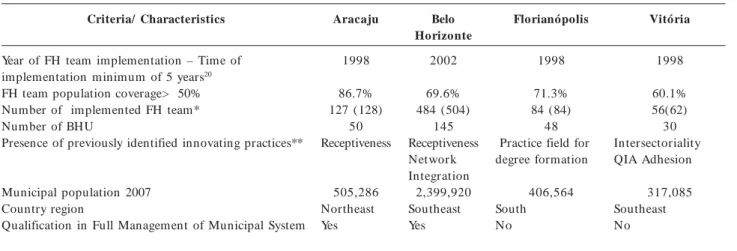
The cities were purposely selected so as to choose consolidated experiences. The selection criteria and the characteristics of the selected cities – Aracaju, Belo Horizonte, Florianópolis and Vitória – are presented in Table 1.
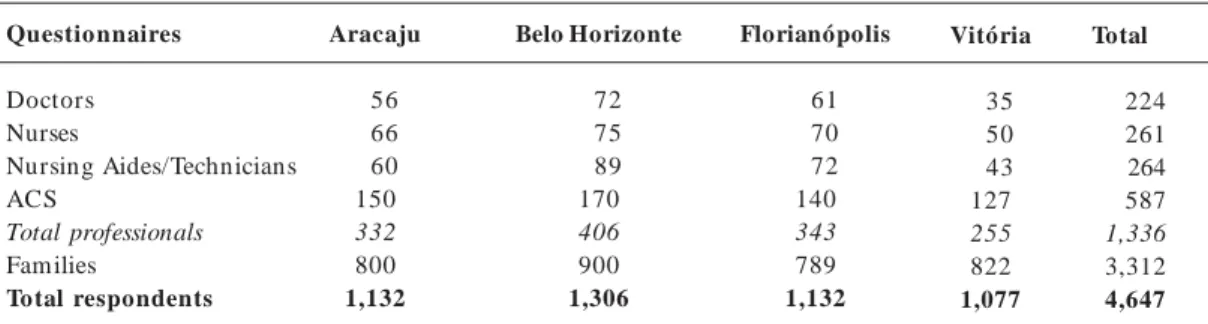
Integration and intersectoriality were analyzed within the scopes of: health care system organiza-tion, professionals’ work process, and the care re-ceived by families. In the four large cities, informa-tion was gathered from three sources: municipal managers, through interviews (77); FH team pro-fessionals, with self-applied questionnaires (1,336), and registered families, with structured question-naires applied in their homes (3,312 families) (Ta-ble 2).
For the selection of registered families, a con-glomerate sampling plan was drawn up, with three selection stages: FH team as primary sampling unit, community health agent (CHA) as secondary unit, and as elementary unit, the registered family. The field research was carried out in the period from May to September, 2008.
This article brings together the analysis of se-lected indicators, com paring study results with managers, professionals and families, using two axes for analysis: health care network integration and intersectorial action.
For integration analysis, different dimensions were investigated. In the health care system organi-zation dimension, the implementation of integra-tion instruments were identified and examined, such as specialized regulation centers, waiting time mon-itoring and service strategies for spontaneous acute
Table 1. Selection criteria and characteristics of the towns studied, 2007.
Criteria/ Characteristics
Year of FH team implementation – Time of implementation minimum of 5 years20 FH team population coverage> 50% Number of implemented FH team* Number of BHU
Presence of previously identified innovating practices**
Municipal population 2007 Country region
Qualification in Full Management of Municipal System
Aracaju
1998 86.7% 127 (128)
50 Receptiveness
505,286 Northeast Yes
Belo Horizonte
2002 69.6% 484 (504)
145 Receptiveness Network Integration
2,399,920 Southeast Yes
Florianópolis
1998 71.3% 84 (84)
48 Practice field for degree formation
406,564 South No
Vitória
1998 60.1% 56(62) 30 Intersectoriality QIA Adhesion
317,085 Southeast No
Source: Nupes/Daps/Ensp/Fiocruz – Family Health Research, four case studies, 2008.
G
io
v
a
n
el
demand. In the FH team work processes, the use of integration instruments, and professionals’ percep-tion on first contact service and the guarantee of access to specialized care were examined. In the us-ers’ care experience, the existence of a regularly-sought service and the constitution of the FH Unit as a first contact service were verified.
For the intersectoriality analysis, intersectorial connection strategies developed in the cities and the role played by FH Strategy were identified. The intersectorial action of the municipal executive branch was studied from the perspective of the Municipal Health Office and policy makers and managers of other offices identified as being more connected with the Municipal Health Office. The analysis dimensions given priority were: fields of action; scope of intervention; sectors involved at local levels (FH teams) and central levels (Munici-pal Health Office and other offices); existence and functioning of associated forum s; and them es/ problems of intersectorial intervention.
The research was financed by the Basic Care Department of the Brazilian Ministry of Health’s Health Care Office.
Results
FH integration to the health care network
The results of the analysis of FH integration to the health service network were organized into two fields: the Strategy’s position in the network and the integration mechanisms, emphasizing the use of in-formation technologies.
The FH Strategy’s position in the assistential network
In the four cities studied, the FH Strategy was adopted with a view to changing the basic care
as-sistential model, placing the FH team as first con-tact service, aiming to constitute an integrated health services system (Table 3).
The cities of Aracaju, Belo Horizonte, Florianó-polis and Vitória implemented FH teams in their traditional basic units and constructed new units for FH implementation in areas without supply. There is an effort to overcome the doubling of as-sistential models in basic care, in an attempt to trans-form health care centers into model FH units. In some of the units, basic care specialists function as support professionals for the health care center’s FH teams. For the policy makers and managers, this measure allowed a common organization logic for basic care to be defined, preventing clashes be-tween different assistential proposals (Table 3).
The regionalization of the municipal system is also a strategy to guarantee access to the specialized care and network integration present in the four cities, investing in the formation of medical special-ization centers and regionalized emergency care ser-vices to offer support in medium complexity to the basic care units in the region (Table 3).
Primary care services have been taking shape as an important source of regular care and a preferen-tial first contact service in the four cities studied. More than 70% (85% in Belo Horizonte) of the registered families seek the same health service for health care assistance or prevention. Out of these, the following indicated the health care center and/ or FH unit as their first contact and regularly-sought service: 75% in Belo Horizonte, 70% in Vitória, 70% in Aracaju and 50% in Florianópolis (Table 3).
Lower proportions of inhabitants who were ill in the last 30 days reported having sought care in FH units or health centers, with more than 50% being reached only in Belo Horizonte, a town where there are diverse strategies for connecting spontaneous acute and programmed demand care and where spontaneous acute demand is daily cared. The low-est proportion was seen in Florianópolis (28%),
Table 2. Questionnaires with professionals and families by town.
Questionnaires
Doctors Nurses
Nursing Aides/Technicians ACS
Total professionals Families
Total respondents
Aracaju
56 66 60 150 332 800
1,132
Belo Horizonte
72 75 89 170 406 900
1,306
Florianópolis
61 70 72 140 343 789
1,132
Vitória
35 50 43 127 255 822
1,077
Total
224 261 264 587 1,336 3,312
4,647
e C
o
le
tiv
a, 1
4
(3
):7
8
3
-7
9
4
, 2
0
0
9
where part of the FHU care for non-priority groups just once a week.
FH team professionals also recognize basic care services as a preferential first contact service. More than 80% of doctors and nurses in the four cities agreed with the statement “The population seeks the FH unit first when it needs health care” (Table 3).
Network integration mechanisms
In the four towns, health services network inte-gration to guarantee specialized care is a concern present in policy makers and managers’ actions and speeches. One of the main strategies identified to integrate basic care to medium complexity in the four cases was the implementation of computer-ized specialcomputer-ized care regulation centers (Table 4).
Table 3. Position of the Family Health Strategy in the health services network, according to professionals, policy makers and users, four large urban centers, Brazil, 2008.
Indicators
Policy makers
Proposed preferential first contact service
Implementation of the FH teams in the pre-existing Health Centers
Medical professionals with basic specializations as support to FH team
Strategies for spontaneous demand care
Regionalization of the municipal health care system
Regionalization of emergency care services
Regionalization of polyclinics/ specialization centers
Families
Percentage of registered families that seek the same health care service for health assistance or prevention Percentage of families that indicate the Health Care Center of Family Health Unit as a service they regularly seek1
Health Center (HS) Family Health Unit (FHU) Total HS + FHU
Percentage of inhabitants who were ill in the last 30 days cared for at the Health Center of Family Health Unit 2
Professionals
Percentage of doctors and nurses who strongly agreed/ agreed with the statement “The population seeks the Fam ily Health Unit first when it needs health care”
Aracaju
FH S FH team in the
health centers Yes
Admission and daily care Eight healh care regions
Partial Partial
76.4
32.9 36.7 69.6 41.1
92.6
Belo Horizonte
FH S FH team in the
health centers Yes
Admission and daily care Nine health care regions
Yes Yes
85.0
41.0 33.6 74.6 52.4
89.1
Florianópolis
FH S FH team in the
health centers Yes
Adm ission and daily care
Five health care regions
Partial Partial
73.8
30.6 19.7 50.3 28.1
87.8
Vitória
FH S FH team in the
health centers Yes
Admission and daily care Six health care regions
No Yes
75.6
31.8 37.4 69.2 47.8
83.5
Source: Nupes/Daps/Ensp/Fiocruz – Family Health Research, four case studies, 2008.
1 Families who regularly seek a service: n= 611 em Aracaju, n = 763 in Belo Horizonte, n= 588 in Florianópolis, n = 623 in Vitória. In Aracaju, Belo
Horizonte and Florianópolis the high proportion of users who indicated the Health center as a service they regularly seek results from not knowing the FH denomination for their neighborhood’s HC, as the implementation of FH teams was mostly carried out in the pre-existing units known as health centers.
G
io
v
a
n
el
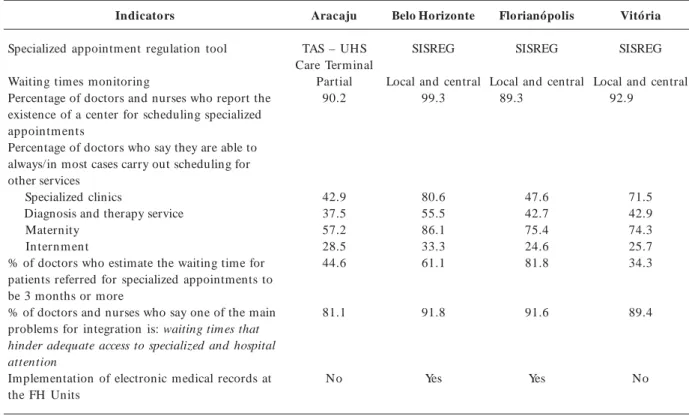
Table 4. Indicators for Family Health Strategy integration to the health care network, four large urban centers, 2008.
Indicators
Specialized appointment regulation tool Waiting times monitoring
Percentage of doctors and nurses who report the existence of a center for scheduling specialized appointm ents
Percentage of doctors who say they are able to always/in most cases carry out scheduling for other services
Specialized clinics
Diagnosis and therapy service Maternity
In tern m en t
% of doctors who estimate the waiting time for patients referred for specialized appointments to be 3 months or more
% of doctors and nurses who say one of the main problems for integration is: waiting times that hinder adequate access to specialized and hospital attention
Implementation of electronic medical records at the FH Units
Aracaju
TAS – UHS Care Terminal
Partial 90.2
42.9 37.5 57.2 28.5 44.6
81.1
No
Belo Horizonte
SISREG Local and central
99.3
80.6 55.5 86.1 33.3 61.1
91.8
Yes
Florianópolis
SISREG Local and central
89.3
47.6 42.7 75.4 24.6 81.8
91.6
Yes
Vitória
SISREG Local and central
92.9
71.5 42.9 74.3 25.7 34.3
89.4
No
Source: Nupes/Daps/Ensp/Fiocruz – Family Health Research, four case studies, 2008.
Belo Horizonte, Florianópolis and Vitória opt-ed for SISREG, an online information system pro-vided by DATASUS/MS, to manage and operate reg-ulation centers, from the basic care network to the specialized and hospital networks, aiming for greater flow control and optimization of resource use. Ara-caju implemented the UHS Care Terminal, linked to the UHS card, as its pilot-project.
The implementation of SISREG in the health centers made it possible to schedule examinations and specialized consultations for procedures with sufficient supply, to define clinical priorities and to monitor waiting times. When the patient is regis-tred in the electronic schedule system, the priority for care is defined based on a classification of high, medium or low risk according to diagnosis. The computerized system allows the FH team to follow the user’s path, so “It is in basic care that treatment is coordinated”, as a local manager in Vitória point-ed out. Local managers also mentionpoint-ed as results of SISREG implementation: a lower number of ab-sences to specialized consultations, reduced lines and waiting times, the possibility to redistribute quotas among health centers, supply contracting based on demand, analysis of forwardings and greater im-partiality in schedule control.
Belo Horizonte stands out among the network connection initiatives. Apart from the computer-ized regulation system, the Municipal Health Office encourages the creation of regulation commissions at the health centers, with criteria for establishing priorities in ascending order coming from the health center.
The strategies for network integration and reg-ulation of access to specialized care informed by the policy makers and managers are confirmed by the professionals. The vast majority of doctors and nurses in the FH teams in the four cities recognize the existence of centers for scheduling specialized consultations (Table 4).
The effectiveness of the integration tools is con-ditioned by supply. The managers in the four cities report insufficient supply in the municipal network to meet the demand for specialized care, producing waiting lines.
e C
o
le
tiv
a, 1
4
(3
):7
8
3
-7
9
4
, 2
0
0
9
Horizonte the proportion was 81% (Table 3). The better results seen in Belo Horizonte may be attrib-uted to the system’s better organization and avail-ability of supply. In the four cases, the main diffi-culty is access to procedures for diagnosis and ther-apy. Half or less of doctors said they were able to schedule these procedures (Table 4).
Guaranteed scheduling doesn’t always bring greater service agility. The average waiting time for specialized consultations was estimated as 3 months or more by 82% of doctors in Florianópolis, 61% in Belo Horizonte, 45% in Aracaju and 34% in Vitória. On the other hand, scheduling for mater-nity was reported by more than 70% of doctors in three cities, which indicates improved access for childbirth care. FH professionals are not yet able to guarantee hospital admissions. Less than a third of FH doctors said they were able to schedule these (Table 4).
More than 80% of FH team doctors and nurses in the four cities believe long waiting lists are the main problem for network integration (Table 4).
Information availability and transference is fun-damental for the regulation and continuity of care, a fact recognized by the policy makers and manag-ers who have been computerizing units and imple-menting electronic records, already present in Flo-rianópolis and Belo Horizonte (Table 4). Belo Hor-izonte has been standing out in information com-puterization (electronic records, scheduling of con-sultations and examinations) and in the implemen-tation of ICT strategies for team support (telemed-icine, telenursing and teleodontology).
In the cities studied, the supply of examinations and specialized consultations is gradually being in-serted into computerized regulation and schedul-ing systems, however, an important challenge to network integration and guaranteed access to spe-cialized care is the presence of different health ser-vice providers. The capital cities studied have spe-cialized state services in their territories which have not been decentralized and serve the population of the entire state.
The obstacles to integration are largest in Vitória and Florianópolis, cities that have recently taken on responsibility for the management of specialized care. In Vitória, managers admit real limits to PHC integration to the assistential network due to the city’s low governability over part of the specialized services, which are under state management. The Agreed and Integrated Plan has proved insufficient to reduce fragmentation between the state and mu-nicipal health networks, for there are no guarantees that the planned quotas for procedures will be dis-tributed among the municipal health units. The pur-chase of specialized services from the private
pro-viders to overcome the insufficiency of municipal supply is not always a successful strategy, whether because the city lacks certain specializations or whether because of the low pay offered by the UHS pay table.
Another obstacle pointed out by municipal pol-icy makers was the absence of Ministry of Health policies for the medium complexity sectors. The policy makers said that in spite of the difficulties faced, the cities have policies to guarantee secondary care, but the same did not occur at the federal level, where there were no specific policies or financing for medium complexity.
Intersectoriality
In the four cities, intersectorial action strategies are developed through the ordinary forums with a diversity of scope (Chart 1). Vitória and Belo Hor-izonte stand out due to the presence of integrated municipal policies with municipal scope. The city of Vitória is striking for its adopted model of integrat-ed public management, which establishintegrat-ed intersec-toriality as a directive for constructing local public policies. The city has a Social Policies Committee, made up of managers of municipal offices, aiming to connect and integrate the sectors, and it also has Territorial Chambers: permanent forums made up of managers and technicians from the various public institutions that act in the territory, seeking to pro-mote an interface between the sectors in order to optimize resources.
G
io
v
a
n
el
(BH Citizenship) and the Vila Viva program s,
which carry out integrated actions in more vulner-able territories.
In the perspective of BH health policy makers and managers, the local territory is the base for intersectorial connection initiatives and the FH team have a vital role in identifying health and social risk situations and the potential to consolidate local so-cial services networks.
The Aracaju Municipal Health Office develops connected actions to confront specific problems, such as the fight against dengue fever, and is princi-pally integrated with the education and social assis-tance offices (Chart 1). Among the broader inter-sectorial connection initiatives in the city are themes such as urban mobility and environment and the
experiences of the Participatory Budget and the Do-mestic Violence Prevention Nucleus. At the local lev-el, the social worker placed at the FH Unit is a link with the social services sector, making it easier to follow the health care conditionalities of the Bolsa Família income supplementation program.
In Florianópolis, the development of intersecto-rial actions is recent and based on specific projects. Those interviewed stated that, as a whole, the city seeks to connect health, education and social assis-tance actions, especially with respect to the elderly, children, the homeless population and sanitary and environmental surveillance. The School Health Pro-motion Commission was especially noted by the managers. It is a forum that has the participation of FH, education, NGO and school representatives,
Chart 1. Chart 1. Chart 1.
Chart 1. Chart 1. Intersectorial action in the four large urban centers. Brazil, 2008.
D imensions
Fields of action
Intersectorial intervention themes/problems
Institutionality
Level of coverage
Government sectors involved
Intersectorial forums and associations
Planning basis
Aracaju
Dengue fever, violence, teenage pregnancy, physical disability, urban mobility, environm ent
Specific projects Municipal health, education, social assistance offices, public cleaning agency, university
Committee to control dengue fever, nucleus on violence, Bolsa Família, participatory budget
Sectorial
Belo Horizonte
Participatory budget, Bolsa Família, social vulnerability, dengue fever, risk factors for cardiovascular diseases, environmental question
Municipal policy Municipal health, education, social assistance, urban policy offices
Intersectorial social policy chambers, executive groups, Bolsa Família work group, regional managing nuclei, BH Cidadania, Vila Viva Social Project Municipal
Florianópolis
Questions related to specific population groups: the elderly, children, the homeless, municipal director plan
Specific projects Municipal health, education, social assistance offices, university
Commission to promote school health
Local
Vitória
Poverty, unem ploym ent, environm ental depredation, violence, traffic accidents, teenage pregnancy
Municipal policy Municipal health, education, social assistance, citizenship and human rights, work and income generation, culture, sports and leisure, urban safety offices and Terra Mais Igual Project
Social policy committee, territorial chambers in all regions of the city, Terra Mais Igual Project, participatory budget
Municipal
e C
o
le
tiv
a, 1
4
(3
):7
8
3
-7
9
4
, 2
0
0
9
jointly coordinated by the Health and Education Offices.
Managers in the four capital cities cite FH as a potential strategy for developing intersectorial ac-tions, however, they stress that health sector partic-ipation in the intersectorial initiatives of the munic-ipal executive branch could be increased, seeking a more central role for health care.
FH team participation in intersectorial actions does not always happen. Half or less of FH teams professionals in the four cities participate in joint activities with other sectors for the solution of com-munity problems (Table 4). In Vitória and Araca-ju, the professionals that most participate in inter-sectorial actions are nurses (58% and 53%), in BH
it is Community Health Workers (34%) and, in Florianópolis, doctors (41%) (Table 5).
Among the problems forwarded by the CHA in joint activities at the local level with public organi-zations, the most frequently mentioned theme was school/education, which is compatible with the long-standing integration in the history of Brazilian pub-lic health. Also mentioned were themes such as waste collection, housing, urbanism, sewage and security (Table 5).
The FH team recognize the low participation in intersectorial activities as a problem. A high percent-age of doctors (>65%) in the four towns found their mediation capacity of intersectorial actions to con-front community problems to be unsatisfactory.
Indicators
Percentage of FHS professionals who participate in activities directed at solving community problems with other public or society entities
Doctors Nurses
CHA (Community Health Agent) Nursing aides/technicians
Types of problems forwarded by CHA who perform activities with other sectors¹
School/education Waste collection Sewage
Urbanism (streets, squares, public illumination) Water
Housing Public security
Income/work generation Transportation
Percentage of doctors who find their mediation capacity of intersectorial actions to be unsatisfactory Percentage of families who were aware of meetings organized by the FH teams to discuss neighborhood health problems2
Percentage of families invited by CHA in the last 12 months to participate in meetings or activities related to neighborhood problems3
Aracaju
30.4 53.0 50.7 33.3
68.4 56.6 39.5 44.7 30.3 44.7 50.0 35.5 13.2 67.8
25.3
22.0
Belo Horizonte
12.5 24.0 34.1 30.3
58.6 29.3 22.4 24.1 13.8 19.0 19.0 20.7 12.1 70.8
30.5
13.8
Florianópolis
41.0 38.6 33.6 29.2
100.0 46.8 38.3 36.2 34.0 29.8 25.5 21.3 14.9 72.2
27.9
24.6
Vitória
37.1 58.0 48.0 34.9
37.8 25.2 17.3 11.8 11.0 23.6 9.4 15.7 6.3 64.7
42.5
32.2
Source: Nupes/Daps/Ensp/Fiocruz – Family Health Research, four case studies, 2008.
¹ CHA who said they participated in activities directed at solving/forwarding problems: n = 76 in Aracaju; n= 58 in Belo Horizonte; n=47 in Florianópolis n=61 in Vitória.
² Families who know the FH: n= 672 in Aracaju, n=760 in Belo Horizonte, n=596 in Florianópolis, n=680 in Vitória.
³ Families who know the CHA in their area: n=527 in Aracaju, n= 631 in Belo Horizonte, n=394 in Florianópolis, n=590 in Vitória.
G
io
v
a
n
el
Discussion:
FH – an integral primary care strategy?
When comparing results, it must be taken into ac-count that the study was designed for a complex analysis of public health care which, in seeking to assess FH potential as an integral PHC strategy, selected experiences that federal managers believed to be consolidated, limiting the generalization of results. The heterogeneity of basic care models im-plemented in Brazilian towns is striking8. The
dis-cussion of results, however, allows the capabilities and the limits of this intervention to be identified.
The analysis of network integration and the in-tersectoriality of consolidated FH experiences re-veals the complexity of changing the assistential model, and the permanence of these challenges in the consolidation phase, and shows that Municipal Health Office is not always attaining these two ob-jectives at the same time.
Overcoming the persistent effects of fragmen-tation in the UHS health care services network and allowing PHC to be the preferential first contact service and gate, as well as the ordering and inte-grating center of the service networks and health promotion, prevention and recovery actions, is one of the main challenges that municipal policy mak-ers and managmak-ers recognize.
The implementation mechanisms and the re-sults obtained by each town are different, but the four cases point to the construction of strategies to overcome the historical insularity of basic care ac-tions. In the four cities studies, the efforts to inte-grate FH Strategy to the services network were pos-itively assessed by managers and recognized by pro-fessionals and families.
An integrated network presupposes a preferen-tial first contact service and gate that organizes ac-cess21. In the cities studied, care and access to
spe-cialized services are structured based on FH with the creation of a preferential first contact service and gate and resolutive PHC services (through an increased medicine list and greater access to com-plementary exams). The results found are coherent with other studies that identified a good FH perfor-mance with a high score for the first contact dimen-sion22,23. The existence of a first contact service,
sought regularly each time the patient needs care in the case of illness or routine check-ups contributes to care coordination3.
Recognizing that no isolated part of the health care systems has all the resources and skills needed to solve the needs of a population necessarily im-plies forming integrated networks, which recognize
the interdependency and, often, the conflicts between social actors and distinct organizations in a power-sharing situation21.
The most successful network integration initia-tives include investments in information and com-munication technologies, with the implementation of computerized regulation systems and electronic records. The creation of own municipal specialized services represents an effort on the part of local policy makers and managers to guarantee second-ary care. The formation of integrated discussion forums between basic and specialized care, telemed-icine and matrix support, is also an important strat-egy, with the potential to overcome the distance be-tween managers and professionals on the two as-sistential levels and network fragmentation.
The four cities have in common the municipal police makers’ political decision to implement FH Strategy to strengthen basic care in the municipal health care system, an essential factor for FH ex-pansion. However, beyond political will, the munic-ipal experiences show that implementation of FH as an ordering and integrating center for the health care services network is facilitated by the institu-tional legacy.
The cities of Belo Horizonte and Aracaju were qualified by the national UHS operational rules to fully manage the health system. On the one hand, municipal management of the system on the differ-ent complexity levels was required and, on the oth-er hand, the cities woth-ere given greatoth-er autonomy in running processes for connecting the health care services network. The greatest difficulties, as identi-fied by managers, lie in organizing the network due to low governability over specialized UHS services in their territories.
Guaranteed access to specialized care faces a se-ries of difficulties in its implementation. However, there has been progress in the regulation of refer-ences and the monitoring of waiting lines, with the implementation of computerized regulation tools. A study performed in 2002 showed that managers already recognized the bottleneck of specialized care, however, they were not able to measure the waiting times, much less regulate them24.
e C
o
le
tiv
a, 1
4
(3
):7
8
3
-7
9
4
, 2
0
0
9
Equally im portant were the recurrent com -plaints from municipal managers about the ab-sence of federal policies for specialized care. The construction of integrated networks requires greater investment in medium complexity services, an as-sistential level which the interviewees consider “the great UHS bottleneck”. It is imperative to fulfill the prom ises of integrality by dem ercantilizing the more complex care levels or, at least, by finding a certain balance in the relationship between the market and the public sphere when providing these actions for the population.
When it comes to intersectorial initiatives, the experiences are more diversified. Intersectorial ac-tion is broader when it responds to a municipal policy and an integrated government action mo-dality that is different from specific projects. Inter-sectoriality is a dynamic and complex process, con-stantly clashing with the sectorial, competitive and hierarchically vertical tradition that marks organi-zations and public services in Brazil25.
It is recognized that FH team intersectorial prac-tices are limited by their hierarchically inferior posi-tion, their local acposi-tion, their dependency on how superior levels handle problems26 and the fact that
the FH team role of mediating intersectorial actions is conditioned by the municipal government’s con-necting action27. However, the results show that these
are not widespread practices. Less than a third of professionals develop actions directed at solving community problems. The derisory results given by the families in FHS community action match the results of other studies where a low score was given to the “community orientation” dimension by FH22,23
users, although this was better than for traditional BCU22.
Some managers state the need to recognize the limits of FHS action, as intersectorial connection must be a structuring strategy on behalf of the municipal executive branch. However, this should not be an impediment for FH teams to take on community actions. Apart from the inadequate qualification of professionals, the way that inter-sectorial action lags behind advances in integration in some of the cases studied raises the question of whether there might be a trade off. In the great ur-ban centers, do the efforts needed to guarantee ac-cess to quality and resolutive health care, by orga-nizing a complex municipal system, exhaust the pos-sibilities for investing in intersectorial connection as a Municipal Health Office initiative?
The answer to this hypothesis requires specific investigation, however, it can be said that the health care sector’s power to intervene in social determi-nants is not predetermined. The extent to which the
health care sector takes the initiative and leads in-tersectorial intervention depends on the type of problem to be confronted and must be flexible17.
In the experiences researched, different situations presented themselves, with different emphases giv-en by the managers according to the terms of inter-vention. Although limited, the greater interface be-tween health care and other sectors for building cit-izenship with intersectorial approaches in munici-pal government policies, expressed in the creation of intersectorial policy management forums and in participatory budget experiences, have broadened the vision of health care social determinants.
The obstacles that need to be overcome in order to guarantee integral care are diverse – financial, insufficient supply and inadequate human resourc-es28, 29 qualification. However, to sum up, the
stud-ies show that FH has the potential to be imple-mented in a comprehensive PHC approach, condi-tioned by local adaptation of the model, with an increase of assistential and professional FH Units resources. For its part, intersectorial action requires more general initiatives from the municipal execu-tive branch to support the local FH teams actions. The main intersectorial initiatives found in the study transcended health care, being led by other sectors, and corresponded to an integrated municipal so-cial development policy.
Taken as parameters for analyzing the implemen-tation of a broad PHC, integration and intersectori-ality are challenges, not always converging, which persist in the consolidation phase of FH Strategy.
Collaborators
G
io
v
a
n
el
References
Macin ko J, Starfield B, Shi L. The Con tribu tion of Pr im ar y Car e System s to H ealth O u tcom es with in Organization for Econom ic Cooperation and Devel-opm ent (OECD) Countries, 1970-1998. HSR: Health Services Research 2003; 38(3):831-865.
Starfield B, Shi L. Policy Relevan t Determ in an ts of H ealth: An In tern ation al Perspective. Health Policy 2002; 60:201-218.
Conill EM, Fausto MCR. Análisis de la problem ática de la integración de la APS en el contexto actual: causas que inciden en la fragmentación de servicios y sus efectos en la cohesión social. Rio de Janeiro: Documento Téc-nico EuroSocial Salud; 2007.
World Health Organization. Primary Health Care. Now more than ever. The World Health Report 2008. Gene-va: WHO; 2008.
Capistrano Filho D. O Programa de Saúde da Família em São Paulo: Estudos Avançados 1999; 13(35):89-100. Brasil. Ministério da Saúde. Secretaria de Atenção à Saúde. Departamento de Atenção Básica. Política N a-cional de Atenção Básica. Brasília: DAB/SAS/Ministé-rio da Saúde; 2006.
Esco r el S, Gio van ella L, Men d o n ça MH M, Sen n a MCM. O Program a de saúde da fam ília e a constru-ção de u m n ovo m odelo par a a aten constru-ção básica n o Brasil. Pan Am erican Journal of Public Health 2007; 21(2/3):164-176.
Vian a ALd’Á, Rocha JSY, Elias PE, Ibañ ez N, Bou s-quat A. Atenção básica e dinâmica urbana nos gran-des m u n icípios pau listas, Brasil. Cad Saude Publica 2008; 24(Supl 1): S79-S90.
Giovanella L. A atenção prim ária à saúde nos países da Un ião Européia: con figurações e reform as orga-n izacioorga-n ais orga-n a década de 1990. Cad Saude Publica 2006; 22(5):951-963.
H ofm ar ch er MM, O xley H , Ru sticelli E. Im proved Health System Perform ance Through Better Care Coor-dination. Paris: OECD; 2007.
Saltm an RB, Rico A, Boerm a WGW. Prim ary care in the driver’s seat? Organizational reform in European prim ary care. Berkshire: Open University Press; 2006. Starfield B. Atenção Prim ária: equilíbrio entre necessi-dades de saúde, serviços e tecnologia. Brasília: Unesco/ Ministério da Saúde; 2002.
Feo JJO, Cam po JMF, Cam acho JG. La coordinación entre Atención Primaria y Especializada? Reforma del sistem a sanitario o reform a del ejercicio profesional. Revista de Administración Sanitaria 2006; 4(2):357-82. Carvalho AI, Buss PM. Determinantes sociais na saú-d e, n a saú-d oen ça e n a in t er ven ção. In : Giovan ella L, Escorel S, Lobato LV, Car valho AI, Noron ha JC, or-ganizadores. Políticas e sistema de saúde no Brasil. Rio de Jan eiro: Fiocruz; 2008.
Ju n queir a LAP. In tersetor ialidade, tran setor ialidade e r ed es sociais n a saú d e. Revista de Adm inistração Pública 2000; 34(6):35-45.
Teixeir a CF, Paim JS. Plan ejam en to e Program ação de Ações Intersetoriais para a Prom oção da Saúde e Qualidade de Vida. In: Teixeira CF, Paim JS, Vilasbo-as AL, organizadores. Promoção e Vigilância da Saúde. Salvador: Instituto de Saúde Coletiva; 2002.p. 59-78. 1.
2.
3.
4.
5.
6.
7.
8.
9.
10.
11.
12.
13.
14.
15.
16.
World Health Organization. Public Health Agency of Can ada. H ealth Equ ity Throu gh In tersectoral Acti-on: An Analysis of 18 Country Case Studies. WH O/ PH AC; 2008. [ cited 2008 Nov 04] . Available from : h ttp :/ / www.p h ac-asp c.gc.ca/ p u blicat/ 2008/ h etia18-esgai18/pdf/hetia18-esgai18-en g.pdf
Yin RK. Estudo de caso: planejamento e métodos. Porto Alegre: Bookman; 2005.
Veney JE, Kaluzny AD. Evaluation and Decision Making for Health Services. Ann Arbor, Michigan: Health Ad-ministration Press; 1991.
Mendes EV. A atenção primária à saúde no SUS. Forta-leza: Escola de Saúde Pública do Ceará; 2002. Hartz ZMA, Contandriopoulos A-P. Integralidade da aten ção e in tegração de serviços de saú de: desafios para avaliar a im plantação de um “sistem a sem mu-ros”. Cad Saude Publica 2004; 20 (Supl 2):S331-S336. Elias PE, Ferreira CW, Alves MC, Cohn A, Kishima V, Escrivão Jr A, Gomes A, Bousquat A. Atenção Básica em saúde: com paração en tre PSF e UBS por estrato de exclusão social no m unicípio de São Paulo. Cien Saude Colet 2006; 11(3):633-641.
Ibañ ez N, Roch a JSY, Car r ar a de Castro P, Ribeiro MCSA, Forster AC, Novaes MHD, Viana ALd’Á. Ava-liação do desem pen ho da aten ção básica n o Estado de São Paulo. Cien Saude Colet 2006; 11(3):683-703. Escor el S, Giovan ella L, Men d on ça MH M, Maga-lhães R, Senna MCM. Avaliação da im plem entação do program a SF em dez grandes centros urbanos: síntese dos principais resultados. 2ª ed. Brasília: Ministério da Saúde/SAS/DAB; 2005.
Andrade LOM. A saúde e o dilema da intersetorialida-de. São Paulo: Hucitec; 2006.
Men d es EV. Um a agenda para a saú de. São Pau lo: Hucitec; 1996.
Papoula SR. O processo de trabalho intersetorial das ESF no m unicípio de Petrópolis-RJ: fatores restritivos e facilitadores [dissertação]. Rio de Janeiro (RJ): Ensp/ Fiocruz; 2006.
Heimann LS, Mendonça MHM. A Trajetória da Aten-ção Básica em Saúde e do Programa de Saúde de Famí-lia no SUS: uma busca de identidade. Lima NT, Gersch-mann S, organizadores. Saúde e democracia. História e Perspectiva do SUS. Rio de Janeiro: Fiocruz; 2005. Conill EM. Ensaio teórico-conceitual sobre APS: de-safio s p ar a o r gan ização d e ser viço s b ásico s e d a Estratégia Saúde da Fam ília em cen tros urban os n o Brasil. Cad Saúde Pública 2008; 24(Sup1):S7-S27.
Artigo apresentado em 17/11/2008 Aprovado em 22/12/2008
Versão final apresentada em 07/02/2009 17.
18.
19.
20.
21.
22.
23.
24.
25.
26.
27.
28.