Revista Brasileira de Farmacognosia 2003
1 Abstract
A proposal for chemical characterisation and quality evaluation of botanical raw materials by analysing the glandular trichomes from the leaves of two different populations of yacón (Polymnia sonchifolia Poeppig & Endlicher, Asteraceae) is described. This species is an Andean medicinal plant and the tea prepared with their leaves displays hypoglycemic property. The method was based on the glandular trichome microsampling using LC/DAD. Qualitative chromatographic fingerprints of the glands were obtained by isocratic runs and then compared between the two populations, showing the same qualitative profile. The two main metabolites detected in the glands were later isolated from a leaf rinse extract by preparative separation and identified as the melampolides enhydrin and uvedalin. These compounds, subtypes of sesquiterpene lactones, were used as chemical markers. This technique is applicable to other medicinal plants and can be used for the evaluation of the quality of dried material or leaf rinse extracts.
Resumo
Neste trabalho é descrita uma proposta para a caracterização química e avaliação da qualidade de drogas vegetais através da análise de tricomas glandulares das folhas de duas populações diferentes de yacón (Polymnia sonchifolia Poeppig & Endlicher, Asteraceae). Esta espécie é uma planta medicinal andina e o chá preparado com suas folhas apresenta propriedade hipoglicemiante. O método baseou-se na microamostragem de tricomas glandulares, empregando-se cromatografia líquida de alta eficiência e detecção por arranjo de diodos. As impressões digitais dos cromatogramas das glândulas foram obtidas em sistema isocrático e comparadas entre si, resultado em um mesmo perfil qualitativo para ambas as populações avaliadas. Os dois metabólitos principais encontrados nas glândulas foram isolados através de métodos preparativos a partir de um extrato de lavagem foliar, sendo identificados como enidrina e uvedalina. Estas substâncias, subtipos de lactonas sesquiterpênicas, foram utilizadas como marcadores químicos. Esta técnica é aplicável a outras plantas medicinais e pode ser usada para avaliar a qualidade de materiais secos ou extratos foliares.
A proposal for chemical characterisation
and quality evaluation of botanical raw
materials using glandular trichome
microsampling of yacón (Polymnia
sonchifolia, Asteraceae), an Andean
medicinal plant
Schorr, K.; Da Costa, F.B.*
Departamento de Ciências Farmacêuticas, Faculdade de Ciências Farmacêuticas de Ribeirão Preto, Universidade de São Paulo
In contrast to a few countries where plant-derived products with a high level of quality, efficacy and safety can be easily acquired by the population, in most others the situation is the opposite, scientific data being poor or absent. This lack of data can result in problems including inefficacy and adverse side effects of phytotherapeutical agents1.
Quality of raw botanical material may undergo alteration in several steps and must be evaluated prior to any statement regarding efficacy and safety. Adequate standardisation involving chemical evaluation can be performed in different ways, depending on whether or not the active compounds of the plant drug are known2. When the active principles are
unknown or not yet clearly defined, marker compounds have to be established for analytical purposes2. Recent advances in
analytical methods for the detection and structure determination of secondary metabolites such as the on-line techniques can be extended to the analysis of quality and standardisation of raw botanical material or herbal preparations.
Polymnia sonchifolia Poeppig & Endlicher
(Asteraceae), yacón, is a perennial herb from the Andes, grown for its inulin and fructan-reserving tuberous roots3. It is
cultivated in western South America, Europe, Japan and Brazil. The tea prepared with their leaves is used as a hypoglycemic agent in traditional medicine and it was demonstrated that aqueous yacón extract produces an increase in the plasma insulin concentration4. An earlier phytochemical investigation of the
chemistry of the leaves showed the presence of sesquiterpene lactones - STL5.
The glandular trichome microsampling technique has been earlier described as a tool for the detection and identification of STL in special glands from Asteraceae for chemotaxonomy6
and was used in this work to obtain chromatographic fingerprint. The glandular trichomes from the leaves of two samples of P. sonchifolia as well as the leaf rinse extract (LRE) showed basically the same chromatographic profile. Two compounds were chemically identified after a preparative run. Despite small quantitative divergences all the materials showed the same main secondary metabolites. The HPLC diagram of the LRE extract contain some additional minor peaks not observed in the glands, as would be expected from its different mode of preparation.
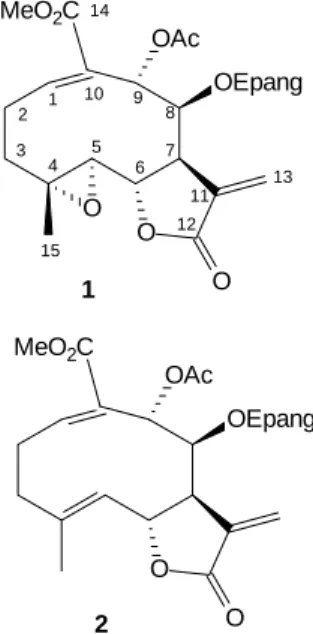
The compounds isolated from the LRE were found to be the melampolides enhydrin 1 and uvedalin 2, two STL. They were identified by means of IR, 1H and 13C NMR as well as COSY
spectroscopy and all data are in agreement with those reported in the literature5. They were also the main metabolites in the
glands of the two analysed samples, which explain the presence of a yellow solid mass in the LRE (see material and methods). The confirmation of their presence in the glands was achieved by indirect comparison of HPLC and UV-VIS/DAD data (Table 1) as well as co-injection with the reference compounds previously isolated. These two STL have been previously described in P. maculata var. maculata8 and Smallanthus sonchifolius5 by means of classical phytochemical methods.
From our previous experience, the chromatographic behaviour
Revista Brasileira de Farmacognosia 2003
2
and UV-VIS/DAD data indicates that the glandular content is composed mainly of STL. This fact can also be confirmed by the IR data of the LRE. Such compounds are typical taxonomic markers in Asteraceae8 while melampolide types are one of the
typical compounds of the genus Polymnia7.
In conclusion, based on the results it can be stated that although only two compounds were chemically identified in the case of the yacón glands, the qualitative chromatographic fingerprint based on LC/DAD data of glands is a fast, reliable and easy way of assessing chemical information on raw botanical materials prior to pharmacological or clinical studies. Where highly volatile components are not involved, the chemical information from dried material stored in herbaria or other plant collections can also be assessed by using this approach9.
Material and Methods
Plant material: P. sonchifolia was collected in November 1999
by K. Schorr. One sample is from a cultivated field at UNAERP, SP, Brazil. A second cultivated sample is from a field at Departamento de Horticultura do CERAT, UNESP, Botucatu, SP. Voucher specimens of each sample (FBC # 95 and # 101 respectively) were deposited in the SPFR herbarium at Departamento de Biologia, FFCLRP, USP, Ribeirão Preto, SP.
HPLC analyses: Shimadzu SCL 10Avp liquid chromatograph,
Shimadzu SPD-M10A diode array detector (DAD), Shimadzu ODS column (5µm, 4.6 x 250 mm), UV detection simultaneously at 225 and 265 nm or DAD. IR spectra: Perkin Elmer 1420 spectrometer. NMR: Brucker DPX 400 (400 MHz for 1H and 100
MHz for 13C); samples in CDCl 3.
Collection of glands: 60 capitate glandular trichomes from
air-dried leaves were manually collected under a microscope with a dissecting forceps. The HPLC conditions were 55% MeOH-H2O,
1.0 mL/min (system 1) and 35% MeCN-H2O, 1.3 ml/min (system
2) and 2,5-dimethylphenol (DMP) was employed as internal standard. The following chromatographic parameters were obtained for the main detected peaks: retention time relative to DMP in both solvent systems - rrt1 and rrt2, ratio of absorption of each peak between 225/265 nm - A225/265, according to6 and
UV-VIS/DAD data of each individual peak.
Compound isolation: in a stainless steel tray, about 200 g of
entire air-dried leaves of the sample FBC # 101 were quickly and carefully rinsed one by one with CH2Cl2 for 20 seconds at room
temperature. The LRE was filtered, concentrated, affording 3.2 g of crude material and re-suspended in MeOH-H2O 7:3 (v/v),
yielding 2.5 g of a cleaned-up extract. The IR spectrum of the supernatant showed an intense g-lactone carbonyl band at 1771 cm-1 indicating the presence of STL. Prior to HPLC analysis, the
extract was dissolved in MeOH and stored in a refrigerator depositing a yellow solid mass after about 4-5 days. The solid mass was manually separated and then washed with cold Et2O
affording 80 mg of 1 as white needles (m.p. 144 - 148 oC). From
this solid mass, compound 2 was isolated by HPLC. The HPLC data for 1 and 2 are trr1 = 0.67 and 1.32; trr2 = 1.75 and 3.12; A225/
265 = 85 and 35; UV λmax = 212 and 200, respectively. Copies of
the original spectra are obtainable from the author of correspondence.
Figura 1. Chemical structures of enhydrin (1) and uvedalin (2)
from P. sonchifolia.
Acknowledgements
The authors wish to thank FAPESP for funds and grants (# 97/05729-4 for FBC and # 99/02357-4 for KS), UNAERP and CERAT (Prof. Francisco L.A. Câmara) for providing the plant material as well as Prof. O. Spring for additional support. Special thanks to Prof. Benjamin Gilbert (FIOCRUZ, RJ) for the kind revision of this manuscript.
References
1 Calixto, J.B. Efficacy, safety, quality control, marketing and
regulatory guidelines for herbal medicines (phytotherapeutic agents). Brazilian Journal of Medical and Biological Research, v. 33, p. 179-189, 2000.
2 Bauer, R.; Tittel, G. Quality assessment of herbal preparations
as a precondition of pharmacological and clinical studies. Phytomedicine, v. 2, p. 193-18,1996.
3 Zardini, E. Ethnobotanical notes on "yacon", Polymnia sonchifolia (Asteraceae). Economic, v. 45, p. 72-85, 1991. 4 Aybar, M.J. ; Riera, A.N.S. ;Grau, A, Sanchez S.S. Hypoglycemic
effect of the water extract of Smallanthus sonchifolius (yacon) leaves in normal and diabetic rats. Journal of Ethnopharmacology, v. 74, p. 125-132, 2001.
5 Inoue, A.; Tamogami, S.; Kato, H.; Nakazato, Y.; Akiyama, M.;
Kodama, O.; Akatsuka, T.; Hashidoko, Y. Antifungal melampolides from leaf extract of Smallanthus sonchifolius. Phytochemistry, v. 39, p. 845-848, 1995.
6 Spring, O. Trichome microsampling of sesquiterpene lactones
for the use of systematic studies. In: Fisher, N.H.; Isman, M.B.;
O
O OEpang OAc
MeO2C
1
2
15 14
13
12 11
10 9
8
7 6 5 4 3
2 1
O
O OEpang OAc
MeO2C
Revista Brasileira de Farmacognosia 2003
3
Stafford, H.A. eds. Recent Advances in Phytochemistry -Modern Phytochemical Methods, New York: Plenum Press, v. 25, p. 319-345, 1991.
7 Le Van N.; Fischer, N.H. Three new melampolide sesquiterpenes,
polymatin A, B and C, from Polymnia maculata Cav. var.
maculata. Phytochemistry, v. 18, p. 851-854, 1979.
8 Seaman F.C. Sesquiterpene lactones as taxonomic characters
in the Asteraceae. Botanical Review, v. 48, p. 123-551, 1982.
9 Spring, O. Chemotaxonomy based on metabolites from
glandular trichomes. Advances in Botanical Research, v. 31, p. 153-174, 2000.
* Corresponding author: Prof. Dr. Fernando B. Da Costa Universidade de São Paulo
Faculdade de Ciências Farmacêuticas de Ribeirão Preto Laboratório de Farmacognosia
Av. do Café s/n , 14040-903 - Ribeirão Preto - SP - Brazil Fax: +55-16-633-1941
E-mail: [email protected]
Resumo
Açaí (Euterpe oleracea Mart.), é uma palmeira tropical muito apreciada por sua beleza e valor nutricional. Estudos químicos revelaram a presença de ácidos graxos e esteróides. No presente trabalho foi avaliada a ação de extratos obtidos dos frutos e flores sobre a produção de óxido nítrico (ON), molécula que apresenta várias atividades fisiológicas, tais como vasodilatação, neurotransmissão, além de atividades tumoricidas e citotóxicas. Células Raw 264,7 estimuladas com lipopolissacarídeo bacteriano (LPS, 100 ng/ml) e interferon-alfa (IFN-alfa, 10 U/ml) produziram grande quantidade de óxido nítrico (35 µM) quando comparadas com as células não estimuladas (3 µM). Os extratos com hexano, diclorometano, acetato de etila e
n-butanol apresentaram alta capacidade de inibição em células
ativadas com LPS e IFN-alfa, de acordo com a concentração, sendo que na concentração mais alta ocorreu uma inibição de quase 100 %. Também avaliamos se o efeito inibitório seria devido a seqüestro do radical livre (ON), através do uso do SNAP (um doador de ON). Somente o extrato em acetato de etila mostrou atividade sequestrante. Esforços estão sendo empregados na tentativa de compreender os possíveis mecanismos associados ao efeito inibitório destes extratos.
Abstract
Açaí (Euterpe oleracea Mart.) is a tropical palm tree appreciated for its attractive beauty and for nutritional purposes. Chemical studies have revealed the presence of fatty acids and steroids. In the present work, it has been tested the action of the extracts obtained from the fruits and flowers on the nitric oxide (NO) production, a very important molecule with a lot of physiological rules such as vasodilatation, neurotransmission, tumoricidal and cytotoxic activity. Cells RAW 264.7 stimulated with bacterial lipopolysaccharide (LPS, 100 ng/ml) and interferon-alpha (IFN-interferon-alpha, 10 U/ml) produce large amounts of nitric oxide (35 µM) when compared with non-stimulated cells (3µM). The hexane, dichloromethane, ethyl acetate and n-butanol extracts have shown high inhibition capacity, concentration-dependent in the cells activated with LPS and IFN-alpha, and the highest concentration has promoted almost 100 % of inhibition. We also have tested if the inhibitory effect was due to a scavenger
Ação de extratos do açaí (Euterpe oleracea
Mart.) sobre a produção de óxido nítrico
em células RAW 264.7
Matheus, M.E.1; Mantovani, I.S.B.2; Santos, G.B.2; Fernandes, S.B.O.2; Menezes, F.S.2; Fernandes, P.D.1*
1Departamento de Farmacologia Básica e Clínica, ICB,
Universidade Federal do Rio de Janeiro
2Departamento de Produtos Naturais e Alimentos,
Faculdade de Farmácia, Universidade Federal do Rio de Janeiro