Revista Brasileira de Farmacognosia 2002
Abstract
Achillea millefolium L. (Compositeae) is used in folk medicine to treat gastric disturbances. Doses of 125, 1500 and 2000 mg/kg protected rats against ulcers induced by ethanol and restraint-in-cold-stress, but not against indomethacin-induced ulcers. Injected into the duodenal lumen the extract inhibited the basal acid secretion. Data from studies indicate that the antiulcer activity of A. millefolium must been related to a inhibition of gastric secretion or to a increase of protective factors in gastric mucosa as mucus, bicarbonate and blood flow. In conclusion, this extract effectively protected the gastric mucosa and inhibited gastric acid secretion. Further studies should also be provided for the stimulation of receptors in the parietal cell to elucidate the route whereby the extract produce this action.
Achillea millefolium L. (Compositeae) popularly known as “pronto alívio”, came from Europe and was introduced in the Americas, being common in Brazil’s subtropical region1. It is used in folk medicine to treat gastric disorders (gastritis, ulcers), headache, fever and toothache. Phytochemistry studies were carried out with this species, describing the presence of essential oils, tanines, terpenes and mucilages2. This paper describes the antiulcerogenic activity of the crude aqueous extract of A. millefolium, L. (EABA) by using in vivo test models in rats and mice. For the elucidation of the activity mode, hypothermic restraint stress-, indomethacin-, ethanol-induced gastric lesions, pylorus ligature and intestinal motility model have been employed.
Material and methods
Plant material: Leaves were cultivated and collected from Fa-zenda Solidariedade of Prefeitura Municipal de Curitiba, Paraná,
Action of crude aqueous extract of leaves
of
Achillea millefolium
L. (Compositae) on
gastrointestinal tract
Cristiane Hatsuko Baggio1; Cristina Setim Freitas1; Paulo
Fernando Nhaducue1; Lia Rieck1; Maria Consuelo Andrade
Marques1*
¹ Department of Pharmacology, Sector of Biological Sciences, Universidade Federal do Paraná, Centro Politécnico, 81531-990, Curitiba, PR, Brazil
Brazil in 1999. Voucher specimens are stored in the Herbarium of Botany Department, UFPR under number UPCB 35822. The material was dried at room temperature and extracted (10% w/V) with hot water (70 oC) during 30 min. The aqueous was concentrated under vacuum to ¼ of the original volume.
Animals: Albino Wistar rats (180-250 g) were kept 6 to a cage under controlled temperature (20 oC) and lighting (12:12 h light/ dark) conditions, with free access to water and food.
Induction of acute gastric lesions by etanol - group13, by
indomethacin - group24 and by stress - group35:Rats deprived
of solid food for 15 h but receiving water plus 5% glucose were treated (p.o.) with the water vehicle (0.5 ml/100 g), with ranitidine (60 mg/kg) and with the EABA at doses from 125 to 2000 mg/kg. Sixty min later, group 1 animals received 70% ethanol, group 2 animals received 20 mg/kg indomethacin (s.c.), and group 3 animals were anesthetized sufficiently with ether so that they could be immobilized in appropriate restraining boxes and maintained at a temperature of 4 oC. The animals were sacrificed 1 hour after treatment in group 1, 6 h after treatment in group 2, and 3 h after treatment in group 3. The stomachs were removed and the mucosa was washed and examined under a stereoscope for quantification of the lesions.
Study of the anti-acid secretion and gastroprotective activity of the extracts in vivo - Pylorus ligature, determination of volume, pH and total acidity6,7, 8:Rats submitted to a 15 hour
fast but with free access to water and glucose (5%) and anesthetized with ether were operated upon for pylorus ligature with sutures and the stomach was removed 4 h after suture of the abdominal wall. The mucosa was washed with 3 ml of water and the gastric content was placed in tubes for later centrifugation at 1500 g x 30 min in a refrigerated centrifuge. The volume of the gastric juice supernatant as determined and completed to 15 ml. Free acidity (pH) was determined with a pH-meter and total acidity by simple titration with 0.1 N NaOH using 2% phenolphthalein as acid-base indicator. Aliquots of 20 ml of the gastric content were incubated with 500 ml of albumin solution (5 mg/ml in 0.06 N hydrochloric acid) at 37 ºC for 10 min. The reaction was stopped with 200 ml of 10% trichloroacetic acid and the samples were centrifuged at 1500 g x 20 min. The supernatant was alkalinized with 2.5 ml of 0.55 M sodium carbonate and 400 ml of 1 N Folin’s reagent was added to the tubes, which were incubated for 30 min at room temperature. The absorbance of the samples was determined by spectrophotometry at 660 nm.
Statistical analysis: The results were expressed as mean ± standard error of mean and the difference between groups were determined by analysis of variance (ANOVA). Significant differences for p <0.05 wereanalyzed by the Tukey Test.
31
Revista Brasileira de Farmacognosia 2002
Results
Gastric protection against ethanol, indomethacin or stress: EABA administered at doses of 125, 1500 and 2000 mg kg, 1 h before the induction of gastric lesions with 70% ethanol, decreased the total index of gastric lesions from 171.83 ± 18.60 in the control group (C) to 59.50 ± 23.36, 11.75 ± 3.11 and 7.00 ± 1.03, respectively (Figure 1). EABA did not protect against lesions induced by indomethacin (20 mg/kg- s.c., 6 h) (Figure 2). EABA at doses of 125, 1500 and 2000 mg/kg, 1 h before the induction of lesions by stress, reduced the total index of gastric lesions from 40.10 ± 6.10 for the control group (C) to 17.50 ± 0.99, 21.70 ± 1.34 and 16.20 ± 1.88, respectively (Figure 3).
Figure 1. Protective effect of the aqueous extract of leaves of Achillea millefolium L. and of ranitidine (R: 60 mg/kg - p.o.) against gastric lesions induced by ethanol (C: control - water 0.5 ml/kg - p.o.). The results are expressed as mean (standard error of mean (n=6). The difference between groups was determined by analysis of
variance (ANOVA). *** Different from the control group at p < 0.001
(Tukey’s Test).
Figure 2. Protective effect of the aqueous extract of leaves of Achillea millefolium L. and of ranitidine (R: 60 mg/kg - p.o.) against gastric lesions induced by indomethacin (C: control -water 0.5 ml/kg - p.o.). The results are expressed as mean ( standard error of mean (n=6). The difference between groups was determined by
analysis of variance (ANOVA). * Different from control group at p <
0.05 (Tukey’s Test).
Figure 3: Protective effect of the aqueous extract of leaves of Achillea millefolium L. and of ranitidine (R: 60 mg/kg - p.o.) against gastric lesions induced by stress (C: control - water 0.5 ml/kg - p.o.). *The results are expressed as mean ( standard error of mean (n=6). The difference between groups was determined by analysis of
variance (ANOVA). ** Different from control group at p < 0.01 and ***
p < 0.001 (Tukey’s Test).
Effect on gastric secretion
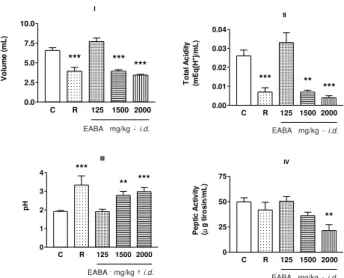
EABA administered by the intraduodenal route (i.d.), immediately after pylorus ligature reduced the volume of the gastric content secreted during a period of 4 h from 5.57 ± 0.36 ml in the control group (water) to 3.93 ± 0.20 ml at the dose of 1500 mg/kg and to 3.44 ± 0.09 ml at the dose of 2000 mg/kg (Figure 4, I). This extract also reduced the total acidity of gastric secretion from 0.026 ± 0.003 mEq[H+]ml-1 in the control group to 0.007 ± 0.001 and 0.004 ± 0.001 mEq [H+].ml-1 at the dose of 1500 and 2000 mg/kg, respectively (Figure 4, II). The pH was increased from 1.92 ± 0.05 (control) to 2.79 ± 0.21 and 2.98 ± 0.21 at the dose of 1500 and 2000 mg/kg, respectively (Figure 4, III). The peptic activity was reduced to 21.55 ± 5.80 at the dose of 2000 mg/kg (Control: 49.89 ± 3.98 mg tirosine/ml/4 h) (Figure 4, IV).
Figure 4. Effects of the crude aqueous extract of leaves of Achillea millefolium L. and of ranitidine (R: 60 mg/kg - i.d.) on the volume (I), total acidity (II), pH (III) and peptic activity (IV) of basal gastric acid secretion after 4 h of pylorus ligature in female rats. C: control, water 0.5 ml/kg - i.d. The results are expressed as mean ( standard error of mean (n=6) and thedifference between groups
0 100 200
-1
C R 125 1500 2000
***
***
***
***
T o ta l In d e xEABA mg/kg - p.o.
0 25 50 75 100
*
C R 125 1500 2000
T o ta l In d e x
EABA mg/kg - p.o.
0 10 20 30 40 50 *** *** ***
EABA mg.kg-1 -p.o.
C R 125 1500 2000
** T o ta l In d e x
EABA mg/kg - p.o.
I 0.0 2.5 5.0 7.5 10.0
EABA mg.kg-1 -i.d.
C R 125 1500 2000
*** *** *** V o lu me ( m L ) II 0.00 0.01 0.02 0.03 0.04 **
C R 125 1500 2000
*** *** T o ta l A c id ity (m E q [H +]/m L )
EABA mg/kg - i.d.
III 0 1 2 3 4
EABA mg.kg-1 -i.d.
C R 125 1500 2000
** *** *** pH IV 0 25 50 75 **
C R 125 1500 2000
P e p tic A c tiv ity (µ g t ir o si n/ m L )
EABA mg/kg - i.d.
EABA mg/kg - i.d.
EABA mg/kg - i.d.
Revista Brasileira de Farmacognosia 2002
was determined by analysis of variance (ANOVA). ** Different from
control group at p < 0.01 and *** p < 0.001 (Tukey’s Test).
Discussion
Although acute lesions induced experimentally in rodents presents many different characteristics of ulcers that occur in man, the results obtained through these methodologies indicate the involvement of some factors in the protective mechanism of gastric mucosa by compounds presented in plants extracts. The aqueous extract of leaves of A. millefolium L. was able to protect the gastric mucosa against the direct necrosing action of ethanol, which can cause injury to the gastric mucosa by damaging and breaking the gelatinous layer composed of mucus and bicarbonate, which protects the stomach9, 10 and stress-induced lesions, suggesting a stimulation of muscarinic receptors (M3) of parietal cells, increased levels of gastrin regulator peptide11-13, stimulation of histamine and reduction of gastric mucosa blood flow, promoting the increase of gastric secretion and reduction of protective factors14-16. The extract was able to reduce the volume and the acidity of secreted gastric juice, suggesting that in the gastric protective action of the extract, there must be a blockage of the mainly receptors presented in the parietal cell (M3, H2 – histamine receptor and
CCKb – gastrine receptor) as well as their second messengers17. In conclusion, this extract effectively protected the gastric mucosa and inhibited gastric acid secretion. Further studies should also be provided for the stimulation of receptors in the parietal cell to elucidate the route whereby the extract produces this action
References
1 Oka, C. Herbário de plantas medicinais. Estufa de mudas em
Caucaia do Alto-Cotia, 1998; São Paulo
2 Negri, G. Descrizione e propietá delle piante medicinali e
velenose della flora italiana. Erbario Figurato, 1979; 5. ed, Urico Hoepi Milano
3 Robert, A.; Nezamis, J. E.; Lancaster, C. & Hauchar, A. J.
Cytoprotection by prosta-glandins in rats. Prevention of gastric necrosis produced by alcohol, HCl, NaOH, hypertonic NaCl and thermal injury. Gastroenterology 1979; 77: 433-443 4 Djahanguiri, B. The production of acute gastric ulceration by
indomethacin in the rat.Scand. J. Gastroenterol. 1969; 4:265. 5 Senay, S. E. & Levine, R. J. Synergism between cold restrait for
rapid production of stress ulcer in rats. Proc. Soc. Exp. Biol. Med. 1967; 124: 1221-1223
6 Shay, H.; Komarov, S. A.; Fels, S. E.; Meraze, D.; Gruentein, M.
& Siplet, H. A simple method for uniform production of gastric ulceration in rat. Gastroenterology 1945; 5: 43-61
7 Domer, F. R. Animal experiments in pharmacological analysis.
Charles T. Thomas Publisher, 1971; 669p
8 Anson, M. L. The estimation of pepsin, trypsin, papain and
catepsin with hemoglobin. J. Gen. Physiol. 1938; 22:78-89
9 Szabo, S. Mechanisms of gastric mucosal injury and protection.
J. Clin. Gastroenterol. 1991; 13: 21S-34S
10 Glavin, G. B.; Gary, B.; Sansor, S. Experimental gastric mucosal
injury: laboratory models reveal mechanisms of pathogenics and new therapeutic strategies. Faseb J. 1992; 6:825-831 11 Pare, W.; Glavin, G. Animal models of stress in pharmacology.
In: Methods in Behavioral Pharmacology, Elsevier Amsterdam. In press, 1992
12 Pachaly, J. R.; Werner, P. R.; Schimanski, J. C.; Ciffoni, E. M. G.
Estresse por captura e contensão em animais selvagens. A Hora Veterinária 1993; 74:47-52
13 Hersey, S. J.; Sachs, G. Gastric acid secretion. Physiological
Reviews. USA 1995; 75 (1):155-189
14 Brodie, D.; Marshall, R. W.; Moreno, O. M. Effect of restrain
on gastric acidity in rat. Am. J. Physiol. 1962; 202:812-814 15 Murakami, M.; Larm, S. K.; Inada, M.; Miyake, M.
Pathophysiology and pathogenesis of acute gastric mucosal lesions after hypothermic restraint stress in rats. Gastroenterology 1985; 88:660-665
16 Al-Yahaia, M. A.; Rafatullah, S.; Mossa, J. S.; Ageel, A. M.;
Al-Said, M. S.; Tariq, M. Gastric antisecretory, antiulcer and cytoprotective properties of ethanolic extract of Alpinia galanga in rats. Phytotherapy Research 1990; 4 (3):112-114 17 Katz, J. Acid secretion and supression. Medical Clinics of
North America 1991; 75 (4): 877-887