445
Metallurgy and materials
Metalurgia e materiais
Abstract
The presence of copper-bearing minerals is known to bring on many challenges during the cyanidation of gold ore, like high consumption of cyanide and low ex-traction of metal, which are undesirable impacts on the auriferous recovery in the subsequent process step. The high copper solubility in cyanide prevents the direct use of classical hydrometallurgical processes for the extraction of gold by cyanidation. Additionally, the application of a conventional lotation process to extract copper is further complicated when it is oxidized. As a result, an acid pre-leaching process was applied in order to clean the ore of these copper minerals that are cyanide consumers. The objective was to evaluate the amount of soluble copper in cyanide before and after acidic cleaning. From a gold ore containing copper, the study selected four samples containing 0.22%, 0.55%, 1.00% and 1.36% of copper. For direct cyanidation of the ore without pre-treatment, copper extraction by cyanide complexing ranged from 8 to 83%. In contrast, the pre-treatment carried out with sulfuric acid extracted 24% to 99% of initial copper and subsequent cyanidation extracted 0.13 to 1.54% of initial copper. The study also showed that the copper contained in the secondary minerals is more easily extracted by cyanide (83%), being followed by the copper oxy-hydroxide minerals (60%), while the copper contained in the manganese oxide is less complexed by cyanide (8% a 12%). It was possible to observe that minerals with low acid solubil-ity also have low solubilsolubil-ity in cyanide. Cyanide consumption decreased by about 2.5 times and gold recovery increased to above 94% after acidic pre-cleaning.
Keywords: copper, mineral, gold, acid cleaning, cyanidation, copper-gold ore. Antonio Clareti Pereira
Doutorando
Universidade Federal de Minas Gerais - UFMG Escola de Engenharia
Departamento de Engenharia Química Belo Horizonte – Minas Gerais - Brasil [email protected]
Viviane da Silva Borges Barbosa Aluna de pós-graduação
Universidade Federal de Ouro Preto - UFOP Escola de Minas
Departamento de Engenharia de Minas Ouro Preto – Minas Gerais - Brasil [email protected]
Effectiveness acidic
pre-cleaning for copper-gold ore
http://dx.doi.org/10.1590/0370-44672016700126
1. Introduction
Cyanidation is the most common method employed to recover gold and sil-ver from their respective ores. In this pro-cess, other metals, besides gold and silver, can be dissolved in certain circumstances and interfere with the extraction eficiency of these targets. Copper is one of these metals, being able to reach concentrations as high as 1,000mg/L. When the cyanide solution contains a high concentration of copper, extraction of precious metals re-duces and operational costs increase (Hsu and Tran, 1996; González et al., 2009).
Copper minerals, either as oxides, sulides or metallic copper, may be re-sponsible for the signiicant consumption of cyanide. Although chalcopyrite is the most abundant of the copper minerals, it is poorly soluble in cyanide. However, other minerals such as azurite, malachite, cuprite and chalcocite exhibit a high solu-bility (Dai and Jeffrey, 2006; Habashi, 1967; Nguyen et al, 1997).
For most operations, the cut-off
grade for direct cyanidation of oxidized gold ore is that of a copper content below 0.5%. Above this value, the cyanide con-sumption by copper minerals becomes signiicant (Dai et al, 2012) because a
high concentration of free cyanide is re-quired for extraction of gold from the ore (Costello et al 1992; Muir et al., 1989).
The cyanidation of bivalent copper minerals results in loss of cyanide in the ratio of 0.5molCN–/molCu2+ leached,
i.e., 0.39kgNaCN/kgCu2+ (Muir, 2011;
Mendes, 1999).
The solubilization of copper by the cyanide process differs from gold and silver. In copper mineral leaching, it is not necessary to employ an oxidizing agent and the time required for dissolution of the mineral species is much smaller; how-ever, the required cyanide concentrations reach higher values. When subjected to cyanidation, ores containing soluble cop-per minerals dis- solve forming various complexes, such as Cu(CN)2–, Cu(CN)
32–
and Cu(CN)43–. This distribution depends
greatly on the pH and the cyanide to copper concentration ratio (Nguyen et al, 1997).
niobium, tantalum and titanium (Gupta e Mukherjee, 1990).
The objective of this study was to evaluate the amount of copper soluble in cyanide before and after acidic pre-cleaning, deining leaching parameters that can be applied to different ore
lithology, such as oxidized, sulide, or transition ores. It also applies to the different types of gold bearings, both refractory and non-refractory. As a result of this acidic pre-cleaning, there is an increased recovery of gold, since gold bearing or associated minerals
were destroyed. However, it is only a secondary effect and the technique does not aim to maximize this effect, only to minimize cyanide consumption by eliminating cyanides, especially copper. This study was done using transition ore (oxidized and sulide).
2. Material and method
2.1. Sample preparation
2.2 Reagents
2.3 Acid cleaning assay
2.4 Soluble copper in cyanide assay
2.5 Chemical and mineralogical characterization
3. Results and discussion
The ore used in this study was obtained from drill core samples from the northern region of Brazil. Four samples were used from four different holes: FS001-53, FS002-56, FS003-78, and FS004-87. The last two digits identify the maximum depth, in meters,
of the sample.
The samples were crushed sepa-rately until particle size was less than 1.0mm. A sample of 100g of this mate-rial was taken for mineralogical analysis and the leftover material was crushed to particle sizes below 0.074mm. Then
three samples were taken from this leftover material: i) 50g were selected for the pre-acid leaching assay (clean-ing) and subsequent cyanidation of the residue; ii) 5g for the direct cyanida-tion ore assay and; iii) 50g went on for chemical analysis.
Chemical grade reagents were used: NaCN 1%, NaOH 5% (Sigma-Aldrich) and H2SO4 98% (F.Maia).
The copper cleaning test consisted of solubilization in an acidic environ-ment of 50g of ore containing copper. This mass was leached in a lat-bot-tomed lask containing 500ml of acid solution (pH<1.0) for 48h at room tem-perature with stirring rate at 300rpm. After the leaching time, the residue was iltered through a vacuum funnel using
blue ribbon ilter paper (Prolab 3552). The solution was collected in a volu-metric lask of 1,000mL; the residue was washed with 200ml of sulfuric acid solution at pH 2.0; and the iltrate was collected in the same lask. Then, the residue was washed with 250ml deion-ized water and stored together with the above solution. The lask volume was
completed until 1,000mL and 100mL of that volume was sent for analysis of the soluble copper in acid. The residue was dried in an oven at 100°C for 6h. The dried solid was crushed to 100% of particle smaller than 0.074mm us-ing mortar and pestle and then headed for the soluble copper in cyanide step (Mendes, 1999).
The soluble copper in cyanide test was applied to the ore and to the waste generated during acid cleaning, using the same procedure. Assays were performed in triplicate and the amount recorded was the arithmetic mean of the three tests.
The dried samples were homoge-nized, disaggregated by mortar and pestle and divided using Rotary Micro Rifler,
generating three samples of 1g per sample. The test was performed with 140ml of the solution of NaCN 1% and NaOH 5% (Sigma- Aldrich) to 1,000g of the solid (residue or ore). The solution was transferred to a beaker with stirring rate of 250rpm, under a temperature of (23±2)°C and then, the solid mass was added, main-taining the stirring for 1 hour. After this
period, the mixture was vacuum iltered using a funnel, blue ribbon ilter paper (3552 Prolab), and a 250ml lask to collect the iltrate. To the cake washing, 100ml of deionized water were used and collected into the same solution lask. The volume was completed to 250ml, homogenized and an aliquot taken for chemical analysis to quantify the soluble copper cyanide.
The chemical analysis for copper of the iltered solutions was made by ICP OES -Inductively Coupled Plasma Optical Emission Spectrometry - (Agilent 725). For the mineralogical characterization, the samples of ore and residue were com-minuted (100%<1mm) and for each one, a polished section was prepared for analysis by QEMSCAN (Quantitative Evalua-tion of Minerals by SCANning electron
microscopy) and by scanning electron microscope. This electron microscope consists of a set of backscattered electron signal detectors and X-ray dispersive energy (EDS), which allow the identiica-tion of the mineral by its brightness and chemical composition.
The QEMSCAN 650 system was used, equipped with two EDS (Energy Dispersive x-ray Spectroscopy)
spectrom-eters, a Bruker 5030 SDD (Silicon Drift Detector), running at 25kV and 10nA. For the measurements, used were the internal standard conditions of quartz and metallic copper in terms of backscattered electron signal calibration.
Cyanide consumption and gold extraction were measured for the stages before and after the acidic pre-cleaning of the ore.
3.1 Chemical and mineralogical characterization
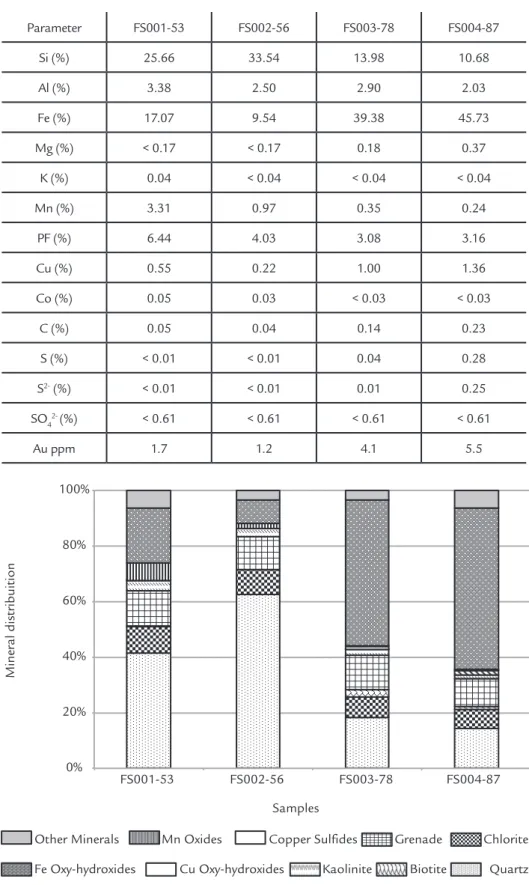
The chemical analysis of the 4 sam-ples is presented in Table 1. The copper
content ranged from 0.22% to 1.36%, and noteworthy are the contents of Si (11% to
447
as the loss on ignition varying between 3% and 6%. The sulfur and carbon levels
were very signiicant, proving the presence of sulides and carbonates in the samples.
Table 1 Chemical composition.
Parameter FS001-53 FS002-56 FS003-78 FS004-87 Si (%) 25.66 33.54 13.98 10.68 Al (%) 3.38 2.50 2.90 2.03 Fe (%) 17.07 9.54 39.38 45.73 Mg (%) < 0.17 < 0.17 0.18 0.37
K (%) 0.04 < 0.04 < 0.04 < 0.04 Mn (%) 3.31 0.97 0.35 0.24
PF (%) 6.44 4.03 3.08 3.16 Cu (%) 0.55 0.22 1.00 1.36 Co (%) 0.05 0.03 < 0.03 < 0.03
C (%) 0.05 0.04 0.14 0.23 S (%) < 0.01 < 0.01 0.04 0.28 S2- (%) < 0.01 < 0.01 0.01 0.25
SO42- (%) < 0.61 < 0.61 < 0.61 < 0.61
Au ppm 1.7 1.2 4.1 5.5
Figure 1 Mineral composition of samples.
The results (Figure 1) indicate that the samples are essentially composed of quartz, chlorite, biotite, garnet, kaolinite, copper sulides, iron and copper oxy-hydroxides, and manganese oxides. The mineralogical analysis, as shown in Figure 1, shows that FS001-53 and FS002-56 are oxidized ores, while FS003-56 and FS004-87 are sulide ores which contain
secondary (chalcocite, covellite) and pri-mary (chalcopyrite) minerals.
In terms of copper bearing miner-als, Figure 2 shows the metal presence in biotite containing between 0.5% and 10.3% of the metal content of FS001-87 and FS001-78 samples, respectively. In this mineral, copper replaces cations of magnesium (Mg2+) or iron (Fe2+), which
have been described for porphyry ores (Ilton e Verblen, 1993). The manganese oxide was identiied as the main cop-per bearer for the samples FS001-56 and FS003-53 representing 98.3% and 99.5% of total copper, respectively. For these oxides, copper may occur adsorbed or replacing Co2+ and/or Ni2+
cations (Guimarães, 2007).
0% 20% 40% 60% 80% 100%
FS001-53 FS002-56 FS003-78 FS004-87
Mineral distribuition
Samples Other Minerals
Fe Oxy-hydroxides
Mn Oxides
Cu Oxy-hydroxides
Copper Sulfides Kaolinite
Grenade Biotite
Figure 2
Copper-bearing minerals composition.
The Figure 3 shows images of tex-tures and common mineral associations
in the samples. The manganese oxides generally appeared illing fractures and
other discontinuities in the rock, while the biotite formed aggregates and ilaments.
Figure 3
Backscattered electron images obtained through a scanning electron microscope showing textures and most common mineral associations within the copper diagnosed samples. Mn oxides en-countered in sample FS001-53 and biotite lamellae associated with iron and copper oxi-hydroxides occurred at the interfaces and along the fractures and cleavage planes of the mineral in sample FS003-78. Subtitles: Bt – Biotite; OxFe – Iron oxi--hydroxides; OxMn – Manganese oxides; Sp – Spertiniite (Copper hydroxide: Cu(OH)2); Cp – Cuprite (Copper oxide: Cu2O; Gra – Garnet; Qz – Quartz.
3.2 Direct cyanidation assay: measuring the copper soluble in cyanide
Several copper minerals are soluble in cyanide but there are exceptions, such as chrysocolla and chalcopyrite. The main effect of copper on the cyanida-tion is to increase cyanide consumpcyanida-tion due to the formation of the complex Cu(CN)32- under typical conditions
(Osseo-Asare et al, 1984).
Considering the above mentioned and based on the chemical composition of the ore, the assessment of soluble cop-per in sodium cyanide aims to quantify the maximum solubilization of this metal in NaCN solutions.
When applying the methodology of Subsection 2.4, the soluble copper in cya-nide was quantiied for the four samples,
as shown in Table 2. The fraction of cop-per soluble in cyanide was very high for FS003-78 and FS004-87; samples which contained sulide minerals and copper oxy-hydroxides. The copper extractions were 60% and 83%, respectively. The lower extraction for FS003-78, rela-tive to the sample FS004-87, might be related to the following reasons: greater biotite content (10.3% versus 3.5%), in which copper is less soluble in cyanide, and also the copper associated with iron hydroxides (Osseo-Asare et al, 1984).
The high solubility of copper in cyanide in FS004-87 is due to the high composi-tion of secondary copper sulide minerals (around 70%), which are very soluble in
cyanide (Hedley and Tabachnick, 1968; Dai and Simons, 2012). The behavior for FS001-53 and FS002-56 samples, with copper barely present in manganese oxides, showed relatively low extrac-tion (8% and 12%), but still signiicant when considering the use of cyanide, even with lower initial copper contents (0.55% and 0.22%). Except for the sample FS003-78, where gold extraction was low (74%), the extractions of the other samples exceeded 97%, showing that gold is accessible to cyanide com-plexation and the ore is not considered refractory. However, there was a high consumption of cyanide between 1,200 and 2,300g/tROM.
-0.2 0.2 0.6 1.0 1.4
FS001-53 FS002-56 FS003-78 FS004-87
Ca (%)
Biotite Chalcopyrite Bornite
449
Sample Initial Cu Sol Cu CN- Au Extraction NaCN consumption
(g/tROM*) Obs FS001-53 0.55% 8.11% 99.35% 1,296
oxidized ore FS002-56 0.22% 12.12% 97.30% 2,011
FS003-78 1.00% 59.82% 74.65% 2,298
Transition ore FS004-87 1.36% 83.41% 98.00% 1,518
Sample Initial Cu Sol Cu CN- Au Extraction NaCN consumption (g/tROM*)
FS001-53 0.55% 24.45% 99.34% 811 FS002-56 0.22% 39.51% 99.80% 785 FS003-78 1.00% 98.68% 94.30% 764 FS004-87 1.36% 73.65% 99.08% 793
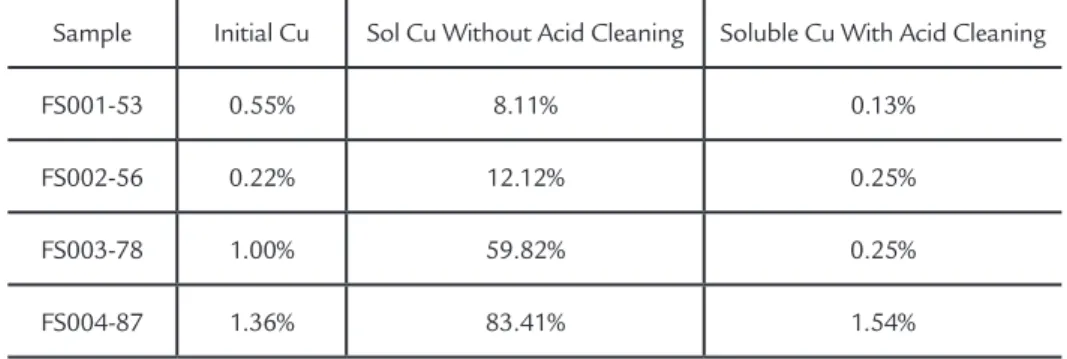
Sample Initial Cu Sol Cu Without Acid Cleaning Soluble Cu With Acid Cleaning FS001-53 0.55% 8.11% 0.13%
FS002-56 0.22% 12.12% 0.25% FS003-78 1.00% 59.82% 0.25% FS004-87 1.36% 83.41% 1.54%
Table 2
Results for direct cyanidation. *ROM: Run Of Mine.
3.3 Acid cleaning assay
The purpose of this step was to evaluate the copper extraction in the acidic stage in order to minimize the impact of this copper content on the consumption of cyanide. Table 3 shows the copper extrac-tion results when applying a preliminary stage of ore cleaning with sulfuric acid, as described in Subsection 2.3.
The analysis of the copper extrac-tion results in the acidic stage (Table 3) shows two groups: the samples formed by FS002-56 and FS001-53 where extraction was low (25 and 40%) and another group, represented by the samples FS003-78 and FS004-87 where the extraction was high (99% and 74%). Based on the mineral-ogical characterization, this behavior is
in agreement with the forms of copper occurrence in these groups.
In FS002-56 and FS001-53, copper is present in manganese oxides (Figure 2), which demonstrates refractory to solubilization (Sahoo, et al, 2001;
Pagnanelli, et al, 2004). On the other
hand, samples FS003-78 and FS004-87 that have copper minerals in other forms, such as adsorbed on phyllo-silicates (biotite) and secondary sulides (Figure 3), show a different response in an acidic environment (Mendes, 1999). Part of the copper present in secondary sulfides is soluble, even without the presence of an oxidizing agent. The sample FS003-78 has copper adsorbed
on biotite, chalcocite, covellite and oxy-hydroxides of copper while the copper from FS004-87 is basically associated with secondary sulide minerals and a small part with chalcopyrite. Second-ary minerals, such as chalcocite, react with cyanide and therefore increase its consumption. The values in the table show that the pre-cleaning acid releases gold not accessible to the cyanide, as evi-denced by the sample FS0003-78, where the extraction increased from 74% to 94%. Sodium cyanide consumption was reduced to values around 2.5 times, normalizing around the 800g/tROM value, improving process parameters for the processing of this ore.
Table 3 Results of copper extraction on acid cleaning.
3.4 Cyanidation of the residue assays
In the residue of the acid stage, produced due to the copper clean-ing treatment, the cyanidation was applied according to the procedure
described in Subsection 2.4. The re-sults are shown in Table 4 and were highly positive for both classes of ore, oxidized, and sulide. The cyanide
soluble copper went from critical val-ues between 8% and 83% to almost insigniicant values between 0.13% and 1.54%.
Table 4 Comparison of soluble copper cyanide before and after acid cleaning.
The results of soluble copper after acid pre-cleaning (Table 4) show that minerals with low acid solubility, such
as manganese and chalcopyrite minerals present in samples FS001-53, FS002-56 and FS004-87 also have low solubility in
Received: 26 September 2016 - Accepted: 3 June 2017.
4. Conclusions
References
The use of pre-conditioning of the gold ore proposed in this study was able to show the extraction potential of copper cyanide, reaching highly satisfactory val-ues, allowing the cyanidation of gold and expressive lower complexation of copper by cyanide.
The inal values of cyanide-soluble copper reached a peak of 1.54% with the
preliminary acid cleaning step, and the direct cyanidation values reached 99% of cyanide-soluble copper. It was possible to observe that minerals with low acid solu-bility also have low solusolu-bility in cyanide. Cyanide consumption decreased by about 2.5 times and gold recovery increased to above 94%. The results also showed that there is a great difference in the amount
of cyanide soluble copper from sulide and oxide ores; however the pre-cleaning technique using acid meets the two classes of ores. Considering the conditions of the pre-cleaning with diluted acid at room temperature (25°C), it is possible to adapt the application for leaching in stockpiles.
COSTELLO, M., RITCHIE, I., LUNT, D. Use of the ammonia cyanide leach sys-tem for gold copper ores with reference to the retreatment of the torco tailings.
Minerals Engineering, v.5, n.10, p.1421–1429, 1992.
DAI, X., JEFFREY, M. I. The effect of sulide minerals on the leaching of gold in aera-ted cyanide solutions. Hydrometallurgy, v. 82, n. 3, p. 118-125, 2006.
DAI, X., SIMONS, A., BREUER, P. A review of copper cyanide recovery technologies for the cyanidation of copper containing gold ores. Minerals Engineering, v. 25,
n. 1, p. 1-13, 2012.
GONZÁLEZ, O. A., ALONSO, F. N., SALAS, A. U. Copper removal from cyanide solutions by acidiication. Minerals Engineering, v. 22, n. 4, p. 324-329, 2009.
GUIMARÃES, S. B. Petrologia e metalogenia do depósito de cobre Bom Jardim de Goiás (GO). Brasília: Instituto de Geociências, Universidade de Brasília, 2007.
108f. (Dissertação de Mestrado em Geologia).
GUPTA, C. K. MUKHERJEE, T. K. Hydrometallurgy in extraction processes. CRC
press, 1990.
HABASHI, F. Kinetics and mechanism of gold and silver dissolution in cyanide so-lution. Montana College of Mineral Science and Technology, 1967.
HEDLEY, N.. TABACHNICK, H. Mineral Dressing Notes n.23. Chemistry of Cya-nidation. New Jersey, USA: American Cyanamid Company, 1968.
HSU, Y. J., TRAN, T. Selective removal of gold from copper-gold cyanide liquors by cementation using zinc. Minerals engineering, v. 9, n. 1, p. 1-13, 1996.
ILTON, E. S., VEBLEN, D. R. Origin and mode of copper enrichment in biotite from rocks associated with porphyry copper deposits; a transmission electron microsco-py investigation. Economic Geology, v. 88, n. 4, p. 885-900, 1993.
MENDES, F. D. Tratamento do minério de ouro-cobre de Igarapé Bahia através de lixiviação sulfúrica seguida de cianetação. Belo Horizonte: Escola de Engenharia, Universidade Federal de Minas Gerais, 1999. 116f. (Dissertação de Mestrado em Engenharia Mineral).
MUIR, D. M. A review of the selective leaching of gold from oxidised copper–gold ores with ammonia–cyanide and new insights for plant control and operation.
Minerals Engineering, v. 24, n. 6, p. 576-582, 2011.
MUIR, D. M., LA BROOY, S. R., CAO, C. Recovery of gold from copper-bearing ores. In: GOLD FORUM ON TECHNOLOGY AND PRACTICES-WORLD GOLD. 1989. p. 363-374.
NGUYEN, H. H., TRAN, T., WONG, P. L. M. Copper interaction during the disso-lution of gold. Minerals engineering, v. 10, n. 5, p. 491-505, 1997.
OSSEO-ASARE, K., XUE, T., CIMINELLI, V. S. T. Solution chemistry of cyanide leaching systems. Precious Metals: Mining, Extraction and Processing, p.
173-197, 1984.
PAGNANELLI, F. et al. Leaching of low-grade manganese ores by using nitric acid and glucose: optimization of the operating conditions. Hydrometallurgy, v. 75,
n. 1, p. 157-167, 2004.
SAHOO, R. N., NAIK, P. K., DAS, S. C. Leaching of manganese from low-gra-de manganese ore using oxalic acid as reductant in sulphuric acid solution.