Abstract
The dispersion degree of the mineral particles in the pulp is especially relevant regarding the performance of the cationic reverse lotation of iron ores. The gangue minerals should remain dispersed while hematite particles should be selectively loccu-lated. The present study addressed determinations of dispersion degree and zeta poten-tial of hematite in the presence of different dispersants, classiied as organic polymeric (natural and synthetic), organic monomeric, and inorganic. Special attention was paid to results achieved at pH 10, used in plant practice. For natural organic polymers, cor-relation was observed between the dispersion degree and the increase in the negative value of zeta potential. Some synthetic organic polymers enhance the dispersion of he-matite particles despite not affecting signiicantly the zeta potential. Sodium silicates, irrespectively of the SiO2/Na2O ratio, at pH 10, did not impact signiicantly either the dispersion degree or the zeta potential.
Keywords: dispersion degree, zeta potential, dispersants, hematite.
Júnia Soares Alexandrino
Professora Drª.
Universidade Estadual de Minas Gerais – UEMG Departamento de Engenharia de Minas João Monlevade – Minas Gerais - Brasil [email protected]
Antônio Eduardo Clark Peres
Professor Dr.
Universidade Federal de Minas Gerais - UFMG Escola de Engenharia
Departamento de Engenharia Metalúrgica e de Materiais Belo Horizonte – Minas Gerais - Brasil
Gilmara Mendonça Lopes
Drª., Analista Operacional Vale (Mina de Brucutu)
São Gonçalo do Rio Abaixo – Minas Gerais - Brasil [email protected]
Otávia Martins Silva Rodrigues
Professora Drª.
Universidade Federal de Ouro Preto – UFOP Escola de Minas
Departamento de Engenharia de Minas Ouro Preto - Minas Gerais - Brasil [email protected]
Dispersion degree
and zeta potential of hematite
Mining
Mineração
http://dx.doi.org/10.1590/0370-44672014690073
1. Introduction
The liberation of hematite in the currently available iron ores requires ine grinding. The aggregation between hematite and gangue particles severely impairs the selectivity of concentration via froth lotation or magnetic separa-tion. The use of dispersants in labora-tory scale investigations related to iron ores has been reported in the technical literature.
Ferreira (2002) investigated the ag-gregation/dispersion of iron ore slimes, with emphasis on interfacial phenomena, in the presence and absence of chemi-cal reagents such as metallic cations, cationic and anionic locculants, and dispersants. The rheological behavior of the pulps was correlated with the dispersion degree and the surface charge of particles.
Vieira and Peres (2013) reported the results of an investigation address-ing the effects of the slurry’s rheological behavior and the state of aggregation and dispersion on wet ultraine grinding of an iron ore concentrate. Regrinding tests were conducted under different conditions of dispersion (pH 7.3, 8.5 and 10.0). The increase of pH from 7.3 to 10.0 increased the slurry dispersion degree, providing lower values of yield stress and apparent viscosity, and a re-duction in speciic energy consumption of 17.4%. So, sodium hydroxide, added at previous processing steps, has acted as a grinding aid. On the other hand, the addition of 300 g/t of lime caused an increase of 27% in the speciic energy consumption, with a signiicant increase in yield stress and consistency index of
the luid, especially for the condition 18 kWh/t.
Lima et al. (2012) investigated
Carlson (2010) reviewed the elec-trokinetic properties of iron oxides stressing the effect of zeta potential on aggregation/dispersion of the particles in the pulp. Operations such as iltration, thickening, sedimentation, and
mag-netic separation were addressed. In the magnetic concentration of iron ores the entrapment of silica bearing particles in the aggregates contaminates the concen-trate. Selective locculation is a desliming operation used in the Tilden
concentra-tor. The ine particles of minerals bear-ing silica and other contaminants are kept dispersed and are removed by the upwards water low. Hematite particles are selectively locculated, as illustrated in Figure 1.
Figure 1
Desliming via selective flocculation.
Silva et al. (2012) investigated the
interaction between sodium silicate and quartz. Strong interaction was observed in the pH range 5 to 8. Above pH 10, the interaction was negligible.
The enhanced performance
of the reverse cationic lotation of iron ores requires the dispersion of gangue particles, and the selective locculation of iron oxide particles is desirable. The motivation for the study was to understand the effect
of dispersants belonging to differ-ent chemical classes, such as organic polymeric (natural and synthetic), organic monomeric, and inorganic, on the dispersion degree and the zeta potential of hematite.
2. Experiment
The pure compact hematite sample from Casa de Pedra mine was supplied by CSN.
The dispersants used in dispersion degree and zeta potential determinations were: dextrin (Cargil®), FloatanM3
(tan-nin, UNITAN S.A.I.C.A.®); citric acid
(Cargil®), sodium silicate C112 SiO 2 /
Na2O = 1.98 to 2.00 (Diaton®), sodium
silicate R2252 SiO2 /Na2O = 2.15 to 2.40 (Diaton®); sodium silicate R3342 SiO
2 /
Na2O = 3.30 to 3.45 (Diaton®);
Dismul-gan V3377 (Clariant®); Dispersogen LFS
(polyarylalkylphenol polyethylene glycol, Clariant®); Polymax T10 (Huntsman®);
Dispersol 589 (polyacrylate, Clariant®);
Depramin 158 CMC (Akzo Nobel®).
The pure corn starch (Maizena®) acts as
an iron oxide depressant with selective flocculation action towards hematite with respect to quartz. Its action was compared with that of the dispersants used in the experiments.
Dispersants concentrations of 4 mg/L and 14 mg/L were used in the deter-minations of the degree of dispersion. An intermediate level of 10 mg/L was selected for zeta potential determinations. Special attention was paid to the results achieved at pH 10, considering that in the plant
practice of cationic reverse lotation of iron ores the pH is set in the range between 10.0 and 10.4.
Dispersion degrees were determined in replicated experiments performed in the sedimentation tube described by Galéry (1985).
Zeta potential microelectrophoreti-cal determinations were done in a zetame-ter apparatus model ZM3-D-G, Zeta Meter systems 3.0+, using video direct images, Zeta Meter, Inc. USA. KCl solu-tion was used as supporting electrolyte. The hematite sample was comminuted to the size range < 10µm.
3. Results and discussion
Results of dispersion degree and zeta potential determinations in the presence of pure corn starch are illustrated in Figure 2
Figure 2
Dispersion degree (left) and zeta potential (right) of hematite in the presence of pure corn starch.
As expected, the pure corn starch at the concentration of 14 mg/L acted as a locculant, signiicantly reducing the hematite dispersion degree at pH 10. For
more alkaline conditions, the locculating action ceased, probably due to the coiling of the starch molecules. The isoelectric point, IEP, was shifted from pH 6.7 in the
blank determination to 3.4 in the presence of starch
dextrin are illustrated in Figure 3.
Figure 3 Dispersion degree (left) and zeta potential (right) of hematite in the presence of dextrin.
Dextrin is a modiied starch present-ing a much lower polymerization degree of the α-D glucose monomer resulting in a polymer with atomic mass unit value
lower than 10,000 which acts as disper-sant. The presence of dextrin rendered the zeta potential less negative in the alkaline pH range and no IEP was observed.
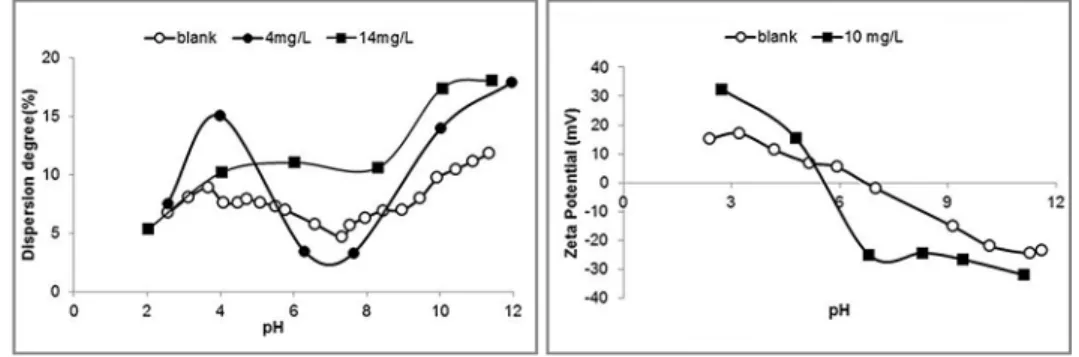
Results of dispersion degree and zeta potential determinations in the presence of the tannin FloatanM3 are illustrated in Figure 4.
Figure 4 Dispersion degree (left) and zeta potential (right) of hematite in the presence of FloatanM3.
The presence of tannin clearly increased the dispersion degree. It is dificult to explain the aspect of the curves for the two concentrations used in the experiments, but the
relevant point is that the dispersion degree at pH 10 is similar for both concentrations. Again the dispersant rendered the zeta potential less nega-tive in the alkaline pH range and no
IEP was observed.
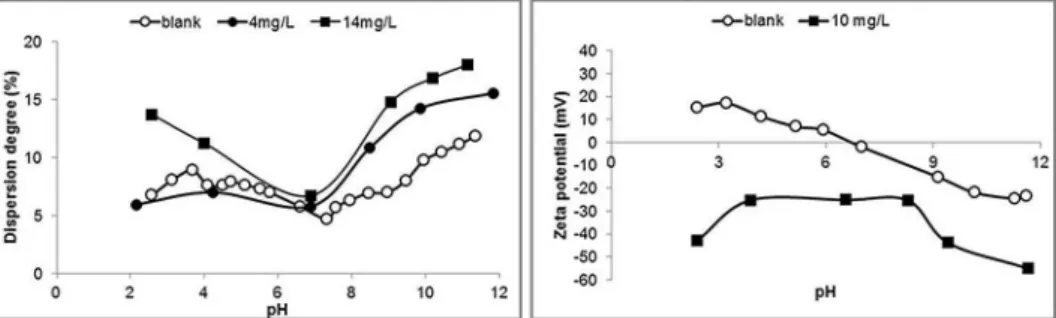
Results of dispersion degree and zeta potential determinations in the presence of citric acid are illustrated in Figure 5.
Figure 5 Dispersion degree (left) and zeta potential (right) of hematite in the presence of citric acid.
At pH 10, citric acid enhanced the dispersion of hematite, the higher concentration being more effective. The zeta potential was negative in the
full pH range investigated, but at pH 10 the zeta potential was unaffected by the presence of citric acid.
Results of dispersion degree and
zeta potential determinations in the presence of sodium silicate C-112 are illustrated in Figure 6.
Figure 6 Dispersion degree (left) and zeta potential (right) of hematite in the presence of sodium silicate C-112.
Sodium silicate C-112 (SiO2/Na2O ratio 1.98-2.00) did not signiicantly af-fect the dispersion degree, except for the
negative effect in the strongly alkaline range. The zeta potential was rendered more negative in the full pH range, but
of sodium silicate R-2252 are illustrated in Figure 7.
Figure 7
Dispersion degree (left)
and zeta potential (right) of hematite in the presence of sodium silicate R-2252.
Dosed at the concentration 14
mg/L, sodium silicate R-2252 (SiO2/
Na2O ratio 2.15-2.40) increased the
dispersion degree and shifted the zeta
potential to more negative values, but the effects signiicant at pH 10.
Results of dispersion degree and zeta potential determinations in the
presence of sodium silicate R-3342 are illustrated in Figure 8.
Figure 8
Dispersion degree (left)
and zeta potential (right) of hematite in the presence of sodium silicate R-3342.
It is dificult to explain the aspect of the dispersion degree curve for the concen-tration 14mg/L of sodium silicate R-3342 (SiO2/Na2O ratio 3.30-3.45), nevertheless
the relevant issue is that at pH 10, the reagent does not signiicantly affect either the dispersion degree or the zeta potential. The IEP was shifted from 6.7 to 5.6.
Results of dispersion degree and zeta potential determinations in the pres-ence of Dismulgan V3377 are illustrated in Figure 9.
Figure 9
Dispersion degree (left)
and zeta potential (right) of hematite in the presence of Dismulgan V3377.
At pH 10 Dismulgan V3377 does not signiicantly affect either the dispersion degree or the zeta
potential. The IEP was shifted from 6.7 to 5.6.
Results of dispersion degree and
zeta potential determinations in the presence of Dispersogen LFS are il-lustrated in Figure 10.
Figure 10
Dispersion degree (left)
and zeta potential (right) of hematite in the presence of Dispersogen LFS.
Dispersogen LFS dosed at the concentration 14 mg/L caused in-crease in the dispersion degree. The
re-agent did not affect the zeta potential. Results of dispersion degree and zeta potential determinations in the
Figure 11 Dispersion degree (left) and zeta potential (right) of hematite in the presence of Polymax T10.
Polymax T10 dosed at both con-centrations caused increase in the dispersion degree. The effect of zeta
potential at pH 10 was not signiicant. The IEP was shifted from 6.7 to 5.6.
Results of dispersion degree and
zeta potential determinations in the presence of Dispersol 589 are illustrated in Figure 12
Figure 12 Dispersion degree of hematite in the presence of Dispersol 589.
Dispersol 589, dosed at both con-centrations, signiicantly enhanced the dispersion. The effect of this acrylate
polymer on the zeta potential was negligible.
Results of dispersion degree and
zeta potential determinations in the presence of Depramin 158 are illus-trated in Figure 13.
Figure 13 Dispersion degree (left) and zeta potential (right) of hematite
in the presence of Depramin 158.
The effect of Depramin 158 was similar to that of Dispersol 589, signiicant
increase in the dispersion degree and neg-ligible effect on the zeta potential.
4. Conclusions
The natural organic polymers dex-trin, FloatanM3 (tannin), and Depramin 158 (carboxymethylcellulose) increase the dispersion degree of hematite in the alkaline pH range. A correlation is ob-served between the dispersion degree and the increase in the negative value of zeta potential. Isoelectric points of hematite were not observed in the presence of these reagents.
The synthetic organic polymers
Dismulgan V3377, Dispersogen LSF, Polymax T10, and Dispersol 589 did not signiicantly affect the zeta potential. Nevertheless Polymax T10 and Dis-persol 589 at both concentrations and Dispersogen LSF at the higher concen-tration 14 mg/L enhance the dispersion of hematite particles.
The three types of sodium silicate utilized, irrespectively of the SiO2 /Na2O ratio, at pH 10, did not signiicantly
im-pact either the dispersion degree or the zeta potential. In the acidic and mildly alkaline pH range the effect was to shift the zeta potential curve towards negative values, preventing the occurrence of iso-electric points.
Citric acid enhanced the dispersion at pH 10, despite not affecting the zeta po-tential at this pH. Considering the full pH range, isoelectric point was not observed in the presence of this reagent.
5. Acknowledgements
Received: 13 May 2014 - Accepted: 29 August 2014.
6. References
CARLSON, J. J. Review of PZC and IEP for Iron Ores. Mineral Processing and
Extractive Metallurgy. (Chemistry-Surfactants Series). New York: Marcel Dekker,
2010. v.37 p.407-447.
FERREIRA, E. E. Iron ore slimes: aggregation/dispersion and rheology. Belo
Hori-zonte: Escola de Engenharia, Universidade Federal de Minas Gerais, 2002. 190p. (Doctor Thesis Engenharia Metalúrgica e de Minas - In Portuguese).
GALÉRY, R. Inluence of the dispersion state on the loatability of the system wil-lemite/dolomite. Belo Horizonte: Escola de Engenharia, Universidade Federal de
Minas Gerais, 1985. 92p. (Master Thesis Engenharia Metalúrgica e de Minas - In Portuguese).
LIMA, N. P., PERES, A. E. C., MARQUES. Effect of slimes on iron ores lotation.
International Journal of Mining Engineering and Mineral Processing, v.1, n.2,
2012, p. 43-46.
MARQUES, M. L. S. Iron ores behavior in the concentration via lotation in the pre-sence of slimes. Belo Horizonte: Escola de Engenharia, Universidade Federal de Minas Gerais, 2013. 88p. (Master Thesis Engenharia Metalúrgica, Materiais e de Minas - In Portuguese).
SILVA, J. P. P., BALTAR, C. A. M., GONZAGA, R. S. G., PERES, A. E. C., LEITE, J. Y. P. Identiication of sodium silicate species used as lotation depressants. Minerals & Metallurgical Processing, v. 29, n. 4, p. 207-210, 2012.
VIEIRA, M. G., PERES, A. E. C. Effect of rheology and dispersion degree on the regrinding of an iron ore. Journal of Materials Research and Technology, 2, n.4,