Biota Neotrop., vol. 13, no. 3
Wing pattern diversity in Brassolini butterflies (Nymphalidae, Satyrinae)
Carla Maria Penz1,2 & Neda Mohammadi1
1Department of Biological Sciences, University of New Orleans, 2000 Lakeshore Dr., New Orleans 70148, USA 2Corresponding author:Carla Maria Penz, email: [email protected]
PENZ, C.M. & MOHAMMADI, N. Wing pattern diversity in Brassolini butterflies (Nymphalidae, Satyrinae). Biota Neotrop. 13(3): http://www.biotaneotropica.org.br/v13n3/en/abstract?article+bn03613032013
Abstract: This study describes and compares the diverse dorsal and ventral wing color patterns of Brassolini butterflies. Thirty-three species are illustrated, where pattern elements of the nymphalid ground plan are labeled in color. In general, a larger number of pattern elements can be identified on the ventral than on the dorsal surface of both wings, and the forewing has a larger number of discernible pattern elements than the hind wing. The dorsal elements are broad, diffuse, and more difficult to identify against the typically brown brassoline wing background color. Species with a light colored dorsal background served as a guide for our proposal that fewer pattern elements are present dorsally, particularly on the hind wing. Colorful bands or markings generally present on the dorsal surface seem to be associated with specific pattern elements and have correspondence to the ventral pattern. We refer to these as trailing bands, and they constitute a predominant feature of the brassoline dorsal coloration. We propose a subordinate groundplan for brassolines and interpret some of the ventral pattern variation in light of their phylogeny. Dorsal color pattern variation that leads to sexual dimorphism and mimetic resemblance are also discussed.
Keywords: butterfly, wing color, nymphalid ground plan, eyespots, ocelus, Caligo.
PENZ, C.M. & MOHAMMADI, N. Diversidade de padrão das asas em Brassolini (Nymphalidae, Satyrinae). Biota Neotrop. 13(3): http://www.biotaneotropica.org.br/v13n3/pt/abstract?article+bn03613032013
Resumo: Este estudo descreve e compara os diversos padrões de coloração dorsal e ventral das borboletas da tribo Brassolini. Com o objetivo de demarcar os elementos do padrão de base dos ninfalídeos (‘pattern elements of the nymphalid ground plan’), 33 espécies são ilustradas. De maneira geral, o número de elementos-padrão identificados na face ventral é maior do que o da face dorsal em ambas as asas, e a asa anterior contém um número maior de elementos visíveis do que a posterior. Os elementos da face dorsal são mais largos e difusos, e também mais difíceis de identificar devido à usual coloração de fundo marrom escuro dos brassolíneos. Espécies que apresentam coloração de fundo clara serviram como guia para a nossa interpretação de que a superfície dorsal das asas apresenta um número reduzido de elementos-padrão, especialmente a da asa posterior. Faixas ou manchas coloridas que geralmente aparecem na superfície dorsal estão aparentemente associadas com elementos-padrão específicos, e apresentam correspondência com faixas que aparecem na face ventral. Estas faixas (‘trailing bands’) se alastram a partir da borda de certos elementos e constituem uma característica predominante da coloração dorsal dos brassolíneos. Nós propomos um padrão de base para os brassolíneos que é subordinado ao dos ninfalídeos, e utilizamos a filogenia do grupo para interpretar alguns aspectos da variação de elementos-padrão da superfície ventral. As variações de padrão e cor que resultam em dimorfismo sexual e mimetismo são discutidas.
155
Brassolini wing color patterns Biota Neotrop., vol. 13, no. 3
napoleon Doubleday, 1849 resembles a dead leaf) while others are quite visible (e.g., some Caligo species have conspicuous eyespots). The richness of color patterns, coupled with differing activity periods (crepuscular vs. diurnal) and flight behaviors, constitute an open field of investigation for this butterfly tribe.
This study represents the first broad survey of color pattern diversity in Brassolini. Here we provide a framework for understanding color pattern variation among genera, which constitutes a required foundation for future work on evolution, development and genetics of wing color patterns in this butterfly group. Ventral patterns are described in detail and dorsal patterns are explained here for the first time. We identify and illustrate pattern elements using the nymphalid ground plan proposed by Schwanwitsch (1924) and Süffert (1927), and modified by Nijhout (1991). We then propose a subordinate groundplan for the Brassolini that is placed in a phylogenetic context. Finally, we briefly discuss instances of sexual dimorphism and color convergence across genera.
Material and Methods
1. Specimens, species and illustrations
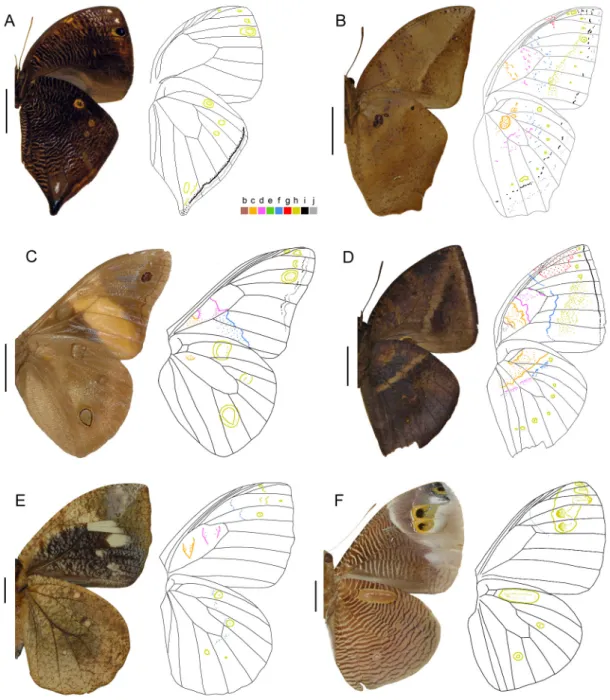
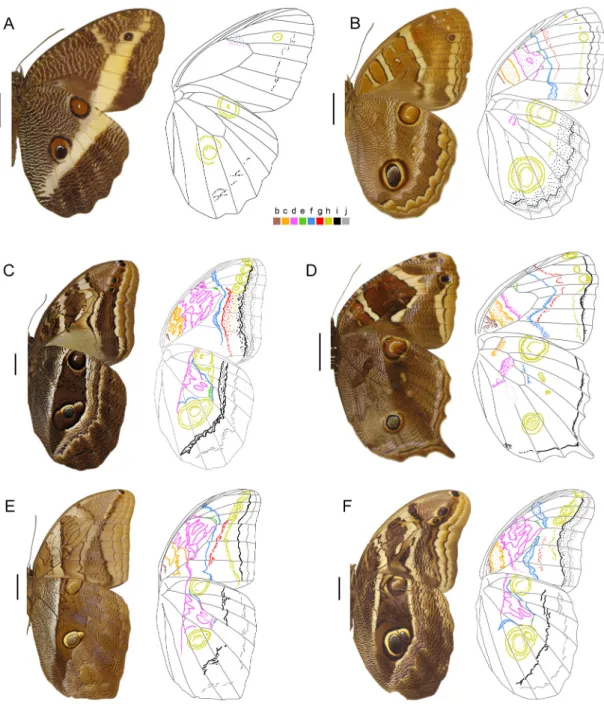
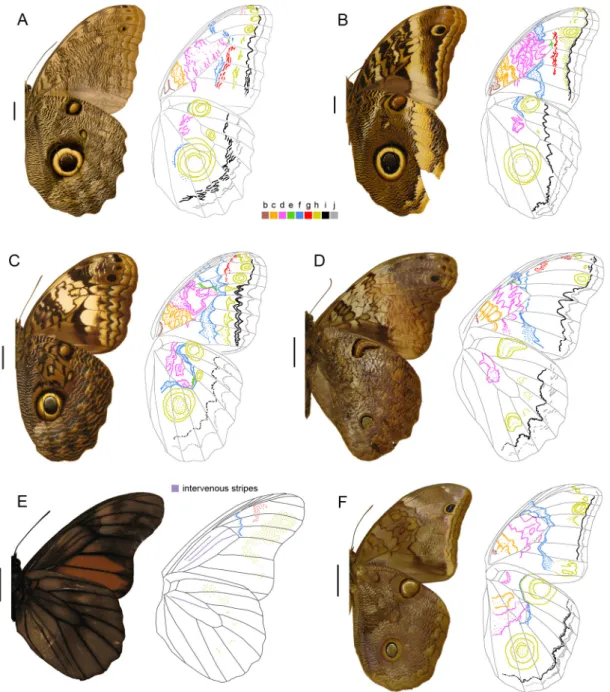
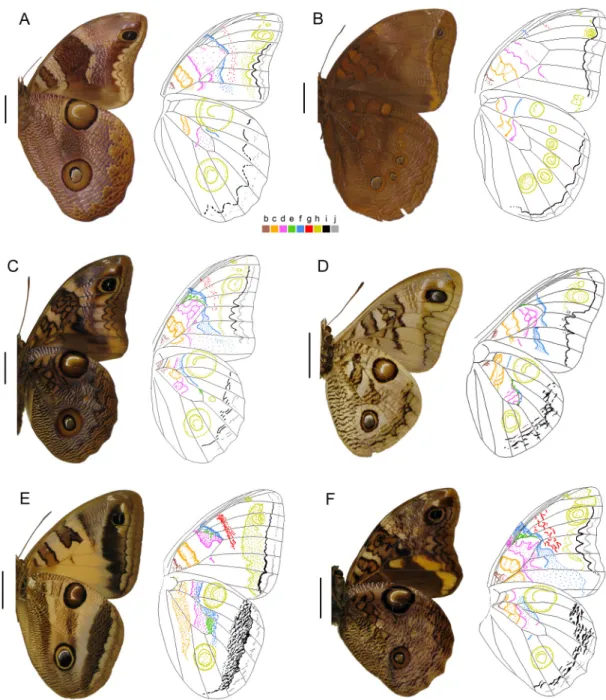
Appendix 1 lists locality data and museum deposition of 554 specimens from 75 species that were examined directly (73% of the Brassolini species diversity), plus sources of photographs of additional taxa. Thirty-three species are illustrated here (usually male). For economy of space, not all species mentioned in the text are included in the figures, but male and female photographs of most brassolines can be found at http://fs.uno.edu/cpenz/Brassolini. html (last accessed 12 August 2013). Photographs were taken with a Cannon G9 digital camera and processed in Adobe Photoshop (Adobe Systems Inc.). Figures with a color-coded key identifying wing pattern elements were prepared using either the type species or an alternative representative of each genus depending on availability of material and /or particular characteristics of their wing patterns. To document variation, multiple species of the same genus were sometimes illustrated. Although body size varies broadly within Brassolini, all images used to describe pattern elements were converted to a similar size to facilitate comparison (Figures 1-7). Images that illustrate sexual dimorphism and color resemblance across genera are scaled proportionately to life size (Figure 9).
2. Homology and the identification of pattern elements
Pattern elements of the nymphalid ground plan (NGP) are discrete components of wing color differentiation expressed on the wing surface (Nijhout 1991 and references therein). Within the comparative context of the NGP, the term ‘homology’ is generally used to indicate the repetition of a pattern element among cells on the same wing (serial homology), the mirror image of elements between wing surfaces (dorso-ventral homology), and the equivalence of pattern elements across species. Although the latter clearly corresponds to evolutionary homology (i.e., characters shared by common ancestry), the identification of NGP pattern elements is somewhat subjective and should therefore be considered a hypothesis of homology that might be tested through a genetic or phylogenetic framework. As such, the coding of pattern elements for species included in this study constitutes a set of working hypotheses.
Our method for the identification of NGP pattern elements followed three steps. First, we studied the pattern element variation across nymphalid subfamilies to build a framework for size and color diversity, as well as the sequential location of individual pattern elements along wing cells (topographical correspondence can be used to infer homology; e.g., DePinna 1991, Rieppel & Kearny
Introduction
Wing colors play vital and diverse roles in Lepidoptera, spanning from physiology (e.g., thermoregulation) to inter and intraspecific interactions. Camouflage, large eyespots for startle or deflection, aposematism and mimicry are notable adaptations that reduce predation risk (e.g., Vane-Wright & Ackery 1984, Chai 1990). Although different in their evolutionary outcome, all of these phenotypic defenses involve impressive modifications of wing pattern elements (Nijhout 1991). For example, some nymphalid butterflies closely resemble dead leaves, a useful appearance at rest of when feeding on fallen rotting fruit (e.g., Zaretis itys (Cramer, 1777), Nymphalidae, Charaxinae; Kallima inachus (Boisduval, 1846), Nymphalidae, Nymphalinae; see http://biology.duke.edu/ nijhout/patterns2.html for a demonstration; last accessed 7 March 2013). In contrast, brightly colored butterflies incur a predation risk that can only be defused if they are chemically protected, mimetic, or too difficult to catch. Among these, mimicry is a particularly complex defense because wing colors play a role in both predator-prey and model-mimic interactions while being also used to mediate male-female, intraspecific communication. In fact, mate-choice experiments suggest that assortative mating based on wing color led to genetic divergence and speciation of the sister taxa Heliconius cydno Doubleday, 1847 and H. melpomene (Linnaeus, 1748) (Nymphalidae, Heliconiinae), which belong to separate mimicry rings (Jiggins et al. 2001). Furthermore, instances of female-limited mimicry also demonstrate the importance of color for mate recognition in butterflies (e.g., Kunte 2008, 2009), implying a potential tradeoff between defensive coloration and mating success in the male sex.
The utility of color for intraspecific interactions likely depends on light levels in the environment. Not surprisingly, nocturnal moth wing colors do not play a role in mate location, recognition, or courtship; chemical communication is favored instead (e.g., Birch 1970), which also seems to be the case in day-flying moths (e.g., Eisner & Meinwald 1995). In contrast, butterfly wing colors are commonly used for male-male and male-male-female-male interactions, and the highly visible, territorial male Morpho butterflies (Nymphalidae, Satyrinae, Morphini) provide a fitting example of both. While dorsal blue colors have a role in male-male and perhaps male-male-female-male interactions (Fruhstorfer 1912, Penz & DeVries 2002, DeVries et al. 2010), the dark and camouflaged ventral wing coloration likely protects both sexes at rest. Thus, the Morpho dorso-ventral differentiation seems to fit the situation described by Oliver et al. (2009) for Bicyclus (Nymphalidae, Satyrinae, Satyrini), where the dorsal color pattern is shaped by sexual selection, while natural selection operates on the camouflaged ventral surface. Members of the Satyrinae tribe Brassolini, sister group to Morphini (Wahlberg et al. 2009), might be under similar selection regimes given the remarkable color pattern differences between their dorsal and ventral wing surfaces.
156
Penz, C.M. & Mohammadi, N.
Biota Neotrop., vol. 13, no. 3
Figure 1. Male wings in ventral view plus a schematic drawing showing color-coded pattern elements. Scale bars: 1 cm. A, Bia actorion, Suriname; B, Narope cyllastros, no data; C, Brassolis sophorae, French Guiana; D, Aponarope sutor, Brazil, Rondônia; E, Dynastor napoleon, Brazil, Santa Catarina; F, Dynastor macrosiris macrosiris, French Guiana.
2002). We did this to be consistent with previous work (Nijhout 1991, 1994, 2001) that formed the basis of more recent research on evolution of development. Second, we examined and compared a large number of species, including all brassoline genera. To account for variation within species, specimens from various localities were studied whenever possible. A large sample size allowed us to use intermediate phenotypes as clues for the identification of pattern elements within and between genera (as suggested by Nijhout 1991). Finally, after pattern elements were color-coded for each species, we checked our identifications of pattern elements for consistency throughout the Brassolini.
3. Terminology and character optimization
Terms and definitions used throughout the text are listed below, including pertinent baseline information:
• Wing background: The background corresponds to the canvas upon which patterns elements are expressed, and background color may or may not be homogeneous across the wing surface (Nijhout 1991);
• Nymphalid ground plan (NGP) pattern elements: The nine pattern elements found in Brassolini are indicated by letters b to j from the wing base to the distal edge, following Nijhout (1991, p.43);
157
Brassolini wing color patterns Biota Neotrop., vol. 13, no. 3
Figure 2. Male wings in ventral view plus a schematic drawing showing color-coded pattern elements. Scale bars: 1 cm. A, Dasyophthalma rusina, South Brazil; B, Opoptera syme, Brazil, São Paulo; C, Caligopsis seleucida, Peru, Madre de Dios; D, Opoptera aorsa, Brazil, Paraná; E, Eryphanis automedon, Ecuador, Sucumbios; F, Eryphanis bubocula, Costa Rica, Guanacaste.
it is not used in the descriptions below. Oceli can be simple (one solid spot) or complex (a spot encircled by rings); • Ripple patterns: These correspond to striations or granular
markings typically found on the ventral wing surface of satyrines. Development of ripple patterns precedes that of NGP pattern elements (Nijhout 2001), and our descriptions and discussion take this into account;
• Trailing bands: The space between certain pattern elements may contain a bright band (white, cream, yellow or orange) that contrasts the dorsal or ventral wing background. We coined the term ‘trailing bands’ for these because, on the ventral surface, they are usually contiguous to one pattern element and diffuse at the opposite side (see Figures 5A for identification on the ventral and dorsal surfaces, and 8A for a
schematic representation). Nonetheless, they can also fill the entire space between two flanking elements, or be diffuse in both the distal and proximal edges. It is, therefore, possible that they are developmentally associated with various pattern elements. Dorsal and ventral trailing band homologues vary in width and color, and may be expressed in the same, or slightly offset, locations. The trailing bands differ from, and should not be confused with, “patterned background colors” described by Nijhout (1991, p.38);
• Wing venation nomenclature follows the Comstock-Needham system (indicated in Figure 8A).
158
Penz, C.M. & Mohammadi, N.
Biota Neotrop., vol. 13, no. 3
Figure 3. Male wings in ventral view plus a schematic drawing showing color-coded pattern elements. Scale bars: 1 cm. A, Caligo eurilochus, Ecuador, Sucumbios; B, Caligo atreus, Colombia, Antiochia; C, Caligo martia, Brazil, Santa Catarina; D, Selenophanes cassiope, Peru, Chanchamayo; E, Penetes pamphanis, Brazil, Paraná; F, Catoblepia xanthus, Brazil, Pará.
the tree used here and that in Penz et al. 2013 did not affect character optimization).
Results
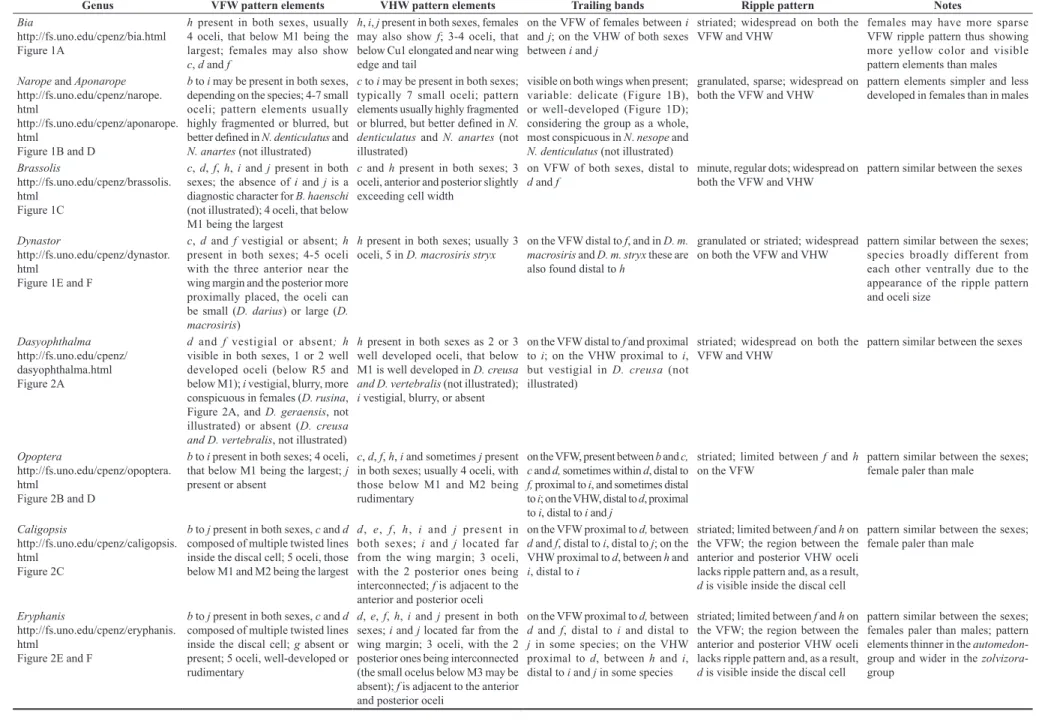
Pattern elements of the nymphalid ground plan were easily identified in most brassolines, although some species had reduced patterns. Color-coded identification diagrams in Figures 1-7 together with Tables 1 and 2 facilitate comparison across genera. Individual pattern elements are more readily recognized on the ventral surface of the wings. Therefore, we address the ventral coloration first, and use it as a guide for the identification of dorsal pattern elements and trailing bands. Based on our comparative study of 75 species, we then propose a subordinate groundplan for Brassolini and place the variation in key characteristics in a phylogenetic context (Figure 8),
noting that some taxa depart from the groundplan. Finally, we describe instances of sexual dimorphism and color pattern convergence among genera (Figure 9).
1. Ventral wing surface
159
Brassolini wing color patterns Biota Neotrop., vol. 13, no. 3
Figure 4. Male wings in ventral view plus a schematic drawing showing color-coded pattern elements. Scale bars: 1 cm. A, Catoblepia orgetorix championi, Panama, Chiriqui; B, Catoblepia berecynthia, Central Peru; C, Mielkela singularis, Mexico, Chiapas; D, Orobrassolis ornamentalis, Brazil, São Paulo; E,
Blepolenis bassus, Brazil; F, Opsiphanes sallei, Peru, Pasco.
Orobrassolis ornamentalis (Stichel, 1906), Figure 4D; Bia actorion (Linnaeus, 1763), Figure 1A). The VHW typically includes elements c, d, f, h, i and j, and although very reduced b and e are also present in some taxa (see Figures 1-4). Element g is absent from the VHW of all species examined. The VHW submarginal bands (i and j) can be absent or present (e.g., absent in Dynastor darius (Fabricius, 1775), Figure 1E; present, sharp in Opoptera syme (Hübner, 1821), Figure 2B; blurred in Caligo eurilochus (Cramer, 1775), Figure 3A).
The position and appearance of pattern elements varies between the VFW and VHW, as it could be expected from their different shape (Figures 1-4). The elements of the central symmetry system (d, e, f) and border oceli (h) are located more distally on the VFW than on the VHW. Element f is usually more visible and expressed across a larger number of wing cells on the VFW than the VHW. The serial
expression of element h on the VFW usually includes simple spots anterior to vein M1 and a complex ocelus in the cell below this vein, but some taxa also have an additional ocelus in the cell below M2 (Dynastor, Figure 1F; Caligopsis and Eryphanis, Figure 2C, E, F). From veins M2 or M3 to the posterior portion of the VFW, h can be absent, fragmented, continuously diffuse, or form a uniquely broad band as in Blepolenis (Figure 4E).
160
Penz, C.M. & Mohammadi, N.
Biota Neotrop., vol. 13, no. 3
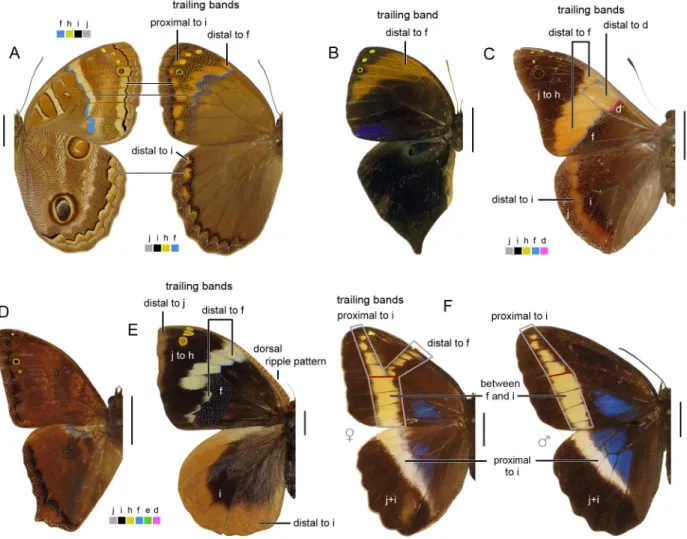
Figure 5. Wings in dorsal view (except for A, left side) indicating color-coded pattern elements and trailing bands. Mostly males, except when indicated. Scale bars: 1 cm. A, Opoptera syme, Brazil, São Paulo, ventral view on the left; B, Bia actorion, Suriname; C, Brassolis sophorae, French Guiana; D, Narope cyllastros, no data; E, Dynastor napoleon, Brazil, Santa Catarina; F, Dasyophthalma rusina, female on the left and male on the right, both from South Brazil.
located below Sc+R1 and Cu1 (anterior and posterior oceli), which are sometimes accompanied by one or two (infrequently three) additional markings. While these markings are usually located below M1 or M2 (Figures 1C, 2E, 3A), Caligopsis (Figure 2C) and Eryphanis (Figure 2E, F) are unique in having a well-developed ocelus below M3. Within category (3) above, the anterior ocelus of the VHW may diverge from the usual, round shape (e.g., Selenophanes cassiope (Cramer, 1775), Figure 3D), and the posterior ocelus may be quite large, expanding across veins Cu1 and Cu2 (e.g., Caligo, Figure 3A-C). The location of the posterior ocelus varies in the proximal-distal axis of the Cu1 cell: it is positioned at the base of the tail near the wing margin in Bia (Figure 1A), very near the discal cell in Dasyophthalma (Figure 2A), Caligopsis (Figure 2C), Eryphanis (Figure 2E, F) and Caligo (Figure 3A, B, C), and approximately at mid-length of the Cu1 cell in the remaining genera. When present, the submarginal bands (i and j) are always thin and distinctive on the VFW, but those on the VHW can be either thin (e.g., Opoptera syme, Figure 2B), or broad and diffuse (e.g., Caligo eurilochus, Figure 3A).
The presence, width, color and intensity of trailing bands vary between genera (Figures 1-4). In several species, the contrast between the dark NGP pattern elements and the white trailing bands produces a striking contrast (e.g., Eryphanis bubocula (Butler, 1872), Figure 2F), and in others the ventral expression of such band is faint (e.g.,
Catoblepia xanthus (Linnaeus, 1758), Figure 3F). A trailing band may also be located in an area of the VFW that is not visible when the butterfly is at rest (e.g., Penetes pamphanis Doubleday, 1849; Figure 3E). Trailing bands constitute a key feature of the dorsal color pattern and will be addressed in more detail below.
161
Brassolini wing color patterns Biota Neotrop., vol. 13, no. 3
162
Penz, C.M. & Mohammadi, N.
Biota Neotrop., vol. 13, no. 3
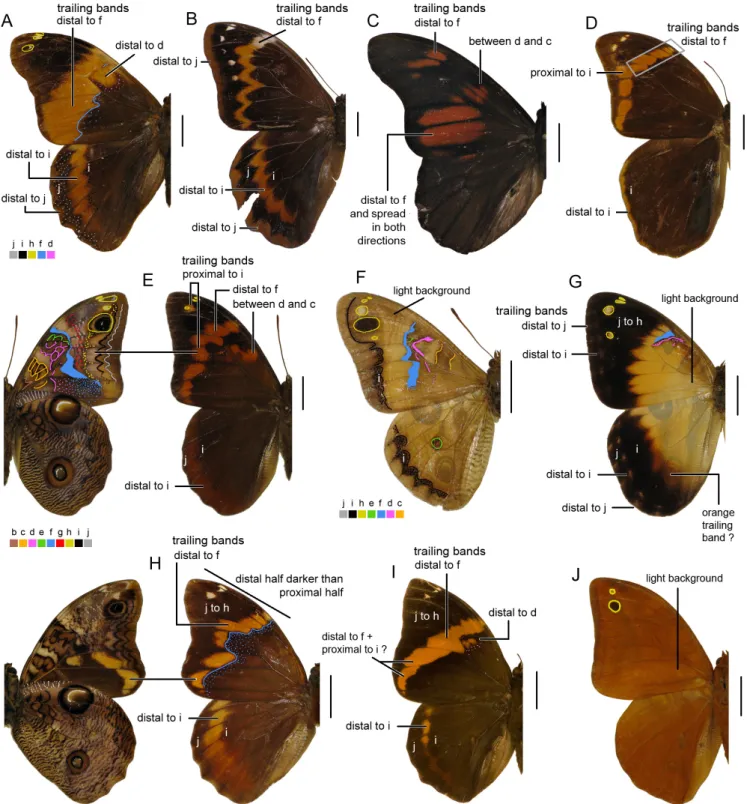
Figure 7. Male wings in dorsal view (except for E and H, left side) indicating color-coded pattern elements and trailing bands. Scale bars: 1 cm. A, Selenophanes cassiope, Peru, Chanchamayo; B, Selenophanes supremus, Peru, Chanchamayo; C, Penetes pamphanis, Brazil, Paraná; D, Catoblepia xanthus, Brazil, Pará; E,
163
Brassolini wing color patterns Biota Neotrop., vol. 13, no. 3
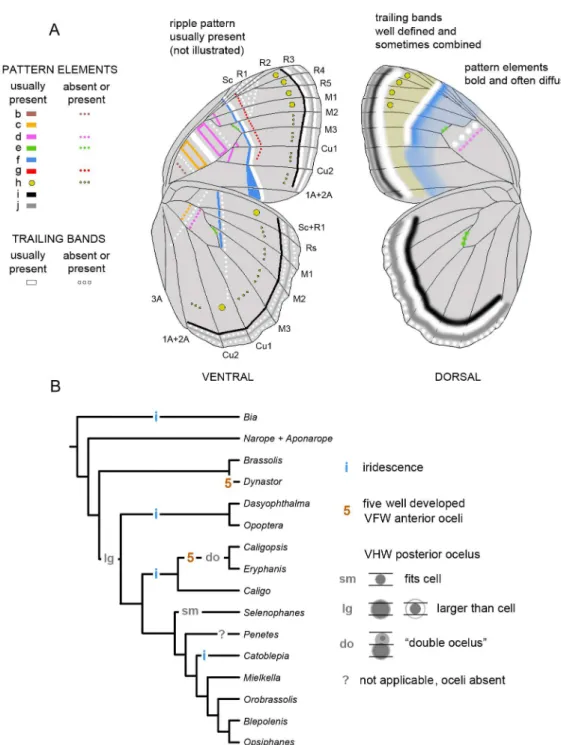
Figure 8. A, Subordinate groundplan for the Brassolini ventral and dorsal wing surfaces. Continuous lines (or a large circle for element h) indicate pattern elements or trailing bands that are usually present, and small dots or dotted lines denote those that are often absent. The wing outline corresponds to Opoptera syme. B, Annotated Brassolini phylogeny on which selected wing color characters have been optimized.
Mielkella singularis (Weymer, 1907) and all Opsiphanes have a small and inconspicuous VHW area lacking ripple patterns close to the wing base (Figure 4C, F), which is not present in Blepolenis or Orobrassolis.
2. Dorsal wing surface
The dorsal color patterns are simpler than those on the ventral surface. They typically include a reduced number of pattern elements, trailing bands, and iridescent patches that are not part of the NGP (Table 2). We selected Opoptera syme (Figure 5A) as a starting point for the identification of dorsal pattern elements and trailing bands
164
Penz, C.M. & Mohammadi, N.
Biota Neotrop., vol. 13, no. 3
165
Brassolini wing color patterns
http://www .biotaneotropica.or g.br/v13n3/en/abstract?article+bn03613032013 http://www .biotaneotropica.or g.br Biota Neotr op.,
vol. 13, no. 3
Table 1. General description of ventral patterns (all links last accessed 1 April 2013).
Genus VFW pattern elements VHW pattern elements Trailing bands Ripple pattern Notes
Bia
http://fs.uno.edu/cpenz/bia.html
Figure 1A
h presentin both sexes, usually 4 oceli, that below M1 being the largest; females may also show
c, d and f
h, i, j present in both sexes, females may also show f; 3-4 oceli, that
below Cu1 elongated and near wing edge and tail
on the VFW of females between i
and j; on the VHW of both sexes
between i and j
striated; widespread on both the
VFW and VHW females may have more sparse VFW ripple pattern thus showing
more yellow color and visible pattern elements than males
Narope and Aponarope
http://fs.uno.edu/cpenz/narope. html
http://fs.uno.edu/cpenz/aponarope. html
Figure 1B and D
b to i may be present in both sexes,
depending on the species; 4-7 small
oceli; pattern elements usually highly fragmented or blurred, but
better defined in N. denticulatus and
N. anartes (not illustrated)
c to i may be present in both sexes; typically 7 small oceli; pattern elements usually highly fragmented
or blurred, but better defined in N. denticulatus and N. anartes (not illustrated)
visible on both wings when present;
variable: delicate (Figure 1B), or well-developed (Figure 1D);
considering the group as a whole, most conspicuous in N. nesope and
N. denticulatus (not illustrated)
granulated, sparse; widespread on
both the VFW and VHW pattern elements simpler and less developed in females than in males
Brassolis
http://fs.uno.edu/cpenz/brassolis. html
Figure 1C
c, d, f, h, i and j present in both sexes; the absence of i and j is a diagnostic character for B. haenschi
(not illustrated); 4 oceli, that below M1 being the largest
c and h present in both sexes; 3 oceli, anterior and posterior slightly exceeding cell width
on VFW of both sexes, distal to d and f
minute, regular dots; widespread on
both the VFW and VHW pattern similar between the sexes
Dynastor
http://fs.uno.edu/cpenz/dynastor. html
Figure 1E and F
c, d and f vestigial or absent; h present in both sexes; 4-5 oceli
with the three anterior near the wing margin and the posterior more proximally placed, the oceli can be small (D. darius) or large (D. macrosiris)
h present in both sexes; usually 3 oceli, 5 in D. macrosiris stryx
on the VFW distal to f, and in D. m. macrosiris and D. m. stryx these are also found distal to h
granulated or striated; widespread
on both the VFW and VHW pattern similar between the sexes; species broadly different from each other ventrally due to the appearance of the ripple pattern and oceli size
Dasyophthalma
http://fs.uno.edu/cpenz/ dasyophthalma.html
Figure 2A
d and f vestigial or absent; h
visible in both sexes, 1 or 2 well developed oceli (below R5 and below M1); i vestigial, blurry, more conspicuous in females (D. rusina,
Figure 2A, and D. geraensis, not illustrated) or absent (D. creusa and D. vertebralis, not illustrated)
h present in both sexes as 2 or 3 well developed oceli, that below M1 is well developed in D. creusa and D. vertebralis (not illustrated);
i vestigial, blurry, or absent
on the VFW distal to f and proximal to i; on the VHW proximal to i, but vestigial in D. creusa (not illustrated)
striated; widespread on both the
VFW and VHW pattern similar between the sexes
Opoptera
http://fs.uno.edu/cpenz/opoptera. html
Figure 2B and D
b to i present in both sexes; 4 oceli, that below M1 being the largest; j
present or absent
c, d, f, h, i and sometimes j present in both sexes; usually 4 oceli, with those below M1 and M2 being rudimentary
on the VFW, present between b and c, c and d, sometimes within d, distal to
f, proximal to i, and sometimes distal to i; on the VHW, distal to d, proximal to i, distal to i and j
striated; limited between f and h
on the VFW pattern similar between the sexes; female paler than male
Caligopsis
http://fs.uno.edu/cpenz/caligopsis. html
Figure 2C
b to j present in both sexes, c and d
composed of multiple twisted lines inside the discal cell; 5 oceli, those below M1 and M2 being the largest
d, e, f, h, i and j present in both sexes; i and j located far from the wing margin; 3 oceli, with the 2 posterior ones being interconnected; f is adjacent to the anterior and posterior oceli
on the VFW proximal to d, between
d and f, distal to i, distal to j; on the
VHW proximal to d, between h and
i, distal to i
striated; limited between f and h on
the VFW; the region between the anterior and posterior VHW oceli
lacks ripple pattern and, as a result,
d is visible inside the discal cell
pattern similar between the sexes; female paler than male
Eryphanis
http://fs.uno.edu/cpenz/eryphanis. html
Figure 2E and F
b to j present in both sexes, c and d
composed of multiple twisted lines inside the discal cell; g absent or
present; 5 oceli, well-developed or
rudimentary
d, e, f, h, i and j present in both sexes; i and j located far from the wing margin; 3 oceli, with the 2 posterior ones being interconnected (the small ocelus below M3 may be absent); f is adjacent to the anterior and posterior oceli
on the VFW proximal to d, between
d and f, distal to i and distal to
j in some species; on the VHW
proximal to d, between h and i, distal to i and j in some species
striated; limited between f and h on
the VFW; the region between the anterior and posterior VHW oceli
lacks ripple pattern and, as a result,
d is visible inside the discal cell
pattern similar between the sexes; females paler than males; pattern elements thinner in the automedon
-group and wider in the zolvizora
166
Penz, C.M. & Mohammadi, N.
http://www .biotaneotropica.or g.br http://www .biotaneotropica.or g.br/v13n3/en/abstract?article+bn03613032013 Biota Neotr op.,
vol. 13, no. 3
Genus VFW pattern elements VHW pattern elements Trailing bands Ripple pattern Notes
Caligo
http://fs.uno.edu/cpenz/caligo.html
Figure 3A, B and C
b to j present in both sexes, c and
d usually composed of multiple
twisted lines inside the discal cell, but sometimes vestigial
(Figure 3A); g absent or vestigial;
4 oceli, 1-3 well-developed, but
element h may be expressed across
the entire wing (e.g., Figure 3C)
d, e, f, h, i and j present in both sexes; i and j located far from
the wing margin; 2-3 oceli, small
ocelus below M1 sometimes
vestigial (Figure 3B) or absent; f may be visible adjacent to the anterior and posterior oceli in some species
s o m e t i m e s a b s e n t o r f a d e d
(Figure 3A); on the VFW, may be
visible distal to c, distal to f, distal to i; on the VHW, proximal to d, distal to i and j
striated; on the VFW, variable from widespread (Figure 3A) to localized
between f and h (Figure 3B) to nearly absent (Figure 3C); on the VHW, variable from tight striations that are widespread (Figure 3A, B)
to loose striations absent from the
submedial area (Figure 3C)
pattern similar between the sexes; females paler than males
Selenophanes
http://fs.uno.edu/cpenz/ selenophanes.html
Figure 3D
b to j present in both sexes, c and d
composed of multiple twisted lines inside the discal cell; g absent or
vestigial; 4-6 oceli, that below M1
being the largest and most complex
d, h, i and j present in both sexes; anterior ocelus round (S. josephus,
not illustrated) or sickle-shaped (Figure 3D); 2-6 oceli, anterior and posterior well-developed
on the VFW trailing colors
interspersed with c and d, and a subtle shade distal to f
striated-granular, present on the distal half of the VFW and throughout the VHW
female colors similar to male but
VHW h series may be more visible
Penetes
http://fs.uno.edu/cpenz/penetes. html
Figure 3E
pattern elements extremely reduced in both sexes; f, g and h diffuse, barely noticeable
pattern elements extremely reduced in both sexes; h diffuse and barely visible
on the VFW, distal to f (weak) absent pattern similar between the sexes; females paler than males
Catoblepia
http://fs.uno.edu/cpenz/opsiphanes. html
Figs 3F, 4A and B
quite variable among species; b
to j present in both sexes of some species, but e, f and g vestigial or absent in others; c and d may be simple or intricate inside the discal cell; 4 oceli, that below M1 being the largest
in both sexes c, d, f, h, i, and j
present and f may be vestigial
(Figure 3F); 2-6 oceli, depending on the species (compare Figure 4A and B); pattern elements quite
variable among species
quite variable among species; on the VFW of C. xanthus (Figure 3F)
trailing colors are subdued distal to f and proximal to i, and are
diffuse on the VHW; in C. orgetorix (Figure 4A) they are prominent on the VFW between b and c, c and d, distal to f, and proximal to i and are
diffuse on the VHW
striated to granular, variable in contrast from faded to bold; present
on the VFW discal cell and space
between f and h, and throughout
the VHW
pattern similar between the sexes; females may be paler than males
Mielkella
http://fs.uno.edu/cpenz/mielkella. html
Figure 4C
b to j present in both sexes; 4 oceli, that below M1 being the largest
b, c, d, e, f, h, i, j present in both sexes; i and j fragmented; 2-3 oceli,
the anterior being the largest, and that below M2 may be vestigial or absent
on the VFW, visible between c
and d, distal to f and proximal to
i; poorly developed on the VHW
striated; limited to a narrow stripe between f and h on the VFW, present throughout the VHW except
for a localized region near the wing base
pattern similar between the sexes; females paler than males
Orobrassolis
http://fs.uno.edu/cpenz/ orobrassolis.html
Figure 4D
b, c, d, e, f, h, i present in both
sexes; 3-4 oceli, that below M1
being the largest
b, c, d, e, f, h, i present in both sexes, but f barely noticeable and
i fragmented; 2 oceli, the anterior being the largest
on the VFW, visible between b and
c, c and d, distal to f; and distal to
i;on the VHW, visible between b
and c, and c and d
striated; limited to a narrow stripe between f and h on the VFW, present throughout the VHW
pattern similar between the sexes; females may be slightly paler than males
Blepolenis
http://fs.uno.edu/cpenz/blepolenis. html
Figure 4E
b to j present in both sexes; h
particularly well developed across the entire wing, forming a dark band
that is unique to Blepolenis among
all brassoline genera; 4-5 oceli, that
below M1 being the largest
c, d, e, f, h, i, j present in both sexes; j fragmented; 2 oceli of approximately the same size
on the VFW, visible between b
and c, c and d, and distal to f; on
the VHW, visible between b and c, distal to f, proximal and distal to i
striated; limited to a triangle between g and h on the VFW, present throughout the VHW
pattern similar between the sexes; females paler than males
Opsiphanes
http://fs.uno.edu/cpenz/opsiphanes. html
Figure 4F
b to j visible in both sexes; 3-4
oceli, that below M1 being the largest
b, c, d, e, f, h, i, j present in both sexes, but f and e vestigial or absent, and i and j fragmented; 2 oceli, the anterior usually larger
variable among species from being
nearly absent (O. cassiae, not
illustrated) to quite conspicuous
(e.g., O. cassina, not illustrated); on
the VFW, visible distal to f below M3 or Cu1, and may also be present distal to d (Figure 4F); usually absent or very faint on the VHW (except for O. blythekitzmillerae, not illustrated)
striated; between f and h on the
VFW, present throughout the VHW,
but sometimes absent from the
VHW base
pattern similar between the sexes; females paler than males
167
Brassolini wing color patterns
http://www .biotaneotropica.or g.br/v13n3/en/abstract?article+bn03613032013 http://www .biotaneotropica.or g.br Biota Neotr op.,
vol. 13, no. 3
Table 2. General description of dorsal patterns (all links last accessed 1 April 2013).
Genus DFW pattern elements DHW pattern elements Trailing bands Iridescence Sexual dimorphism
Bia
http://fs.uno.edu/cpenz/bia.html
Figure 5B
difficult to identify due to dark
brown background; h present as
three anterior oceli near wing outer edge
difficult to identify due to dark brown background
on the DFW, one trailing band
distal to f; absent on the DHW
Male: depending on the species, a
strongly iridescent patch near DFW
tornus, a strongly iridescent patch occupying most of the DHW, or no visible iridescence
Female: depending on the species, a
large, diffuse iridescent patch in the
posterior portion of the DFW medial area,
accompanied or not by a small diffuse iridescent patch centrally on the DHW
coloration clearly dimorphic due to differences in iridescence; wing shape similar between the sexes
Narope and Aponarope
http://fs.uno.edu/cpenz/narope. html
http://fs.uno.edu/cpenz/ aponarope.html
Figure 5D
some species are homogeneously brown, so pattern elements could not
be identified (e.g., N. cyllastros, not
illustrated); d to j (minus g) are visible in some species (e.g., N. cyllarus,
Figure 5D); N. guilhermei (not illustrated) is exceptional in which all pattern elements seem to be present dorsally, especially in the female
some species are homogeneously brown, so pattern elements could not be identified; when pattern elements are visible, typically e, i
and j only can be identified
absent from DFW and DHW; we
hypothesize that the orange patches
present in N. guilhermei (not
illustrated) constitute background coloration not covered by the bold dorsal pattern elements
absent from both sexes some species clearly dimorphic,
others mildly dimorphic in color; wing shape dimorphic
Brassolis
http://fs.uno.edu/cpenz/brassolis. html
Figure 5C
d to j (minus g) are visible i and j on the DFW, distal to d and distal
to f, amalgamated but f sometimes visible at the edge of the discal cell; on the DHW, distal to i
absent from both sexes mildly dimorphic in color; wing
shape dimorphic
Dynastor
http://fs.uno.edu/cpenz/dynastor. html
Figure 5E
possibly f to j (minus g) given that the distal portion of the wing is darker than the basal to medial area
i only, or i and j faintly visible on the DFW, a broken band distal to f, and a continuous band distal to j; on the DHW, distal to i and distal to j
absent from both sexes mildly dimorphic in color; wing
shape slightly dimorphic
Dasyophthalma
http://fs.uno.edu/cpenz/ dasyophthalma.html
Figure 5F
difficult to identify from the brown
background, h barely visible in female D. rusina only (Figure 5F,
left image)
i and j faintly visible, slightly darker brown than the rest of the wing
on the DFW, bands distal to f and between f and i; on the DHW, a band proximal to i
present in the post-basal and posterior DFW and medial area of the DHW
of both sexes of D. rusina and D.
geraensis, females having smaller
patches
dimorphic in color mostly due to the anterior trailing band distal to f present in females, but the band between f and
i is more tilted diagonally in males; wing shape slightly dimorphic
Opoptera
http://fs.uno.edu/cpenz/opoptera. html
Figure 5A
f to j (minus g) are visible in some species (e.g., O. syme Figure 5A),
but in others the wing background is dark and only h and sometimes i can be identified
i only, or i and j on the DFW, bands distal to f
and proximal to i; on the DHW, a band distal to i and sometimes one distal to j
absent from males; a patch present
on the DHW of O. syme females;
widespread and very faint iridescence present on both wings of female O. aorsa and O. hilaris
species vary in being monomorphic (females only slightly paler in O.
sulcius and O. fruhstorferi) to
mildly dimorphic; wing-shape
similar between males and females
Caligopsis
http://fs.uno.edu/cpenz/ caligopsis.html
Figure 6A
d to j (minus g; e absent or present);
h present as anterior oceli becoming a bold band posteriorly
difficult to identify from the brown
background, but i and j can be seen
in the female in Figure 6A
on the DFW, bands distal to d, distal to f, proximal to i, proximal to j are visible in the female, but only the
latter two can be identified in the
male; on the DHW, a faint band is visible distal to j on the female
faint iridescence on the medial to basal area of both wings in the female; males of some locations display iridescence that is stronger than in females
dimorphic in color; wing-shape
similar between males and females, but male forewing posterior margin bowed
Eryphanis
http://fs.uno.edu/cpenz/ eryphanis.html
Figure 6B and C
difficult to identify from the brown
background; h present as three to
five anterior oceli
difficult to identify from the brown
background; i only, or i and j are sometimes visible
on the DFW, bands distal to f, proximal to i and distal to j are absent or present depending on the species; on the DHW, a band distal to i is absent or present depending on the species
variable between the sexes and between species; when clear blue iridescence is present in both sexes, it is stronger in the male than in the female sex; in some species the male has a sheen that gives out a faint
insinuation of iridescence (Figure 6B),
while the females clearly have pale blue iridescent areas on both wings
168
Penz, C.M. & Mohammadi, N.
http://www .biotaneotropica.or g.br http://www .biotaneotropica.or g.br/v13n3/en/abstract?article+bn03613032013 Biota Neotr op.,
vol. 13, no. 3
Genus DFW pattern elements DHW pattern elements Trailing bands Iridescence Sexual dimorphism
Caligo
http://fs.uno.edu/cpenz/caligo. html
Figure 6D to I
d to j or h to j (minus g; e absent or present); in some species h is present as anterior oceli becoming a bold band posteriorly
difficult to identify from the brown
background, but i and j can be seen in some species
on the DFW, a band distal to f is present in several species, proximal to i in some, and distal to d in C. martia (Figure 6F); two species
have a band distal to i on the DHW (C. atreus, Figure 6E; and C. uranus, not illustrated), and that of C. oberthurii (not illustrated) seems to be located proximal to i;
some species are hypothesized to have light or colorful background that produces a similar appearance to trailing bands
in both sexes, absent or present in one wing only or both
mildly dimorphic in color; wing shape similar between males and females
Selenophanes
http://fs.uno.edu/cpenz/ selenophanes.html
Figure 7A and B
difficult to identify from the brown
background, presumably d to j or h
to j (minus g); h forms a long series of spots in S. supremus (Figure 7B)
difficult to identify from the brown
background, but i and j can be seen in some cases, especially S.
supremus (Figure 7B)
on the DFW, a band distal to f only, or combined with one distal to d; on the DHW, bands distal to i and distal to j present or absent
absent from both sexes monomorphic to mildly sexually
dimorphic in color; wing shape similar between males and females
Penetes
http://fs.uno.edu/cpenz/penetes. html
Figure 7C
difficult to identify from the brown
background
difficult to identify from the brown
background
on the DFW, a discontinuous band
distal to f and another between c
and d; on the DHW, a spot near the anterior margin that presumably corresponds to the band distal to i
absent from both sexes monomorphic in color, but females
slightly paler than males; wing shape similar between males and females
Catoblepia
http://fs.uno.edu/cpenz/ catoblepia.html
Figs 7D
difficult to identify from the brown
background, presumably d to j or f
to j (minus g); h usually appears as white spots above M1 and an ocelus below this vein, more spots are occasionally present below M2
difficult to identify from the brown
background; i and j, or i only, presumably present
on the DFW, a continuous or broken
band distal to f combined with one proximal to i; on the DHW, a band distal to i that may or may not reach the wing margin
absent from both sexes wing shape similar between males
and females but variable between species
Mielkella
http://fs.uno.edu/cpenz/ mielkella.html
Figure 7E
difficult to identify from the brown
background, presumably d to j
(minus g); h usually appears as small spots above M1 and a faint ocelus below this vein
difficult to identify from the brown
background; i and j presumably present
on the DFW, a band distal to f
combined with one proximal to i; on the DHW, a band distal to i
absent from both sexes sexual dimorphism in wing color
and shape
Orobrassolis
http://fs.uno.edu/cpenz/ orobrassolis.html
Figure 7F
c to i (minus g); h appears as small white spots above M1 an ocelus below this vein and a white spot below M2
e and i difficult to identify due to the light
background
absent from both sexes monomorphic, but females slightly
paler; wing shape similar between males and females
Blepolenis
http://fs.uno.edu/cpenz/ blepolenis.html
Figure 7G
d to j (minus g); h appears as small white spots above M1 a faint brown ocelus below this vein and one or two white spots below M2
i and j difficult to identify due to the light
background; it is possible that the diffuse dark orange edges of the blended pattern elements could be a trailing band
absent from both sexes mildly sexually dimorphic in color;
wing shape similar between males and females, but female wings slightly broader
Opsiphanes
http://fs.uno.edu/cpenz/ opsiphanes.html
Figure 7H to J
for most species, difficult to identify
from the brown background, presumably d to j or f to j (minus
g); h usually appears as white spots above M1 and a faint ocelus below this vein; h only in O. boisduvallii,
h and i in O. blythekitzmillerae
for most species, difficult to identify
from the brown background; i
and j presumably present; all
pattern elements absent in O.
boisduvallii, i only present in O. blythekitzmillerae
for most species, on the DFW, a
band distal to f possibly blended
with one proximal to i; on the
DHW, a band distal to i is usually present; absent from O. boisduvallii
and O. blythekitzmillerae
absent from both sexes mildly sexually dimorphic in color;
wing shape dimorphic
169
Brassolini wing color patterns Biota Neotrop., vol. 13, no. 3
horizontal lines connecting the images). The trailing band distal to f is shorter and more diffuse on the DFW than on the VFW. A diffuse and broken band is located distal to i on DHW, and its ventral homologue is better defined. Opoptera syme females show a faint iridescent patch on the DHW that is not associated with any of the NGP pattern elements (Figure 9B). The fortuitous dorsal coloration of this species allowed us to build a comparative framework used to interpret the dorsal patterns of other brassolines (Figures 5-7).
Few pattern elements can be identified on the dorsal wing surface (Table 2). Visible pattern elements are broad and diffuse, usually blending with the brown wing background (Figures 5-7). Therefore, in species with predominantly dark brown wings, identification of pattern elements was not possible (e.g., Bia, Figure 5B; Penetes; Figure 7C; Table 2). Orobrassolis constitutes an exception where the pale wing background allowed for the identification of six pattern elements on the DFW (c, d, e, f, h, and i; Figure 7F). Element f and those distal to it are generally expressed on the DFW except for g, and the homogeneously dark distal half of the DFW of some taxa suggests that such pattern elements blend together (e.g., Opsiphanes, Figure 7H, I). Nonetheless, elements c and d are visible on the DFW of some taxa (Brassolis, Figure 5C; Caligopsis, Figure 6A; Orobrassolis, Figure 7F; Blepolenis, Figure 7G). Element h usually appears as a series of two or three anterior, simple spots and one diffuse ocelus below M1. However, additional spots are found in some species (e.g., Selenophanes supremus Stichel, 1901; Figure 7B), or h may be extended across the entire DFW in others (e.g., Caligo eurilochus and C. oileus C. Felder & R. Felder, 1861; Figure 6D, G). Most brassolines seem to lack pattern elements proximal to i on the DHW, but e is present in a few taxa (Narope, Figure 5D; Orobrassolis, Figure 7F). In contrast to other brassolines, element e is present on both the DFW and DHW of most species of Narope (Figure 5D). The dark distal portion of the DHW of some species of Caligo (e.g., C. eurilochus, Figure 6D) expands over an area that includes element h on the ventral surface. Although it is possible that h might be present on the dorsal surface of such species, we conservatively interpreted all brassolines as lacking h on the DHW.
Light-colored trailing bands constitute a highly visible component of the dorsal brassoline coloration because they contrast the brown wing background. As shown in Figures 5-7 (see also Table 2), these bands are found on both wings, varying in position, width, length, amalgamation, color, and intensity. Most brassolines have a band across the DFW, and the two main components of this band can be easily identified in Opoptera syme (Figure 5A); i.e., the trailing bands distal to f and proximal to i. Amalgamation of the same two DFW trailing bands in Opoptera staudingeri (Godman & Salvin, 1894) (Figure 9J) result in a single, continuous, curved band, an arrangement that is also found in Catoblepia (example in Figure 7D). Some taxa have a band distal to element d that blends with that distal to f (e.g., Brassolis, Figure 5C; Caligo martia (Godart, 1824), Figure 6F; Selenophanes cassiope, Figure 7A). A band between DFW elements c and d is present in a few species (e.g., Mielkella singularis, Figure 7E). Regarding the DHW, when a trailing band is present, it usually corresponds to that distal to element i (Figures 5A, C, E; 6B, E; 7A, D to H), and sometimes a faded band distal to j is also visible (Figure 7A, G). Dasyophthalma is unusual in having a trailing band located proximal to element i (Figure 5F).
Dorsal iridescence is present in species of seven genera, in both sexes or one sex only (Table 2). Among the species and specimens examined here, iridescence is found in both sexes of some species of Bia, Dasyophthalma, Eryphanis, Caligo and Catoblepia orgetorix (Hewitson, 1870), being more intense in males. Female-limited faint iridescence is visible on the DHW of Opoptera syme (Figure 9B) and both wings of O. aorsa (Godart, 1824) and O. hilaris Stichel, 1901
(not illustrated), Caligopsis seleucida (Figure 9D; but an iridescent male is illustrated by D’Abrera 1987), and Catoblepia soranus (Westwood, 1851) (not illustrated).
3. Subordinate groundplan for Brassolini
Figure 8A summarizes the proposed subordinate groundplan for Brassolini. Pattern elements and trailing bands represented by solid lines or large circles are typically present, and those indicated by dotted lines are often absent. Pattern elements are narrower and more clearly defined on the ventral than on the dorsal wing surfaces, where they are broad and diffuse. While the ventral wing coloration is derived mostly from pattern elements and ripple patterns, trailing bands constitute the most visible component of the dorsal surface.
The number of visible pattern elements decreases progressively from the VFW to the VHW, and DFW to the DHW. Pattern elements c, d, f, h, i and j are usually expressed on the VFW, and e and g were visible in fewer of the examined species. Elements c and d vary from straight lines to a complex web of interlocking lines, and they fill a large portion of the wing surface together with f. Round oceli are typically visible above vein M2, and h may be irregularly shaped or absent below that vein. Elements i and j are typically thin and may fade towards the VFW tornus. Pattern element h is the dominant feature of the VHW. It can be expressed as a series of simple or complex round oceli, but most species display two complex oceli (anterior and posterior) that flank several irregular markings. Although f, i and j are often expressed, element f is usually visible on the anterior portion of the wing only, and i and j interact with the ripple pattern and appear more diffuse than their VFW counterparts. The DFW groundplan includes few pattern elements, typically f and those distal to it, except for g. We hypothesize that element g is absent from the DFW based on the dorsal patterns of Opoptera syme (Figure 5A) and other species that have a light background color (e.g., Figures 5D; 6D, G, H; 7F, G, J), and also because g is often missing from the VFW. Finally, most pattern elements are absent from the DHW, and most species display a combination of elements i and j plus a trailing band (e is found in a few taxa).
The ventral color patterns of Narope, Aponarope and Penetes are unusual within Brassolini, and depart from the groundplan. While well developed in other members of the tribe, the border oceli of Narope and Aponarope appear as small spots that blend with their unique, finely granular ripple pattern, and the pattern elements are highly fragmented in these genera (Figure 1B, D). In Penetes, the few pattern elements present are diffuse and barely noticeable, and ripple patterns are also lacking (Figure 3E). Intervenous stripes that are not part of the NGP are visible inside Penetes VFW discal cell (3 stripes) and VHW discal cell (one stripe). Incidentally, the dark intervenous stripes in Penetes are indicative of unpigmented intervenous stripes that distort certain pattern elements in other brassolines. For example, in the VFW discal cell of Selenophanes (Figure 3D) element c appears as a series of four contiguous circles that possibly result from distortions from three intervenous stripes.
170
Penz, C.M. & Mohammadi, N.
Biota Neotrop., vol. 13, no. 3
supports our hypothesis that many pattern elements are absent from the dorsal wing surface of brassolines, especially the DHW.
4. Dorsal sexual dimorphism and color pattern
convergence
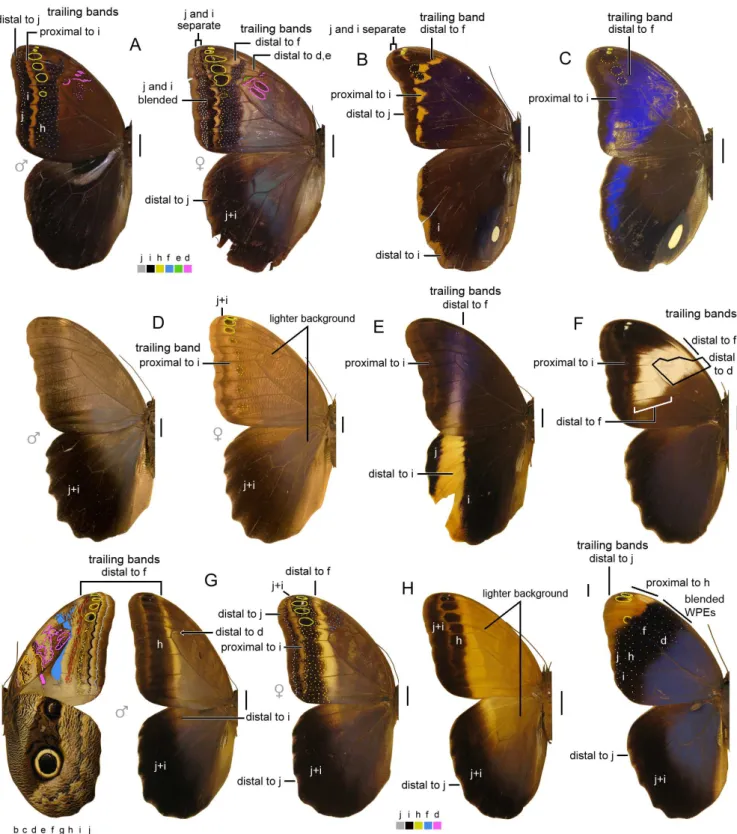
In most brassoline species, males and females are only mildly dimorphic in their dorsal colors, and have similar wing shape (Table 2). Mild color dimorphism results from females having more clearly defined dorsal pattern elements and / or trailing bands than males. For example, in some Caligo (e.g., C. oileus; Figures 6G, 9E) both the dorsal pattern elements and trailing bands are more visible in females. The slight iridescence of some female Opoptera (Figure 9B) and Catoblepia (not illustrated), or slightly wider and paler trailing bands of Opsiphanes (Figure 9L) can also be considered mild color dimorphism.
There are instances in which dorsal colors and wing shape are clearly different between the sexes (Table 2). The genus Bia is an interesting case in which obvious sexual differences can occur on both the dorsal and ventral wing surfaces. The DFW orange trailing band and iridescent patch are positioned more distally in the males, and females have a less intense, but larger iridescent patch extending through the discal cell in the medial area of the wing (Figure 9A; male iridescence may be absent in some forms). In some locations, the female VFW has reduced ripple patterns distal to element f such that the distal portion of the hind wing has a predominantly yellow appearance (not illustrated). Within Narope, N. guilhermei Casagrande, 1989 (not illustrated) is the most notable for color differences between the sexes, but males and females differ in wing shape in all species. Sexual dimorphism in Dasyophthalma results from differences in the DFW trailing band distal to f that is present in females only, and also the larger, more intense iridescent patches in males of two species (Figures 5F, 9C). In some Eryphanis, males are much more intensely iridescent than females (Figure 9G). Differences in wing shape plus the colors and width of trailing bands produces strong sexual dimorphism in Mielkella singularis (Figure 9K).
In a few cases, strong sexual dimorphism is intertwined with dorsal color convergence across genera. Female Catoblepia orgetorix orgetorix, C. orgetorix magnalis Stichel, 1902 and C. orgetorix championi Bristow, 1981 (Figure 9H), and both sexes of C. orgetorix rothschildi Casagrande & Lamas, 2004, resemble Caligo atreus (Kollar, 1850) and depart strongly from the typical Catoblepia phenotype (Figure 9I). This resemblance to C. atreus can be achieved with few phenotypic modifications: (1) all dorsal female trailing bands become lighter in color, (2) the DFW trailing bands are amalgamated and positioned closer to the medial area of the wing, (3) a patch of iridescent scales is superimposed onto the DFW trailing band, and (4) the DHW trailing band becomes wider, reaching the wing edge. The monomorphic Opoptera staudingeri differs from close relatives in the aorsa-group by lacking hind wing tails and in the continuous, relatively wide DFW and DHW trailing bands. Such modifications yield a resemblance to species of Catoblepia (compare Figure 9J and H). Finally, due to their dorsal iridescence, Caligopsis seleucida females (Figure 9D) more closely resemble some Caligo (Figure 9F) than the conspecific male.
Discussion
This study represents the first comprehensive examination of color pattern diversity in the tribe Brassolini. Here we describe the expression of pattern elements across all genera, and propose a subordinate groundplan for the tribe (Figure 8A). Much variation was found on the ventral forewing surface, with the number of visible pattern elements ranging from one to nine. Except for Penetes, ripple
patterns were prevalent on the ventral hind wing and expressed to a lesser extent on the ventral forewing, varying from sharply striated, to blurry, or granular. On the dorsal wing surface pattern elements are broader and more diffuse than on the ventral surface (bold, sensu Nijhout & Wray 1986), and are often amalgamated. Furthermore, fewer pattern elements are identifiable on the dorsal than on the ventral surface (Figure 8A). The dorsal forewing typically includes f, h, i and j, but e and d are sometimes visible. The dorsal hind wing lacks most pattern elements, usually displaying only i and j. We hypothesize that the dorsal white, yellow or orange trailing bands might be associated with particular pattern elements, and they constitute an important feature of the brassoline groundplan. Finally, iridescent bands do not correspond to NGP elements, but may be superimposed onto them. The presence and intensity of iridescence is quite variable, appearing in different areas of the wing, and evolving independently in four separate Brassolini lineages (sensu Penz 2007) when optimized onto the tree using parsimony (Bia-clade, Opoptera -clade, Caligo-clade and Opsiphanes-clade; Figure 8B).
The dorsal and ventral wing surfaces of brassolines differ in the number of identifiable pattern elements, and occasionally in their background color. Similar to what Nijhout & Wray (1986) described for Charaxes (Charaxinae, sister to Satyrinae which includes Brassolini; Wahlberg et al. 2009), brassoline ventral pattern elements are narrower, better defined and easier to identify than the dorsal ones, which are broad and sometimes diffuse. While dorsal and ventral surfaces contain the same set of pattern elements in Charaxes (Nijhout & Wray 1986, p.400), we hypothesize that in most brassolines fewer elements are present dorsally, particularly on the hind wing (Figure 8A). This hypothesis is based on an inter-related series of comparative observations. First, the yellow or orange dorsal wing background color of some species markedly differs from the typical brown. This greatly facilitated the identification of pattern elements that were present, and also revealed that some were absent (e.g., Narope cyllastros Doubleday, 1849, Figure 5D; Opsiphanes boisduvallii, Figure 7J). Second, only distal pattern elements could be identified in several species that have pale brown dorsal background (e.g., Opoptera syme, Figure 5A; Caligopsis seleucida, Figure 6A; Caligo oileus, Figure 6G). Third, in some species the distal half of the wings is darker than the proximal half, suggesting that distal pattern elements are bold/amalgamated as in Charaxes (Nijhout & Wray 1986), while proximal ones are not expressed (e.g., Brassolis, Figure 5C; Opsiphanes sallei Doubleday, 1849; Figure 7H). As an alternative hypothesis, it may be that the dorsal background color changes as a gradient across the wing as in C. eurilochus (Figure 6D). However, the dorsal pattern of C. eurilochus seems to constitute a dull version of C. arisbe Hübner, 1822 (Figure 6H), where the yellow background highlights the same dorsal elements also present in C. eurilochus, especially the female.
171
Brassolini wing color patterns Biota Neotrop., vol. 13, no. 3
ventral background color in O. boisduvallii may have a simple genetic control.
Within Brassolini, the expression of border oceli (h) varies between the forewing and hind wing, and between the antero-posterior axis and dorso-ventral surfaces of each wing. The ventral forewing element h typically appears as a series of distinctive light colored spots and / or complex oceli anterior to vein M2, and is either absent or composed of brown spots, blotches, diamonds or lines posterior to that vein. As an exception, a complex ocelus posterior to M2 is only found on the ventral surface of Dynastor and Caligopsis + Eryphanis, representing a developmental parallel given that these genera belong to two separate clades (Penz 2007; Figure 8B). The antero-posterior modifications of h support the proposal that reduced covariance and genetic correlations between wing cells allow differential expression of serial homologues (Paulsen 1994; Nijhout 1994, 2001; but see also Monteiro et al. 1997, Monteiro 2008). Although diffuse and subdued, the ventral forewing expression of element h is mirrored on the dorsal forewing. In contrast, the prominent ventral hind wing oceli lack dorsal homologues, thus demonstrating dorso-ventral independence of pattern formation.
We observed considerable variation in the number and size of the ventral hind wing oceli and their putative interaction with adjacent pattern elements or other color components. In the majority of brassolines, the ventral hind wing oceli located below veins Sc+R1 and Cu1 (anterior and posterior oceli) are the largest and most complex, while those in other cells are smaller, simpler, vestigial, or absent. The absence of oceli below veins M3 and Cu2 seems to have preceded and facilitated the increase in size of the posterior ocelus in several taxa, Caligo being the most obvious example (Figure 3A, B, C). Furthermore, differences in the organization of the posterior ocelus suggest independent evolution of increased size. For instance, in some species the dark ocelar center crosses veins M3 and Cu2 (e.g., Caligo atreus, Figure 3B), while in others the outermost ring only expands cell boundaries (e.g., Catoblepia orgetorix, Figure 4A). The unique fusion of posterior oceli in the sister genera Caligopsis and Eryphanis is also noteworthy because it shows that serial homologues can interact to form novel designs (see Nijhout 2001 for several examples of such interaction). Finally, the posterior ocelus is contained inside cell cu1 in Bia, Narope, Brassolis and Dynastor, early lineages in the Brassolini phylogeny (Penz 2007; Figure 8B). Although a larger posterior ocelus seems to have evolved at the ancestor of the Opoptera + Caligo + Opsiphanes-clades (Figure 8B), this character is not homogeneous between or within the 12 genera in these lineages (compare Figure 2E and F plus Figure 4A and B) and variation is size is continuous.
The ventral hind wing of several species in the Caligo-clade combines a ripple-free, dark medial area with a large posterior ocelus; intriguing from both developmental and ecological perspectives. If the ripple pattern is determined before the NGP pattern elements (Nijhout 1991, 2001), a ripple-free “window” can only be produced if ripple pattern expression is blocked at that specific site early in pattern development (see Figures 2C, E, F; 3C). The large ventral hind wing oceli of Caligo are quite obvious when these butterflies feed on the ground or rest on vertical tree trunks (pers. obs.), and the ripple-free medial area enhances visibility of the oceli. There are two main hypotheses for the evolution of conspicuous oceli in Lepidoptera (reviewed in Stevens 2005): they can be used as a deflection point (target) that directs predator attacks to non-essential body parts, or function as a startling display. In support of the deflection hypothesis, it has been demonstrated that the posterior hind wing tornus is more noticeable yet structurally weaker than the surrounding areas in a sample of African species (DeVries 2002, 2003) and South American Pierella astyoche (Erichson, 1849) (Nymphalidae, Satyrinae; Hill
& Vaca 2004). Although untested, Stradling (1976) hyothesized that in some Eryphanis and Caligo the posterior ocelus plus a dark band across the wing look like a reptile in profile to function as a startle display.
Field experiments and observations demonstrated that ventral oceli play a role in mate selection. Choice trials showed that male Lycaeides idas (Linnaeus, 1761) (Lycaenidae) selected females based on the size of their ventral hind wing aurorae and spots (Fordyce et al. 2002), and male and female Bicyclus anynana show a seasonal preference for ocelus size (Prudic et al. 2011). During courtship, male Pierella astyoche hover by decoupling forewing from hind wing movement, and clearly display the large hind wing white spots to the potential mate (CMP pers. obs.), an additional function to anti-predator defense (see above). Male Caligo form mating leks at forest edges (Freitas et al. 1997, Srygley & Penz 1999). Upon arrival at the lek site, female C. illioneus (Cramer, 1775) appear to detect perched males visually (CMP pers. obs.). When approached, males take off and initiate aerial courtship behavior. It therefore seems possible that the ventral hind wing oceli of Caligo play a role in mate location, and also function as a startle display in both sexes. Given the diversity in size, color and number of oceli in brassolines, we might expect that oceli may serve multiple purposes.
Brassolines defy classical definitions of Batesian and Müllerian mimicry. There are examples of color resemblance among genera, but there is no evidence of chemical protection (see Chai 1990). The most notable case involves the convergence of Catoblepia orgetorix onto Caligo atreus with which it overlaps geographically (Figure 9H, I). Four lines of evidence support this assertion: (1) the dorsal phenotype of orgetorix departs from the typical Catoblepia; (2) ventral hind wing oceli are the largest in the genus, and resemble Caligo; (3) convergence is limited to females in the subspecies orgetorix, championi and magnalis, fitting the expectations of sex-limited mimicry (Turner 1984, Silberglied 1984) and appearing to be the ancestral condition; and (4) both sexes of C. orgetorix rothschildi (endemic to the Magdalena Valley, Colombia) have the mimetic phenotype, suggesting that evolution of male color convergence followed that of the female. If Caligo and Catoblepia lack chemical defenses, then the resemblance could potentially be explained by an “arithmetic” effect (safety in numbers; Vane-Wright 1976, after Van Someren & Jackson 1959). Whether the similarity among these species confers a fitness-related advantage is unknown, and fieldwork is needed to assess if predators recognize and avoid them. The resemblance between Opoptera staudingeri and Catoblepia orgetorix (Figure 9J and H), and some geographical races of Brassolis sophorae (Linnaeus, 1758) and Selenophanes cassiope (Figures 5C and 6G) also catch the eye, but remain inexplicable. These examples demonstrate that remarkable similarity can be accomplished with relatively few modifications of the trailing bands (color, width, position) and the addition of iridescence (see Results).