Choice of common bean parents based on combining ability estimates
Cristina de Fátima Machado, João Bosco dos Santos, Glauber Henrique de Sousa Nunes
and Magno Antonio Patto Ramalho
Departamento de Biologia, Universidade Federal de Lavras, Lavras, MG, Brazil.
Abstract
The obtention of genetically improved cultivars is the main objective of breeding programs, whose efficiency is increased by a careful choice of parents. Based on both general (GCA) and specific (SCA) combining abilities for grain yield, the purpose of this research was to choose the most promising populations of common beans, for line selection. GCA and SCA were measured by means of a complete diallel without reciprocals, using twelve cultivars/lines. Parents and corresponding F2segregating populations were evaluated for grain yield by a 9 x 9 triple
square lattice design. It was found that the segregating populations differed in grain yield, with predominant SCA effects, but with significant GCA effects as well. Among the populations derived from parents with positive GCA values, Aporé x CI-128, CI-128 x Pérola, PF-9029975 x Ouro Negro, and CI-128 x Ouro Negro also showed positive SCA values and high grain yields, therefore being the most promising populations for grain yield improvement. The highest values of specific combining ability were observed in populations H-4-7 x ESAL 693, CI-128 x Pérola, and A-285 Rudá x IAC Carioca Aruã, which must be the most segregating ones. Hybrid combinations with a high SCA deriving from at least one parent with high GCA were: Pérola x CI-128 and Ouro Negro x Pérola. Although line ESAL 693 presented the lowest GCA value, one of its derived populations, ESAL 693 x H-4-7, had the highest SCA and heterosis values. The high correlation between heterosis and SCA indicates that heterosis can be useful when SCA is not available.
Key words: Phaseolus vulgaris, specific and general combining ability, diallel.
Received: March 5, 2002; accepted: April 26, 2002.
Introduction
Increase in yield potential of common bean (Phaseolus vulgaris) cultivars has been small, in spite of large variation of most traits, including grain yield. There-fore, the obtention of genetically improved cultivars is the main objective of breeding programs, which have their effi-ciency increased by a careful choice of parents. One of the most commonly used methodologies for choosing parents is diallel cross, which informs about the parents’ potential when in hybrid combinations, and also about gene action involved in determining quantitative traits (Cruz and Vencovsky, 1989; Ramalhoet al., 1993). Griffing’s (1956) diallel analysis procedure is among the most useful ones, especially its method IV, which only considers the hybrid performance, and allows to estimate both exact SCA and GCA.
As GCA depends predominantly on additive effects of the genes, it informs about the potential of the segregat-ing populations for selection of high grain yield lines
(Ramalhoet al., 1993). It has been the parameter employed to choose promising segregating populations, which should have the highest averages. As for SCA, which depends pre-dominantly on non-additive effects of the genes, it allows to identify populations which are potentially more useful to liberate variability in the segregating generations (Veigaet al., 1998).
The purpose of this research was to choose the most promising common bean populations for selection of lines, based on general and specific combining abilities for grain yield, and to verify the association between specific com-bining ability and heterosis.
Material and Methods
This study was carried out on the experimental field of the Biology Department of the Federal University of Lavras (UFLA), located in the southern region of the State of Minas Gerais, Brazil, at an altitude of 910 m, 21°45’S latitude, and 45°00’W longitude. The soil in the experimen-tal area is classified as dystrophic dark red latosol, cerrado phase.
www.sbg.org.br
Material
Cultivars and lines used are listed in Table I. They were crossed according to the complete diallel scheme without reciprocals (Griffing, 1956). The crosses were done as suggested by Ramalhoet al.(1993).
Experimental procedures
Parents and F2 segregating populations were
evalu-ated by means of a 9 x 9 triple lattice design. Each plot con-sisted of two two-meter-long rows, 50 cm apart, with 15 seeds sown per linear meter. Controls CII-244, CII-348, IAPAR-81, LH-9, Carioca, B1 and LH-11 were included. The equivalent of 400 kg/ha of the formula 4-14-8 (N, P2O5
and K2O, respectively) was used as a fertilizer during
sow-ing, and 150 kg/ha of ammonium sulfate were applied 20 days after emergence. The field was irrigated by aspersion when necessary. Grain yield was determined for each plot and expressed as kg/ha.
Genetic and statistical analysis
Grain yield of segregating populations, parents and controls was analyzed according to the statistical model Yijw= u + ti+ rj+ bw(j)+ eijw, where Yijwis the grain yield of
treatment “i” in block “w” within replication “j”; u is the general mean of the treatments; tiis the fixed effect of
treat-ment i (i = 1, ... 81); rjis the random effect of replication “j”
(j = 1, ...3); bw(j)is the random effect of block “w” within
replication “j” (w = 1, ...9), and eijwis the error effect of the
plot that received treatment “i”, in block “w”, within repli-cation “j”, and ~N (0,σ2
).
The sum of squares of the segregating populations, estimated from the adjusted means of previous variance
analysis, was decomposed in the diallel analysis, according to method IV (Griffing, 1956), using the model Yij= m + gi
+ gj+ sij+ eij, where Yij is the mean value of hybrid ij (i,
j = 1,2, ...p, i < j); m is the general mean of the segregating populations; giand gjare the general combining ability
ef-fects of the ithand jthparents, respectively; sijis the specific
combining ability effect of the ijthcross, and eijis the error
associated with the ijthobservation.
Since it was not possible to obtain four of the 66 hy-brid combinations, the least square method (Vencovsky and Barriga, 1992) was used to estimate the parameters of the model, and Searle’s (1976) parametric restriction
n gi i
i 1
= =
∑
φ12
(niis the number of crosses involving each
par-ent) to solve the generalized inverse matrix.
The variance estimate of the general combining abil-ity was obtained using the diagonal of the augmented ma-trix (X’X)-1multiplied by the mean square of the effective error of the variance analysis, divided by the number of data that originated the average.
Heterosis was estimated by the expression:
hij(%)=
− −
+
2F2 P P
P P
i j
i j
, wherehij is the average heterosis
of the F2population obtained from the cross of i and j
par-ents, F2is the mean grain yield of the F2population, and, Pi
and Pjare the corresponding means of parents i and j,
re-spectively.
The rank correlation between heterosis and SCA was estimated.
Results and Discussion
The variance analysis of grain yield indicated a sig-nificant genetic difference between treatments at the
proba-Table I- Origin, genealogy, growth habit, coat color and 100-seeds-weight of 12 common bean cultivars/lines.
Cultivars origin Genealogy2/ Growth habit1/ Coat color 100-seeds weight (g)
1-Aporé CNPAF (Carioca/Mexico168)//(Cari-oca/Bat76)
III Beige with brown stripes 27
2-H-4-7 UFLA (EMGOPA 201 Ouro/Carioca) III Beige with brown stripes 21
3-PF -9029975 CNPAF (Carioca80/Rio Tibagi) II Beige with brown stripes 17
4-CI - 128 UFLA Recurrent selection III Beige with brown stripes 25
5-Carioca - MG UFLA (Carioca 80/Rio Tibagi) II Beige with brown stripes 18
6-CI - 21 UFLA Recurrent selection III Beige with brown stripes 22
7-Carioca 300 V UFLA Selection in Carioca III Beige with brown stripes 22
8-Ouro Negro CIAT Introduction of Honduras III Black 24
9-A-285 Rudá CIAT (Carioca/Rio Tibagi) II Beige with brown stripes 16
10-ESAL 693 UFLA (Carioca TU/Line 3272) I Beige with brown stripes 19
11-Pérola CNPAF Selection in Aporé II/III Beige with brown stripes 23
12-IAC Carioca Aruã IAC (Cornell 49-242/AB-136) II/III Beige with brown stripes 25
2/: single cross; //: double cross.
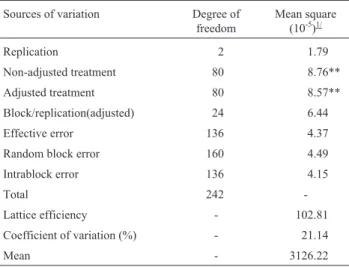
bility level of 1% (Table II). The lattice showed little efficiency due to the reduced and uniform experimental area. Experimental precision, measured by the variation co-efficient, was adequate, because it fell among the values usually obtained for this trait in common bean experiments (Ramalhoet al., 1993 and Abreu, 1997).
The decomposition of the sum of squares of popula-tions in the general (GCA) and specific (SCA) combining abilities is presented in Table III. For GCA, the mean square was significant at the 5% level of probability, whereas for SCA, it was significant at 1%. According to these results, the genetic quadratic component of SCA is about four times higher than the component of GCA, and both can be approximately estimated from the mean squares (Table III). A possible explanation for the superior-ity of SCA is that the cultivars/lines studied were selected by previous assays. There are indications that, by adopting this procedure, the genetic variance for additive effects (GCA) is reduced, increasing the relative importance of the non-additive genetic effects (Sprague and Tatum, 1942; Lonquist and Gardner, 1961; Allard, 1971; and Vencovsky, 1980). Using adapted and non-adapted common bean cultivars with a wide genetic variation, Abreu (1997) ob-served that, both for GCA and SCA, there were significant effects of similar magnitude.
According to Griffing (1956), parents which present the highest GCA estimates should generate a population with a higher mean yield. However, in the process of choos-ing parents, the highest GCA alone is not sufficient for this choice, since, if the parents are genetically similar, the pop-ulation will present a restricted variability, reducing the chances to select improved lines. On the other hand, SCA measures the degree of allelic complementation. Therefore, a SCA with a higher and positive magnitude, as compared to GCA, indicates that there are crosses likely to liberate greater variability than others. Thus, the results of the
diallel regarding grain yield suggest that this cross scheme should be efficient in choosing the more promising segre-gating populations, that is, those with high SCA values, coming from parents with the highest magnitudes of GCA.
In ongoing breeding programs, previously selected superior lines and the best cultivars already in use are usu-ally interbred (Fehr, 1987). However, the problem of this practice is the increasing degree of parentage among the su-perior parents used. The consequence of the crossing of these related parents is the generation of segregating popu-lations with a reduced variability.
In the current study, the parents are from the Carioca group, all are represented by selected lines and cultivars used by the farms, with the exception of the Ouro Negro cultivar of black seeds. Thus it is possible that their degree of parentage is high. Consequently, this is the situation in which the choice of parents or of the more promising segre-gating populations should ensure a more successful pro-gram.
The estimates of general combining ability (gi) for
each parental line/cultivar are found in Table IV. gi
esti-mates close to zero indicate that the cultivar/line does not differ from the general mean of all crosses. On the other hand, positive or negative estimates indicate that the re-spective parent is better or worse than the other culti-vars/lines included in the diallel, as compared to the mean yield of the crosses (Griffing, 1956; Vencovsky, 1969). Those values correspond to the frequency of favorable or unfavorable alleles of the parents with additive effects for grain yield. Consequently, parents with higher gi values
should generate a segregating population with the highest mean yield, from which better lines can be selected.
The positive givalues presented by Aporé, PF-90975,
CI128, Ouro Negro and Pérola indicate that they are ideal for the generation of populations with a high grain yield (Table IV). On the other hand, the ESAL 693 line showed the highest negative estimate of gi, differing from the
high-est positive value by approximately 5.2 times the standard deviation of gi. The low yield potential of this line was
al-ready expected, since it is the only line with type I growth habit, the others being type II or III (Table I).
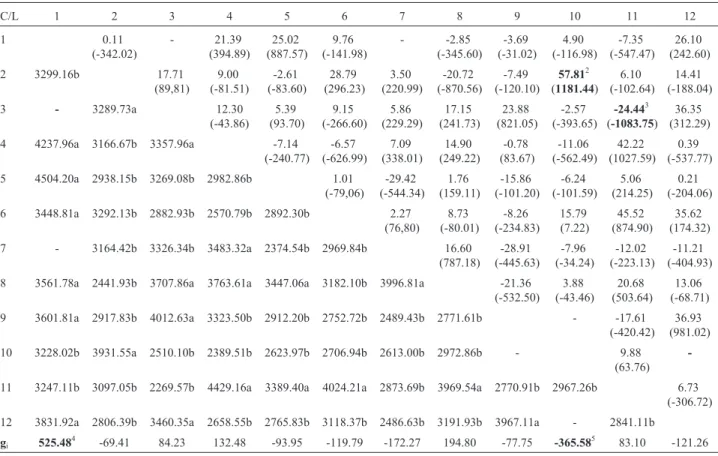
Table IV also presents estimates of the specific com-bining ability (sij) of the 62 populations. Low sijvalues
indi-cate that the respective populations exhibited the grain
Table II- Variance analysis of grain yield (kg/ha) of parents, controls and F2populations.
Sources of variation Degree of freedom
Mean square (10-5)1/
Replication 2 1.79
Non-adjusted treatment 80 8.76**
Adjusted treatment 80 8.57**
Block/replication(adjusted) 24 6.44
Effective error 136 4.37
Random block error 160 4.49
Intrablock error 136 4.15
Total 242
-Lattice efficiency - 102.81
Coefficient of variation (%) - 21.14
Mean - 3126.22
1/**: significant at 1% level of probability in the F test.
Table III- Variance analysis with decomposition of population effects in general and specific combining abilities, related to grain yield (kg/ha).
Sources of variation Degree of freedom Mean square(10-5)1/
Populations 61 2.84**
GCA 11 4.23*
SCA 50 2.53**
Error 122 1.46
1/* and ** : significant at the 5% and 1% levels of probability,
yield predicted by their parents’ general combining abili-ties. However, positive or negative sijvalues indicate that
the grain yield of a particular cross is respectively better or worse than expected, based on the parental GCA (Griffing, 1956).
Out of the F2populations deriving from parents with
positive gi values, Aporé x CI-128, CI-128 x Pérola,
PF-9029975 x Ouro Negro and CI-128 x Ouro Negro also exhibited positive sijvalues and high grain yield, therefore
being the most promising ones for line selection. It should stressed that the first two populations stand out not only for their higher yield, but also for having Carioca type grains, which significantly facilitates the selection of lines with a grain type that is well accepted by the consumers. It was also observed that the highest mean yields were presented by populations of which at least one of the parents showed positive GCA (Table IV).
It is important to mention that even within a group of non-adapted cultivars/lines there are some combinations that supplement themselves, such as H-4-7 x ESAL 693,
285 Rudá x IAC Carioca Aruã, and PF-9029975 x IAC Carioca Aruã. They displayed grain yield, sijand heterosis
of great magnitudes (Table IV), although the general com-bining abilities of their parents were negative, except for line PF-9029975. It is worth pointing out, however, that there is a possibility of grain yield variability liberation in these populations, which can be exploited for the selection of superior lines.
Heterosis (hij) estimates (Table IV), were coherent
with the SCA estimates,i.e., hybrid combinations with high SCA values presented high values of heterosis, as indicated by the rank correlation between those variables (r = 0.71**). This association suggests that heterosis can be used for the choice of potentially more segregating popula-tions in situapopula-tions where SCA cannot be estimated.
Conclusions
1. Differences in grain yield of the F2 populations
could be mainly explained by specific combining ability,
Table IV- Estimates of heterosis (%), specific combining ability sij(between parentheses, above the diagonal), mean grain yield (kg/ha) (below the
diagonal), and general combining ability (gi).
C/L 1 2 3 4 5 6 7 8 9 10 11 12
1 0.11 (-342.02) - 21.39 (394.89) 25.02 (887.57) 9.76 (-141.98) - -2.85 (-345.60) -3.69 (-31.02) 4.90 (-116.98) -7.35 (-547.47) 26.10 (242.60)
2 3299.16b 17.71
(89,81) 9.00 (-81.51) -2.61 (-83.60) 28.79 (296.23) 3.50 (220.99) -20.72 (-870.56) -7.49 (-120.10) 57.812
(1181.44) 6.10 (-102.64)
14.41 (-188.04)
3 - 3289.73a 12.30
(-43.86) 5.39 (93.70) 9.15 (-266.60) 5.86 (229.29) 17.15 (241.73) 23.88 (821.05) -2.57 (-393.65) -24.443
(-1083.75) 36.35 (312.29)
4 4237.96a 3166.67b 3357.96a -7.14 (-240.77) -6.57 (-626.99) 7.09 (338.01) 14.90 (249.22) -0.78 (83.67) -11.06 (-562.49) 42.22 (1027.59) 0.39 (-537.77)
5 4504.20a 2938.15b 3269.08b 2982.86b 1.01 (-79,06) -29.42 (-544.34) 1.76 (159.11) -15.86 (-101.20) -6.24 (-101.59) 5.06 (214.25) 0.21 (-204.06)
6 3448.81a 3292.13b 2882.93b 2570.79b 2892.30b 2.27 (76,80) 8.73 (-80.01) -8.26 (-234.83) 15.79 (7.22) 45.52 (874.90) 35.62 (174.32)
7 - 3164.42b 3326.34b 3483.32a 2374.54b 2969.84b 16.60 (787.18) -28.91 (-445.63) -7.96 (-34.24) -12.02 (-223.13) -11.21 (-404.93)
8 3561.78a 2441.93b 3707.86a 3763.61a 3447.06a 3182.10b 3996.81a -21.36 (-532.50) 3.88 (-43.46) 20.68 (503.64) 13.06 (-68.71)
9 3601.81a 2917.83b 4012.63a 3323.50b 2912.20b 2752.72b 2489.43b 2771.61b - -17.61 (-420.42)
36.93 (981.02)
10 3228.02b 3931.55a 2510.10b 2389.51b 2623.97b 2706.94b 2613.00b 2972.86b - 9.88 (63.76)
-11 3247.11b 3097.05b 2269.57b 4429.16a 3389.40a 4024.21a 2873.69b 3969.54a 2770.91b 2967.26b 6.73 (-306.72)
12 3831.92a 2806.39b 3460.35a 2658.55b 2765.83b 3118.37b 2486.63b 3191.93b 3967.11a - 2841.11b
gi 525.48 4
-69.41 84.23 132.48 -93.95 -119.79 -172.27 194.80 -77.75 -365.585 83.10 -121.26
1/: Means followed by the same letter in the column did not differ at the 10% level of probability in the Scott-Knott test.
C/L: cultivars/lines (1- Aporé, 2- H-4-7, 3- PF-9029975, 4- CI-128, 5- Carioca MG, 6- CI-21, 7- Carioca 300V, 8- Ouro Negro, 9- A-285 Rudá, 10- ESAL 693, 11- Pérola, 12- IAC Carioca Aruã).
2/: F
2populations with highest heterosis and SCA values. 3/
: F2populations with lowest heterosis and SCA values. 4/: cultivar with highest GCA value.
5/
: line with lowest GCA value.
which constitutes an efficient predictor of population vari-ability;
2. Among populations derived from parents with pos-itive gi values, Aporé x CI-128, CI-128 x Pérola,
PF-9029975 x Ouro Negro, and CI-128 x Ouro Negro also exhibited positive sijvalues and high grain yields, therefore
being the most promising ones for the selection of lines. 3. The significant positive correlation between SCA and heterosis indicates that both estimates are useful to pre-dict potentially more segregating populations.
Acknowledgments
Research supported by CNPq and FAPEMIG.
References
Abreu A de FB (1997) Predição do potencial genético de popu-lações segregantes do feijoeiro utilizando genitores inter-raciais. Doctoral thesis, Universidade Federal de Lavras, Lavras, MG.
Allard RW (1971) Princípios de melhoramento genético das plan-tas. Editora Edgard Blucher, São Paulo. pp 381.
Cruz CD and Vencovsky, R (1989) Comparação de alguns méto-dos de análise dialélica. Revista Brasileira de Genética 12:425-438.
Falconer DS (1987) Introdução à genética quantitativa. Viçosa: UFV, Imprensa Universitária, pp 279.
Fehr WR (1987) Principles of cultivar development. New York: MacMillan. pp 536.
Griffing JB (1956) Concept of general and specific combining ability in relation to diallel systems. Australian Journal of Biological Science 9:463-493.
Lonquist JH and Gardner CO (1961). Heterosis in inter-varietal crosses in maize and its implication in breeding procedure. Crop Science 1:179-183.
Ramalho MAP, Santos JB dos, and Zimmermann MJO (1993) Genética quantitativa em plantas autógamas: aplicações no melhoramento do feijoeiro, Goiânia: UFV, pp 271. Searle SR (1976). Linear models for unbalanced data. New York:
Wiley, pp 536.
Sprague GF, and Tatum LA (1942) General vs specific combining ability in single crosses of corn. Journal American Society Agronomy 34:923-932.
Veiga RD, Nunes GHS, and Santos JB dos. (1998) Associação de parâmetros do dialelo com a variabilidade de populações segregantes avaliada por simulação. In: Encontro Mineiro de Geneticistas 5, Sociedade Brasileira de Genética Re-gional Minas Gerais, Viçosa, pp 65.
Vencovsky R (1969) Genética quantitativa. In: Kerr WE (org.) Melhoramento e genética. São Paulo: Melhoramento, pp17-38.
Vencovsky R (1980) Herança quantitativa. In: Paterniani E e Veigas, G. Melhoramento e produção de milho no Brasil. 2.ed. Campinas: Fundação Cargill, ESALQ, Piracicaba, pp122-199.