RESEARCH ARTICLE / ARTIGO
Development of classification criteria for resistance to
soybean rust and differences in virulence among Japanese
and Brazilian rust populations
Naoki Yamanaka1, Yuichi Yamaoka2, Masayasu Kato1*, Noelle G. Lemos1, André L. de L. Passianotto3, João
V.M. dos Santos3, Eduardo R. Benitez4, Ricardo V. Abdelnoor3, Rafael M. Soares3 & Kazuhiro Suenaga1
1Japan International Research Center for Agricultural Sciences - JIRCAS, 1-1, Ohwashi, Tsukuba, Ibaraki, 305-8686, Japan;
2Graduate School of Life and Environmental Sciences, University of Tsukuba, 1-1-1 Tennodai, Tsukuba, Ibaraki, 305–8572,
Japan; 3Embrapa Soja, 86001-970, Londrina PR, Brazil; 4National Institute of Crop Science - NICS, 2-1-18 Kannondai, Tsukuba, Ibaraki, 305-8518, Japan
Author for correspondence: N. Yamanaka, e-mail: [email protected]
*Present address: National Agricultural Research Center - NARC, 3-1-1 Kannondai, Tsukuba, Ibaraki, 305-8666, Japan
ABSTRACT
In recent years soybean rust, caused by Phakopsora pachyrhizi has become one of the most serious threats to soybean production in Brazil. Breeding lines and varieties have been selected for resistance to soybean rust in Asia. However, differences in virulence between Asian and Brazilian rust populations should be considered in order to select and use resistant resources from Asia. Here, we suggest criteria for distinguishing resistant from susceptible types by the analysis of four resistance characters: frequency of lesions having uredinia, number of uredinia per lesion, frequency of open uredinia, and sporulation level, determined by the utilization of 63 genotypes. Under growth chamber conditions, a set of 13 soybean varieties were exposed to three rust populations—one from Japan and two from Brazil— and evaluated for the resistance characters mentioned above. The Japanese and Brazilian populations clearly differed in virulence, as did the two Brazilian populations. Only two resistance genes, Rpp4 from PI459025 and Rpp5 from Shiranui, commonly conferred resistance on all three rust populations. The number of resistant varieties or resistance genes useful in both countries appears limited. Therefore, a resistant cultivar that is universally effective against soybean rust should be developed by pyramiding some major resistance genes and by introducing horizontal resistance.
Keywords: Phakopsora pachyrhizi, lesion type, pathogenicity, resistant variety. RESUMO
Desenvolvimento de critério de classificação da resistência à ferrugem asiática da soja e diferenças de virulência entre populações do Japão e do Brasil
Nos últimos anos a ferrugem asiática, causada pelo fungo Phakopsora pachyrhizi tornou-se uma das mais sérias ameaças a produção de soja Brasileira. Linhagens melhoradas e variedades têm sido selecionadas para a resistência à ferrugem da soja na Ásia, entretanto para a seleção e utilização dessas fontes de resistência, diferenças de virulência entre populações Asiáticas e Brasileiras desse fungo devem ser consideradas. Neste trabalho sugerimos um critério para se distinguir resistência de susceptibilidade pela análise de quatro caracteres de resistência: freqüência de lesões contendo urédias, número de urédias por lesão, freqüência de urédias abertas e nível de esporulação determinados pela utilização de 63 genótipos. Sob condições controladas em câmaras de crescimento, treze variedades de soja foram expostas a três populações de fungos— uma populaçãoproveniente do Japão e duas populaçõesprovenientes do Brasil—e avaliadas quanto aos caracteres de resistência mencionados acima. As populaçõesBrasileiras diferiram entre si claramente quanto a virulência e em relação à população de isolados do Japão. Apenas dois genes de resistência, Rpp4 presente na variedade PI459025 e Rpp5
presente na variedade Shiranui conferiram resistência as três populaçõesda ferrugem. O número de variedades ou genes resistentes úteis em ambos os países parece ser limitado. Assim, um cultivar universalmente efetivo contra a ferrugem da soja deveria ser desenvolvido pela piramidação de genes maiores de resistência e pela introdução de resistência horizontal.
Palavras-chave: Phakopsora pachyrhizi, tipo de lesão, patogenicidade, variedade resistente.
INTRODUCTION
Soybean rust, caused by Phakopsora pachyrhizi Syd. & P. Syd., has been observed in Japan for more than 100
reduce the soybean yield by more than 75 % (Navarro et al., 2004; Ivancovich, 2005; Yorinori et al., 2005).
The development of resistant varieties is an efficient way to manage soybean rust. Five major resistance genes—
Rpp1, Rpp2, Rpp3, Rpp4, and Rpp5— have been identified
in Asian soybean varieties (Hartwig & Bromfield, 1983; Hartwig, 1986; Garcia et al., 2008; Pierozzi et al., 2008). Most of the major resistance genes are considered race-specific (Bromfield & Hartwig, 1980, 1983; Bromfield, 1984; Hartwig, 1986) and the pathogen of soybean rust presents high race variability (Yamaoka et al., 2002; Oliveira et al., 2005). Thus, although many breeding lines and cultivars have been selected for resistance to soybean rust in Asia, they cannot be utilized without knowledge of the differences in virulence between South American and Asian rust populations. In order to use these resistant materials from Asia in the Brazilian breeding program, we need to determine the differences in virulence between Asian and South American rust populations by using a single, comprehensive method of virulence evaluation.
The “lesion type” classification, based on lesion color and the number of sporulating uredinia, has been used to identify the virulence of soybean rust isolates (Bromfield, 1984). However, lesion color can vary a lot and some resistant lesions that do not sporulate can be found in tan-colored lesions. In addition, continuous variation of lesion color among varieties makes it difficult to group all phenotypes into a limited number of lesion types, such as RB (Resistant) and TAN (Susceptible) (Kato & Yorinori, 2008). On the other hand, lesion color is known to be controlled by resistance genes. For example, quantitative trait locus (QTL) analysis of lesion color in 120 F2 plants revealed that major resistance genes, Rpp2
from PI230970 and Rpp4 from PI459025, can genetically contribute to the darkening of lesion color under greenhouse conditions (Yamanaka et al., 2008). Thus, lesion color should also be considered when selecting resistant genotypes. Bonde et al. (2006) suggested that the number and size of uredinia are desirable indexes for detecting resistance derived from major genes and also partial resistance to soybean rust. These indexes are represented by numerical values and are considered more suitable than the index based on lesion color for deciding resistance because of their objectivity.
To choose appropriate traits that would enable us to classify levels of soybean rust resistance in soybean cultivars, we investigated five traits related to resistance in 63 genotypes infected with a Japanese rust population. We also investigated the application of these traits to the determination of differences in virulence among three rust populations collected in Japan and Brazil during 2007 and 2008.
MATERIALS AND METHODS
Japanese and Brazilian rust populations
In this study, we used non-purified isolates derived from single spore isolation and rust populations putatively containing various races. This choice was because our objective was to clarify the regional differences in virulence
of soybean rust by comparing dominant races in each region, rather than some specific races. The Japanese rust population (JRP) was collected from rust-infected soybean in an experimental field of the National Agricultural Research Center (NARO), Tsukuba, Ibaraki, Japan in September 2007. Infected leaflets were collected in plastic bags. Urediniospores on more than 20 leaflets were mixed and put into microtubes. Open microtubes containing urediniospores were placed on silica gel for 1 day and then stored at –80 oC. Urediniospores of JRP were propagated on Glycine max cv. Tachinagaha before they were used for inoculation. Brazilian rust population 1 (BRP-1) was obtained from a greenhouse at the Brazilian Agricultural Research Corporation, National Soybean Research Center (Embrapa Soja), Londrina PR, Brazil in January 2008. BRP-1 was originally derived from a commercial field in the state of Mato Grosso and had been maintained on
Glycine max cv. BRSMS Bacuri in the greenhouse. BRP-1 has been used in previous studies (Yamanaka et al., 2007b; Kato & Yorinori, 2008; Silva et al., 2008; Yamanaka et al., 2008). Brazilian rust population 2 (BRP-2) was also obtained from a greenhouse at Embrapa Soja in August 2008. BRP-2 had the same origin as BRP-1 but had been maintained on various soybean genotypes in a different greenhouse at EMBRAPA Soja. BRP-2 was imported to Japan (Import permit No. 20Y157) and used for the experiments, together with JRP, at the Japan International Research Center for Agricultural Sciences (JIRCAS). The experiment using BRP-1 was performed at EMBRAPA Soja. All experiments were carried out according to the conditions described below. Urediniospores of each rust population were suspended in distilled water with 0.04% (v/v) of polyoxyethylene sorbitan monolaurate (Tween 20, Sigma) to prepare suspensions of about 50,000 spores/mL for inoculation.
Plant materials and growth conditions
EntryGenotype Characteristics Source 4
Reference
1 PI200492 (Komata) Standard variety (SV) havingRpp1 EMBRAPA Hartwing and Bromfield, 1983
2 Tainung 4 SV havingRpp1 EMBRAPA Yamaoka et al., 2002
3 PI587880A(Huang Dou) SV havingRpp1 EMBRAPA Ray et al., 2009 4 PI587886 (Bai Dou) SV havingRpp1 EMBRAPA Ray et al., 2009
5 PI230970 (No.3) SV havingRpp2 EMBRAPA Hartwing and Bromfield, 1983 6 PI417125 (Kyushu 31) SV havingRpp2
1
EMBRAPA Nogueira et al., 2008 7 PI462312 (Ankur) SV havingRpp3 EMBRAPA Hartwing and Bromfield, 1983 8 PI459025 (Bing Nan) SV havingRpp4 EMBRAPA Hartwing, 1986
9 Shiranui SV havingRpp5 2
EMBRAPA Garcia et al., 2008
10 PI416764 (Akasaya) SV EMBRAPA Arias et al., 2008
11 PI587905 (Xiao Huang Dou) SV EMBRAPA Miles et al., 2006
12 TK5 SV of susceptible control EMBRAPA Yamaoka et al., 2002 13 Wayne SV of susceptible control EMBRAPA Yamaoka et al., 2002
14 PI459025A Resistant variety putatively having Rpp4 EMBRAPA Pierozzi et al., 2008
15 PI594767A Resistant variety EMBRAPA Miles et al., 2006
16 GC00002- 100 Resistant variety developed by AVRDC AVRDC AVRDC, 1989 17 GC00138- 29 Resistant variety developed by AVRDC AVRDC AVRDC, 1989 18 GC60020- 8-7-7-18 Resistant variety developed by AVRDC AVRDC AVRDC, 1989 19 GC84040- 16-1 Resistant variety developed by AVRDC AVRDC AVRDC, 1992 20 GC84051- 9-1 Resistant variety developed by AVRDC AVRDC AVRDC, 1992 21 GC84058- 21-4 Resistant variety developed by AVRDC AVRDC AVRDC, 1992 22 GC85037- 2-3-5-1 Resistant variety developed by AVRDC AVRDC Yorinori, 2008 23 GC85039- 1-2-1-1 Resistant variety developed by AVRDC AVRDC
-24 GC86004- 9 Resistant variety developed by AVRDC AVRDC AVRDC, 1992 25 SS86045-23-2 Resistant variety developed by AVRDC AVRDC AVRDC, 1992 26 GC87012- 10-B-5 Resistant variety developed by AVRDC AVRDC AVRDC, 1992 27 GC87016-11 -B-2 Resistant variety developed by AVRDC AVRDC AVRDC, 1992 28 SRE-B-15C Resistant variety developed by AVRDC AVRDC AVRDC, 1989 29 SRE-D-11C Resistant variety developed by AVRDC AVRDC Oloka et al., 2008
30 Xiao Jing Huang Resistant variety screened from genetic resources JAAS Yamanaka et al., 2007a, 2008 31 Niu Mao Huang Resistant variety screened from genetic resources JAAS Yamanaka et al., 2007a, 2008 32 Qin Dou Resistant variety screened from genetic resources JAAS Yamanaka et al., 2007a, 2008 33 Da Bai Qi Resistant variety screened from genetic resources JAAS Yamanaka et al., 2007a, 2008 34 6611 Resistant variety screened from genetic resources JAAS Yamanaka et al., 2007a, 2008 35 Himedaizu Resistant variety screened from genetic resources JIRCAS Yamanaka et al.,2007a, 2008 36 Lu Pi Dou Resistant variety screened from genetic resources JAAS Yamanaka et al., 2007a, 2008 37 Hei Dou Resistant variety screened from genetic resources JAAS Yamanaka et al., 2007a, 2008 38 Da Li Zi Resistant variety screened from genetic resources JAAS Yamanaka et al., 2007a, 2008
39 Hougyoku Resistant variety NICS
-40 Sachiyutaka Resistant variety NICS
-41 FT2 EMBRAPA Yamanaka et al., 2007b
42 Davis Susceptible variety EMBRAPA Yamanaka et al., 2007b
43 Kinoshita Resistant variety havingRpp5 4
EMBRAPA Garcia et al., 2008
44 Abura Resistant variety EMBRAPA Laperuta et al., 2008
45 RI75 Susceptible variety EMBRAPA
-46 BR01-17996 Breeding line resistant to soybean rust EMBRAPA
-47 BR01-18437 Resistant line having single recessive major gene EMBRAPA Pierozzi et al., 2008 48 BRSMS-Bacri Resistant variety putatively having Rpp3
3
EMBRAPA Kato and Yorinori, 2008 49 EMBRAPA48 Susceptible variety EMBRAPA Ribeiro et al., 2008 50 Misuzudaizu Susceptible variety Chiba Univ. Yamanaka et al., 2001 51 Moshidou Gong 503 Susceptible variety Chiba Univ. Yamanaka et al., 2001
52 BRS184 Susceptible variety EMBRAPA Yamanaka et al., 2008
53 BRS231 Tolerant variety EMBRAPA Yamanaka et al., 2008
54 BB17 Recombinant Inbred Line from BRS184 X BRS231EMBRAPA Yamanaka et al., 2008 55 BB18 Recombinant Inbred Line from BRS184 X BRS231EMBRAPA Yamanaka et al., 2008 56 BB19 Recombinant Inbred Line from BRS184 X BRS231EMBRAPA Yamanaka et al., 2008 57 BB20 Recombinant Inbred Line from BRS184 X BRS231EMBRAPA Yamanaka et al., 2008 58 BB21 Recombinant Inbred Line from BRS184 X BRS231EMBRAPA Yamanaka et al., 2008 59 BB22 Recombinant Inbred Line from BRS184 X BRS231EMBRAPA Yamanaka et al., 2008 60 BB25 Recombinant Inbred Line from BRS184 X BRS231EMBRAPA Yamanaka et al., 2008 61 BB26 Recombinant Inbred Line from BRS184 X BRS231EMBRAPA Yamanaka et al., 2008 62 BB28 Recombinant Inbred Line from BRS184 X BRS231EMBRAPA Yamanaka et al., 2008 63 BB29 Recombinant Inbred Line from BRS184 X BRS231EMBRAPA Yamanaka et al., 2008
Resistant variety putatively having Rpp3 3
TABLE 1 - Soybean genotypes used in this study. All 63 were used initially to test the Japanese rust population, and entries 1 to13 were also used to test the Brazilian rust populations
BRP-2, respectively. All sets of experiments were carried out using the following growth conditions.
Three plants per genotype were grown in pots filled with soil from the field, in a growth chamber at 24ºC and under a 14-h light photoperiod. Luminance at the soil surface of the chamber was 19,000 to 23,000 lux, provided by fluorescent lamps. Plants were inoculated with spore suspension when they had reached the V3 to V4 growth stage (Fehr et al., 1971). The lower surface of first trifoliolate leaves was scrubbed by the fingers with distilled water for about 10 seconds per leaflet in order to receive the spore suspension well, and then the spore suspension (about 0.1mL per one leaf) was spread homogenously on the lower surface of the leaves with a paintbrush. Inoculated plants were covered with plastic bags to maintain humidity and the temperature was kept at 24ºC for 24 h. Then the plastic bags were removed and the inoculated plants were transferred into the growth chamber under the same temperature and luminance conditions as described above for another 13 days until evaluation. Each experiment respectively for the infections from JRP, BRP-1, and BRP-12 was performed in the present study.
Evaluation
Lesion color (LC) and number of uredinia per lesion (NoU), which have been used to determine resistance to soybean rust (Bromfield 1984.), were scored two weeks after inoculation. In addition, frequency of lesions that had uredinia (%LU), frequency of open uredinia (%OU), and sporulation level (SL) were also evaluated. Thus a total of five resistance characters were evaluated under a stereomicroscope. LC of each lesion was classified into six categories in accordance with the method of Kato & Yorinori (2008): 1 (very dark) to 6 (very light). SL of each lesion was classified into 0 (no spores) to 3 (abundant spores) (Figure
1). Phenotypic data for %LU and %OU were obtained from at least 30 lesions per genotype and phenotypic data for LC, NoU and SL were decided by the average values of at least 30 lesions from three plants. Pearson’s correlations between these five characters and their significance were also calculated.
Phenotypic values in these resistance characters were respectively classified into resistant or susceptible types. Then five resistance categories of soybean genotypes: Immunity, Highly resistant, Resistant, Slightly resistant, or Susceptible, were determined based on the types in the resistance characters. We judged the differences in virulence among rust populations by these five categories of resistance in soybean genotypes.
RESULTS
Phenotypes of resistance against JRP
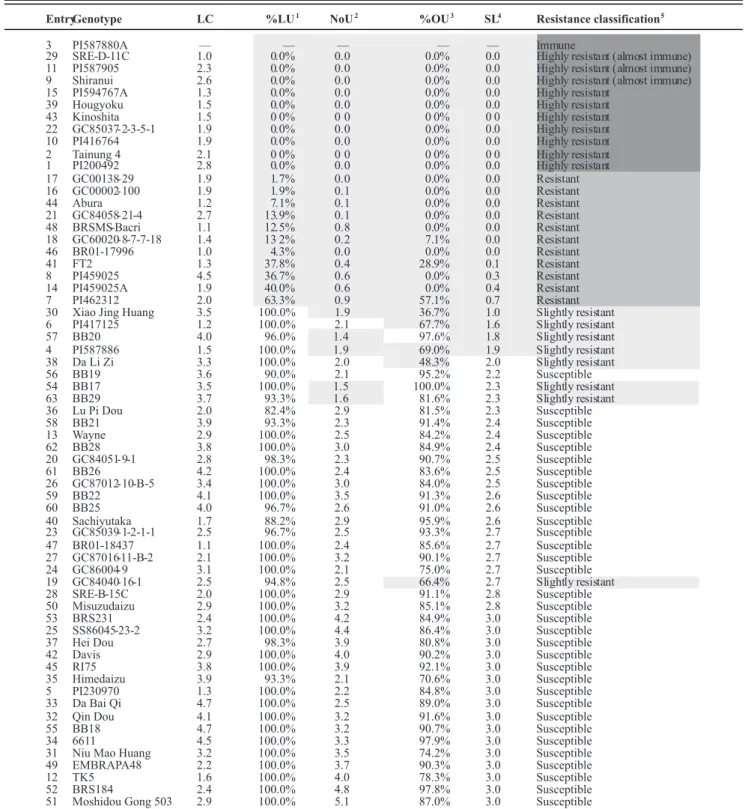
Phenotypic values of the five resistance characters in the 63 soybean genotypes, which had been infected with JRP, were arranged on the basis of their SLs (Table 2). Then frequency distributions of the five resistance characters in the 63 genotypes (Figure 2) were created. All the frequency distributions except that for LC were bimodal, and the genotypes could mostly be clearly classified into two classes: resistant and susceptible, although some showed intermediate values. On the other hand, continuous variation in LC was observed. In addition, in three genotypes, SRE-D-11C, PI587905, and Shiranui showed imperfect formation of lesions that might have been caused by very strong resistance (e.g. SRE-D-11C in Figure 3). Therefore, various types of lesions in terms of LC and SL were also observed (Figure 3).
All correlations among the five characters were significant at the level of P < 0.001 by t-test. Correlations among the four characters excluding LC were very high, with values of 0.868 to 0.953; LC had lower correlations
FIGURE 1 - Standards for lesion color A. and sporulation level B. Pictures of lesions for the color standard were taken after removal of the urediniospores to clearly reveal the color. Imperfect formation of lesions might have been the result of a hypersensitive response; lesions with this type of pigmentation were
classified into lesion color class 1. A
EntryGenotype 3 PI587880A 29 SRE-D-11C 11 PI587905 9 Shiranui 15 PI594767A 39 Hougyoku 43 Kinoshita 22 GC85037-2-3-5-1 10 PI416764 2 Tainung 4 1 PI200492 17 GC00138-29 16 GC00002-100 44 Abura 21 GC84058-21-4 48 BRSMS-Bacri 18 GC60020-8-7-7-18 46 BR01-17996 41 FT2 8 PI459025 14 PI459025A 7 PI462312 30 Xiao Jing Huang 6 PI417125 57 BB20
4 PI587886 1.5 38 Da Li Zi 3.3
56 BB19 3.6
54 BB17 3.5
63 BB29 3.7
36 Lu Pi Dou 2.0
58 BB21 3.9 93.3% 13 Wayne 2.9 100.0% 62 BB28 3.8 100.0% 20 GC84051-9-1 2.8 98.3%
61 BB26 4.2 100.0% 2.4 83.6% 2.5 Susceptible 26 GC87012-10-B-5 3.4 100.0% 3.0 84.0% 2.5 Susceptible 59 BB22 4.1 100.0% 3.5 91.3% 2.6 Susceptible 60 BB25 4.0 96.7% 2.6 91.0% 2.6 Susceptible 40 Sachiyutaka 1.7 88.2% 2.9 95.9% 2.6 Susceptible 23 GC85039-1-2-1-1 2.5 96.7% 2.5 93.3% 2.7 Susceptible 47 BR01-18437 1.1 100.0% 2.4
27 GC87016-11-B-2 2.1 100.0% 3.2 24 GC86004-9 3.1 100.0% 2.1 19 GC84040-16-1 2.5 94.8% 2.5 28 SRE-B-15C 2.0 100.0% 2.9 50 Misuzudaizu 2.9 100.0% 3.2 53 BRS231 2.4 100.0% 4.2 25 SS86045-23-2 3.2 100.0% 4.4 37 Hei Dou 2.7 98.3% 3.9 42 Davis 2.9 100.0% 4.0
45 RI75 3.8 100.0% 3.9 92.1% 3.0 Susceptible 35 Himedaizu 3.9 93.3% 2.1 70.6% 3.0 Susceptible 5 PI230970 1.3 100.0% 2.2 84.8% 3.0 Susceptible 33 Da Bai Qi 4.7 100.0% 2.5 89.0% 3.0 Susceptible 32 Qin Dou 4.1 100.0% 3.2 91.6% 3.0 Susceptible 55 BB18 4.7 100.0% 3.2 90.7% 3.0 Susceptible 34 6611 4.5 100.0% 3.3 97.9% 3.0 Susceptible 31 Niu Mao Huang 3.2 100.0% 3.5 74.2% 3.0 Susceptible 49 EMBRAPA48 2.2 100.0% 3.7 90.3% 3.0 Susceptible 12 TK5 1.6 100.0% 4.0 78.3% 3.0 Susceptible 52 BRS184 2.4 100.0% 4.8 97.8% 3.0 Susceptible 51 Moshidou Gong 503 2.9 100.0% 5.1 87.0% 3.0 Susceptible
LC %LU 1 NoU 2 %OU 3 SL 4 — 1.0 2.3 2.6 1.3 1.5 1.5 1.9 1.9 2.1 2.8 1.9 1.9 1.2 2.7 1.1 1.4 1.0 1.3 4.5 1.9 2.0 3.5 1.2 4.0 Resistance classification 5 100.0% 100.0% 90.0% 100.0% 93.3% 82.4% 100.0% 100.0% 96.0% 2.1 97.6% 2.3 2.5
3.0 84.9% 2.4
2.3 90.7% 2.5 Susceptible 2.9 84.2% 2.4 91.4% 2.4 81.5% 2.3 2.0 2.1 95.2% 100.0% 81.6% 2.0 2.2 2.3 2.3 Susceptible Susceptible Susceptible Susceptible Susceptible 85.6% 2.7 90.1% 2.7 75.0% 2.7 2.7 91.1% 2.8 85.1% 2.8 84.9% 3.0 86.4% 3.0 80.8% 3.0 90.2% 3.0 Susceptible Susceptible Susceptible Susceptible Susceptible Susceptible Susceptible Susceptible Susceptible
TABLE 2 - Phenotypes of the five resistance characters against the Japanese rust population in 63 soybean genotypes. List arrangement
is determined by the values of the 5 resistance characters in the following order: first: sporulation level (SL); second: number of uredinia (NoU); third: frequency of lesions with uredinia (%LU); fourth: frequency of open uredinia (%OU); fifth: lesion color (LC). All values are rounded off to the first decimal place
T
ropical Plant Pathology 35 (3) May - June 2010
N.
Y
amanaka et al.
12
10
8
6
4
2
0
40
30
20
10
0
20
15
10
5
0
20
15
10
5
0
30
25
20
15
10
5
0
1.0-1.5
1.5-2.0
2.0-2.5
2.5-3.0
3.0-3.5
3.5-4.0
4.0-4.5
4.5-5.0
5.0-5.5
5.5-6.0
0%-10%
10%-20%
20%-30%
30%-40%
40%-50%
50%-60%
60%-70%
70%-80%
80%-90%
90%-100% 0.0-0.5
0.5-1.0
1.0-1.5
1.5-2.0
2.0-2.5
2.5-3.0
3.0-3.5
3.5-4.0
4.0-4.5
4.5-5.0
5.0-5.5
5.5-6.0 0.0-0.5
0.5-1.0
1.0-1.5
1.5-2.0
2.0-2.5
2.5-3.0
0%-10%
10%-20%
20%-30%
30%-40%
40%-50%
50%-60%
60%-70%
70%-80%
80%-90%
90%-100%
FIGURE
2
-
Frequency
distribution
of
the
5
characters
for
resistance
against
the
Japanese
rust
population
in
the
63
genotypes.
LC,
%LU,
NoU,
%OU,
and
SL
mean
lesion
color
,
frequency
of
lesion
having
uredinia,
number
of
uredinia
per
lesion
frequency
of
open
uredinia,
and
sporulation
level,
respectively
.
Estimated
boundary
values
between
resistant
and
susceptible phenotypes for each character are shown by arrows.
Number of genotypes Number of genotypes Number of genotypes
Number of genotypes Number of genotypes
LC
%LU
NoU
%OU
FIGURE 3 - Examples of the different pigmentation and sporulation of lesions observed in the 63 genotypes in response to inoculation with the Japanese rust population.
SRE-D-11C Highly resistant (Almost immune)
Hougyoku
Highly resistant Slightly resistantXiao Jing Huang
GC84051-9-1
Susceptible SusceptibleDa Bai Qi
(0.412 to 0.515) with the other four resistance characters (Table 3). That is, most varieties had the same phenotypes— resistance or susceptible—in terms of the four resistance characters, with the exception of LC, and the darkness of LC was not always correlated with the production of uredinia and spores. For example, PI459025 (Rpp4) produced lesions that had a low NoU and SL but a light LC (with score of 4.5, Table 2). On the other hand, PI230970 (Rpp2) and TK5, which had abundant spore production, had dark LC (with scores of 1.3 and 1.6, respectively).
Classification criteria for resistance to soybean rust The frequency distributions of four characters (excluding LC) in the 63 genotypes were bimodal (Figure 2), and two peaks that may have been associated with resistant and susceptible genotypes were observed. The thresholds between resistant and susceptible were determined between these two peaks (Figure 2) for the four resistance characters (excluding LC), as follows. The value of 2.0 for SL was primarily determined as the boundary value for distinguishing resistant (R) and susceptible (S). In this study, SL is considered to be the most important character for soybean rust resistance among the five because the amount of spores produced directly influences multiplication of soybean rust. An SL of less than 2.0 was clearly different from a larger (susceptible) SL. The boundary values between R and S for the other three characters were then determined to minimize the number of genotypes showing both R and S phenotypes in the four resistance characters. That is, the values 0.0 ≤ x < 2.0 and 2.0 ≤ x were respectively classified as resistant and susceptible for NoU. The values 0.0 ≤ x < 70.0 and 70.0 ≤ x ≤ 100.0 were respectively classified as resistant and susceptible for both %OU and %LU.
Finally, all 63 genotypes were classified into five kinds of resistance classification, “Immune”, “Highly resistant”, “Resistant”, “Slightly resistant”, and “Susceptible”, according to the classification criteria of “Immune” = having no lesions; “Highly resistant” = having lesions showing the resistant phenotype in all four characters and with no uredinia; “Resistant” = having lesions showing the resistant
phenotype in all four characters and possessing uredinia; “Slightly resistant” = having lesions that show resistant phenotype in any of four characters; and “Susceptible” = having lesions with susceptible phenotypes in all four resistance characters. These five resistance categories of genotypes were also applied to the other two Brazilian rust populations in order to identify the difference in the virulence among three populations.
Pathogenic differences among the 3 rust populations We examined the pathogenic differences among JRP, BRP-1, and BRP-2 in the 13 standard varieties based on the criteria we determined (Figure 4). With BRP-1 infection, a few whitish lesions in 100 dark brown lesions were observed in the genotype, PI416764. With BRP-2 infection, two clearly different types of lesions with similar frequencies were also observed on PI587905. Such mixed lesions were not observed in JRP.
Some pathogenic differences were observed between BRP-1 and BRP-2. Major differences in virulence were observed in PI230970 (Rpp2), PI417125 (Rpp2), PI462312 (Rpp3), and PI416764 (Figure 4). Until 2008, it had not been reported that Brazilian rust populations show virulence against genotypes containing the Rpp2 gene. In addition, stronger
LC %LU NoU %OU SL
LC – 0.515 0.412 0.502 0.499
%LU – – 0.873 0.951 0.944
NoU – – – 0.868 0.926
%OU – – – – 0.953
SL – – – – –
TABLE 3 - Pearson correlations among the five characters for resistance against the Japanese rust population in the 63 genotypes.
FIGURE 4 - Phenotypes of resistance against Japanese and Brazilian rust populations in 13 standard varieties. 1-9: Varieties having one
of known resistance genes, 10 and 11: Varieties having identified their resistance but not identified their genes yet, 12 and 13: Susceptible
standard varieties.
virulence of BRP-2 than BRP-1 was observed in PI459025 with the Rpp4 gene. Thus, the resistance conferred by Rpp4
from PI459025 against Brazilian populations might have started to break down. Clear differences in virulence between the Japanese and the two Brazilian populations were observed in all four varieties that have the Rpp1 gene: PI200492, Tainung 4, PI587880A, and PI58788. All the differences in these varieties involved the Brazilian populations causing stronger disease than the Japanese one.
DISCUSSION
Various types of lesions obtained from JRP infection We considered that following factors were likely to have been associated with various types of lesions observed in JRP infection. First, not only major resistance genes but also minor resistance genes may have influenced these resistance characters. A continuous degree of resistance has previously been observed among soybean lines that have identical compositions of the major resistance genes but have different genetic backgrounds (Nogueira et al., 2008; Yamanaka et al., 2008). In this study, PI417125, which has the major resistance gene, Rpp2, did not show as clearly resistant but were seen to be slightly resistant (Table 2). This is also an example of the major resistance genes showing their resistance quantitatively or soybean varieties having quantitative trait loci for resistance characters except for major genes. Second, the mixture of races in JRP might have produced continuous variation in the average values of the characters in the 30 lesions sampled per genotype. Mixed types of lesions, which can be clearly distinguished from each other, were not observed in JRP infection. However, it is difficult to differentiate types of pathogenic races without clear differences in their LCs or SLs. Thus, the average values of the resistance characters could have been derived
from different pathogenic races. Consequently, the use of both lines that are isogenic for each major resistance gene and single-lesion isolates taken from rust populations will be necessary to determine the boundaries between resistant and susceptible types more exactly.
Classification criteria for resistance to soybean rust The resistance genes Rpp2 and Rpp4 contribute genetically to the darkness of LC against BRP-1 under greenhouse conditions (Yamanaka et al., 2008). PI459025 (Rpp4) had an LC score that differed with the growth environment, namely 4.5 in this study and 1.2 under greenhouse conditions (data not shown). This suggests that LC is easily influenced by environmental factors. We consider spore production to be more important than LC in the identification of resistance against soybean rust. LC showed a low correlation with the other four resistance characters, which appear to be more important for selection in the breeding program (Table 3). This, combined with apparent variation with environmental factors mentioned above and the fact that it shows not bimodal but continuous distribution (Figure 2), makes it unlikely to be a suitable criterion for resistance classification of genotypes. However, a clear difference in LC is considered to be useful for detecting mixed lesions derived from different pathogenic races.
and Severity check may also be useful for introducing the minor genes and for evaluating effectiveness of fungicide application (Godoy et al., 2009). In addition, we observed high correlation among 4 characters related to resistance. This observation may enable us to simplify the process of evaluation. The criteria to decide resistance against soybean rust were determined by large number of phenotypes: four characters in 63 genotypes. However, phenotypic data of genotypes shown in this study are based on a one-time experiment, and thus we have to treat the data carefully by considering that.
Pathogenic differences among the 3 rust populations The two Brazilian rust populations previously shown to have similar virulence in a different set of differential varieties in 2005 (Kato & Yorinori, 2008), showed some difference in their virulence in this study. Therefore, the differences observed here are likely to have resulted from a change in virulence, large changes in the race population, or both, which occurred from 2005 to 2008 in the two greenhouses. Phenotypes resistant to BRP-1 or BRP-2 were observed in varieties with the genes Rpp2, Rpp3, Rpp4, and Rpp5 (entries 5 to 9) and in PI416764, but only two of these varieties, PI459025 (Rpp4) and cv. Shiranui (Rpp5), were resistant to both Brazilian populations (Figure 4). In other words, only two of the five major genes can be expected to be useful in resistance to Brazilian soybean rust. In addition, Brazilian populations caused more virulent reaction than Japanese populations in 13 standard varieties. With the infections of two Brazilian populations, two clearly different types of lesions were observed in the genotypes, PI416764 and PI587905, respectively for 1 and BRP-2, in 13 standard varieties. However, such mixed lesions were not observed in JRP infection using 63 genotypes. This fact indicated that Brazilian rust populations may have not only higher but also more diverse virulence than the Japanese one. The most significant difference between the Japanese and Brazilian populations was observed in the 4 genotypes having Rpp1 gene in this study. Pham et al. (2009) detected a susceptible reaction of Rpp1 (PI200492) in the Brazilian isolate, but immunity and resistant reactions in the Indian and Louisiana isolates, respectively. Li (2009) also detected high resistance in PI200492 against 3 isolates from Mississippi. Thus, the resistant allele of Rpp1 from PI200492 can be useful in some regions of Asia and the USA but not in Brazil.
Our results suggested that the resistant varieties or resistance genes useful in Brazil were limited. They also suggested that a breakdown of major resistance genes or large changes in race populations, as observed in the case of the Rpp2 gene (from PI230970 and PI417125), are occurring. Therefore, a resistant cultivar that is universally effective against soybean rust should be developed by pyramiding many major resistance genes and by introducing horizontal resistance.
ACKNOWLEDGEMENTS
We thank Tomomi Mori and Akiko Takahashi of the Japan International Research Center for Agricultural Sciences - JIRCAS for their technical assistance. We also thank Drs. José Tadashi Yorinori (Tadashi Agro), and Hajime Akamatsu (JIRCAS) for their technical advice and encouragement. We are grateful to the Asian Vegetable Research and Development Center - AVRDC, the Soybean Research Center, the Jilin Academy of Agricultural Sciences - JAAS, Chiba University, Brazilian Agricultural Research Corporation - EMBRAPA, and National Institute of Crop Science - NICS for providing seeds of plant materials. This study was conducted under the JIRCAS research project, “Identification of Stable Resistance to Soybean Rust for South America”.
REFFERENCES
Arias CAA, Toledo JFF, Almeida LA, Pipolo AE, Carneiro GES, Abdelnoor RV, Rachid BF, and Ribeiro AS (2008) Asian rust in Brazil: Varietal resistance. In: Kudo H, Suenaga K, Soares RM, Toledo A (Eds.) JIRCAS Working Report No. 58. Tsukuba Japan.JIRCAS Working Report No. 58. Tsukuba Japan. JIRCAS. pp. 29–30.
Asian Vegetable Research and Development Center (1989) Progress Report 1989. Shanhua, Taiwan, AVRDC Publication.
Asian Vegetable Research and Development Center (1992) Progress Report 1992. Shanhua, Taiwan, AVRDC Publication.
Bonde MR, Nester SE, Austin CN Stone CL, Frederick RD, Hartman GL, Miles MR (2006) Evaluation of virulence of
Phakopsora pachyrhizi and P. meibomiae isolates. Plant Disease 90:708–716.
Bromfield KR (1984) Soybean Rust – Monograph No. 11. Saint
Paul MN. APS Press.
Bromfield KR, Hartwig EE (1980) Resistance to soybean rust and
mode of inheritance. Crop Science 20:254-255.
Fehr WR, Caviness CE, Burnood DT, Pennington JS (1971) Stage of development descriptions for soybeans, Glycine max (L.) Merril. Crop Science 11:929–931.
Garcia A, Calvo ÉS, Kiihl RA de S, Harada A, Hiromoto DM, Vieira LGE (2008) Molecular mapping of soybean rust (Phakopsora pachyrhizi) resistance genes: discovery of a novel locus and alleles. Theoretical and Applied GeneticsTheoretical and Applied Genetics 117:545–553.
Godoy CV, Flausino, Santos LCM, Del Ponte EM (2009).
Eficiência do controle da ferrugem asiática da soja em função do
momento de aplicação sob condições de epidemia em Londrina, PR. Tropical Plant Pathology 34:56-61.
Hartwig EE (1986) Identification of a 4th major gene conferring
resistance to soybean rust. Crop Science 26:1135–113.
Hartwig EE, Bromfield KR (1983) Relationships among 3 genes conferring specific resistance to rust in soybeans. Crop Science
23:237–239.
Ivancovich A (2005) Soybean rust in Argentina. Plant Disease 89:667–668.
Kato M, Yorinori JT (2008) A study on a race composition of
Phakopsora pachyrhizi in Brazil: a difficulty of race identification. In:In: Kudo H, Suenaga K, Soares RM, Toledo A (Eds.) JIRCAS WorkingJIRCAS Working Report No. 58. Tsukuba Japan. JIRCAS. pp. 94–98.
Laperuta LDC, Arias CAA, Ribeiro AS, Rachid BF, Pierozzi PHB, Toledo JFF, Pípolo AE, Carneiro GES (2008) New genes conferring resistance to Asian soybean rust: allelic testing for the Rpp2 and Rpp4
loci. Pesquisa Agropecuária Brasileira 43:1741–1747.
Li S (2009) Reaction of soybean rust-resistant lines identified in
Paraguay to Mississippi isolates of Phakopsora pachyrhizi. Crop Science 49:887–894.
Miles MR, Frederick RD, Hartman GL (2006) Evaluation of soybean germplasm for resistance to Phakopsora pachyrhizi. Plant Health Progress doi 10.1094/PHP-2006-0104-01-RS.
Monteros MJ, Missaoui AM, Phillips DV, Walker DR, Boerma HR
(2006) Mapping and confirmation of the ‘Hyuuga’ red-brown lesion
resistance gene for Asian soybean rust. Crop Science 47:829–834.
Navarro JC, Nakasato R, Utiamada CM, Yorinori JT (2004) First report of “Asian” soybean rust in Bolivia. In: Moscardi F et al. (Eds.) Abstracts of contributed papers and posters / VII World Soybean Research Conference, IV International Soybean Processing and Utilization Conference, III Congresso Brasileiro de Soja. LondrinaLondrina PR. Embrapa Soja. pp. 85–86.
Nogueira LM, Passionotto ALL, Silva DCG, Santos JVM, Arias CAA, Abdelnoor RV & Yamanaka N (2008) Os genes de resistência à ferrugem asiática da soja, Rpp2 e Rpp4, apresentam efeitos não-aditivos quando acumulados em uma variedade. Tropical Plant Pathology 33 (Supl.):204.
Oliveira ACB, Godoy CV and Martins MC (2005) Avaliação da tolerância de cultivares de soja à ferrugem asiática no Oeste da Bahia. Fitopatologia Brasileira 30:658-662.
Oloka HK, Tukamuhabwa P, Sengooba T, Shanmugasundram S (2008) Reaction of Exotic Soybean Germplasm to Phakopsora pachyrhizi in Uganda. Plant Disease 92:1493-1496.
Pham TA, Miles MR, Frederick RD, Hill CB, Hartman GL (2009) Differential responses of resistant soybean entries to isolates of
Phakopsora pachyrhizi. Plant Disease 93:224-228.
Pierozzi PHB, Ribeiro AS, Moreira JUV, Laperuta LDC, Rachid BF, Lima WF, Arias CAA, Oliveira MF, and Toledo JFF (2008) New soybean (Glycine max Fabales, Fabaceae) sources of qualitative genetic resistance to Asian soybean rust caused by Phakopsora pachyrhizi (Uredinales, Phakopsoraceae). Genetics and Molecular Biology 31:505–511.
Ray JD, Morel W, Smith JR, Frederick RD, Miles MR (2009) Genetics and mapping of adult plant rust resistance in soybean PI 587886 and
PI 587880A. Theoretical and Applied Genetics 119:271–280.
Ribeiro AS, Toledo JFF, Arias CAA, Godoy, CV, Soares RM, Moreira JUV, Pierozzi PHB, Vidigal MCG, Oliveira MF (2008) Genetic control of soybean (Glycine max) yield in the absence and presence of the Asian rust fungus (Phakopsora pachyrhizi). Genetics and Molecular Biology 31:98–105.
Rossi RL (2003) First report of Phakopsora pachyrhizi, the causal organism of soybean rust in the province of Misiones, Argentina. Plant Disease 87:102.
Silva DCG, Yamanaka N, Brogin RL, Arias CAA, Nepomuceno AL, Di Mauro A, Pereira S, Nogueira LM, Passianotto ALL, Abdelnoor RV (2008) Molecular mapping of two loci that confer resistance to Asian rust in soybean. Theoretical and Applied Genetics 117:57–63
Yamanaka N, Ninomiya S, Hoshi M, Tsubokura Y, Yano M, Nagamura Y, Sasaki T, and Harada K (2001) An informative linkage
map of soybean reveals QTLs for flowering time, leaflet morphology
and regions of segregation distortion. DNA Research 8:61–72.
Yamanaka N, Sato H, Yang Z, Xu DH, Catelli LL, Arias CAA, Abdelnoor RV, Nepomuceno AL (2007a) Genetic relationship of Japanese, Chinese and Brazilian soybean gene pools revealed by SSR markers. Genetics and Molecular Biology 30:85–88.
Yamanaka N, Silva DCG, Gilli JR, Fuentes FH, Yang Z, Polizel A, Sato H, Watanabe S, Ban T, Homma Y, Harada K, Brogin RL, Nepomuceno AL, Abdelnoor RV (2007b) Application of DNA markers for identifying genes for resistance to soybean diseases in South America and for evaluating genetic relationships among soybean gene pools. In: Suenaga K, Kudo H, Oshio S (Eds.) JIRCAS Working Report No. 51. Tsukuba Japan. JIRCAS. pp. 47–54.
Yamanaka N, Silva DCG, Passianotto ALL, Nogueira LM, Polizel AM, Pereira SS, Santos JVM, Brogin RL, Arias CAA,
Hoffmann-Campo CB, Nepomuceno AL, Abdelnoor RV (2008) Identification of
DNA markers and characterization of the genes for resistance against Asian soybean rust. In: Kudo H, Suenaga K, Soares RM, Toledo AIn: Kudo H, Suenaga K, Soares RM, Toledo A (Eds.) JIRCAS Working Report No. 58. Tsukuba Japan. JIRCAS. pp.JIRCAS Working Report No. 58. Tsukuba Japan. JIRCAS. pp. 99–107.
Yamaoka Y, Fujiwara Y, Kakishima M. Katsuya K, Yamada K, Hagiwara H (2002) Pathogenic races of Phakopsora pachyrhizi on soybean and wild host plants collected in Japan. Journal of General Plant Pathology 68:52–56.
Yorinori JT (2008) Soybean germplasms with resistance and tolerance to Asian rust and screening method. In: Kudo H, Suenaga K, SoaresIn: Kudo H, Suenaga K, Soares RM, Toledo A (Eds.) JIRCAS Working Report No. 58. TsukubaJIRCAS Working Report No. 58. Tsukuba Japan. JIRCAS. pp. 70–87.
Yorinori JT, Paiva WM, Frederick RD, Costamilan LM, Bertagnoli PF, Hartman GL, Godoy CV, Nunes JJ (2005) Epidemics of soybean rust (Phakopsora pachyrhizi) in Brazil and Paraguay from 2001 to 2003. Plant Disease 89:675–677.
TPP 9093 - Received 27 July 2009 - Accepted 28 May 2010 Section Editor: Luis Eduardo Aranha Camargo