Bull Pan Am Heallh Organ S(3), 1982
THE STRATEGY,
COST, AND PROGRESS OF
PRIMARY
HEALTH
CARE1
Robert G. A. Bolandz and Mary E. M. Young*
Recent years have seen mounting public and governmental enthusiasm for prima7y health care projects around the world. This article aAs a number of hard questions about how the progress achieved through such ventures appears to relate to the costs involved and the strategies pursued.
Introduction
The slogan “Health for All by the Year
2000” (I) today repeatedly confronts virtually every student of international health. Express- ing the creed and concept of comprehensive primary health care, it possesses a high degree
of political and humanitarian appeal and
simultaneously projects the underlying theme
of “social justice for all.” Supporting this ap-
proach, valuable pioneering research projects
in primary health care at Narangwal, India
(21, Danfa, Ghana (3J and Lampang, Thai-
land (4, 5) have demonstrated that with good
leadership, enthusiasm, appropriate technolo-
gy, and volunteer labor, comprehensive low-
cost primary health care can succeed in im-
proving people’s health status anywhere so
long as adequate financing is available; and
since the 1978 Alma-Ata International Con-
ference on Primary Health Care there has
been an increasing investment in primary
health care projects throughout the world,
projects that have employed increasingly so-
phisticated planning and management tech-
niques. Nevertheless, except in China, no na-
tional projects have demonstrated that they
can provide long-term comprehensive prima-
l Al so appearing in Spanish in the B&in de la Of;ina
&nit&k Panamericana. The views and intemretations ex- pressed in this article are the authors’ own and do not necessarily reflect the official or unofficial position of any organization.
2P reventive Medicine Resident, School of Hygiene and Public Health, the Johns Hopkins University, 615 North Wolfe Street, Baltimore, Maryland, U.S.A.
ry health care in conditions of chronic poverty with purely local resources (6).
Although an international definition of the
term “primary health care” has been arrived
at (7), the term may still be confusing-for in some cases it is used to mean comprehensive
primary health care (which includes the eight
functions of nutrition, expanded immuniza-
tion, sanitation and water supply, family plan-
ning, control of communicable diseases,
maternal and child health care, health educa-
tion, and basic curative care) and at other
times it is used to mean selective primary health care, which includes only limited func- tions (8). In this regard, it is not at all certain
that primary health care needs to be compre-
hensive in order to be effective (9J or that selective primary health care might not offer a
more appropriate and practical avenue for at-
taining health for all by the year 2000.
Moreover, despite the volume of published
data on primary health care projects and the
unrestrained enthusiasm about comprehen-
sive primary health care, it is still very difficult to determine the overall coverage, quality, ef-
ficiency, and effectiveness of the primary
health care available (10, 11). One complica-
tion here is that the routine international
health statistics and reports of less-developed countries are generally considered less reliable than those of developed countries (22) for very
practical reasons involving problems of com-
munication, geography, administration,
financing, and so forth. Also, since health and
politics are related, some of the published
health data must pass through a political
234 PAHO BULLETIN l vol. 16, no. 3, 1982
screening process before being released to the care coverage with national programs, using
public; and so doubt is often raised regarding mainly their own resources, although Cuba is
its objective validity. In addition, much said to have received subsidies from the USSR
published data tends to consist of “process” and Tanzania has received large sums from
and “output” data re!ating to specific prima- church groups. The health care in question
ry health care projects, with little “outcome” appears to be supplied either free or at a low
or “effectiveness” data being available for the affordable cost; traditional methods are used
country as a whole. where appropriate; and the countries’ health
Finally, although reports on primary health resources appear to be fairly equally shared by
care consistently report “progress,” we are the general population.
also confronted with broad statements such as It is true that the political weakness of the
“comprehensive primary health care is not medical profession in these countries may
available for 70 per cent of the world’s popula- have contributed to a relatively easy accep-
tion,” or “40 per cent of the world’s children tance of paramedical staffs; and relative politi-
are malnourished,” which leaves room for cal and economic stability may have contrib-
doubt about the effectiveness of primary uted to the continuity of health care services
health care to date (10). Of course, it is cer- and organizations. Moreover, each of these
tainly easier to criticize international health countries appears to constitute a controlled
work than to perform it; and some degree of society operated essentially through a one-
professional optimism that “things are getting party system; and each possesses a govern-
better” may be needed to keep people moti- ment with both the political will and political
vated for the nearly impossible task that lies strength needed to overcome early political
ahead. But even so, the tendency to pass and cultural strains and to implement radical
quickly over less successful older projects and but necessary changes in the health system.
concentrate attention on new, more promising Even in this context, it is worth noting that
projects (11) may not be productive over the curative care may have been provided largely
long run. to satisfy public demand, while the major
Keeping these things in mind, it would health status improvements may well have
seem worth taking a brief hard look at primary been accomplished through direct and indirect
health care in several countries around the preventive measures.
world and to review in a general way how pri- In general, these countries do not seem to
mary health care progress appears to relate to permit the same degree of personal freedom
the costs involved and the strategies pursued. accepted as “normal’ ’ in the Western democ-
racies-the individual freedom to live and
Successful Programs work where one pleases, to travel about freely
without permission, to marry and reproduce
The primary health care programs of three freely without official legal constraints, and so
major developing countries appear to have on. Thus, these successful primary health care
achieved significant success. The countries in- programs seem to suggest some “trade-off’ of
volved are Cuba, with an annual per capita such individual freedoms for better individual
GNP of US$810; China, with an annual per health and generally significant improvement
capita GNP of US$460; and Tanzania, with in the rates of infant mortality, life expectan-
an annual per capita GNP of US$lOO (15, 12, cy, and net population growth.
13). According to the published data, these
countries have provided virtually 100 per cent Less Successful Programs
of their urban and rural populations with ac-
cess to and coverage by primary health care of Despite very considerable efforts to achieve
adequate quality. Furthermore, they have comprehensive primary health care for all,
Boland and Young . PRIMARY HEALTH CARE 235
countries with large populations have been ex-
periencing considerable difficulty. Three of
these countries are Nigeria, with an annual
per capita GNP of US$560 (9); India, with an
annual per capita GNP of USfl80 (14, 1.5);
and Afghanistan (before 1980), with an an-
nual per capita GNP of US$240 (II).
According to the published data, it would
seem that coverage with comprehensive
primary health care of adequate quality was
being provided for less than 30 per cent of the population, leaving 70 per cent to be covered by traditional healers. In the cities, interna-
tional standards of health care were being
maintained for some parts of the population,
and in some rural areas comprehensive
primary health care was achieving high cover-
age through programs financed by external
funds-programs that could not be supported
over the long run by local resources.
In these countries there has been a strong
political commitment to primary health care,
but there has been relatively little of the politi-
cal organization and political power needed to
achieve it for the general population, especial- ly in view of the strength of the traditional
medical profession. Major difficulties have
arisen, not so much with the training of medi-
cal workers, but rather with their long-term
financing, deployment, and logistical and
managerial support within the government’s
administrative systems. Not only has reorga-
nization and management training within
each country’s ministry of health proved ex-
tremely difficult, but such reorganization and
training has not been adequate to cope with
the envisaged radical changes-changes that
would affect the whole government’s adminis-
trative and political structure (‘1.2).
However, these societies, although fairly
strongly controlled in terms of western demo-
cratic standards, have not yet made the
“trade-off’ of individual freedom for individ-
ual health. Thus, their community participa-
tion schemes may not bring “social justice for
all,” but rather another system of less than
complete equality (16)-a system wherein
local resources do not seem to offer either 100
per cent coverage with comprehensive prima-
ry health care or the eventual prospect of at- taining acceptable levels of infant mortality,
life expectancy and net population growth.
Economic Costs
There seems to be general agreement that
long-term health is more related to nutrition,
environmental conditions, and economic
development than it is to the quality of cura- tive medical care (8), but also that environ-
ments with chronic poverty are particularly
resistant to economic development efforts.
This has led to increasing efforts by interna-
tional health professionals to show that com-
prehensive primary health care can be
achieved with good technique for less than
US$S per capita annually (17).
Within this context, it is surprising how
such low-cost estimates have tended to become accepted as practical targets without external verification (18). (In the business world, cost estimates are usually regarded more skeptical-
ly until they are audited by independent pro-
fessional accountants.) Moreover, it would
seem that establishing the per capita cost of
primary health care requires clear definition
of exactly what primary health care functions
are provided for the specified population, and
what assumptions have been made and
justified. In this vein, it is quite difficult to
decide whether such computations should in-
clude the “opportunity” cost of “free” man-
power, supplies, food, etc.; international staff-
ing costs (including head office overhead);
water costs; road costs; supervisory costs;
health ministry reorganization costs; training
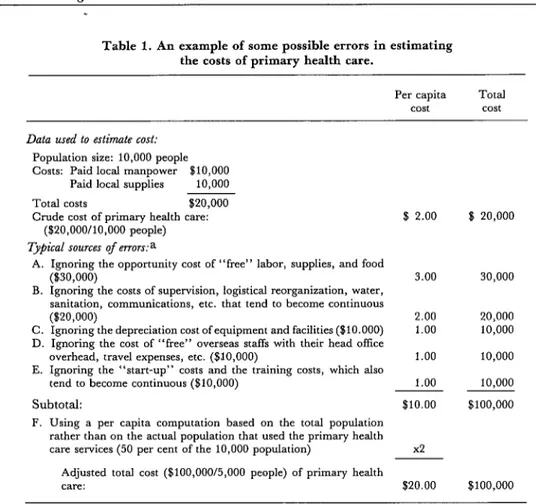
costs; and so on. Table 1 presents a hypotheti-
cal case showing some potential causes of
error in such computations. It should also be
recognized that the correct computation of
past costs does not guarantee that future costs will be the same or that they will be support-
able. Overall, we should recognize that there
236 PAHO BULLETIN l vol. 16, no. 3, 1982
Political and Cultural Costs
At the Alma-Ata Conference in 1978 (l),
the Director-General of the World Health
Organization, Dr. Halfdan Mahler, hinted at
the political and cultural cost of primary
health care when he set forth political and
social actions vital to achieving health for all by the year 2000 through primary health care. These actions, together with what logically ap- pear to be the political and social cost implica- tions of such actions, are as follows:
Action needed Cost implications
1) Address inequality.
2) Insure proper plan- ning and implementa- tion of primary health care in the relevant sec- tors.
3) Mobilize the indi- vidual, family, and com- munity to identify with primary health care through participation in management and plan- ning.
4) Introduce reforms to insure the availability of technology capable of providing coverage for the whole country.
5) Introduce changes in the existing health systems.
6) Make a political commitment to primary health care.
This involves a substantial sharing of resources, both within countries and be- tween countries, that entails a significant political cost
(17).
Despite variations in cul- tural values and manage- ment styles that affect the relative importance of time, efficiency, and other factors, this action involves political and cultural costs (11). Health may be a lower pri- ority with some communi- ties than cultural values or economic development; so this action likewise involves political and cultural costs (17).
Servicing sparsely populated rural areas with little politi- cal influence involves signif- icant political cost (13).
Traditional conservatism, of both rural populations and the medical profession, as well as a demand for curative rather than the
more effective preventive health care measures causes such action to involve signif- icant political cost (19). This commitment cannot be total, since we cannot expect the goal of health to be deemed more important than, say, the internal and external security of the state; but the stronger such a com- mitment is, the higher will be its political cost (20).
Thus, for a less-developed country with
political and economic instability, the political cost of Health for All by the Year 2000 seems very high. As a result, we may find the prac-
tice of insufficient expenditure on health but
extensive expenditure for weapons to reflect a
country’s relative priorities-priorities justi-
fied on the grounds that without political and economic stability all primary health care sys- tems will fail in the long run.
It should also be noted that the cultural cost
of primary health care may be considerable in
countries that do not aspire to the Western
model of rapid economic progress and prefer a slower rate of change that permits preserva- tion of existing cultural values (21). In such
societies, chronic economic poverty may go
hand in hand with use of traditional healers; prevailing concepts of life, death, and disease;
and prevailing religious values. Most coun-
tries have long had health systems in which
traditional healers provide care appropriate
for local beliefs and resources. Unless general
development can be provided for the people
thus served, a little isolated primary health
care may foster disillusionment with a lifestyle from which there is no escape. Hence, modern
Western medicine may become competitive
with and partly destroy the traditional culture in the name of “health for all” (11), and so the cultural cost of primary health care may be significant.
Primary Health Care Strategies
The 1981 General Assembly of the World
Health Organization approved a global strate-
gy of Health for All by the Year 2000 involv-
ing comprehensive primary health care for
everyone (7). This meeting went further than
the Alma-Ata Conference in trying to show
not merely what must be achieved but how it could be achieved. The approved global strat- egy deals with such matters as infrastructure,
comprehensive 100 per cent coverage, com-
munity services, selective technology, and in-
Boland and Youne l PRIMARY HEALTH CARE 237
Table 1. An example of some possible errors in estimating the costs of primary health care.
Per capita Total
cost cost
Data used to estimate cost:
Population size: 10,000 people Costs: Paid local manpower $10,000
Paid local supplies 10,000
Total costs $20,000
Crude cost of primary health care: ($20,000/10,000 people)
Typical sources of evow:a
A. Ignoring the opportunity cost of “free” labor, supplies, and food ($30,000)
B. Ignoring the costs of supervision, logistical reorganization, water, sanitation. communications, etc. that tend to become continuous ($20,000)
C. Ignoring the depreciation cost of equipment and facilities ($10.000) D. Ignoring the cost of “free” overseas staffs with their head offke
o;erhead, travel expenses, etc. ($lO,OOO)
E. Ignoring the “start-up” costs and the training costs, which also tend to become continuous ($10,000)
Subtotal:
F. Using a per capita computation based on the total population rather than on the actual population that used the primary health care services (50 per cent of the 10,000 population)
Adjusted total cost ($100,000/5,000 people) of primary health care:
$ 2.00
3.00
2.00 1.00
1.00
1.00 $10.00
x2
$20.00
16 20,000
30,000
20,000 10,000
10,000
10,000 $100,000
$100,000
aThe allocation ofjoint costs that affect both health and general development is a difficult technical decision for which the assumptions need to be clearly defined. This is similar to the cost-analysis problem facing oil industries seeking to determine the “cost” of different products coming out of the same “barrel of oil.”
cific indicators to measure progress, these being:
1) Endorsement at the highest levels of the goal of Health for All by the Year 2000.
2) Adoption of mechanisms for involving people in the implementation of primary health care.
3) A health expenditure amounting to 5 per cent of the GNP.
4) The earmarking of a “reasonable” percent- age of the GNP for community-based rather than hospital-based care.
5) Provision of support by developed countries to less-developed countries.
6) Provision of selective primary health care to promote water supply and sanitation, the expanded program of immunization, and establishment of local curative care facilities that can be reached within an hour by those served.
7) Adequate childhood nutrition.
8) An infant mortality rate of less than 50 deaths per 1,000 live births.
9) A life expectancy at birth of at least 60 years. 10) An annual GNP per capita above US$500. 11) An equitable distribution of health services for both urban and rural populations.
12) Adoption of new, broader health indicators covering both environmental conditions and the de- mand, supply, and utilization of health services.
This new global strategy, together with the enthusiastic support it has received, is making an important contribution toward the goal of Health for All by the Year 2000. For as Dr.
238 PAHO BULLETIN l vol. 16, no. 3, 1982
The goal is there; the ways to attain it are daily becoming clearer; and the lesson of the past two years is that if we temper our dreams with realism, we shall reach our goal in spite of the world’s political and economic malaise
(7).
All this creates a need for global primary
health care policies-that is, for decision-
making rules capable of developing the strate- gy into operational plans. It is hoped that such
policies, which must consider the political,
cultural, and economic costs of primary health care, will deal with the following unresolved issues:
l Is the universal enthusiasm for compre-
hensive primary health care, which is similar
to the enthusiasm for disease eradication and
vertical health programs, justified by progress
to date? Since primary health care does not
need to be comprehensive to be effective,
would Selective Primary Health Care for All
by i990-care encompassing nutrition, the
expanded program of immunization, control
of endemic diseases, and health education-
be a more realistic international target? (8,
22).
l Should very low-income countries with
annual per capita GNPs of less than US$200
have the right (not merely the privilege) of
free selective primary health care provided
under a system of international social security,
subject to annual audit and reporting? Should
these countries in greatest need receive total or partial priority? (20).
l Apart from the very low-income coun-
tries, should any primary health care project
be started or allowed to continue at a level that
cannot be supported in the long run by local
resources, irrespective of outside financing?
Should international help normally consist of
manpower using local resources, rather than
free food and supplies that provide only tem-
porary relief and encourage long-term depen-
dence? Should it be required that all new pri- mary health care projects be part of national schemes after professional study of the politi-
cal, cultural, and economic costs involved? (6, 23, 24).
l Is it reasonable for less-developed coun-
tries to offer primary health care as a “free”
service when traditional healers continue to
cover over 50 per cent of the population on a
fee-for-service basis in accordance with local
custom? Should primary health care workers
be volunteers rather than paid professionals,
since the long-term continuity of volunteers is
directly dependent upon paid employment
opportunities- either in other work or as fee-
for-service traditional healers?
l Should the twenty-odd basic generic
drugs that could adequately treat 90 per cent
of the world’s communicable diseases (II) be
manufactured by WHO at cost; and should
drug manufacturers be prohibited from selling
the same drugs under brand names so as to take the profit out of basic medications?
l Should controlled traditional healing be
recognized as acceptable and desirable
curative care in certain environments rather
than merely a low-cost substitute for unafford- able Western medical care? (6, 18).
l Should an annual audit designed to im-
prove the reliability of national health
statistics be made a first priority of interna- tional support, considering that such statistical data are vital to international resource alloca- tion for health on an objective basis?
l Is the concerted effort being made to pro-
duce low-cost primary health care with im-
proved technology (e.g., at a cost of US$6 per capita per annum) realistic over the long run,
considering that an average life expectancy of
over 60 years would entail heavy costs for the care of chronic diseases, on which developed countries spend over US$800 per capita each year?
l Should international refugee aid for
primary health care be limited in time, so as to
avoid becoming a secondary support for ag-
gressive political change and to conserve inter- national health resources?
l Should voluntary service organizations
Boland and Youn,c l PRIMARY HEALTH CARE 239
tional primary health care projects be licensed
annually, audited, and monitored in such a
way that their efforts are coordinated with
primary health care global strategies, global
policies, and national programs?
l Recognizing that nutrition and the en-
vironment have historically played a larger
role in reducing the prevalence of communica-
ble diseases than has improved curative care,
how can we reconcile the distribution of free
food to less-developed countries with the need
to avoid creating long-term dependence?
l Is it reasonable to concentrate attention
on the failure of developed countries to share
resources adequately with the less-developed
countries, while playing down the reluctance
of less-developed countries to recognize an in- creasing need for internal sharing of limited resources?
l Is the recent recognition of primary
health care as a viable financial development
opportunity by the World Bank and other in-
ternational organizations justified by the
available data? (81.
. Overall, should recognition be given to
the probability that health for all by the year 2000 may be more influenced by the adequacy
of nutrition and the expanded program of im-
munization than by the quality of medical ser- vices that seem to involve relatively high eco-
nomic, political, and cultural costs?
Concluding Note
This brief article has sought to review
primary health care progress in less-developed
countries with large populations; to assess the
economic, political, and cultural costs as they
relate to the new WHO global strategy for
Health for All by the Year 2000 using primary
health care; and to identify some unresolved
issues. Pending clarification of such issues, the following tentative suggestions appear to be in order:
1) The concept of Health for All by the
Year 2000 and the global strategy for achiev- ing it with primary health care have had a pro-
found political influence throughout the
world, but many unresolved issues remain to
be clarified by the development of decision-
making rules in the form of primary health
care global policies.
2) Progress in primary health care for large
populations in less-developed countries seems
to require a “trade-off’ of some individual
freedom for individual health.
3) The costs of primary health care appear
to be mainly economic, but the major con-
straints involved may well be its political and cultural costs.
4) The global primary health care strategy
calls for 100 per cent comprehensive primary
health care by the year 2000; a more realistic
intermediate target might be Selective Prima-
ry Health Care for All by 1990 covering the
areas of nutrition, the expanded program of
immunization, control of communicable dis-
eases, and health education.
5) For very low-income countries with
annual per capita GNPs of less than US$200,
one desirable method for directing interna-
tional aid to the most needy would be a system
of international social security giving their
people the right (not the privilege) of free
selective primary health care.
6) Licensing and conducting an annual
audit of all organizations involved in interna-
tional primary health care could provide a
way to coordinate and control their efforts
within the framework of a global primary
health care strategy and policies.
SUMMARY
With good leadership, adequate financing, ap- status practically anywhere; and, since the 1978
propriate technology, and volunteer labor, pro- Alma-Ata International Conference on Primary
grams of comprehensive low-cost primary health Health Care, there has been an increasing invest-
240 PAHO BULLETIN l vol. IS, no. 3, 1982
world. This article briefly examines primary health care efforts in six countries and reviews in a general way how the progress achieved through such efforts appears to relate to the costs involved and the strategies pursued.
To begin with, the governments that have achieved the most marked success with national programs appear to exercise a strong degree of political control over their societies and to possess both the political will and political strength needed to effect radical changes in their health systems. Other countries that have made major efforts to provide comprehensive primary health care for all their people have experienced considerable diflicul- ty. This general pattern suggests that the degree of success achieved depends partly upon a govern- ment’s willingness and ability to pay a political price-and also to trade some measure of indi- vidual freedom for improved individual health.
Concerning economic costs, a number of authors have tried to show that comprehensive primary health care can be provided by means of appropri- ate technology at low cost-e.g., for less than US$6 per year. Such estimates need to be regarded with some caution, since they are apt to omit a variety of
hidden costs that can raise the actual cost many times.
In addition, the cultural costs of primary health care can be considerable in countries that do not aspire to the Western model of rapid economic progress and prefer a slower pace of change that permits preservation of existing cultural values.
In 1981 the General Assembly ofWHO approved a global strategy for attaining “Health for All by the Year 2000.” This strategy has created a need for global policies-that is, for decision-making rules capable of developing the strategy into opera- tional plans. These policies need to deal with a wide range of unresolved issues-including whether the enthusiasm for comprehensive primary health care is justified; whether an international social security system should be established to help the poorest countries provide such care; whether local primary health care activities should be self-supporting; and whether the goal of producing very low-cost com- prehensive primary health care with improved tech- nology is less realistic than selective primary health care covering only the areas of nutrition, the ex- panded program of immunization, control of com- municable diseases, and health education.
REFERENCES
(1) World Health Organization. Primal Health Care: Report of the International Conference on Primary Health Care, Alma-Ata, USSR, September 1978. Geneva, 1978.
(2) Taylor, C. E. From Projects to Implementa- tion: The Narangwal Experience. Speech presented at the National Symposium on the Evaluation of Primary Health Care Programs sponsored by the Indian Council of Medical Research. April 1980.
(3) University of Ghana Medical School and the University of California School of Public Health. Danfa Project Final Report. Los Angeles, 1979.
(4) Werner, D. The village health worker: lackey or liberator? World Health Forum 2( 1):46-53, 1981.
(5) World Health Organization. The Work of WHO, 1978-1979. Biennial Report of the Director General to the World Health Organization and the United Nations. Geneva, 1980.
(6) World Bank. Health Sector Policy Paper. Washington, D. C., 1980.
(7) World Health Organization. Health for All by the Year 2000: Strategies. Geneva, 1980.
(8) Evans, J. R., et al. Health care in the devel- oping world: Problems of scarcity and choice. N EngfJMed 305(19):1117-1127, 1981.
(9) Ransome-Kuti, O., and C. DeSweemer.
The Project Approach to the Development of a Basic Health Delivery System in Nigeria. Unpub- lished paper, 1980.
(10) World Health Organization. S&h Report of the World Health Situation, 1977-1979: Part I, Global Analysis; Part H, Review by country and Area. Geneva, 1980.
(11) O’Connor, R. W. Managing Health Systems in Developing Areas. Lexington Books, Boston, 1980.
(12) Adjukanovic, V., and E. P. Mach. Alterna- tive Approaches to Meeting Basic Needs in Developing Countries. World Health Organization, Geneva, 1975.
(13) Navarro, V. Health, health services, and health planning in Cuba. Znt J Health Serv 2:397- 432, 1979.
(14) Mabele, R., W. M. Lyakurwa, T. N. Beno, and S. M. Wang-we. The economic develop- ment of Tanzania. Scient$c American 243(3): 182- 191, 1980.
(15) Krishna, R. The economic development of India. Scientific American 243(3):166-181, 1980.
Boland and Young l PRIMARY HEALTH CARE 241
(17) Taylor, C. E. Ethical Implications of Health for All by the Year 2000. Speech presented at the Annual Conference of the American Public Health Association. New York, October 1979.
(18) Bayoumi, A. The training and activity of village midwives in the Sudan. Trap Doct, July 1976, pp. 118-125.
(19) Thorne, M. C. Primary Health Care in the Near East. Unpublished paper, 1979.
(20) Illich, I. Medical Nemesis: The Expropriation of Health. Marion-Beyeres, London, 1975.
(21) Taylor, C. E. Changing Patterns in intema-
tional Health: Motivation and Relationships. American Public Health ’ Association, Washington, D.C., 1979.
(22) Berggren, W. L., D. C. Ewbank, and G. G. Berggren. Reduction of mortality in rural Haiti through a primary health care program. N Engl J Med 304:1324-1330, 1981.
(23) Smith, R. A. Manpower and PrimaT Health Care. University of Hawaii Press, Honolulu, 1978. (24) Akerele, O., I. Tabibzadeh, and J. McGilvray. A new role for medical missionaries in Africa. WHO Chron 30:175-180, 1976.
POLIOMYELITIS IN GUATEMALA
Twenty-eight cases of clinically diagnosed poliomyelitis, including two fatal cases, were reported from Guatemala City and six interior depart- ments of Guatemala during the period 1 June - 20 August 1982. Most of the cases occurred in children below three years of age. Of 16 children with cases occurring in July, 10 had not received any poliomyelitis vaccine, five had received one dose, and one had reportedly received three doses. Be- cause the total of 16 cases reported in July was above the average reported for that month in 1975-1981, special control measures have been instituted. Laboratory investigation of the cases is in progress.