Drivers of Time-Activity Budget Variability
during Breeding in a Pelagic Seabird
Gavin M. Rishworth1*, Yann Tremblay2,3, David B. Green1, Mae¨lle Connan1, Pierre A. Pistorius1
1.DST/NRF Centre of Excellence at the Percy FitzPatrick Institute, Department of Zoology, Nelson Mandela Metropolitan University, Summerstrand, South Africa,2.Institut de Recherche pour le De´veloppement (IRD), UMR EME-212 Exploited Marine Ecosystems, Centre de Recherche Halieutique Me´diterrane´enne et Tropicale, Se`te cedex, France,3.Instituto del mar del Peru (IMARPE), Esquina Gamarra y gal Valle s/n Chucuito Callao, Peru
Abstract
During breeding, animal behaviour is particularly sensitive to environmental and food resource availability. Additionally, factors such as sex, body condition, and offspring developmental stage can influence behaviour. Amongst seabirds, behaviour is generally predictably affected by local foraging conditions and has therefore been suggested as a potentially useful proxy to indicate prey state. However, besides prey availability and distribution, a range of other variables also influence seabird behavior, and these need to be accounted for to increase the signal-to-noise ratio when assessing specific characteristics of the environment based on behavioural attributes. The aim of this study was to use continuous,
fine-scale time-activity budget data from a pelagic seabird (Cape gannet,Morus
capensis) to determine the influence of intrinsic (sex and body condition) and extrinsic (offspring and time) variables on parent behaviour during breeding. Foraging trip duration and chick provisioning rates were clearly sex-specific and associated with chick developmental stage. Females made fewer, longer foraging trips and spent less time at the nest during chick provisioning. These sex-specific differences became increasingly apparent with chick development. Additionally, parents in better body condition spent longer periods at their nests and those which returned later in the day had longer overall nest attendance bouts. Using recent technological advances, this study provides new insights into the foraging behaviour of breeding seabirds, particularly during the post-guarding phase. The biparental strategy of chick provisioning revealed in this study appears to be an example where the costs of egg development to the female are balanced by paternal-dominated chick provisioning particularly as the chick nears fledging.
OPEN ACCESS
Citation:Rishworth GM, Tremblay Y, Green DB, Connan M, Pistorius PA (2014) Drivers of Time-Activity Budget Variability during Breeding in a Pelagic Seabird. PLoS ONE 9(12): e116544. doi:10.1371/journal.pone.0116544
Editor:Kentaro Q. Sakamoto, Hokkaido University, Japan
Received:September 8, 2014
Accepted:December 10, 2014
Published:December 31, 2014
Copyright:ß2014 Rishworth et al. This is an open-access article distributed under the terms of theCreative Commons Attribution License, which permits unrestricted use, distribution, and repro-duction in any medium, provided the original author and source are credited.
Data Availability:The authors confirm that all data underlying the findings are fully available without restriction. Time-activity budget data files from the data used in this study for foraging trip and nest attendance durations as well as provisioning rates in relation to parent sex, chick age and bout initiation time are publically hosted on figshare, accessible athttp://dx.doi.org/10.6084/m9.figshare. 1267322.
Funding:This research was funded by the National Research Foundation (NRF) of South Africa, who also provided a bursary to GMR. The funders had no role in study design, data collection and analysis, decision to publish, or preparation of the manuscript.
Introduction
Animals face a trade-off in time-allocation within their activity budgets which is dependent on their current state (e.g. breeding) as well as external pressures (e.g. predation risk) [1,2]. While breeding, they are especially sensitive to environ-mental and resource availability [3]. This is apparent in seabirds, which are long-lived species, where the costs of reproduction are balanced against future survival [1,4]. Poor conditions in terms of prey availability are often reflected through reduced breeding success (e.g. [5]). Amongst animals such as seabirds which exhibit biparental care [6], disproportionate reproductive investment from one partner might require compensation by the other to maximise offspring fitness (e.g. [7]). Consequently, differing sexes have evolved traits which limit
competition for similar resources while provisioning their offspring [8,9]. Strategies such as divergent foraging locations (e.g. [8]), physical dimorphism allowing for or forcing separate resource niches (e.g. [10]), or paternal dominance of offspring provisioning to compensate for female investment in egg or foetus development (e.g. [11]) appear to reduce inter-sex competition for prey resources. In terms of offspring survival, accommodating these sex-specific behaviours is important for seabird conservation to ensure that the resource requirements of both parents are met [12,13].
Besides resource availability and gender roles, other factors also influence how seabirds allocate their time during breeding. In order to survive, adults in poor condition tend to spend more time foraging at the cost to offspring allocation [14,15]. The pre-breeding season is therefore an important preparation period for reproduction [16]. Seabirds which have not built up sufficient reserves during the non-breeding period often exhibit reduced reproductive success [17]. These factors, together with heritable or learnt traits, affect the amount of inter-individual variability [18,19], which can be as important as inter-sex differences in driving behavioural variability [20]. Data on an animal’s time-activity budget in relation to these factors that potentially influence behaviour are important when interpreting their responses to external factors and the state of the environment [21,22]. Therefore, the aim of this study was to investigate which variables influence parental time-activity budgets while breeding in a seabird. We selected the colonially-breeding Cape gannet,Morus capensis, as a model species for several ecological and practical reasons:
(2) Understanding the constraints placed on adults throughout offspring development is important [1], and being a long-lived species, poor resource availability will be reflected in terms of reproduction rather than adult survival in the Cape gannet [5,26]. This study builds upon the few studies which have investigated time-activity budgets in volant seabirds during the post-guarding phase of chick development [24,27].
(3) The Cape gannet is a colonial-breeder [28] and central-place forager [29], with strong nest-site fidelity [30], which offers several advantages in terms of ease, quantity and quality of data collection (see ‘Materials and Methods’ and [24]).
(4) Lastly, from a fisheries management perspective, seabird behavioural data have been advocated as a useful proxy for prey conditions [31,32] as the time-activity budget of many seabirds is sensitive to fluctuating prey availability [33–36]. However, the correlation between seabird behaviour and prey availability can be masked by factors such as gender [9,37], individual variability in phenotypes [38], conspecific and interspecific interactions [7,39–41], chick age [42], time constraints [43], individual responses [18,20], and meteorological conditions [44]. It is consequently important to understand how these factors relate to seabird behaviour. The Cape gannet has been suggested as a potential biomonitor of its local environment [45] as the effects of variability in its two primary, and commercially-important, prey items, sardine, Sardinops sagax and anchovy, Engraulis encrasicolus
[46,47], have been demonstrated [26,48].
Using a new generation VHF-based monitoring system that recorded data on time-activity budgets of Cape gannet breeding pairs throughout the breeding season [24], we investigated the influence of chick age, sex, time of arrival or departure to or from the nest and body condition on a number of adult
behavioural parameters. In particular we were interested in foraging trip duration, nest attendance and trip frequency as response variables.
Materials and Methods
Ethics statement
Data collection
Pairs of breeding Cape gannets from 20 and 30 nests on Bird Island, Algoa Bay (33
˚
509S, 26˚
179E), were fitted with VHF transmitters (NTQB-6-2, Lotek Wireless, United Kingdom) in the 2011/2012 (10–15 December 2011) and 2012/ 2013 (5–12 December 2012) breeding seasons, respectively to automatically record their presence at the island (see [24]). Transmitters were attached to PVC leg-rings and with the leg-rings weighed ,10 g, approximately 0.4% of the average body mass of Cape gannets measured during this study. A coded signal was transmitted at 150.38 MHz every 39–40 s from the transmitters and received by a Yagi antenna fitted to a 12 V solar-powered receiver (DataSika-C5; BioTrack, United Kingdom) when birds were at their nests. Received signals were recorded as a unique coded identity in addition to a date, time and signal strength. Data from the VHF receiver were downloaded on a monthly basis during both breeding seasons.Body mass (to the nearest 25 g) and wing chord length (to the nearest 1 mm) were measured at deployment from each equipped bird. Body condition of adults was expressed as body mass over wing length [45]. A few breast feathers were plucked from each bird to allow for DNA sex-determination [49]. All parents fitted with VHF transmitters were attending a chick no younger than one week old. Each chick was carefully removed from its nest to measure culmen length (to the nearest 0.1 mm), wing chord length and body mass and returned within three minutes. The age of each chick at the time of its parent’s VHF transmitter attachment was determined from morphometric measurements [50]: when wing chord length was less than 40 mm, age (days)52ln((89.782b/6.156b)/
0.086)+0.5, and when it was greater than 40 mm, age51.3952ln(ln(588.8/w)/ 0.0264)+0.5, whereb is culmen length (mm) and w is wing chord length (mm).
To aid identification, unique PVC leg-rings were fitted to chicks when their tarsus had a large enough diameter (older than 3 weeks). Nests were periodically checked during the breeding season (8–28 December, 27 January to 6 February and 22–26 March 2011/2012 and 5–13 December, 15–27 January and 27 February 2012/ 2013) and all chick mortalities were recorded.
Data analysis
(see [24]). If the chick fledged (no mortality recorded) then the data were selected until the chick was 100 days old, the average fledging age [51].
Foraging trip and nest attendance duration as well as provisioning rate were all right-skewed and therefore log-transformed before each was incorporated into a linear mixed-effects model (LMM; ‘‘lmer’’ in the ‘‘lme4’’ package) fitted by restricted maximum likelihood (REML) using R (R 2.15.1; R Foundation for Statistical Computing, Vienna, Austria). The following predictor variables were used: chick age (as a continuous number), sex, adult body condition and time of behaviour initiation (foraging trip or nest attendance) as a factor grouped into one-hour bins as well as the interaction of sex with each of these variables. All permutations of the predictor variables for each adult behavioural parameter were modelled separately and Akaike Information Criterion (AIC) scores [52]
calculated. The most parsimonious model had the lowest AIC score with other models having DAIC#2 also being considered [53]. To account for the effect of
repeated measures (pseudoreplication), nest-site (which accounted for potential correlation of partner behaviour during chick brooding) and individual were specified in the model as random intercepts. The significance of the effect of inter-seasonal variability was tested using log-likelihood ratio tests (LRT [54]), comparing the null model (no explanatory variables included) to the null plus random intercept model. A significance level of a50.05 was used and all results
are presented as mean ¡95% CI of the mean.
Results
The VHF receiver on Bird Island recorded 4,563 foraging trips and 4,463 nest attendance bouts from VHF-equipped Cape gannets in the 2011/2012 (n51,108 and 1,068, respectively) and 2012/2013 (n53,455 and 3,395, respectively) breeding seasons. Chicks were measured from a younger age in 2012/2013 (18.6¡2.6 versus 24.8¡2.7 d; t(2,48)53.14, p,0.05) as nest monitoring began approximately five days earlier than in 2011/2012.
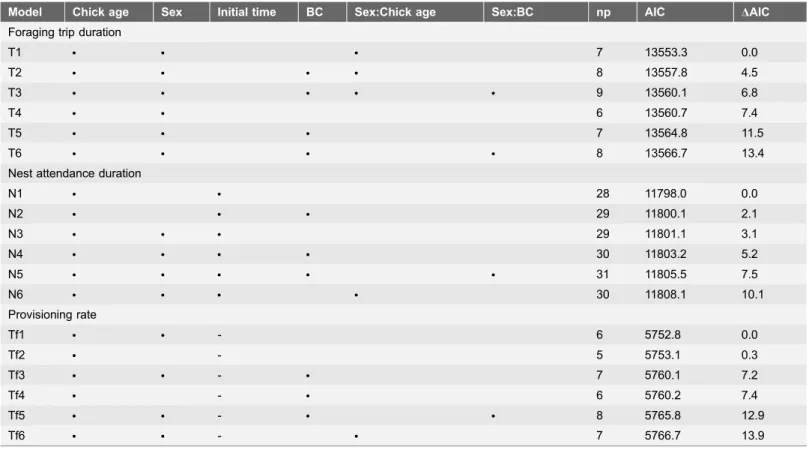
Parental behaviour parameters (foraging trip duration, nest attendance duration and provisioning rate) were not significantly different between the two breeding seasons (LRTs: all p.0.10) and therefore data from both seasons were pooled. Foraging trip duration was best explained by chick age, adult sex and the interaction of adult sex with chick age (Model T1; Table 1). Nest attendance duration was best predicted by chick age, nest arrival time and adult body condition (Models N1 and N2; Table 1). Chick age and adult sex were the best predictors of adult provisioning rate (Models Tf1 and Tf2; Table 1). Residual errors for these models appeared normally distributed. Interaction predictors of adult sex with both time and adult body condition were not supported in the most parsimonious models.
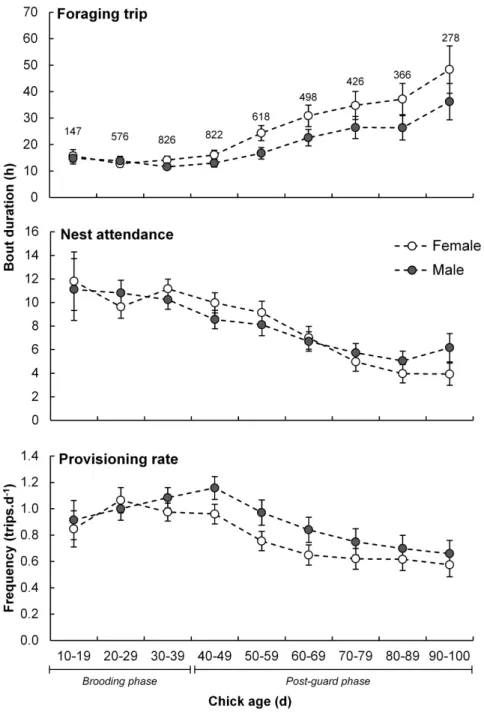
Nest attendance duration decreased with chick age (Fig. 1;Table 2). Provisioning rates were highest when chicks were of an intermediate age and least frequent near fledging, showing an overall decreasing linear trend with chick age (Table 2).
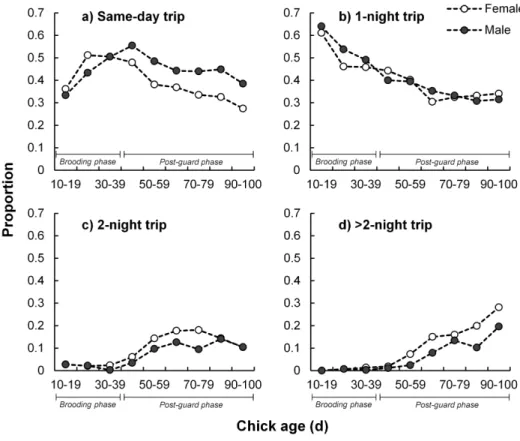
Foraging trip duration was related to adult sex interacting with chick age with females spending longer periods at sea than males (average over chick-rearing period of 24.3¡3.4 versus 17.7¡1.4 h, respectively; Fig. 1), especially when the chicks neared fledging (Table 2). Males made more frequent foraging trips than females (0.95¡0.07 versus 0.84¡0.07 trips.d21; Fig. 1; Table 2). Furthermore, males made a greater proportion of same-day foraging trips than females and this was especially apparent amongst adults attending advanced chicks (Fig. 2;
Table 2). Nest attendance duration did not appear to be a function of sex
(Table 1) although males generally spent longer periods at the nest (9.5¡1.1
versus 8.7¡1.1 h;Fig. 1).
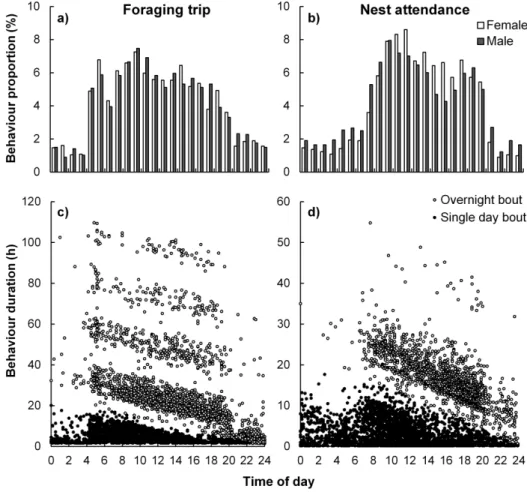
Sex-specific interactions with nest departure and arrival time were not useful in explaining variability in foraging trip or nest attendance durations. Nest departure time peaked between 09:00 and 10:00 (Fig. 3a). Females tended to arrive back at
Table 1.Linear mixed-effects models of Cape gannet behavioural parameters.
Model Chick age Sex Initial time BC Sex:Chick age Sex:BC np AIC DAIC Foraging trip duration
T1 N N N 7 13553.3 0.0
T2 N N N N 8 13557.8 4.5
T3 N N N N N 9 13560.1 6.8
T4 N N 6 13560.7 7.4
T5 N N N 7 13564.8 11.5
T6 N N N N 8 13566.7 13.4
Nest attendance duration
N1 N N 28 11798.0 0.0
N2 N N N 29 11800.1 2.1
N3 N N N 29 11801.1 3.1
N4 N N N N 30 11803.2 5.2
N5 N N N N N 31 11805.5 7.5
N6 N N N N 30 11808.1 10.1
Provisioning rate
Tf1 N N - 6 5752.8 0.0
Tf2 N - 5 5753.1 0.3
Tf3 N N - N 7 5760.1 7.2
Tf4 N - N 6 5760.2 7.4
Tf5 N N - N N 8 5765.8 12.9
Tf6 N N - N 7 5766.7 13.9
These were constructed using log-transformed foraging trip duration (T), nest attendance duration (N) and provisioning rate (Tf) of breeding adult birds at Bird Island, Algoa Bay, as a function of predictor variables: chick age as a continuous number, adult sex, adult sex interacting with chick age, time of bout initiation, adult body condition index (BC) and BC interacting with sex. Number of parameters in each model (np), Akaike Information Criterion (AIC) scores and the AIC difference from the most parsimonious model (DAIC) are shown.
their nests later (peaking between 11:00 and 12:00) than males (peaking between 09:00 and 10:00; Fig. 3b).
As expected, nest arrival time was a highly significant predictor of overall adult nest attendance duration (Table 2;Fig. 4). Birds departing earlier or arriving later generally had longer foraging trip or nest attendance bouts, respectively,
Fig. 1. Sex-specific behavioural parameters of adult Cape gannets at Bird Island, Algoa Bay, as a function of the age of the chicks they are provisioning.Females are represented by white circles and males by dark circles. Total number of foraging trips recorded per chick age category, as well as brooding and post-guard phase of chicks, are indicated.
irrespective of the number of nights away from or at the nest (Fig. 3c and d;
Fig. 4). Departure frequency noticeably increased (between 04:00 and 05:00) after
civil dawn (when the sun is below 6
˚
on the horizon), tapering off by 06:00Table 2.Most-parsimonious linear mixed-effects models of Cape gannet behavioural parameters fitted by restricted maximum likelihood. Foraging trip duration (h) Nest attendance (h) Provisioning rate (trips.d21)
df P (SE) P (SE) P (SE)
Intercept 1 1.78 (0.07) 1.45 (0.54) 0.74 (0.02)
Chick age 1 0.02 (0.001) 20.02 (0.001) 20.004 (0.0003)
SexM 1 0.11 (0.09) - 0.06 (0.02)
Time 23 - seeFigure 4
-Body condition index 1 - 0.16 (0.09)
-SexM:Chick age 1
20.01 (0.002) -
-M: Coefficient reflective of male behaviour.
These used the logarithm of foraging trip duration, nest attendance duration and provisioning rate of breeding adult birds at Bird Island, Algoa Bay, as a function of chick age as a continuous number, adult sex, adult sex interacting with chick age, time of bout initiation and adult body condition index (Model T1, N2 and Tf1;Table 1). Model parameter estimates (P) represent the directional effect of the predictors relative to their reference category. Time is a factor divided into one-hour bins.
doi:10.1371/journal.pone.0116544.t002
Fig. 2. Sex-specific foraging trip length proportions of adult Cape gannets at Bird Island, Algoa Bay as a function of chick age.Same-day (a), one- (b), two- (c) and greater than two-night (d) foraging trips are indicated for female (white circles) and male (dark circles) birds. Brooding and post-guard phase of chicks are indicated.
Fig. 3. Timing of bout initiation and duration for breeding Cape gannets at Bird Island, Algoa Bay.
Proportion (a and b) and duration (c and d) of foraging trip (left) and nest attendance (right) bouts as a function of bout initiation time are indicated. Behaviour proportions are distinguished by sex (males as dark bars and females as white) and behaviour durations according to those which occurred over one or more midnights (white circles) and those which did not extend over any midnights (dark circles). Trip duration is shown for trips which occurred over fewer than five nights (98.4% of all trips).
doi:10.1371/journal.pone.0116544.g003
Fig. 4. Parameter estimates of nest arrival time as a predictor of nest attendance duration for breeding Cape gannets at Bird Island, Algoa Bay.Time is modelled as 24 one-hour bins. Parameter estimates are derived from Model N2,Tables 1and2. Standard error bars as well as day (light squares) and night (dark squares) are indicated.
(roughly 1.5 h after sunrise) and then increasing to a relatively steady level by 07:00 when arrivals to the nest started increasing (Fig. 3a and b). Trips which were initiated between dusk and dawn (n5561; 12.3%) were shorter (8.5¡1.5 h) than those initiated during daylight hours (22.3¡0.8 h) and more frequent following sunset than before sunrise (Fig. 3a).
There was no significant difference in body condition between males and females at the time of VHF deployment (5.89¡0.13 versus 5.90¡0.12 g.mm21; t(2,98)50.04, p50.92), and consequently sexual segregation in adult body condition was not a predictor of adult behavioural parameters (Table 1). Additionally, both overall foraging trip duration and provisioning rate did not appear to be driven by adult body condition (Table 1). However, gannets which were in better body condition spent longer periods of time at their nests (Table 2).
Discussion
Using an extensive data set on foraging trip and nest attendance durations it was here clearly demonstrated that time-activity budgets in a chick-rearing seabird were sex-dependent and linked to chick development. Furthermore, the amount of time that adults were spending at their nests was related to the time of nest arrival, while nest attendance was positively related to body condition. With one exception [27], this represents the first comprehensive analysis of continuous time-activity budget data for a volant seabird through chick development up to fledging. Unlike the study on wandering albatrosses, Diomedea exulans [27], we used coded (rather than multiple-frequency), leg-ring-attached (rather than temporary, tail-feather attachment) VHF transmitters, allowing for fine-scale simultaneous sampling of a large number of study birds which yielded high-resolution, long-term nest attendance data [24].
Sex-related differences
In monomorphic species, inter-sex differences in foraging behaviour are thought to be related to intraspecific competition and resource partitioning or parental investment strategies and requirements [9,55]. Sexual segregation in foraging effort is apparent for both the western [5,25] and southern coast (this study) Cape gannet populations. Longer foraging trip durations by female Cape gannets have been demonstrated before from South Africa’s west coast populations [5,25]. However, foraging trip duration decreased with increasing chick age [5] whereas an opposite trend was evident from the current study (Fig. 1). As the current study’s data extend until fledging, an advantage of VHF-based monitoring [24], the younger chick age at which monitoring ceased [5] likely yielded this
their frequently non-attended chicks (e.g. [5,8]). During this period the likelihood of not observing birds during provisioning bouts increases. These results therefore present a new insight into seabird foraging ecology in the poorly-documented post-guarding stage of a chick’s development.
Data from this study supports the existence of sexual segregation in parental investment strategies in seabirds, particularly as the chick ages. Although females generally return to their nests later than males (Fig. 3b), perhaps suggesting differing foraging locations, it is unlikely that intraspecific competition entirely drives this segregation as females do not have consistently longer foraging trip durations than males (Fig. 1) (sensu [9]). Northern gannets, Morus bassanus do not show sexual dimorphism in foraging trip duration, but are similar to Cape gannets in that both species show sex-specific time-budgets at sea [8,25]. Female northern gannets forage in different areas, make longer, deeper dives and spend more time resting on the sea surface than males [8]. This suggests that female gannets may utilise different resources compared to males to reduce intraspecific competition [5], although not demonstrated in this study.
The cost of bearing an egg may be associated with the longer time that females spend away from the nest and their need to replenish spent resources [15,25,56]. In some alcids the male is solely responsible for chick provisioning in the latter stages of chick development [11,55] whereas in rockhopper penguins, Eudyptes chrysocome the male effectively fasts during brooding while the female provisions their chick and possibly herself [57]. Female Cape gannets have a greater
proportion of longer foraging trips, especially when the chick is older (Fig. 2;
Table 2), suggesting that they might use this period and strategy to replenish their
spent resources associated with egg development [15,58]. In light of this, the disparity in foraging duration would possibly be accentuated through a reduction in prey availability following high levels of prey consumption during the advanced stage of the breeding season [48,59]. Additionally, male Cape gannets appear to work harder towards their chick’s development by foraging more frequently than females as their chick ages (Figs. 1and2; although this does not indicate that the quantity of food provisioned differed between parents as no data was collected on meal size). This has been demonstrated in other bird taxa where the costs of egg production are shifted towards male-dominated chick provisioning [11,13]. Males also spend more time at the nest with the chick while their partner forages, especially when they are in good body condition.
Other drivers of time-activity budgets
foragers at sea increases substantially, increasing the density of birds in the local marine environment. This might enable birds to maintain an efficient foraging network over larger distances [40,62–64]. It is therefore likely that the observed increase in foraging effort (longer trip durations) with chick age is as a response to either or both increased chick demand and local prey depletion or accessibility during the breeding season. Regular acoustic-based prey abundance assessments would be able to assess whether local prey availability diminishes significantly at this site during the course of the Cape gannet breeding season.
Foraging behaviour amongst seabirds is intrinsically linked to body condition [14,65]. Therefore Cape gannets, which were in better condition, expectedly spent more time at their nests, reflecting more discretionary time in their time budget [36,66]. However, there appeared to be no effect of body condition on foraging trip duration or frequency. This assumed that the single measurement of body condition at the time of transmitter deployment was representative of that adult’s relative condition during the entirety of chick provisioning. However, body condition changes throughout the breeding season [5] and therefore these data may not be sensitive to intra-seasonal fluctuations in body condition. Another method of body condition calculation, for example fat deposit measurement using ultra-sound (e.g. [67]), or a continuous measure of adult body condition throughout the breeding season such as automated body mass measurements (e.g. [68]), while minimising handling and disturbance [69], might be more
informative.
Procellariiformes), historically viewed as being visual foragers [72], do
occasionally return to or depart from their nests after dark [27] or use other cues (such as olfaction) to locate their prey [73,74]. Additionally, while not tested in this study, moon phase can have a noticeable influence on nocturnal activity patterns in seabirds [75]. The visually-foraging Cape gannet might utilise nocturnal hours to commute between nearby profitable foraging grounds, thus maximising available daylight hours for active foraging.
Conclusions
The chick-provisioning strategy observed in this study demonstrates an example of gender role shifts where the paternal partner increases its relative reproductive effort as a response to decreased investment by females as offspring near
independence. In addition to sex, the developmental stage of the chick largely influenced foraging effort while adult body condition determined the amount of time allocated to nest attendance. The effect of resource availability on animal breeding behaviour [21] is important in seabirds because their behaviour can be used to indicate the state of prey [31,76]. This has relevance to fisheries
management as behavioural attributes of seabirds can be used as a tool for monitoring prey availability during chick-rearing [2,76]. Clearly a good
understanding of the full spectrum of intrinsic and extrinsic influences of seabird behaviour would need to underpin such an approach. The automated VHF system provides a continuous measure of colonial animal behaviour on which the effects of predictor variables can be tested [24]. Linking fine-scale time-activity budget data to acoustic survey data on epipelagic prey, while accounting for the
influences of sex and chick developmental stage, would be the next step forward.
Acknowledgments
South African National Parks (SANParks) is thanked for providing logistical support and accommodation on Bird Island. Peter Ryan is thanked for his comments on an earlier version of this paper. We are also thankful to Samantha Patrick and an anonymous reviewer for their useful comments that helped improve the manuscript.
Author Contributions
Conceived and designed the experiments: GMR YT PAP. Performed the experiments: GMR DBG MC PAP. Analyzed the data: GMR YT. Contributed reagents/materials/analysis tools: YT PAP. Wrote the paper: GMR YT DBG MC PAP. Designed the software interface used in raw-data processing: YT.
References
2. Harding AMA, Piatt JF, Schmutz JA (2007) Seabird behavior as an indicator of food supplies: sensitivity across the breeding season. Marine Ecology Progress Series 352: 269–274.
3. Shaffer SA, Costa DP, Weimerskirch H (2003) Foraging effort in relation to the constraints of reproduction in free-ranging albatrosses. Functional Ecology 17: 66–74.
4. Bell G(1980) The costs of reproduction and their consequences. American Naturalist 116: 45–76.
5. Mullers RHE,d Tinbergen JM(2009) Parental provisioning behaviour predicts survival of Cape gannet chicks under poor conditions. Ardea 97: 89–98.
6. Trivers R(1972) Parental investment and sexual selection. In: B Campbell, , editor. Sexual Selection and the Descent of Man. Chicago: Aldine. pp. 136–179.
7. Bijleveld AI, Mullers RHE(2009) Reproductive effort in biparental care: an experimental study in long-lived Cape gannets. Behavioral Ecology 20: 736–744.
8. Lewis S, Benvenuti S, Dall’Antonia L, Griffiths R, Money L, et al. (2002) Sex-specific foraging behaviour in a monomorphic seabird. Proceedings of the Royal Society of London Series B: Biological Sciences 269: 1687–1693.
9. Welcker J, Steen H, Harding AMA, Gabrielsen GW(2009) Sex-specific provisioning behaviour in a monomorphic seabird with a bimodal foraging strategy. Ibis 151: 502–513.
10. Lewis S, Schreiber EA, Daunt F, Schenk GA, Orr K, et al.(2005) Sex-specific foraging behaviour in tropical boobies: does size matter? Ibis 147: 408–414.
11. Harding AMA, Van Pelt TI, Lifjeld JT, Mehlum F(2004) Sex differences in little aukAlle alleparental care: transition from biparental to paternal-only care. Ibis 146: 642–651.
12. Phillips RA, Silk JRD, Phalan B, Catry P, Croxall JP (2004) Seasonal sexual segregation in two
Thalassarchealbatross species: competitive exclusion, reproductive role specialization or foraging niche divergence? Proceedings of the Royal Society of London Series B: Biological Sciences 271: 1283–1291.
13. Catry P, Phillips RA, Croxall JP, Ruckstuhl K, Neuhaus P (2006) Sexual segregation in birds: patterns, processes and implications for conservation. In: KE Ruckstuhl, Neuhaus P, editors. Sexual segregation: ecology of the two sexes. Cambridge, UK: Cambridge University Press. pp. 351–378.
14. Weimerskirch H(1998) How can a pelagic seabird provision its chick when relying on a distant food resource? Cyclic attendance at the colony, foraging decision and body condition in sooty shearwaters. Journal of Animal Ecology 67: 99–109.
15. Weimerskirch H, Cherel Y, Cuenot-Chaillet F, Ridoux V(1997) Alternative foraging strategies and resource allocation by male and female wandering albatrosses. Ecology 78: 2051–2063.
16. Sandberg R, Moore FR (1996) Fat stores and arrival on the breeding grounds: reproductive consequences for passerine migrants. Oikos 77: 577–581.
17. Pinaud D, Weimerskirch H(2002) Ultimate and proximate factors affecting the breeding performance of a marine top-predator. Oikos 99: 141–150.
18. Bolnick DI, Svanba¨ck R, Fordyce JA, Yang LH, Davis JM, et al.(2003) The ecology of individuals: incidence and implications of individual specialization. American Naturalist 161: 1–28.
19. Clutton-Brock T, Sheldon BC (2010) Individuals and populations: the role of long-term, individual-based studies of animals in ecology and evolutionary biology. Trends in Ecology and Evolution 25: 562– 573.
20. Sommerfeld J, Kato A, Ropert-Coudert Y, Garthe S, Hindell MA(2013) The individual counts: within sex differences in foraging strategies are as important as sex-specific differences in masked boobies
Sula dactylatra. Journal of Avian Biology 44: 531–540.
21. Cuthill IC, Houston AI(1997) Managing time and energy. In: Krebs JR, Davies NB, editors. Behavioural ecology: An evolutionary approach. Malden, U.S.A.: Blackwell Publishing. pp. 97–120.
22. McNamara JM, Houston AI (2009) Integrating function and mechanism. Trends in Ecology and Evolution 24: 670–675.
23. Nelson JB(1978) African or Cape gannet. In: JB Nelson, editor. The Sulidae Gannets and boobies. Oxford: Oxford University Press. pp. 231–265.
25. Mullers RHE, Navarro RA(2010) Foraging behaviour of Cape gannets as an indicator of colony health status. Endangered Species Research 12: 193–202.
26. Pichegru L, Ryan PG, van der Lingen CD, Coetzee J, Ropert-Coudert Y, et al. (2007) Foraging behaviour and energetics of Cape gannetsMorus capensisfeeding on live prey and fishery discards in the Benguela upwelling system. Marine Ecology Progress Series 350: 127–136.
27. Weimerskirch H, Lys P(2000) Seasonal changes in the provisioning behaviour and mass of male and female wandering albatrosses in relation to the growth of their chick. Polar Biology 23: 733–744.
28. Crawford RJM, Dundee BL, Dyer BM, Klages NTW, Meyer MA, et al.(2007) Trends in numbers of Cape gannets (Morus capensis), 1956/1957–2005/2006, with a consideration of the influence of food and other factors. ICES Journal of Marine Science 64: 169–177.
29. Orians GH, Pearson NE(1979) On the theory of central place foraging. In: Horn D, Mitchell R, Stairs G, editors. Analysis of ecological systems. Columbus, OH: Ohio State University Press. pp. 154–177.
30. Klages NTW(1994) Dispersal and site fidelity of Cape gannetsMorus capensis. Ostrich 65: 218–224.
31. Durant JM, Hjermann DØ, Frederiksen M, Charrassin JB, Le Maho Y, et al.(2009) Pros and cons of using seabirds as ecological indicators. Climate Research 39: 115–129.
32. Monaghan P (1996) Relevance of the behaviour of seabirds to the conservation of marine environments. Oikos 77: 227–237.
33. Cairns DK(1987) Seabirds as indicators of marine food supplies. Biological Oceanography 1987: 261– 271.
34. Cairns DK, Bredin KA, Montevecchi WA (1987) Activity budgets and foraging ranges of breeding common murres. Auk 104: 218–224.
35. Kadin M, O¨ sterblom H, Hentati-Sundberg J, Olsson O(2012) Contrasting effects of food quality and quantity on a marine top predator. Marine Ecology Progress Series 444: 239–249.
36. Litzow MA, Piatt JF(2003) Variance in prey abundance influences time budgets of breeding seabirds: evidence from pigeon guillemotsCepphus columba. Journal of Avian Biology 34: 54–64.
37. Thaxter CB, Daunt F, Hamer KC, Watanuki Y, Harris MP, et al.(2009) Sex-specific food provisioning in a monomorphic seabird, the common guillemotUria aalge: nest defence, foraging efficiency or parental effort? Journal of Avian Biology 40: 75–84.
38. Gre´millet D, Charmantier A(2010) Shifts in phenotypic plasticity constrain the value of seabirds as ecological indicators of marine ecosystems. Ecological Applications 20: 1498–1503.
39. Lewis S, Sherratt TN, Hamer KC, Wanless S(2001) Evidence of intra-specific competition for food in a pelagic seabird. Nature 412: 816–819.
40. Tremblay Y, Thiebault A, Mullers R, Pistorius P(2014) Bird-borne video-cameras show that seabird movement patterns relate to previously unrevealed proximate environment, not prey. PLoS ONE 9: e88424.
41. Wakefield ED, Bodey TW, Bearhop S, Blackburn J, Colhoun K, et al.(2013) Space partitioning without territoriality in gannets. Science 341: 68–70.
42. Lewis S, Hamer KC, Money L, Griffiths R, Wanless S, et al.(2004) Brood neglect and contingent foraging behavior in a pelagic seabird. Behavioral Ecology and Sociobiology 56: 81–88.
43. Lewis S, Schreiber EA, Daunt F, Schenk GA, Wanless S, et al.(2004) Flexible foraging patterns under different time constraints in tropical boobies. Animal Behaviour 68: 1331–1337.
44. Gre´millet D, Dell’Omo G, Ryan PG, Peters G, Ropert-Coudert Y, et al.(2004) Offshore diplomacy, or how seabirds mitigate intra-specific competition: a case study based on GPS tracking of Cape gannets from neighbouring colonies. Marine Ecology Progress Series 268: 265–279.
45. Lewis S, Gre´millet D, Daunt F, Ryan PG, Crawford RJM, et al.(2006) Using behavioural and state variables to identify proximate causes of population change in a seabird. Oecologia 147: 606–614.
46. Batchelor AL, Ross GJB(1984) The diet and implications of dietary change of Cape gannets on Bird Island, Algoa Bay. Ostrich 55: 45–63.
48. Mullers RHE, Navarro RA, Underhill LG, Visser GH(2007) Breeding in a dynamic system: intra- and inter-seasonal variability in foraging behaviour and chick growth of Cape Gannets. In: SP Kirkman, editor. Final report of the BCLME (Benguela Current Large Marine Ecosystem) project on top predators as biological indicators of ecosystem change in the BCLME. Cape Town, South Africa: Avian Demography Unit, University of Cape Town. pp. 155–162.
49. Rishworth GM, Connan M, Green DB, Pistorius PA(2014) Sex differentiation based on the gular stripe in the apparently monomorphic Cape gannet. African Zoology 49: 107–112.
50. Mullers RHE, Navarro RA, Crawford RJM, Underhill LG(2009) The importance of lipid-rich fish prey for Cape gannet chick growth: are fishery discards an alternative? ICES Journal of Marine Science 66: 2244–2252.
51. Jarvis MJF(1971) Ethology and ecology of the South African Gannet,Sula capensis. University of Cape Town.
52. Posada D, Buckley TR(2004) Model selection and model averaging in phylogenetics: advantages of Akaike Information Criterion and Bayesian approaches over Likelihood Ratio Tests. Systematic Biology 53: 793–808.
53. Burnham KP, Anderson DR(2002) Model selection and multimodel inference: a practical information-theoretic approach (2nd ed.). New York: Springer. 488 p.
54. Zuur AF, Ieno EN, Walker NJ, Saveliev AA, Smith GM(2009) Mixed effects models and extensions in ecology with R. New York: Springer. 574 p.
55. Elliott KH, Gaston AJ, Crump D(2010) Sex-specific behavior by a monomorphic seabird represents risk partitioning. Behavioral Ecology 21: 1024–1032.
56. Hatch SA(1990) Time allocation by northern fulmarsFulmarus glacialisduring the breeding season. Ornis Scandinavica 21: 89–98.
57. Tremblay Y, Cherel Y(2003) Geographic variation in the foraging behaviour, diet and chick growth of rockhopper penguins. Marine Ecology Progress Series 251: 279–297.
58. Monaghan P, Nager RG(1997) Why don’t birds lay more eggs? Trends in Ecology and Evolution 12: 270–274.
59. Furness RW, Birkhead TR(1984) Seabird colony distributions suggest competition for food supplies during the breeding season. Nature 311: 655–656.
60. Dall’Antonia L, Gudmundsson GA and Benvenuti S(2001) Time allocation and foraging pattern of chick-rearing razorbills in Northwest Iceland. Condor 103: 469–480.
61. Adams NJ, Abrams RW, Siegfried WR, Nagy KA, Kaplan IR(1991) Energy expenditure and food consumption by breeding Cape gannetsMorus capensis. Marine Ecology Progress Series 70: 1–9.
62. Thiebault A, Mullers R, Pistorius P, Meza-Torres MA, Dubroca L, et al.(2014) From colony to first patch: processes of prey searching and social information in Cape gannets. Auk 131: 595–609.
63. Thiebault A, Mullers RHE, Pistorius PA, Tremblay Y(2014) Local enhancement in a seabird: reaction distances and foraging consequence of predator aggregations. Behavioral Ecology 25: 1302–1310.
64. Thiebault A, Tremblay Y (2013) Splitting animal trajectories into fine-scale behaviorally consistent movement units: breaking points relate to external stimuli in a foraging seabird. Behavioral Ecology and Sociobiology 67: 1013–1026.
65. Jo¨nsson KI(1997) Capital and income breeding as alternative tactics of resource use in reproduction. Oikos 78: 57–66.
66. Burger AE, Piatt JF(1990) Flexible time budgets in breeding common murres: buffers against variable prey abundance. Studies of Avian Biology 14: 71–83.
67. Moseley C, Gre´millet D, Connan M, Ryan PG, Mullers RHE, et al.(2012) Foraging ecology and ecophysiology of Cape gannets from colonies in contrasting feeding environments. Journal of Experimental Marine Biology and Ecology 422–423: 29–38.
68. Le Maho Y, Gendner JP, Challet E, Bost CA, Gilles J, et al.(1993) Undisturbed breeding penguins as indicators of changes in marine resources. Marine Ecology Progress Series 95: 1–6.
70. Ropert-Coudert Y, Gre´millet D, Kato A, Ryan PG, Naito Y, et al.(2004) A fine-scale time budget of Cape gannets provides insights into the foraging strategies of coastal seabirds. Animal Behaviour 67: 985–992.
71. Garthe S, Benvenuti S, Montevecchi WA(2003) Temporal patterns of foraging activities of northern gannets,Morus bassanus, in the northwest Atlantic Ocean. Canadian Journal of Zoology 81: 453–461.
72. Weimerskirch H, Wilson RP (1992) When do wandering albatrosses Diomedea exulans forage? Marine Ecology Progress Series 86: 297–300.
73. Reynolds AM(2012) Olfactory search behaviour in the wandering albatross is predicted to give rise to Le´vy flight movement patterns. Animal Behaviour 83: 1225–1229.
74. Nevitt GA, Veit RR, Kareiva P(1995) Dimethyl sulfide as a foraging cue for Antarctic procellariiform seabirds. Nature 376: 680–682.
75. Pinet P, Jaeger A, Cordier E, Potin G, Le Corre M (2011) Celestial moderation of tropical seabird behavior. PLOS ONE 6: e27663.