Lantana camara L., a member of family Verben-aceae, is an evergreen, aromatic weed, native to tropi-cal America, but it is now cultivated in many other parts of the world [Raghu et al. 2004]. Almost all parts
of this plant have been used traditionally for treatment of several ailments due to their multiple biological ac-tivities such as anthelmintic [Patel et al. 2011], bechic, anti-leukemia [Badakhshan et al. 2009], larvicidal
VARIATION IN ANTIOXIDANT AND ANTIMICROBIAL ACTIVITIES
IN
LANTANA CAMARA
L. FLOWERS IN RELATION TO EXTRACTION
METHODS
Madiha Manzoor
1, Farooq Anwar
2, Bushra Sultana
1, Muhammad Mushtaq
11Department of Chemistry and Biochemistry, University of Agriculture
Faisalabad-38040, Pakistan
2Department of Chemistry, University of Sargodha
Sargodha-40100, Pakistan
ABSTRACT
Background. The present work was designed to appraise how different extraction solvents and techniques
affect the extractability of antioxidant and antimicrobial components from Lantana camara (L. camara) fl owers.
Material and methods. Four extraction solvents including 100% methanol, 80% methanol, 100% ethanol
and 80% ethanol coupled with three extraction techniques namely stirring, microwave-assisted stirring and ultrasonic-assisted stirring employed to isolate extractable components from the fl owers of L. camara. The extracts produced were evaluated for their antioxidant and antimicrobial attributes.
Results and discussion. The yield of extractable components varied over a wide range 4.87-30.00% in
relation to extraction solvent and techniques. The extracts produced contained considerable amounts of total phenolics (8.28-52.34 mg GAE/100 g DW) and total fl avonoids (1.24-7.88 mg CE/100 g DW). Furthermore, a promising antioxidant activity in terms of DPPH° scavenging, inhibition of linoleic acid peroxidation and reducing power, as well as antimicrobial potential of the extracts were recorded against the selected bacterial and fungal strains.
Conclusions. It was concluded that both extraction solvent and techniques employed affected the antioxidant
and antimicrobial attributes of the extracts from L. camarafl owers. With few exceptions, overall methanolic extracts produced by ultrasonic-assisted stirring offered superior activities followed by the microwave-as-sisted stirring and then stirring. The results advocate the use of appropriate extraction strategies to recover potent antioxidant and antimicrobial agents from the fl owers of L. camara for nutraceutical and therapeutic uses.
Key words: Lantana camara, extractable components, total phenolics, total fl avonoids, effective extraction,
radical scavenging
[Kumar and Maneemegalai 2008], antioxidant [Bhak-ta and Ganjewala 2009], antibacterial [Ganjewala et al. 2009], antiproliferative [Gomes-de Melo et al. 2010], antiulcerogenic [Thamotharan et al. 2010], hemolytic [Kalita et al. 2011], antimutagenic activity, antihyper-tensive [Kaur et al. 2010] and hepatoprotective activi-ties [Abou El-Kassem et al. 2012]. Most importantly, the fl ower extracts of L. camara are used in folk medi-cine for the management of several disorders includ-ing cancers, asthma, tumors, bilious fevers, chicken pox, eczema, measles, ulcers, swellings, high blood pressure, catarrhal infections, rheumatism, tetanus, malaria and abdominal viscera [Ghisalberti 2000, Day et al. 2003]. These medicinal properties and therapeu-tic uses of this herb are attributed to the presence of several triterpenoids, napthaquinones, fl avonoids, al-kaloids and glycosides with diverse biological activi-ties [Raghu et al. 2004, Anwar et al. 2013].
Recently, there is a revival of interest in the use of plants as natural remedy for medication of sev-eral health disorders due to the reason that they pos-sess multiple biological activities, compatibility with system biology, potential physiological functions and protective role against several degenerative diseases [Suhaj 2006, Iqbal and Bhanger 2007, Tadhani et al. 2007, Espin et al. 2007, Wolfe et al. 2009, Lifschitz 2012, Gaweł 2012].
The extraction of antioxidant components from a plant material is a crucial step so as to accomplish further fractionation, isolation, purifi cation and charac-terisation of biologically active compounds. A variety of extraction techniques such as orbital shaker, stirring, accelerated solvent extraction, microwave assisted ex-traction and supercritical fl uid extraction etc., are in use to recover antioxidant and nutraceutical components from plant matrices [Wang and Weller 2006, Shabbir et al. 2011, Sultana et al. 2009, Mariod et al. 2012, An-war and Przybylski 2012]. All techniques have some advantages and disadvantages over others, but none of these is claimed to be perfect in all aspects.
In view of the above-mentioned reports, this study was planned to explore the availability of potent phe-nolic antioxidants as well as antimicrobial agents of
L. camara fl owers using different extraction tech-niques and solvents with the major aim to devise an appropriate extraction strategy for isolation of potent antioxidant and antimicrobial extracts.
MATERIAL AND METHODS
Collection of samples
Flowers of L. camara were collected from the vicinity of the University of Agriculture, Faisalabad and further identifi ed and authenticated by Dr. Man-soor Hameed, Department of Botany, University of Agriculture, Faisalabad. The fl owers were manually washed with distilled water and dried under ambient conditions.
Reagents and standards
All the standard antibiotic and culture media were purchased from Oxoid Ltd. (Hampshire, UK). 2,2-di-phenyl-1-picrylhydrazyl (DPPH), butylated hydroxy-toluene (BHT) (99.0% ascorbic acid, trichloro-acetic acid, catechin, gallic acid, Folin-Ciocalteu reagent, sodium nitrite, aluminium chloride, ferric chloride, potassium ferricyanate, linoleic acid and various refer-ence chemicals were purchased from Sigma Chemical Co. (St. Louis, MO, USA). All other chemicals such as anhydrous sodium carbonate, ferrous chloride, am-monium thiocyanate, chloroform, ethanol and metha-nol of analytical grade were purchased from Merck (Darmstadt, Germany), unless stated otherwise.
Extracting solvents
The dried fl ower samples of L. camara were ground into a fi ne powder (80-mesh) using a blender (Anix, Germany). Four solvent systems, 100% meth-anol, 80% methanol (methanol:water, 80:20 v/v), 100% ethanol and 80% ethanol (ethanol:water, 80:20 v/v) were employed for the extraction of antioxidant components.
Extraction techniques
same practice. The pooled extracts were freed of sol-vent at 45°C under reduced pressure, using a rotary evaporator (EYELA, SB-651, Rikakikai Co. Ltd. To-kyo, Japan) and stored at –4°C until used for analy-ses. The percent yield of extracts was determined gravimetrically.
Total phenolic content (TPC)
The total phenolic contents (TPC) in the L. camara
fl ower extracts were estimated following the slightly modifi ed Folin-Ciocalteu reagent method [Chaovana-likit and Wrolstad 2004]. Briefl y, crude extract (50 mg) of each extract was mixed with Folin-Ciocalteu rea-gent (0.5 mL), diluted with deionized water (7.5 mL), incubated at room temperature for 10 min and then mixed with 20% sodium carbonate (1.5 mL) solu-tion. The mixture was heated at 40°C (water bath) for 20 min, cooled and absorbance measured at 755 nm (U-2001, Hitachi Instruments Inc., Tokyo, Japan) to calculate the amount of TP as gallic acid equivalents using a standard curve within range of 10-100 ppm (R2 = 0.9986).
Total fl avonoid contents (TFC)
Total fl avonoid contents (TFC) in L. camarafl ow-er extracts wow-ere detow-ermined by the spectrophotomet-ric method as previously described by Dewanto et al. [2002]. Briefl y, 1 mL (0.1 mg/mL) of each extract was diluted with 4 mL of water. To this mixture 0.3 mL of 5% NaNO2, 0.3 mL of 10% AlCl3 and 2 mL of 1.0 M NaOH were added at 5, 6 and 10 min, respectively. The mixture was then diluted with water (2.4 mL) and absorbance read at 510 nm to calculate TFC (g/100 g of DW) as catechin equivalents (CE).
DPPH° Scavenging assay
The 2,2-diphenyl-1-picrylhydrazyl radical (DPPH) scavenging potential of biological components ex-tracted from L. camarafl owers was evaluated spec-trophotometrically as described by Tepe et al. [2006]. Aliquots (50 μl) of the extract samples at various con-centrations (10-100 μg/ml) were mixed with 5 ml of 0.004% methanol solution of DPPH, incubated for 30 min at room temperature and then absorbance re-corded at 517 nm against a blank. Scavenging (%) of DPPH° by different extracts was calculated by the fol-lowing formula:
I (%) = 100 × (Ablank – Asample/Ablank)
Where Ablank and Asample denote the absorbance of con-trol and test compounds, respectively.
Antioxidant activity in linoleic acid system The antioxidant activity of L. camara fl ower ex-tracts was also assessed in terms of measurement of percentage inhibition of peroxidation using linoleic acid system as documented earlier by Iqbal et al. [2007]. Accurately weighed 5 mg extract was trans-ferred to a mixture of 0.13 mL linoleic acid, 10 mL ethanol (99.8%) and 10 mL 0.2 M sodium phosphate buffer (pH 7). The resulting solution was diluted to 25 mL with deionised water. The mixture was incu-bated at 40°C for 175 h and the extent of oxidation was monitored by the following equation:
100 – [(Abs. increase of sample at 175 h / Abs. increase of control at 175 h) × 100]
Determination of reducing power
The reducing power of different extracts of L. ca-mara fl owers was assessed using the procedure re-ported by Yen et al. [2007] with slight modifi cations. Briefl y, 2.5-10.0 mg extract was mixed with 5.0 mL of 0.2 M sodium phosphate buffer (pH 6.6) and potas-sium ferricyanide (1.0%), and incubated the mixture at 50°C for 20 min. Then, 5 mL of trichloroacetic acid (10%) were added, centrifuged at 5°C in a refriger-ated centrifuge machine at 980 X gfor 10 min (CHM--17; Kokusan Denki, Tokyo, Japan). The supernatant (5.0 mL) was collected, decanted, diluted with 5.0 mL of distilled water, mixed with 1.0 mL ferric chloride (0.1%) and absorbance read at 700 nm using a spectro-photometer (U-2001, Hitachi Instruments Inc., Tokyo, Japan).
Antimicrobial activity
The antimicrobial activity of L. camara fl ower ex-tracts against four bacterial strains: Escherichia coli,
Staphylococcus aureus, Pasturella multocida, and Ba-cillus subtilis, and four pathogenic fungi: Aspergillus
were infused with 30 mg/mL of different extracts placed on the inoculated agar. Antibiotics; Amoxycillin and Flumequine (30 μg/disc) were used as positive control for bacteria and fungi, respectively, whereas a disc with-out samples was used as a negative control.
All the extracts of L. camara fl owers were tested in Nutrient broth (NB) and Sabouraud dextrose broth (SDB) supplemented with Tween-80 detergent to a fi -nal concentration of 0.5% (v/v) for bacteria and fungi, respectively. Growth control (NB/SDB + Tween 80), sterility control (NB/SDB + Tween-80 + test oil) and 20 μL of the test solution were added to 96 well mi-croplates having 160 μL NB and SDB for bacteria and fungi, respectively. The microplates were inoculated with 20 μL (5 × 10⁵ CFU/mL (colony forming units) of standard microorganism suspension and incubated for 24 h at 37°C ( bacteria) and 30°C (fungi).
Statistical analysis
All the data acquisition tests were conducted in triplicate and statistical analyses including one-way ANOVA were performed using Microsoft Excell 2010 and Minitabl 13 portable (Minitab Inc., State College, PA) with probability value of p ≤ 0.05 considered to be statistically signifi cant.
RESULTS AND DISCUSSION
Extract yield
The quantity of available antioxidant compo-nents from a plant depends on the nature of solvent,
components and target material, as well as on their assimilation during extraction procedure [Hsu et al. 2006]. In the present work, we used methanol and ethanol (100 and 80%, respectively) as extraction media and magnetic stirring (MS), ultrasonic assist-ed magnetic stirring (UMS) and microwave assistassist-ed magnetic stirring (MMS) as extraction techniques to extract biologically active components from L. ca-mara fl owers. The percentage yield (g/100 g of dry weight) of extractable components from L. camara
fl owers varied signifi cantly in relation to extraction solvents and techniques employed. A maximum yield of extract (30.00%) was obtained with 80% aqueous methanol using UMS, while the minimum (4.87%) in the case of 100% ethanol with MS (Table 1). The variation in percentage extract yields might be attrib-uted to the nature and polarity of extraction solvent, as well as the effi cacy of extraction technique towards solubilization and recovery of extractable components [Sultana et al. 2009, Hsu et al. 2006]. Based on the extract yield data, the overall extraction potential of the tested solvents/techniques followed the order: 80% methanol UMS > 80% ethanol MMS > 100% methanol UMS > 80% ethanol MMS > 80% ethanol MS > 80% methanol UMS > 100% methanol MMS > 100% methanol MS > 100% ethanol UMS > 80% methanol MS > 100% ethanol MMS > 100% etha-nol MS. The UMS technique with both solvents was found to be much effi cient among others that might be linked to its better effi cacy towards rupturing plant cell walls, facilitating solvent access to the cell contents,
Table 1. Percentage yield of L. camarafl ower extracts, g/100 g of dry weight
Solvent system
Extraction techniques
magnetic stirring (MS) microwave assisted magnetic
stirring (MMS)
ultrasonic assisted magnetic stirring (UMS)
100% methanol 17.13 ±0.34A
a 17.00 ±0.34
C
a 21.53 ±0.46
B b
100% ethanol 4.87 ±0.14 C
b 9.87 ±0.39
D
a 15.00 ±0.20
D b
80% methanol 14.60 ±0.59B
c 19.53 ±0.56
B
b 30.00 ±0.60
A a
80% ethanol 18.87 ±0.46A
b 21.87 ±0.44
A
a 18.53 ±0.37
C b
Values (mean ±SD) are average of three samples analysed individually in triplicate. Small alphabets in subscript
within the same row show signifi cant difference at P < 0.05 among extraction techniques. Upper case alphabets in
enhanced mass transfer and provision of high contact surface area between the material and the liquid phase [Novak et al. 2008]. Our present trends revealing best effi cacy of aqueous methanol (80% methanol) in con-junction with UMS offering highest extract yield can be supported by the results of Sun et al. [2011] who observed that ethanol coupled with ultrasonic is more effi cient than the classical extraction system.
Total phenolic contents (TPC)
Total phenolic contents (TPC) of extracts from
L. camara fl owers produced by different extraction solvents and technique ranged from 8.28-52.34 mg GAE/100 g DW (Table 2). The 80% aqueous metha-nol when used with UMS (80% methametha-nol-UMS) ex-tracted the highest TP (52.34 mg/100 g DW), while the lowest (8.28 mg/100 g DW) was observed in the case when 100% ethanol was employed with magnetic stir-ring (100% – MS). This variability in TPC available from the fl owers of L. camara for different solvents
and extraction practices in the present study might be attributed to varying degree of effectiveness of the ex-traction technique, as well as the solvent employed. The 80% methanol-UMS might have recovered high-est amount of total phenolics due to improved cell wall rupturing, better chemical solubilization, fa-cilitated solvent access to the cell contents, enhanced mass transfer and higher contact surface area between both extraction phases during ultrasonication (REFS). Higher recovery of phenolics in the case of 80% methanol-UMS during the present experiments is in accordance with the earlier literature reports [Ghafoor et al. 2009, Khan et al. 2010].
Total fl avonoids contents (TFC)
Total fl avonoid contents (TFC) of different ex-tracts from L. camara fl owers ranged from 1.24-7.88 (mg CE/100 g DW). Aqueous methanol (80%) when used along with UMS gave maximum TFC (7.88 mg/100 g DW), while minimum (1.24 mg/100 g DW)
Table 2. Total phenolic content (TPC) of L. camarafl owers, mg GAE/100 g DW
Solvent system
Extraction technique
MS MMS UMS
100% methanol 33.57 ±0.67A
a 22.10 ±0.66
C
b 24.90 ±0.48
B b
100% ethanol 8.28 ±0.25D
b 12.00 ±0.30
D
a 15.70 ±1.71
D b
80% methanol 25.40 ±1.02B
b 52.20 ±1.57
A
a 52.34 ±1.56
A a
80% ethanol 11.70 ±0.23C
b 37.61 ±1.50
B
a 13.34 ±0.53
C b
Explanations as in Table 1.
Table 3. Total fl avonoid contents (TFC) of L. camarafl owers, mg CE/100 g DW
Solvent system
Extraction technique
MS MMS UMS
100% methanol 4.36 ±0.08A
b 3.31 ±0.06
C
a 3.74 ±0.07
B a
100% ethanol 1.24 ±0.04B
b 2.25 ±0.04
D
a 2.85 ±0.03
B c
80% methanol 3.81 ±0.15A
b 7.85 ±0.24
A
a 7.88 ±0.16
A a
80% ethanol 1.76 ±0.07B
b 5.64 ±0.22
B
a 2.60 ±0.08
B b
with absolute ethanol during MS. Total fl avonoid con-tents of L. camara fl ower extracts were lower than those present in Boerhaavia diffusa (9.20 mg/100 g) [Olaleye et al. 2010], however, these values are within the range of green tea (2.37 and 22.5 mg CE/100 g) [Tsai et al. 2008]. A higher level of TFC in the UMS produced extracts during the present analysis is in agreement with previous studies by Ghafoor et al.
[2009] and Khan et al. [2010]. DPPH radical scavenging assay
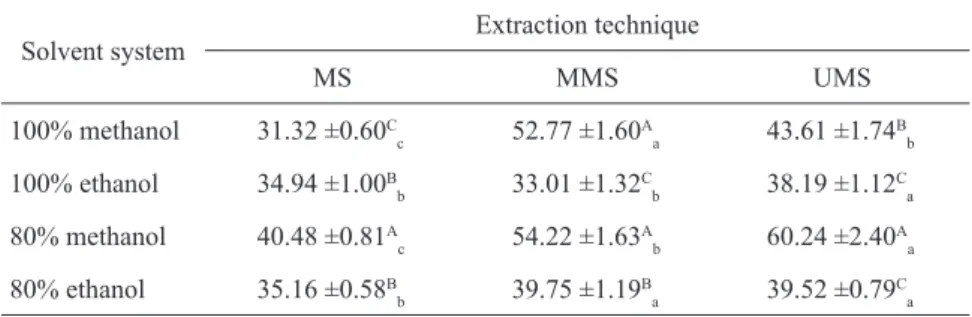
Antiradical activity of the L. camara fl ower ex-tracts was assessed by investigating their potential to scavenge DPPH° and found to be 31.32-60.24% (Table 4). Highest DPPH radical scavenging capacity (60.24%) was noted for the UMS produced aqueous methanol extract (60.24%), while the lowest by the MS absolute methanol extract (31.32%). The varia-tion in DPPH° scavenging ability of L. camara fl ower extracts in relation to different extraction solvents and techniques might be related to the availability of
biologically active components as function of extrac-tion media.
When compared with sole related studies, the pres-ently recorded radical scavenging activity of L. ca-marafl ower extracts was found to be lower than that of leaves of Salvia miltiorrhiza (70%) [Zhang et al. 2010], however, it was greater than that of peanut skins (31.5-32.59%) as reported by Nepote et al. [2002].
Antioxidant activity in linoleic acid system
The inhibition of linoleic acid peroxidation by the extracts varied over a wide range 40.85-72.00% versus butylated hydroxyl toluene (BHT) being used as a positive control (90.76%). The extract of L. ca-mara fl owersobtained using 80% aqueous methanol and UMS showed the highest inhibition (72.00%) of linoleic acid peroxidation, whereas the lowest for MS produced using 100% ethanol.
Overall, the results of the present study indi-cated that methanol solvent extraction accomplished with UMS offered highest inhibition of linoleic acid
Table 5. Percentage inhibition of peroxidation activity of L. camarafl ower extracts
Solvent system
Extraction technique
MS MMS UMS
100% methanol 43.00 ±0.90Cc 47.14 ±1.48Cb 49.71 ±1.22Ca
100% ethanol 40.85 ±1.43Cb 42.86 ±2.11Db 48.57 ±1.74Ca
80% methanol 45.00 ±1.80Bc 56.43 ±1.13Ab 72.00 ±1.50Aa
80% ethanol 51.29 ±2.07Aa 52.86 ±1.28Bb 62.14 ±1.04Ba
Explanations as in Table 1.
Table 4. DPPH° radical scavenging activity of L. camarafl ower extracts
Solvent system
Extraction technique
MS MMS UMS
100% methanol 31.32 ±0.60C
c 52.77 ±1.60
A
a 43.61 ±1.74
B b
100% ethanol 34.94 ±1.00B
b 33.01 ±1.32
C
b 38.19 ±1.12
C a
80% methanol 40.48 ±0.81A
c 54.22 ±1.63
A
b 60.24 ±2.40
A a
80% ethanol 35.16 ±0.58B
b 39.75 ±1.19
B
a 39.52 ±0.79
C a
peroxidation among others. The same behaviour of an-tioxidant activity in linoleic acid system was observed by Toma et al. [2001] who revealed that ultrasonic-as-sisted extraction considerably increased the recovery of potent antioxidant components.
Reducing power
The reducing potential of extracts (2.5-7.5 mg/mL) from the fl owers of L. camara yielded by different ex-traction solvents and techniques (in terms of absorb-ance data) varied between 0.549 and 0.781 (Table 6) showing a concentration dependent trend. Aqueous ethanol (80% ethanol) extract yielded UMS exhib-ited the highest reducing power while the lowest for absolute ethanol extract with MS. Furthermore, the reducing potential shown by L. camara fl ower ex-tracts (0.343 to 0.781) was found to be greater than anise (Pimpinella anisum L.) seed extracts (0.276) as explored by Gulcin et al. [2003], however, slightly
lower than that investigated by Chen et al. [2007] for aqueous methanol extracts of Psidium guajava leaves (0.820).
Antimicrobial activity
The results for antimicrobial activity of different extracts from L. camarafl owers against selected food-borne and pathogenic bacteria and fungi are presented in Tables 7-8. The results show that all the extracts of
L. camara fl owers possess notable antimicrobial ac-tivity against bacterial and fungal strains. The mini-mum inhibitory concentration (MIC) values observed for different extracts by the disc diffusion method, showed that aqueous methanol extract produced by UMS presents the best antimicrobial potential (MIC values 0.07-0.15 μg/ml), against S. aureus and A. fl a-vous strains. The 80% ethanol in combination with magnetic stirring also extracted a signifi cant antimi-crobial activity against P. multocida and A. alternata
Table 6. Reducing power of L. camarafl ower extracts
Solvent
Concen-tration mg/mL
Extraction technique
MS MMS UMS
100% methanol 2.5 0.419 ±0.008Aa 0.496 ±0.014Ba 0.523 ±0.010Ca
5.0 0.525 ±0.016Ab 0.534 ±0.016Bb 0.568 ±0.014Cb
7.5 0.678 ±0.027Ac 0.607 ±0.012Bc 0.740 ±0.020Cc
100% ethanol 2.5 0.343 ±0.010Aa 0.421 ±0.017Ba 0.410 ±0.013Ca
5.0 0.416 ±0.016Ab 0.477 ±0.019Bb 0.511 ±0.015Cb
7.5 0.549 ±0.011Ac 0.665 ±0.020Bc 0.628 ±0.025Bc
80% methanol 2.5 0.409 ±0.016Aa 0.525 ±0.010Ba 0.421 ±0.008Ba
5.0 0.457 ±0.009Ab 0.570 ±0.022Bb 0.620 ±0.018Cb
7.5 0.606 ±0.018Ac 0.706 ±0.028Bc 0.701 ±0.018Bc
80% ethanol 2.5 0.345 ±0.007Aa 0.460 ±0.014Ba 0.527 ±0.015Ca
5.0 0.404 ±0.01Ab 0.527 ±0.021Bb 0.554 ±0.022Cb
7.5 0.565 ±0.022Ac 0.654 ±0.026Bc 0.781 ±0.031Cc
Values (mean ±SD) are average of triplicate samples analysed individually in triplicate, whereas 100% and 80% denote absolute and aqueous, respectively. Small alphabets in superscript within the same
column show signifi cant difference at P < 0.05 among extraction solvents. Upper case alphabets in
with t inhibition zones (16.50 and 16.48 mm) and MIC value (0.62 and 0.65 μg/ml), respectively.
In general, the antimicrobial activity of the tested
L. camarafl ower extracts was found to be comparable with the standard drugs, amoxicillin and fl umequine. In comparison with some other related studies, the antimicrobial activity of L. camara fl ower extracts was slightly smaller than that of basil (Ocimum basili-cum L.) as reported by Hussain et al. [2008]. The meth-anolic and ethmeth-anolic extracts of Punica granatum were equally effective against Bacillus cereus, Escherichia coli, and Salmonella aureus as shown by L. camara
fl ower extracts in the present work [Voravuthikunchai and Kitpipit 2005]. Kim et al. [2008] found that the extracts of Polygonum cuspidatum strongly inhibited the growth of B. cereus, S. aureus, and E. coli, but lesser than L. camarafl ower extract. It was also found that L. camara fl ower extract exhibited signifi cantly
higher activity against E. coli and S. aureus than that of Cassia auriculata reported by Samy and Ignaci-muthu [2000].
CONCLUSION
Overall, L. camarafl owers contained considerable amount of total phenolics and fl avonoids, which ren-dered L. camara extracts as potential antioxidant and antimicrobial agents. Of the extraction solvents and extraction systems used, ultrasonic assisted magnetic stirring in combination with aqueous methanol was found to be the most effi cient for the maximum re-covery of antioxidant and antimicrobial components. Overall, this reveals that L. camara fl owers contain valuable antioxidant and antimicrobial components that can be isolated for further uses as nutraceuticals and functional food ingredients.
Table 7. Antibacterial activity of extracts from L. camarafl owers
Samples extract
Bacterial strain
E. coli P. multocida B. subtilis S. ureus
mmL mg/mLM mm mg/mL mm mg/mL mm mg/mL
Flumequine 19.70 ±0.8b 0.5 ±0.0d 21.70 ±1.1b 0.4 ±0.0c 23.10 ±0.9d 0.2 ±0.0b S. ureus 0.1 ±0.0c
100% M-MS 20.50 ±0.6b 0.20 ±0.0a 22.00 ±0.4b 0.34 ±0.0b 22.00 ±0.4d 0.15 ±0.0a 22.30 ±1.2a 0.11 ±0.0c
100% E-MS – 0.23 ±0.0a 19.75 ±0.6a 0.45 ±0.0c 20.00 ±0.6c 0.22 ±0.0b 25.50 ±1.1b 0.09 ±0.0a
80% M-MS 20.75 ±0.4b 0.34 ±0.0b 18.00 ±0.7a 0.23 ±0.0a 20.50 ±0.8c 0.30 ±0.0c 28.00 ±0.8c 0.12 ±0.0c
80% E-MS 18.50 ±0.7a 0.52 ±0.0d 25.00 ±0.5c 0.40 ±0.0c 23.50 ±0.7d 0.18 ±0.0ab 25.00 ±0.5b 0.14 ±0.0c
100% M-MMS 19.00 ±0.4a 0.40 ±0.0c 21.00 ±0.6b 0.35 ±0.0b 17.00 ±0.6a 0.25 ±0.0bc 22.50 ±0.9a 0.13 ±0.0c
100% E-MMS 20.75 ±0.6b 0.35 ±0.0b 30.00 ±1.2d 0.40 ±0.0c 19.75 ±0.4b 0.33 ±0.0d 20.00 ±0.6a 0.08 ±0.0a
80% M-MMS 22.00 ±0.6c 0.45 ±0.0cd 24.50 ±0.5c 0.45 ±0.0c 22.00 ±0.8d 0.15 ±0.0a 24.50 ±0.5b 0.19 ±0.0d
80% E-MMS – 0.52 ±0.0d 16.50 ±0.3a 0.62 ±0.0d 19.75 ±0.3c 0.21 ±0.0b 30.00 ±1.2d 0.08 ±0.0a
100% M-UMS 19.25 ±0.4b 0.60 ±0.0d 22.50 ±0.9b 0.52 ±0.0cd 21.00 ±0.4bc 0.24 ±0.0bc 30.00 ±1.2d 0.13 ±0.0c
100% E-UMS – 0.43 ±0.0c 25.00 ±1.0c 0.43 ±0.0c 18.00 ±0.5a 0.23 ±0.0bc 25.00 ±0.7c 0.15 ±0.0d
80% M-UMS 21.00 ±0.8c 0.53 ±0.0d 28.00 ±0.8cd 0.55 ±0.0cd 23.00 ±0.7d 0.25 ±0.0bc 20.00 ±0.6a 0.07 ±0.0a
80% E-UMS 18.75 ±0.3a 0.25 ±0.0a 25.50 ±1.1c 0.37 ±0.0b 22.00 ±0.6d 0.14 ±0.0a 30.00 ±1.2d 0.16 ±0.0cd
Values (mean ±SD) are: L average diameter of inhibition zone (mm), M minimum inhibitory concentration (mg/mL) of triplicate
samples analysed. MS – magnetic stirring, MMS – microwave assisted magnetic stirring, UMS – ultrasonic assisted magnetic
stir-ring, M – methanol, E – ethanol. Small alphabets in subscript within the same column show signifi cant difference at P < 0.05 among
REFERENCES
Abou Kassem L.T., Mohammed R.S., El Souda S.S., El-Anssary A.A., Hawas U.W., Mohmoud K., Farrag A.R., 2012. Digalacturonide fl avones from Egyptian Lantana
camarafl owers with in vitro antioxidant and in vivo
hepatoprotective activities. Z. Naturforsch C. 67 (7-8), 381-90.
Albayrak S., Aksoy A., Sagdic O., Hamzaoglu E., 2010. Compositions, antioxidant and antimicrobial activities
of Helichrysum (Asteraceae) species collected from
Turkey. Food Chem. 47 (3), 381-388.
Anwar F., Przybylski R., 2012. Effect of solvents extraction on total phenolics and antioxidant activity of extracts from fl axseed (Linum usitatissimum L.). Acta Sci. Pol., Technol. Aliment. 11 (3), 293-301.
Anwar F., Kalsoom U., Sultana B., Mushtaq M., Mehmood, T., Arshad H.A., 2013. Effect of drying method and ex-traction solvent on the total phenolics and antioxidant activity of caulifl ower (Brassica oleracea L.) extracts. Int. Food Res. J. 20 (2), 653-659.
Badakhshan M.P., Sreenivasan S., Jegathambigai R.N., Surash R., 2009. Anti-leukemia activity of methanolic extracts of Lantana camara. Phcog. Res. 1, 274-279. Barreira J.C.M., Ferreira I.C.F.R., Oliveira M.B.P.P.,
Perei-ra J.A., 2008. Antioxidant activities of the extPerei-racts from chestnut fl ower, leaf, skins and fruit. Food Chem. 107, 1106-1113.
Begum S., Wahab A., Siddiqui B.S., Qamar F., 2000. Ne-maticidal constituents of the aerial parts of Lantana
ca-mara Linn. J. Nat. Prod.63, 765-770.
Bhakta D., Ganjewala D., 2009. Effect of leaf positions on total phenolics, fl avonoids and proantho-cyanidins con-tent and antioxidant activities in Lantana camara (L). J. Sci. Res. 1, 363-69.
Calliste C.A., Trouillas P., Allais D.P., Duroux J.L., 2005.
Castanea sativa Mill. leaves as new sources of natural
antioxidant: An electronic spin resonance study. J. Agric. Food Chem. 53, 282-288.
Table 8. Antifungal activity of extracts from L. camarafl owers
Sample extract
Fungal strain
A. niger A. fl avous R. solani A. alternata
mm mg/mL mm mg/mL mm mg/mL mm mg/mL
Flumequine 17.80 ±0.7a 0.40 ±0.0c 16.30 ±1.1a 0.60 ±0.0d 19.60 ±1.0a 0.30 ±0.0 15.90 ±0.8a 0.70 ±0.0
100% MS 16.50 ±0.3a 0.35 ±0.0b 18.50 ±0.7b 0.25 ±0.0b 21.00 ±0.6b 0.32 ±0.0 16.75 ±0.7a 0.62 ±0.0
100% ES 18.00 ±0.5b 0.56 ±0.0d 19.00 ±0.5b 0.38 ±0.0c 20.75 ±0.8a 0.28 ±0.0 17.00 ±0.3a 0.52 ±0.0
80% MS 18.50 ±0.7b 0.23 ±0.0a 21.00 ±0.8bc 0.34 ±0.0b 19.00 ±0.4a 0.19 ±0.0 19.50 ±0.6b 0.45 ±0.0
80% ES 21.50 ±0.4bc 0.22 ±0.0a 22.50 ±0.9c 0.28 ±0.0b 21.00 ±0.6b 0.15 ±0.0 21.00 ±0.8b 0.32 ±0.0
100% MMS 18.00 ±0.5b 0.180 ±0.0a 19.00 ±0.6b 0.36 ±0.0 20.75 ±0.8b 0.29 ±0.0 22.75 ±0.4c 0.41 ±0.0
100% EMS 16.50 ±0.6a 0.27 ±0.0b 17.50 ±0.3a 0.59 ±0.0d 19.50 ±0.4a 0.21 ±0.0 18.00 ±0.5a 0.29 ±0.0
80% MMS 24.50 ±0.5d 0.32 ±0.0b 25.00 ±1.0d 0.17 ±0.0a 21.50 ±0.3b 0.15 ±0.0 19.50 ±0.8b 0.57 ±0.0
80% EMS 18.50 ±1.0b 0.21 ±0.0a 18.75 ±0.4b 0.47 ±0.0c 19.00 ±0.6a 0.25 ±0.0 16.50 ±0.3a 0.65 ±0.0
100% MUS 20.00 ±0.4b 0.38 ±0.0c 24.00 ±0.5d 0.23 ±0.0a 22.50 ±0.9c 0.21 ±0.0 23.00 ±0.7c 0.52 ±0.0
100% EUS 20.00 ±0.6b 0.17 ±0.0a 19.00 ±0.6a 0.43 ±0.0c 21.00 ±0.4b 0.34 ±0.0 21.50 ±0.8b 0.27 ±0.0
80% MUS 25.00 ±1.0d 0.15 ±0.0a 26.00 ±0.8d 0.15 ±0.0a 22.75 ±0.7bc 0.21 ±0.0 22.00 ±0.4b 0.65 ±0.0
80% EUS 20.00 ±0.9b 0.32 ±0.0b 21.00 ±0.7bc 0.29 ±0.0b 19.50 ±0.6a 0.25 ±0.0 24.75 ±1.2d 0.55 ±0.0
Calucci C.P., Zandomeneghi M., Capocchi A., Ghiringhelli S., Saviozzi F., Tozzi S., Luciano G., 2003. Effects of -irradiation on the free radical and antioxidant contents in nine aromatic herbs and spices. J. Agric. Food Chem. 51, 927-934.
Chaovanalikit A., Wrolstad R.E., 2004. Total anthocyanins and total phenolics of fresh and processed cherries and their antioxidant properties. J. Food Sci. 69 (1), 67-72. Chen H.Y., Lin Y.C., Hsieh C.L., 2007. Evaluation of
anti-oxidant activity of aqueous extract of some selected nu-traceutical herbs. Food Chem. 104, 1418-1424.
Chun S.S., Vattem D.A., Lin Y.T., Shetty K., 2005. Phenolic antioxidants from clonal oregano (Origanum vulgare) with antimicrobial activity against Helicobacter pylori. Process Biochem. 40, 809-816.
Day M.D., Wiley C.J., Playford J., Zalucki M.P., 2003. Lan-tana: Current management, status and future prospects. Aust. Cent. Int. Agric. Res. Canberra, 128.
Dewanto V., Wu X., Adom K.K., Liu R.H., 2002. Thermal processing enhances the nutritional value of tomatoes by increasing total antioxidant activity. J. Agric. Food Chem. 50, 3010-3014.
Espin J.C., Garcia-Conesa M.T., Barberan F.A.T., 2007. Nu-traceuticals: facts and fi ction. Phytochem. 68, 2986-3008. Ganjewala D., Sam S., Khan K.H., 2009. Biochemical com-positions and antibacterial activities of Lantana camara plants with yellow, lavender, red and white fl owers. Eur. Asia J. Biol. Sci. 3, 69-77.
Gaweł E., 2012. Chemical composition of lucerne leaf ex-tract (EFL) and its applications as a phytobiotic in hu-man nutrition. Acta Sci. Pol., Technol. Aliment. 11 (3), 303-310.
Ghafoor K., Choi Y.H., Jeon J.Y., Jo I.H., 2009. Optimiza-tion of ultrasound-assisted extracOptimiza-tion of phenolic com-pounds, antioxidants, and anthocyanins from grape (
Vi-tis vinifera) seeds. J. Agric. Food Chem. 57, 4988-4994.
Ghisalberti E.L., 2000. Lantana camara L. (Verbenaceae). Fitoterapia 71 (5), 467-486.
Gomes-de-Melo J., Sousa-de-Araujo T.A., Nobre-de-Al-meida T.C.V., Lyra-de-Vasconcelos C.D., Desterro-do--Rodrigues M., Carneiro-do-Nascimento S., 2010. An-tiproliferative activity, antioxidant capacity and tannin content in plants of semi-arid Brazil. Molecules 15, 8534-8542.
Gulcin I., Oktay M., Kirecci E., Kufrevioglu O.I., 2003. Screening of antioxidant and antimicrobial activities of anise (Pimpinella anisum L.) seed extracts. Food Chem. 83, 371-382.
Halliwell B., 1997. Antioxidants and human disease: a gen-eral introduction. Nutr. Rev. 55, 544-552.
Hinneburg I., Dorman H.J.D., Hiltunen R., 2006. Antioxi-dant activities of extracts from selected culinary herbs and spices. Food Chem. 97, 122-129.
Hsu J.L., Su C.Y., Lin J.W., 2006. Resection of a granular cell tumor of the larynx followed by medialization lar-yngoplasty with bipedicled sternohyoid muscle transpo-sition. Otolaryngol. 135 (6), 983-985.
Hussain A.I., Anwar F., Sherazi S.T.H., Przybylski R., 2008. Chemical composition, antioxidant and antimicrobial activities of basil (Ocimum basilicum) essential oils depends on seasonal variations.Food Chem. 108 (3), 986-995.
Iqbal S., Bhanger M.I., 2007. Stabilization of sunfl ower oil by garlic extracts during accelerated storage. Food Chem. 100 (1), 246-254.
Iqbal S., Bhanger M.I., Anwar F., 2007. Antioxidant proper-ties and components of some commercially available va-rieties of rice bran in Pakistan. Food Chem. 93, 340-361. Jing W., Baoguo S., Yanping C., Yuan T., Xuehong L., 2008. Optimization of ultrasound-assisted extraction of phe-nolic compounds from wheat bran. Food Chem. 106, 804-810.
Kalita S., Kumar G., Karthik L., Rao K.V.B., 2011. Phy-tochemical composition and in-vitro hemolytic activity
of Lantana camara L. (Verbenaceae) leaves. Pharmacol.
Newsletter 1, 59-67.
Kaur S., Kumar S., Kaur P., Chandel M., 2010. Study of an-timutagenic potential of phytoconstituents isolated from
Terminalia arjuna in the Salmonella/Microsome Assay.
Am. J. Biomed. Sci. 2, 164-77.
Khan M.K., Vian M.A., Tixier A.S.F., Dangles O., Chemat F., 2010. Ultrasound-assisted extraction of polyphenols (fl avanone glycosides) from orange peel (Citrus sinen-sis L.). Food Chem. 119, 851-858.
Kim N.Y., Song E.J., Kwon D.Y., Kim H.P., Heo M.Y., 2008. Antioxidant and antigenotoxic activities of Ko-rean fermented soybean. Food Chem. Toxicol. 46 (3), 1184-1189.
Kumar M.S., Maneemegalai S., 2008. Evaluation of larvi-cidal effect of Lantana camara Linn against mosquito species Aedes aegypti and Culex quinquefasciatus. Ad-van. Biol. Res. 2, 39-43.
Lifschitz C., 2012. New actions for old nutrients. Acta Sci. Pol., Technol. Aliment. 11 (2), 183-192.
of different parts from Annona squamosa, and
Catuna-regam nilotica methanolic extract. Acta Sci. Pol.,
Tech-nol. Aliment. 11 (3), 249-257.
National Committee for Clinical Laboratory Standards (NCCLS). Approved Standard M2-A6. 1997. NCCLS Wayne, PA.
National Committee for Clinical Laboratory Standards (NCCLS). M100-S9. 1999. NCCLS Wayne, PA.
Nepote V., Grosso N.R., Guzman C.A., 2002. Extraction of antioxidant components from peanut skins. Grassay Aceites 53 (4), 391-395.
Novak I., Janeiro P., Seruga M., Brett A.M.O., 2008. Ultra-sound extracted fl avonoids from four varieties of Por-tuguese red grape skins determined by reverse-phase high-performance liquid chromatography with electro-chemical detection. Anal. Chim. Acta 630, 107-115. Olaleye M.T., Akinmoladun A.C., Ogunboye A.A.,
Akinda-hunsi A.A., 2010. Antioxidant activity and hepatopro-tective property of leaf extracts of Boerhaavia diffusa Linn against acetaminophen-induced liver damage in rats. Food Chem. Toxicol. 99 (3), 450-454.
Patel J., Kumar G.S., Deviprasad S.P., Deepika S., Qureshi M.S., 2011. Phytochemical and anthelmintic evalua-tion of Lantana camara (L.) var. aculeate leaves against
Pheretima posthuma. J. Global Trends Pharm. Sci. 2,
11-20.
Raghu C., Ashok G., Dhanaraj S., Suresh B., Vijayan P., 2004. In vitro cytotoxic activity of Lantana camara Linn. Ind. J. Pharmacol. 104 (3), 1106-1114.
Ribeiro B., Rangel J., Valentao P., Andrade P.B., Pereira J.A., Bolke H., 2007. Organic acids in two Portuguese chestnut (Castanea sativa Miller) varieties. Food Chem. 100, 504-508.
Samy R.P., Ignacimuthu S., 2000. Antibacterial activity of some folklore medicinal plants used by tribals in West-ern Ghats of India. J. Ethnopharm. 69, 63-71.
Sing C., Zerba K., Nelson M., Lussier-Cacan S., Kardia S., 2000. The relative role of invariant and context depend-ent genetic effects in predicting cardiovascular disease. Atherosclerosis 151 (1), 235.
Suhaj M., 2006. Spice antioxidants isolation and their anti-radical activity: a review. J. Food Compos. Anal. 19, 531-537.
Sun Y., Liu D., Chen J., Ye X., Yu D., 2011. Effects of dif-ferent factors of ultrasound treatment on the extraction yield of the all-trans-b-carotene from citrus peels. Ultra-son Sonochem. 18, 243-249.
Shabir G., Anwar F., Sultana B., Khalid Z.M., Afzal M., Khan Q.M., Ashrafuzzaman M., 2011. Antioxidant and antimicrobial attributes and phenolics of different sol-vent extracts from leaves, fl owers and bark of Gold Mo-har [Delonix regia (Bojer ex Hook.) Raf.]. Molecules 16,7302-7319.
Sultana B., Anwar F., Ashraf M., 2009. Effect of extraction solvent/technique on the antioxidant activity of selected medicinal plant extracts. Molecules 14,2167-2180. Tadhani M.B., Patel V.H., Subhash R., 2007. In-vitro
anti-oxidant activities of Stevia rebaudiana leaves and cal-lus. J. Food Compos. Anal. 20, 323-329.
Tepe B., Sokmen M., Akpulat H.A., Sokmen A., 2006. Screening of the antioxidant potentials of six Salvia spe-cies from Turkey. Food Chem. 95, 200-204.
Thamotharan G., Sekar G., Ganesh T., Sen S., Chakraborty R., Kumar S.N., 2010. Antiulcerogenic effects of
Lan-tana camara Linn. leaves On in-vivo test models in rats.
Asian J. Pharm. Clinic. Res. 3, 57-60.
Toma M., Vinatoru M., Paniwnyk L., Mason T.J., 2001. Ul-trason Sonochem. 8, 137.
Tsai T.H., Tsai T.H., Chien Y.C., Lee C.W., Tsai P.J., 2008. In vitro antimicrobial activities against cariogenic
strep-tococci and their antioxidant capacities: A comparative
study of green tea versus different herbs. Food Chem. 110, 859-864.
Valentao P., Fernandes E., Carvalho F., Andrade P.B., Sea-bra R.M., Bastos M.L., 2002. Antioxidative properties of cardoon (Cynara cardunculus L.) infuzion against superoxide radical, hydroxyl radical and hypochlorous acid. J. Agric. Food Chem. 50, 4989-4993.
Voravuthikunchai S.P., Kitpipit L., 2005. Activity of medici-nal plant extracts against hospital isolates of methicillin-resistant Staphylococcus aureus. Clin. Microbiol. Infec. 11, 510-512.
Wang L., Weller C.L., 2006. Recent advances in extraction of nutraceuticals from plants. Trends Food Sci. Technol. 17, 300-312.
Wojdyło A., Oszmiański J.O., Czemerys R., 2007. Anti-oxidant activity and phenolic compounds in 32 selected herbs. Food Chem. 105, 940-949.
Yen G.C., Duh P.D., Chuang D.Y., 2007. Antioxidant ac-tivity of anthraquinones and anthrone. Food Chem. 70, 307-315.
Zhang G., He L., Hu M., 2011. Optimized ultrasonic-assist-ed extraction of fl avonoids from Prunella vulgaris L. and evaluation of antioxidant activities in-vitro. Innov. Food Sci. Emer. Techn. 12, 18-25.
Zhang Y., Li X., Wang Z., 2010. Antioxidant activities of leaf extract of Salvia miltiorrhiza Bunge and related phenolic constituents. Food Chem. Toxicol. 54, 607-616. Zia-ur-Rehman, Salariya A.M., Habib F., 2003. Antioxidant
activity of ginger extract in sunfl ower oil. J. Sci. Food Agric. 83, 624-629.
Received – Przyjęto: 12.03.2013 Accepted for print – Zaakceptowano do druku: 23.04.2013
For citation – Do cytowania
Manzoor M., Anwar F., Sultana B., Mushtaq M., 2013. Variation in antioxidant and antimicrobial activities in Lantana camara L.