discourse as factors of construction of the
rural world representations
Laene Mucci Danie*
Nora Presno Amodeo**
Abstract
This paper presents some of the results of a master`s degree research that exam-ined the representations of the rural world by the ads of the Globo Rural magazine in the 1980s, 90s, 2000s. This work presents the shapes, types, classes and the discourse of advertising in the magazine that contribute for representations of the rural world built by its ads. After analyzing 384 ads, it was concluded that advertising changes over time and represented the plurality of identities of the new rural world and the social changes suffered by rural areas.
Keywords: Social representations. Rural Ads. Globo Rural Magazine. Publicity discourse.
Introduction
T
his article shows part of the results from a research1 that analyzed how the Publicity produced by printed media represents the rural world, observing its evolution, between*Ms. SC., Member of the academic staff of the Under Degree Course of Com-munication, Center for Humanities, Languages and Arts of the Universidade Federal de Viçosa. Viçosa – MG, Brazil. E-mail: [email protected] ** Ph.D. Coordinator of the Under Degree Course on Cooperatives’ Manage-mentand member of the academic staff of the Post-graduation Program of Rural Extension, Rural Economy Department, Center for Agrarian Sciences, of the Universidade Federal de Viçosa, Viçosa – MG, Brazil. E-mail: [email protected]
the 80s and 2000s, thought the announcements from the Globo Rural magazine (GR). It is presented in this work the shapes, types, ads classes and also the Publicity speech applicants at the
GR that contributed to the construction of representations made by its advertising.
The purpose of this research was to know better the socio-cultural representation of the rural world built by Globo Rural
magazine announcements, also to analyze its Publicity speech, understand the content and list the representation – defined here according to Laplantine e Trindade (1977, p.77), as “any mental translation and interpretation of a perceived external reality.” The aim of this study was to understand the characteristics of rural world through rural representations linked in advertising of
GR magazine. Moreover, comparing advertising in the magazine in the 1980s, 1990s and 2000s, raising the representations of ru-ral and its transformations, also analyzing dialogues and images presented in ads.
Since it is an investigative study of rural ads and due the scarce literature, this study was characterized by its descriptive as well exploratory character. About the temporal dimension this study was transversal by tendency.
The 1980s was chosen as a starting point for research because coincides with the period of the consolidation of the Brazilian agriculture modernization. It has been also the emergence of the Brazilian rural advertising medium. It was in the early 80s, ac-cording to Ramos and Marcondes (1995), as a way to overcome the widespread economic crisis in this period, the segmentation in the Brazilian publishing market started, financially supported, as is well known, largely by advertising.
Headed by the weekly television program, the Globo Rural, whose audience has increased quickly2, came up with books, supplements and magazines, such as Globo Rural magazine.
From the 1980s until the today, the Globo Rural magazine, within the agricultural titles, is the one that most has been present in the Brazilian daily life. Launched on October 1985, it is the most popular monthly rural magazine in Brazil3, with the largest circulation and distribution4 through the sale of subscriptions and on newsstands across the country. The units of analysis of this research were the announcements of GR magazine, selected by stratified purposive sampling. This selection allowed coverage of editions of different months in three different decades of publica-tion. The corpus analysis was composed by all the ads from the se-lected editions, except the classified. The choice of the years to be studied was made by drawing a number from zero to nine, which would correspond to the year of each decade. Thus, the number eight was drawn, and then there were selected the years 1988, 1998 and 2008. This research was performed transversely, issues of March, June, September and December, in order to covering the four seasons of the year. Thus, covering the announcements destined to the different rural activities, characterized usually by their production cycles, usually annually.
Theoretical framework
Anthropologists and communication researchers have argued that the function of advertising, besides of selling products, is to talk to (and about) the society. Advertisers and researchers have
2 The program was first issued in January 1980, half an hour’s long. Due to
increases in audience and in demand for advertising spaces, already in August the same year, the program doubles its duration, half to one hour.
3A Lavoura is the oldest rural magazine of the country (1897). It is bimonthly
edited and distributed free to members of the National Society of Agriculture (SNA), universities and research centers.
4 The Globo Rural reached in 2008, according to the Circulation Verification
witnessed “the fact that advertising plays the ideas, values and culture, prevailing at the time of its conception” (Galvão, 1998, p.18). Advertising expresses opinions and suggests behaviors. It is therefore an action, demonstration, social and collective rep-resentation
Consisted by the resulting influences from the society, as well as from its values and practices, advertising also acts on itself, reaffirming values , stereotypes and worldviews. In this way, the advertising, through ad / language, is a social representation that reproduces the values and the intellectual and emotional aspects of society.
Advertising is a form of cultural representation, and can be seen, according to Rocha (1990), as a myth in its production and as a ritual at its reception. According to Da Matta (1997) and Rocha (1990), rites and myths are social creations and cultural events. Based on this, and also based on Bourdieu5 (1996), for whom the rites, by acting on the representation of reality, have the power to act on it. It can be stated that advertising influences the several constructions of reality.
Collecting and data analysis / Methodology
Initially, a literature search was performed as a fundamental step in contextualizing the work and the selection of theories and techniques to evaluate the ads. The context of agricultural poli-cies and models of rural development was constructed from the exploration of scientific literature and from media of the period, specifically, Veja, a national magazine, through its collection, com-plete available on the site http://veja.abril.com.br/acervodigital.
Considering the concept of advertising as:
a set of empirical techniques that rely largely on knowledge from psychology, sociology, anthropology, communication, semiotics and even neurobiology (ZOZZOLI, 2007, p.37)
5 In The Economics of Linguistic Exchanges, Bourdieu (1996) states that social
And whereas it is situated in a complex field, it resorted to interdisciplinary6 to achieve the goals. Thus, the concepts were perceived, and the analyzes were performed according to categories of advertising, linguistics and semiotics. The announcements were analyzed according to the following methodological approach: classification of categories and advertising concepts present in the advertisements; identification of the structural discursive aspects and semiotic structural features of ads, from its form / art and content / text, and content encoding of messages from the ads. This was made for all 384 ads of the four editions of the three decades considered.
Due space limits will only be presented in this article the results of the analysis of advertisements based on Publicity, spe-cifically as the area, graphics, type, resource concepts, types of advertising, propaganda functions, message style, and also analysis of advertising speech.
Analysis of the ads based on Publicity and results
In the first stage of the methodological approach set out in this study - the classification of concepts and categories of ads adver-tising - some characteristics of adveradver-tising presents at Globo Rural
magazine in the 1980s, 1990s and 2000s were revealed. Afterwards, other peculiarities emerged through data and categories crossing.
There were considered all the ads, excluding the calhaus7. These ads in the magazine itself are considered “stopgap” because usually meet non-negotiated spaces by the commercial department of GR. Also there were excluded classified ads and ads from the Agroshoppingsections because of lacks of features of consumer advertising in this type of advertising, in which “the elements of persuasion are conspicuously absent” (VESTEGRAARD ; SCH-RODER, 2004, p.3-4).
6 It is understood interdisciplinarity as an integrative methodology of knowledge
areas, as MUNIZ; RIBEIRO (2000) does.
7 Calhaus are announcements of the magazine that are only published when
Area
The 1988 editions had 496 pages and 211 ads. In 1998, the magazines have 62 ads in 432 pages and, in 2008, summed 480 pages and 111 ads (Table 1). Comparing the three decades, the year 1988 was the best in magazine advertising in GR, with more pages, larger total area devoted to advertising and therefore more ads.
From 1988 to 2008, despite the number of ads has decreased to almost half (from 211 to 111) it was observed that at the Globo Rural magazine this number never exceeded 29% of its total area. This meant, for example, that twice the number of ads in 1988 did not represent twice the area of advertisements, inferring that there were smaller ads in large quantity.
The lowest number of ads in 1998 called attention. It was difficult to state the reason for this decline, however, this was a time of crisis, economic recession with high interest rates and low dollar fluctuations rate, allowing food prices to remain relatively low (the so called green anchor from the Plan real).
In 2008, the GR advertising increased both in number of pages, and in the number/area of ads. From 1998 to the present decade, the ads have increased almost 80% in volume and 1% in area. Despite this increase, the area of the ads did not exceed 30% because it is well known that in publishing, they normally avoid the area of advertising exceeds the 40% in order to do not disturb the reader and cause complaints.
Graphic resources
The percentage of the ads constituted by only words, called
Table 1 - Graphics resources in the Announcements from the GR in the years 1988, 1998 and 2008
Resource 1988 1998 2008
Nº % Nº % Nº %
All type 12 5,7 2 3,2 -
-With photo 123 58,3 43 69,4 74 66,7
With ilustration 48 22,8 4 6,4 3 2,7
With photo and
ilustration 28 13,2 13 21 34 30,6
Total/Base Nº 211 100,0 62 100,0 111 100,0
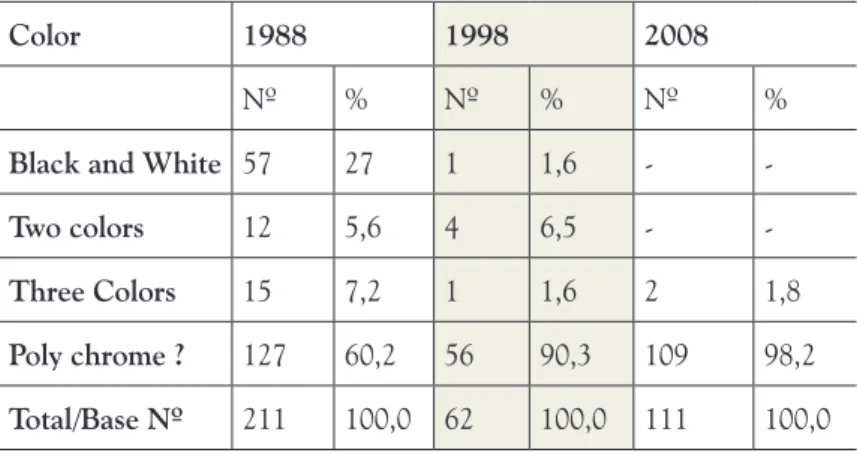
Contrasting with the “all type” ads, the magazines were increasingly invaded by the colors. Ads printed in polychrome increased 50% from 1988 (60.2%) to 1998 (90.3%) and reached in 2008 almost all of the ads (98%). The production capacities of ads, such as, number of colors, pictures and graphics (tables 1 and 2) followed the technological changes in the printing industry.
Table 2 – The colors in the announcements from GR magazines in the years 1988, 1998 and 2008
Color 1988 1998 2008
Nº % Nº % Nº %
Black and White 57 27 1 1,6 -
-Two colors 12 5,6 4 6,5 -
-Three Colors 15 7,2 1 1,6 2 1,8
Poly chrome ? 127 60,2 56 90,3 109 98,2
Type of ads
Regarding the type of advertising, over the decades studied, there was a predominance of products (89.6% in 1988, 75.3% in 1998 and 70.4% in 2008), although it was observed a slight decrease from 19.2% from 1988 to 2008. On the other hand, announcements of services increased from 1988 (6.6%) to 2008 (16.2%). The same occurred with institutional announcements: 1988 (3.8%) to 2008 (13.5%).
The increased in the diversification of the ad type presented by rural advertising over the decades showed their greater complex-ity and also the increased valorization of the rural public and the maturity of rural propaganda as specific segment of advertising in general. Thus, over time, it was recognized the importance of adding value to products through the creation and improvement of services, which were offered in advertisements. Also, from 1990s, probably driven by the existence of the Consumer Code and by programs of total quality, companies began to invest in the valorization of the logotype, divulging the organization and its values , to build the loy-alty of their customers, positioning itself more intense in the media.
Type and concept of the ad
In ad creation, advertising professionals define what is known as the concept of ad creation - the basis of the argument, which maintains the main sales approach - usually developed from a positive feature, a value of the product being advertised, a so-cial virtue in the moment. There were not considered ads that showed just the product, without any elaboration in art direction or in writing8, and do not had any concept, despite its frequency among the journals studied.
8 Creating an ad is composed by the direction of art that takes care of the visual
Among the ads studied in the three decades, most had more than one concept. In 1988, for example, about 30% of product announcements had two concepts and 2.4%, more than two. This proportion decreased in 1998 to 12.9% and in 2008 and to 16.2%. It was necessary to understand, however, that the percentage is based on the number of ads each year, not on the number of oc-currences of the concepts.
The economic argument, in which the ad promises advanta-geous and profitable products was one of the most frequent among the announcements of GR. Between product announcements, this type of ad appeared in 47.6% of the total ad in 1988. Among the institutional listings of the same year, the concept shared the lead with “Production / Productivity” and “Culture”, both present in 42% of the ads cited year.
In 1998, the economic approach was also the most frequent, with 44.4% among the announcements of services. In 2008, the concept led with 28.6%, of the announcements of products.
The idea of modernity and technological innovation was ahead among announcements of services in 1988 (53.3%). In 1998, main-tained its leadership with 32.6% among advertisements of products and 75% of the institutional ones. This concept was also the most frequent (33.3%) among announcements of services in 2008.
Absent among advertisements in the 1980s, the “Ecology / Environment” concept emerged with 8.1% in the 1990s. Among the institutional ads, the ecological approach jumped from 1988 (14.3%) to 2008 (43.7%).
Over the decades, the concepts (and hence the appeals) were changing, showing changes in the meanings and representations assigned to the rural world.
Types of advertising and advertising functions
In this work was understood that the category commercials “camouflages the intentions of advertisers” (PINHO, 2009 com. pes,). Thus, there are classified subdivisions of advertising: (1) of products, (2) of services, (3) generic or commodities, (4) retail, (5) comparative, (6) cooperative,(7) promotion, and (8) legal – as proposed by Pinho (1990). In this subdivision, it was disregarded the commercial advertising in the form of “classified” since - as previously reported – it was decided by their exclusion.
The advertising of products or services were predominated, however the slightly decreased over the three decades – 1988 (91.7%) to 2008 (85.3%). The ads that directly or indirectly mentioned the competition, comparative advertising type (“ the result is a final product superior to similar”), also decreased from 1988 (5.4%) to 2008 (4.2%). In contrast, promotion advertising type (which present jointly with the product or service, some sort of advantageous condition: promotion) increased from 1988 (0.5%) to 2008 (6.3%). On a small scale, appeared the coopera-tive advertising, jointly held by the manufacturer with one or more retailers, or by various manufacturers and a large store in 1988 (2.4%), 1998 (no entries) and 2008 (3.2%). The “retail”, also called commercial, which is the sponsor of the ads by retail-ers (stores, consumer cooperatives, supermarkets, malls, among others) appeared only in 2008 (1%). Ads of type “Commodity” did not appear.
announce-ments have to be published in major national newspapers and official gazettes.
According to Pinho (1990), advertising has five functions: (1) protective, (2) identity, (3) public service, (4) motivation and (5) institutional. Identify these five functional categories in the ads helped the process of collecting data about the uses and purposes of those.
The Protective advertising serves to protect the company from possible economic or political restrictions that may arise from government regulations and to inform public opinion on political, economic, social and environmental issues. Advertising focused on public service provides public utilities and motivation advertising aims to mobilize society and, or, influence government action. Among the GR announcements, the Institutional ads, whose function is to promote the acceptance of the company as a public institution prevailed in 1988 (100%) and 2008 (56.3%). In the decade of 1998, the kind of “Identity” ads, whose function is to build an organizational personality, a visual identity and assign values and characteristics to the company, was the most frequent, with 75%. In 2008, there were announcements representative of all five functions, which was interpreted as a consideration of the advertisers about the public rural segment.
The style of message
the Professor José Benedito Pinho, it was added to this classifica-tion the style humor, because good humor is a common feature of Brazilians and very present in advertising language. As the ad can present more than one concept, it can also has more than one message style. With more than one style ads were identified in 1988 (8%), 1998 (21.3%) and 2008 (18%). Due to the variety of styles in a same announcement, it was marked therefore, the number of times occurred in each style, thus the number of total ads marked exceeded the total number of ads.
The “Scenes of Real Life” style, which naturalizes the use of the product by ordinary people (not popularly known) was predominant in advertisements of all ads in 1988 (30.8%) to 1998 (37%).
However, the “atmosphere or image” style messages that ab-stract the product / service, relating them to feelings and sensa-tions, prevailed in 2008 (30.6%). In the course of three decades, there are styles that have increased their participation: “Fantasy”, which creates an amazing aura, unreal, around product / service, doubled from 1988 (4.2%) to 2008 (9.9%); the “Humor” jumped from 1988 (1.9%) to 2008 (8.1%), and Style “technical Knowl-edge”, which demonstrates the technical ability of the company to manufacture the product, increased from 1988 (14.7%) for 2008 (20.7%).
stimulate consumption, by the relaxation of the public, through laughter and dreams. It was noticed that the conceptual trend in these three categories coincided, in the 90s, with the valorization of modernization and the importance of innovations and tech-nologies. In the late 2000s, the concepts aligned to rise of values related to the importance of environmental issues and also those related to economic issues, stimulated by the global crisis.
After an assessment of the concepts and messages of the ads, it was necessary to discuss what it was said and how advertising represented rural.
The advertising speech
Since an announcement is planned, at the time of the concept definition, it brings in itself references, clearly showed or implied from other texts: the intertextuality. As Fairclough argues, “all statements are populated and, in fact, made of pieces of state-ments from others, more or less explicit or complete” (Fairclough, 2001, p.134).
The advertising speech, under metaphors forms, wordplay, popular expressions, testimonials of famous people, associations of ideas, double meanings, among others, is built with earlier discur-sive elements recognized, and therefore easily assimilated by the public. According to Aumont (2004) assimilation is the “pleasure of rediscovering a visual experience into an image, in a repetitive mode, condensed and controllable (AUMONT 2004, p.83), and this happens because of the constant comparison that the public does between what they see and what they’ve seen in another past moment, called perceptual constancy (AUMONT, 2004, p.82).
of the sales approach, the ad already gives clues at this moment of how it represent itself, the product / service that is intended to sell, and how it sees its consumer audience. Not all of the announcements brought representations about the rural field. Some just offered products or services without making mention (or reference) to the rural areas, hence with no representations whatsoever about it.
The percentage of ads in GR magazine that made reference to rural increases between 1980 and 2000, with a slight decline in 1990. This increase may have been indicative of progressive special-ization of rural propaganda and advertising market segmentation. This reference to the rural world in the ads indicated that they are directed, although not exclusively, to rural consumer au-dience. However, it was about those references that the research and analysis of the rural were performed, represented on the advertising of GR magazine, between the products / services most publicized of the most frequent categories.
The category “Machinery, equipment, implements and rural services” occupied nearly 40% of the advertising area of GR
magazine in the three decades studied. The representations made by ads of mowers and water pumps were analyze. The advertise-ments of water pumps displayed a strong tendency to show the country as a mechanical workspace, conveying the idea that with the right technology, it is a space that promotes affluence. The announcements of the mowers during the decades of 98 and 2008 revealed a different image of a rural represented as a workspace that can be light, easy and even pleasurable. By bringing urban images complementarity was pointed out, underlying mixing and similarity instead of dichotomy between urban and rural areas. When portraying the country9 style, with the image of a famous
9 The country style represents a new rurality, packed by music and sports (mostly
country singer, it was built an image of rural less work-related and more sophisticated.
When analyzing the ads of technical courses, the most publicized product during the three decades, within category “Communication and Training”, it was noticed that rural was rep-resented as an area of vast estates, however with difficult access to services, as a space for businesses, no longer tied exclusively to agricultural or livestock production, an area of mobility and social growth.
Within the category “vehicles and associated parts” there were analyzed announcements of trucks and oil (most common in the 80s and 90s) and pick-ups vehicles, more frequent in the 2000’s.
The ads of trucks showed a heavy or light, impersonal or hu-manized rural representation, the rural world as a place for work and productivity. The ads of oil, based on the concepts of “production / productivity” and message style “Fantasy”, portrayed a rural world of large farm, whose owners would be readers of GR magazine.
to a representation of the rural as world, outside everyday life, something presented in the form of discovery, with fun.
final remarks
It was important to learn and discover which representation of rural advertising has widespread, because the representation spread by the media on a specific reality ends up influencing the way that reality is perceived – and built – by whom is represented by it and by third parties.
The advertising analysis is useful because it marks the evo-lution of graphics and production of advertisements; it identi-fies and categorizes the concepts of the ads and their styles of messages; it specifies the types of advertising and advertising functions; it shows clues on which images of rural world, the ads of Globo Rural magazine built over the decades studied. This advertising was becoming more sophisticated over time, in technical terms: color, imaging, ad size. Thus, it was evident that there were continued solid investments by companies and agen-cies to gain the preference of “rural” entrepreneurs. In this game of persuasion, or seduction, several representations on rural were presented. This variety of representations of the rural confirms the claims of theorists and scholars on the heterogeneity of the rural world representations.
artificially drop on the price of agricultural products. And, despite increased production, producers of commodities received relatively little for their production. The country was in a recession, so in the beginning of the following year, the dollar was released and other measures were implemented. Therefore, advertising profits decreased and only big advertisers divulged.
Throughout the analysis and comparison of the ads, it was noticed that while the context has changed, the representations of rural attended and expressed their modifications. This evidence confirms the hypothesis of this research that advertising, over time, represented the multiplicity of new rurality identities and social changes incorporated into the rural world.
The Publicity in GR has also changed. The small and simple ads, which predominated in the editions of 1988, were switch to large and colorful ones from wealthy advertisers. In late 2000’s, the GR magazine advertisements portrayed the undocking of space-time advocated by Giddens (2002): The rural world is moving from a passive representation, halt, backward, to an ac-tive, modern and globalized rural world. The rural world has not stopped in time, and changes all the time. Even the countryside, for example, that in the past was seen as passive, something to be contemplated, metaphorically it becomes a possibility for interac-tion and adventure.
References
AUMONT, Jacques. A imagem. 8 ed. Campinas: Papirus, 2004. (Coleção Ofício de Arte e Forma).
BOURDIEU, Pierre. Linguagem e Poder simbólico. In: ______ A economia das trocas lingüísticas. São Paulo: Edusp, 1996. p.81-128.
PAULA, Silvana G de. Quando o campo se torna uma experiência urbana: o caso do estilo de vida country no Brasil. In: Estudos Sociedade e Agricultura,
17, p.33-53, out. 2001.
FAIRCLOUGH, Norman. Teoria social do discurso. Discurso e mudança social. Tradução de Izabel Magalhães. Brasília: UnB, 2001. p.89-131. GALVÃO, A.S. Mulher, margarina, clichês & outros ingredientes. 213p. Dis-sertação (Mestrado em Comunicação). São Bernardo do Campo, POSCOM/ UMESP, 1998.
GIDDENS, Anthony. Modernidade e identidade. Rio de Janeiro: Zahar, 2002. KOTLER, Philip e ARMSTRONG, Gary. Princípios de marketing. 12. Ed. Tradução Cristina Yamagami. São Paulo: Pearson Prentice Hall, 2007.
LAPLANTINEE L. Trindade. O que é imaginário. São Paulo: Brasiliense, 1977. AUTORES. O Jeca tatu não é mais jeca; representações sobre o rural nos anúncios veiculados na revista Globo Rural, entre 1980 e 2000. 129 f.,2010 - Dissertação (Mestrado em Extensão Rural)- Universidade Federal de Viçosa, Viçosa-MG.
MUNIZ, J. N.; RIBEIRO, C. A. A. S. Interdisciplinaridade: a metodologia in-tegrada na elaboração de planos diretores de recursos hídricos. In: PRUSKI, F. F.; SILVA, D.D. (Eds.). Gestão de Recursos Hídricos: aspectos legais, econô-micos, administrativos e sociais. Brasília, DF: Secretaria de Recursos hídricos; Viçosa, MG: Universidade Federal de Viçosa; Porto Alegre, RS: Associação Brasileira de Recursos Hídricos, 2000.
PINHO, J.B. Propaganda institucional: usos e funções da propaganda em relações públicas. São Paulo: Summus, 1990.
RAMOS, Ricardo; MARCONDES, Pyr. 200 anos de Propaganda no Brasil. São Paulo: Meio e Mensagem, 1995.
ROCHA, Everardo P. Guimarães. Magia e capitalismo. Um estudo antropoló-gico da publicidade. 2. ed., São Paulo: Brasiliense, 1990.
VESTEGRARD, Torben; SCHRODER, Kim. A linguagem da propaganda.
São Paulo: Martins Fontes, 2004. (Coleção biblioteca universal).
Laene Mucci Danie
She recived her Master’s Degree in Rural Extension in the Business Rural Depart-ment at the Universidade Federal de Viçosa. She is coordinator of the extension projects “Cinecom – Cinema e Cultura para Todos” (“Cinecom – Movie and culture for all”) and “Comunicação em movimento – O Expresso, o jornal-mural para quem anda de ônibus” (“Communication on the move – O Expresso, the newspaper-wall for bus”). Professor of Photojournalism and Publishing in the Communication Department at the Universidade Federal de Viçosa.
Nora Presno Amodeo
She recived her Doctor’s Degree in Development, Agriculture and Society at the Universidade Ferderal Rural do Rio de Janeiro. Professor of bachelor’s course of Cooperatives and f the Graduate Program in Rural Extension. Business Rural Department at the Universidade Federal de Viçosa.