1 Address: Correspondence concerning this article should be addressed to Luciano L’Abate. Department of Psychology, Georgia State University, Atlanta, Georgia 30303, USA. E.mail: [email protected]
Hurt Feelings and Personality Socialization in the Family
Luciano L’Abate1 Georgia State University, USA
ABSTRACT - The purpose of this article is to summarize a developmental, relational theory of personality socialization in the family and other settings. This theory consists of two assumptions about space and time, from which are derived two respective processes about the ability to love and the ability to negotiate. The contents of the theory consist of three modalities: Being, Doing, and Having. From these processes and contents other models about a continuum of likeness, selfhood and personality propensities, priorities, and intimacy are developed. This theory can be evaluated in the laboratory through self-report, paper-and-pencil tests, and in applied or clinical settings through enrichment programs, workbooks, and therapeutic tasks.
Key words: Theory construction; theory testing; models; family; personality.
Sentimentos de Injúria e Socialização da Personalidade na Família
RESUMO – O objetivo desse artigo é apresentar, resumidamente, uma teoria desenvolvimentista e relacional da socializa-ção da personalidade na família e em outros contextos. Esta teoria consiste de dois pressupostos sobre espaço e tempo, dos quais são derivados dois processos respectivos sobre as habilidades de amar e negociar. Os conteúdos da teoria consistem de três modalidades: Ser, Fazer e Ter. A partir desses processos e conteúdos, são desenvolvidos outros modelos sobre o continuum de similaridade, tendências de personalidade e temor de ser injuriado, prioridades e intimidade. Esta teoria pode ser avaliada em laboratório, através de testes de auto-relato e de lápis e papel, e em contextos aplicado ou clínico, através de programas de enriquecimento, livros e tarefas terapêuticas.
Palavras-chave: construção de teoria; teste de teoria; modelos; família; personalidade.
relationality, as seen in intimate relationships rather than in hypothetical or inferred internal traits or states; (c) de-velopment, over the individual and family life-cycles, from dependency in childhood to denial of dependency in ado-lescence, interdependence in adulthood, and return to de-pendence in old age; (d) covering both functional and dys-functional aspects of personality socialization; and (e) veri-fiability, not only in the laboratory, through self-report, paper-and-pencil tests, but also in primary, secondary, and tertiary prevention settings as well.
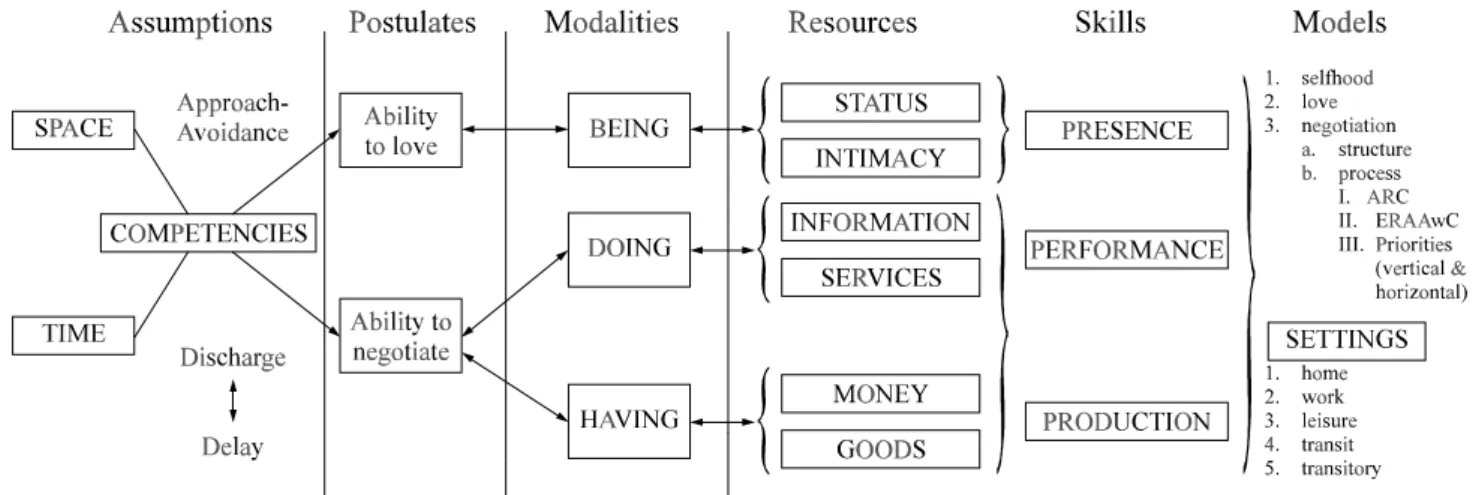
The theory, in brief, is composed of: (a) processes in time and space, (b) postulates about contents in resources and modalities exchanged, leading to the ability to love and the ability to negotiate, (c) settings, and (d) models. These components go from general, seemingly abstract constructs (see the left side of Figure 1) to the specific and concrete ones (at the right of Figure 1). The rest of this article is devoted to expanding and explaining Figure 1.
Assumptions of processes in space and time
Personality socialization assumes space and time as two basic processes that subsume respectively, distance and regu-lation or control. Distance is defined by extremes in ap-proach-avoidance between intimates, and among non-inti-mates. For example, extremes in approach could be seen in symbiotic attachments (“I cannot live without you”) that result in internal (against the self rather than against oth-ers) self-abuse and apathy or neglect. Extremes in avoid-ance-withdrawal are seen in abandonments and rejections. This article is a short summary of a theory of
personal-ity socialization in the family which is found in its various expansions in both English and Italian languages (L’Abate, 1976, 1986, 1994, 1997, 1998a, 1998b). The thesis of this theory is that at the bottom of personality socialization there are underlying hurt feelings and fears of being hurt that are produced in the family of origin. Personality socialization, in this regard, can be viewed as a process of creating an artichoke. Underneath its external leaves, after passing through the prickly choke at the very heart, there are these feelings of hurt. They are often but not always and not al-ways fully solved and resolved in functional relationships through reciprocal sharing with loved ones. However, they are not confronted and shared, and usually not resolved, in dysfunctional ones. They linger on and influence personal-ity socialization throughout individual and family life-cycles (Bradley, 2000; Watson, 2000). Before reaching these feel-ings of hurt, however, one must deal with many leaves that cover, defend, and protect them. One cannot get to these feelings because the prickly choke of anger and, sometimes rage, makes it difficult and in some cases impossible to reach them (L’Abate, 1999).
Somewhere in the middle of this dimension lies the proper balance of distance, ultimately culminating in closeness and intimacy. The latter is defined as the sharing of hurts and fears of being hurt. Intimacy is frequent in functional rela-tionships and defective, if not absent, in dysfunctional ones. Time subsumes a dimension of regulation defined by extremes in discharge or disinhibition (fast responding) on one hand, and delay or inhibition (slow responding) on the other. Extremes in discharge are visible in externalizations, as in hyperactivity, impulsivity, and acting out behaviors. Extreme in delay are visible in internalizations, as in com-pulsive thinking and ruminations, anxieties, depressions, and, ultimately, alienations and suicides. Functionality is found in a balance in the regulation of discharge-delay pro-cesses. Developmentally, the infant is born in a world of space (distance) that becomes a world of time with age (regulation).
Both distance and regulation underlie the concept of interpersonal and intimate competence, implying an inter-action between individuals, parents, partners, relatives, and friends. This framework is consistent, continuous, and re-ducible to monadic models of behavior that follow acontextual and intraindividual rather than interindividual thinking. Both distance and regulation are well accepted constructs in the psychological literature, even though they are not used in an interpersonal context as they are used in this theory.
Postulates and modalities of exchange
The two assumptions of space and time lead to two pos-tulates about two respective sets of abilities: the ability to love and the ability to negotiate.
The first postulate: Ability to love
Love is expressed through (a) attributing, asserting, and affirming the importance of self and of loved ones, and (b) the ability to be intimate, that is, being emotionally
avail-able to oneself and intimate others through sharing of hurts and fears of being hurt. This process means being together unconditionally, without demands for performance, perfec-tion, producperfec-tion, or problem-solving. The ability to love, therefore, even though it may possess a cognitive compo-nent, is based on the ability to experience, accept, and share a wide spectrum of feelings, painful and joyful. Hence, emotionality (E) is at the very bottom of our existence. It consists of feelings of love between partners, between par-ents and children, and among relatives and friends, as well as hurt feelings that unavoidably occur in everybody’s life, whether we like them or not.
E, therefore, is the primary component of a crucial model of the theory. In E, it is where feelings of hurt and fears of being hurt are developed. They are shared reciprocally in functional relationships. They are avoided and even put down, ridiculed, suppressed, and repressed through inter-nalizations or exterinter-nalizations in dysfunctional ones. E, therefore, is the basic context of socialization. Infants are born in an emotional context, the marriage of parents or caretakers, and grow up in an emotional network of family relationships.
The second postulate: Ability to negotiate
The ability to negotiate, problem-solve, brain-storm, and bargain is developed from the ability to regulate the self in relationship with intimate others (Vichinich, 1999). This ability is based on a balance of discharge-delay processes that is present in functional relationships but defective or even absent in dysfunctional ones. It means being able to regulate oneself and, in so doing, allowing others to ex-press themselves, giving them the freedom of free discharge in helpful and creative ways without delays, distractions, and procrastinations. If there is no balance in regulation, then severe, abusive, neglectful and contradictorily incon-sistent, and hurtful discharges would result in rebellions and retaliations at one hand, or extremes in delays and with-drawals on the other.
Negotiation and problem-solving take place within func-tional, democratic relationships, where the singular impor-tance of all participants is not only acknowledged but val-ued. In dysfunctional relationships, where either immedi-ate discharge (name calling, blaming, put-downs, etc.) reaches abusive proportions or procrastinating delays take place, there is no possibility of reaching an agreement and consensus about how to solve even the smallest, irrelevant issues (“Making mountains out of mole-hills”).
The process of negotiation is composed by various parts: (a) task assignments, consisting of decisions about orchestrationally large decisions, such as moving, buying a new house, or a car, versus instrumental issues like routine, every-day tasks, what to eat, where to eat, what TV show to see, etc.; (b) power sharing and division of labor, consist-ing of authority (who makes the decisions) and responsi-bility (who carries them out); and (c) contents (informa-tion, services, goods, and money).
Potential negotiation in personality and family mem-bers is a multiplicative function of level of functionality (ill), ability to negotiate (skill), and motivation to negotiate (will). While the motivation to be emotionally available to self and loved ones is based mostly on E, the process of negotiation requires access, acknowledgment of, and reli-ance on E, followed by R (for both Rationality and Regula-tion). Both E and R determine subsequent Activities, Aware-ness, and Context. These components of the model ERAAwC will be elaborated below.
Modalities of exchange: Contents of the life triangle
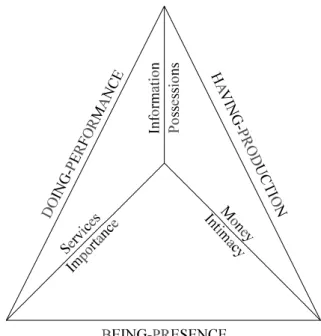
Processes of loving and negotiating are related to three modalities of exchange - Being, Doing, and Having - de-rived from six classes borrowed from the resource exchange theory (Foa & Foa, 1974): importance and intimacy make up Being, services and information make up Doing, and money and possessions make up Having. These resource classes and the three modalities make up the Triangle of Living (see Figure 2). Being or Presence means being emo-tionally available to ourselves and intimate others through attribution of their importance and sharing of hurts and fears of being hurt, that is, intimacy. Doing or Performance is defined as whatever has to be done to survive and to enjoy life. Having or Production is defined as the wherewithal relevant to survival and enjoyment. The combination of Doing and Having defines power and the ability to negoti-ate. In democratic relationships, power is shared and nego-tiated equitably, in win-win processes. In chaotic or dys-functional relationships, power is either in the hands of one family member who uses it despotically, or there is no power negotiated at all, because everybody defeats everybody else. No one wins. Power is negotiated effectively and success-fully in functional relationships but not is negotiated at all or negotiated ineffectively or unsuccessfully in dysfunc-tional ones.
Being together or Presence are not negotiable because they are based on feelings and attributions that are
impos-sible to negotiate. One does not negotiate how much one loves intimate others. Presence can only be shared in the sense of being emotionally available to oneself and signifi-cant others. In functionalities, Presence is kept separated from Performance and Production, i.e., from Power. In dysfunctionalities, Power and Presence become fused, con-fused, and diffused to the point that issues of Power (Per-formance and Production) are mixed with issues of Pres-ence. When importance and intimacy are not expressed and shared unconditionally, they become conditional on Per-formance or Production or both. Consequently, Doing or Having often times become substitute expressions of Be-ing (“If you loved me you would do...”; “If you loved me you would buy me...”).
The greater the level of competence of family mem-bers, the greater the chances of successful negotiation. Unwillingness or inadequate ability to negotiate power is the basis of conflicts and struggles. We need to negotiate about what kind of information should be allowed at home, who should provide what services within and without the home, and what should be bought with the money earned. For instance, L’Abate and Hewitt (1988) applied the distinction of Power (Performance + Production) vs. Pres-ence (Importance + Intimacy), that is, Being Present, to a classification of sex and sexuality. They argued that most sexual dysfunctions are based on the inability to Be emo-tionally present to self and to a partner. Perhaps, our Ameri-can culture stresses sexual performance and production, at the expense of sexual presence, the sharing of past hurts and fears of being hurt again. That process often means being vulnerable to the partner’s whim and will. Functional sex and sexuality imply the ability to be emotionally avail-able to one’s partner before becoming fully availavail-able sexu-ally. A couple cannot share a good orgasm unless they are able to cry together. Sexual performance or production, that
is, the physical act of intercourse at the expense of emo-tional presence is bound to produce deviations and distur-bances that will affect subsequent development of how sex and sexuality are going to be shared with partners.
Personal and interpersonal competence in intimate re-lationships, therefore, is defined by what an individual is, does, and has in different settings. Various skills and test-able models can be derived from the two sets of abilities and the three modalities.
Support for this seemingly abstract dichotomy of power and presence defined through modalities of exchange, in addition to the early work of Foa and Foa (1974), can be found, among others, in Bakan’s (1968) important and in-fluential distinction between communal and agentic rela-tionships. This distinction has been supported empirically by the work of Clark and her co-workers (Clark, 1986; Clark & Reis, 1988). This distinction has been applied to psycho-therapeutic practices related to relationship (community) and structuring (agency) skills (L’Abate, 1996, 1997). More recently, the importance of money and possessions as sources of power has been stressed by Doyle (1999). He developed models of personality development very similar to those presented here and elsewhere.
Settings
The ability to negotiate requires also the skill to sepa-rate Being from Doing and Having in five settings: resi-dence, school/work, surplus times, transit, and transitory. The importance of settings in determining behavior and interactions between personality socialization was stressed long ago by ecological psychologists, e. g., Barker (1968), to cite one pioneer among many to follow. Each setting has its peculiar, explicit or implicit rules, predictable or unpre-dictable regulations, consistent or inconsistent requirements and task demands that are setting-specific and that differ from one setting to another.
The three major settings where exchanges occur are: (a) residence, (b) school/work, and (c) surplus time. The latter is divided into survival and leisure activities, i.e., sur-vival vs. enjoyment. All three settings interact and overlap with two other settings, transit and transitory. Transit set-tings are used for transportation from one setting to an-other, such as cars, buses, planes, trains, highways, parking lots, airports, or train stations. Transitory means settings that change over one’s life-cycle, such as schools, grocery stores, barber shops, beauty saloons, shopping malls, res-taurants, churches, sport arenas, and hotels. In some cases, survival and enjoyment overlap. For instance, some people have fun at work and no fun at home. Some have fun at home and none at work. Some have fun in both settings. Some have no fun in either. Others work very hard at set-tings that are supposed to produce enjoyment, like gyms, parks, and recreation facilities.
Furthermore, each setting has specific exchange func-tions. For instance, banks exchange money. Schools, book-stores, and libraries exchange information. Hospitals and
clinics exchange services, etc. Stores provide and exchange goods for money. The home, ideally, should provide im-portance and intimacy in addition to all other resources. However, not all homes provide importance and intimacy. On the contrary, they may provide some goods, services, and information but no love.
Competencies and abilities vary according to the task demands and requirements of each setting. The number of settings is finite and objectively defined. In order of func-tional importance, settings are: home, school/work, surplus time (survival and enjoyment), transit, and transitory. Of course there may be overlaps among all five settings. For instance, leisure activities may take place at home, or, in some instances, in work settings, as, for example fitness rooms in workplaces. Competence in one setting does not necessarily predict and transfer to competence in another setting. One could be a terrific parent but be a mediocre employee. By the same token, one could be a remarkable athlete during leisure hours but be a poor provider at home. Competence in various settings helps to define the level of functioning of an individual. For instance, superior func-tioning may include being a caring and effective partner and parent who excels in school and at work, enjoying lei-sure time activities after successful completion of survival tasks. By the same token, then, settings are necessary to discriminate among levels of functionality in personality socialization, from superior to adequate, to mediocre, to inadequate, and to failure.
Models
The theory is composed of one not-yet tested and eight testable models. A model is a simplified representation of more complex concepts or patterns derived from assump-tions, postulates, and modalities of the theory (see Figures 1 and 2). For instance, the two assumptions of space and time become more concrete and visible when distance and regulation, with their respective polarities, are visualized as two orthogonal dimensions, making them into a first model (see Figure 1). By the same token, the three modali-ties of Being, Doing, and Having can be visualized as an equilateral triangle where Presence is at the bottom, Per-formance on the left, and Production on the right (see Fig-ure 2), making them a second model.
A not-yet tested, metatheoretical model
relation-ships. It discriminates among two major levels, descriptive and explanatory. Each level is subdivided into two other ones.
The first descriptive level signifies what is publicly vis-ible and immediate, to the point of being photographed, audio-taped, or video-recorded. Description can be either public, including how a relationship is presented to outside observers, the impression-making facade (“I am a nice per-son, with a nice marriage and nice children”) versus more private, phenotypical aspects that may be hidden from the self, intimate others, and public observation and even from measurement. What really happens in the secrecy and pri-vacy of one’s own home? The publicly “nice” person may be actually a nasty despot, a mean partner, and an abusive parent. The connection between presentational and pheno-typical levels can be minimal and consistent between the two levels (“What you see is what you get”) or can be re-versed. What is presented publicly may be fairly consistent with what happens inside the home. Or else, it could be extremely inconsistent, for instance, nice on the outside but nasty inside the home. By the same token, this connec-tion could be conceivably reversed the other way that is, nasty on the outside and nice on the inside, with all pos-sible consistencies and inconsistencies between the public and private levels of observation and interpretation.
The explanatory level is what is used to make sense of both descriptive, presentational, and phenotypical levels. It is subdivided into genotypical and historical levels. The former has included hypothetical constructs like the ego and the superego, ascribed needs (drives, motivations), or inferred traits (extroversion, open-mindedness, introversion, etc.). The latter are constructs dear to theorists who stress the importance of specific traits or states inferred from self-report, paper-and-pencil instruments such as the Big Five Factors model (Costa & Widiger, 1994). These traits are used to “explain” why someone behaves or relates the way he or she does (“She is liberal because she is extroverted,
open-minded, etc.”). Consistent with the thesis of this theory, the most hidden part, even from the self, at the genotypical level, is hurt feelings and fears of being hurt.
The historical level consists of intergenerational, gen-erational, and developmental events, including the current situation, underlying present behavior (“He abused his wife because he was an abused child.”). This level, therefore, “explains” all the other three levels in a much more ad-equate fashion than could be achieved at genotypical or descriptive levels. Here is where past traumas, illnesses, painful, and joyful events help us to understand how one relates to intimate others.
Testable models
From the assumptions and postulates of the theory are derived eight models. Of course, the first two models, dis-tance/regulation and Presence, Performance, and Produc-tion – have been already introduced.
ERAAwC
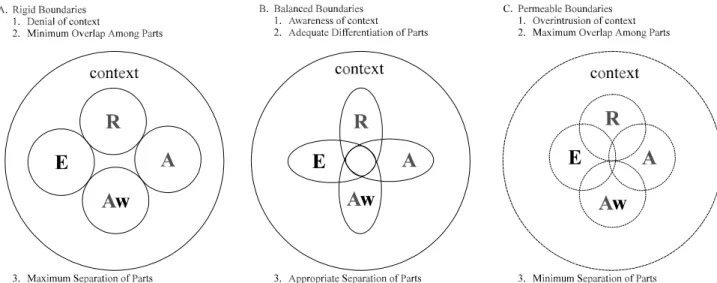
The third model already introduced but needing expan-sion is the circular ERAAwC shown in Figure 3. The five components of the model vary in (a) size, (b) strength of boundaries, and (c) amount of overlap.
This model performs at least three functions. First, it serves as a basis for understanding the development of per-sonality socialization from E to C, with the other compo-nents as intermediary steps (L’Abate, 1986, 1994, 1997). Second, this model serves to describe an almost invariant sequence of steps in the process of negotiation. One needs to start with E, expressing and sharing feelings of whatever kind, progressing then to R, discussing and brain-storming about pros and cons of possible courses of action, with an agreement or consensus about which particular course of action (A) to follow. After trying out A, for a chosen period
of time, ideally, there should be feedback (Aw) about what-ever has been learned during the consensually chosen course of A (Ferrari & Sternberg, 1998). As Baumeister and Tice (2001) commented on the change function of Aw: “Self-awareness can help motivate people to try to change for the better” (p. 57). This feedback loop would return the pro-cess to E, starting it all over again, but restricting the choices available since one has already been used unsuccessfully. This process takes place within the overarching influence of Aw as a change agent with the acknowledgment, denial, or ignorance of Context. Without an awareness of C, Aw
may remain a futile, redundant exercise in rumination and obsessive-compulsive thinking. This process, of course, takes place internally as a dialogue within the self as well as with involved others. This is how negotiation and prob-lem-solving occur.
Third, this model serves as the basis for a classification of theories of personality and psychotherapy. For instance,
E has been stressed by humanistic schools. R has been stressed by psychoanalytic, reality, cognitive, and rational-emotive schools. A has been stressed by behavioristic schools. Aw has been stressed by Gestalt and Gestalt-like schools or Eastern philosophies as well as by present-day research (Ferrari & Sternberg, 1998). C has been stressed by family therapies. The latter, as well as primary preven-tion approaches, can be classified, in turn, according to the ERAAwC components of the model (Hansen & L’Abate, 1982; L’Abate, 1986, 1994, 1997).
A continuum of likeness in close relationships
The fourth model consists of a dialectical, developmental
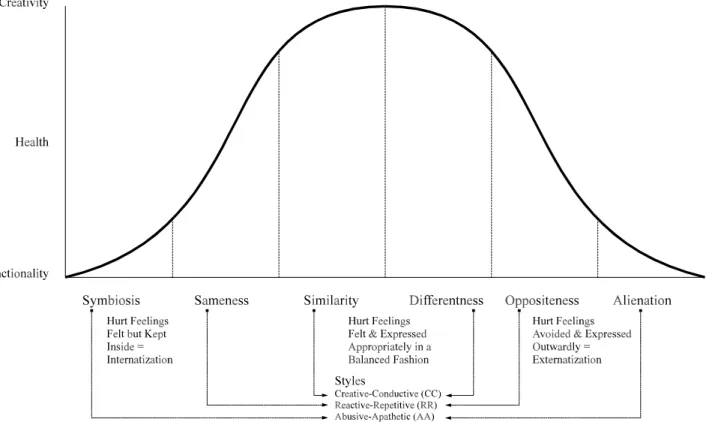
continuum of likeness that underlies human relationships. The purpose of this continuum is to describe how people relate with each other in intimate and non-intimate rela-tionships. This continuum was originally postulated (L’Abate, 1976, p. 79) as “a bell-shaped distribution con-sisting of six ranges: Symbiosis, Sameness, Similarity, Differentness, Oppositeness, and Alienation” (see Figure 4). No single range can conceivably describe behavior in intimate relationships by itself, isolated from other ranges. Each range needs a dialectical counterpart to define itself according to a combination of two ranges related to each other. For instance, a combination of the two extremes of the distribution, Symbiosis and Alienation, would lead to-ward an Abusive-Apathetic (neglectful) interpersonal style (AA) with individual-relational pathology in close relation-ships. At the intermediate level of the distribution, a com-bination of Sameness and Oppositeness would lead toward a Reactive-Repetitive, conflictful and competitive style (RR), intra-and interpersonally. In the center of the distri-bution, a combination of Similarity and Differentness would lead toward a positively collaborative Conductive-Creative style (CC). These three styles form the basis for the fifth ARC model (see Figure 4), with two dysfunctional styles, with AA being the most dysfunctional, RR being interme-diate in functionality, and CC being functional.
Hence, in Figure 4, vertically, a dimension of psycho-pathology lies at the bottom and at the two extremes of the distribution. Emotional and mental health lie at the middle, intermediate level, while CC lies in the center. By CC here it means interacting and relating with intimate others in extremely positive ways. It does not mean creativity in ar-tistic, scientific, or professional endeavors. These two realms, intimate and non-intimate, may well be unrelated with each other. One could be a genius in art or science and a failure as a partner or parent.
The theoretical origin of this continuum has been ex-pressed at length in previous publications (L’Abate, 1976, 1986, 1994, 1997, 1998a). Conceptually, it predecessors are found in: (a) social comparison theory; (b) research on modeling, identity-formation, and identification in devel-opmental, personality, and social psychology theories; and (c) self-differentiation theory (Barone, Hersen, & Van Hasselt, 1998; Ewen, 1998).
Briefly, a child develops a sense of self-identity and becomes socialized, at least in part, in comparison with major caretakers, modeling how they relate to the child as well as between and among themselves. For instance, the child may learn positive or negative behavior from how caretakers relate to him or her and between themselves and intimate others. The child may model without awareness of this modeling process.
The three processes, social comparison, identity-forma-tion, and identification have been “explained” in the extant literature through a single and simple dichotomy of simi-larity/dissimilarity, a process that takes place also within couples and between parents and children. Early theories describing this process, however, were usually acontextual, monadically non-relational, and rather vague as far as their interpersonal origins. Personality socialization seemed to develop in a vacuum, without specific relationships with intimate others. Most textbooks and handbooks about per-sonality published in the USA fail to make references to “parents”, “mother or father”, “marriage”, “siblings,” or “parents” (L’Abate, 1994, 1997). Furthermore, since simi-larity was conceptualized according to a simple dichotomy of similar-dissimilar, no other possibilities along a con-tinuum could be considered. Consequently, this relational continuum was deemed necessary to “describe” and even “explain” self-differentiation in close relationships. It meant going well beyond a simple-minded dichotomy and con-sider the possibility of a continuum of likeness along at least six ranges, as shown in Figure 4.
Applications of this continuum to various intra-inter-personal relationships are many. Very briefly, starting with the two processes of Approach-Avoidance in distance (space) and of Discharge-Delay regulation (time), it is pos-sible to expand this continuum by applying it to various intra-and interpersonal relationships. Not all relationships can describe all individuals. For instance, one individual could conceivably be in the middle of the distribution in parental practices, that is, using a CC style in this area, but be at another extreme, even RR or AA in how he or she
manages work conditions. Being in the middle of one range (CC) does not necessarily predict whether that individual will be within the same range in work activities. Being in one range according to one style (RR) does not necessarily predict whether the same style will be followed in another area of functioning.
More concretely, parents who require blind, uncritical obedience and submission to their values and behaviors (i.e., sameness) will very likely produce oppositeness and rebel-lion in some of their offspring. Stereotypically, males may eventually rebel and become anti-establishment and join juvenile gangs, learning acting out and behaving impul-sively. Females may submit to and follow parental demands for sameness. However, eventually they will end up marry-ing someone who is actmarry-ing out and non-conformist (L’Abate & Harrison, 1992). Individuals or couples at the very ex-treme of symbiosis will produce offspring that is character-ized by alienation and withdrawal from society. Parents who follow a CC style and are characterized by similarity and differentness in their personality and parental practices will very likely produce offspring with the same kind of style (CC) and positive personality characteristics.
Feelings, how one perceives and experience emotion-ally-tinged events, and how these feelings are expressed and shared outwardly as emotions develop along a con-tinuum of likeness, transmitted generationally and intergenerationally.
Selfhood
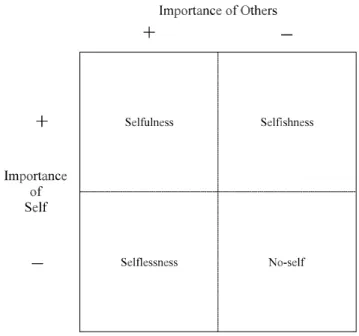
In addition to an underlying likeness continuum to de-scribe subtle and not subtle or not so obvious development of functionalities (CC), internalizations (RR), externalizations (RR), and psychopathology (AA) in relationships, it was necessary to introduce a sixth model. This one deals with how intimates interact with each other in fairly obvious ways, if we were able to observe them in private. Here is where the metatheoretical model about levels of observation and inter-pretation comes into being. People behave in different ways, in different settings, and at different levels of observation and interpretation. How one relates privately at home does not necessarily predict how one is going to relate in public places, school/work, leisure time activities. Furthermore, the resource class of importance, already introduced, needs to be expanded into a full-fledged model concerning how the Self manifests itself. This model is needed to describe, if not explain, personality propensities that predict how individu-als relate to each other in the privacy of home and not in public settings. Hence, this Selfhood model assumes that at-tribution, ascription, and assertion of importance is the pri-mary, fundamental resource exchanged among intimates as well as in non-intimates, verbally, non-verbally, and in writ-ing. Asking to write an article for a prestigious journal is how one’s importance is ascribed, for instance.
there is an appropriate balance of distance and regulation, there is the development of functional relationships, as seen in a personality propensity named Selfulness. When ap-proach is greater than avoidance and discharge is greater than delay, there is the development of a personality pro-pensity called Selfishness. When avoidance is greater than approach, and delay greater than discharge, there is the development of a personality propensity called Selflessness. When there are extreme, contradictory, and inconsistent imbalances in distance and regulation, there is the develop-ment of a personality propensity called No-self. However, this is just an incomplete introduction sufficient to link this model to the assumptions of the theory. It is still insuffi-cient in terms of how importance is asserted in four pro-pensities.
These four propensities are coupled with the resource class of importance to complete the model according to its application to intimate relationships. Selfhood, in its four propensities becomes the centerpiece of exchanges between and among intimates (parents, parent-child, siblings) and non-intimates. The self is shown by how one relates inti-mates in close, prolonged, and committed relationships, away from the scrutiny of occasional outsiders. The self-presentational facade in public cannot last long and be sus-tained in private. Eventually this facade gives way to what an individual really is by how he or she relates with inti-mate others. It is relatively easy to make a good impression in short-lived, superficial, and even contrived relationships. It is much more difficult to behave positively in the heat of closeness and familiarity.
To expand on the four propensities in their interpersonal implications, they are:
(1) Selfulness represents the positive attribution of impor-tance to self and intimate others, resulting in positive outcomes and synergistic growth in the relationship (“We both must win together”). In Selfulness it is pos-sible to balance appropriately distance and regulation, separating issues of Presence from issues of Power. Within the context of this propensity mostly functional relationships develop using a CC style.
(2) Selfishness represents the positive attribution of impor-tance to self and the negative attribution of imporimpor-tance to intimate others, resulting in conflictful outcomes and no growth in the relationship (“I win, you lose.”). Self-ishness tends to rely more on approach than on avoid-ance, and on discharge more than on delay. Individuals characterized with this propensity tend to push limits on their partners, authorities, and anybody who lets them do that, such as seen in the pathological extremes of this propensity, as seen in addictions and criminalities. Extremes in selfishness are therefore represented by externalizations, where the self is asserted at the ex-pense of others as in assaults, thefts, rapes, and mur-ders, using a RR style.
(3) Selflessness represents the negative attribution of impor-tance to self and positive attribution of imporimpor-tance to others, resulting in conflictful stasis in the relationship
(“You win, I lose”). This propensity tends to rely more on avoidance than approach, and on delay more than on discharge. Individuals characterized by this propensity are unable to draw lines to protect themselves and their bodies (“the condom line”). This is the case of co-de-pendent individuals, usually spouses or partners of ad-dicts and criminals (L’Abate & Harrison, 1992). Self-less individuals tend to be gullible, loyal, and respon-sible, trying to make up complementarily for qualities not usually found in selfish individuals. They are none-theless attracted to selfish individuals just as the latter is attracted to the former (RR). In the long run, this attrac-tion becomes antagonistic and conflictful, where either depression, suicide, hospitalization, or divorce become the inevitable outcome.
Another characteristic of selfless individuals is unreal-istic optimism, hoping that somehow selfish partners will eventually, by some miracle, change for the better (L’Abate & Harrison, 1992). Extremes in selflessness are seen in in-ternalizations, composed by anxieties, depressions, panic attacks, and affective disorders leading to suicide, either slow and prolonged as in some addictions, or sudden and seemingly unexpected.
(4) No-self represents the negative attribution of impor-tance to self and to others, resulting in a negatively nihilis-tic, and ultimately destructive breakdown at the personal and interpersonal level (“We are not going to win. We both must lose”). The No-self propensity relies on contradictory and inconsistent extremes in both distance and regulation (AA), as represented by severe psychopathology as in para-noias, schizoid, and schizophrenic-type disorders, combin-ing both ruthlessness and attack with apathy, passivity, and submission.
Priorities
All the previous models are developmental predecessors of those that follow. One model is the basis for the next one. One cannot understand this model unless he/she understand the previous ones. To understand how we allocate space, time, and energy within each setting and from one setting to another, we need to invoke the concept of priorities, a sev-enth model. This concept is motivational in nature and is similar to “goals” in the work of other theorists (Carver & Scheier, 1999). Priorities pertain to definite choices we make about who and what is important to us in our lives to survive and to enjoy. How important is a person, an object, or an activity? How important is one’s self in relation to other selves? In a way, the Selfhood model is another way of look-ing at Priorities. However, this model goes beyond Selfhood. It includes settings and contexts within each setting. One setting can be enhanced or reduced in importance by in-creasing or dein-creasing the importance of other settings. For example, activities in the leisure arena may become anti-dotes for the negative effects of stresses at work or at home. How one juggles and counterbalances demands and diffi-culties to maintain balance in one’s life reflects one’s pri-orities. Priorities motivate people to move toward or away from other people or to negotiate or to avoid negotiation with significant others over important issues in their lives. Love is not enough, just as negotiation is not enough. A person needs both to survive and to enjoy life, the two ma-jor priorities from which all the other priorities derive.
The priorities can be measured easily by time analysis. How much time does one spend in each setting? What mo-dality of expression – Being, Doing, or Having – is being used in a primary, secondary, and tertiary manner? For in-stance, Being is much more relevant in the home setting than Doing and Having. However, without the latter two, one cannot live on being alone. Doing and Having may be more relevant in settings like school/work and leisure ac-tivities. Which of these three modalities is more important than the other two? As shown in the Selfhood model, indi-viduals choose how self is related to other selves, it is an issue of priorities.
By the same token, priorities can be applied also to the ERAAwC model. For instance, one can choose E at the expense of R and derail the whole process of development. Or chose R at the expense of E and again derail the same process. One needs to balance E with R and with the other components of the model. Without this balance, it will be difficult to fully use one’s available assets.
Priorities can be divided into vertical and horizontal. Vertical priorities are developmental and can be differenti-ated according to the three modalities of Being, Doing, and Having. For instance, personal and interpersonal priorities are ranked according to the relative importance given to the self and significant others. One may value Doing more than Having or Being, stressing the importance of work setting at the expense of home or leisure settings. This stress, for instance, could define the great American workaholic
man or woman. By the same stereotypic token, of course, a woman could be defined by her stress on Being emotion-ally available at home. Work and leisure time settings may be considered secondary to her emotional availability and closeness with intimate others. Horizontal priorities, on the other hand, exist regardless of how one chooses what is important for the self and intimate others, because they re-late to settings and not to a person’s level of socialization. In brief, vertical and horizontal priorities intersect and in-teract with each other to produce different outcomes.
How successful one is in any setting depends a great deal on individual priorities. If one defines oneself prima-rily in occupational terms, for instance, obtaining a sense of importance from one’s job or career (“I am an engineer”) rather than domestically (“I am a partner and parent first and then an employee”), it follows that that individual may spend more time and energy at work than at home. By the same token, avocational pursuits may overshadow domes-tic and occupational roles. There is a need to balance mo-dalities and settings so that no modality or setting is stressed at the expense of the others.
Some priorities are automatic and outside the realm of
Aw. Other priorities are completely conscious and within the realm of Aw. The salience and satisfaction derived from each modality and setting remain the individual preroga-tive that determines how each modality and setting is ranked in respect to the others. Consequently, we need to differen-tiate priorities into primary, secondary, tertiary and quar-tic. Primary priorities are automatic and outside the realm of individual Aw. They are called primary because they are developed earlier in the life-cycle than secondary ones. Consequently, they are more difficult to change. Second-ary priorities are semi-automatic and somewhat within the realm of Aw, depending, of course, on how wide and deep
Aw is, since this asset varies a great deal from one indi-vidual to another. Tertiary priorities are within the realm of Aw and within the conscious regulation of the individual. They are voluntary and intentional. Quartic priorities con-sist of routine, every-day behaviors that are taken for granted as a matter of course like brushing one’s teeth, taking a shower, etc. This hierarchy of priorities is similar to the one proposed by Carver and Sheier (1999) in regard to goals, a notion that is much more difficult to evaluate than priori-ties.
Voluntary, intentional, tertiary priorities include the ERAAwC model. Normatively speaking, there are various choices available, each with its pros and cons, as, for in-stance, if E>R or A; or R>E or A; or A > R or E; or R>A or
E. Additionally, within each component of this model, there are choices to be made according to which priority is rel-evant to the individual. For instance, with E, one must chose between disclosure vs. disclosure, expression vs. non-expression, sharing vs. non-sharing, positive vs. negative expression. Within R, one can choose whether to use it vs. non-using it, whether to consider its primacy vs. non-pri-macy in respect to E and A. Within A, one can choose whether to be destructive vs. non-destructive, helpful vs. hurtful. Within Aw, one can choose whether to allow it to intrude vs. reject it, accept it vs. rejecting it, overusing it vs. underusing or even disuse it. Within C, one can choose between its denial or its denial vs. its acceptance, its valu-ing vs. its dismissal. Of course many individuals do not feel they have choices concerning any of these components. Again, it depends on what is more important to them.
Within the level of tertiary conscious choices, there are vertical priorities pertaining to self, partner, parents, children, relatives, friends, and neighbors. These priorities are related to the Likeness continuum by being differentiated, and there-fore functional, in the middle of the distribution (see Figure 4), and undifferentiated, and therefore dysfunctional, toward the two extreme ranges of the same distribution.
Quartic priorities consist of every-day habits necessary for self-preservation, self-presentation, and self-survival. Attainment of priorities at the higher level begins with the completion of priorities at lower levels, going up on the hierarchy. For instance, if the major priority is to advance at work and work is more important than family, then brush-ing one’s teeth, takbrush-ing a shower, and presentbrush-ing oneself in acceptable if not elegant clothes, fitting the work setting and tasks to be accomplished at work could well begin be-fore reaching that setting. One might not devote too much time and energy to self-presentation if his/her home and family have different priorities than work. At work, in ad-dition to self-presentation, getting along with co-workers and fulfilling well a supra-ordinate’s request may be the next step to reach the desired priority. Asking for extra as-signments, staying later than other workers, and arriving early may be other ways to enhance one’s self-presenta-tion. However, if too much time and energy are expended at work, there may not be sufficient time and energy left to devote it to one’s family, home, and leisure time activities. Priorities become involved in the next, eighth, and last model, where one needs to choose whether E is more im-portant than R or other components of the ERAAwC model, and whether relying on E is made at the expense of the other components of the model.
Intimacy: Hurt feelings and fears of being hurt
The inability to experience and express hurt feelings and fears of being hurt leads to three dysfunctional roles in
intimate relationships, namely: Rescuer, Persecutor and Victim, forming what has been called the Drama Triangle (L’Abate, 1986). Given that triangle, there are four pos-sible roles on how to deal with hurt feelings:
1. The Rescuer, Savior, or Saint role, trying to make things better for those who are hurting, often at one’s own ex-pense, by not valuing one’s own feelings, and valuing oth-ers’ feelings more than one’s own instead, leading to the personality propensity of Selflessness, already discussed. 2. The Persecutor role means inflicting hurts on others, whether intimates or non-intimates, leading to Selfish-ness.
3. The Martyr or Victim role, keeping hurt feelings inside without ever expressing them, or, at the other extreme, exploding in a destructive manner, assuming all three roles at the same time, that is, stoic Victim, hateful Persecutor, or noble, compassionate Savior, leading to No-self. These three roles are played out in dysfunctional rela-tionships, with each individual switching from one role to another. The fourth alternative is played in functional rela-tionships:
4. The normalizing role of Sharing hurt feelings with those we love and who love us through crying together, Being together physically and emotionally, leads toward Selfulness. Sharing hurts means not playing the three destructive roles and becoming sane and intimate.
Conclusion
According to this theory, personality is manifested in relationships, especially intimate ones. The theory is com-posed of nine models, one probably non-testable and eight testable, in some cases, tested. Evaluation of these models has taken place in the laboratory through self-report, pa-per-and-pencil tests measuring the ERAAwC, Likeness, Styles, Selfhood, Priorities, Intimacy, and Drama Triangle models (L’Abate, De Giacomo, McCarty, De Giacomo, & Verrastro, 2000; L’Abate, Lambert, & Shenck, in press). In primary prevention, the ability to love and to negotiate have been evaluated through enrichment programs administered to functional and semi-functional couples and families (L’Abate & Weinstein, 1987; L’Abate & Young, 1987). In secondary prevention, assumptions and models have been evaluated through mental health workbooks (L’Abate, 2001). In tertiary prevention or psychotherapy, two tasks have been used to evaluate this theory clinically rather than empirically: Sharing of hurt feelings in couples (L’Abate, 1986, 1994, 1997), and hugging, holding, huddling, and cuddling in couples and families (L’Abate, in press).2
References
Bakan, D. (1968). Disease, pain and sacrifice: Toward a psychol-ogy of suffering. Boston, MA: Beacon Press.
Barker, R. G. (1968). Ecological psychology: Concepts and meth-ods for studying the environment of human behavior. Stanford, CA: Stanford University Press.
Barone, D. F., Hersen, M., & Van Hasselt, V. B. (1998). (Eds.).
Advanced personality. New York: Plenum.
Baumeister, R. F., & Tice, D. M. (2001). The social dimension of sex. Boston, MA: Allyn & Bacon.
Bradley, S. J. (2000). Affect regulation and the development of psychopathology. New York: Guilford.
Carver, C. S., & Scheier, M. E. (1999). Stress, coping, and self-regulatory processes. In L. A. Pervin & O. P. John (Eds.),
Handbook of personality: Theory and research (pp. 553-575). New York: Guilford.
Clark, M. S (1986). Evidence for the effectiveness of manipula-tions of communal and exchange relamanipula-tionships. Personality and Social Psychology Bulletin, 12, 414-425.
Clark, M. S., & Reis, H. T. (1988). Interpersonal processes in close relationships. Annual Review of Psychology, 39, 609-672. Costa, P. T., Jr., & Widiger, T. A. (Eds.). (1994). Personality
dis-orders and the five factor model of personality. Washington, DC.: American Psychological Association.
Doyle, K. O. (1999). The social meanings of money and posses-sions: In search of a talisman. Thousand Oaks, CA: Sage. Ewen, R. B. (1988). An introduction to theories of personality.
Hillsdale, NJ.: Earlbaum.
Ferrari, M., & Sternberg, R. J. (1998). Self-awareness: Its nature and development. New York: Guilford.
Foa, U. G., & Foa, E. R. (1974). Societal structures of the mind. Springfield, IL: C. C. Thomas.
Hansen, J. C., & L’Abate, L. (1982). Approaches to family therapy. New York: Macmillan.
L’Abate, L. (1976). Understanding and helping the individual in the family. New York: Grune & Stratton.
L’Abate, L. (1986). Systematic family therapy. New York: Brunner/ Mazel.
L’Abate, L. (1994). A theory of personality development. New York: Wiley.
L’Abate, L. (1996). Theory building, theory testing, and training in family psychology. In M. Cusinato (Ed.), Research on family
resources and needs across the world (pp. 57-72). Milano, Italy: LED.
L’Abate, L. (1997). The self in the family: A classification of per-sonality, criminality, and psychopathology. New York: Wiley. L’Abate, L. (1998a). Discovery of the family: From the inside to the outside. American Journal of Family Therapy, 26, 265-280.
L’Abate, L. (1998b). How should a theory of personality social-ization in the family be evaluated? Strategies of theory test-ing. Famiglia, Interdisciplinaritá, Ricerca: Rivista di Studi Familiari, 3, 5-32.
L’Abate, L. (1999). Being human: Loving and hurting. In A. C. Richards & T. Schumrum (Eds.), Invitations to dialogue: The legacy of Sidney Jourard (pp. 81-90). Dubuque, IO: Kendall/ Hunt.
L’Abate, L. (Ed.). (2001). Distance writing and computer-assisted interventions in psychiatry and mental health. Westport, CT: Ablex.
L’Abate, L. (in press). Hugging, holding, huddling and cuddling (3HC): A task prescription in couple and family therapy. Jour-nal of Activities in Psychotherapy Practice.
L’Abate, L., De Giacomo, P., McCarty, F., De Giacomo, A., & Verrastro, G. (2000). Evaluating three models of intimate re-lationships. Contemporary Family Therapy: An International Journal, 22, 103-122.
L’Abate. L., & Harrison, M. G. (1992). Treating codependency. In L. L’Abate, J. E. Farrar, & D. A. Serritella (Eds.), Hand-book of differential treatments for addictions (pp. 286-306). Boston, MA: Allyn & Bacon.
L’Abate, L., & Hewitt, D. (1988). Toward a classification of sex and sexual behavior. Journal of Sex and Marital Therapy, 14, 29-39.
L’Abate, L., Lambert, R. N., & Shenck, P. (in press). Testing a relational model of psychopathology with the MMPI-2. Ameri-can Journal of Family Psychology.
L’Abate, L., & Weinstein, S. (1987). Structured enrichment pro-grams for couples and families. New York: Brunner/Mazel. L’Abate, L., & Young, L. (1987). Casebook: Structured
enrich-ment programs for couples and families. New York: Brunner/ Mazel.
Vichinich, S. (1999). Problem solving in families: Research and practice. Thousand Oaks, CA: Sage.
Watson, D. (2000). Mood and temperament. New York: Guilford.
Received March 20, 2000 Revision received October 18, 2000 Final version November 24, 2000