VJing
from Wikipedia,
the free encyclopedia
G
REYSCALEP
UBLISHING Based upon the revision last edited byThis edition: August 2010
Edited during Mapping Festival, Geneva www.mappingfestival.com
Assembled during Hyperactivity, Centre d’Art Contemporain de Neuchâtel www.can.ch
Cover art by CHiKA ISBN 978-2-9700706-0-3 CC Attribution-Share Alike 3.0 Some rights reserved
Typeset in DejaVu 2.30
DejaVu (c) 2003 by Bitstream, Inc DejaVu Sans (c) 2006 by Tavmjong Bah DejaVu changes are in public domain
who had the word «video jockey» written on her paycheck
Contents
Aknowledgements...1 Prologue...5 Introduction...9 VJing...17 1. History...192. Common technical setups...43
3. Research and reflective thinking...49
References...51
Talk:VJing...55
Article Sources and Contributors...66
Image Sources...68
License...73
Aknowledgements
by Manuel Schmalstieg
This book is the outcome of a collective writ-ing workshop that was held in Geneva between May 6th-13th 2010. Taking place in the con-text of Mapping Festival, an event dedicated to live audiovisual performance art, this
writing-sprint gathered a small but dedicated team of
contributors who spent seven days discussing, expanding, translating and improving the Wiki-pedia article dedicated to the artistic practice of VJing.
There are several people without whom this project would not happen. I would like to thank in particular Justine Beaujouan and Boris Edel-stein from the Mapping Festival, who shared our enthousiasm and provided financial back-ing, work-space, food and accomodation. The whole Mapping team has been of great assis-tance, notably Stef who has managed travel lo-gistics for the foreign Wiki-Sprinters.
I must thank all the participants in the sprint for their dedication: Ana Carvalho who–for our luck–stayed a few days longer than planned due to the icelandic volcano ashes, Tom Bassford who brought some friction and controversy into the editing process, Carrie Gates who rescued
the sprint with advanced sticky-notes technol-ogy, Raphael Di Luzio who managed to partici-pate regardless the melting of the ice blocks, Carole Thibaud who did an amazing translation work (maybe another book to be published), not to forget the online contributors who did their best to synchronize across their respective time zones: Alex Berry, CHiKA and Xárene Eskandar (USA), Kenneth Feinstein (Singapore), and Elsa Vieira (Prague).
Gratitude goes also to Ilan Katin and LeCol-lagiste, who visited us during the sprint to share with us their personal philosophical views on VJing. Last but not least, we are indebted to the 370-something wikipedians who have worked on the previous iterations of this article since it was created in 2006.
Probably the idea of this wiki-sprint wouldn’t materialize without the inspiring work of the Floss Manuals community led by Adam Hyde, who perfected the revolutionary concept of the «book-sprint» as a means of producing textual content through a collaborative process that has proved amazingly efficient and exciting.
On a more technical side, our work was facili-tated by the open-source software tool
Ether-Pad, a web-based collaborative real-time text
editor (sadly discontinued by Google after its aquisition in December 2009) which has proved
tremendously useful for our project. We thank the German Pirate Party for maintaing a free and independent EtherPad server hosted at <www.piratenpad.de>.
The editing of this book, several months af-ter the Wiki-Sprint, was carried out in August 2010 during the Summerlab, a group residen-cy hosted by the Centre d’Art de Neuchâtel. I thank the team of CAN, Arthur De Pury, Marie Villemin and Marie Léa Zwahlen, for providing a perfect context for this editorial activity.
Prologue
VJing – Performing Live du premier
coup with Light
by Raphael DiLuzio
Imagination, Edgar Degas once remarked, is the post powerful tool at an artist’s disposal. Timothy Williamson, a visiting professor at M.I.T. and Princeton and the Wykeham Profes-sor of Logic at Oxford University, wrote in a Op-Ed piece for the New York Times, “In science, the obvious role of imagination is in the con-text of discovery.”1 Anthropologists assert the importance of the imagination as an elemental aspect of human survival.
To imagine, to dream, to visualize in what-ever medium of choice is what the artist does. Prior to the onset of cinematic technology and its rapid evolution into the current digital form, the visual imaginings of artists were limited, for the most part, to the singular (or sequential) image frozen in time. These images captured only a moment, only a glimpse of the entirety of
1 – Timothy Williamson, “Reclaiming the
Imagination”, August 15th 2010, New York Times
Online Editorials and Opinions Section, http://
opinionator.blogs.nytimes.com/2010/08/15/ reclaiming-the-imagination/
the artist’s potential creative vision. The singu-lar or fixed images were enough for an eye that was silent; one that was conditioned to seeing movement and narration frozen inside the tyr-anny of the unchanging rectangle of the picture plane or on the surfaces of carved stone.
For the human eye the act of seeing is not a rigid thing; it is fluid, as the eye moves so rapid-ly from side to side, up and down that we don’t even notice the constant flickering of our own vision. In fact, to gaze upon an immobile image set in a limited picture plane, like the proverbi-al “fly in stuck in honey,” is proverbi-almost an unnaturproverbi-al act. The silent eye of the pre-cinematic era was only a result of our inability to create imagery that was as fugitive and ephemeral as the shift-ing vision of Mount Sainte-Victoire that Paul Cezanne tried over and over again to capture. Cezanne and other painters at the turn of the 19th Century presaged the cinematic eye, an eye that could not be silent and motionless, but one that would see and move in time.
Unlike prior artistic forms, the historical de-velopment of the motion picture, as a creative medium was unique. It did not arise from the needs or creative explorations of the artists. In-stead, the invention of a new technology “gave
rise to the discovery and gradual perfection of a new art.”2 No sooner had this art form been established then the reverse became true and much like other visual art forms the creative desires and explorations of art-makers spurred innovation and advancement of the art form it-self.
More importantly, this “new art form,” this “new technology,” this “new media” freed the creative visualizer from the tyranny of the un-changing image. It allowed the artist to act in the moment, to create images that moved in time, could be shifted, transformed and edited on the fly. Our current tools for creative visual expression include computers, software and hardware devices for mixing, superimposing and projecting these images live or du premier
coup. Now the artist can invent and imagine on
the fly. They can present not a frozen glimpse, not a small portion of an inner dream, but the entirety of a creative vision.
Some call this creative act VJing or visualiz-ing, whatever you call it and however it is done, whether by loops of celluloid placed on multiple projectors or complex computer software; re-gardless of if it is done on the walls of a heated dance club or in the pristine space of a
mu-2 – Panfosky, Erwin. (1997). Three essays on style;
seum; the creative individual can now present broken cinematic narratives, syncopated geom-etries of colliding image and color. In essence, they can perform live and create lucid dreams that capture the most experimental expressions and discoveries of the artist imagination.
Introduction
by Ana Carvalho
The wiki-sprint dedicated to VJing, part of the process of which this book is a final, tactile re-sult, took place in Geneva mid-May 2010. This writing sprint focused “on collaborative knowl-edge management and writing, around the top-ic of realtime video performance.”3 This gather-ing of practitioners aimed at creatgather-ing a stable description and definition of VJing as artistic practice and resulted in an immediate central outcome: the development of a Wikipedia page. Participants of this one week-long marathon of writing, arrived to Geneva from several loca-tions such as Brighton, Porto, Saskatoon and Maine and participated online from several other locations, such as Singapore, Prague, San Francisco and New York.
As diverse as the participants’ geographical origins, were their conceptual and aesthetic approaches, shaping the wiki-sprint as a collec-tive heterogeneous gathering. The heterogene-ity of the group and the great diversheterogene-ity in opin-ion translate into intense debates.
Taking collaborative experimentation and open access to information as features of the wiki-sprint, we can establish its cultural con-text within DIY4 subculture. Other relevant features which help to define DIY as subculture are: the exchange through gift economy, strong emphasis on social network relationships, vis-ible in the action of collaboration and involving creative and appropriative use of technology. These features provide context to the wiki-sprint as a bridging moment, but also to two as-pects being connected through this bridge: the practice of live performance and the Wikipedia. At the VJing wiki-sprint, open access to knowl-edge exists in the process and in final result, through writing. How is open access to knowl-edge and collaborative culture, as a methodol-ogy and outcome, perceptible in live realtime practices?
Taking as starting point the resultant text from the wiki-sprint, published at the time on the Wikipedia, this text proposes possibilities for widening the debate on the broader practic-es of audiovisual performance, from the point of view of the VJ. This proposal to debate is organized as a set of questions, grounded on knowledge expressed on the Wikipedia page, aiming at those interested in the ideas that
in-4 – For a broader approach to its ethics, see: http:// en.wikipedia.org/wiki/DIY_ethic
form and are informed by realtime visual per-formance.
Located at the convergence between disci-plines and unclassified knowledge, VJing is in-terdisciplinarity5 at its best. At the root of its definition lies its combination with artistic ex-pression through audio; examples of realtime visual manipulations to silence are rare excep-tions. This means that VJ work is of a collabora-tive nature, especially with musicians, sound artists and DJs. It also unveils an enormous po-tential when combined with other disciplines, within art contexts but also with science, hu-manities and all sorts of faiths and believes.
How does the diversity in background knowl-edge of the participants of collaborative teams relate to a deeper and broader mergence, and which results can be envisaged for evolution of VJing? What can be the long term effects of
5 – By interdisciplinary we mean the articulation of disciplines of knowledge into an inter-relationship, established through a reciprocal relationship between them.
In terms of attitude, interidsciplinarity is curiosity, open mind towards collaboration, cooperation and community.
From the original in Portuguese.
POMBO, Olga – Interdisciplinaridade e Integração
de Saberes. In Liinc em Revista, volume1, n.1,
March 2005, 1 –15. 2005. [Consult. 14 Junho 2010]. Available: < http://www.ibict.br/liinc >.
the use VJing as research methodology and as improvised, spontaneous outcome onto other disciplines? How does the relationship be-tween disciplines affect the core, the structure of (what defines) each one involved? How can these multiple dynamics be seen in the perfor-mative moment, defined by time, space, con-text, audience and performers?
The relationship with technology, which al-lows realtime manipulation to happen, is in-timate. A part of VJing antecessors, Colour Organs for example, are technological experi-ments with auditive and visual perception. Tech-nology is not only in close connection with the act of performing, it also establishes channels for communication and further development of related communities. What defines and chang-es the practicchang-es related to manipulation of visu-als within its historical phases? What is the role of current technologies and the ways in which they are used in defining aesthetics? Would it be possible to develop a whole section within the history of technology based on its develop-ments for abstract visual manipulation? What is the affection of the combination between mo-bile technology, online social networks and a life style centered around digital technology on individual and collective identity?
Since the moment when VJs started to pro-duce their own original visual material for live
performances, that very realtime manipulation has been claiming its own territory within artis-tic pracartis-tices.
Since then, a change has gradually been occurring, from events centered on music, to which visuals have a secondary role, towards events where the importance is shared. This implies other changes: formation of teams, work on a project’s concept, more relevance to the creative process and attention to content.
The performative moment is unique and at the same time made of endless repetitions. By using image loops, the same material is re-peated over and over during the performance. The repetition of material from previous per-formances or from films is the data for remix, establishes a connection to the past and con-stitutes the unique combination experienced at each performative moment. In this relationship between uniqueness and repetition, what is the meaning of moment, the now, as a point in time between past and future? How can this flow of repetitions, which constitutes uniqueness, be described in abstract forms?
Performance is potentially an act of guer-rilla6 in its momentary appropriation of spaces. Visual projections have the power to change the visual appearance of, for example, a small dark alley, through shapes, movement and col-ors. This change that a projection is capable of making, both indoors and outdoors, is compa-rable to the 1960s Happenings in its power of changing the everyday life. Through these momentary actions, the everyday becomes cel-ebration, art happens everywhere. Clubs, cir-cus tents, living rooms, offices, bars and res-taurants, the street and the parking lot, also the Internet, all of these have been spaces claimed by VJing. Since the space is flexible, visual per-formance defines its own territory during its momentary occupation.
Other projects before, and the wiki-sprint in particular, demonstrate that conceptual, theo-retical approaches and abstract understanding of VJing have been done from within, from the practitioner’s point of view. The inside perspec-tive looks at nuances and details. How does this look at what is close, affect the way VJing has been taking textual, reflective shapes? An outside, more distant point of view, would take more generic approaches, perhaps even more
6 – Within the context of guerrilla related to art practice. For more information, see http:// en.wikipedia.org/wiki/Guerrilla_art
abstract. How different would the visual per-former’s look onto another discipline be, de-scribing it from a distant position?
The resultant outcomes from debates on real-time performance may take many forms, from text to visual formats and performative acts. The outcome from the VJing wiki-sprint is as ephemeral as a realtime performance: Wikipe-dia is editable, the VJing page will change as the practice evolves, perhaps towards some future shift that will change its definition or change it towards something else, a new mo-mentary practice.
Fig. 1 — A VJ working with computers with their projection in the background.
VJing
VJing is a broad designation for realtime
visual performance. Characteristics of VJing are the creation or manipulation of imagery in realtime through technological mediation and for an audience, in synchronization to music.7 VJing often takes place at events such as con-certs, nightclubs, music festivals and some-times in combination with other performative arts. This results in a live multimedia perfor-mance that can include music, actors and danc-ers. The term VJing became popular in its asso-ciation with MTV’s Video Jockey but its origins date back to the New York club scene of the 70s.8,9 In both situations VJing is the manipula-tion or selecmanipula-tion of visuals, the same way DJing is a selection and manipulation of audio.
7 – “VJ: an artist who creates and mixes video live and in synchronization to music”. - Eskandar, p.1. 8 – Dekker, Anette (May 2006) [2003], “Synaesthetic Performance in the Club Scene”, Cosign 2003:
Computational Semiotics, retrieved 7 May 2010
9 – “The term VJ was first used at the end of the 1970s in the New York club Peppermint Lounge” - Crevits, Bram (2006), “The roots of VJing - A historical overview”, VJ: audio-visual art + VJ
culture (London: Laurence King): 14, , retrieved 11
One of the key elements in the practice of VJing is the realtime mix of content from a “li-brary of media”, on storage media such as VHS tapes or DVD disks, video and still image files on computer hard drives, live camera input, or from a computer generated visuals.10 In addi-tion to the selecaddi-tion of media, VJing mostly im-plies realtime processing of the visual material. The term is also used to describe the performa-tive use of generaperforma-tive software, although the word “becomes dubious (...) since no video is being mixed”.11
10 Davis, Grant (2006), “VJ 101:: Hardware/ Software Basics”, vE-jA: Art + Technology of Live
Audio-Video (San Francisco: h4SF): 12
11 Watz, Marius (2006), “More Points on the Chicken: and new Directions in Improvised Visual Performance”, vE-jA: Art + Technology of Live
1. History
1.1 Antecedents
Historically, VJing gets its references from art forms that deal with the synesthetic
experi-ence of vision and sound. These historical
ref-erences are shared with other live audiovisual art forms, such as Live Cinema, to include the camera obscura, the panorama and diorama, the magic lantern, color organ, and liquid light
shows.
The color organ is a mechanism to make col-ors correspond to sound through mechanical and electromechanic means. Bainbridge Bish-op, who contributed to the development of the color organ, was “dominated with the idea of painting music”. In a book from 1893 that docu-ments his work, Bishop states: “I procured an organ, and experimented by building an attach-ment to the keys, which would play with differ-ent colored lights to correspond with the music of the instrument.”12
Between 1919 and 1927, Mary
Hallock-Greenewalt, a piano soloist, created a new
technological art form called Nourathar, which means “essence of light” in arabic. Her light
mu-12 – Bainbridge, Bishop (1893), A Souvenir of the
sic consisted of environmental color fields that produced a scale of light intensities and color. “In place of a keyboard, the Sarabet had a con-sole with graduated sliders and other controls, more like a modern mixing board. Lights could be adjusted directly via the sliders, through the use of a pedal, and with toggle switches that worked like individual keys.”13
In clubs and private events in the 1960s “people used liquid-slides, disco balls and light projections on smoke to give the audience new sensations. Some of these experiments were linked to the music, but most of the time they
13 – Betancourt, Michael (May 2008). “Pushing the Performance Envelope”. MAKE 14 (1556-2336): 47. Fig. 2 — Mary Hallock-Greenewalt and her electric light “color organ”
functioned as decorations.”14 These came to be known as liquid light shows. From 1965 to 1966 in San Francisco, the visual shows by art-ist collectives such as The Joshua Light Show and the Brotherhood of Light accompanied The
Grateful Dead concerts, which were inspired
by the Beat generation–in particular the
Mer-ry Pranksters–and fueled by the “expansion of
consciousness” from the Acid Tests.
The Exploding Plastic Inevitable, between 1966 and 1967, organized by Andy Warhol con-tributed to the fusion of music and visuals in a party context. “The Exploding Party project examined the history of the party as an experi-mental artistic format, focusing in particular on music visualization - also in live contexts” 15
14 – Dekker (2006) 15 – Lund (2009)
1.2 1970s
1.2.1 Important events
During late 70’s video and music perfor-mance became more tightly integrated. At con-certs, a few bands started to have regular film/ video along with their music. Experimental film maker Tony Potts was considered an unofficial member of The Monochrome Set for his work on lighting design and film making for projec-tions for live shows. Test Department initially worked with “Bert” Turnball as their resident visual artist, creating slideshows and film for live performances.16 The organization, Ministry of Power included collaborations with perfor-mance groups, traditional choirs and various political activists. Industrial bands would per-form in art contexts, as well as in concert halls, and often with video projections. Groups like
Cabaret Voltaire started to use low cost video
editing equipment to create their own time-based collages for their sound works. In their words, “before [the use of video], you had to do collages on paper, but now you present them in rhythm—living time—in video.” The film col-lages made by and for groups such as the Test
Dept, Throbbing Gristle and San Francisco’s Tuxedomoon became part of their live shows.
16 – credited on Beating The Retreat, Some Bizzare Records, 1984
An example of mixing film with live perfor-mance is that of Public Image Ltd. at the Ritz Riot in 1981. This club, located on the East 9th St in New York, had a state of the art video pro-jection system. It was used to show a combina-tion of prerecorded and live video on the club’s screen. PiL played behind this screen with lights rear projecting their shadows on to the screen. Expecting a more traditional rock show, the audience reacted by pelting the projection screen with beer bottles and eventually pulling down the screen.17
1.2.2 Technological developments
With the advent of the first audio synthesizers built by Bell Labs in the ‘70s, image synthesiz-ing was not far behind. An artist retreat in Owe-go New York called Experimental Television
Center, founded in 1971, made contributions to
the development of many artists by gathering the experimental hardware created by video art pioneers: Nam June Paik, Steve Rutt and Bill
Etra, and made the equipment available to
art-ists in an inviting setting for free experimen-tation. Many of the outcomes debuted at the nightclub Hurrah which quickly became a new alternative for video artists who could not get
17 – Caraballo, Ed (1977), There’s A Riot Goin’ On:
The Infamous Public Image Ltd. Riot Show, The Ritz- 1981, retrieved 11 May 2010
their avant garde productions aired on regular broadcast outlets. Similarly, music video devel-opment was happening in other major cities around the world, providing an alternative to mainstream television.
A notable image processor is the Sandin
Im-age Processor (1971), primarily as it describes
what is now commonly referred to as open
source.
The Dan Sandin Image Processor, or “IP,” is an analog video processor with video signals sent through processing modules that route to an output color encoder. The IP’s most unique attribute is its non-commercial philosophy, em-phasizing a public access to processing meth-ods and the machines that assist in generating the images. The IP was Sandin’s electronic ex-pression for a culture that would “learn to use High-Tech machines for personal, aesthetic, religious, intuitive, comprehensive, and explor-atory growth.” This educational goal was sup-plemented with a “distribution religion” that enabled video artists, and not-for-profit groups, to “roll-your-own” video synthesizer for only the cost of parts and the sweat and labor it took to build it. It was the “Heathkit” of video art tools, with a full building plan spelled out, including electronic schematics and mechanical assembly information. Tips on soldering, procuring elec-tronic parts and Printed Circuit boards, were
also included in the documentation, increasing the chances of successfully building a working version of the video synthesizer. 18
18 – http://www.audiovisualizers.com/toolshak/ vidsynth/sandin/sandin.htm, retrieved 12 May 2010
1.3 1980s
1.3.1 Important events
The rise of electronic music (especially in house and techno genres) and DJ club culture provided more opportunities for artists to cre-ate live visuals at events. The popularity of MTV lead to greater and better production of music videos for both broadcast and VHS, and many clubs began to show music videos as part of en-tertainment and atmosphere.
Joe Shannahan (owner of Metro in 1989-1990) was paying artists for video content on VHS. Part of the evening they would play MTV music videos and part of the evening they would run mixes from local artists Shanahan had com-missioned.19
Medusa’s (an all-ages bar in Chicago) in-corporated visuals as part of their nightly art performances throughout the early to mid 80s (1983–85).20 Also in Chicago during the mid-80s was Smart Bar, where Metro held “Video Metro” every Saturday night.21
19 – Interview with Brien Rullman aka VJ Tek of OVT. 10 May 2010
20 – http://www.medusachicago.com/history.html 21 – http://metrochicago.com/history/
1.3.2 Technological developments
In the 1980s the development of relatively cheap transistor and integrated circuit technol-ogy allowed the development of digital video effects hardware at a price within reach of indi-vidual VJs and nightclub owners.
One of the first commercially distributed vid-eo synthesizers available in 1981 was the CEL
Electronics Chromascope sold for use in the
de-veloping nightclub scene.22 The Fairlight
Com-puter Video Instrument (CVI), first produced in
1983, was revolutionary in this area, allowing complex digital effects to be applied in real time to video sources. The CVI became popular amongst television and music video producers and features in a number of music videos from the period. The Commodore Amiga introduced in 1985 made a breakthrough in accessibility for home computers and developed the first computer animation programs for 2D and 3D animation that could produce broadcast results on a desktop computer.
22 – http://www.eyetrap.net/Chromascope_Video_ Synthesizer.html
1.4 1990s
1.4.1 Important events
A number of recorded works begin to be published in the 1990s to further distribute the work of VJs, such as the Xmix compilations (beginning in 1993), Future Sound of London’s “Lifeforms”(VHS, 1994), Emergency Broadcast
Network’s “Telecommunication Breakdown”
(VHS, 1995), Coldcut and Hexstatic’s “Timber” (VHS, 1997 and then later on CDRom including a copy of VJamm VJ software), and “The Mego Videos” compilation of works from 1996-1998 (VHS/PAL, 1999).
Also of note is the CD release of Jean Michel
Jarre “Odyssey Through O2” that came with a
copy of the ArKaos software (1998).
In the United States, the emergence of the
rave scene is perhaps to be credited for the
shift of the VJ scene from nightclubs into under-ground parties. From around 1991 until 1994, Mark Zero would do film loops at Chicago raves and house parties.23 One of the earliest large-scale24 Chicago raves was “Massive New Years Eve Revolution” in 1993, produced by Milwau-kee’s Drop Bass Network. It was a notable event
23 – Interview with Brien Rullman of OVT. 24 – Interview with OVT.
as it featured the Optique Vid Tek (OVT) VJs on the bill. This event was followed by Psychosis, held on 3 April 1993, and headlined by Psychic
TV, with visuals by OVT Visuals. In San
Fran-cisco Dimension 7 were a VJ collective work-ing the early West Coast rave scene beginnwork-ing in 1993. Between 1996 and 1998, Dimension 7 took projectors and lasers to the Burningman festival, creating immersive video installations on the Black Rock desert.
In the UK groups such as The Light Surgeons were transforming clubs and rave events by combining the old techniques of liquid light-shows with layers of slide, film and video projections. Another collective, “Hex” were working across a wide range of media - from computer games to art exhibitions - the group pioneered many new media hybrids, including live audiovisual jamming, computer-generated audio performances, and interactive collabora-tive instruments. This was the start of a trend which continues today with many VJs working beyond the club and dance party scene in areas such as installation art.
The Japanese book “VJ2000” (Daizaburo Ha-rada, 1999) marked one of the earliest publica-tions dedicated to discussing the practices of VJs.
1.3.2 Technological developments
The combination of the emerging rave scene, along with slightly more affordable video technology for home-entertainment systems, brought consumer products to become more widely used in artistic production. However, costs for these new types of video equipment were still high enough to be prohibitive for many artists.
There are four main factors that lead to the proliferation of the VJ scene in the 2000s:
1. affordable and faster laptops;
2. the release of the Edirol V4 four-channel video mixer in 2001; and
3. drop in prices of video projectors (espe-cially after the dot-com bust where companies were loading off their goods on craigslist)25
4. the emergence of strong rave scenes and the growth of club culture internationally
As a result of these, the VJ scene saw an ex-plosion of new artists and styles. These condi-tions also facilitated a sudden emergence of a
25 – Interview with Grant Davis aka VJ Culture specifically about the San Francisco scene.
less visible (but nonetheless strong) movement of artists who were creating algorithmic, gen-erative visuals.
This decade saw video technology shift from being strictly for professional film and televi-sion studios to being accessible for the
prosum-er market (e.g. the wedding industry, church
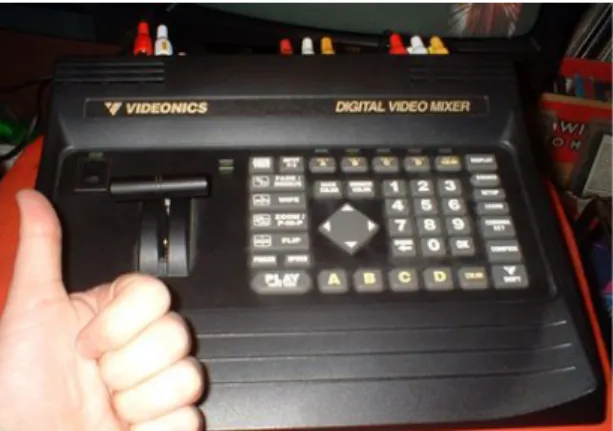
presentations, low-budget films, and commu-nity television productions). These mixers were quickly adopted by VJs as the core component of their performance setups.26 This is similar to the release of the Technics 1200 turntables, which were marketed towards homeowners desiring a more advanced home entertainment system, but were then appropriated by musi-cians and music enthusiasts for experimenta-tion. Initially, video mixers were used to mix pre-prepared video material from VHSplayers and live camera sources, and later to add the new computer software outputs into their mix. The 90s saw the development of a number of digital video mixers such as Panasonic’s WJ-MX50, WJ-MX12, and the Videonics MX-1.
In 1998, Roland / Edirol released the V5 Vid-eo Canvas, which was a hybrid device
featur-26 – “Before Edirol (...) introduced the first mass produced video mixer designed for live video mixing, the only other options for video mixers were those meant for professional use, such as the Panasonic MX-50.” - Davis, p.12
ing solid state storage of still images combined with a basic video mixer. The V5 marked an important transition point, where large music corporations saw an emerging market for video performance hardware. The products that fol-lowed the V5 have become the mainstay of VJ hardware setups.27
Early desktop editing systems such as the NewTek Video Toaster for the Amiga computer were quickly put to use by VJs seeking to cre-ate visuals for the emerging rave scene, whilst software developers began to develop systems
27 – Sound on Sound - The History of Roland. Retrieved August 18, 2006.
specifically designed for live visuals such as O’Wonder’s “Bitbopper”.28
The first known software for VJs was Vujak - created in 1992 and written for the Mac by EBN artist Brian Kane for use by the video art group he was part of - Emergency Broadcast
Network. In the mid-90s, Audio reactive pure
synthesis (as opposed to clip-based) softwares such as Cthugha and Bomb were influential. By the late 90s there were several PC based VJing software available, including generative visuals programs such as MooNSTER, Aestesis, and
Advanced Visualization Studio, as well as video
clip players such as Motion Dive, ArKaos, and
VJamm.
Programming environments such as Max/
MSP, Macromedia Director and later Quartz Composer started to become used by
them-selves and also to create VJing programs like VDMX or pixmix. These new software products and the dramatic increases in computer pro-cessing power over the decade meant that VJs were now regularly taking computers to gigs.
1.5 2000s
1.5.2 Important events
The new century has brought new dynamics to the practice of visual performance. To be a VJ previously had largely meant a process of self-invention in isolation from others: the term wasn’t widely known. Then through the rise of internet adoption, having access to other prac-titioners very became the norm, and virtual communities quickly formed. The sense of col-lective then translated from the virtual world onto physical spaces. This becomes apparent through the numerous festivals that emerge all over Europe with strong focus on VJing.
The VideA festival in Barcelona ran from 2000 - 2005.29, AVIT, clear in its inception as the online community of VJCentral.com self-organising a physical presence, had its first festival in Leeds (2002),30 followed by Chicago (2003), Brighton (2003), San Francisco (2004), and Birmingham (2005), 320x240 in Croatia (2003), Contact Europe in Berlin (2003). Also
29 – “VideA was the first festival in Spain and perhaps to Europe to dedicate itself to the VJ’s art.” - Makela, Mia (2006), “VJ Scene Spain”, vE-jA: Art
+ Technology of Live Audio-Video (San Francisco:
h4SF): 98
the Cimatics festival in Brussels should be credited as a pioneering event, with a first fes-tival edition in 2002 completely dedicated to VJing. In 2003, the Finnish media arts festival
PixelAche was dedicated to the topic of VJing,
while in 2003, Berlin’s Chaos Computer Club started a collaboration with AVIT organisers that featured VJ Camps and Congress strands.
LPM - Live Performers Meeting live video
per-formers, visual artists and vj meeting was born in Rome in 2004 with the aim to answer to the need for creating a space-temporal referential field where to meet, know each other and share vjing related experiences, with an edition in Mexico in 2008, LPM is now an international meeting dedicated to artists, professionals and passionates of veejaying, visual and live video performance. The MUTEK festival (2000–pres-ent) in Montréal regularly featured VJs
along-Fig. 4 — Two VJs collaborating on a mix at an outdoor electronic music festival.
side experimental sound art performances, and later the Elektra Festival (2008–present) also emerged in Montréal and featured many VJ performances. In Perth, Australia, the Byte Me! festival (2007) showed the work of many VJs from the Pacific Rim area alongside new media theorists and design practitioners. Two festi-vals entirely dedicated to VJing, Mapping
Fes-tival in Geneva and Vision’R in Paris, held their
first edition in 2005. As these festivals emerged that prominently featured VJs as headline acts (or the entire focus of the festival), the rave festival scene also began to regularly include VJs in their main stage lineups with varying de-grees of prominence.
With lesser funding, the US scene has been host to more workshops and salons than fes-tivals. Between 2000-2006, Grant Davis (VJ Culture) and Jon Schwark of Dimension 7 pro-duced “Video Salon”, a regular monthly gath-ering significant in helping establish and edu-cate a strong VJ community in San Francisco, and attended by VJs across California and the United States.31 In addition, they produced an annual “Video RIOT!” (2003–2005) as a politi-cal statement following the R.A.V.E. Act
(Re-ducing Americans’ Vulnerability to Ecstasy Act)
of 2003; a display of dissatisfaction by the re-election of George W. Bush in 2004; and in
ance of a San Francisco city ordinance limiting public gatherings in 2005.
Several VJ battles and competitions began to emerge during this time period, such as Video Salon’s “SIGGRAPH VJ Battle” in San Diego (2003), Videocake’s “AV Deathmatch” series in Toronto (2006) and the “VJ Contests” at the Mapping Festival in Geneva (2009). These worked much like a traditional DJ battle where VJs would be given a set amount of time to show off their best mixes and were judged according to several criteria by a panel of judges.
Databases of visual content and promotional documentation became available on DVD for-mats and online through personal websites and through large databases, such as the
“Pre-linger Archives” on Archive.org. Many VJs
be-gan releasing digital video loop sets on vari-ous websites under Public Domain or Creative
Commons licensing for other VJs to use in their
mixes, such as Tom Bassford’s “Design of Sig-nage” collection (2006), Analog Recycling’s “79 VJ Loops” (2006), VJzoo’s “Vintage Fairlight Clips” (2007) and Mo Selle’s “57 V.2” (2007).
Promotional and content based DVDs began to emerge, such as the works by Mixmasters (2000–2005), Lightrhythm Visuals (2003),
Vi-somat Inc. (2002), and Pixdisc, all of which
techniques. These were then later followed by NOTV, Atmospherix, and other labels. Mia Makela curated a DVD for Mediateca of Caixa Forum called “LIVE CINEMA” in 2007, focus-ing on the emergfocus-ing sister practice of “live cinema”. Individual VJs and collectives also published DVDs and CD-ROMs of their work, including Eclectic Method’s bootleg video mix (2002) and Eclectic Method’s “We’re Not VJs” (2005), as well as eyewash’s “DVD2” (2004) and their “DVD3” (2008).
Books reflecting on the history, technical as-pects, and theoretical issues began to appear, such as “The VJ Book: Inspirations and Practi-cal Advice for Live Visuals Performance” (Paul Spinrad, 2005), “VJ: Audio-Visual Art and VJ Culture” (Michael Faulkner and D-Fuse, 2006), “vE-jA: Art + Technology of Live Audio-Video” (Xárene Eskandar [ed], 2006), and “VJ: Live Cinema Unraveled” (Tim Jaeger, 2006). The subject of VJ-DJ collaboration also started to become a subject of interest for those studying in the field of academic human–computer
inter-action (HCI).
1.5.2 Technological developments
The availability and affordability of new con-sumer-level technology allowed many more people to get involved into VJing. The dramatic increase in computer processing power that
be-came available facilitated more compact, yet of-ten more complex setups, sometimes allowing VJs to bypass using a video mixer, using pow-erful computers running VJ software to control their mixing instead. However, many VJs con-tinue to use video mixers with multiple sources, which allows flexibility for a wide range of input devices and a level of security against comput-er crashes or slowdowns in video playback due to overloading the CPU of computers due to the demanding nature of realtime video processing. In 2001, Roland / Edirol released the V4 Video mixer, a popular video mixer designed specifically for VJing. It features MIDI control
to enable integration with digital music equip-ment, and quickly became adopted as a stan-dard VJ mixer. Other companies (Korg and
Pio-neer, for example), following the success of the
V4, launched visual mixers as well. The Edirol V8 came out in 2008.
Today’s VJs have a wide choice of off the shelf hardware products, covering every aspect of visuals performance, including video sample playback (Korg Kaptivator), real-time video ef-fects (Korg Entrancer) and 3D visual genera-tion (Edirol CG8).
The widespread use of DVDs gave initiative for scratchable DVD players (Pioneer DVJ-X1 and Pioneer DVJ-1000).
Many new models of MIDI controllers be-came available during the 2000s, which allow VJs to use controllers based on physical knobs, dials, and sliders, rather than interact primarily with the mouse/keyboard computer interface.
There are also many VJs working with experi-mental approaches to working with live video. Open source graphical programming environ-ments (such as Pure Data) are often used to create custom software interfaces for perfor-mances, or to connect experimental devices to their computer for processing live data (for ex-ample, the IBVA EEG-reading brainwave unit,
Fig. 6 — An example of some VJ software, a preview monitor, and the resultant projection.
the Arduino microprocessor, or circuit bending children’s toys).
The second half of this decade also saw a dramatic increase in display configurations be-ing deployed, includbe-ing widescreen canvases, multiple projections and video mapped onto the architectural form. This shift has been under-lined by the transition from broadcast based technology - fixed until this decade firmly in the 4x3 aspect ratio specifications NTSC and PAL - to computer industry technology, where the varied needs of office presentation, immersive gaming and corporate video presentation have led to diversity and abundance in methods of output. Compared to the ~640x480i fixed
for-mat of NTSC/PAL, a contemporary laptop using DVI can output a great variety of resolutions up to ~2500px wide, and in conjunction with the Matrox TripleHead2Go can feed three differ-ent displays with an image coordinated across them all.
Fig. 7 — Various VJ hardware set up for a performance.
2. Common technical setups
A significant aspect of VJing is the use of technology, be it the re-appropriation of exist-ing technologies meant for other fields, or the creation of new and specific ones for the pur-pose of live performance. The advent of video is a defining moment for the formation of the VJ (video jockey).
Often using a video mixer, VJs blend and superimpose various video sources into a live motion composition. In recent years, electronic musical instrument makers have begun to make specialty equipment for VJing.
VJing developed initially by performers using video hardware such as videocameras, video decks and monitors to transmit improvised per-formances with live input from cameras and even broadcast TV mixed with pre-recorded el-ements. This tradition lives on with many VJs using a wide range of hardware and software available commercially or custom made for and by the VJs.
VJ hardware can be split into categories -
• Source hardware generates a video picture
which can be manipulated by the VJ, e.g.
vid-eo cameras and Vidvid-eo Synthesizers.
• Playback hardware plays back an existing
video stream from disk or tape based
age mediums, e.g. VHS tape players and
DVD players.
• Mixing hardware allows the combining of
multiple streams of video e.g. a Video Mixer or a computer utilizing VJ software.
• Effects hardware allows the adding of
spe-cial effects to the video stream, e.g. Colour Correction units
• Output hardware is for displaying the video
signal, e.g. Video projector, LED display, or
Plasma Screen.
There are many types of software a VJ may use in their work, traditional NLE production tools such as Adobe Premiere, After Effects, and Apple’s Final Cut Pro are used to create content for VJ shows. Specialist performance software is used by VJs to playback and manip-ulate video in realtime.
VJ performance software is highly diverse, many applications are developed by VJs them-selves specifically to suit their own performance style. Graphical programming environments such as Max/MSP/Jitter, vvvv, Isadora and Pure
Data have developed to facilitate rapid
develop-ment of such custom software without needing years of coding experience.
Small companies producing dedicated VJ software such as Modul8, Resolume, VJamm,
FLxER, VDMX, Livid CellDNA or Grand VJ/
ArKaos give VJs a sophisticated interface for realtime processing of multiple layers of video clips combined with live camera inputs, giving VJs a complete off the shelf solution so they can simply load in the content and perform.
An opensource video effects plugin architec-ture called Freeframe32 has been developed to allow sharing of realtime video effects plugins between VJ softwares.
32 – http://www.freeframe.org
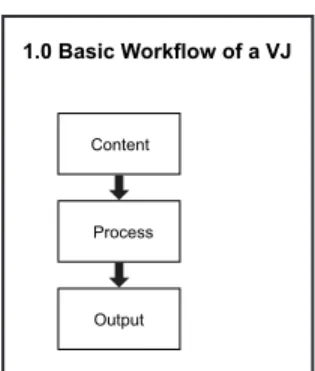
Fig. 8 — This image shows the basic conceptual workflow for a VJ.
Content
Process
Output
2.1 Sample workflows
There are many types of configurations of hardware and software that a VJ may use to perform.
Fig. 9 — This image shows a sample setup of how a VJ may set up an analog VJ workflow.
VHS Deck
Projector
DVD Player Videocamera Video GameSystem Webcam
Analog Video Mixer
1.1 Sample Analog Workflow of a VJ
Note: this is a sample setup and there are many possibilities - any one of the above content sources (or others) may be used
Fig. 10 — This image shows a sample setup of how a VJ may set up a digital VJ workflow.
Digital Video Clips
Digital Video Mixer
DVD Player Videocamera Video Game
System Webcam
Computer with VJ Software MIDI
Controller Computer withVJ Software
1.2 Sample Digital Workflow of a VJ
Projector Monitor
Note: this is a sample setup and there are many possibilities - any one of the above content sources and processing methods (or others) may be used
3. Research and reflective
thinking
Several research projects have been dedi-cated to the documentation and study of VJing from the reflective and theoretical point of view. In the Netherlands Media Art Institute, Montevideo / Time Based Arts, Annet Dekker organized a research on the subject called VJ
Cultuur – a state of flux33. Dekker wrote widely on the history of VJing and its contextualization within the club culture. In the same year, 2005,
VJ Theory 34 began publishing texts written by practitioners and academics, and organizing collective discussions online and offline around subjects related to VJing and audiovisual per-formative practices. Between 2005 and 2006 several books were published with interviews, showcasing works and related artists, provid-ing an overview of the current practice.35
33 – “VJCultuur, a state of flux”. 2004/2005. . Retrieved 12 May 2010.
34 – “VJ Theory”. 2005. . Retrieved 12 May 2010. 35 – These include The VJ Book: Inspirations and
practical Advice for Live Visuals Performance by
Paul Spinrad, VJ: Audio-Visual Art and VJ Culture edited by D-Fuse, vE-jA: Art + Technology of Live
Audio-Video edited by Xárene Eskandar. For more
Round tables, talks, presentations and dis-cussions are part of festivals and conferences related to new media art, such as ISEA and Ars
Electronica for example, as well as specifically
related to VJing, as is the case of the Mapping Festival. Exchange of ideas through dialogue contributed to the shift of the discussion from issues related to the practicalities of production to more complex ideas and to the process and the concept. Subjects related to VJing are, but not exclusively: identity and persona (individu-al and collective), the moment as art, audience participation, authorship, networks, collabora-tion and narrative. Through collaborative proj-ects, visual live performance shift to a field of interdisciplinary practices.
Periodical publications, online and printed, launched special issues on VJing. This is the case of AMinima printed magazine, with a spe-cial issue on Live Cinema 36 (which features works by VJs), and Vague Terrain (an online new media journal), with the issue The Rise of the VJ.37
36 Makela (ed.), Mia (December 2009), “Live Cinema”, AMinima Magazine (Barcelona) (22) 37 Gates (ed.), Carrie (March 2008). “The Rise of the VJ”. Vague Terrain (9). Retrieved 12 May 2010.
See also
• Video art
• Music visualization • Video scratching • New Media art festivals • Live event visual amplification • Video synthesizer
• DVJ
References
Amerika, Mark (2007). Meta/Data: A Digital Poetics. Cambridge: MIT Press. ISBN
978-0-262-01233-1
Dekker, Anette (2006), “Synaesthetic Perfor-mance in the Club Scene”, Cosign 2003:
Com-putational Semiotics, retrieved 7 May 2010
Eskandar, Xárene (ed) (2006). vE-jA: Art +
Technology of Live Audio-Video. San Francisco:
h4SF. ISBN 978-0976506058
Faulkner, Michael / D-Fuse (ed), 2006. VJ:
Audio-Visual Art and VJ Culture. London:
Harada, Daizaburo (1999) (in Japanese), VJ2000, August
Jaeger, Timothy (2006), Vj: Live CInema
Un-raveled. Handbook for Live Visual Performance,
retrieved 12 May 2010
Lehrer, Jonah (2008). Proust was a
neuro-scientist. New York:Mariner. ISBN
978-0-618-62010-4
Lund, Cornelia & Lund, Holger (eds), 2009.
Audio.Visual- On Visual Music and Related Media. Estugarda: Arnoldsche Art publishers.
ISBN 978-3-89790-293-0
Manu; Ideacritik & Velez, Paula, et all. (2009) "Aether9 Communications: Proceedings". TK: Greyscale Editions. Vol3, Issue 1. ISSN 1663-7658
Spinrad, Paul (2005). The VJ Book:
Inspira-tions and practical Advice for Live Visuals Performance. Los Angeles: Feral House. ISBN
1-932595-09-0
VJ Theory (ed) (2008). "VJam Theory: Col-lective Writings on Realtime Visual Perfor-mance". Falmouth:realtime Books. ISBN 978-0-9559892-0-4
Ustarroz, César (2010) Teoría del VJing -
Realización y Representación Audiovisual en Tiempo Real. ISBN: 978-84-7954-703-5. www. teoriadelvjing.com
Talk:VJing
External links
Also, two suggestions for common VJ soft-ware: Cycling ‘74s jitter (Max/MSP have their own page) http://www.cycling74.com/products/
jitteroverview and Quartz Composer. http:// developer.apple.com/graphicsimaging/quartz/ quartzcomposer.html (also has its own page
al-ready too). —Preceding. unsigned. comment. added. by. Djrug. (talk. •. contribs). 05:02,. 13. March.2009.(UTC)
There is a weekly gathering which features audio/visualists in New York City and globally called Share, whose site is at http://www.share.
dj/ and the New York City specific page: http:// www.share.dj/share/ I didn’t want to edit the
page directly (since I’ve never contributed be-fore), but think this would be a good inclusion.
Djrug (talk) 04:54, 13 March 2009 (UTC)
I removed sections wholly composed of exter-nal links that had been added by 81.106.146.155 wikipedia is not a links database etc etc --Sleepytom 23:45, 31 July 2006 (UTC)
I added back in the links to Regional VJ meet-ings. Please discuss here before removing them, I’m interested to know why (whoever re-moved them) thinks they are not appropriate.
Momothemonster 01:56, 21 July 2006 (UTC)
momo_the_monster
Please do not add links unless discussed here. Thanks. Lewispb 22:24, 4 July 2006 (UTC) Added referenced quotes at start of page with definitions of VJing. Also added VJ Hard-ware section with some history of VJ related hardware and some relevant links - please don’t delete these as they are not spam - i know that wikipedia is not a link database etc etc
Sleepy-tom 20:06, 12 July 2006 (UTC)
Added list of notable VJs with links to wikipe-dia pages if they have them (err is it better to add dead links for everyone in the intrests of fairness or should it be left as is for people to update if the add pages about these people?) also added references section 81.179.124.243 09:08, 13 July 2006 (UTC)
Removed spam links to shops selling DVD content
removed spam external links posted in the notable VJs section Sleepytom 20:10, 16 August 2006 (UTC)
Hello, blog.lecollagiste.com why the site is spam? how a webmag on culture vjing is spam? human or robot behind this decision unjustifi-able and anti french? thank you answer me with valid argument —Preceding unsigned comment added by 82.224.12.148 (talk) 08:15, 6 July 2009 (UTC)
See WP:ELNO #1, #4, and #11. --Ronz (talk) 16:45, 9 July 2009 (UTC)
Need to understand why community building initiatives such as festivals and gatherings have been removed from this posting. VisionR, LPM, Mapping Festival, AVIT events in general are a major factor in the growth and expansion of this medium. —Preceding.unsigned.comment. added.by.Senterio.(talk.•.contribs).16:17,.27. August.2009.(UTC)
Context
I don’t believe the tag on the article which says “The introduction to this article provides insufficient context for those unfamiliar with the subject matter.” is required. The opening is perfectly understandable. Falcolombardi87 18:58, 21 August 2006 (UTC)
I've just been through it and it is fine. I've expanded it slightly but it was good enough
be-fore to remove the tag. In case it isn't I've laft it there and another editor can make the final call on that one. (Emperor 20:55, 14 May 2007 (UTC))
Just to note that John Logie Baird was pro-ducing Television broadcasts in 1926 - before Farnsworth - http://en.wikipedia.org/wiki/John_
Logie_Baird
87.194.207.97 (talk) 18:26, 6 February 2010
(UTC)
notable VJs
(please sign your comments or it makes the discussion hard to follow)
I don’t think the “top 20” notable VJs is ap-propriate. It was done in a London magazine and do not reflect the reality that is why I re-moved it. There a lot of notable VJs not men-tioned here, this is not a British review!
i disagree with the above statement - DJ mag-azine is an internationaly avaiable magasine which is widely read. whilst it is debatable if the VJs listed in their top 20 are the “best” they are internationaly regarded VJs and as such are a good start for a list of notable VJs. other simi-lar sections of the wikipedia contain lists of
no-table practitioners so i feel it is appropriate for the VJ section to also contain such a section. i’m not going to reinsert it yet as i feel we should have more consensus on this but imho a notable VJs section is a usefull addition to the VJ entry.
Sleepytom 12:17, 12 September 2006 (UTC)
I too agree with SleepyTom that it should be included.
Although I disagree with the results and how they were obtained it is the nearest thing we have to decent list. To remove the list and have nothing to put in its place seem less correct. Does the person that removed the section have a better list. Rovastar
Thank you for not putting back this notable VJ list. I agree that DJ magazine is internation-al magazine, but the poeple who voted for the artists were english, and actually, the guy who was doing this survey (VJ Anyone) finally found himself in this list....wonder why... There is a VJ book that is coming out from D Fuse this fall that is a more open to what happens around the world. Maybe you should make a list out of art-ist invited in internationaly known Electronic arts Festival, like Ars Electronica, MUTEK, Ci-matics,
I took out the advertising from a artist collec-tive in the section of official events. If you guys want publicity, go somewhere else!
I do agree with not having a list of VJs as that would be contributing to stardom of some and is totally what to me this is not about. Nonethe-less there is no reason why not add software and festivals as well as gathering, since there is a list of hardware (and a picture of a V4? Al-right, is a good mixer but hey, how about other mixers? ). Other think, This should add some other work around VJing as for example people who write about it. VJ Theory (www.vjtheory. net) for example, Professor VJ and others. Or are you guys just interested in the practice and showcase of work and not on reflective thinking on your practice? (Auidoforvisual) —Preced-
ing.unsigned.comment.added.by.Audioforvi-sual.(talk.•.contribs).20:27,.27.August.2009.
(UTC)
History
Deleted the entire paragraph referenced in this section and reproduced below during wiki-sprint because could not find anywhere any ci-tations or sources, only found either the entire paragraph, or pieces of it, verbatim on various sites, but never any citations or sources. We all discussed and agreed most of it fell into the
anecdotal realm, especially the first sentence regarding the check and also the part regard-ing “...usregard-ing the first video synthesizer in the late 70s...” Wasn’t clear if author meant the first synth was made in late 70s, which would have been inaccurate, or if author first used the synth (which one?) in the late 70’s. Here is a copy of the paragraph removed:
“The first written use of the word “video jockey” was used on the paycheck of Merrill Al-dighieri in May 1980. She had been improvising live interpretations of the DJ music 8 hours per night for several weeks in an experiment to cre-ate a visual component to the music and light-shows in the club, using the newly installed vid-eo system which had TV monitors throughout the club hanging from the ceiling. Her studies in film with such innovators in animation and sound as Stan Brackage and Michael Snow, and her apprenticeship at Rhombex Studios in NYC using the first video synthesizer in the late 70s prepared her for this natural evolution of art and technology. She continued VJing in several nightclubs in NYC through the 80ies and then became active in producing finished music vid-eo oriented programs for Sony, MTV, and exper-imental films and animations for PBS. She occa-sionally tours with highlights from her archives and continues to experiment in multi-media production.” —Preceding.unsigned.comment.
added.by.Roguewaves.(talk.•.contribs).10:33,. 12.May.2010.(UTC)
In the Mid 90s, before Aestisis and more in-fluential, there was Cthugha and Bomb.
I am the person I wrote about who had the first written use of the word VJ on her pay-check. I am the person MTV first asked about the term I used to describe myself, and it is why they used the term in their TV channel they started about 6 months later. I added as much of the info I know about pioneers in the art of video as seem relevant to me in my path to invent the term and the job of VJ. If anybody would like to write me to talk about anything or find outside sources to add footnotes to make a better article, please do so, but I am the source.
Tonedefcom (talk) 02:06, 28 April 2009 (UTC)
Demo Scene
Maybe it would be a good idea to make a comment about how the European demo scene has highly influenced VJ software. Aestesis, Motion Dive and Moonster have been written by old demomakers —Preceding unsigned com-ment added by 209.17.131.25 (talk) 00:18, 13 March 2009 (UTC)
Definitions or advertisement?
Are those “definitions” in the first segment there for any reason except self-advertisement (each is followed by a BIG LINK IN CAPI-TAL LETTERS...) And some don’t make much sense... Quote: “VJ allows audio visual artists to research and resample mainstream audio visual culture.” Uhh, the VJ allows artists to research? Is he a sheriff of the visual arts? Or is VJ a corporation?? Or a military organisa-tion (“Vojska Jugoslavije”)? Quite confusing... ;) --Irina666 (talk) 23:56, 24 February 2008 (UTC) t a rough guess I’d say the term might be a contraction of “Video Jockey”, since the role ap-pears to be the video equivalent of a DJ (Disc Jockey). Might be useful if someone could find a source or two for this and insert it into the ar-ticle... Mittfh (talk) 23:53, 18 April 2009 (UTC) In my opinion, the article should be called make some distinction - as not all VJs are per-formance artists, though the video mixing tech-nology *is* often used for live performances and performance art. Deadchildstar (talk) 21:45, 8 August 2009 (UTC)
Proposed name change of the
article
A group of editors is currently trying to im-prove this article (wikipedians Anaoak, Axela-tor, Carriegates, Kenfeinstein, Roguewaves, Sleepytom and myself). We are wondering if the title shouldn’t be changed into VJing, or maybe
VJing (live visual performance).
Arguments pro:
• If you read through the article, you will
no-tice that it describes the artform of VJing, rather than the person (the VJ) practicing this artform. The same is the case for articles such as video art, installation art,
architec-ture, design, sculparchitec-ture, electronic art...
• If you check the What links here page, you
will notice that most of these articles use the word “VJing”, “VJ-ing”, or “VJ art”, rather than “VJ”, to link to this page.
• In other languages the page can also become
VJing as this is a multilingual and interna-tional designation for the practice.
• VJ is an independent practice and not
direct-ly related to DJ.
• The page is about the practice of VJing and
not the practitioner, the VJ. This is applicable to any other area of work wether this is with-in an artistic context or any other context.
For example we refer to medicine to describe what it is (as well as its many branches) and not the the doctor as the one who practices.
Anaoak (talk) 16:37, 12 May 2010 (UTC)
Arguments against:
• the page about DJing redirects to DJ. • Wikipedia pages in other languages are all
named either VJ, Video-jockey or Visual-jock-ey.
Please voice your opinions about this na-mechange. --1904.CC (talk) 09:36, 12 May 2010 (UTC)
Article Sources and
Contributors
VJing
Source: http://en.wikipedia.org/w/index. php?oldid=375365003 Contributors:1904.CC, Addenda, Alansohn, Alejandro Man-rique Hernandez Reinoso, Amgdesousaferreira, Anaoak, Anonymous Dissident, Arisontime, Axelator, Azart, Bongwarrior, Brianhe, Calaca-role, Carriegates, Chase me ladies, I’m the Cav-alry, Ckatz, Clubmarx, Csji, Cybercobra, Dana boomer, Decadentol, Dispenser, DojinLover, DonMcgregor, Dvd9978, Dyesect, East3Yr-sWest3Yrs, Echuck215, Emperor, Eric sigma6, Ethicoaestheticist, Ewlyahoocom, Firsfron, G-my, Gianlucadelgobbo, Gwernol, Haukurp, Hiberniantears, Husond, IanManka, Ianfaith, Impy4ever, Irina666, J.onbob34, JHunterJ, Je-roen, Joeyskye, JosephCampisi, Kanonkas, Ken-feinstein, Ketiltrout, Lewispb, MER-C, Mary-landArtLover, Masondixon, Mbell, Mbover-load, Michael Hardy, Mikakun, MikeWazowski, Momothemonster, Moreproduct, Moumou82, Nbarth, Newton-noze, Nightstallion, Norman-beats, OlEnglish, Opticalengineers,
Ownly-anangel, Peteohearn, PigFlu Oink, Psyberpixie, Robofish, Roguewaves, Ronz, Samuel1107, Scriberius, ShakingSpirit, Sidhekin, Sleepytom, Snakedancer, Soliel76, Soulshaker, Spot, Ste-phen McGlynn, Strongbad411, Sweetcandypro-ject, Takehiko, Telartis, Thenostril, Tobyspark, Toddthille, Topherzee, Urdujamanaoag, Veinor, Weissmann, Wes!, Xarene, Xiayu, Z-d, Zvar, 272 anonymous edits
Talk:VJing
Source: http://en.wikipedia.org/w/index. php?oldid=362473047
Contributors:
1904.CC, Anaoak, Audioforvisual, Deadchild-star, Djrug, Emperor, Falcolombardi87, Iri-na666, Lewispb, Mittfh, Momothemonster, Roguewaves, Ronz, Rovastar, Senterio, Sleepy-tom, Spot, Tonedefcom, 10 anonymous edits