Extraction and physicochemical characterization of
Sargassum vulgare
alginate from Brazil
Marcia R. Torres,
aAlessandra P. A. Sousa,
aEduardo A. T. Silva Filho,
aDirce F. Melo,
aJudith P. A. Feitosa,
bRegina C. M. de Paula
b,*and Maria G. S. Lima
aaDepartamento de Bioquı´mica e Biologia Molecular, Universidade Federal do Ceara´, CP 6020, CEP 60455-760,
Fortaleza, Ceara´, Brazil
bDepartamento de Quı´mica Orgaˆnica e Inorgaˆnica, Universidade Federal do Ceara´, CP 12.200, CEP 60455-760,
Fortaleza, Ceara´, Brazil
Received 24 November 2006; received in revised form 21 May 2007; accepted 22 May 2007 Available online 2 June 2007
Abstract—Alginate fractions fromSargassum vulgarebrown seaweed were characterized by1H NMR and fluorescence spectroscopy and by rheological measurements. The alginate extraction conditions were investigated. In order to carry out the structural and physicochemical characterization, samples extracted for 1 and 5 h at 60C were further purified by re-precipitation with
eth-anol and denoted as SVLV (S. vulgarelow viscosity) and SVHV (S. vulgarehigh viscosity), respectively. The M/G ratio values for SVLV and SVHV were 1.56 and 1.27, respectively, higher than the ratio for mostSargassumspp. alginates (0.19–0.82). The homopolymeric blocks FGGand FMMof these fractions characterized by1H NMR spectroscopy were 0.43 and 0.55 for SVHV and 0.36 and 0.58 for SVLV samples, respectively, these values typically being within 0.28–0.77 and 0.07–0.41, respectively. There-fore, the alginate samples fromS. vulgareare much richer in mannuronic block structures than those from otherSargassumspecies. Values ofMwfor alginate samples were also calculated using intrinsic viscosity data. TheMwvalue for SVLV (1.94·105g/mol) was lower than that for SVHV (3.3·105g/mol). Newtonian behavior was observed for a solution concentration as high as 0.7% for SVLV, while for SVHV the solutions behaved as a Newtonian fluid up to 0.5%. The optimal conditions for obtaining the alginates fromS. vulgarewere 60C and 5 h extraction. Under these conditions, a more viscous alginate in higher yield was extracted from the
seaweed biomass.
2007 Elsevier Ltd. All rights reserved.
Keywords: Sargassum vulgare; Alginate; Brown algae; Viscosity; NMR spectroscopy
1. Introduction
Alginates are polysaccharides found in brown seaweeds and are composed mainly of linear polymers of
b-(1!4)-DD-mannuronic (M) anda-LL-guluronic (G) acids differing in terms of their proportions and linear arrangements.1 The sequence of monomers (M, G) changes greatly depending on the source (algal species or tissue).2 Although the main source of alginates is brown seaweed, similar polysaccharides are found in the capsulae of some soil bacteria.3In brown seaweeds,
alginates are the most abundant polysaccharides reach-ing up to 40% of the dry weight.4They are mainly found in the cellular wall matrix.5Matrix polysaccharides are produced by geobacteria Azotobacter vinelandii, Azoto-bacter crococum and some species ofPseudomonas.4
Alginates do not have any nutritional value; however, they are often employed as additives to change and sta-bilize the texture of foods. The most important alginate properties are the ability to form a gel and the stabiliza-tion of aqueous mixtures and emulsions.4
1H NMR spectroscopy is the main technique used in
the investigation of alginate composition and structural patterns.6–9Alginate structures are generally constituted
of homopolymeric blocks (M blocks and G blocks) that
0008-6215/$ - see front matter 2007 Elsevier Ltd. All rights reserved. doi:10.1016/j.carres.2007.05.022
can be separated by heteropolymeric blocks (MG blocks).9 The M/G ratio and block structure have a strong effect on the physical properties of alginate.
The alginate and the biomass ofSargassumspp. have been reported to be suitable substrates for heavy-metal adsorption, and the adsorption parameters for Cd,10–12
Au,13Cu,7,14Fe,15Ni,16Pb,17and Zn7have been
inves-tigated. Davis et al.10,11showed that the amount of
gulu-ronic acid and of ugulu-ronic acid diads and triads are the critical parameters in the use of alginate fromSargassum spp. for metal biosorption strategies. Also, in this regard, Donati et al.17 investigated the role of the MG sequence in the calcium alginate network.
Pharmacological experiments have revealed that poly-saccharides extracted from Sargassum fusiforme mark-edly decrease the content of total cholesterol, triglycerides, and low-density hypoprotein cholesterol in rats.18A crude extract of Sargassum polycystumhas been shown to have a considerable effect in the preven-tion of severe lipid disturbances and to metabolize enzymes triggered by acetaminophen during hepatic injury.19
Alginate is employed as a matrix for encapsulation and/or release of cells20 and also for the release of
drugs.21,22 It is also used in the form of microparticles for antigen release systems since it is unspecific, non-toxic and, most importantly, because it is approved by the US Food and Drug Administration.23Oral adminis-tration of alginate microspheres induces systemic and mucosal immune response in a wide variety of animals. These microspheres act not only as a release system, but also as adjuvants since the induction of cytokines has been observed.23
Some reports on the seaweed Sargassum vulgare, mainly from Brazil, are available in the literature. An evaluation of the methods for extraction and quantifica-tion of protein from marine macro- and microalgae, including S. vulgare, is available in the literature24 as
well as its amino acid composition.25The chemical com-position (protein, carbohydrate, lipids, fiber, ash, and nitrogen) of this seaweed was investigated in order to evaluate its potential nutritive value.26 An extract of S. vulgare algae at 5% concentration has shown 78.8% syncytium inhibitory activity toward the human T-cell lymphotropic virus (HTLV-1), and it may be useful in preventing infection.27 Another potential application of this seaweed is as biosorbent for heavy metals (Cd and Cu).S. vulgare biomass uptakes more Cd and Cu than other Sargassum species (Sargassum filipendula and Sargassum fluitans).14 With regard to S. vulgare polysaccharides, the only relevant study found in the lit-erature was published in 1995, which presented an over-view of four main polysaccharides,28 with no alginate
characterization.
Taking into account the potential application of S. vulgare alginate, its extraction conditions were
investi-gated, and the alginates obtained were characterized. We intend to use these alginates in future studies as a matrix for enzyme and drug encapsulation.
2. Materials and methods
2.1. Extraction and purification of alginates
Specimens of the brown seaweed S. vulgare were collected in August 2001 from the Atlantic coast in northern Brazil (Pacheco Beach, Caucaia, Ceara´). The samples were cleaned, washed in distilled water and stored at 20C. Alginates were extracted according
to Calumpong et al.29 (modified procedure). The algae samples were dried to constant weight at 60C, then
soaked in 2% formaldehyde for 24 h, washed with water and then added to 0.2 M HCl and left for another 24 h. After this time the samples were washed again in dis-tilled water before extraction with 2% sodium carbon-ate. The extract was then divided into three aliquots.
Alginate extraction was monitored over time at differ-ent temperatures (25, 60, and 80C). Aliquots collected
after different time periods were centrifuged, and the supernatants were labeled as crude extracts. The algi-nate sample was then obtained from the crude extract by precipitation with ethanol. The precipitate was washed twice with acetone and dried under ambient atmosphere.
The alginate fractions obtained by extraction at 60C
for 1 h and 5 h were purified by re-precipitation with ethanol as previously described and denoted as S. vulg-are low-viscosity (SVLV) and S. vulgare high-viscosity (SVHV) samples, respectively.
2.2. Fluorescence spectroscopy analysis
Fluorescence spectra were obtained with a HITACHI F-2000 spectrofluorimeter following the procedure used by Klock et al.30 The alginate fractions (SVLV and SVHV) were dissolved in distilled water (1% w/v) and filtered through disposable membrane syringe filters (0.2lm). The excitation wavelength was 366 nm, and the emission signals were observed in the range of 380–600 nm.
2.3. General characterization
The protein content was calculated from the %N deter-mined by elemental analysis using a multiplication fac-tor of 6.25.26 Elemental microanalyses were performed
in a Carlo Erba EA model 1108 equipment. The mois-ture content was obtained by heating 0.1 g of the sam-ples at 105C until constant weight. Samples of 0.1 g
were heated at 600C until constant weight for ash
2.4. Nuclear magnetic resonance spectroscopy
1H NMR spectra of 0.1% w/v solutions in D
2O were
recorded on a Fourier-transform Bruker Avance DRX 500 spectrometer, equipped with an inverse multinuclear gradient probe-head withz-shielded gradient coils, and with a Silicon Graphics Workstation, at 353 K. Chemical shifts are given in ppm relative to internal sodium 2,2-dimethylsilapentane-5-sulphonate (DSS) at 0.00 ppm. Baseline correction was carried out prior to integration, and the block patterns were obtained through the aver-age of three determinations of each sample. Samples were prepared for NMR analysis by the partial acid hydrolysis method.10
2.5. Intrinsic viscosity
The intrinsic viscosities were measured on an Ubbelohde viscometer, with 0.5-mm capillary diameter, and with a solvent flow time (0.1 M NaCl) of 127.3 s at 25C. The
initial alginate solutions (SVLV and SVHV) in a concen-tration of 30 mg/10 mL were prepared by stirring for at least 4 h at room temperature (25C). All flow times
were mean values of at least five replicates.
2.6. Rheological determinations
The flow curves for SVLV and SVHV in 0.1 M NaCl aqueous solutions were obtained with a Brookfield rheo-meter, cone-plate model LV-DV-III, at 25C, over a
range of polysaccharide concentrations from 0.1 to 1.0 g/dL.
3. Results and discussion
3.1. Effect of extraction conditions on the yield and specific viscosity
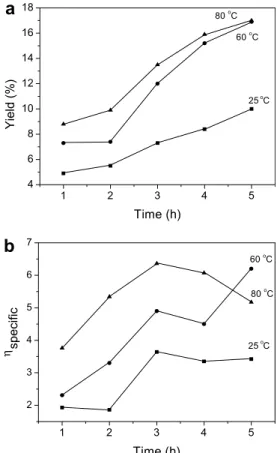
The alginate extraction was monitored over time at different temperatures. The alginate yield increased with temperature (Fig. 1a). After 3 h of heating the yields ob-tained at 60 and 80C were similar. The best yield value
was registered after 5 h of extraction at 60 or 80C. This
value (16.9%) is 40% higher than the yield for the sample extraction at 25C. Davis et al.10 found values in the
range of 21.1–24.5% forS. fluitans and 16.3–20.5% for Sargassum oligocystumwith variations being dependent on the alginate extraction method used. In another study, Davis et al.11obtained higher yields for the same species, of 45% and 37%, respectively. Also, yield values forSargassum dentifolium,Sargassum asperifolium, and Sargassum latifolium of 3.25%, 12.4%, and 17.7%, respectively, have been reported.9The average result ob-tained for S. vulgare is within the range reported for alginate from theSargassumgenus; however, it is lower
than alginate from other algal species (22–61%).8 The polysaccharide content ofS. vulgare was less than that determined by Marinho-Soriano et al.,26 possibly due to weight difference using protein, lipid, fiber, moisture, and ash content (67.8% of dry matter). The Sargassum seaweed polysaccharide is a unique mixture, mainly algi-nate and fucoidan.14Taking into account that alginate is
not the major component of S. vulgare polysaccha-rides,28 the yield value of 16.9% for alginate is not unexpected.
The effect of extraction time and temperature on spe-cific viscosity can be seen in Figure 1b. An increase in the temperature of the extraction procedure resulted in higher solution viscosity, probably due to dissolution of high molar mass macromolecules. Since the extrac-tion for 5 h at 60C produced an alginate solution
vis-cosity slightly higher than that at 80C, the optimal
temperature for obtaining alginates from S. vulgare was established as 60C.
The analytical data obtained for SVLV and SVHV were similar (Table 1). The protein values determined through nitrogen content (%N·6.25)26 were 1.1 and
1.0 for SVHV and SVLV, respectively. Slightly different values for nitrogen content have been reported in the lit-erature.26The protein content ofS. vulgare polysaccha-rides is very low when compared with that reported for
1 2 3 4 5
4 6
a
b
8 10 12 14 16 18Yield (%
)
Time (h)
25o
C 60oC 80o
C
1 2 3 4 5
2 3 4 5 6 7
η specific
Time (h)
25o
C 80o
C 60o
C
the total biomass (15.8%).26 In a previous study, S.
fluitans and Sargassum siliquosum alginate were found to contain no detectable nitrogen content; however, Sargassum thumbergiihad 6.9% of protein.11
Considering the sodium alginate structure and the sample moisture content, the calculated C and H mass percentages were 32.1% and 4.13%, respectively, for SVLV and 31.5% and 4.08%, respectively, for SVHV. The experimental results were quite different, the %C being lower and the %H higher. This difference is greater for SVLV, being about4% for C and +1% for H. This could be because the moisture content at the moment of microanalysis was higher than the value given inTable 1, and also, cations other than sodium may have been present.
3.2. Fluorescence spectroscopy
The alginate purity degree is very important for medical applications. Unpurified alginate can lead to the devel-opment of fibrotic cell overgrowth around the alginate microcapsules. The main contaminants are polyphenols, endotoxins, and proteins.31The degree of purification of
the alginates was verified by fluorescence spectroscopy, which can detect polyphenolic impurities often found in alginates.32 It can be noted in Figure 2 that the unpurified S. vulgare alginates showed the presence of residues emitting at 450 nm. After dissolution and re-precipitation with ethanol, the fluorescence intensity
was reduced by 52.7% for both SVLV and SVHV samples. These results are consistent with the values reported by Orive et al.20 for Laminaria hyperborea alginates (63%). Klo¨ck et al.30reported that the remain-ing contaminants detected in the fluorescence spectra of alginates from Durviella potatorum (another brown algae) could not be identified. However, in vitro and in vivo biocompatibility tests have shown that these impurities did not induce the production of anti-alginate antibodies.32
3.3. 1H NMR characterization
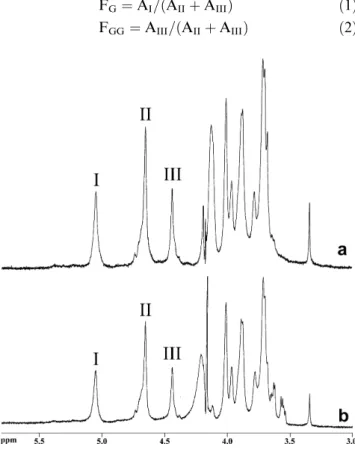
Figure 3shows the1H NMR spectra for the SVLV and SVHV alginates. Both spectra show the characteristics of the guluronic acid anomeric proton (G-1) at 5.06 ppm (peak I); guluronic acid H-5 (G-5) at 4.4 ppm (peak III); and mannuronic acid anomeric pro-ton (M-1) and the C-5 of alternating blocks (GM-5) overlapped at 4.7 ppm (peak II).1H NMR spectroscopy is a reliable method for the determination of the compo-sition and also the block structures of alginate mole-cules.8,9 The block structure and M/G ratio were
calculated using the method proposed by Grasdalen5
and Grasdalen et al.6 The individual guluronic acid
(FG) and the doublet (FGG) fractions can be calculated
from the area under the peak (I to III) using the equations
FG¼AI=ðAIIþAIIIÞ ð1Þ
FGG¼AIII=ðAIIþAIIIÞ ð2Þ
Table 1.Analytical data ofSargassum vulgarealginates
Analytical parameter (m/m %) SVLV SVHV
H 5.15 4.49
C 27.7 28.1
N 0.178 0.164
S 0 0
Protein from N% 1.1 1.0
Moisture 14 16
Ash 2 1
350 400 450 500 550 600
0 10 20 30 40
D C B A
Intensit
y
Wavelength (nm)
Figure 2. Fluorescence analysis of alginate samples: (a) unpurified SVLV sample; (b) unpurified SVHV sample; (c) purified SVHV sample; (d) purified SVLV sample.
The fraction M can be determined by
FM¼1FG ð3Þ
and the M/G ratio is given by
M=G¼ ð1FGÞ=FG ð4Þ
The ability to form gels from alginate is markedly influenced by the uronic acid composition (mannuronic and guluronic acid ratio).33 Brittle gels are obtained
from alginate with a low M/G ratio, while elastic gels are formed from alginate with a high M/G ratio.33
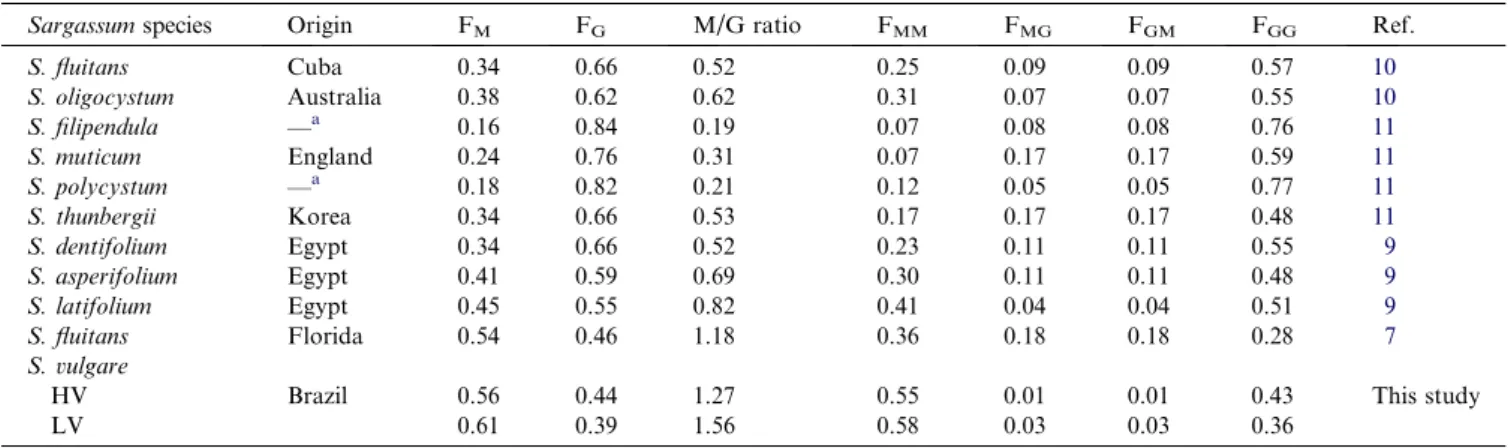
The comparison of the M/G ratio and other data for S. vulgarealginate (SVLV and SVHV) with similar data for alginates from otherSargassumspecies are given in
Table 2. An unusually high M/G ratio was observed forS. vulgarealginate. The M/G ratio values for SVLV and SVHV were 1.56 and 1.27, respectively, higher than the ratio for most ofSargassumspp. alginates. The M/G ratio varies according to the extraction methodology and location from which the algae were collected. Davis et al.11 analyzed the effect of extraction procedures on M/G ratio forS. fluitansandS. oligocystum. The varia-tion in the M/G ratio was 0.52–0.57 forS. fluitansand 0.49–0.62 for S. oligocystum, depending on the extrac-tion procedures. It can be noted that the sample of S. fluitansinvestigated by Davis et al.11had a very low
M/G ratio when compared with that obtained for the same algae by Forest and Volesky (1.18).7This dissimi-larity may be due to the difference in the geographical location of the algae. The results obtained for SVLV are similar to those observed for S. fluitans collected from the Gulf of Mexico along the Florida coast.7 High-er values for the M/G ratio wHigh-ere obsHigh-erved forLaminaria trabeculataseaweed from Chapaco, Chile (1.73),34 Asco-phyllum nodosum (1.14–1.29),33 Macrocystis pyrifera (1.38),33 andLaminaria digitata (1.56).35
It is not only the M/G ratio which has an influence on alginate gelling properties, but also the presence of homopolymeric block structures, that is, mannuronic
acid blocks (FMM), guluronic blocks (FGG), and
alter-nating blocks (FMG).
The increasing interest in alginate for industrial appli-cation is due to its ability to form gel in the presence of calcium ions. However, the gel formation occurs mainly as a function of the formation of enriched GG junction zones.9 Alginate has been used as a bioadsorbent for
heavy metals, such as Cd2+, a process which is
depen-dent on the abundance of GG block diads.10,11
The doublet fractions (FGG and FMM) are obtained
from the following relationships:9
FGGþFGM¼FG ð5Þ
FMMþFMG¼FM ð6Þ
Data for doublet fractions of S. vulgare are also shown in Table 2. Sargassum alginates possess a high quantity of homopolymeric guluronic blocks (FGG).
The alternating block fractions (FMG and FGM) range
from 0.04 to 0.20.9–11 An unusual fraction pattern was
obtained in this study forS. vulgarealginate. Both sam-ples showed high values for homopolymeric mannuronic acid blocks and lower values for alternating blocks than those previously described in the literature for Sargas-sum alginates.9–11 Low alternating block values have been previously observed for alginate fromS. latifolium (0.04),9 Sargassum thunbergii (0.05) and S. polycystum (0.05).11However, these samples are rich in FGGblocks.
A high FMM fraction has been found for alginate from
S. fluitans from Florida7 and L. digitata, but in these cases the alternating block fraction was much higher (0.17 and 0.24 for S. fluitans and L. digitata, respec-tively) than the value found for S. vulgare samples (0.01–0.03). Different properties of S. vulgare alginates are expected.
3.4. Intrinsic viscosity
Intrinsic viscosity is a measure of the hydrodynamic vol-ume occupied by the macromolecule at infinite dilution
Table 2.Compositional data of alginates extracted from species ofSargassum
Sargassumspecies Origin FM FG M/G ratio FMM FMG FGM FGG Ref.
S. fluitans Cuba 0.34 0.66 0.52 0.25 0.09 0.09 0.57 10
S. oligocystum Australia 0.38 0.62 0.62 0.31 0.07 0.07 0.55 10
S. filipendula —a 0.16 0.84 0.19 0.07 0.08 0.08 0.76 11
S. muticum England 0.24 0.76 0.31 0.07 0.17 0.17 0.59 11
S. polycystum —a 0.18 0.82 0.21 0.12 0.05 0.05 0.77 11
S. thunbergii Korea 0.34 0.66 0.53 0.17 0.17 0.17 0.48 11
S. dentifolium Egypt 0.34 0.66 0.52 0.23 0.11 0.11 0.55 9
S. asperifolium Egypt 0.41 0.59 0.69 0.30 0.11 0.11 0.48 9
S. latifolium Egypt 0.45 0.55 0.82 0.41 0.04 0.04 0.51 9
S. fluitans Florida 0.54 0.46 1.18 0.36 0.18 0.18 0.28 7
S. vulgare
HV Brazil 0.56 0.44 1.27 0.55 0.01 0.01 0.43 This study
LV 0.61 0.39 1.56 0.58 0.03 0.03 0.36
a
in a specific solvent at a given temperature. It is depen-dent on the molar mass, composition, and sequence of M and G residues, as well as the ionic strength. Intrinsic viscosity is defined by the Huggins equation as
½g ¼lim
c!0gsp=
c ð7Þ
Intrinsic viscosity was determined in dilute solutions using Eq. 8, where gsp and gsp/c are the specific and
reduced viscosity, respectively, and kH is the Huggins
constant
gsp=c¼ ½g þkH½g2c ð8Þ
The plot of reduced viscosity versus alginate concen-tration is shown inFigure 4for SVLV and SVHV sam-ples. The intrinsic viscosities in 0.1 M NaCl at 25C for
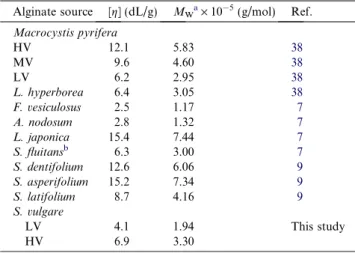
SVHV and SVLV were 6.9 and 4.1 dL/g, respectively. These alginates, particularly the SVLV, had low [g] val-ues when compared to otherSargassumalginates, which are in the range of 6.3–15.2 dL/g (Table 3). The lower
value obtained for SVLV may be due to the high content of FMM fraction in this sample, which is more flexible
than the FGGfraction. If the [g] values of alginate from other algae sources are included in the range (seeTable 3), the intrinsic viscosity ofS. vulgarealginates is in the observed range (2.5–15.4).
Due to the low viscosity and high FMM fraction the
S. vulgare alginate samples may not possess the gelling properties required for some alginate applications. However, these characteristics may be useful for obtain-ing of polyelectrolyte complexes for the production of drug delivery micro- and nanoparticles. In some cases, a charged polysaccharide with low viscosity is needed.
3.5. Molar mass
The viscosity average molar mass (Mv) was determined
using the Mark–Houwink equation
½g ¼kMa
v ð9Þ
where k and a are empirical coefficients dependent on the polymer and solvent–temperature systems. For algi-nate,avalues from 0.73 to 1.31 can be obtained depend-ing on the ionic strength and alginate composition.36,37
Higheravalues are typical of G-rich alginate, while low-er values are obslow-erved for M-rich alginates, which are more flexible.4,36
On considering alginate from five sources, Clementi et al.38 proposed empirical relations for [g] and the weight-average molar mass (Mw)
½g ¼0:023M0:984
w ð10Þ
where [g] is given in dL/g andMin kDaltons.
TheMwvalues for alginates fromS. vulgareand from
other algal sources were estimated from the intrinsic vis-cosity data, using Eq.10, as shown inTable 3. The val-ues for all alginates lay within the order of magnitude of 105g/mol, including the SVLV and SVHV samples. The
molar mass value for SVLV was lower than most values reported for alginates from the Sargassum species, but higher than those obtained for alginates extracted from A. nodosumandFucus vesiculosus.7SVHV had a molar mass value similar to that reported for S. fluitans,7but lower than those calculated for S. dentifolium and S. asperifolium.9
3.6. Rheological measurements
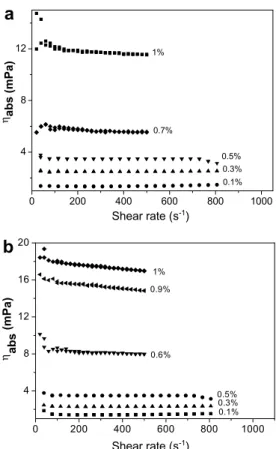
Rheological behavior is an important parameter for the application of polysaccharides in the food industry. Flow curves for Na-purified SVHV and SVLV samples in aqueous solutions were performed in the concentra-tion range of 0.1–1.0 g/dL in 0.1 M NaCl (Fig. 5). In the Power–Law model, the solution behavior can be described by Eq. 11
0.00 0.05 0.10 0.15 0.20 0.25 0.30 0
2 4 6 8 10 12 14
ηesp
/c (dL/g)
Concentration (g/dL)
Figure 4. Specific viscosity of SVLV (d) and SVHV (j) samples in
0.1 M NaCl.
Table 3. Intrinsic viscosity and average molar masses of alginates from different sources
Alginate source [g] (dL/g) MWa·105(g/mol) Ref. Macrocystis pyrifera
HV 12.1 5.83 38
MV 9.6 4.60 38
LV 6.2 2.95 38
L. hyperborea 6.4 3.05 38
F. vesiculosus 2.5 1.17 7
A. nodosum 2.8 1.32 7
L. japonica 15.4 7.44 7
S. fluitansb 6.3 3.00 7
S. dentifolium 12.6 6.06 9 S. asperifolium 15.2 7.34 9
S. latifolium 8.7 4.16 9
S. vulgare
LV 4.1 1.94 This study
HV 6.9 3.30
aCalculated from [
s¼mcn ð11Þ
where m is the consistency index (Pa sn),
n is the flow behavior index,s is the shear stress and cis the shear rate. The parametersmandncan be obtained by linear regression analysis.39The parameters obtained (Table 4) and the flow behavior index are closer to 1 for Newto-nian fluids.
Newtonian behavior is observed for a solution frac-tion as high as 0.7% for SVLV, while for the SVHV sam-ple the solutions behaved as Newtonian fluid up to 0.5%. These results differ from those obtained by Man-cini et al.40for alginate fromM. pyrifera (M
was
calcu-lated from [g] using Eq. 10 range: 2.95·105 to 5.83·104g/mol) and L. hyperborea (Mw as calculated
from [g] using Eq. 10= 3.05·104g/mol), where pseudoplasticity was observed for a very low solution concentration of 0.125%.
Acknowledgements
We are grateful to CENAUREMN—UFC for the NMR spectra and to Conselho de Desenvolvimento Cientı´fico e Tecnolo´gico (CNPq-Brazil) for financial support.
References
1. Sharma, A.; Gupta, M. N. Carbohydr. Polym.2002,48, 391–395.
2. Donati, I.; Vetere, A.; Gamini, A.; Skajak-Bræk, G.; Coslovi, A.; Campa, C.; Paoletti, S. Biomacromolecules 2003,4, 624–631.
3. Llanes, F.; Sauriol, F.; Morin, F. G.; Perlin, A. S.Can. J. Chem.1997,75, 585–590.
4. Moe, S. T.; Draget, K. I.; Skajak-Bræk, G.; Smidsrød, O. InFood Polysaccharides and their Applications; Stephen, A., Ed.; Marcel Dekker: New York, 1995; pp 245–286. 5. Grasdalen, H.Carbohydr. Res.1983,118, 255–260. 6. Grasdalen, H.; Larsen, B.; Smidsrød, O.Carbohydr. Res.
1979,68, 23–31.
7. Fourest, E.; Volesky, B.Appl. Biochem. Biotechnol.1997, 67, 33–44.
8. Panikkar, R.; Brasch, D. J. Carbohydr. Res. 1996, 293, 119–132.
9. Larsen, B.; Salem, D. M. S. A.; Sallan, M. A. E.; Mishrikey, M. M.; Beltagy, A. I. Carbohydr. Res.2003, 338, 2325–2336.
10. Davis, T. A.; Ramirez, M.; Mucci, A.; Larsen, B.J. Appl. Phycol.2004,16, 275–284.
11. Davis, T. A.; Llanes, F.; Volesky, B.; Mucci, A.Environ. Sci. Technol.2003,37, 261–267.
12. Holan, Z. R.; Volesky, B.; Prosetyo, I.Biotechnol. Bioeng. 1993,41, 819–825.
13. Volesky, B.; Kuyucak. N. U.S. Patent 4,769, 223, 1998.
14. Davis, T. A.; Volesky, B.; Vieira, R. H. S. F.Water Res. 2000,34, 4270–4278.
15. Figueira, M. M.; Volesky, B.Biotechnol. Bioeng.1997,54, 334–350.
16. Holan, Z. R.; Volesky, B. Biotechnol. Bioeng. 1994, 43, 1001–1009.
17. Donati, I.; Holtan, S.; Mørch, Y. A.; Borgogna, M.; Dentini, M.; Skajak-Bræk, G.Biomacromolecules2005,6, 1031–1040.
18. Mao, W. J.; Li, B. F.; Gu, Q. Q.; Fang, Y. C.; Xing, H. T. Hydrobiologia2004,512, 263–266.
19. Raghvendran, H. R. B.; Sathivel, A.; Devaki, T.Mol. Cell. Biochem.2005,276, 89–96.
20. Orive, G.; Ponce, S.; Herna´ndez, M. R.; Gasco´n, R. A.; Igartua, M.; Pedraz, L. J. Biomaterials 2002, 23, 3825– 3831.
21. Chen, H.; Ouyang, W.; Jones, M.; Hague, T.; Lawuyi, B.; Prakash, S.J. Microencapsulation2005,22, 539–547. 22. Kim, M. S.; Park, G. D.; Jun, S. W.; Lee, S.; Park, J. S.;
Hwang, S. J. J. Pharm. Pharmacol. 2005, 57, 1521– 1528.
0 200 400 600 800 1000
4 8 12
η
η
abs (mPa)
Shear rate (s-1)
Shear rate (s-1) 1%
0.7%
0.5% 0.3% 0.1%
0 200 400 600 800 1000
4 8 12 16 20
abs
(mPa
)
0.1% 0.3% 0.5% 0.6%
0.9% 1%
a
b
Figure 5. Effect of shear rate on the viscosity of S. vulgarealginate solutions in 0.1 M NaCl at 25C. (a) SVHV; (b) SVLV.
Table 4. Power-law parameter in 0.1 M NaCl solutions at different alginate concentration
Concentration (% (w/v))
SVLV sample SVHV sample
m(Pa sn
) na Rb m(Pa sn
) na Rb
0.1 1.00 0.10 99.6 1.00 0.09 98.7
0.3 0.96 0.22 98.9 0.98 0.18 99.3
0.5 0.95 0.35 98.9 0.97 0.26 99.2
0.7 0.91 0.85 99.1 0.92 0.69 99.0
1.0 0.91 1.00 99.1 0.92 1.20 98.4
aDimensionless.
23. Pereira, L.; Sousa, A.; Coelho, H.; Amado, M. A.; Ribeiro-Claro, A. J. P.Biomol. Eng.2003,20, 223–228. 24. Barbarino, E.; Lourenc¸o, S. O.J. Appl. Phycol.2005,17,
447–460.
25. Ramos, M. V.; Monteiro, A. C. O.; Moreira, R. A.; Carvalho, A. D. F. U. J. Food Biochem. 2000, 24, 33– 39.
26. Marinho-Soriano, E.; Fonseca, P. C.; Carneiro, M. A. A.; Moreira, W. S. C. Bioresour. Technol. 2006, 97, 2402– 2406.
27. Romanos, M. T. V.; Andrade-Serpa, M. J.; dos Santos, M. G. M.; Ribeiro, A. C. F.; Yoneshigue-Valentin, Y.; Costa, S. S.; Wigg, M. D.Cancer Invest.2002,20, 46–54. 28. Dietrich, C. P.; Farias, G. G. M.; de Abreu, L. R. D.; Leite, E. L.; da Silva, L. F.; Nader, H. B.Plant Sci.1995, 108, 143–153.
29. Calumpong, P. H.; Maypa, P. A.; Magbanua, M. Hydro-biologia1999,398, 211–215.
30. Klo¨ck, G.; Frank, H.; Houben, R.; Zekorn, T.; Horcher, A.; Siebers, U.; Wo¨hrle, M.; Federlin, K.; Zimmermann, U. Appl. Microbiol. Biotechnol. 1994, 40, 638–643.
31. Dusseault, J.; Tam, S. K.; Menard, M.; Polizu, S.; Jourdan, G.; Yahia, L.; Halle, J. P. J. Biomed. Mater. Res. Part A2006,76A, 243–251.
32. Klo¨ck, G.; Pfeffermann, A.; Ryser, C.; Grohn, P.; Kuttler, B.; Hahn, H.-J.; Zimmermann, U.Biomaterials1997,18, 707–713.
33. Penman, A.; Sanderson, G. R.Carbohydr. Res.1972,25, 273–282.
34. Chandria, N. P.; Matsuhiro, B.; Vasquez, A. E. Carbo-hydr. Polym.2001,46, 81–87.
35. Grasdalen, H.; Larsen, B.; Smidsrød, O.Carbohydr. Res. 1972,56, C11–C15.
36. Mackie, W.; Noy, R.; Sellen, D. B.Biopolymers1980,19, 1839–1860.
37. Martinsen, A.; Skjak-Bræk, G.; Smidsrød, O.Carbohydr. Polym.1991,15, 171–193.
38. Clementi, F.; Mancini, M.; Moresi, M.J. Food Eng.1998, 36, 51–62.
39. Marcotte, M.; Hoshahili, R. A. T.; Ramaswamy, S. H. Food Res. Int.2001,34, 695–703.