Article
Roving Focus Groups:
Collecting Perceptual Landscape Data in Situ
Dennis B. Propst
Maureen H. McDonough Christine A. Vogt Dori M. Pynnonen
Michigan State University East Lansing, Michigan USA
© 2008 Propst. This is an Open Access article distributed under the terms of the Creative Commons Attribution License (http://creativecommons.org/licenses/by/2.0), which permits unrestricted use, distribution, and reproduction in any medium, provided the original work is properly cited.
Abstract
Although focus groups are adaptable to unique situations, experts warn that the physical environment in which discussions take place should (a) be free from distractions, (b) be neutral, and (c) permit participants to face each other. In 2004 and 2005 the authors experimented with roving focus groups in the rural landscape of Michigan (USA). As they moved along in a vehicle, participants discussed features that contributed to and detracted from rural landscape character. Results from a follow-up survey supported focus group themes. Such a congruence of results provides confidence in the procedure and expands interpretation of the concept, rural character. Qualitative procedures are rarely used to evaluate landscapes. In this study roving focus group results provided reliable and valid policy-relevant criteria at sufficient detail for planning purposes. The authors demonstrate the technology used to record the focus groups and discuss the pros and cons and ways of improving this procedure.
Keywords: focus groups, qualitative research, landscape assessment, rural character
Introduction
According to Krueger and Casey (2000), focus groups are defined by five characteristics: “(1) people who (2) possess certain characteristics (3) provide qualitative data (4) in a focused discussion (5) to help understand the topic of interest” (p. 10). The focus group procedure is flexible and has been adapted to a number of unique situations, including periodically repeated focus groups, more than one moderator, videoconferencing via the telephone or the Internet, and community-based participatory research (Desai, 2005; Kieffer et al., 2005; Kitzinger & Barbour, 1999; Krueger & Casey, 2000; Morgan, 1997; Stewart, Shamdasani, & Rook, 2007). Krueger and Casey have warned researchers who are adapting focus groups to new situations to consider what the method can and cannot do, focusing specifically on four features:
1. The purpose of the effort: Use focus groups to collect data, listen, and learn, not to teach, inform, resolve conflicts, achieve consensus, or sanction a position or decision.
2. The people involved in the process: The participants are preselected; open invitations to the public are not appropriate.
3. The nature of the discussion: The discussion involves mostly open-ended questions, which allow participants a range of ways to respond; however, they are not broad discussions of anything that happens to be on people’s minds.
4. The nature of the environment: The environment should be conducive to listening, sharing, and responding.
As to the last point, focus group environments should be free from outside distractions (Krueger & Casey, 2000; Stewart et al., 2007). Auditory distractions create problems with clear audio recordings. Visual distractions include large windows or open doors and hallways where passersby might interrupt the discussions. The environment should be neutral. For example, because they are places where young people are subordinate to adults, schools might be
nonneutral and hence inappropriate locations for focus group discussion with youth (Krueger & Casey, 2000). The physical environment should be such that the attention of the group is focused on the discussion topic and that participation by everyone is maximized (Stewart et al., 2007). To ensure that these two criteria are met, experts advise that participants be seated around a table so that they face each other (Krueger, 1994; Morgan, 1997; Stewart et al., 2007) and that a socially comfortable distance (i.e., one that does not violate personal space) be provided (Stewart et al., 2007). Familiar settings (malls, community centers, etc.) motivate individuals to participate in focus group discussions and enhance their influence (versus that of the interviewer) in the interview process (Kieffer et al., 2005 Krueger & Casey, 2000; Morgan, 1997).
Focus group discussions have been conducted in a variety of locations, including restaurants, hotel rooms, classrooms, private homes, shopping malls, parks, community centers, and public buildings (Kitzinger & Barbour, 1999; Krueger & Casey, 2000; Stewart et al., 2007). They have also been conducted in multiple countries via the Internet (Desai, 2005). Discussions are
Study background and purpose
Urban expansion threatens rural land in North America. The amount of urban land in the United States is projected to grow from 3.1% in 2000 to 8.1% in 2050, an area larger than the state of Montana (Nowak & Walton, 2005). According to the U.S. Census of Agriculture and U.S. Department of Agriculture statistics, an average 2.2 million acres of farmland per year were converted to urban uses between 1992 and 2001 (Clouser, 2005; Nickerson & Hellerstein, 2007). Similar changes are occurring in Canada (Hofman, Filoso, & Schofield, 2005; van Wassenaer, Schaeffer, & Kenney, 2000). At the same time, there is a renewed interest in improving the economic diversity and vitality of rural communities as a stabilizing force in regional and national economies (Reeder & Brown, 2005; Whitener & McGranahan, 2003; Whitener & Parker, 2007). In response to these forces, rural residents in the United States and Canada are asking planning officials in provincial, state, and local governments to protect rural character. A critical problem, however, is a poor understanding of how local residents perceive and define rural character. In the United States, only a handful of empirical investigations have been published in the past 15 years. As a consequence, it is difficult for planning officials to develop policy-relevant criteria for managing the landscape or guiding new development. In 2004 and 2005, with a grant from the U.S. Department of Agriculture/Forest Service, the authors experimented with mobile focus groups and a unique visual stimulus: the rural landscape of south central Michigan as perceived from the window of a moving vehicle.
Previous research has found visual preference to be useful in assessing public opinion (Kaplan & Kaplan, 1989). Dynamic displays, such as videos, have been more effective in measuring
environmental preferences than static representations, such as still frames (Heft & Nasar, 2000). In this study researchers decided that driving people around the countryside would provide the visual stimulus needed for a thorough discussion of the salient features of rural character and enhance ecological validity (Brewer, 2000; Shadish, Cook, & Campbell, 2002). This reasoning was the foundation for a roving focus group methodology in which the focus group traveled by vehicle on a predetermined route.
This was not a purely methodological study. The primary purpose was to provide
recommendations to land use planners based on a holistic and defensible assessment of rural residents’ perceptions and definitions of rural character. To enable a broad interpretation of rural character based on multiple data sources and perspectives (Olsen, 2004; Patton, 2002), a
qualitative-quantitative approach (roving focus groups followed by a random sample survey) was used. The choice of a survey as the quantitative procedure was based on conceptual,
methodological, and practical reasons. As almost all previous landscape and rural character studies have employed surveys similar to the one used in this study, comparisons across studies could be made. In addition, survey results are quantifiable and generalizable. Both
methodological characteristics are important to those in the land use planning and other professions who may not find focus group results as credible or “scientific” as those obtained from quantitative procedures (Krueger & Casey, 2000).
Because the roving focus group procedure had not been tested previously, the authors had the opportunity to examine the extent to which violation of the best practices recommended by focus group experts, especially the warning that participants should be able to face each other and the moderator, would affect focus group data reliability and validity. The extent to which survey data are consistent with focus group findings affects confidence in the roving focus group
Method
The roving focus group method was implemented in September 2004 (Study 1) and replicated in May 2005 (Study 2). For each study six separate groups were transported in midsized vans through six townships in south central Michigan (total of 12 separate focus groups and 50 residents). According to 2000 census data, the total population of 18,408 ranged from 2,300 to 3,600 persons per township. Township residents were primarily White (97%) with moderate income levels (on average, 3.4% of households were below the poverty level). The population was mostly middle-aged; however, the 65+ cohort was 9% and growing. There were relatively few rental units; 80 to 90% of households lived in owner-occupied dwellings. The landscape is typical of the traditional Midwest rural mix of large fields for pasture and row crops, small woodlots, flat to slightly rolling topography, a few small towns, and numerous single-family dwellings that vary greatly in house size, lot acreage, and architectural style. Although not as common as they once were, historic homes, farm, and barns (100 years old and more) can be easily found. These townships have experienced some population growth in the past decade; however, much of the private land is still undeveloped.
The team of researchers selected travel routes that maximized the opportunity to observe physical features found in previous studies to be important to rural character perceptions (Ryan, 2002; Sullivan, 1994): (a) farmland associated with wooded areas, (b) housing type, (c) amount and density of trees, (d) new homes adjacent to farming operations, and (e) natural resource features (e.g., woods and wetlands). The length of each route was timed so that at an average speed of 15 miles (24 kilometers) per hour, with three to four stops for extended discussions of particular features, each group interview would last 45 minutes to one hour. The routes ranged in distance from 10 to 18 miles (16-29 km). Debriefing with participants indicated that the length of time in the vehicles was appropriate and comfortable.
To control for possible seasonal biases owing to leafless trees or fall colors, both studies were conducted when deciduous trees were in full leaf. The time of day (mid to late afternoon) was held constant to maintain the same relative amount and angle of sunlight and to reduce risks associated with additional traffic. The procedure was pretested before the initial focus group discussion.
Residents were asked to point out features, scenes, and landscapes that they felt represented various levels of rural character, and to point out features that detracted from the concept of rural character. The following statement guided the discussions:
As we drive along, please point out and discuss the scenes or features (buildings, vegetation, water, etc.) that come to mind when you think about the term rural character. Feel free also to point out things that you feel detract from or are not representative of rural character. If the driver is going too fast or if you want the driver to stop so we can discuss something, just ask.
There were two primary facilitator probes:
1. When a participant says, “That house (or other feature) is a poor example of rural character,” if necessary, the facilitator might have to ask for specifics as to why the person feels this way.
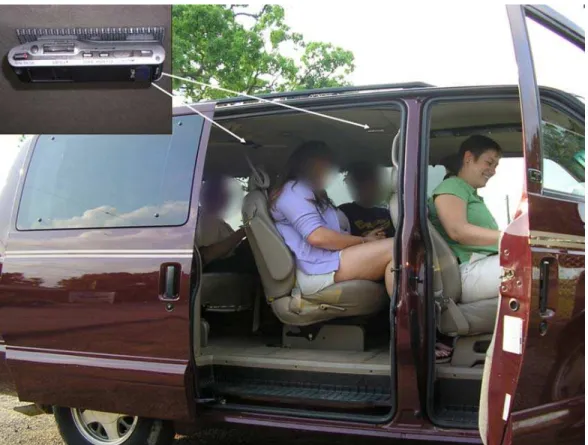
Figure 1. Roving focus group showing locations of digital audio recorders attached to ceiling of van and facilitator in front seat. Microphones were later attached to the audio recorders to improve sound quality of recorded discussions.
The discussions were digitally recorded with two Sony Memory Stick digital voice recorders (ICD-MS515) for later transcription. Both recorders were attached to the ceiling of the vehicle (Figure 1). An external microphone was used to improve sound quality. To reduce noise, the vehicle was driven on paved roads only.
After the recordings were transcribed, we used Atlas.ti 5.0 to categorize the focus group discussions into distinct thematic areas. Codes were developed a priori based on the guiding question and previous investigations that identified features perceived to add to and detract from rural character (Ryan, 2002, 2006; Sullivan, 1994, 1996; Vogt & Marans, 2004). Each transcript received two independent researcher reviews. We assessed interrater reliability by comparing the results of the two independent reviews. Where discrepancies were found, a third reviewer identified the most appropriate code to be used in the analysis.
Motivating people to attend
The size and nature of the grant did not allow the offering of monetary incentives to encourage participation. However, effective incentives do not necessarily involve money (Krueger & Casey, 2000; Morgan, 1997; Stewart et al., 2007). They also include having a credible external sponsor, personal contacts that are positive and convenient, easily located meeting locations, the natural curiosity of participants, and their willingness to share their opinions on matters that they feel directly affect their community. Because Michigan State University (MSU) is a land grant university, researcher affiliation with it was an incentive. Most individuals in rural communities in Michigan have interacted with MSU in one way or another and generally hold the institution in high regard. Focus group participants were motivated by the topic (rural character) and its
relevance to their community. They were also intrigued by the process (being driven around their community in a vehicle while discussing rural character). As such, finding sufficient participants was not a major limitation of the study even though no tangible incentives were offered.
Cancellations or “no-shows” occurred only once in 12 focus groups.
Ethical considerations
The entire protocol, including transporting participants in vehicles and questions asked, was reviewed and approved by the university’s institutional review board (IRB). To minimize
respondent burden, the length of the travel routes were selected such that the entire procedure did not last longer than one hour. Participants were informed that only drivers with good driving records would be used and that the driver would not be distracted by participating in the discussions. The driver’s speed did not exceed 30 miles (48 kilometers) per hour, and the emergency lights were left on for the duration of the trip. Participants signed a consent form acknowledging their understanding of the voluntary nature of the study, that their names would not be placed on the recordings or transcripts, and that they could discontinue their participation at any time. The consent form contained names and contact information of the principal
investigator and chair of the university’s IRB.
Roving focus group size
Krueger and Casey (2000) have noted that the ideal size of a focus group for noncommercial topics is 6 to 8 but that the size can range from 4 to 12. Others have noted that the application of appropriate focus group methods should not be constrained by group size orthodoxy (Kitzinger & Barbour, 1999; Morgan, 1997). The challenge with focus groups of only 4 or 5 participants is fewer ideas or experiences to share, yielding “a rather dull discussion” (Stewart et al., 2007, p. 58). Another potential disadvantage is that small groups are sensitive to the dynamics between individual participants (e.g., domination, lack of cooperation, friendship) (Morgan, 1997). The advantages, on the other hand, are that this size can be more easily recruited and accommodated in settings where space is limited. Because of seating limitations (an eight-passenger minivan seats six to seven comfortably, one of whom is the driver and another is the note taker), focus group sizes in this study were either 4 or 5. In total there were 50 focus group participants evenly divided between the two studies.
study had significant experience with the topic. They had lived in the study counties an average of 30 years and thus had witnessed significant change. They were extremely willing to share their thoughts about rural character. As such, the smaller size of the groups was appropriate and not deemed to be a threat to study validity.
Survey
Landscape scenes highlighted in the focus group discussions were professionally photographed and used, along with focus group results, to develop a photo survey questionnaire similar to that used in other rural landscape studies (e.g., Ryan, 2002, 2006; Sullivan, 1994). The questionnaire was mailed to 1,000 randomly selected households in the townships in which the focus groups were conducted. A 56.3% response rate was obtained. To check for nonresponse bias, all nonrespondents were contacted through a one-page letter that asked them to respond to 13 items from the original survey. Nonrespondents were contacted only once in this manner. Seventy-eight nonrespondents returned the completed letter. There was no significant difference between respondents and nonrespondents on 12 of the 13 items.
Results
The average age of the 50 discussants was 53 (range 23-84 years). A total of 27 women and 23 men participated in the study. Although some had recently moved from more densely populated areas to the six townships, many had known only rural areas as home. Almost all had lived in southern Michigan at least half if not all of their lives (mean = 43 years; range: 1-81 years). They had lived in their current homes an average of 19 years (range 1-78 years).
The coding process yielded three general content categories that represented all of the themes from the 12 focus group discussions. Coders labeled these categories “compatible” (features that were compatible with rural character), “incompatible” (features that were not compatible with or detracted from rural character), and “conditional” (features that participants could accept as compatible with rural character but only if certain conditions were met). The participants men-tioned many different natural and cultural features. The compatible features that were menmen-tioned most frequently in descending order were farms (fields, crops, pasture, farm equipment, farmland, etc.), old buildings (barns, farmhouses, churches, etc.), animals (livestock and wildlife), trees (forests, woodlots, trees along the road and in front of homes), housing type (homes not close together, older homes, homesteads, restoring older homes, etc.), water (marshes, streams, wetlands, ponds, streams, rivers), transportation (unpaved roads, little or no traffic), landscaping (open fields, ungroomed/unmanicured areas, use of local rocks), vegetation other than trees (wild, natural growth; random country vegetation), cemeteries,andmultisensory experiences
(agricultural odors, clear view of stars at night, animal sounds, patterns in the fields, quiet). The first four themes—farms, old buildings, animals, and trees—dominated the discussions.
acres). Likewise, there was no agreement about the setback distance for homes. Some felt that older homes positioned close to roads were compatible with rural character. Some felt that some level of rural compatibility would be achieved by positioning new homes near the back of long lots and nestle them into existing woodlots. Also, some participants felt that subdivisions that were screened by trees and vegetation would not detract as much from rural character as unscreened and highly visible developments. The same was true with regard to the screening of modular or manufactured homes. The amount of discussion for each of the four conditional themes was nearly the same.
Support for thematic reliability
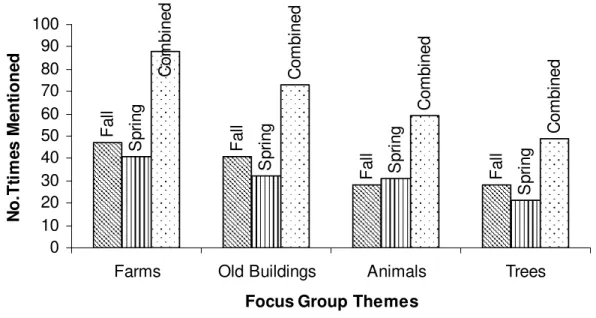
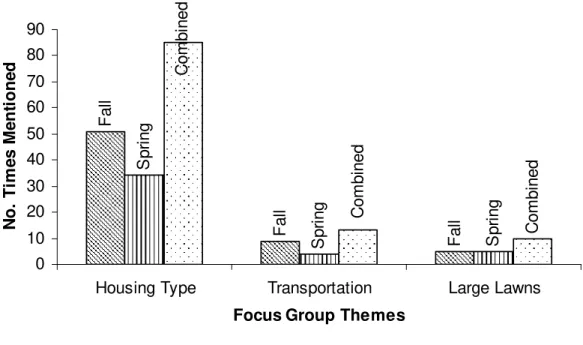
As compared to the fall focus groups, no new themes emerged in the spring focus groups, which was held 8 months later and in a different season. This level of agreement between the two studies is evidence of the reliability of the roving focus group method. In addition, there were no major seasonal differences between fall and spring focus group results regarding features that were compatible with rural character. The same themes dominated the discussions in the same priority order (Figure 2). The only exception was that animals received slightly more discussion in the spring than the fall. This difference might have been due to the relative abundance of newborn livestock and waterfowl in the spring. In terms of features that detract from rural character, fall focus groups tended to discuss more negative housing themes than spring focus groups, but the overall pattern was the same, and no new themes emerged (Figure 3). That there was one more person in the fall focus groups (n = 26) than in the fall (n = 24) may explain why fall frequencies in Figures 2 and 3 are slightly higher.
Figure 2. Features and themes that are compatible with rural character: Comparison of results from study one (fall, 6 focus groups, n = 26) and study two (spring, 6 focus groups, n = 24)
Fa ll Fa ll Fa ll Fa ll Sp ri n g Sp ri n g Sp ri n g Sp ri n g C om b ined C om bi ned C om bi ned Co m b in e d 0 10 20 30 40 50 60 70 80 90 100
Farms Old Buildings Animals Trees
Focus Group Themes
Figure 3. Features and themes that are not compatible with rural character: Comparison of results from study one (fall, 6 focus groups, n = 26) and study two (spring, 6 focus groups, n = 24)
Fa ll Fa ll Fa ll Sp ri n g Sp ri n g Sp ri n g C o m b ined Co m b in e d Co m b in e d 0 10 20 30 40 50 60 70 80 90
Housing Type Transportation Large Lawns
Focus Group Themes
N o. Ti m e s M e nt io ne d
Support for validity
Criteria for the establishment of trustworthiness (i.e., validity) of the focus group data were followed (Krueger & Casey, 2000). Questions were pretested and adjusted to ensure free and open dialogue among participants. Facilitators who were familiar with the rural environment of Michigan were selected and then trained. During focus group sessions, participants were asked through probes or follow-up questions to clarify ambiguous statements. Facilitators repeated key themes and asked participants to verify their accuracy.
Ecological validity contributes to the external validity, or generalizability, of research results (Brewer, 2000; Shadish et al., 2002). Ecological validity is established when the methods, the settings, and the recorded behaviors approximate the real-life situation of the study. There is evidence of ecological validity in the roving focus procedure. Focus group discussions were not based on virtual representations (e.g., surveys, photographs) but took place in rural environments where participants lived for all or significant portions of their lives. In their daily lives
participants are exposed to the focus group stimulus, rural landscapes, from the position of a moving vehicle. Furthermore, familiar settings motivate individuals to participate in focus group discussions and enhance their influence (versus that of the interviewer) in the interview process (Kieffer et al., 2005; Krueger & Casey, 2000; Morgan, 1997).
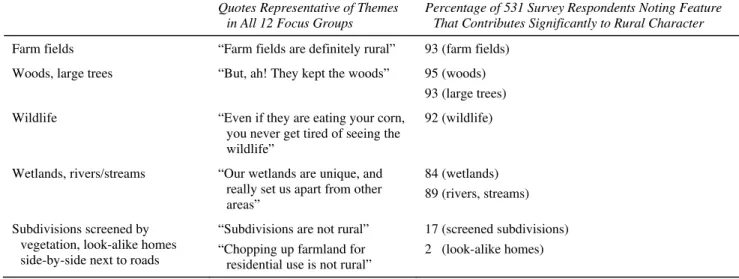
Quotes Representative of Themes in All 12 Focus Groups
Percentage of 531 Survey Respondents Noting Feature That Contributes Significantly to Rural Character
Farm fields “Farm fields are definitely rural” 93 (farm fields)
Woods, large trees “But, ah! They kept the woods” 95 (woods)
93 (large trees)
Wildlife “Even if they are eating your corn,
you never get tired of seeing the wildlife”
92 (wildlife)
Wetlands, rivers/streams “Our wetlands are unique, and
really set us apart from other areas”
84 (wetlands) 89 (rivers, streams)
Subdivisions screened by vegetation, look-alike homes side-by-side next to roads
“Subdivisions are not rural” “Chopping up farmland for
residential use is not rural”
17 (screened subdivisions) 2 (look-alike homes)
Table 1. Comparison of focus group (2004-05) and survey (2006) results.
could not be seen from the road. Nearly all focus group participants felt that identical, or “look-alike,” homes built close to one another adjacent to roads were major threats to rural character. These detractors from rural character were supported by survey results. Respectively, 17% and 2% of survey respondents rated screened subdivisions and look-alike homes as contributing to rural character (Table 1).
Discussion
In this study we identified specific landscape and cultural features that define rural character by studying rural community residents in situ. Facilitator and researcher observations, participant debriefing, spontaneous participant comments, and comparison with quantitative data from a random household survey indicated that the mobile focus group procedure was effective in eliciting participants’ perceptions about rural landscapes. Transcription error rates due to inaudible recordings were less than 5%. Not being able to face each other limited the ability of the moderator to observe nonverbal information. However, the facilitator in the front passenger seat could glance back at the participants and, in a relatively small vehicle, was able to observe nonverbal cues at least part of the time.
The major disadvantage of the roving focus group method (i.e., inability of participants to face each other) was offset by the relaxed nature of the environment through which participants traveled and participant enjoyment of the procedure. Participants often expressed enjoyment of the experience: “Yeah, it is just nice to drive around and look at the countryside.”
participant comments about the procedure that this message was received. Having participants in direct contact with the object of the discussion was highly appropriate given the visual nature of the stimulus. Moving through the countryside was an effective way of stimulating discussion and increased the ecological validity of the study. Results, then, have been interpreted in light of the focus group setting. Neutrality was neither assumed nor a goal.
It is possible that some participants in rural communities know each other well or have other reasons for holding back on negative evaluations of certain features, like subdivisions. Although not asked by researchers, 2 or 3 of the participants stated that they lived in one of the subdivisions being discussed. Groups of friends are less likely to yield variance in opinion than a group of strangers (Stewart et al., 2007). Pretesting and employing sufficient focus groups should overcome this concern. In our case, another round of focus groups would have increased confidence about apparent inconsistencies in the identification of incompatible rural features (Figure 3). On the other hand, such a variance in response is a positive result. The sheer number of focus groups employed (six per study) likely generated sufficient variance even though the persons may have known each other fairly well and the groups were small. After a review of the literature, Stewart et al. concluded that although potentially an influence, the degree to which friends and acquaintances influence the results is “modest at best” (p. 34). Focus groups do not necessarily have to consist of strangers (Morgan, 1997). The real issue is whether the particular group is comfortable in discussing the subject in a manner that is useful to the researchers (Morgan, 1997). From observation during the informal get-acquainted prelude to each focus group, it was clear that our groups consisted of friends, acquaintances, and strangers. It was also clear that this combination posed little threat to the comfort level of the participants as they discussed rural character. Riding through the countryside and viewing pleasant scenery appeared to alleviate social tensions and stimulate a free-flowing exchange of thoughts and experiences. There is empirical support that natural landscapes reduce stress (Ulrich et al., 1995).
The process of replication (additional focus groups) and triangulation (multiple methods)
increases confidence in the results being genuine instead of artifacts of the situation or the method (Gilchrist & Williams, 1999; Jick, 1979; Webb, Campbell, Schwartz, & Sechrest, 1966).
Replication helped control for any seasonal effect, which is relevant when studying landscape perception. As for triangulation, it is not a given that two different methods addressing the same question will yield similar results (Todd & Lobeck, 2004). For this and other practical and theoretical reasons, the integration of quantitative and qualitative methods is of interest to social scientists, particularly as a way of elucidating the research topic (Olsen, 2004; Shih, 1998; Todd,
Nerlich, McKeown, & Clarke
, 2004). In this case, survey results, which are based onindividual responses, shed light on the focus group themes, which are based on group interaction. Correspondence of results enhances credibility in the policy relevance of the compatible and incompatible features of rural character. By being consistent with survey results, a researcher can reasonably conclude that even on their own, focus group results provided reliable and valid policy-relevant criteria at sufficient detail for planning purposes.
In addition to confirming focus group findings, the combined focus group–survey approach provided one of the positive aspects of qualitative-quantitative research as outlined by Olsen (2004), namely the meta-interpretation of rural character from multiple data sources and
perspectives. In what Olsen described as a dialectical learning process, one set of results informed and modified the interpretation of the other.
landscape changes have taken place or are imminent and decision must be made by local officials with public input, for example the siting of windmill farms, factories, housing developments, parks, and parkways.
Notes
1. Those who want to employ the roving focus group method should consider some practical recommendations. The first is to use a vehicle large enough to seat at least six comfortably (a driver, a facilitator, 4 or 5 participants). Second, the authors recommend employing two high-quality audio recording devices for better sound high-quality of all participants and for backup in case one device fails. Third, it is advisable to attach an external microphone to the audio devices to improve sound quality. Fourth, rough or unpaved roads should be avoided to diminish the amount of external noise on the recordings.
2. Details of the focus group and survey results are contained in working papers, which are available from Dennis Propst ([email protected]).
References
Brewer, M. (2000). Research design and issues of validity. In H. Reis & C. Judd (Eds.),
Handbook of research methods in social and personality psychology (pp. 99-120). Cambridge, UK: Cambridge University Press.
Clouser, R. L. (2005). Issues at the urban-rural fringe: The land use debate—Situational
background (University of Florida, Institute of Food and Agricultural Sciences, EDIS Publication FE551). Retrieved May 20, 2008, from http://edis.ifas.ufl.edu/FE551
Desai, S. (2005). Conducting multi-country focus group discussions on the Net. ACNielsen Insights Asia Pacific, 104. Retrieved May 11, 2007, from
http://asiapacific.acnielsen.com/pubs/2005_q1_ap.shtml
Gilchrist, V. J., & Williams, R. L. (1999). Key informant interviews. In B. F. Crabtree & W. L. Miller (Eds.), Doing qualitative research (2nd ed., pp. 71-78). Thousand Oaks, CA: Sage. Green, J., & Hart, L. (1999). The impact of context on data. In R. S. Barbour & J. Kitzinger (Eds.), Developing focus group research: Politics, theory and practice (pp. 21-35). London: Sage.
Heft, H., & Nasar, J. L. (2000). Evaluating environmental scenes using dynamic versus static displays. Environment & Behavior, 32, 301-322.
Hofman, N., Filoso, G., & Schofield, M. (2005). The loss of dependable agricultural land in Canada. Rural & Small Town Analysis Bulletin, 6, 1-16.
Jick, T. D. (1979). Mixing qualitative and quantitative methods: Triangulation in action.
Administrative Science Quarterly, 24, 602-611.
Kieffer, E. C., Salabarria-Pena, Y., Odoms-Young, A. M., Willis, S. K., Baber, K. E., & Guzman, J. R. (2005). The application of focus group methodologies to community-based participatory research. In B. A. Israel, E. Eng, A. J. Schulz, & E. A. Parker (Eds.), Methods in community-based participatory research for health (pp. 146-166). San Francisco: Jossey-Bass.
Kitzinger, J., & Barbour, R. S. (1999). Introduction: The challenge and promise of focus groups. In R. S. Barbour & J. Kitzinger (Eds.), Developing focus group research: Politics, theory and practice (pp. 1-20). London: Sage.
Krueger, R. A. (1994). Focus groups: A practical guide for applied research (2nd ed.). Thousand Oaks, CA: Sage.
Krueger, R. A., & Casey, M. A. (2000). Focus groups: A practical guide for applied research
(3rd ed.). Thousand Oaks, CA: Sage.
Morgan, D. L. (1997). Focus groups as qualitative research. Thousand Oaks, CA: Sage. Nickerson, C., & Hellerstein, D. (2007). Farmland preservation programs: Another tool for managing urban growth? Amber Waves, 5(2). Retrieved May 20, 2008, from
http://www.ers.usda.gov/AmberWaves/April07/Findings/Farmland.htm
Nowak, D. I., & Walton, J. T. (2005). Projected urban growth (2000-2050) and its estimated impact on the U.S. forest resource. Journal of Forestry, 103, 383-389.
Olsen, W. K. (2004). Triangulation in social research: Qualitative and quantitative methods can really be mixed. Developments in Sociology, 20, 103-121.
Patton, M. Q. (2002). Qualitative research and evaluation methods (3rd ed.). Thousand Oaks, CA: Sage.
Reeder, R. J., & Brown, D. M. (2005). Recreation, tourism, and rural well-being (Economic Research Report No. 7). Washington, DC: U.S. Department of Agriculture, Economics Research Service. Retrieved July 11, 2007, from www.ers.usda.gov/publications/err7/err7.pdf
Ryan, R. L. (2002). Preserving rural character in New England: Local residents’ perceptions of alternative residential development. Landscape & Urban Planning, 61, 19-35.
Ryan, R. L. (2006). Comparing the attitudes of local residents, planners, and developers about preserving rural character in New England. Landscape and Urban Planning, 75, 5-22.
Shadish, W., Cook, T., & Campbell, D. (2002). Experimental and quasi-experimental designs for generalized causal inference. Boston: Houghton Mifflin.
Shih, F. (1998). Triangulation in nursing research: Issues of conceptual clarity and purpose.
Journal of Advanced Nursing, 28, 631-641.
Stewart, D. W., Shamdasani, P. N., & Rook, D. W. (2007). Focus groups: Theory and practice
(2nd ed.). Thousand Oaks, CA: Sage.
Sullivan, W. C., III. (1996). Cluster housing at the rural-urban fringe: The search for adequate and satisfying places to live. Journal of Architectural Planning Research, 4, 47-63.
Todd, Z., & Lobeck, M. (2004). Integrating survey and focus group research: A case study of attitudes of English and German language learners. In Z. Todd, B. Nerlich, S. McKeown, & D. D. Clarke (Eds.), Mixing methods in psychology: The integration of qualitative and quantitative methods in theory and practice (pp. 169-184). New York: Psychology Press.
Todd, Z., Nerlich, B., & McKeown, S. (2004). Introduction. In Z. Todd, B. Nerlich, S.
McKeown, & D. D. Clarke (Eds.), Mixing methods in psychology: The integration of qualitative and quantitative methods in theory and practice. New York: Psychology Press.
Ulrich, R. S., Simons, R. F., Losito, B. D., Fiorito, E., Miles, M. A., & Zelson, M. (1995). Stress recovery during exposure to natural and urban environments. In A. Sinha (Ed.), Readings in environmental psychology (pp. 149-178). London: Academic Press.
van Wassenaer, P. J. E., Schaeffer, L., & Kenney, W. A. (2000). Strategic planning in urban forestry: A 21st century paradigm shift for small town Canada. Forest Chronicles, 76,241-245. Vogt, C. A., & Marans, R. W. (2004). Natural resources and open space in the residential decision process: A study of recent movers to fringe counties in southeast Michigan. Landscape and Urban Planning, 69, 255-269.
Webb, E. J., Campbell, D. T., Schwartz, R. D., & Sechrest, L. (1966). Unobtrusive measures: Nonreactive measures in the social sciences. Chicago: Rand
McNally.
Whitener, L. A., & McGranahan, D. A. (2003). Rural America: Opportunities and challenges.
Amber Waves, 1, 14-21. Retrieved October 7, 2007, from
http://www.ers.usda.gov/Amberwaves/feb03/Features/ruralamerica.htm
Whitener, L. A. & Parker, T. (2007). Policy options for a changing rural America. Amber Waves,
5, 58-65. Retrieved October 7, 2007, from