W
ORK PERFORMED AT:G
ENOMICSOFP
LANTS
TRESSLABORATORYInstituto de Tecnologia Química e Biológica Universidade Nova de Lisboa
Av. da República 2780-157 Oeiras Portugal
S
UPERVISORS:Dr. Nelson José Madeira Saibo
Auxiliary Investigator at GPlantS laboratory (ITQB-UNL)
Prof. M. Margarida Oliveira
Aos meus pais,
por me amarem e ajudarem
Science and art have that in common that
everyday things seem to them new and attractive.
Friedrich Nietzsche
vii ACKNOWLEDGMENTS
To Nelson Saibo for being my PhD supervisor, for the help and guidance during all this years, for all the brilliant ideas you gave me and for always “pushing” me to give my best in everything I do. Above all, thank you for allowing me to enter in the science world and to believe in me and in my work.
To Prof. Margarida Oliveira for helping me to be a “scientist” (almost). Thank you for accepting me in your lab when I was just another student and for helping me grow up not only “scientifically” but also personally. Moreover, thank you for always find time to guide my work and to give me new ideas for all the problems I encounter.
To Ana Paula Santos for the help with the microscope “world”, especially with the confocal “monster”. Thank you for all the advices and for always be available to help.
To Lisete Fernandes from IGC for all the help with the “EMSA saga”. If it weren’t for your wonderful advices, for sure it would be even more difficult to finish that part of the work.
To Laszlo Bogre from Royal Holloway (University of London) for accepting me in his lab and teaching new techniques that helped me finish my PhD.
To Tiago Lourenço for all the fruitful talks during my PhD and for the several ideas that you gave me to overcome the million problems I had during these years. Also thank you for noticing when something was wrong and helping me to find a way out.
viii
To Pedro Barros for the companionship and the nice insights you gave me. Thank you for always be willing to help. Also, I am really thankful that you have worked with almond all this years, because when we talked about our work problems, I always realized that rice is a fairly easy plant to work with and all my problems may not be that complicated.
To André Cordeiro for joining the lab when you did and for always be ready to help whenever needed. If it weren’t for your help I would probably had to work 24h a day to finish this thesis, so thank you for working so hard and for doing all the work the best way possible.
To Isabel Abreu for always be available to talk about everything and for helping me realize that my work is actually not that bad. Thank you for making difficult questions that “force” me to think outside the box.
To Safina Khan for all the help during my staying in Royal Holloway, not only for guiding me in the lab but also for making me feel welcome and for the nice company and friendship. I’m saving a nice bottle of wine for us to celebrate.
To Mafalda Rodrigues for helping me in a million things. From proteins to plants, you always have some great idea. Also, thank you for the companionship during the several long nights that we spent in the lab.
To Sónia Negrão for all the “pet-talks” that truly helped me gain more confident in my work. Also for helping me to have a more positive thinking and to keep in mind that one day all the hard work will be worth it.
ix To Helena Sapeta for the nice talks while we see if it rains outside
and for always be interested about how everything is going. To all the members of the GPlantS lab, Cecília, Nuno, Alicja,
Paulinha, Liliana, “Joões”, Margarida and Filipa for making the lab a really nice place to work at.
To Regina Menezes, Catarina Pimentel and Catarina Amaral for always giving me good advices and for always being willing to help.
To Ana Barbas for the useful advices during the first steps of the “EMSA saga”. Thank you for the strength you gave me, it really helped me carry on.
To Claudia Santos for introducing me to the difficulties of the ubiquitin world.
To Forest Biotech group for always having everything that we miss in the lab. Also thank you for the helpful advices and the nice companionship during these years.
To Zé and Sandra for the help with the “EMSA saga”. Thank you for introducing me to the “giraffe” and the nice things we can do with it.
To Miguel Costa for teaching me about plant physiology and one of the techniques that always intrigued me.
To Marta Alves for always asking how is everything going and for caring about me and my work. Thank you for making me feel that “yes, I can”.
To Inês and Mara for helping me let go work and realize that life cannot be only dependent on work. Also thank you for the late afternoons with the nice beer, good snacks and wonderful company.
x
Obrigado por me fazeres sentir especial e por estares sempre comigo nas coisas boas e menos boas. Obrigado por seres como és.
Aos meus irmãos, pela força e apoio que me têm dado ao longo destes anos. Obrigado por me contarem muitas “Estoínhas” em pequenina que de certeza me inspiraram! Ao meu maninho e padrinho, por estares sempre ao nosso lado, por fazeres tudo para nos ajudar a alcançar os nosso sonhos e por puxares por mim para alargar os meus horizontes e querer ser sempre melhor. Se não fosse a tua ajuda ao longo destes anos, teria sido muito mais difícil de atingir este patamar. À minha maninha Lena por estares sempre pronta a ajudar, por te preocupares comigo e por me fazeres sentir que posso contar contigo para tudo. À minha maninha Célia pela boa disposição e por me fazeres rir naqueles tempos difíceis. Obrigado por seres um exemplo para mim de como é possível ser independente, chegar longe e ser feliz.
Aos meus pais, por me acompanharem e ajudarem durante toda a vida. Obrigado por acreditarem em mim e me darem força para ser sempre melhor e para tentar ir sempre mais longe. Obrigado por tirarem as pedras do caminho, mesmo antes de aparecerem. Amo-vos muito.
xi The author of this thesis, Tânia Sofia Lobato Paulo Serra, hereby declares to have had active participation in the following research papers:
Ana Paula Santos, Tânia S. Serra, Duarte Figueiredo, Pedro Barros, Tiago Lourenço, Subhash Chander, M. Margarida Oliveira and Nelson J. M. Saibo. (2011) Transcription regulation of abiotic stress responses in rice: a combined action of transcription factors and epigenetic mechanisms. OMICS A Journal of Integrative Biology, 15
(12):839-57
Tânia S. Serra performed part of the review work and manuscript writing. This manuscript includes part of the work described in Chapter I.
Duarte Figueiredo, Pedro Barros, André Cordeiro, Tânia S. Serra, Tiago Lourenço, M. Margarida Oliveira and Nelson J. M. Saibo. (2012) Seven Zinc Finger transcription factors are novel regulators of the rice gene OsDREB1B. Journal Experimental Botany, Published
Online (doi: 10.1093/jxb/ers035)
Tânia Serra participated in the experimental work and manuscript writing.
Tânia S. Serra, Duarte Figueiredo, André Cordeiro, Tiago Lourenço, Isabel A. Abreu, Alvaro Sebastián, Lisete Fernandes, Bruno Contreras-Moreira, M. Margarida Oliveira and Nelson J. M. Saibo. OsEREBP1 and OsEREBP2 bind to the OsRMC promoter and may
regulate its gene expression under salt stress. (In preparation).
xii
Tânia S. Serra, André Cordeiro, Laszlo Bögre, M. Margarida Oliveira and Nelson J. M. Saibo. OsEREBP1 encodes an AP2/ERF transcription factor involved in high salinity, drought and ABA responses. (In preparation)
Tânia S. Serra participated in the experimental design, the laboratory work and manuscript writing. This manuscript includes the work described in Chapter IV.
Tânia S. Serra, M. Margarida Oliveira and Nelson J. M. Saibo. OsEREBP2 is a multifunctional AP2/ERF transcription factor mediating abiotic stress and hormone signaling pathways. (In preparation)
xiii LIST OF ABBREVIATIONS
3-AT 3-amino-1,2,4-triazole
aa amino acid
ABA Abscisic Acid
AP2/ERF APETALA2/Ethylene Response Factor
ATP Adenosine Triphosphate
bp base pair
BLAST Basic Local Alignment Search Tool CAMV35S Cauliflower Mosaic Virus 35S promoter
cDNA complementary DNA
ºC degree Celsius
dNTPs Deoxynucleotide Triphosphates
DNA Deoxyribonucleic Acid
dS DeciSiemens
DUF26 Domain of Unknown Function 26
EC Saturated Paste Extract
EDTA Ethylene Diamine Tetraacetic Acid
ERE Ethylene-Responsive Element
FAO Food Agriculture Organization
g relative centrifugal force
GFP Green Fuorescence Protein
GST Glutathione S-Transferase
GUS β-Glucuronidase
HA Hemagglutinin
h hour
kDa kiloDalton
kg kilogram
LUC Luciferase
xiv
MAPK Mitogen-Activated Kinase
µCi microCurie
µg microgram
µL microlitre
µm micrometer
µM micromolar
mL millilitre
mM millimolar
m35S minimal 35S promoter
min minute
M Molar
m meter
nm nanometer
Os Oryza sativa
PCR Polymerase Chain Reaction
PEG Polyethylene Glycol
RT-PCR Reverse Transcription – PCR
RLK Receptor Like-Kinase
RNA Ribonucleic Acid
RAM Root Apical Meristem
PTMs Post-Translational Modifications
s second
SAM Shoot Apical Meristem
SDS-PAGE Sodium Dodecyl Sulfate – Polyacrylamide Gel Electrophoresis
SD Standard Deviation
TF Transcription Factor
T-DNA Transfer-DNA
wt wild-type
xv SUMMARY
Rice (Oryza sativa L.) is cultivated worldwide and is the staple
food for more than one-half of the world population. Abiotic stress conditions, such as high salinity, drought and low temperature have a strong negative effect on rice production. High salinity severely affects rice growth and reduces grain yield, as it induces late flowering and lowers pollen viability. To cope with saline environments, plants rely on the perception and transduction of stress signals through specific response pathways, which activate several adaptation mechanisms. Salt stress adaptation involves Na+ intracellular compartmentalization, synthesis of osmoprotectants and restriction of Na+ accumulation in the shoots. Transcription factors (TFs) play an important role in the modulation of stress responses. A single TF regulates the expression of several stress-responsive genes, allowing a fast and efficient response to stress conditions. Therefore, a study of the transcriptional network regulating plant stress responses may not only elucidate the mechanisms involved in plant adaptation to stress, but also allow the identification of candidate genes for the generation of stress tolerant crops.
The main goal of our study was to identify and characterize TFs in rice involved in the stress-induced responses to high salinity. Initially, we selected five genes reported in the literature as responsive to salt stress and analyzed in detail their gene expression in rice seedlings subjected to salt stress. Among the genes analyzed, we have selected Oryza sativa Root Meander Curling (OsRMC), which
xvi
TFs, OsEREBP1 and OsEREBP2, belong to the ERF subfamily and were shown to interact with a GCC-like motif in the OsRMC gene
promoter. In addition, trans-activation assays showed that both TFs negatively regulate OsRMC gene expression.
When we analyzed OsEREBP1 and OsEREBP2 gene expression
in rice seedlings that were subjected to high salinity, drought, ABA and low temperature treatments, we observed that OsEREBP1
transcript level was not significantly affected by most stresses applied. Therefore, we propose that under the conditions tested, this TF is mainly regulated by post-translational modifications (PTMs). In addition, under salt stress conditions, we observed an increased OsEREBP1 protein level associated with higher protein stability, which is in agreement with our hypothesis. The OsEREBP2
transcript level was differentially expressed in response to all the treatments applied, suggesting that this TF is a multifunctional protein with a role in several abiotic stress responses. Sub-cellular localization studies in onion epidermal cells revealed that OsEREBP1 is located exclusively in the nucleus, whereas OsEREBP2 is dispersed throughout the cell.
xvii deficit conditions indicated that OsEREBP1 plays also a role in drought stress responses. On the other hand, OsEREBP2-OX plants displayed a phenotype resembling abnormal responses to auxins and/or cytokinins. The expression of auxin- and cytokinin-responsive genes was altered in the transgenic plants, as well as the expression of genes involved in the maintenance and function of the shoot apical meristem (SAM). Therefore, we suggest that OsEREBP2 plays a role in developmental processes.
Complementation studies with Arabidopsis mutants for orthologs of OsEREBP1 and OsEREBP2, rap2.2 and abr1, respectively,
revealed that OsEREBP1 and RAP2.2 may have different functions in high salinity and drought stress responses. When rap2.2 seedlings
over-expressing OsEREBP1 were subjected to these stress
treatments, no root phenotype complementation was observed. In contrast, OsEREBP2 heterologous expression rescued the abr1
germination phenotype under high salinity and ABA treatments, suggesting that OsEREBP2 may have a similar function to ABR1.
xix SUMÁRIO
O arroz (Oryza sativa L.) é cultivado em todo o mundo, sendo a
base da alimentação para mais de metade da população mundial. O stress abiótico, como por exemplo a elevada salinidade, secura e baixa temperatura exercem efeitos negativos na produção de arroz. A elevada salinidade afeta severamente o crescimento do arroz e reduz a produção de grão, pois provoca atrasos na floração reduzindo ainda a viabilidade do pólen. A sobrevivência em solos com elevada salinidade depende da perceção e transdução dos sinais de stress, os quais, através das vias de sinalização específicas, ativam vários mecanismos de adaptação. Estes mecanismos incluem a compartimentação intracelular de Na+, síntese de osmoprotectores e diminuição da acumulação de Na+ na parte aérea da planta. Os fatores de transcrição (FTs) desempenham um papel importante na modulação da resposta ao stress, pois um único FT tem a capacidade de regular a expressão de vários genes de resposta ao stress, permitindo uma resposta rápida e eficiente. Assim, o estudo da regulação transcricional envolvida na resposta ao stress, não só elucida os mecanismos de adaptação das plantas ao stress, como pode também permitir a identificação de genes candidatos para a produção de plantas mais tolerantes.
O principal objetivo deste estudo foi identificar e caracterizar FTs envolvidos na resposta do arroz ao stress provocado por elevada salinidade. Inicialmente, foram selecionados cinco genes descritos na literatura como sendo regulados pelo stress salino e a sua expressão foi analisada em plantas sujeitas a tratamentos de elevada salinidade. Entre os genes analisados, selecionámos o
xx
detalhe, por apresentar uma elevada resposta ao stress salino e por poder estar envolvido na perceção dos sinais de stress. Utilizando o sistema de yeast one-hybrid, para fazer o rastreio de uma biblioteca
de expressão de cDNA enriquecida em genes de resposta ao stress salino, foi-nos possível identificar dois FTs que se ligam ao promotor do gene OsRMC. Provámos que estes dois FTs, OsEREBP1 e
OsEREBP2, pertencentes à subfamília ERF, se ligam especificamente a um motivo GCC-like identificado no promotor do gene OsRMC. Por outro lado, através de ensaios de transactivação
verificámos que os FTs regulam negativamente a expressão do gene OsRMC.
A análise da expressão dos genes OsEREBP1 e OsEREBP2, em
plantas de arroz submetidas a tratamentos de elevada salinidade, secura, ABA e baixa temperatura, revelou que o nível do transcrito
OsEREBP1 não é significativamente afetado pela maioria dos
tratamentos aplicadas. Assim, propomos que, sob as condições analisadas, este FT deverá ser regulado principalmente por modificações pós-traducionais (MPTs). De acordo com esta hipótese, observámos que em condições de stress por elevada salinidade ocorre uma maior acumulação da proteína OsEREBP1 devido ao aumento da sua estabilidade. Quanto ao gene
OsEREBP2, este revelou-se diferencialmente expresso em resposta
a todos os tratamentos realizados, o que sugere que a proteína OsEREBP2 é multifuncional, estando envolvida na resposta a diversas condições de stress abiótico. Através de estudos de localização sub-celular, demonstrou-se que, em condições controlo, a proteína OsEREBP1 está localizada exclusivamente no núcleo, enquanto a proteína OsEREBP2 se encontra dispersa na célula.
sobre-xxi expressar estes FTs de arroz (OsEREBP1-OX e OsEREBP2-OX). As sementes das plantas OsEREBP1-OX apresentaram maior sensibilidade ao tratamento com elevada salinidade durante a germinação, mas o fenótipo da raiz e a taxa de sobrevivência ao stress salino foi semelhante ao observado em plantas selvagens. Estes resultados reforçam a hipótese de que o FT OsEREBP1 é regulado maioritariamente por MPTs em resposta a este stress. Foi também demonstrado que este FT pode estar envolvido na resposta ao ácido abscísico (ABA) . A germinação das sementes OsEREBP1-OX foi mais afetada pelo tratamento com ABA do que as sementes selvagens. Além disso, na presença de ABA, as plantas transgénicas OsEREBP1-OX apresentaram uma maior inibição do crescimento da raiz comparativamente às plantas selvagens. O aumento da tolerância das raízes observado quando as plantas transgénicas foram submetidas a condições de défice hídrico induzido por PEG, sugere que o OsEREBP1 pode também estar envolvido na resposta à seca. As plantas OsEREBP2-OX apresentaram um fenótipo que sugere a existência de uma resposta anormal a auxinas e/ou citocininas. Verificámos que a expressão de genes de resposta a auxinas e citocininas, bem como a expressão de genes envolvidos na manutenção e função do meristema apical, está afetada nas plantas transgénicas. Assim, propomos que o OsEREBP2 esteja envolvido nos mecanismos reguladores do desenvolvimento da planta.
Efetuámos também estudos de complementação nos mutantes de Arabidopsis, rap2.2 e abr1, os quais correspondem aos ortólogos
xxii
submetidas a estes stresses, não se observou a reversão do fenótipo da raiz observado no mutante rap2.2. Por outro lado, a
expressão heteróloga do OsEREBP2 permitiu a reversão do fenótipo de germinação do mutante abr1, em condições de elevada
salinidade e em tratamentos com ABA, indicando que os FTs OsEREBP2 e ABR1 têm funções semelhantes.
xxiii TABLE OF CONTENTS
Acknowledgments... vii List of Abbreviations ... xiii Summary ... xv Sumário ... xix Chapter I ... 1
General Introduction and Research Objectives
Chapter II ... 53 OsEREBP1 and OsEREBP2 bind to the OsRMC promoter and
may regulate its gene expression under salt
Chapter III ... 85 Characterization of the OsEREBP1 and OsEREBP2 interaction with the OsRMC promoter
Chapter IV ... 115
OsEREBP1 encodes an AP2/ERF transcription factor involved
in high salinity, drought and ABA responses
Chapter V ... 151 OsEREBP2 is a multifunctional AP2/ERF transcription factor mediating abiotic stress and hormone signaling pathways
1
General Introduction and Research Objectives
2
TABLE OF CONTENTS – CHAPTER I
Rice as a crop model plant ... 3 High salinity effects on plant growth and development ... 5
High salinity effects on rice growth and development ... 7
Perception and transduction of stress signals ... 8
Perception ...10
Second messengers ...13
MAPKs ...15
Transcription factors involved in abiotic stress responses ...19
MYB family ...20
NAC family ...22
bZIP family ...24
AP2/ERF family ...25
3 Rice as a crop model plant
Rice (Oryza sativa L.) is one of the oldest and most important
crops worldwide, being estimated that more than one-half of the world population relies on this crop to survive (Molina et al. 2011).
The cultivated rice can be divided in two main subspecies, indica and japonica, based on physiological and morphological features (Molina et al. 2011; Ronald et al. 2008). Indica rice is mainly cultivated in
Asia, whereas japonica rice production occurs in Asia and also in
Africa, North America and Europe (Ronald et al. 2008). In Europe,
rice is mainly produced in Italy, Spain and Greece, which together account for approximately 60% of total European rice production (FAOSTAT data, 2010). In contrast, Portugal produces less than 4% of the European production (170200 tones in 2010). However, Portugal is the major consumer of milled rice in the European Union (EU), with a consumption of 14.84 kg/person/year in 2007, followed by Belgium and Spain with only 8.12 and 7.21 kg/person/year, respectively (FAOSTAT data, 2007).
Rice consumption is expected to increase over the next decades along with the world population growth. However, rice production is becoming insufficient to fulfill the world demand for this cereal (Roy
et al. 2011). In addition to the increased world population, water
4
used to improve several crops. Arabidopsis is considered the standard model organism for the study of plant biology, mainly due to its small genome size, short generation time and simple transformation methods (Buell and Last 2010; Koornneef and Meinke 2010). Additionally, the availability of its genome sequence, large genomic resources and mutant collections, make this dicotyledon the most studied plant species (Spannagl et al. 2011). Many basic
mechanisms involved in plant development and tolerance to biotic and abiotic stresses are common to all plants. In most of the cases, the genes identified in Arabidopsis can be directly used in heterologous systems or as candidate genes to identify orthologs in crops (Feuillet et al. 2011). However, the identified orthologs may
have alternative functions and, even when the basic mechanisms are similar, the underlying pathways may diverge (Movahedi et al. 2011;
Rensink and Buell 2004). Therefore, the study of a crop model organism may overcome these limitations. Rice belongs to the Poaceae family which includes other agronomically important crops, such as maize, wheat, barley and rye (Rensink and Buell 2004). The high degree of conservation of phenotypic features and the conserved synteny among the cereal genomes, promotes the study of rice as a model crop. Additionally, rice has a small genome size (390 Mb) compared to other cereals such as maize (2300 Mb), barley (5100 Mb) and wheat (17000 Mb) (IRGSP 2005; Mayer et al.
2011; Santos et al. 2011).The availability of its complete genome
5 High salinity effects on plant growth and development
High salinity negatively affects crop productivity and quality worldwide. The soil is considered to contain high salt concentration when the electrical conductivity of the saturated paste extract (ECe) is above 4 dS/m (≈ 40 mM NaCl) (Chinnusamy et al. 2005). Most
crops are glycophytes and thus sensitive to high salinity; however if plants are gradually exposed to increasing salt concentration (acclimation) they may acquire some degree of stress tolerance (Negrao et al. 2011).
Plant responses to high salinity can be divided in two phases: the initial rapid osmotic response and the slower ion-specific response (Munns and Tester 2008). The osmotic response caused by salt stress is mainly related to the effect of the salt that surrounds the roots and is very similar to the drought stress response. Osmotic stress decreases the rate of leaf growth through reduction of cell elongation and cell division (Munns and Tester 2008). The rate of leaf and root elongation decreases rapidly and is followed by a partial recover to a reduced steady rate after a few hours of osmotic stress (Munns 2002). Along the stress period, leaf production decreases and the new leaves are smaller and thicker. Root growth is however less affected than leaf growth. Increased stress severity can cause leaf growth arrest; whereas roots can recover faster and maintain a lower but steady growth rate (Hsiao and Xu 2000). Osmotic stress induces stomatal closure to avoid water loss via transpiration. In this process, the plant hormone abscisic acid (ABA) plays an important role in the regulation of stomatal movement (Finkelstein et al. 2002).
Several stress conditions induce synthesis of ABA, which promotes stomatal closure and inhibits its opening (Hubbard et al. 2010). ABA
6
promoting the efflux of K+ and anions and removal of organic solutes from the cell, which leads to reduced cellular turgor and rapid stomatal closing (Hubbard et al. 2010; Kim et al. 2010). The stomatal
closure caused by osmotic stress results in reduced photosynthesis rate, mainly due to lower CO2 assimilation. In addition, severe osmotic stress results in decreased activity of several enzymes involved in the photosynthetic metabolism (Saibo et al. 2009). The
decrease in photosynthesis rate leads to a higher formation of reactive oxygen species (ROS) causing oxidative stress (Munns and Tester 2008). ROS induce oxidative damage of lipids, proteins and nucleic acids (Türkan and Demiral 2009). The osmotic stress effects on photosynthesis depends on the intensity and duration of the stress, leaf age and plant species (Chaves et al. 2009).
The continued exposure to high salinity leads to the ion-specific phase of salt stress, characterized by the increase in the rate of senescence of older leaves (Munns and Tester 2008). Sodium ions enter plant roots by the apoplastic pathway and the symplastic pathway through channels and transporters, and then enter in the transpirational stream (Gao et al. 2007). Na+ and other ions are
7 cytosol K+/Na+ ratios (Gao
et al. 2007; Mahajan and Tuteja 2005).
Increased Na+ concentration in the soil decreases root K+ uptake (Gao et al. 2007). Moreover, Na+ competes with K+ for intracellular
influx by nonselective transporters and may also compete for K+ binding sites (Bartels and Sunkar 2005; Mahajan and Tuteja 2005). The severity of salt-induced injuries depends not only on the salinity level but also on other environmental conditions like temperature and on the genetic variations regarding the efficiency of stress tolerance mechanisms (Munns 2002). The rate at which older leaves die and new leaves are produced may determine plant survival. Increased tissue necrosis will reduce the plant photosynthetic capacity and therefore the carbohydrate levels required to develop younger leaves, leading to a further reduction in growth rate (Munns and Tester 2008). In addition, the photosynthetic processes are thought to be affected by the accumulation of toxic ions in the leaf tissues (Chaves et al. 2009). Continued exposure to stress for weeks or
months leads to lateral shoot inhibition, altered flowering time and reduced seed production (Munns 2002).
High salinity effects on rice growth and development
Rice production is highly affected by abiotic stress conditions, such as low temperature, drought and high salinity. In Portugal, rice productivity is affected by low temperature mainly in the North region (Mondego river bed) and by high salinity in the Center (Tejo and Sorraia) and South regions (Sado). Rice yield decreases by 12% per
dS/m in soils with EC above 3 dS/m (Chinnusamy et al. 2005).
8
tolerance during germination and vegetative growth, and high sensitivity at seedling and reproductive stage (Negrao et al. 2011).
The osmotic effect of salt stress was proposed to last only a few hours or days due to leakage from rice roots, which allows higher Na+ influx (Gao
et al. 2007; Munns and Tester 2008). As described
for other plant species, rice growth is also affected under high salinity. Reduced leaf growth has been reported for plants exposed to prolonged salt stress conditions (see Negrão et al. (2011) and
references therein). Rice yield greatly decreases due to lower pollen viability, reduced panicle length and delayed panicle emergence and flowering (Moradi and Ismail 2007; Negrao et al. 2011). Plants
exposed to moderate stress (NaCl < 50 mM) display delayed flowering and reduced seed yield, whether exposure to severe stress (NaCl > 100 mM) may lead to plant death before maturity is reached. Perception and transduction of stress signals
Plant response to adverse environmental conditions relies on the perception of stress signals, generation of second messengers and signal transduction through phosphorylation cascades (Hirayama and Shinozaki 2010). These cascades will activate proteins involved in the direct cell protection or in the regulation of the stress response, ultimately leading to the physiological and biochemical modifications necessary for plant survival (Xiong et al. 2002). Figure 1 illustrates
9
Figure 1. Regulatory network of stress responses to abiotic stress conditions. Stress signals are initially perceived by sensors, such as receptor-like kinases (RLKs). These proteins trigger the generation of second messengers, which include calcium ions (Ca2+) and reactive oxygen species (ROS), to transduce the perceived stress signals. Variations in the content and/or nature of second messengers in the cell lead to the activation of signal transducers, such as mitogen-activated protein kinases (MAPKs) and Ca2+ protein sensors like calcineurin B-like proteins (CBLs).
10
Perception
The apoplast, which consists of the cell wall and the intercellular spaces, is considered the bridge from the environment to the protoplast (Pignocchi and Foyer 2003). It perceives environmental changes and stress signals and then transfers them into the protoplast to trigger a response. The apoplast matrix contains solutes (e.g. amino acids, ions and sugars), proteins (e.g. extensins and peroxidases) and cell-wall constituents (e.g. celluloses and glycoproteins) (Pignocchi and Foyer 2003). Several reports indicate that upon stress conditions the apoplast protein composition is altered in both abundance and protein type (Bhushan et al. 2007;
Dani et al. 2005; Pandey et al. 2010). Proteins with signaling function
were shown to be differentially expressed in response to dehydration (Bhushan et al. 2007), high salinity (Zhang et al. 2009b) and
pathogen elicitor (Casasoli et al. 2008). Some of the identified
11 to metals, pathogen resistance and probably in abiotic stress responses (Morillo and Tax 2006; Seifert and Blaukopf 2010; Yan et al. 2006). The LRR-RLKs and cysteine-rich RLKs are not bound to
the cell wall, however the proximity of the plasma membrane to the apoplast due to turgor pressure suggests that any perturbation in the apoplast is perceived by the plasma membrane (Monshausen and Gilroy 2009; Seifert and Blaukopf 2010). The LRR-RLKs are the largest RLK class comprising at least 200 and 309 members in Arabidopsis and rice, respectively (Gish and Clark 2011; Sun and Wang 2011). The best characterized LRR-RLKs were shown to be involved in meristem regulation (CLAVATA (CLV) pathway) and hormone signaling (brassinosteroid-insensitive-1 (BRI1) pathway) (Gish and Clark 2011). Some members of this class were also reported to be involved in abiotic stress responses. An LRR-RLK from Medicago truncatula, Srlk, was reported to regulate the root
response to high salinity (de Lorenzo et al. 2009). Several LRR-RLKs
putatively involved in abiotic stress responses were identified through a reverse genetic approach in Arabidopsis, but their function is still unknown (ten Hove et al. 2011).
RLKs containing a cysteine-rich domain in their extracellular regions include the S-domain (SRK) and the DUF26 (Domain of Unknown Function 26)-domain (CRKs) proteins. These domains are enriched in cysteines but are structurally distinct (Chen 2001). The S-domain was initially identified in the Brassica S-receptor kinase
(SRK), which is involved in pollen recognition in the self-incompatibility response (Gish and Clark 2011). Other S-domain containing proteins were identified in Arabidopsis, ARK1 and ARK3, and reported to have a putative role in biotic stress responses (Haffani et al. 2004). The DUF26 domain is characterized by the
12
mediate protein-protein interactions (Chen 2001). CRKs specific function is unknown for most of the class members, but some evidences suggest that they may have a role in biotic and abiotic stress responses. Gene expression studies have indicated that several CRKs are induced by pathogen infection and oxidative stress (Gish and Clark 2011; Haffani et al. 2004; Wrzaczek et al. 2010).
Atypical forms of RLKs, named receptor-like proteins (RLPs) were identified for several RLK classes (Chen 2001; Gish and Clark 2011). These protein forms contain the same extracellular domain as RLKs, but lack the transmembrane and the intracellular kinase domain (secreted proteins) or only lack the intracellular kinase domain. Some RLPs were reported to function independently of RLKs whereas others act in combination with the RLK counterpart. The CLAVATA system relies on the interaction between the LRR-RLP CLAVATA2 and the LRR-RLK CLAVATA1 to form a complex that will become active after binding to the specific ligand CLAVATA3 (Rojo et al.
2002). The rice Root Meander Curling (OsRMC) gene encodes a
RLP from the CRK class involved in biotic and abiotic stress responses. This RLP contains two DUF26-domains in the extracellular region but lack the transmembrane and intracellular kinase domains, suggesting that it is secreted (Jiang et al. 2007;
Zhang et al. 2009b). Protein localization studies indicated that
OsRMC is located in the apoplast and/or the plasma membrane (Jiang et al. 2007; Zhang et al. 2009b). The presence of a signal
peptide with transmembrane character may explain the plasma membrane location (Jiang et al. 2007). The OsRMC protein was
shown to accumulate in response to high salinity, pathogen inoculation, jasmonic acid (JA) and wound stimuli (Kim et al. 2003;
Kim et al. 2004; Shen et al. 2003; Zhang et al. 2009b), while rice
13 treatments at germination and adult stage (Zhang et al. 2009b). In
addition, salt-stress responsive genes were up-regulated in the transgenic lines, suggesting that OsRMC negatively regulates the response to high salinity through deregulation of gene expression. These transgenic lines also displayed enhanced sensitivity to JA and increased root coiling, indicating that OsRMC negatively regulates root development and coiling processes mediated by JA (Jiang et al.
2007).
Second messengers
Signal perception leads to the generation of second messengers like calcium (Ca2+) and reactive oxygen species (ROS), which transduce the stress signal (Figure 1). A wide range of biotic and abiotic stress signals cause transient elevation of cytosolic calcium levels [Ca2+]cyt (Kim
et al. 2009). However, each stress signal induces
a specific perturbation in the calcium levels, termed “Ca2+signature” that can vary in kinetics, magnitude and sub-cellular location (Tuteja and Mahajan 2007). Elevation of [Ca2+]cyt can be due to influx from the apoplast and/or from intracellular organelles, such as the vacuole and the endoplasmic reticulum (ER). Calcium increase in the cytosol is perceived by protein sensors such as the calmodulin (CaM), Ca2+ -dependent protein kinases (CPKs/CDPKs) and calcineurin B-like proteins (CBLs) (DeFalco et al. 2010). CaMs bind to Ca2+ through
14
and/or abiotic stress responses has been proposed for CPKs identified in Arabidopsis, tobacco and rice (DeFalco et al. 2010). OsCPK13 gene expression is induced by drought and high salinity
conditions and its over-expression in rice enhanced plant tolerance to these stresses. Arabidopsis AtCPK23 was reported to be involved in stomatal opening and its over-expression increased drought and salt stress sensitivity. The CBLs have Ca2+-binding properties similar to CaMs and are regulatory subunits for serine/threonine protein kinases, named CBL-interacting protein kinases (CIPKs) (DeFalco et al. 2010). The best characterized CBL-CIPK interaction is involved in
the salt-overly-sensitive (SOS) signaling pathway (Luan 2009). The Arabidopsis calcium sensor SOS3 (CBL4) was shown to interact with SOS2 (CIPK24) upon [Ca2+]cyt perturbations regulating its kinase activity and targeting it to the plasma membrane (Luan 2009). The SOS3-SOS2 complex regulates SOS1, a Na+/K+ exchanger located in the plasma membrane, enhancing Na+ efflux and contributing to Na+ ion homeostasis. CIPK24 was also reported to be targeted to the vacuole membrane upon binding to CBL10 (Luan 2009). The precise function of the CBL10-CIPK24 complex is unknown, however some speculate that it may regulate a tonoplast Na+/H+ exchanger, NHX1, involved in high salinity tolerance (DeFalco et al. 2010).
15 identification of genes whose expression is regulated by specific oxidative stress signals originated in different subcellular locations, suggested that ROS have a signaling function (Moller and Sweetlove 2010). The specific mechanism of ROS signaling is still unknown but several hypothesis have been proposed (Mittler et al. 2011; Moller
and Sweetlove 2010). Some authors argue that the ROS signal by itself functions as a second messenger and the amplitude, frequency and/or localization of the signal can trigger specific gene expression patterns. Others suggest that peptides derived from oxidized proteins may act as second messengers that trigger specific stress responses. ROS accumulation caused by biotic and abiotic stress conditions was shown to modulate the response to stress signals. The increase in apoplastic ROS levels under water stress conditions was shown to promote cell wall loosening in maize, allowing cell elongation and ultimately stress adaptation (Zhu et al. 2007). In
addition, ROS accumulation was reported to activate cascades of mitogen-activated protein kinases (MAPKs) (described below) involved in biotic and abiotic stress responses (Mittler et al. 2011).
The Arabidopsis MEKK1-MKK1/2-MPK4/6 signaling cascade was shown to participate in cold and salt stress responses and some members are activated by ROS (Jaspers and Kangasjarvi 2010; Mittler et al. 2011).
MAPKs
The mitogen-activated protein kinases (MAPK) function in signal transduction cascades that amplify and integrate external stimuli into the cell metabolic and transcriptional response mechanisms (Figure 1) (Rodriguez et al. 2010; Sinha et al. 2011). The basic MAPK
16
kinase (MKK/MAP2K) that in turn activates a MAP kinase (MPK/MAPK). MAPKs can phosphorylate several cytosolic and nuclear targets, including other kinases, enzymes and TFs. MAP kinase kinase kinase kinases (MAP4K) were also reported to be involved in these cascades but function as adaptors between upstream signals and the MAPK cascade itself. Based on the amino acid sequences of the kinase domain, MEKKs can be divided into two main groups: MEKK-like and RAF-like kinases that are similar to mammalian MEKK and RAF1 proteins, respectively (Ichimura et al.
2002; Rodriguez et al. 2010). MEKK proteins from both groups were
reported to be involved in stress responses. AtMEKK1 gene
expression is induced by wound, high salinity, cold and drought stress conditions and its activity is promoted by H2O2 (Pitzschke et al. 2009). This MEKK was shown to be an upstream activator of the
MKK2-MPK4/6 cascade involved in Arabidopsis high salinity and cold stress responses (Teige et al. 2004). In addition, AtMEKK1
interacts with MKK1, which is activated by H2O2 and phosphorylates MPK4, suggesting a role of AtMEKK1 in ROS homeostasis (Pitzschke et al. 2009). The rice putative RAF-like kinase DSM1 was
proposed to mediate ROS and drought stress signaling responses (Ning et al. 2010). DSM1 over-expression increased rice tolerance to
drought stress, whereas dsm1 mutants displayed enhanced
sensitivity to this abiotic stress. In addition, the rice mutants were more sensitive to oxidative stress suggesting a putative role in ROS scavenging.
Arabidopsis and rice MKK proteins are classified into four groups (A-D) according to their sequences and structures (Hamel et al.
17 cold and salt stress treatments (Teige et al. 2004). MKK2
over-expression increased the transcript level of several stress-responsive genes and enhanced plant tolerance to high salinity and freezing conditions. MKK2 was reported to phosphorylate MPK4 and MPK6, which are activated by several stresses, including pathogen infection, and osmotic, cold and oxidative stress (Teige et al. 2004).
Arabidopsis MKKs from groups B (MKK3) and C (MKK4 and MKK5) were reported to be mainly involved in biotic stress responses (Doczi
et al. 2007; Sinha et al. 2011). In rice, OsMKK4 from group C was
shown to mediate the response to arsenic stress (Sinha et al. 2011).
Arabidopsis MKK9 belongs to group D and was proposed to mediate ABA and salt stress responses (Alzwiy and Morris 2007).
Plant MAPKs are classified in 4 groups (A-D) and contain either TEY (group A-C) or TDY (group D) phosphorylation motifs in their activation domain (Ichimura et al. 2002; Liu and Xue 2007). A
conserved C-terminal common docking (CD) domain was detected in group A and B proteins and proposed to function as a docking site for MKKs and protein substrates (Ichimura et al. 2002). Group C
proteins also display a CD domain but with modified residues. MAPKs from group D lack a CD domain and contain an extended C-terminal region compared to proteins from the other groups (Ichimura
et al. 2002). Several MAPKs were reported to have a role in biotic
and abiotic stress responses. Arabidopsis MPK4 (group B) and MPK6 (group A) are activated by cold, salt, drought and wounding (Teige et al. 2004). In rice, OsMAPK5 (group A) activity was shown
to be induced by pathogen infection and ABA, drought, high salinity and cold stress treatments (Xiong and Yang 2003). In addition, studies with rice plants over-expressing and silencing OsMAPK5
18
signaling responses was assigned to the group C MAPK MPK7 (Doczi et al. 2007). This protein was shown to be activated and
stabilized by MKK3 which blocks its degradation. The MKK3-MPK7 module was proposed to regulate the expression of pathogenesis-related (PR) genes upon activation by ROS.
The rice blast- and wounding-activated MAP kinase (OsBWMK1) belongs to the group D of MAPKs and is encoded by three alternative splice variants: OsBWMK1L, OsBWMK1M and OsBWMK1S (Koo et al. 2007). The protein isoforms were shown to
have different gene expression profiles in response to biotic and abiotic stress conditions. OsBWMK1M and OsBWMK1S gene
expression was shown to be up-regulated by H2O2, JA, salicylic acid (SA), NaCl and fungal elicitors, whereas OsBWMK1L transcript level
was not altered by any of these treatments (Koo et al. 2007). OsBWMK1S transcript level was also shown to be induced by other
biotic and abiotic stress conditions, such as wounding, ABA and drought stress (Agrawal et al. 2003; He et al. 1999). The kinase
activity of this isoform was also reported to be induced by pathogen signals and ROS (Cheong et al. 2003). According to Koo et al.
(2007) the three isoforms display different subcellular locations. OsBWMK1S was mainly detected within the nucleus, whereas OsBWMK1L and OsBWMK1M were predominantly located in the cytosol. Upon treatment with H2O2 and SA, the OsBWMK1L isoform was shown to be translocated into the nucleus. The OsBWMK1S isoform role in biotic stress responses was further analyzed through over-expression in tobacco plants (Cheong et al. 2003). The
transgenic plants displayed enhanced resistance to bacterial and fungal pathogens and increased accumulation of PR transcripts. In
19 elements. OsBWMK1L and OsBWMK1M isoforms were also reported to phosphorylate OsEREBP1 in vitro (Koo et al. 2007).
Several putative MAPK targets have been identified in Arabidopsis through protein microarrays (Feilner et al. 2005;
Popescu et al. 2009). These studies predicted that the same MAPK
can phosphorylate several targets, but some targets are modified by a single MAPK. Thus, MAPKs with similar sequences display some specificity towards its targets. The majority of the identified targets are TFs putatively involved in development and stress responses (Popescu et al. 2009). Several members from the MYB, bZIP,
AP2/ERF and WRKY TF families were predicted to be phosphorylayed by MAPKs (Popescu et al. 2009).
Transcription factors involved in abiotic stress responses
Stress signals perceived by the cell are transduced and amplified through phosphorylation cascades that target proteins directly involved in cell protection or in the regulation of gene expression (e.g. transcription factors) (Xiong et al. 2002). The products of these
genes can also promote the synthesis of hormones like abscisic acid (ABA) that initiate a second round of signaling. Transcription factors (TFs) are master regulatory proteins that can modulate the expression of several target genes through interaction with the cis
-elements present in the gene promoters (Nakashima et al. 2009).
TFs involved in abiotic stress responses include members of the MYB, NAC, bZIP and AP2/ERF families, which can function in both ABA-dependent and ABA-independent signaling pathways (Agarwal and Jha 2010; Shao et al. 2007). Members of other TF families are
20
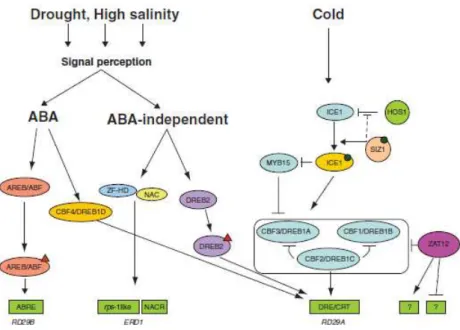
Figure 2. Transcriptional network of abiotic stress responses. Transcription factors and post-translational modifying enzymes are represented in ovals and circles, respectively. The triangles indicate post-translational modifications. The green boxes indicate cis-elements or putative motifs (question marks) identified in stress-responsive genes. The black dot corresponds to SUMOylation modification of ICE1 by SIZ1. The dashed black line represents competition between SIZ1 and HOS1 for binding to ICE1. Figure adapted from Saibo et al. (2009) and Yamaguchi-Shinozaki and Shinozaki (2006).
MYB family
Transcription factor proteins from the MYB family contain MYB repeats (R) involved in DNA-binding and protein-protein interactions (Feller et al. 2011). The number of tandem MYB repeats groups
21 Feller et al. (2011) and references therein). In rice, several MYB
proteins were reported to be involved in cold stress responses.
MYBS3 transcript level is regulated by cold, high salinity and ABA,
and its over-expression in rice was shown to enhance plant tolerance to cold (Su et al. 2010). OsMYB3R-2 was shown to play an important
role in cell-cycle regulation, but it is also involved in abiotic stress responses (Ma et al. 2009). Its gene expression is induced under
cold, drought and high salinity, and OsMYB3R-2 over-expression in
rice enhanced plant cold tolerance (Ma et al. 2009). On the other
hand, when over-expressed in Arabidopsis, this TF improved tolerance to drought and high salinity (Dai et al. 2007). OsMYB4 was
shown to be involved in both biotic and abiotic stress responses (Vannini et al. 2006). The TF over-expression in heterologous
systems conferred tolerance to different stress conditions depending on the plant host (Agarwal and Jha 2010; Park et al. 2010). The
increased stress tolerance was proposed to be related to the OsMYB4 putative function in osmotic adjustment (Park et al. 2010).
Studies with rice plants over-expressing OsMYB4 revealed that the
increased cold tolerance can be related to reduce oxidative injuries due to enhanced antioxidant capacity (Park et al. 2010). The
transcriptional activity of some MYB proteins was shown to be dependent on the interaction with basic Helix-Loop-Helix (bHLH) proteins from the MYC subgroup (Feller et al. 2011). AtMYC2 and
AtMYB2 were shown to interact with the MYCRS and MYBRS cis
-elements present in the promoter of the drought- and ABA-inducible gene rd22 (Figure 2) (Abe et al. 2003). TF co-expression in
Arabidopsis protoplasts strongly activated rd22 transcription. In
22
cooperative interaction between MYB15 and ICE1 (Inducer of CBF Expression 1) (Figure 2) (Agarwal et al. 2006a). ICE1 encodes a
MYC-type bHLH TF, which positively regulates CBF/DREB1 genes
expression and has an essential role in cold acclimation (Chinnusamy et al. 2003). This TF was shown to down regulate the
gene expression of MYB15, which represses the transcription of CBF/DREB1 genes (Mazzucotelli et al. 2008). Under cold stress
conditions, ICE1 TF is activated through phosphorylation and SUMOylation by the SUMO E3 ligase SIZ1 (SAP and MIZ domain protein) (Chinnusamy et al. 2007). ICE1 SUMOylation blocks its
proteosomal degradation mediated by the E3 Ubiquitin ligase HOS1 (High expression of Osmotically responsive gene 1) (Miura et al.
2007). The ICE1 active form increases the expression of
CBF/DREB1 genes and, thus, enhances plant tolerance to low
temperatures. NAC family
NAC [NAM (No Apical Meristem), ATAF (Arabidopsis Transcription Activation Factor), and CUC2 (Cup-shaped Cotyledon)] proteins are characterized by a highly conserved N-terminal NAC domain that binds to target DNA and a divergent region in the C-terminal domain that regulates its transcriptional activity (Olsen et al.
2005). These proteins have been implicated in the regulation of several processes, including developmental mechanisms and stress responses (Olsen et al. 2005). Arabidopsis ATAF1 was reported to
be involved in both biotic and abiotic stress responses (Wu et al.
2009). Its gene transcripts accumulate in response to drought, high salinity, ABA, JA, wounding and pathogen infection. Additionally,
ATAF1 over-expression enhanced tolerance to drought stress and
23 pathogen infection. Several NAC proteins were shown to regulate the transcription of stress-responsive genes cooperatively with other TFs. ANAC019, ANAC055 and ANAC072 interact with the zinc-finger homeodomain (ZF-HD) protein ZFHD1 to regulate the drought-dependent expression of ERD1 (Early Responsive to Drought 1)
(Figure 2) (Tran et al. 2007). Arabidopsis plants over-expressing both NAC and ZFHD1 TFs displayed improved drought tolerance. In rice,
OsNAC5 was demonstrated to form homo- and heterodimers with the NAC domains of OsNAC5, OsNAC6 and SNAC1 (Takasaki et al.
2010). Additionally, OsNAC5 and OsNAC6 transcriptionally activate
OsLEA3 (Late Embryogenesis Abundant group 3 protein), a
stress-inducible gene whose over-expression enhances rice drought tolerance. Rice plants over-expressing OsNAC6 displayed improved
tolerance to drought, high salinity and blast disease, suggesting that the TF is involved in both biotic and abiotic stress responses (Nakashima et al. 2007). OsNAC10 function in abiotic stress
responses was revealed through its over-expression driven by a constitutive and a root-specific promoter in rice (Jeong et al. 2010).
The transgenic plants displayed enhanced tolerance to drought, high salinity and cold stress at the vegetative stage. In addition, OsNAC10
root-specific over-expression resulted in increased rice grain yield under field drought conditions. ONAC045 was also shown to have an important role in rice response to drought and high salinity (Zheng et al. 2009). Its over-expression resulted in rice plants with enhanced
tolerance to this abiotic stress conditions. In both OsNAC10 and ONAC045 transgenic plants the enhanced tolerance was associated with the induction of stress-responsive genes (Jeong et al. 2010;
24
bZIP family
The basic-region leucine zipper (bZIP) TFs contain a basic region that interacts with the DNA and a leucine zipper involved in protein homo- and heterodimerization (Jakoby et al. 2002). Several bZIP
proteins have been implicated in ABA-dependent abiotic stress responses and are thus referred to as ABRE-binding (AREB) proteins or ABRE-Binding Factors (ABFs). These proteins modulate the expression of ABA-responsive genes through binding to the ABA Responsive Element (ABRE; ACGT-core), a cis-element present in
their promoter region (Umezawa et al. 2010; Zhang et al. 2005).
However, the presence of one ABRE was shown to be insufficient to activate ABA-dependent gene expression and an additional element termed coupling element (CE) was shown to be required (Gomez-Porras et al. 2007; Zhang et al. 2005). Two CEs (CE1 and CE3)
were identified in wheat and shown to form an ABA-responsive complex. Additionally, ABREs themselves and the dehydration-responsive element (DRE) were reported to function as CEs. bZIP proteins were shown to interact with DNA as homo- or heterodimers and the affinity to specific DNA sequences may be dependent on the dimer formed (Siberil et al. 2001). Additionally, phosphorylation was
proposed to determine the DNA binding affinity and the formation of specific dimers (Schutze et al. 2008). Rice bZIPs TRAB1 and OsVP1
were shown to directly interact and to putatively regulate the expression of ABA-responsive genes (Hobo et al. 1999). TRAB1
directly binds to ABRE motifs and this interaction was enhanced upon ABA-dependent phosphorylation (Kagaya et al. 2002).
Additionally, TRAB1 phosphorylation was shown to be triggered by high salinity treatments (Kobayashi et al. 2005). Rice OSBZ8 activity
25 promote the bZIP interaction with the promoter of several LEA genes
(RoyChoudhury et al. 2008). OSBZ8 transcripts were shown to
rapidly accumulate in response to ABA and to be present at higher levels in salt-tolerant rice cultivars as compared to salt-sensitive ones (Mukherjee et al. 2006). OsABF1 and OsABF2 also play a role in
abiotic stress responses. Their transcript levels are up regulated under different stress conditions, including cold, drought and high salinity, and the respective mutants showed enhanced sensitivity to high salinity and drought stress (Hossain et al. 2010a; Hossain et al.
2010b). In Arabidopsis, AREB1 transcriptional activity was reported to be dependent on ABA-mediated multisite phosphorylation (Furihata et al. 2006). Over-expression of a constitutive active form
of AREB1 resulted in the expression of downstream genes involved in drought stress tolerance, such as the LEA genes RD29B and RAB18 (Fujita et al. 2005). The transgenic plants displayed ABA
hypersensitivity and enhanced drought tolerance. AP2/ERF family
AP2/ERF (APETALA2/Ethylene Response Factor) TFs are characterized by the highly conserved AP2 domain involved in TF binding to DNA (Dietz et al. 2010; Santos et al. 2011). The origin of
these proteins in plants is proposed to result from horizontal transfer of an HNN-AP2 endonuclease from bacteria or viruses (Magnani et al. 2004). The plant AP2/ERF family is divided in five subfamilies,
AP2, RAV, ERF, DREB and ‘others’, according to the similarity of their DNA binding domains (Sakuma et al. 2002). The AP2
26
(Dietz et al. 2010; Swaminathan et al. 2008). Arabidopsis and pepper
RAV proteins have been implicated in stress responses. RAV1 and RAV2 transcripts accumulated in Arabidopsis plants subjected to
several abiotic stress conditions (Woo et al. 2010). Over-expression
of CARAV1 from pepper in Arabidopsis greatly enhanced plant
resistance to pathogen infection and tolerance to osmotic stress (Sohn et al. 2006). Members from the DREB
(Dehydration-Responsive Element Binding protein) and ERF (Ethylene Responsive Factor) subfamilies are implicated in biotic and abiotic stress responses. These proteins contain only one AP2 domain but have different DNA binding specificity due to the amino acids in position 14 and 19 (Sakuma et al. 2002). The 14th alanine and the
19th aspartic acid are conserved in the ERF proteins, whereas valine and glutamic acid are conserved within DREB proteins. Although both ERF and DREB TFs recognize the core sequence CCGNC, their DNA-binding specificity is determined by the sequences that surround this core motif. DREB proteins usually recognize the dehydration responsive element (DRE; A/GCCGAC), whereas ERF TFs preferentially interact with ERE (Ethylene-Responsive Element), which contains a core sequence designated GCC box (AGCCGCC) (Mizoi et al. 2012). Although ERE and DRE are considered the
optimal target sites for ERF and DREB proteins, respectively, several studies indicate that members of these subfamilies can bind to either
cis-elements with different affinity levels and to sequences containing
variations of both core motifs (Fujimoto et al. 2000; Kizis et al. 2001).
Proteins from the DREB subfamily were reported to recognize cis
27 CRT-binding factors/DRE-binding proteins (CBF/DREB) (Baker et al.
1994; Jiang et al. 1996; Stockinger et al. 1997).
Proteins from the ERF subfamily were initially characterized as regulators of ethylene signal transduction pathways, but their role in biotic and abiotic stress responses has been shown in several plant species (Xu et al. 2011). The identification of ERE cis-elements in
the promoter region of several pathogenesis-related (PR) genes,
suggested that ERF had a role in biotic stress responses (Dietz et al.
2010; Gutterson and Reuber 2004). Additionally, studies in Arabidopsis, tobacco and tomato revealed that ERF over-expression enhanced plant resistance to fungal and bacterial pathogens (Xu et al. 2011). The involvement of ERF TFs in abiotic stress responses
was confirmed in several plant species (Xu et al. 2011). Tomato
JERF1 was shown to be regulated at transcriptional level by ethylene, jasmonic acid, ABA and high salinity (Wu et al. 2007).
When over-expressed in tobacco JERF1 enhanced plant tolerance to high salinity and cold stress through the transcriptional activation of stress-responsive genes. JERF1 was also reported to interact with multiple cis-acting elements, such as GCC box, DRE and CE1 and,
therefore, proposed to function in both dependent and ABA-independent stress signaling pathways. GmERF3 from soybean was shown to function in biotic and abiotic stress responses (Zhang et al.
2009a). When over-expressed in tobacco, it increased tolerance to high salinity and drought stress. Additionally, the transgenic plants displayed enhanced resistance to bacterial, fungal and viral pathogens, suggesting that GmERF3 is also involved in biotic stress responses. In rice, OsBIERF2, OsBIERF3 and SUB1A were reported to be involved in abiotic stress responses. OsBIERF2 (also named AP37 or OsERF3) gene expression was induced by high salinity and
28
both stress conditions and to low temperature at vegetative stage (Oh et al. 2009). In addition, these transgenic plants showed
enhanced drought tolerance during the reproductive stage, leading to an increased grain yield as compared to wild-type plants. OsBIERF3 (also named AP59) has a role in rice biotic and abiotic stress responses. Tobacco plants over-expressing this TF showed enhanced disease resistance against infection by virus and bacteria, and increased drought and high salinity tolerance (Cao et al. 2005).
The SUB1A-1 allele was identified only in rice indica cultivars and
reported to contribute to the higher submergence tolerance observed in these cultivars as compared to the japonica ones. Introgression of SUB1A-1 in japonica cultivars enhanced rice tolerance to
submergence and drought stress (Fukao et al. 2011).
DREB proteins are mainly implicated in plant responses to abiotic stress conditions. This subfamily was divided in two subclasses, CBF/DREB1 and DREB2, due to their differential gene expression pattern in Arabidopsis plants subjected to abiotic stress conditions (Agarwal et al. 2006b). The fact that some genes are identified as
CBF and others as DREB, results from the fact that at the same time two independent teams have characterized the same genes in Arabidopsis (Liu et al. 1998; Stockinger et al. 1997). The
CBF/DREB1 subclass includes the CBF3/DREB1A, CBF1/DREB1B
and CBF2/DREB1C genes, which were up-regulated by low
temperatures but not by drought or high salt stress. Contrary, the DREB2 genes, DREB2A and DREB2B, were only induced by
29 2009). In Arabidopsis, the CBF/DREB1 regulon was proposed to be regulated by the zinc-finger TF ZAT12 which reduces the expression of CBF/DREB genes (Vogel et al. 2005). ZAT12 putative homologs
were identified in rice and barley, but their function in still unknown (Skinner et al. 2006). The CBF/DREB1 regulon has an important role
in low temperature responses. Over-expression of CBF/DREB1 genes in Arabidopsis and other plant species, such as rice and wheat, resulted in improved plant tolerance to low temperature but also to salt and drought stress conditions (Nakashima et al. 2009; Xu et al. 2011). In rice, OsDREB1A, OsDREB1B and OsDREB1F are
induced by drought, high salinity and cold stress (Dubouzet et al.
2003; Fukao et al. 2011; Gutha and Reddy 2008; Wang et al. 2008),
and their over-expression in Arabidopsis and rice improved tolerance to those stresses in both species (Ito et al. 2006). OsDREB1A-OX
plants displayed increased content of osmoprotectants and activation of several stress-responsive genes (Ito et al. 2006). Studies in
tobacco revealed that OsDREB1B is also involved in biotic stress responses and radical scavenging processes (Gutha and Reddy 2008). Some rice DREB genes were shown to have a putative role in
ABA-dependent responses. OsDREB1F was induced by an ABA
treatment (Wang et al. 2008) and Arabidopsis plants over-expressing
OsDREB1D showed decreased sensitivity to ABA (Zhang et al.
2009c). DREB2 proteins have been identified in Arabidopsis and several crop species, such as rice, wheat, barley and maize (Matsukura et al. 2010). Under control conditions, Arabidopsis
DREB2A was shown to be regulated at post-translational level through ubiquitination by DRIP1 and DRIP2 RING E3 ligases (Qin et al. 2008). Over-expression of the DREB2A constitutively active form
resulted in enhanced tolerance to drought stress (Sakuma et al.