241
Two new ornamental loricariid catfishes of
Baryancistrus
from rio Xingu drainage (Siluriformes: Hypostominae)
Lúcia Rapp Py-Daniel
1, Jansen Zuanon
2and Renildo Ribeiro de Oliveira
1Two new species of the hypostomine genus Baryancistrus are described from the rio Xingu drainage. Baryancistrus xanthellus is distinguished from all other Baryancistrus species by the presence of yellow spots along the entire body and conspicuous yellow marks on distal tip of dorsal and caudal fins. Baryancistrus chrysolomus is distinguished from its congeners by its uniform dark body coloration and presence of yellow bands on dorsal and caudal fins. Despite the lack of formal description, these species are very popular in the international aquarium trade. We expect that these formal descriptions might contribute to the improvement of Brazilian regulations in the international trade of ornamental loricariids.
Duas espécies novas de hipostomíneos do gênero Baryancistrus são descritas da bacia do rio Xingu. Baryancistrus xanthellus se diferencia de todas as outras espécies de Baryancistrus pela presença de pontos amarelos em todo o corpo e presença de manchas conspícuas amarelas nas pontas das nadadeiras dorsal e caudal. Baryancistrus chrysolomus se distingue de seus congêneres pela sua coloração escura uniforme e presença de uma faixa amarela nas nadadeiras dorsal e caudal. Apesar de não estarem formalmente descritos, esses peixes são muito populares no comércio aquariofilista internacional. Esperamos que essas descrições formais contribuam para melhorar a regulamentação brasileira no comércio internacional de loricariídeos ornamentais.
Key words: Amazon fishes, Aquarium trade, Belo Monte, Taxonomy.
¹Coleção de Peixes, Programa de Coleções e Acervos Científicos (PCAC), Instituto Nacional de Pesquisas da Amazônia (INPA). Av. André Araújo, 2936, 69011-970 Petrópolis, Manaus, AM, Brazil.
²Coordenação de Pesquisas em Biologia Aquática (CPBA), Instituto Nacional de Pesquisas da Amazônia (INPA). Av. Andre Araújo, 2936, 69011-970 Petrópolis, Manaus, AM, Brazil.
Introduction
The loricariid genus Baryancistrus Rapp Py-Daniel, 1989 currently comprises four species: B. niveatus (Castelnau, 1855), the type species of the genus described from the rio Araguaia, Brazil, B. longipinnis (Kindle, 1895) from rio Tocantins, Brazil, B. demantoides Werneke, Sabaj, Lujan & Armbruster, 2005, and B. beggini Lujan, Arce & Armbruster, 2009 both from the area of confluence of ríos Orinoco and Ventuari in Venezuela and Colombia. This genus is characterized by a heavy and robust head and body, presence of strong odontodes on the cheek plates, numerous teeth, large and parallel disposed maxillae, and almost complete abdominal plating (Rapp Py-Daniel, 1989; Werneke et al., 2005; Lujan et al., 2009). All these features are overwhelmingly present in other loricariids, from which Baryancistrus is distinguished by the presence of a hypertrophied membrane posterior to the last branched dorsal-fin ray. This membrane can reach the supporting plate of the adipose fin or not, different from the genera Oligancistrus, Parancistrus, and
respectively) and “Iriri golden nugget pleco” (L177), while the other is referred to as “mango pleco” under code L47. These two catfishes are herein described and some information on their ecology and behavior are provided.
Material and Methods
Measurements were made with digital calipers to the nearest 0.1 mm. All measurements and counts were taken in the left side, unless the structure was missing or damaged. Counts and measurements follow Armbruster (2003) and Oliveira et al. (2010). Counts included: number of plates between the extended dorsal fin membrane and supporting plate of the adipose fin and number of plates in the caudal peduncle. Museum acronyms follow Reis et al. (2003).
Color based differential key of Baryancistrus species (for living and preserved specimens):
1. Body uniformly dark or with faint light dots ... 2
1’.Body largely covered by conspicuous yellow or light dots ... 4
2. Presence of a continuous light band (bright yellow in living specimens) on border of dorsal and caudal fins .………... Baryancistrus chrysolomus (rio Xingu)
2’. Dorsal and caudal fins without light terminal bands ... 3
3. Body uniformly dark without any dots (small sized fishes, up to 80.9 mm SL) ... Baryancistrus beggini (río Orinoco)
3’.Body covered with small and inconspicuous light dots of different sizes (but always smaller than pupil): larger on head, body and fin rays, and minute on interradial membranes (large fishes, up to 206.4 mm SL) ... Baryancistrus longipinnis (rio Tocantins)
4. Light dots covering only the anterior portion of body (to dorsal fin), posterior portion of body and fins plain ... Baryancistrus demantoides (río Orinoco)
4’.Light dots covering whole body ... 5
5. Presence of light band (bright yellow in living specimens) on border of dorsal and caudal fins, broader in juveniles, and reduced to light markings on distal tips of dorsal and caudal in adults ... Baryancistrus xanthellus (rio Xingu)
5’.Absence of light band on border of dorsal and caudal fins in juveniles and adults ... ... Baryancistrus niveatus (rios Araguaia and Tocantins)
Baryancistrus xanthellus, new species Figs. 1 and 2
Holotype. INPA 33849, 214.2 mm SL, Brazil, Pará, Senador José Porfírio, rio Xingu in the vicinity of the cachoeira Buraco do Inferno, 03º27’07”S 51º41’53”W, 18 Mar 1997, J. Zuanon.
Paratypes. Brazil, Pará, rio Xingu: ANSP 191482, 3, 183.8-188.7 mm SL, MCP 45752, 2, 191.0-196.3 mm SL, MNRJ 37863, 2, 186.2-191.5 mm SL, Arroz Cru, 03º25’16”S 51º55’08”W, 1 Oct 1990, L. Rapp Py-Daniel & J. Zuanon. INPA 3942, 7, 78.3-184.8 mm SL (4 not measured), Furo do Tucum Seco, 1 Oct 1990, L.
Rapp Py-Daniel & J. Zuanon. INPA 3955, 27, 48.9-126.2 mm SL, 1 c&s, 82.0 mm SL, (19 not measured), INPA 3963, 3, 110.3-145.1 mm SL (1 not measured), Cachoeira do Kaituká, 03º33’47”S 51º51’20”W, 9 Oct 1990, L. Rapp Py-Daniel & J. Zuanon. INPA 4057, 1, 223.3 mm SL, Ilha de Babaquara, 03º12’43”S 52º12’12”W, 4 Oct 1990, L. Rapp Py-Daniel & J. Zuanon. INPA 4058, 1, 224.0 mm SL, Praia do Pedral, 03º15’16.7”S 52º13’12”W, 7 Oct 1990, L. Rapp Py-Daniel & J. Zuanon. INPA 31414, 9, 49.8-210.2 mm SL (4 not measured), Comunidade do Maia, 03º30’44”S 51º44’43”W, 9 Nov 2008, L. Rapp Py-Daniel & R. R. Oliveira. INPA 31423, 1, 48.3 mm SL, Cachoeira do Landi, 03º35’01”S 51º49’21”W, 8 Nov 2008, L. Rapp Py-Daniel & R. R. Oliveira. INPA 31473, 6, 51.2-171.8 mm SL, (2 not measured), Arroz Cru, 03º25’20”S 51º57’22”W, 6 Nov 2008, L. Rapp Py-Daniel & R. R. Oliveira. INPA 31772, 1, 55.3 mm SL, Ilha do Davi, 03º32’39”S 51º57’29”W, 10 Nov 2008, L. Rapp Py-Daniel & R. R. Oliveira. INPA 31799, 2, 57.8-189.3 mm SL, Gorgulho da Rita, 03º20’14”S 52º11’18”W, 7 Nov 2008, L. Rapp Py-Daniel & R. R. Oliveira. INPA 33848, 1, 212.8 mm SL, Cachoeira Buraco do Inferno, 03º27’07”S 51º41’53”W, 17 Mar 1997, J. Zuanon. INPA 33850, 5, 88.4-162.6 mm SL, 1 c&s, 88.4 mm SL, Corredeiras do Arini, 03º24’15”S 51º41’53”W, 6 Sep 1997, J. Zuanon. INPA 33851, 1, 65.1 mm SL, Furo do Ramiro, 03º15’21”S 52º05’06”W, 15 Sep 1997, J. Zuanon. INPA 33852, 1, 175.2 mm SL, Ponta da Ilha da Bela Vista, 03º24’22”S 51º43’03”W, 29 Sep 1996, J. Zuanon. INPA 33941, 1, 110.9 mm SL, Costa Junior, 03º29’28”S 52º19’07”W, 12 Oct 1996, J. Zuanon. MPEG 19132, 2, 171.3-183.0 mm SL, Ilha de Babaquara, 5 Oct 1990, J. Zuanon. MZUSP 106738, 3, 173.3-194.7 mm SL, Ilha de Kaituká, 03º33’47”S 51º51’20”W, 8 Oct 1990, L. Rapp Py-Daniel & J. Zuanon. ZUEC 4485, 2, 46.6-52.5 mm SL, just above Senador José Porfirio, 02º41’7.7”S 52º00’30.9”W, 13 Sep 1997, J. Zuanon. Rio Iriri: INPA 30767, 1, 146.4 mm SL, ROM 88756, 2, 137.2-191.2 mm SL, Ilha do Curapé, 04º06’53”S 53º22’28”W, 17 Aug 2008, H. López-Fernández et al. INPA 31081, 2, 184.4-207.0 mm SL, ROM 88757, 1, 172.5 mm SL, Cachoeira Grande do Iriri, 03º51’34”S 52º41’25”W, 23 Aug 2008, H. López-Fernández et al. INPA 31095, 2, 176.6-188.6 mm SL, ROM 88755, 2, 103.8-187.5 mm SL, above mouth of rio Novo, 04º28’11”S 53º41’38”W, 21 Aug 2008, H. López-Fernández et al. INPA 31169, 1, 140.8 mm SL, ROM 88754, 1, 131.1 mm SL, Cachoeira Grande do Iriri, 03º50’35”S 52º44’03”W, 24 Aug 2008, H. López-Fernández et al. INPA 32452, 1, 46.3 mm SL, Barinha, 04º09’05”S 53º23’28”W, 19 Aug 2008, H. López-Fernández et al.
three species). Baryancistrus xanthellus differs from B. beggini by a larger number of mandibulary teeth (around 60) on both maxillae versus 34-36 teeth in the premaxillary and 34 teeth in the dentary in B. beggini). The presence of bold yellow markings in young B. xanthellus is the reason for its popular name in the aquarium trade: “amarelinho” in Portuguese (meaning little yellow).
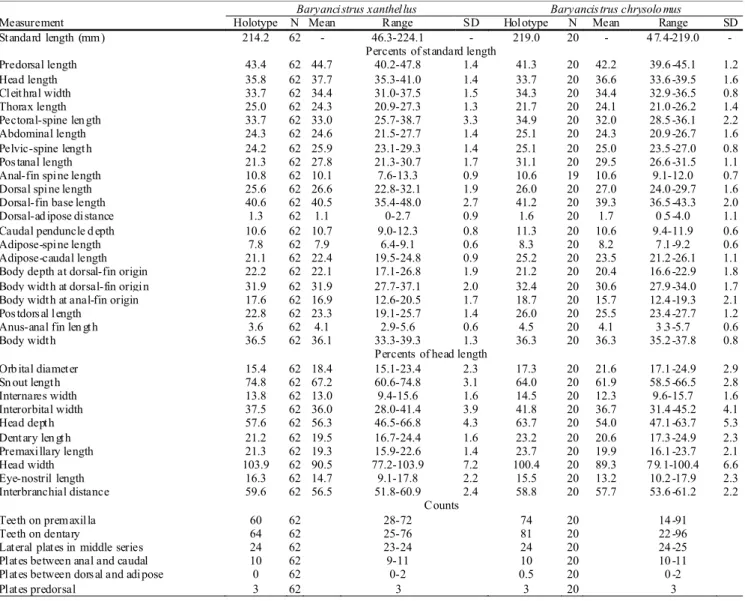
Description. Morphometrics and meristics in Table 1. Medium-size loricariids, bigger specimen examined reached 224.1 mm SL. Body short and robust, deep. Profile from snout to eye strongly sloped, gently convex from eye to insertion of dorsal fin due to prominence of supraoccipital process. Profile
strongly inclined from dorsal-fin insertion to caudal fin. Body deepest at region between supraoccipital and dorsal-fin insertion. Ventral surface flat and straight from snout tip to caudal-fin base. Head and eyes without crest. Anterior lateral plates gently bent; rest of body not keeled. Anterior portion of body half oval in cross section, triangular at caudal peduncle.
Head large and wide; snout round in dorsal view. Eye large and round, iris operculum not visible. Orbit slightly elevated; interorbital area almost completely flat. No ridge between eyes and nares. Supraoccipital process conspicuous, elevated and rounded posteriorly. Supraoccipital limited posteriorly by pair of large quadrangular plates, almost fused.
Predorsal area reduced, with only one pair of small, separated diamond-shaped plates anterior to nuchal plate.
Mouth wide; lips large, covered with small round papillae except on area around maxillae. Maxillary barbel thick and short. Branchial opening moderate, wider in larger specimens. Interbranchial distance approx. 56.5% in head length.
Head and body completely covered by large plates dorsally, except dorsal-fin base. Ventral surface largely unplated from snout to anal fin; in larger specimens, presence of two or three minute round plates close to insertion of pectoral spine or urogenital opening. Twenty-two perforated median plates, 23 lateral plates; four oblong plates on caudal-fin base. All plates marked with lines of odontodes. Numerous hypertrophied odontodes only on evertible cheek plates, well developed in larger specimens with largest odontode reaching posterior end of first lateral plate. Ventral border of opercle with series of strong but short odontodes on probably mature males.
Dorsal fin II,7; spinelet present and dorsal-fin locking mechanism functional. Dorsal fin long and low, reaching
adipose spine on small specimens when adpressed. Dorsal-fin posterior membrane covering four plates immediately behind last dorsal-fin ray, but not reaching preadipose plate. Adipose fin large and with posterior membrane slightly developed. One single plate separating dorsal from preadipose plate. Caudal fin i,14,i, emarginated. Pectoral fin I,6, large, reaching well beyond posterior end of pelvic-fin base when adpressed. Pectoral fin covered by large odontodes on (possibly mature) males. Pelvic fin i,5 reaching posterior end of anal fin base when adpressed. Anal fin i,4, very reduced. All simple first rays covered by numerous short odontodes on their free surface.
Teeth long and deeply cuspidate. Cusps round and similar in larger specimens with vertical divide between cusps; in smaller specimens cusps are largely asymmetrical, with internal cups larger. Premaxilla and dentary of similar size and disposed in parallel to anterior border of snout. Modal number of premaxillary teeth 32; dentary teeth mode 46 (range of number of mandibulary teeth in Table 1). Buccal papilla long and digitiform.
Table 1. Morphometric and meristic data of Baryancistrus xanthellus and Baryancistrus chrysolomus.
Baryanci strus xanthel lus Baryancis trus chrysolo mus
Measurement Holotype N Mean Range SD Hol otype N Mean Range SD
St andard length (mm ) 214.2 62 - 46.3-224.1 - 219.0 20 - 4 7. 4-219.0 -
Percents of st andard length
Predorsal length 43.4 62 44.7 40.2-47.8 1.4 41.3 20 42.2 39.6 -45.1 1.2
Head length 35.8 62 37.7 35.3-41.0 1.4 33.7 20 36.6 33.6 -39.5 1.6
Cl eit hral width 33.7 62 34.4 31.0-37.5 1.5 34.3 20 34.4 32.9 -36.5 0.8
Thorax length 25.0 62 24.3 20.9-27.3 1.3 21.7 20 24.1 21.0 -26.2 1.4
Pectoral-spine len gth 33.7 62 33.0 25.7-38.7 3.3 34.9 20 32.0 28.5 -36.1 2.2
Abdominal length 24.3 62 24.6 21.5-27.7 1.4 25.1 20 24.3 20.9 -26.7 1.6
Pelvic-spine lengt h 24.2 62 25.9 23.1-29.3 1.4 25.1 20 25.0 23.5 -27.0 0.8
Pos tanal length 21.3 62 27.8 21.3-30.7 1.7 31.1 20 29.5 26.6 -31.5 1.1
Anal-fin spi ne length 10.8 62 10.1 7.6-13.3 0.9 10.6 19 10.6 9.1-12.0 0.7
Dorsal spi ne length 25.6 62 26.6 22.8-32.1 1.9 26.0 20 27.0 24.0 -29.7 1.6
Dorsal-fin base length 40.6 62 40.5 35.4-48.0 2.7 41.2 20 39.3 36.5 -43.3 2.0
Dorsal-ad ipose di stance 1.3 62 1.1 0-2.7 0.9 1.6 20 1.7 0 .5 -4.0 1.1
Caudal penduncle d epth 10.6 62 10.7 9.0-12.3 0.8 11.3 20 10.6 9.4-11.9 0.6
Adipose-spi ne length 7.8 62 7.9 6.4-9.1 0.6 8.3 20 8.2 7 .1 -9.2 0.6
Adipose-caudal length 21.1 62 22.4 19.5-24.8 0.9 25.2 20 23.5 21.2 -26.1 1.1
Body depth at dorsal-fin origin 22.2 62 22.1 17.1-26.8 1.9 21.2 20 20.4 16.6 -22.9 1.8
Body widt h at dorsal-fin origi n 31.9 62 31.9 27.7-37.1 2.0 32.4 20 30.6 27.9 -34.0 1.7
Body widt h at anal-fin origin 17.6 62 16.9 12.6-20.5 1.7 18.7 20 15.7 12.4 -19.3 2.1
Pos tdors al l ength 22.8 62 23.3 19.1-25.7 1.4 26.0 20 25.5 23.4 -27.7 1.2
Anus-anal fin len gt h 3.6 62 4.1 2.9-5.6 0.6 4.5 20 4.1 3 .3 -5.7 0.6
Body widt h 36.5 62 36.1 33.3-39.3 1.3 36.3 20 36.3 35.2 -37.8 0.8
Percents of head length
Orb ital diamet er 15.4 62 18.4 15.1-23.4 2.3 17.3 20 21.6 17.1 -24.9 2.9
Sn out lengt h 74.8 62 67.2 60.6-74.8 3.1 64.0 20 61.9 58.5 -66.5 2.8
Internares width 13.8 62 13.0 9.4-15.6 1.6 14.5 20 12.3 9.6-15.7 1.6
Interorbital width 37.5 62 36.0 28.0-41.4 3.9 41.8 20 36.7 31.4 -45.2 4.1
Head dept h 57.6 62 56.3 46.5-66.8 4.3 63.7 20 54.0 47.1 -63.7 5.3
Dent ary len gt h 21.2 62 19.5 16.7-24.4 1.6 23.2 20 20.6 17.3 -24.9 2.3
Premaxi llary length 21.3 62 19.3 15.9-22.6 1.4 23.7 20 19.9 16.1 -23.7 2.1
Head width 103.9 62 90.5 77.2-103.9 7.2 100.4 20 89.3 7 9. 1-100.4 6.6
Eye-nostril length 16.3 62 14.7 9.1-17.8 2.2 15.5 20 13.2 10.2 -17.9 2.3
Interbranchial distance 59.6 62 56.5 51.8-60.9 2.4 58.8 20 57.7 53.6 -61.2 2.2
Counts
Teeth on prem axil la 60 62 28-72 74 20 14 -91
Teeth on dentary 64 62 25-76 81 20 22 -96
Lat eral plat es in middle series 24 62 23-24 24 20 24 -25
Pl at es between anal and caudal 10 62 9-11 10 20 10 -11
Pl at es between dors al and adi pose 0 62 0-2 0.5 20 0 -2
Color in life. Overall body color dark brown at dorsum and sides, paler on abdomen. Numerous bright, similar-sized yellow spots over head, body, dorsal, adipose, and caudal fins, and on dorsal surface of pectoral and pelvic fins. Yellow spots almost size of pupil in juveniles, becoming proportionally smaller, more numerous and somewhat paler in adults. Young specimens with wide yellow band on distal third of caudal and dorsal fin; dorsal-fin band larger anteriorly, becoming gradually slender posteriorly. In adults, bands on fins become reduced to spots on anterior distal ends of dorsal and caudal fins (Fig. 2). Considerable variation in density and size of spots.
Color in alcohol. Similar to pattern described for living specimens but with ground color brown to dark olive and white to cream markings (Fig. 1).
Distribution. This species has been recorded from the area called Volta Grande do rio Xingu, an area immediately above Belo Monte falls, and from rio Iriri, the larger tributary of rio Xingu (Figs. 3 and 4a).
Etymology. From the Greek xanthellus, yellow, in allusion to the bright color of the specimens. A noun in apposition.
Fig. 3. Map of lower rio Xingu area, showing the collecting sites of Baryancistrus xanthellus (triangles) and Baryancistrus chrysolomus (squares). Black solid symbols indicate holotypes localities.
Popular name. Known in the aquarium trade as “amarelinho” (= little yellow) and “cascudo pepita-de-ouro” (in Portuguese), or L018 and L085; and golden nugget pleco or Iriri golden nugget pleco (in English), or L177.
intestines of loricariids (intestinal length up to 16 times the body length; Zuanon, 1999). Occasional bryozoans and chironomid larvae were also found. Underwater observations indicate that the food is scraped from the surface of submerged rocks by gently combing the periphyton cover with the numerous and tightly spaced teeth (JZ, pers. obs.).
Baryancistrus chrysolomus, new species Figs. 5 and 6
Holotype. INPA 33947, 219.0 mm SL, Brazil, Pará, Altamira, rio Xingu at Furo do Ramiro, 03º15’21”S 52º05’06”W, 15 Sep 1997, J. Zuanon.
Paratypes.Brazil, Pará, rio Xingu: INPA 28483, 3, 40.3-65.3 mm SL, 1 c&s, 58.4 mm SL, (1 not measured), Furo da Crente, 03º27’30”S 51º54’41”W, 17 Sep 1997, J. Zuanon. INPA 31408, 4, 55.6-92.2 mm SL, Comunidade do Maia, 03º30’44”S 51º44’43”W, 9 Nov 2008, L. Rapp Py-Daniel & R. R. Oliveira. INPA 31438, 9, 47.4-89.1 mm SL, 1 c&s, 74.4 mm SL, (3 not measured), Comunidade do Maia, 03º31’42”S 51º45’02”W, 9 Nov 2008, L. Rapp Py-Daniel & R. R. Oliveira. INPA 31800, 3, 53.5 mm SL (2 not measured), Coqueiro, 03º06’54”S 51º43’15”W, 5 Nov 2008, L.
Rapp Py-Daniel & R. R. Oliveira. INPA 33844, 1, 166.2 mm SL, Viracebo do Arroz Cru, 03º25’16”S 51º55’08”W, 7 Oct 1996, J. Zuanon. INPA 33845, 2, 207.6-207.8 mm SL, same data as holotype. INPA 33846, 1, 191.7 mm SL, MPEG 19133, 1, 142.7 mm SL, Furo do Ramiro, 03º15’21”S 52º05’06”W, 12 Sep 1997, J. Zuanon. MZUSP 106739, 1, 184.2 mm SL, Furo do Ramiro, 03º15’21”S 52º05’06”W, 6 Oct 1996, J. Zuanon. ZUEC 4484, 1, 69.5 mm SL, Furo de Ramiro, 03º15’21”S 52º05’06”W, 13 September 1997, J. Zuanon. Rio Curuá: MZUSP 97226, 8, 45.5-182.4 mm SL, rio Iriri drainage, 08º19’07”S 55º05’23”W, 22 Oct 2007, J. L. Birindelli et al.
Diagnosis. Baryancistrus chrysolomus can be distinguished from all its congeners, except B. xanthellus, by the presence of a broad orange to yellow band along the entire distal border of dorsal and caudal fin (vs. all fins without yellow bands). Baryancistrus chrysolomus differs from B. niveatus and B. demantoides by the absence of clear dots on the body (vs. presence of clear dots on whole body in B. niveatus and in anterior part of the body in B. demantoides). Baryancistrus chrysolomus can also be distinguished from B. longipinnis, B. demantoides and B. niveatus by having a naked abdomen (vs. partially or completely plated in these three species). Baryancistrus chrysolomus can be further distinguished from B. beggini by the larger number of mandibulary teeth (around 70) (vs. 34-36 in premaxillary and 34 in dentary in B. beggini). Baryancistrus chrysolomus differs from B. xanthellus by the general body color; in B. chrysolomus the body is dark with very faint, almost indistinguishable light marks, vs. a conspicuously spotted coloration in B. xanthellus. Both young of B. xanthellus and B. chrysolomus have wide light bands on dorsal and caudal fins, but only B. chrysolomus retains the band in adults. Besides, both species can be distinguished by the difference on the rest of the body coloration (spotted in B. xanthellus vs. almost plain in B. chrysolomus).
Description. Morphometrics and meristics in Table 1. Medium-size loricariids; bigger specimen examined reached 219.0 mm SL. Very similar to preceding species. Body short and robust, deep. Profile from snout to eye strongly sloped, gently convex from eye to insertion of dorsal fin due to prominence of supraoccipital process. Profile strongly inclined from dorsal-fin insertion to caudal fin. Body deepest between supraoccipital and dorsal-fin insertion. Ventral surface flat and straight from snout tip to caudal-fin base. Snout with low vertical ridge conspicuously covered by a series of smaller plates. Anterior lateral plates gently bent; low ridge along dorsal fin until base of adipose fin. Anterior portion of body half oval in cross section, triangular at caudal peduncle.
Head large and wide; snout round in dorsal view. Eye large and round, iris operculum present. Orbit not elevated; interorbital area flat. No ridge between eyes and nares. Supraoccipital process not elevated, almost indistinct from rest of bone, round posteriorly and elevated. Supraoccipital limited by a pair of large quadrangular plates tightly connected. Predorsal area reduced, with one pair of separated diamond-shaped plates anterior to nuchal plate.
Mouth wide; lips large with small round papillae except around maxillae. Maxillary barbels slender and short. Branchial opening moderate, wider in larger specimens. Interbranchial distance large approx. 57.7% in head length.
Head and body completely covered by large plates
dorsally, except dorsal-fin base. Ventral surface largely unplated from snout to anal fin or urogenital opening, larger specimens with few patches of odontodes close to pectoral fin insertion. Twenty-five perforated median plates, 24 lateral plates; four to five short oblong plates on caudal-fin base. All
plates strongly sculpted with lines of odontodes more developed posteriorly. Numerous hypertrophied odontodes on evertible cheek plates, well developed in larger specimens. Ventral border of opercle with series of strong but short odontodes.
Dorsal fin II,7; spinelet present and locking mechanism functional. Dorsal fin long and low, reaching adipose spine when adpressed. Dorsal-fin posterior membrane covering next three to four plates, but not reaching preadipose plate. Adipose fin large with posterior membrane well developed. Only one plate separating dorsal fin from preadipose plate. Caudal fin i,14,i, emarginate. Pectoral fin I,6, large, reaching well beyond posterior end of pelvic-fin base when adpressed. Pectoral fin covered by large odontodes in males. Pelvic fin i,5 reaching posterior end of anal fin base when adpressed. Anal fin i,4. All simple first rays covered by numerous short odontodes on their free surface.
Teeth long and deeply cuspidate. Cusps largely asymmetrical; internal cusp larger. Premaxilar and dentary
bones of similar size and disposed parallel to anterior snout border. Maximum of 91 teeth on premaxillary and 96 on dentary. Modal number of premaxillary teeth 30; dentary teeth mode 34 (range of number of mandibulary teeth in Table 1). Buccal papilla short and digitiform.
Color in life. Body dark brown to olive at dorsum and sides, paler ventrally. Very faint pale spots over body, hardly visible on fins. Juveniles with whitish orange band on distal fourth of caudal and dorsal fins, narrower in adults (Fig. 6).
Color in alcohol. Similar to pattern of living specimens but opaque brown to dark olive ground color and almost indistinguishable pale marks. Bands on fins creamy (Fig. 5).
Distribution. Known from rio Xingu, in the area called Volta Grande do rio Xingu, immediately above Belo Monte falls and below Belo Monte village, and from rio Curuá, rio Iriri, the larger tributary of rio Xingu (Figs. 3 and 4b).
Etymology. From the Greek chryso, meaning orange or yellow and loma meaning border, in allusion to the colored band at the border of the dorsal and caudal fins. A noun in apposition.
Popular name. This species is commonly known in the Brazilian aquarium trade as “aba laranja”, (orange border), “cascudo Magnum”, (large pleco), or L047. In English, this fish receives the name of mango pleco.
Ecological notes. Baryancistrus chrysolomus seems to be much rarer than B. xanthellus in the rapid stretches of “Volta Grande” of the rio Xingu (Fig. 4b). Differently from the preceding species, young specimens of B. xanthellus occur in marginal areas of the rapids, near the river banks, usually just one or two individuals. The individuals were found under rocks in places with slow to moderate flowing water, usually with sediment accumulation over the rocks and river bottom. Other loricariid species found in the same habitat were Peckoltia vittata and young individuals of Hypostomus spp. Adult B. chrysolomus were collected under large flat rocks settled directly on the river bottom, in places with considerable amounts of fine sediments. The diet of B. chrysolomus (only two specimens analyzed) is very similar to that described for B. xanthellus and was composed by loose algae (mainly diatoms) and occasional invertebrate larvae associated with fine sediments and sand grains. The combination of the type of food items detected, the presence of fine sediments in the gut, a very long (up to 20 times the body length) and coiled intestine, and tooth number and arrangement, also suggest a periphyton-combing feeding strategy for this species.
Discussion
Baryancistrus species are very conservative in shape, color pattern and overall measurements. All measurements and proportions of B. xanthellus and B. chrysolomus are largely similar; however, some features might be useful in the differentiation of all these taxa. Baryancistrus beggini seems to be a very small Baryancistrus species, reaching up to 80 mm SL, in contrast to B. niveatus, B. longipinnis, B. xanthellus, and B. chrysolomus that can reach more than 200 mm SL. Dorsal-fin membrane is developed in all Baryancistrus species but it reaches the preadipose plate only in B. beggini and in young specimens of B. xanthellus and B. chrysolomus. Abdomen is partially to almost completely plated in large specimens of Baryancistrus niveatus, B. longipinnis, and B. demantoides, with concentration of plates on gular area, pectoral girdle, and around anus. In B. niveatus from the rio Tocantins, patches of odontodes were observed in all specimens larger than 96 mm SL. Besides, large specimens of B. niveatus show dense concentration of plates even below lower lip. Large specimens of B. longipinnis, also from rio Tocantins, despite showing concentration of plates in certain ventral areas (pectoral girdle, sides, around pelvics, and urogenital opening), do not have plates below the lower lip or on the gular area. The largest specimen of Baryancistrus
beggini reached 80 mm SL and the species is cited as having a naked abdomen. All specimens of B. chrysolomus and B. xanthellus have the abdomen largely unplated, with larger specimens showing scattered patches of odontodes of few minute plates at pectoral-fin insertion or close to urogenital opening.
Baryancistrus chrysolomus seems to have the largest mandibles, carrying up to 90 mandibulary teeth. Baryancistrus xanthellus has around 70, B. demantoides around 50 and B. beggini have 34-36 mandibulary teeth. Low tooth counts in B. beggini might be related to the small size of the fish, since small specimens of B. chrysolomus and B. xanthellus also have similar counts to B. beggini.
Finally, the spotted color pattern seems to be most generalized. Baryancistrus niveatus, B. xanthellus, B. longipinnis, and B. demantoides (although partially) have white to yellowish white dots over a darker background. According to Werneke et al. (2005), Baryancistrus demantoides may have spots on basal portions of membranes and sometimes fins, different from B. niveatus, B. xanthellus, and B. longipinnis. The type of B. longipinnis is largely plain, but it was described as having body, rays, and connecting membranes covered with small white spots, less conspicuous on rays and body (Kindle, 1895). Even B. chrysolomus has a faint spotted pattern, despite its striking clear band on dorsal and caudal fins. The only exception seems to be B. beggini with a plain dark coloration. Among the spotted Baryancistrus species, all dots along body and fins of the same individual are of similar sizes, except in B. demantoides and B. longipinnis. Baryancistrus demantoides have smaller dots on head and B. longipinnis have conspicuously minute dots on fin membranes, in contrast to larger dots on head, body and fin rays (Fig. 7).
Despite all morphological variation among different populations along the rio Xingu, the dotted-color pattern is quite pervasive. Recently, B. xanthellus was successfully breed in aquarium (Leuenberger, 2007) and the hatches have the color pattern cited above.
de Mello, 1987). The large-scale habitat modifications that result from river damming represent the biggest threat to the conservation of rheophilic fishes, many of which still undescribed. Conservation efforts directed to the maintenance of pristine river stretches large enough to contain several rapids sections should be aimed, in order to allow the existence of viable populations of the remarkable diversity of fishes present in these aquatic habitats. Comparative material. Baryancistrus longipinnis: Holotype: MCZ 29051, 1, Trocera on Tocantins. Non-types: Pará, rio Tocantins: INPA 3225, 1, 102.8 mm SL, Breu Branco, 04º04’04”S 49º38’13”W. INPA 6046, 3, 84.7-172.3 mm SL, Tucuruí, lake upstream Tucuruí. INPA 6061, 14, 77.1-172.1 mm SL, 1 c&s, 83.2 mm SL, downstream Tucuruí, 03º45’58”S 49º40’21”W. INPA 6329, 109, 46.5-206.4 mm SL, Tucuruí, downstream the dam, 03º45’58”S 49º40’21”W. INPA 11147, 3, 115.9-192.3 mm SL, Itupiranga, Capueranga, 05º10’29.8”S 49º21’54”W. Baryancistrus niveatus: Syntypes: MNHN A.9453, 1, 245.5 mm SL, province of Goyaz, río Araguay. MNHN A.9454, 1, 231.9 mm SL, province of Goyaz, río Araguay. Non-types: Pará, rio Tocantins: INPA 2988, 18, 40.1-179.8 mm SL, 1 c&s, 66.3 mm SL, pools on river bed below dam. INPA 2989, 1, 202.4 mm SL, Tucuruí, Jatobal, 04º30’37”S 49º28’49”W. INPA 6051, 182, 52.6-210.2 mm SL, Tucuruí, downstream dam, 03º45’58”S 49º40’21”W. INPA 6052, 1, 123.7 mm SL, lake upstream Tucuruí. INPA 20733, 1, 228.5 mm SL, Marabá, 05º24’34”S 49º06’11.1”W.
Acknowledgements
We are deeply indebted to all staff of INPA Fish Collection (Marcelo Rocha, André Canto, and Lindalva Negrão) for helping with material and many hours of discussion about fishes; to IBAMA staff that helped during the field trip to Altamira in 2008 (Henrique Anatole and James Bessa); to Henrique Anatole (IBAMA) by kindly providing all the underwater images; to the Altamira fishermen that showed us all the spots to collect loricariids in rio Xingu rapids (Izaltino Barbosa, Aldecir de Souza, David da Silva, and Daniel da Silva); to Leandro M. Sousa and José Birindelli (MZUSP) for exchanging fishes, images, and ideas; to Mark Sabaj-Pérez for images and Renata Frederico for helping with maps. Field trips to rio Xingu were sponsored by former ORSTOM institute (LRP and JZ), Fundação “O Boticário” de Proteção à Natureza and WWF-Brasil (JZ), and IBAMA (LRP and RRO). Images from types were made available through the All Catfish Planetary Inventory site. LRP and RRO benefited from CNPq project, proc. n. 474236/2004-8, and collecting license SISBIO n. 11561, of 6 Sep 2007. JZ receives a productivity grant from CNPq (process 307464/2009-1).
Literature Cited
Armbruster, J. W. 2003. Peckoltia sabaji: a new species from the Guyana Shield (Siluriformes: Loricariidae). Zootaxa, 344: 1-12. Castelnau, F. L. 1855. Poissons. In: Animaux nouveaux ou rares recueillis pendant l’expédition dans les parties centrales de l’Amérique du Sud, de Rio de Janeiro a Lima, et de Lima au Para; exécutée par ordre du gouvernement Français pendant les années 1843 a 1847. xii + 112p., pls. 1-50.
Kindle, E. M. 1895. The South American cat-fishes belonging to Cornell University. Annals of the New York Academy of Sciences, 7: 249-256.
Junk, W. J. & J. A. S. Nunes de Mello. 1987. Impactos ecológicos das represas hidrelétricas na bacia Amazônica Brasileira. Tübinger Geographische Studien, 95: 367-385.
Leuenberger, von J. 2007. Aus Fehlern lernen und mit viel Geduld doch zum Erfolg - Nachzucht von Baryancistrus sp. L 177. Barben-Salmler-Schmerlen-Welse-Report, 19: 13-18.
Lujan, N. K., M. Arce & J. W. Armbruster. 2009. A new black
Baryancistrus with blue sheen from the Upper Orinoco (Siluriformes: Loricariidae). Copeia, 2009: 50-56.
Oliveira, R. R., J. Zuanon, L. H. Rapp Py-Daniel & M. S. Rocha. 2010. Peckoltia compta, a new species of catfish from the Brazilian Amazon, rio Tapajós basin (Siluriformes: Loricariidae). Zootaxa, 2534: 48-56.
Rapp Py-Daniel, L. H. 1989. Redescription of Parancistrus aurantiacus (Castelnau,1855) and preliminary establishment of two new genera: Baryancistrus and Oligancistrus
(Siluriformes, Loricariidae). Cybium, 13: 235-246.
Reis, R. E., S. O. Kullander & C. J. Ferraris Jr. Eds. 2003. Check List of the Freshwater Fishes of South and Central America. Porto Alegre, Edipucrs, 729p.
Werneke, D. C., M. H. Sabaj, N. K. Lujan & J. W. Armbruster. 2005. Baryancistrus demantoides and Hemiancistrus subviridis, two new uniquely colored species of catfishes from Venezuela (Siluriformes: Loricariidae). Neotropical Ichthyology, 3: 533-542.
Zuanon, J. A. S. 1999. História natural da ictiofauna de corredeiras do rio Xingu, na região de Altamira, Pará. Unpublished Ph.D. Dissertation, Universidade Estadual de Campinas, Campinas.