Correspondence: Lorena Silva Vargas
Rua Joaquim Carlos dos Santos, 835 Nossa Senhora de Fátima 38740-000 Patrocínico, MG, Brasil E-mail: [email protected]
Received: 26 Mar 2015 Approved: 29 Mar 2016
How to cite: Vargas LS, Lucchese R, Silva AC,
Guimarães RA, Vera I, Castro PA. Determinants of tobacco use by students. Rev Saude Publica. 2017;51:36.
Copyright: This is an open-access article distributed under the terms of the Creative Commons Attribution License, which permits unrestricted use, distribution, and reproduction in any medium, provided that the original author and source are credited.
http://www.rsp.fsp.usp.br/
Determinants of tobacco use by students
Lorena Silva VargasI, Roselma LuccheseII, Andrécia Cósmem da SilvaIII, Rafael Alves GuimarãesIV, Ivânia VeraII, Paulo Alexandre de CastroV
I Programa Municipal de Controle do Tabagismo. Secretaria Municipal de Saúde de Catalão. Catalão, GO, Brasil II Departamento de Enfermagem. Universidade Federal de Goiás. Catalão, GO, Brasil
III Universidade Estadual de Goiás. Ipameri, GO, Brasil
IV Faculdade de Enfermagem. Universidade Federal de Goiás. Goiânia, GO, Brasil V Departamento de Física. Universidade Federal de Goiás. Catalão, GO, Brasil
ABSTRACT
OBJECTIVE: Estimate the prevalence and determinants of tobacco use by students.
METHODS: This cross-sectional study, carried out between 2013 and 2014, evaluates 701 public school students between 10 and 79 years of age living in a city in the countryside of the State of Goias, Midwest of Brazil. A structured questionnaire collected the data and the predictor variables were demographic data, family nucleus, religion, physical activity practice, family functionality and parental smoking. Two multivariable models were implemented, the irst for occasional tobacco use and the second for regular use, acquiring the measure of prevalence ratio (PR) and their respective 95%CI. Variables with p < 0.10 were included in Poisson regression models with robust variance to obtain the adjusted PR (adPR) and 95%CI. he Wald Chi-Squared test examined the diferences between proportions, and values with p < 0.05 were statistically signiicant.
RESULTS: he prevalence of occasional and regular tobacco use were 33.4% (95%CI 29.8–36.9) and 6.7% (95%CI 5.0–8.8), respectively. he factors associated with occasional tobacco consumption were age of 15 to 17 years (adPR = 1.98) and above 18 years (adPR = 3.87), male gender (adPR = 1.23), moderate family dysfunction (adPR = 1.30), high family dysfunction (adPR = 1.97) and parental smoking (adPR = 1.60). In regards to regular consumption of tobacco, age above 18 years (adPR = 4.63), lack of religion (adPR = 2.08), high family dysfunction (adPR = 2.35) and parental smoking (adPR = 2.89) remained associated.
CONCLUSIONS: Students exhibit a high prevalence of occasional and regular tobacco use. his consumption relates to sociodemographic variables and family dysfunction.
INTRODUCTION
Smoking, a huge public health problem throughout the world, is responsible for the death of 6 million people every year, mostly through chronic noncommunicable diseases, such as neoplasms, respiratory and cardiovascular diseasesa,b. Use of tobacco causes an estimated 71% of deaths by lung neoplasms, 42% of chronic respiratory diseases and 10% of cardiovascular diseases. In 2012, the World Health Organization (WHO) estimated a 36.1% and 6.8% prevalence of tobacco use in men and women over 15 years of age, respectivelyc. In Brazil, the rate is 21% of men and 12% of womenc.
Adolescents and young adults, especially students, correspond to groups with high vulnerability to tobacco consumption. In fact, the use of tobacco, especially when accessed by electronic devices (e-cigarettes), has increased in these populations1. In developed countries like the United States (US) and Canada, the frequency of tobacco use in the last 30 days is 12.7% and 14.4% in students, respectively. In developing countries, these rates reach 9.2% in Uruguay, 12.5% in Colombia, 12.3% in Bolivia, 14.7% in Paraguay, and 18.7% in Argentina4. In Brazil, a study conducted with 61,037 students of 26 capital cities and the Federal District, National Survey of School Health (PeNSE) participants, estimated the prevalence of occasional tobacco use and in the last 30 days of 22.7% and 7.1%, respectively2. Multiple factors are associated with tobacco use in these populations, such as sociodemographic characteristics (age, gender, religion)3; factors related to the school environment ( friend’s inluence, friends who smoke, school disapproval)4; and behavioral factors (illicit drug use, early sexual activity, among others)5. A systematic review looking to analyze tobacco use in adolescents and identify subgroups at greatest risk found a 9.3% average prevalence of tobacco use in the last 30 days in this population. he authors identiied the following variables as main risk factors: increasing age, use of other substances, suicide ideation, lack of religion and parental exposure to smoking products3.
Despite numerous studies investigating the risk factors of tobacco use, few investigations have focused on family inluence in the use of that substance, and on family dysfunction in particular. Research indicates that the family environment and conflictual family relationships are directly associated with an increase in the odds of experimentation, regular consumption of tobacco and nicotine addiction in students. Factors such as the inluence of smoker parents and siblings, having single or divorced parents, low education level, lack of family support and participation, and no monitoring and limitations by guardians are responsible for increased use in adolescents and young adults6,7.
Studies indicate high smoking prevalence in students4-6. Hence, to plan public policies and
intervention strategies for prevention and control tobacco use damages, it is necessary to investigate the school environment and the family relationships of students, as well as reviewing previously studied variables and the inluence of family functionality in the epidemiology of tobacco use from consistent and validated instruments on family dynamics. Following this perspective, this study’s objectives were to estimate the prevalence and determinants of tobacco use by students.
METHODS
his is a cross-sectional study carried out with students from urban and rural public schools in a countryside city in Goiás. he data collection took place between November 2013 and February 2014. Subjects were 10 years old or older and regularly enrolled in schools of primary and secondary education or in the course for Youth and Adult Education (EJA). For this investigation, the cut-of age was 10 years, set by the World Health Organization (WHO) as the beginning of adolescenced. For the sample calculation, we used a population of 7,700 students enrolled in 23 schools in the municipality, with 95% conidence level, 5% sampling error and 30% prevalence of a World Health Organization.
Global status report on noncommunicable diseases, 2010. Geneva; 2011 [cited 2015 Oct 28]. Available from: http:// www.who.int/nmh/publications/ ncd_report_full_en.pdf b World Health Organization. Who Report on the Global Tobacco Epidemic, 2015: raising taxes on tobacco. Geneva; 2015 [cited 2015 Oct 7]. Available from: http://apps.who.int/iris/ bitstream/10665/178574/1/ 9789240694606_eng.pdf c World Health Organization. Global status report on
noncommunicable diseases, 2010. Geneva; 2011 [cited 2015 Oct 28]. Available from: http://www.who. int/nmh/publications/ncd_report_ full_en.pdf
regular tobacco consumption, found in research carried out in students of Goiânia, State of Goiáse, with a minimum size of 542 people. his number was increased by 20%, considering possible losses or refusals, totaling a sample of 651 subjects. Due to the availability of time and physical space in some schools, we interviewed over 50 individuals, ending the inal sample with 701 students.
For participant selection, we used a probabilistic sampling. Of all municipal schools (n = 45), 23 had students within the age range of this study. School units were invited to participate in the research. One school unit refused to attend, claiming it would happen during the inals period. hus, there was a redistribution of the number of subjects assigned to the schools (n = 7). Initially, there was a random selection of classes and, for every classroom, individuals were drawn and invited to participate as subjects in the research. Selected students under the age of 18 received a consent term (CT) for them and their parents to sign and an informed consent term (ICT) for their parents or guardians to sign. he choice of the number of students selected in each school was proportional to the number of students enrolled in each institution. Cases of non-submission of the TA and the ICT or refusal (students under the age of 18 years) accounted for 11% of the sample. Hence, a new individual was selected randomly, following the sampling standards of conduct. Mental health specialists and researchers developed the data collection instrument using variables tested and validated in other studies in populations of adolescents and young adults. here was also a questionnaire recommended by WHO for the evaluation of family functionality of adolescents and young adultsf.
Tablets, palmtops, and laptops were used to collect data through a semi-structured questionnaire computerized in Google Docs, making the use of printed materials unnecessary. he information was automatically stored in spreadsheets.All participants were interviewed face-to-face in a private location on the educational institutions’ premises.
his study’s outcome variables were: “tobacco use at least once in life” and “regular consumption of tobacco”, deined by the use on one or more days in the past 30 days2. his study analyzes the following predictor variables: sociodemographic data (age, gender, children, and skin color), family nucleus (living with family or friends; alone), religion, physical activity practice, family functionality and parental smoking. he age variable categories were ≤ 14 years old, 15-17 years old and ≥ 18 years old. Factors associated with regular tobacco consumption were analyzed by grouping the ages as ≤ 18 years old and > 18 years old because there was no prevalence of tobacco use in adolescents aged 14 years old or less. Skin color was categorized as white or non-white (black, dark-skinned and yellow)8.
APGAR measured the family functionality. It is an instrument to assess a person’s satisfaction index with their family’s functioning according to ive items, namely: Adaptation, Partnership, Growth, Afection, and Resolve. For each category, the family functionality received a score ranging from zero to two points. hus, the sum of scores can range from zero to four, when there is high family dysfunction, from ive to six, if moderate family dysfunction, and from seven to 10, the family’s functionality is goodf.
he Fagerström test (FT) was applied to students who reported regular tobacco consumption. his tool is easy-to-use, can be self-applied, contains six items, and the sum of answers explains the degree of dependence on nicotine, with scores ranging from zero to ten points. For scores ranging from zero to two, the dependency is very low; three to four equals low dependence; ive is medium dependence; six to seven equals high dependence, and eight to ten equals very high dependency9.
he family APGAR and FT instruments have undergone reliability testing with Cronbach’s alpha. he results were 0.70 for APGAR and 0.88 for FT.
he statistical program Statistical Package for the Social Sciences (SPSS), version 22.0, received data from the spreadsheets. Prevalence of occasional and regular tobacco use was calculated with 95% conidence intervals (95%CI). Two multivariable models were e Instituto Nacional de Câncer.
Vigilância de tabagismo em escolares: dados e fatos de 12 capitais brasileiras (VIGESCOLA). Rio de Janeiro; 2004 [cited 2015 Feb 28]. Available from: http://www.inca. gov.br/tabagismo/31maio2004/ vigescola.pdf
f Pan American Health Organization. Latino families and youth: a compendium of assessment tools. Washington (DC); 2013 [cited 2015 Feb 28]. Available from: http://www.paho. org/hq/index.php?option=com_ docman&task=doc_
implemented to estimate the associated factors, the irst for occasional tobacco use and the second for regular use, acquiring the measure of prevalence ratio (PR) and their respective 95%CI. Initially, there was a univariate analysis between the outcome variables and potential associated factors. Afterward, variables with p < 0.10 were included in Poisson regression models with robust variance to obtain the adjusted PR (adPR) and 95%CI. Age and gender were potential confounders and no variable was a modiier efect in the testing of collinearity. he inal models were adjusted for all variables with p < 0.10 and potential confounders (age and gender). he Wald Chi-Squared test tested the diferences between proportions, and values with p < 0.05 were statistically signiicant.
he Research Ethics Committee of the Universidade Federal de Goiás approved this study (Protocol 334.515/2013).
RESULTS
Seven-hundred and one students participated in the study, 51.8% female and 48.2% male. he participant’s average age was 19.8 years old (SD = 9.9). As for skin color, approximately half (47.4%) self-declared as dark-skinned and the majority (87.2%) reported having a religion (Table 1).
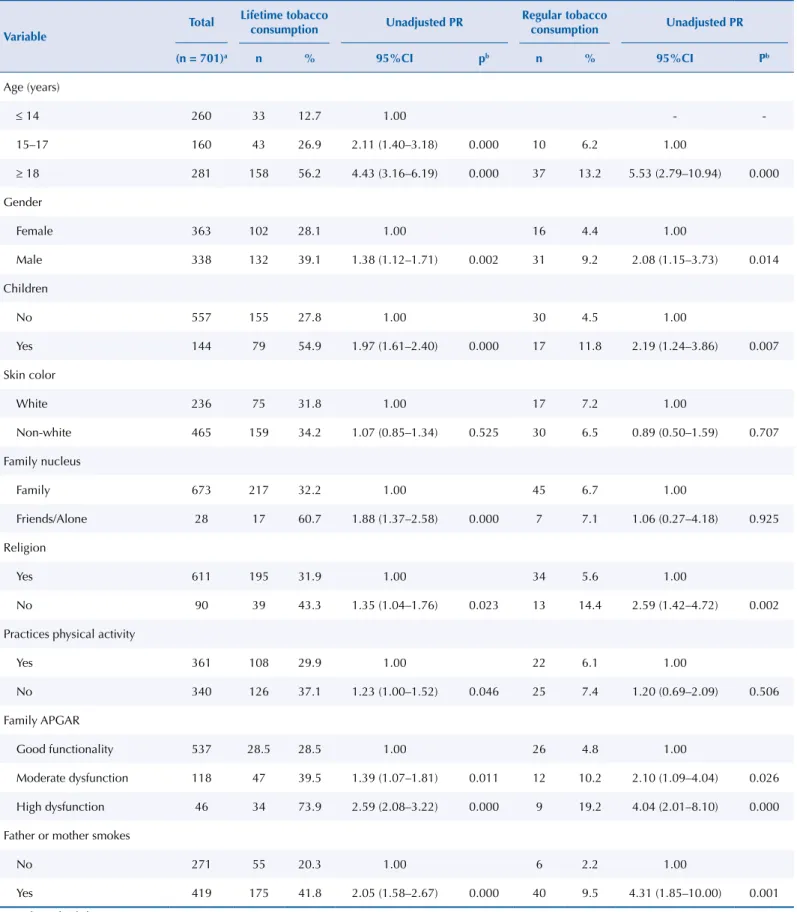
he prevalence of occasional and regular tobacco use were 33.4% (95%CI 29.8–36.9) and 6.7% (95%CI 5.0–8.8), respectively. Table 2 presents the univariate analysis of potential factors associated with these usage patterns in the students studied.
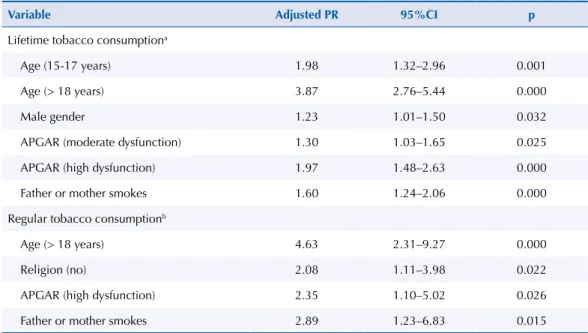
In the multivariate model, factors independently associated with occasional tobacco consumption were ages between 15 and 17 years old (adPR = 1.98) and above 18 years old (adPR = 3.87), male gender (adPR = 1.23), moderate family dysfunction (adPR = 1.30), high family dysfunction (adPR = 1.97) and parental smoking (adPR = 1.60). In regards to regular consumption of tobacco, age above 18 years (adPR = 4.63), lack of religion (adPR = 2.08),
Table 1. Sociodemographic profile of students from public schools in the countryside of Goiás, in the
Midwest region of Brazil.
Variable n* %
Gender
Female 363 51.8
Male 338 48.2
Age (years; average: 19.8; SD = 9.9)
≤ 14 260 37.1
15–17 160 22.8
≥ 18 281 40.1
Skin color (self-declared)
Yellow 36 5.1
White 236 33.7
Black 97 13.8
Dark-skinned 332 47.4
Religion
Catholic 299 42.7
Evangelic 281 40.1
Spiritist 27 3.9
Other 4 0.5
None 90 12.8
high family dysfunction (adPR = 2.35) and parental smoking (adPR = 3) remained associated factors in multivariate analysis (Table 3).
Of the subjects who reported regular tobacco use (n = 47), 74.5% (95%CI 60.5–85.0) presented nicotine dependence high/very hight in FT.
Table 2. Univariate analysis of factors associated with occasional and regular tobacco consumption in students from public schools in the
countryside of Goiás, in the Midwest region of Brazil.
Variable
Total Lifetime tobacco
consumption Unadjusted PR
Regular tobacco
consumption Unadjusted PR
(n = 701)a n % 95%CI pb n % 95%CI Pb
Age (years)
≤ 14 260 33 12.7 1.00 -
-15–17 160 43 26.9 2.11 (1.40–3.18) 0.000 10 6.2 1.00
≥ 18 281 158 56.2 4.43 (3.16–6.19) 0.000 37 13.2 5.53 (2.79–10.94) 0.000
Gender
Female 363 102 28.1 1.00 16 4.4 1.00
Male 338 132 39.1 1.38 (1.12–1.71) 0.002 31 9.2 2.08 (1.15–3.73) 0.014
Children
No 557 155 27.8 1.00 30 4.5 1.00
Yes 144 79 54.9 1.97 (1.61–2.40) 0.000 17 11.8 2.19 (1.24–3.86) 0.007
Skin color
White 236 75 31.8 1.00 17 7.2 1.00
Non-white 465 159 34.2 1.07 (0.85–1.34) 0.525 30 6.5 0.89 (0.50–1.59) 0.707
Family nucleus
Family 673 217 32.2 1.00 45 6.7 1.00
Friends/Alone 28 17 60.7 1.88 (1.37–2.58) 0.000 7 7.1 1.06 (0.27–4.18) 0.925
Religion
Yes 611 195 31.9 1.00 34 5.6 1.00
No 90 39 43.3 1.35 (1.04–1.76) 0.023 13 14.4 2.59 (1.42–4.72) 0.002
Practices physical activity
Yes 361 108 29.9 1.00 22 6.1 1.00
No 340 126 37.1 1.23 (1.00–1.52) 0.046 25 7.4 1.20 (0.69–2.09) 0.506
Family APGAR
Good functionality 537 28.5 28.5 1.00 26 4.8 1.00
Moderate dysfunction 118 47 39.5 1.39 (1.07–1.81) 0.011 12 10.2 2.10 (1.09–4.04) 0.026
High dysfunction 46 34 73.9 2.59 (2.08–3.22) 0.000 9 19.2 4.04 (2.01–8.10) 0.000
Father or mother smokes
No 271 55 20.3 1.00 6 2.2 1.00
Yes 419 175 41.8 2.05 (1.58–2.67) 0.000 40 9.5 4.31 (1.85–10.00) 0.001
DISCUSSION
he present study investigated the prevalence and determinants of tobacco use by students in a countryside city in Goiás. he results indicate a high prevalence of occasional and regular tobacco use, suggesting the students vulnerability for this behavior. Important variables were associated with tobacco consumption, such as increasing age, male gender, lack of religion and having a parent who smokes. As far as we know, this is the irst study to assess the inluence of family dysfunction and tobacco consumption in students using as an instrument recommended and validated by the WHO as an indicator. he indings indicate a strong association between family dysfunction and tobacco consumption in this population, which highlights the need for further research and knowledge production and evidence that subsidize the activities of health professionals as well as teachers, with a focus on family-centered interventions.
Results indicate high prevalence of occasional tobacco use (33.4%), similar to the rate found in students from developed countries, such as the USA (34.7%)1 and Canada (36.6%)10, and in South American developing countries, such as Uruguay (26.4%), Bolivia (40.5%), Colombia (31.7%), Paraguay (33.0%), and Argentina (41.0%)11. On the other hand, the prevalence of regular tobacco use (6.7%) was lower than the one found in students from other countries, such as the USA (12.7%)1, Canada (14.4%)10, Uruguay (9.2%), Colombia (12.5%), Bolivia (12.3%), Paraguay (14.7%), and Argentina (18.7%)11. In fact, the pattern of regular psychoactive substances use (particularly tobacco) varies substantially among countries in the American continent, relecting the diferent methodological approaches, the magnitude of investigated samples and mainly the discrepancy in sociodemographic characteristics. In particular, the increase in age and male gender are the variables most responsible for disparities in rates of smoking among students. In addition to these factors, it is important to consider that the present study is prone to response bias and may have underestimated the results.
In Brazil, the prevalence of occasional tobacco use found here was higher than the multicenter study conducted in students attending PeNSE (33.4% versus 22.7%), however, the rate of regular use was similar between both types of research (6.7% versus 7.1%)2. It should be noted that the diferences between the studies in regards to methodologies, the number of participants and other characteristics might have contributed to the disproportions between occasional smoking
Table 3. Factors associated with occasional and regular tobacco consumption in students from public
schools in the countryside of Goiás, in the Midwest region of Brazil.
Variable Adjusted PR 95%CI p
Lifetime tobacco consumptiona
Age (15-17 years) 1.98 1.32–2.96 0.001
Age (> 18 years) 3.87 2.76–5.44 0.000
Male gender 1.23 1.01–1.50 0.032
APGAR (moderate dysfunction) 1.30 1.03–1.65 0.025
APGAR (high dysfunction) 1.97 1.48–2.63 0.000
Father or mother smokes 1.60 1.24–2.06 0.000
Regular tobacco consumptionb
Age (> 18 years) 4.63 2.31–9.27 0.000
Religion (no) 2.08 1.11–3.98 0.022
APGAR (high dysfunction) 2.35 1.10–5.02 0.026
Father or mother smokes 2.89 1.23–6.83 0.015
a Model adjusted for age, gender, children, living arrangement, physical activity practice, family APGAR, and parental smoking.
rates. PeNSE encompassed 61.037 ninth-grade students enrolled in elementary education level public and private schools of all Brazilian State capitals, using a self-applied questionnaire2. his study, however, examined only students of public schools, junior high, high school and EJA in the State of Goiás’ countryside and using face-to-face interviews. herefore, more research is necessary to evaluate the diferences in behavior related to the initiation and consumption patterns of tobacco in students, especially considering regional diferences12.
his study found a higher prevalence of occasional tobacco use in male students, ratifying the greater vulnerability of men to tobacco use when compared to women. Smoking is considered more acceptable among men and can be a symbol of power, contributing to the disparity between the rates of tobacco use among genders13. Despite this inding, the consumption of tobacco by women has increased, indicating a higher risk of nicotine dependence and the development of tobacco-related diseases in females and epidemiological changes trend in the future3, driven by increased acceptance of this behavior in women because of the social rise of the female gender6.
In this study, we observed a positive gradient of occasional and regular tobacco consumption with aging, corroborating other investigations2,3. he systematic review pointed out that the use of tobacco is high in their early teens and still increases with advancing age3, which may relect the increase of external inluences (access to advertisements, parental and colleague inluence) throughout life.
In this research, students who were children of smokers had a higher prevalence of occasional and regular tobacco use. In fact, prolonged exposure to parental smoking is associated with early experimentation and habitual consumption of tobacco by teenagers and young adults14. Systematic review ratiies that the use of tobacco by family members, especially parents, has a strong inluence on the smoking behavior and an impact on increased nicotine dependence in adolescents15. Some mechanisms, such as positive attitudes about tobacco and availability of cigarettes in family environments, as well as imitation and learning this behavior from parents, are responsible for this intersection16,17.
Students with no religion presented a higher prevalence of regular tobacco consumption, as well as in other investigations. Religious belief is considered a strong protective factor against the use of psychoactive substances, because some religions impose more limits or even prohibit certain behaviors and conduct, including the use of psychoactive substances. In addition, religion can be a positive inluence on the family structure, as well as in other lifestyles, and may contribute to decreasing the rates of tobacco use18.
his study found an association between family dysfunction and occasional and regular tobacco use, using the family APGAR instrument as an indicator. A study conducted in public university students in Colombia showed that having dysfunctional families is directly associated with the use of tobacco19. In India, an investigation conducted with 526 between 15 and 19 years of age found a strong association between family conlicts and teenage smoking20. Similarly, a study conducted with 4,786 adolescents and their parents in a mental health center in the United States showed that family involvement with the children’s daily activities is a protective factor against external problems that may lead to the initiation of tobacco use and the use of other psychoactive substances, while non-involvement contributes to early drug experimentation7.
Teenagers from dysfunctional families can be encouraged to use tobacco within the family environment or in other social spaces, such as in schools. his inluence increases if these individuals are exposed to other risk factors, such as parental smoking, divorced parents or low-income families21. he family institution can play an important protective role, as well as be responsible for the exposure of adolescents to drugs, including alcohol and tobacco. Positive family inluence requires paying attention to the teenager’s routine with adequate parental control and authority and family attention to coping situations for smoking and to the search for abstinence and help in cases of relapse22.
with emphasis on the efective practice of primary health care in and out of schools that include tracking the nicotine dependence in this population6.
Some limitations of this study must be considered when interpreting the results. he transversal nature of the investigation prohibits the establishment of a cause-and-efect relationship between the use of tobacco and the variables investigated. he data were self-reported, and may under or overestimate the results. In an attempt to ease such restrictions, we assured the conidentiality of this study during data collection and everything took place in a private environment, so the answers could be as reliable as possible.
he indings of this study indicated the high prevalence of occasional and regular tobacco use by students and its association with sociodemographic variables and family dysfunction. We must consider such factors in the practice of health promotion and disease prevention in the context of tobacco control programs and school health, looking to extend control actions in school environments, as well as to implement public policies that contemplate the intersection between families, community, and the healthcare sector. It is necessary to rethink strategies for intersectional planning, especially in education and health, increasing the surveillance of tobacco use by students and families. Finally, the results of this study show the importance of adopting APGAR in an intensive approach to individuals at risk for tobacco use, and conirms the use of FT in smoker care and in the development of future epidemiological studies and clinical trials.
REFERENCES
1. Arrazola RA, Dube SR, King BA. Tobacco product use among middle and high school students - United States, 2011 and 2012. MMWRMorb Mortal Wkly Rep. 2013;62(45):893-7. Disponível em: https://www.cdc.gov/mmwr/preview/mmwrhtml/mm6245a2.htm
2. Barreto SM, Giatti L, Oliveira-Campos M, Andreazzi MA, Malta DC. Experimentation and use of cigarette and other tobacco products among adolescents in the
Brazilian state capitals (PeNSE 2012). Rev Bras Epidemiol. 2014;17 Suppl 1:62-76. https://doi.org/10.1590/1809-4503201400050006
3. Barbosa Filho VC, Campos W, Lopes AS. Prevalence of alcohol and tobacco use among Brazilian adolescents: a systematic review. Rev Saude Publica. 2012;46(5):901-17. https://doi.org/10.1590/S0034-89102012000500018
4. Menezes AMB, Dumith SC, Martínez-Mesa J, Silva AER, Cascaes AM, Domínguez GG, et al. Mental health problems and smoking among adolescents from Southern Brazil.
Rev Saude Publica. 2011;45(4):700-5. https://doi.org/:10.1590/S0034-89102011005000030
5. Panatto D, Amicizia D, Domnich A, Lai PL, Cristina ML, Signori A, et al. Tobacco smoking among students in an urban area in Northern Italy. J Prev Med Hyg. 2013;54(2):97-103.
6. Abreu MNS, Caiaffa WT. Influência do entorno familiar e do grupo social no tabagismo entre jovens brasileiros de 15 a 24 anos. Rev Panam Salud Publica. 2011;30(1):22-30. https://doi.org/10.1590/S1020-49892011000700004
7. Schlauch RC, Levitt A, Connell CM, Kaufman JS. The moderating effect of family involvement on substance use risk factors in adolescents with severe emotional and behavioral challenges.
Addict Behav. 2013;38(7):2333-42. https://doi.org/10.1016/j.addbeh.2013.02.010
8. Vieira PC, Aerts DRGC, Freddo SL, Bittencourt A, Monteiro L. Uso de álcool, tabaco e outras drogas por adolescentes escolares em município do Sul do Brasil. Cad Saude Publica. 2008;24(11):2487-98. https://doi.org/10.1590/S0102-311X2008001100004
9. Pérez-Ríos M, Santiago-Pérez MI, Alonso B, Malvar A, Hervada X, Leon J. Fagerstrom test for nicotine dependence vs heavy smoking index in a general population survey.
BMC Public Health. 2009;9:493. https://doi.org/10.1186/1471-2458-9-493
10. Minaker LM, Ahmed R, Hammond D, Manske S. Flavored tobacco use among Canadian students in grades 9 through 12: prevalence and patterns from the 2010-2011 youth smoking survey. Prev Chronic Dis. 2014;11:140094. https://doi.org/10.5888/pcd11.140094
12. Martínez-Mantilla JA, Amaya-Naranjo W, Campillo HA, Díaz-Martínez LA, Campo-Arias A. Daily cigarette smoking among Colombian high school students: gender related psychosocial factors. Rev Lat Am Enfermagem. 2008;16(5):903-7. https://doi.org/10.1590/S0104-11692008000500017
13. Brathwaite R, Addo J, Smeeth L, Lock K. A systematic review of tobacco smoking prevalence and description of tobacco control strategies in Sub-Saharan African Countries; 2007 to 2014.
PLoS One. 2015;10(7):e0132401. https://doi.org/10.1371/journal.pone.0132401.
14. Mays D, Gilman SE, Rende R, Luta G, Tercyak KP, Niaura RS. Parental smoking exposure and adolescent smoking trajectories. Pediatrics. 2014;133(6):983-91. https://doi.org/10.1542/peds.2013-3003
15. Leonardi-Bee J, Jere ML, Britton J. Exposure to parental and sibling smoking and the risk of smoking uptake in childhood and adolescence: a systematic review and meta-analysis. Thorax. 2011;66(10):847-55. https://doi.org/10.1136/thx.2010.153379
16. Selya AS, Dierker LC, Rose JS, Hedeker D, Mermelstein RJ. Risk factors for adolescent smoking: parental smoking and the mediating role of nicotine dependence. Drug Alcohol Depend. 2012;124(3):311-8. https://doi.org/10.1016/j.drugalcdep.2012.02.004
17. Gilman SE, Rende R, Boergers J, Abrams DB, Buka SL, Clark MA, et al. Parental smoking and adolescent smoking initiation: an intergenerational perspective on tobacco control. Pediatrics. 2009;123(2):e274-81. https://doi.org/10.1542/peds.2008-2251
18. Gomes FC, Andrade AG, Izbicki R, Moreira-Almeida A, Oliveira LG. Religion as a protective factor against drug use among Brazilian university students: a national survey. Rev Bras Psiquiatr. 2013;35(1):29-37. https://doi.org/10.1016/j.rbp.2012.05.010
19. Cogollo-Milanés Z, Arrieta-Vergara KM, Blanco-Bayuelo S, Zapata K, Rodriguez-Berrio Y. Factores psicosociales asociados al consumo de sustancias en estudiantes de una universidad pública. Rev Salud Publica (Bogota). 2011;13(3):470-9. https://doi.org/10.1590/S0124-00642011000300009
20. Bagchi NN, Ganguly S, Pal S, Chatterjee S. A study on smoking and associated psychosocial factors among adolescent students in Kolkata, India. Indian J Public Health. 2014;58(1):50-3. https://doi.org/10.4103/0019-557X.128168
21. Nogueira ALA, Sousa FGM, Silva IR, Silva ACO, Silva DCM, Santana E. Funcionalidade de famílias de adolescentes de escolas públicas: uma abordagem descritiva. Cogitare Enfermagem. 2012;17(2):224-31. https://doi.org/10.5380/ce.v17i2.25878
22. Paiva FS, Ronzani TM. Estilos parentais e consumo de drogas entre adolescentes: revisão sistemática. Psicol Estud. 2009;14(1):177-83. https://doi.org/10.1590/S1413-7372200900010002
Funding: Fundação de Amparo à Pesquisa (FAPEG – Public Call 006/2012). Promotion of scientiic research for coping with illicit drugs and alcohol in the State of Goiás (Digital control 201200661660420).
Authors’ Contribution: Study planning and design, data collection, analysis and interpretation, manuscript writing:
LSV, RL, ACS, IV. Analysis and interpretation of data, compilation and critical review of the manuscript: RAG, PAC.