Setting health priorities in a community:
a case example
Fábio Alexandre Melo do Rego SousaI, Maria José Garcia GoulartI, Antonieta Manuela dos Santos BragaII, Clara Maria Oliveira MedeirosI, Débora Cristina Martins RegoI, Flávio Garcia VieiraIII, Helder José Alves da Rocha PereiraIV, Helena Margarida Correia Vicente TavaresV, Marta Maria Puim LouraVI
I Centro de Saúde de Ponta Delgada. Unidade de Saúde de Ilha de São Miguel. Ponta Delgada, Açores, Portugal
II Centro de Saúde de Vila do Porto. Unidade de Saúde de Ilha de Santa Maria. Vila do Porto, Açores, Portugal III Unidade de Saúde Pública. Unidade de Saúde de Ilha de São Miguel. Ponta Delgada, Açores, Portugal IV Departamento de Enfermagem, Saúde da Família e Comunidade. Escola Superior de Saúde. Universidade dos
Açores. Ponta Delgada, Açores, Portugal
V Serviço de Hemodiálise. Hospital do Divino Espírito Santo, EPE. Ponta Delgada, Açores, Portugal
VI Serviço de Saúde Ocupacional. Hospital do Divino Espírito Santo, EPE. Ponta Delgada, Açores, Portugal
ABSTRACT
OBJECTIVE: To describe the methodology used in the process of setting health priorities for community intervention in a community of older adults.
METHODS: Based on the results of a health diagnosis related to active aging, a prioritization process was conceived to select the priority intervention problem. he process comprised four successive phases of problem analysis and classiication: (1) grouping by level of similarity, (2) classiication according to epidemiological criteria, (3) ordering by experts, and (4) application of the Hanlon method. hese stages combined, in an integrated manner, the views of health team professionals, community nursing and gerontology experts, and the actual community. RESULTS: he irst stage grouped the identiied problems by level of similarity, comprising a body of 19 issues for analysis. In the second stage these problems were classiied by the health team members by epidemiological criteria (size, vulnerability, and transcendence). he nine most relevant problems resulting from the second stage of the process were submitted to expert analysis and the ive most pertinent problems were selected. he last step identiied the priority issue for intervention in this speciic community with the participation of formal and informal community leaders: Low Social Interaction in Community Participation.
CONCLUSIONS: he prioritization process is a key step in health planning, enabling the identiication of priority problems to intervene in a given community at a given time. here are no default formulas for selecting priority issues. It is up to each community intervention team to deine its own process with diferent methods/techniques that allow the identiication of and intervention in needs classiied as priority by the community.
DESCRIPTORS: Health Priorities. Health Planning, methods. Planning Techniques. Social Planning. Consumer Participation. Health Inequalities. Hanlon Method.
Correspondence:
Fábio Alexandre Melo do Rego Sousa Rua da Grotinha, 1
9500-354 Ponta Delgada (Apartado 279)
E-mail: fabioalexandre.sousa@ gmail.com
Received: 8 Jun 2015
Approved: 30 Nov 2015
How to cite: Sousa FAMR, Goulart MJG, Braga AMS, Medeiros CMO, Rego DCM, Vieira FG et al. Setting health priorities in a community: a case example. Rev Saude Publica. 2017;51:11.
Copyright: This is an open-access article distributed under the terms of the Creative Commons Attribution License, which permits unrestricted use, distribution, and reproduction in any medium, provided that the original author and source are credited.
INTRODUCTION
Health intervention implies considering multicausal and multifactorial realities. Community health professionals face the following challenges: maintaining the quality of health interventions in highly complex contexts; using professional practices based on available scientiic evidence; and enabling access to efective and proximity health care to promote
community empowerment7.
Deining priorities in research and developing public health policies reinforce the importance of planning health strategies. Such planning is a process that establishes priorities with goals and continuity, considering the limits set by existing resources and political, social, cultural, institutional, inancial-economic, and international backgrounds12. hese backgrounds are
interrelated and mutually inluencing, reacting to potential changes. hus, health planning is a valuable tool for structured intervention in communities and the necessary deinition of priorities8. he issues requiring priority intervention in a speciic period of time should be contextually deined, since there are seldom enough resources for interventions addressed to all the needs
of a given community5,9. hus, methodologies for setting health priorities that scientiically
support the decision-making process and guide community intervention are essential.
Diferent methods/techniques can be used in this process, individually or combined8,10. It is up
to community intervention teams to deine their own staged processes, incorporating criteria
and procedures that allow them to identify and intervene in the community’s priority needs.
he objective of this study was to describe the process of setting health priorities for
community intervention in a community of older adults.
METHODS
he process of setting health priorities involved the participation of several actors (health team, experts and community) focused on the promotion of active aging. he problems presented serve to illustrate and describe the way in which an increasingly reined and
integrated analysis strategy was conceived to identify the most relevant health problems in a given community in the active perspective of the actors involved. To better understand
the problems, it is important to clarify the framework used to interpret active aging. Active aging can be viewed individually and in population groups. Its implementation allows people
to realize their potential for physical, social, mental, and welfare development, to socialize
according to their needs, desires and capabilities, and to receive adequate protection, security
and care when they need help11,14,16.
he initial data used in the analysis process stem from a health diagnosis previously performed by the team with 100 independent older adults, aged 65-84, living in the district of Fajã de Baixo, on the island of São Miguel, in the Azores archipelago, Portugal. he diagnosis instrument was a questionnaire based on determinants considered relevant to active aging described in the literature and organized into diferent domains: material (physical and economic environment), biological (health and biological characteristics), behavioral (lifestyle and adherence to health care), and psychosocial (emotional state, social support network, education and spirituality) determinants1,9,13,16,a.
he identiication of the health needs of the community of older adults, resulting from the evaluation of those health determinants, allowed the identiication of a diverse set of problems. A classiication was developed to enable the selection of the priority problem(s)
for intervention.
he prioritization phase was structured into four stages, using diversiied procedures and criteria:
1. Grouping of health needs according to their level of similarity;
2. Classification of the grouped needs by the community intervention team according
to classic epidemiological criteria – magnitude, vulnerability and transcendence4,8.
Different strategies were used to reduce subjectivity in applying the criteria: a) review of the initial literature/collection of evidence about the grouped problems; b) division
of the team into subgroups for independent classification of the list of problems,
and c) group discussion and agreement of the classifications assigned to each
problem – obtaining consensus.
3. Ordering of the highest scoring problems in the previous stage by experts in gerontology and community nursing and public health. he average value was calculated from the sum of the values corresponding to the position on the priority ranking, determined by each expert, divided by the number of experts;
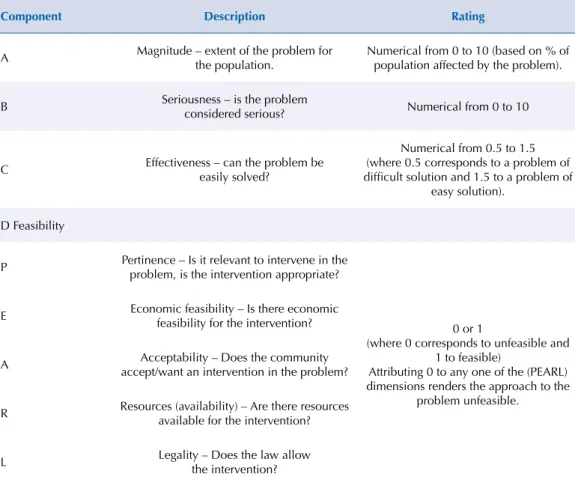
4. Application of the Hanlon method2,8,b to prioritize the highest ranked problems according to the experts. his method enables the assessment of health needs by applying criteria, aggregated into components, using the formula:
priority order = (A+B) C × D,
where A represents the magnitude of the problem; B the seriousness of the problem; C the
efectiveness of the solution; and D the feasibility of intervention classiied by the acronym
PEARL (pertinence, economic feasibility, acceptability, resources, and legality) (Table 1).
The PEARL component involves discussing community needs with a focus group
comprised of community leaders and formal and informal representatives. The focus
group included: chairman, priest, two parish social workers, head nurse of the local
health center, a local pharmacy official, and four older adults residing in the parish.
b Tavares A. Métodos e técnicas de planeamento em saúde. 2a ed. Lisboa: Ministério da Saúde; 1992. (Cadernos de formação, vol 2).
Table 1. Hanlon Method Components.
Component Description Rating
A Magnitude – extent of the problem for
the population.
Numerical from 0 to 10 (based on % of population affected by the problem).
B Seriousness – is the problem
considered serious? Numerical from 0 to 10
C Effectiveness – can the problem be
easily solved?
Numerical from 0.5 to 1.5 (where 0.5 corresponds to a problem of difficult solution and 1.5 to a problem of
easy solution).
D Feasibility
P Pertinence – Is it relevant to intervene in the problem, is the intervention appropriate?
0 or 1
(where 0 corresponds to unfeasible and 1 to feasible)
Attributing 0 to any one of the (PEARL) dimensions renders the approach to the
problem unfeasible.
E Economic feasibility – Is there economic
feasibility for the intervention?
A Acceptability – Does the community
accept/want an intervention in the problem?
R Resources (availability) – Are there resources available for the intervention?
L Legality – Does the law allow
the intervention?
Table 2. Problem grouping by level of similarity. Fajã de Baixo, Portugal, 2012.
Problems/Needs detected
1 – Housing conditions conducive to accidents:
• 33.0% of older adults have a bathroom far from the bedroom; 63.0% do not have safety devices in the bathroom; 67.0% use stairs to access their house; 57.0% use stairs daily inside the house; in 20.0% of the cases the stairs had no handrail. 42.0% have slippery floors at home; 32.0% have no carpet anti-slip grip; 84.0% have heaters inside the house.
2 – Low social interaction:
• 57.0% of older adults prefer staying home to going out and socializing; individual recreational activities are predominant, and for 75.0% the most frequent is watching TV/listening to music.
3 – Feeling of loneliness: • 23.0% Report feeling alone.
4 – Decrease in the level of self-esteem and perception of happiness: • 32.0% report not feeling happy most of the time.
• There is a trend for self-esteem to diminish with age.
5 – Lack of motivation to engage in intervention/social support activities: • 84.0% do not volunteer work and of those, 77.0% do not wish to. • 26.1% do not know the purposes/projects of the parish’s institutions.
6 – Lack of motivation to engage in activities for personal development and future projects: • 84.0% do not volunteer and of those, 77.0% do not wish to.
• 88.0% do not study nor want to. • 34.0% report having no life project.
7 – Feeling insecure:
• 22.0% of older adults do not feel safe in their area of residence.
8 – Inadequate attitude towards being a potential victim of violence. • 12.1% would not tell anyone if they were a victim of violence.
9 – Lack of regular physical activity: • 57.6% do not do any physical activity.
10 – Inadequate eating habits:
• 53.0% of older adults have an unbalanced diet at dinner. • 46.0% of older adults have only 3 meals a day.
• 75.0% have a low water intake.
11 – Cohabitation with smokers:
• 23.6% of older adults live with people who smoke.
12 – Lack of family doctor:
• 45.0% of older adults do not have a family doctor.
13 – Non-adherence to medicine regimen:
• 50.6% of older adults forget to take routine medication.
14 – Non-adherence to officially recommended influenza vaccination schedule: • 68.4% did not take the flu vaccine for the period.
15 – Lack of oral health care:
• 96.0% of older adults have lost teeth. • 67.3% do not go to the dentist.
16 – Decreased self-perceived visual and auditory acuity: • 45.0% of older adults have vision problems. • 29.0% have hearing problems.
17 – Self-perceived overweight condition: • 46.0% reported being overweight.
18 – Existence of diagnosed chronic diseases:
• 92.0% of older adults present chronic pathology (48.0% rheumatic disease, 47.0% cerebrovascular disease, 33.0% diabetes).
19 – Occurrence of falls and fear of falling:
Table 3. Team ranking of grouped needs/problems. Fajã de Baixo, Portugal, 2012.
Highest scoring problems Lowest scoring problems
Problem Score Problem Score
Lack of regular physical activity. 11 Loneliness. 8
Existence of diagnosed chronic diseases. 11 Decreased self-esteem and
self-perceived happiness. 8
Inadequate eating habits. 10 Decreased self-perceived visual and
auditory acuity. 8
Low social interaction. 9 Housing conditions conducive
to accidents. 7
Non-adherence to medicine regimen. 9 Poor awareness of parish support
institutions for older adults. 7
Non-adherence to officially recommended influenza vaccination schedule. 9
Lack of motivation to engage in activities for personal development and
future projects.
7
Lack of oral health care. 9 Lack of family doctor. 7
Self-perceived overweight condition. 9 Feeling insecure. 6
Occurrence of falls and fear of falling. 9 Inadequate attitude towards being a
potential victim of violence. 6
Cohabitation with smokers. 5
Table 4. Ranking of nine problems by experts. Fajã de Baixo, Portugal, 2012.
Problem Expert 1 Expert 2 Expert 3 Average Ranking
Non-adherence to medicine regimen 1 1 2 1.3 1
Low social interaction 2 6 1 3.0 2
Lack of regular physical activity 3 3 4 3.3 3
Occurrence of falls and fear of falling 5 2 3 3.3 4
Inadequate eating habits 4 5 5 4.7 5
Self-perceived overweight condition 6 4 6 5.3 6
Existence of diagnosed chronic diseases 7 8 7 7.3 7
Lack of oral health care 8 7 9 8.0 8
Non-adherence to influenza vaccination 9 9 8 8.7 9
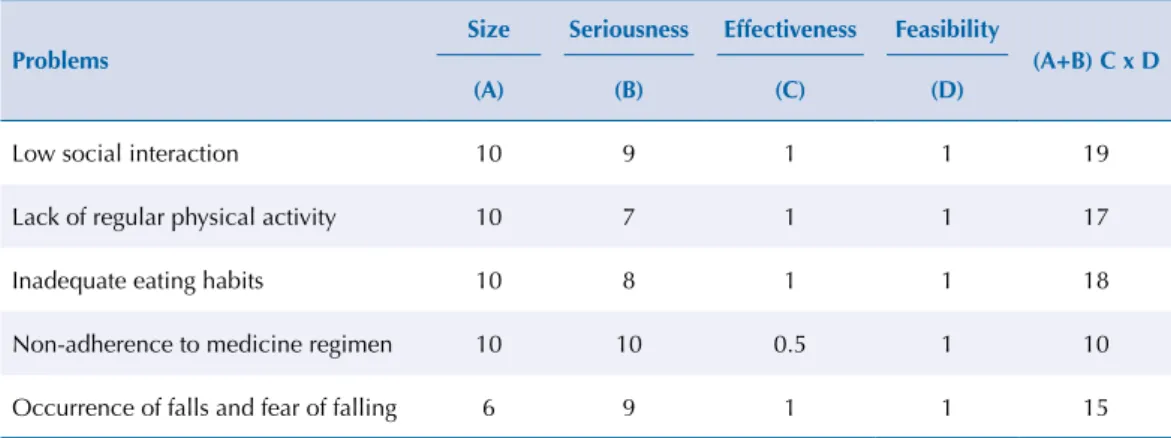
Table 5. Final ranking of problems following use of the Hanlon Method. Fajã de Baixo, Portugal, 2012.
Problems
Size Seriousness Effectiveness Feasibility
(A+B) C x D (A) (B) (C) (D)
Low social interaction 10 9 1 1 19
Lack of regular physical activity 10 7 1 1 17
Inadequate eating habits 10 8 1 1 18
Non-adherence to medicine regimen 10 10 0.5 1 10
The participants were selected for performing functions with decision-making power and mobilizing capacity in the parish, as well as their thorough knowledge of the community and its dynamics. Each of the five problems proposed for debate was analyzed considering the following parameters: (i) pertinence of the problem; (ii) level of community acceptance for intervention in the problem; (iii) economic feasibility, and (iv) availability of community resources.
RESULTS
In step 1, the indings obtained from the community health diagnosis were analyzed according to the diferent health determinants. his allowed the identiication of 37 real and/or potential problems that could negatively inluence the aging process. Grouping according to level of similarity led to reclassiication into 19 problems (Table 2).
The screening of problems in step 2 was carried out by applying three classic
epidemiological criteria – magnitude, transcendence and vulnerability4,8 – to each of
the 19 problems detected by the intervention team members. A symbols scale was used to classify the impact of each problem. The symbol (+) corresponded to low impact (25.0%); the symbol (++) to medium impact (26.0% to 50.0%); the symbol (+++) to high impact (51.0% to 75.0%); and the symbol (++++) to the greatest impact (> 75.0%). The
total score was obtained from the sum of the symbols assigned to each one of the three
criteria (Table 3).
Stage 3 consisted in the ranking of the nine highest-scoring problems in the previous stage by experts in the area of gerontology and community nursing and public health, thus adding to the analysis their specialized knowledge about the topics being debated. hat resulted in a reordering of the list of priority problems (Table 4). In step 4, the ive problems most highly rated by the experts were analyzed in a systematic and organized way, according to the four components deined in the Hanlon method (Table 5). he application of those components – magnitude, seriousness, efectiveness, and feasibility (which includes the PEARL component, discussed with the community) resulted in the selection of the priority problem for intervention in the given community of older adults: low social interaction in
community participation.
DISCUSSION
his article described systematically the steps, strategies and procedures that enabled the selection of a priority problem from an initial set of 37 needs identiied in a community
health diagnosis.
Prioritizing means establishing a hierarchy of identiied problems in order to determine
priorities for intervention, i.e., classifying health problems according to their importance,
efectiveness, and the feasibility of proposed interventions10.
Pallàs et al. (2003) point out that any prioritizing process involves subjectivity which cannot be completely eliminated due to several factors that inluence the health dynamics of a community. Acknowledging the interference of subjectivity in these processes highlights
the need to clarify strategies and steps in an orderly and systematic way to achieve a more
transparent, well-grounded and auditable process5. he uniqueness of each prioritization process results in the incorporation of diferent “views” by various professionals. It also
receives important contributions from sources outside community intervention teams,
PERSPECTIVE OF THE INTERVENTION TEAM
his focused on the work of the members of the community intervention team. It comprised organizing the indings from the community health diagnosis, namely grouping the health problems/needs according to their level of similarity and classifying them by applying
epidemiological criteria.
Analyzing relexively the procedures used in the prioritization process, a irst evaluation by the intervention team was considered relevant. he deinition of a preliminary list of priority
problems, supported by continuous literature review and processes of debate, consensus
and minimization of subjectivity, ensured a better organization of the information, and thus a better-grounded and more eicient prioritization process. his strategy guaranteed that the issues presented to the experts and community for debate were centered on a
restricted set of needs, avoiding dispersion and contributing to the focused participation
of those stakeholders.
PERSPECTIVE OF THE EXPERTS
In the next phase, the incorporation/intervention of external perspectives in analyzing the problems of the prioritization process was deemed important. Pallàs et al. (2003) reairm the importance, in setting priorities for problem analysis and decision-making, of incorporating
contributions other than those of the members of the actual intervention teams10.
Of the 19 highest-scoring problems in the previous phase, nine were selected in the independent ranking of the experts. heir intervention made an important contribution to evaluating the problems by enabling a broad “external look” with diferent perspectives of
the themes under debate.
he experts’ work revealed dissonance with the order previously established by the team, since only the lack of regular physical activity was classiied by both experts and team among the three highest-scoring problems. On the other hand, in a broader analysis, the experts’ intervention allowed a clearer diferentiation of the ordering of problems. he six problems classiied by the team with the same score (ranked in fourth position – Table 3) were diferentiated by the experts, who assigned them diferent positions (Table 4).
he joint process of problem selection and analysis by the team and experts enabled the identiication and ordering of the ive most pertinent interventions in terms of potential
health gains.
he diferent analyses of the various professionals enriched the process of prioritizing and debating the problems encountered. hey stressed the need for the community to be involved in the decision-making process regarding issues that afect them directly6,15.
PERSPECTIVE OF THE COMMUNITY
One of the essential assumptions for the success of health interventions in communities is the importance of their playing an active role in identifying and minimizing existing or potential health problems, in order to promote higher levels of health and well-being. he concept of empowerment acquires special relevance. It is understood as a social process by which individuals, organizations and communities develop expertise in solving challenges in a context of action/change in the social and political environment, aimed at acquiring better levels of quality of life and equity6,15.
he Hanlon method was chosen to ensure the community’s involvement in the prioritization process. One of the requirements for its use is the analysis of problems and feasibility of
his method, which combines criteria of problem importance (magnitude and seriousness) and criteria of resolution capacity (solution efectiveness and intervention feasibility),
complemented the analysis process, incorporating the community’s perspective on the propriety of action related to the various problems, and assessed their level of acceptability.
he problems were contextualized in the environment in which they happen by those who experience their inluence, assessing the existence of potential resources for community
intervention. Using the focus group to incorporate the community’s input in setting priorities
was one of the key steps in the process.
he focus group is an established social research technique organized as a structured discussion, involving the progressive sharing and clariication of participants’ points of view and ideas. It is particularly interesting for analyzing topics that may give rise to diferent opinions or bring up complex issues that need to be explored with greater precision3.
he use of this technique allowed the sharing of several perspectives and experiences on the subjects under debate, enabling a clear assessment of the position of the various actors
in relation to each problem.
he debate translated a process of mediation between the team and the community, stimulating relection on the issues being discussed. his contributed to deciding on the
priority problem and developing critical reasoning and capacity for future intervention.
he prioritization process, with the ensuing selection of the priority problem, led to the implementation of a community intervention project, developed with the community of older adults. he objective was to increase their levels of community participation and
strengthen social interaction.
Health planning is a demanding and meticulous development process. Its implementation is essential for community work. Health diagnosis and the various existing prioritization methods are instruments available to health professionals who work at the community level
and intend to engage in pertinent, multicausal issues.
The priority setting methodology implies the development of a framework for the
construction of a process based on rigorous criteria, adaptable by each team and consensual
for the diferent elements, in which community participation is mandatory. In the example herein presented, the use of diferent stages and, in particular, the Hanlon method, was an added value for the diversity of components and the expectation of community participation in decision making.
Starting out from a list of health problems identiied by the performance of a health diagnosis in a community of older adults, and the deinition of a multi-stage priority setting process that integrated diferent perspectives, it was possible to progressively select the identiied problems. his culminated in the selection of the problem acknowledged as top priority.
his process, by including the diferent actors involved, is time consuming and implies the development of skills in managing and integrating diferent perspectives in multiple
processes of discussion and negotiation. However, the integrated inclusion of the perspective
of diferent actors (health professionals and community) allows a progressive analysis of the problems identiied in a community. hus, it leads to efective decision-making processes and adds community knowledge to the inlexibility of numbers. his balance may be the key to success in community health interventions, since it ensures that the problems identiied are efectively valued by the communities.
he publication of more concrete experiences, describing how community health teams implement inclusive strategies to allocate scarce resources according to existing data, will
REFERENCES
1. Buss PM, Pellegrini Filho A. A saúde e seus determinantes sociais. Physis. 2007;17(1):77-93. https://doi.org/10.1590/S0103-73312007000100006
2. Chao R, Alvarez M. Diagnóstico comunitário de la situation de salud. Rev Cubana Med Gen
Integr. 1996;12(3):289-94.
3. Geoffrion P. O grupo de discussão. In: Gauthier B, editor. Investigação social: da problemática à colheita de dados. Loures: Lusociência; 2003. p.319-44.
4. Gonçalves A. Problema de saúde pública: caraterizando e avaliando aplicações. Rev Bras Epidemiol. 2006;9(2):251-6. https://doi.org/10.1590/S1415-790X2006000200013
5. Keller L, Strohshein S, Briske L. Prática de enfermagem de saúde pública centrada na população: a roda de intervenção. Stanhope M, Lancaster J. 7a ed. Enfermagem de saúde pública. Loures: Lusodidacta; 2011. p. 196-23.
6. Laverack G. Promoção de saúde: poder e empoderamento. Loures: Lusodidacta; 2008.
7. Lock S. Prática baseada na evidência. In: Stanhope M, Lancaster J. 7a ed. Enfermagem de saúde pública. Loures: Lusodidacta; 2011. p. 290-301.
8. Martínez D, Palacio J, Oliver A, Fuente N, Mariscal C, Corral M et al. Conceptos generales en atención primária para enfermaria. Sevilha: Edufarma; 2007.
9. Pallàs J, Baiges J. Análisis de la situación de salud. In: Zurro A, Pérez J. 5a ed. Atención primaria: conceptos, organización y práctica clínica. Madrid: Elsevier; 2003. p. 327-44.
10. Pallàs J, Bertrán E, Baiges J. Bases para la programación en atencíon primaria. In: Zurro A, Pérez J. 5a ed. Atención primaria: conceptos, organización y práctica clínica. Madrid: Elsevier; 2003. p. 408-19.
11. Paúl C. Envelhecimento activo e redes de suporte social. Rev Fac Letras Univ Porto: Sociologia. 2005;15(1):275-88.
12. Preteleiro M, Marques R, Galhardo T. Uma análise crítica das orientações estratégicas: o plano nacional de saúde português. Lisboa: Observatório Português dos Sistemas de Saúde; 2004.
13. Rodrigues R, Crespo S, Loureiro L, Silva S, Azeredo Z, Silva C. Os muito idosos: avaliação funcional multidimensional. Rev Enferm Refer.2015;4(5):65-75. https://doi.org/10.12707/RIV14040
14. Veras R. Envelhecimento populacional contemporâneo: demandas, desafios e inovações. Rev Saude Publica. 2009;43(3):548-54. https://doi.org/10.1590/S0034-89102009005000025
15. Wiggins N. Popular education for health promotion and community empowerment: a review of the literature. Health Promot Int. 2011;27(3):356-71. https://doi.org/10.1093/heapro/dar046
16. World Health Organization. Active ageing: a policy framework. Geneva: World Health Organization; 2002.
Authors’ Contribution: Study design and plan: FS, MG, AB, CM, DR, FV, HP,HT, ML. Data collection: FS, MG,
AB, CM, DR, FV, HP,HT, ML. Data analysis and interpretation: FS, MG, AB, CM, DR, FV, HP,HT, ML. Manuscript preparation and drafting: FS, MG, AB, CM, DR, HP. Critical review of manuscript: FS, MG, DR, HP. Final approval: FS, MG, DR, HP.