Elyne Montenegro EngstromI,II Inês Rugani Ribeiro de CastroII,III Margareth PortelaI
Letícia Oliveira CardosoII Carlos Augusto MonteiroIV
I Escola Nacional de Saúde Pública Sérgio
Arouca. Fundação Oswaldo Cruz. Rio de Janeiro, RJ, Brasil
II Instituto de Nutrição Annes Dias. Secretaria
Municipal de Saúde do Rio de Janeiro. Rio de Janeiro, RJ, Brasil
III Instituto de Nutrição. Universidade Estadual
do Rio de Janeiro. Rio de Janeiro, RJ, Brasil
IV Faculdade de Saúde Pública. Universidade
de São Paulo. São Paulo, SP, Brasil Correspondence:
Elyne Montenegro Engstrom Instituto de Nutrição Annes Dias Av. Pasteur 44 – Botafogo 22290-240 Rio de Janeiro, RJ, Brasil E-mail: [email protected] ocruz.br Received: 9/27/2007
Reviewed: 2/29/2008 Accepted: 3/26/2008
Effectiveness of daily and weekly
iron supplementation in the
prevention of anemia in infants
ABSTRACT
OBJECTIVE: To evaluate the effectiveness of universal prophylactic targeting with iron sulfate on daily or weekly basis in the prevention of anemia in infants.
METHODS: Randomized clinical fi eld trial with children between ages six and 12 months seen at primary health care units in the municipality of Rio de Janeiro, Brazil, between 2004 and 2005. Three concurrent cohorts were compared: daily group (n=150; 12.5mg Fe/day); weekly group (n=147; 25mg Fe/week) and control group. The intervention consisted of universal supplementation with iron sulfate for 24 weeks, combined with educational adherence-promoting measures. Outcome: mean serum hemoglobin concentration, distribution and prevalence of anemia (Hb<110.0 g/l) at age 12 months. Effectiveness was evaluated considering both intent to treat and adherence to protocol, using multiple regression analysis (linear and Poisson).
RESULTS: Groups were homogeneous in terms of descriptive variables. The intervention was implemented successfully, with high adhesion to protocol in both groups, and no statistical difference between them. After adjustment, only the daily regimen showed a protective effect. Adherence analysis demonstrated an evident dose-response effect on mean Hb and prevalence of anemia only for the daily regimen. No protective effect was detected for the weekly regimen.
CONCLUSIONS: Universal supplementation with iron sulfate from six to 12 months of age was effective in increasing serum Hb and decreasing risk of anemia only when administered on a daily basis.
DESCRIPTORS: Infant. Anemia, Iron-Defi ciency, prevention & control. Ferrous Sulfate, analysis. Dietary Supplements. Effectiveness.
INTRODUCTION
Iron-defi ciency anemia (IDA) is a relevant nutritional defi ciency due to its ef-fects on child development10 and to the magnitude of current prevalence levels.23 Such relevance has led to the establishment of public policies for its prevention and control in Brazil.a,b It is estimated that 12% of children under fi ve years
a Ministério da Saúde. Agência Nacional de Vigilância Sanitária. Resolução RDC nº 344, de 13
de dezembro de 2002. Aprova o Regulamento Técnico para a Fortifi cação das Farinhas de Trigo e das Farinhas de Milho com Ferro e Ácido Fólico, constante do anexo desta Resolução. Diário Ofi cial União. 18 dez 2002. [cited 2008 Jul 31] Available from: http://e-legis.bvs.br/leisref/public/ showAct.php?id=1679
b Ministério da Saúde. Secretaria de Atenção à Saúde. Departamento de Atenção Básica. Manual
of age from developed countries are anemic, although countries such as the United States have succeeded in reducing the prevalence of this condition to under 1%.25 By contrast, the proportion of anemic children in developing countries is as high as 51%.13
In Brazil, it is estimated that 50-70% of children aged six to 24 months are anemic.b Monteiro et al12 showed that prevalence of anemia among underfi ves in the city of São Paulo doubled between 1973/74 and 1995/96, and Oliveira et al have shown a similar trend for the state of Paraíba, in Northeastern Brazil, between 1982 and 1992. The greater vulnerability of children under two years of age is due to the large demand for iron during growth and to insuffi cient intake of this nutrient, both terms of quantity and bioavailability, in children’s usual diet at this age.14,20
In response to this, international organizations have recommended three strategies for IDA prevention: nutritional education, food fortification, and iron supplementation. The latter of these strategies is recom-mended for more susceptible groups, such as infants, in places where prevalence of IDA is high (>40%).7,20,23 In consonance with these strategies, the fortifi cation of fl our and cornmeal with iron and folic acid became mandatory in Brazil in 2004, and preventive supple-mentation with ferrous sulfate (FS) for susceptible groups was introduced in this country in 2005.a,b
Despite being in use in several countries, it is an inter-national consensus that such programs are ineffective in preventing and controlling IDA.1 Recent programs centered on iron supplementation have begun to con-sider not only effi cacy, but also effectiveness – the ability to produce the desired effects under the expected usage conditions or when incorporated into operational programs.19 According to this new conception, the focus of action, formerly placed on treatment, is moved to the prevention of IDA, making adherence a key point in the success of these interventions.1,7
Daily supplementation with iron salts, the classic form of administration in prevention programs, has the dis-advantage having poor adherence, and therefore low effectiveness.1 As an alternative, weekly supplementa-tion was suggested in the mid-1990s as a regimen of similar effi cacy, and potentially greater effectiveness.22 In a meta-analysis study carried out in 1999, Beaton & McCabec concluded that both daily and intermit-tent administration were effi cacious under favorable conditions, especially when given under supervision;
however, daily administration was more effi cacious (by about 5-10%) than the weekly regimen in most scenarios considered. These authors highlight, however, that since only one of the studies reviewed focused on infants, further evidence is still required in order to eval-uate the effi cacy of daily vs. weekly supplementation in this age group. The results of four subsequent stud-ies adopting the IRIS (The International Research on Infant Supplementation Initiative) protocol,6 in which daily and weekly supplementation were compared among infants, indicate that only daily supplementa-tion is effi cacious in controlling anemia.8,9,16,21 Prior to the present clinical trial, there was no record of a study comparing the effectiveness of daily and weekly iron supplementation in preventing anemia among infants.
The present study was aimed at evaluating the absolute and relative effectiveness of prophylactic supplemen-tation with FS, given on a daily or weekly basis, in preventing infant anemia.
METHODS
We carried out a controlled, non-blinded, clinical trial under fi eld conditions, randomized by groups consisting of primary healthcare units (PHU).4,5 The study popula-tion corresponded to the entire clientele under 1 year of age of PHUs in the city of Rio de Janeiro, Brazil.
We established three concurrent cohorts of children aged six months at the start of follow-up. The fi rst two cohorts were defi ned based on the prophylactic iron supplementation regimen adopted at the PHU (either daily – DG; or weekly – WG). The third cohort (control group – CG) comprised children from PHUs that did not alter their usual infant care procedures. Children in this group were not exposed to iron salts between ages fi ve and 12 months. The effectiveness of prophy-lactic supplementation was evaluated by comparing DG and WG cohorts with CG. Relative effectiveness was calculated by comparing DG and WG with each other. Data collection was carried out between March 2004 and June 2005.
The major component of the intervention was to provide mothers with vials of FS syrup during routine follow-up visits carried out when babies reached the age of six months. This was accompanied by the instruction to administer the product to the child in a preventive manner, either every day (DG) or one day per week (WG), for 24 weeks, until he or she completed 12 months of age.
a Ministério da Saúde. Agência Nacional de Vigilância Sanitária. Resolução RDC nº 344, de 13 de dezembro de 2002. Aprova o Regulamento
Técnico para a Fortifi cação das Farinhas de Trigo e das Farinhas de Milho com Ferro e Ácido Fólico, constante do anexo desta Resolução. Diário Ofi cial União. 18 dez 2002. [cited 2008 Jul 31] Available from: http://e-legis.bvs.br/leisref/public/showAct.php?id=1679
b Ministério da Saúde. Secretaria de Atenção à Saúde. Departamento de Atenção Básica. Manual operacional do Programa Nacional de
Suplementação de Ferro. Brasília; 2005 (Série A. Normas e Manuais Técnicos). [cited 2008 Jul 31] Available from: http://dtr2004.saude.gov. br/nutricao/documentos/manual_ferro.pdf
c Beaton GH, McCabe G, 1999. Effi cacy of intermittent iron supplementation in the control of iron defi ciency anaemia in developing
The ferrous sulfate syrup used (SSFARM) contained 5 mg/ml ferrous sulfate. This syrup was produced espe-cially for the present study by Farmanguinhos/Fiocruz, and was approved in sensorial evaluation tests with one-year-old children, which showed greater acceptance of this product than of the FS routinely used in public healthcare services. The dose to be administered to the child was based on international recommendation,8 and corresponded to 12.5 mg iron (2.5ml) per day (2.5 ml) for DG and 25 mg iron (5.0 ml) per week for WG. The amount necessary for the 24 weeks of treatment (fi ve and two vials for DG and WG, respectively) was given to the mother in a single installment at the beginning of the intervention.
The second part of the intervention consisted of an educational component, administered during the re-cruitment visit, and which included two items: a booklet for mothers addressing the causes, consequences, and means of prevention of anemia, as well as orientation on the use of SSFARM, and a calendar for recording all doses administered to the child.
Health care professionals were trained to deliver the in-tervention and were given scientifi c material providing information on the clinical and epidemiological aspects of anemia and the nature of the proposed intervention. Child follow-up during the intervention was done ac-cording to the routine procedures of each PHU.
The size of each group was calculated assuming preva-lence of anemia among 12-month-olds of 60%, differ-ence in prevaldiffer-ence between intervention and control groups of 30%, 80% statistical power, 5% signifi cance level, and an allocation ratio of 1:1. These parameters led to a minimal sample size of 120 children per group, or 145 per group assuming 20% losses to follow-up.
At the time of the study, the city of Rio de Janeiro had 93 PHU. For operational reasons, the sampling universe consisted only of PHU with a monthly clientele of at least 60 children under 1 year of age and which used a computerized management information system. We identifi ed 28 PHU that fulfi lled these conditions. Of these, we randomly selected three units each for DG and WG, and nine for CG.
The inclusion criteria for the intervention groups (DG and WG) were as follows: age six months (±29 days) at the time of the recruitment visit; absence of iron salt supplementation in the month preceding re-cruitment, and negative for sickle-cell anemia during routine neonatal screening. Children were selected by a health worker from the PHU itself during a routine visit according to these eligibility criteria. During this visit, a follow-up evaluation was scheduled for a date immediately after the end of the intervention period. To reduce potential losses at this point, we resorted to contacting mothers by aerogram, telephone, and home
visits. One hundred and eighty-eight children were selected for DG and 188 for WG; of these, we were able to evaluate 150 and 147, respectively (roughly 80% of selected children). Losses were similar in both groups, and were due mostly to problems in locat-ing subjects’ homes, especially in slum areas, and to changes of address.
Eligibility criteria for CG were the same as those of the two intervention groups, in addition to absence of iron salt supplementation between fi ve and 12 months of age. In order to prevent any contact between the research team and these children before 12 months of age, recruitment of subjects into this group was done retrospectively, based on computerized databases of appointments made at the nine PHUs allocated to this group. From these databases, we were able to identify 495 children aged 6.0 months (± 29 days) seen dur-ing the same period as the children recruited to the intervention groups. We sent aerograms to all mothers of these children, inviting them to bring their children to the health unit for an evaluation. Of the total aero-grams sent out, 58 returned due to failure to locate the delivery address. Of the remainder, (n=437), 312 (71.4%) corresponded to children who showed up for the interview, of which 94 fulfi lled the eligibility criteria for inclusion in CG.
Data collection was identical for all three groups. Prior to the fi nal evaluation, identifi cation data and weight at six months were extracted from the child’s health records. During this evaluation, trained researchers administered a semi-structured questionnaire aimed at characterizing the children and their families and evalu-ating the intervention, measured the child’s weight and length, and collected a blood sample for hemoglobin (Hb) quantifi cation.
Exposure to the intervention was evaluated based on four parameters: motherhaving received the predicted number of vials of SFFARM, mother having received the educational materials, mother’s accurate reproduc-tion of the SFFARM prescripreproduc-tion (periodicity, dose, and duration) and total amount of iron (mg) effectively administered to the child during the intervention pe-riod. The latter was estimated by measuring the volume of syrup left over in SFFARM vials returned by the mother at the time of evaluation, or the volume indi-cated by the mother using a standard graded vial with a scale in milliliters. The total amount of SFFARM administered was analyzed in absolute (mean) and proportional terms (respectively, mean intake and ratio between the amount administered and that predicted for the 24 weeks of supplementation: 2,500 mg for DG and 1,500 mg for WG).
Initially, we compared pairs of groups as to fam-ily, mother, and child characteristics. Intervention groups were then compared in terms of indicators of exposure. The statistical signifi cance of differences between groups was determined using Student’s T test or analysis of variance for difference in means, and by chi-squared test for differences in proportions, always adopting a 5% signifi cance level. For effective-ness evaluation, we carried out regression analyses by intention to treat4 of the effect of exposure status on outcomes of interest, employing multiple linear regres-sion for mean Hb and Poisson regresregres-sion3 for anemia status. We also carried out analyses of adherence to protocol (considering terciles of the iron intake dis-tribution) so as to determine the dose-response effect of the amount of mg of iron administered. Regression model coeffi cients provided estimates, both crude and adjusted for confounder variables, for differences in means between groups and anemia prevalence ratios (PR), with their respective 95% confi dence intervals (CI). We considered as potential confounders initially all household, maternal, or child variables with p-val-ues below 0.20 for association with the outcome in bivariate analyses. We maintained in the fi nal model all attributes determining variations of at least 10% in the regression coeffi cients.
We used EpiInfo (6.04) software for sample size and power calculations, data entry, and calculation of anthropometric indicators. Remaining analyses were carried out using Stata software v.9.0, taking into ac-count cluster sampling.
All children with anemia at the end of the study were treated with FS using the therapeutic dosage (3-4 mg iron/kg/day). The study protocol was approved by the Research Ethics Committees of the Escola Nacional de Saúde Pública and of the Municipal Secretariat of Health of Rio de Janeiro.
RESULTS
Birth variables, health conditions in the fi rst semester of life, and socioeconomic characteristics were similar in the three groups, with the exception of daycare at-tendance and parity (Table 1).
Also similar were mean age in months at beginning (5.7; sd=0.871) and end (12.3; sd 0.943) of treatment, mean duration in months of exclusive breastfeeding (2.3; sd=1.82) and exclusive or predominant breast-feeding (3.9; sd=2.15), and mean age in months of in-troduction of cow’s milk (4.26; sd=2.55), beans (6.01; sd=1.89), dark-green leafy vegetables (6.59; sd=2.04), meat (6.31; sd=1.64) and liver (6.58; sd=1.97) (data not presented as a table).
The three groups were also similar at 12 months with respect to breastfeeding and intake of other types of milk and of dietary sources of iron in the day preced-ing the interview. On the other hand, intake of milk or dairy along with a salty meal was signifi cantly greater among children in CG (34.4%) than among DG (27.9%) and WG (22.8%).
The intervention was implemented adequately in both groups, without statistically signifi cant differences be-tween groups with respect to distribution of educational materials and SSFARM and to accurate reproduction of prescription instructions (Table 2).
Regarding the total amount of iron (mg) effectively administered, the proportion of children with good adherence to SSFARM (intake of at least 70% of the prescribed amount) was high in both groups – 65.3% in DG and 75.9% in WG (p=0.09) (data not presented as a table). However, as expected due to the dosage and periodicity prescribed for each group, there was an important difference in total iron intake during the intervention: 1,846.9 mg (sd=623.3) for DG and 722.4 mg (sd=241.4) for WG. Analysis by intake level represents from another angle the large difference in iron intake between the two groups (Table 2).
Figure. Distribution of serum hemoglobin (Hb) levels
ac-cording to study group. Rio de Janeiro, Southeastern Brazil,
2005. 0 5 10 15 20 25 30 35 40
<80 80 90 100 110 120 130 ≥140
Hb level (g/l)
%
Table 1. Characterization of intervention and control groups selected from among children seen at age 6 months in public healthcare units. Rio de Janeiro, Southeastern Brazil, 2005.
Indicator/ variable
Daily
Group (GD) Group (GS)Weekly Group (GC)Control p-value
n % n % n % DG vs. WG DG vs. WG DG vs. WG Sociodemographic conditions
Child’s sex 150 147 94 0.694 0.693 0. 981
Male 52.0 54.4 54.3
Female 48.0 45.6 45.7
Mother’s age (years) 150 147 94 0.462 0.598 0.597
<19 16.7 13.6 16.0
20-29 54.7 55.8 50.0
≥30 28.7 30.6 14.0
Primiparas 148 48.0 147 43.5 94 40.4 0.041 0.373 0.704 Mother’s schooling (grades) 148 93 0.644 0.519 0.804
0-3 11.5 146 7.5 5.4
4-7 31.1 31.2 32.3
8-10 35.1 36.3 39.7
≥11 22.3 24.7 22.6
Mother works outside home 150 34.0 147 29.9 94 30.9 0.701 0.694 0.919 Child attends day care 150 9.3 147 6.1 93 2.15 0.640 0.002 0.323 Father present 150 73.3 147 76.2 93 71.0 0.551 0.668 0.315 Father’s schooling (grades) 105 111 64 0.385 0.158 0.717
0-3 19.0 8.1 4.69
4-7 34.3 32.4 35.9
8-10 27.6 28.8 21.9
≥11 19.0 30.6 37.5
Per capita income in minimum wages 136 88 0.474 0.788 0.233 <0.25 19.9 132 15.2 22.7
0.25-0.50 33.8 40.2 33.0
>0.50 46.3 44.7 44.3
Garbage – direct collection 150 55.3 147 63.3 94 51.1 0.746 0.688 0.565 Electricity in household 150 99.3 147 98.6 93 100.0 0.607 1.000 1.000 Water in household 149 98.0 145 98.6 93 100.0 0.636 1.000 1.000 Consumer goods in household 150 147
Radio 92.0 91.2 94 89.4 0.714 0.354 0.490 Fridge 95.3 98.6 94 95.7 0.172 0.832 0.200 Washing machine 45.3 56.5 94 47.9 0.192 0.805 0.330 VCR 42.0 45.6 94 28.7 0.370 0.058 0.020 Television 99.3 95.2 94 98.9 0.098 0.730 0.160 Car 13.3 14.3 94 19.2 0.871 0.464 0.160
Number of goods 94 0.257 0.550 0.053
1-2 8.0 8.2 9.6
3 31.3 20.5 36.2
4 30.0 33.6 27.7
5 25.3 33.6 17.0
6 5.3 4.1 9.6
Birth conditions
Birthweight < 2,500 g 150 7.3 146 8.2 94 10.6 0.557 0.208 0.378 Preterm (GA < 37 weeks) 148 9.5 147 11.6 94 15.4 0.504 0.126 0.228 C-section 150 32.0 147 36.1 91 15.1 0.388 0.053 0.098 Hospital admission before 6 months 150 6.7 147 2.7 92 7.6 0.169 0.800 0.112 Nutritional status at 6 months 125
The frequency distribution of Hb levels in the three groups shows an increasing gradient for hemoglobin concentration between CG and WG and WG and DG (Figure).
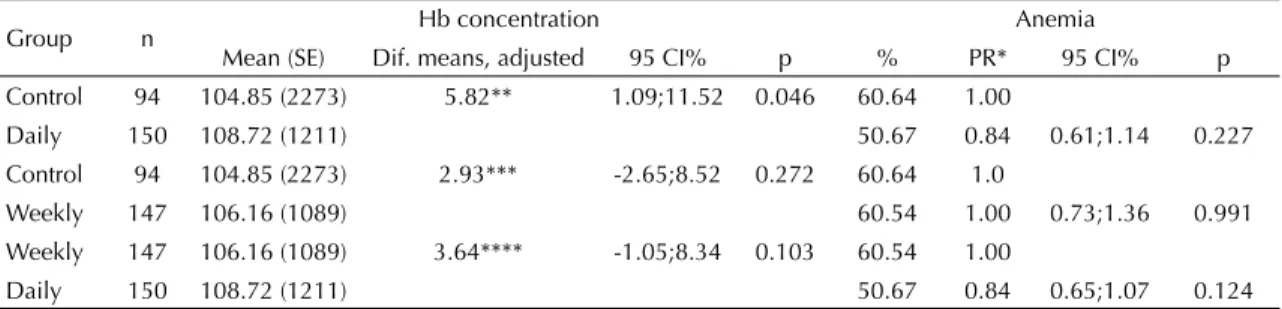
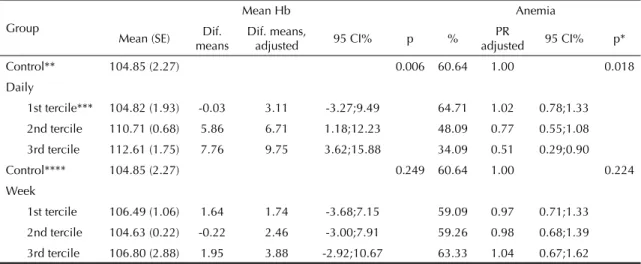
Regression analysis by intention to treat (Table 3) showed a statistically signifi cant difference in mean Hb levels only between DG and CG (5.82; 95% CI [1.09;11.52]; p=0.046). Analysis by adherence to protocol showed a clear dose-response effect in DG when compared to CG for both mean Hb (p for linear trend=0.006) and prevalence ratio of anemia (p for linear trend=0.018). No effect was observed for the weekly regimen (Table 4).
DISCUSSION
Our data do not confi rm the hypothesis that daily and weekly supplementation are equally effective. The present study shows that only daily supplementation with iron was effective in preventing anemia among studied infants. The effectiveness of the daily regimen was evidenced by the increased mean Hb concentration when compared to non-supplemented infants, and by the dose-response effect of supplementation on anemia prevalence. There was no evidence of effectiveness for the weekly iron supplementation regimen.
Effectiveness in preventing infant anemia, shown in the present study only for the daily regimen, is in accordance with the results of four clinical trials that evaluated the effi cacy of daily and weekly regimens using equivalent doses of iron and supplementation periods.6,8,9,16,21 On the other hand, our results are not in agreement with those of Thu et al,18 who found evidence of similar effi cacy between daily and weekly supplementation regimens in increasing Hb levels and reducing anemia prevalence in infants using iron doses that were slightly lower than those of the present study (8 mg/day and 20 mg/week).
The few effectiveness studies available in the literature are not fully comparable to the present data due to dif-ferences in age range, iron dosage, and periodicity of supplementation. In a study11 carried out in the city of Sao Paulo, Brazil, children aged six to 59 months who were given weekly FS supplementation (4 mgFe/kg/ week) for six months showed increased Hb levels and a small but signifi cant reduction in prevalence of anemia. However, this study11 did not include a daily supple-mentation group. The difference between the fi ndings of this and the present studies may be explained, at least partly, by differences in iron dosage and child age.
With regard to internal validity, the fi rst aspect to be ex-amined is the possibility of our fi ndings being spurious.
Table 2. Indicators of intervention implementation and estimated supplement-derived iron intake (mg) by children according to
study group. Rio de Janeiro, Southeastern Brazil, 2005.
Indicator Group (%)Daily Group (%)Weekly p
Mothers who reported receiving the following components of the intervention:
Booklet 92.7 80.3 0.149
Calendar 97.3 94.6 0.577
Orientation to record
doses on calendar 92.5 94.2 0.765
Mothers who correctly reproduced instructions received with respect to:
Periodicity 79.2 89.8 0.319
Dose 85.1 81.0 0.257
Duration 88.0 86.3 0.263
Vials recovered in relation to the expected number
97.0 99.3 0.375
Children with total iron intake in mg estimated at:
Zero 0.0 1.4 0.001
1-749 4.8 31.7
750-1749 29.9 66.9
≥1750 65.3 0.0
Table 3. Comparison of hemoglobin concentration (Hb in g/l) and prevalence (%) of anemia between studied groups: analysis
by intention to treat. Rio de Janeiro, Southeastern Brazil, 2005.
Group n Hb concentration Anemia
Mean (SE) Dif. means, adjusted 95 CI% p % PR* 95 CI% p
Control 94 104.85 (2273) 5.82** 1.09;11.52 0.046 60.64 1.00
Daily 150 108.72 (1211) 50.67 0.84 0.61;1.14 0.227
Control 94 104.85 (2273) 2.93*** -2.65;8.52 0.272 60.64 1.0
Weekly 147 106.16 (1089) 60.54 1.00 0.73;1.36 0.991
Weekly 147 106.16 (1089) 3.64**** -1.05;8.34 0.103 60.54 1.00
Daily 150 108.72 (1211) 50.67 0.84 0.65;1.07 0.124
Diferences in means adjusted for the following variables:
* PR: Prevalence ratios provided without adjustment, since no potential confounder was maintained in the fi nal regression models.
** Income, use of cow’s milk, age of introduction of vegetables
This is unlikely due to the statistical signifi cance of dif-ferences between DG and the other two groups. Study power, recalculated a posteriori using the parameters encountered, was 74%.
A second aspect of the validity of the present results is the possibility of selection or information bias. Regard-ing selection bias, one possibility is that families in the control group may have been more committed to child care, given that group was composed only of children whose mothers responded to recruitment by aerogram or telephone. In this case, bias would have acted against the hypothesis of a positive effect of the intervention. However, a comparison of selected characteristics failed to detect statistically signifi cant differences between the three groups. The possibility of information bias is unlikely, given that the same procedures and techniques were used for evaluating the three groups.
Another aspect of internal validity is the presence of residual confounder effects. Though impossible to exclude, there is this possibility given the successful randomization of study groups with respect to the great majority of an extensive series of potential confounders, including intake of dietary sources of iron, and the addi-tional control for relevant factors, carried out by means of regression analyses. It should be mentioned that we did not include in the list of sources of dietary iron foods containing fl our or cornmeal, which, during the period of data collection, began to be fortifi ed compulsorily with iron and folic acid. The absence of control for consumption of fortifi ed fl our and cornmeal, however, seems unlikely to have affected our results. In addition to not having expressive participation in the infant
diet, a study of the effectiveness of fl our and cornmeal fortifi cation carried out simultaneously with the present study failed to detect any positive effect of fortifi cation on hemoglobin concentration in children.2
Also arguing against the possibility of residual con-founding is the fact that study groups were composed of concurrent cohorts of children of similar age select-ed from the same target population and, furthermore, the rigorous observation of identical eligibility criteria for the three groups. In addition, rigor with respect to age was important in order to avoid confounding, since improvement in iron defi ciency indicators with age is well documented, regardless of the presence of intervention.14,20,23
Another argument in favor of internal validity is the suggestion that the association detected is causal. Both the daily and weekly groups were exposed to treat-ment, as evidenced by the high level of adherence to SSFARM, a key aspect of effectiveness studies. The fact that good adherence was achieved in the daily group contradicts the arguments of other authors,22 who claim that weekly administration would lead to greater adherence, and therefore effectiveness, than daily ad-ministration. With respect to the biological plausibility of our fi ndings, we were able to detect a dose-response effect of SSFARM intake on hemoglobin levels in the daily group. The absence of such an effect for the weekly regimen may indicate that the total amount of iron supplied to the child would not be suffi cient to prevent anemia. However, higher doses of iron in a single weekly dose may lead to adverse effects, thus compromising adherence.1,7
Table 4. Comparison of hemoglobin concentration (Hb in g/l) and prevalence (%) of anemia between studied groups: analysis
by adherence to protocol. Rio de Janeiro, Southeastern Brazil, 2005.
Group
Mean Hb Anemia
Mean (SE) meansDif. Dif. means, adjusted 95 CI% p % adjustedPR 95 CI% p*
Control** 104.85 (2.27) 0.006 60.64 1.00 0.018
Daily
1st tercile*** 104.82 (1.93) -0.03 3.11 -3.27;9.49 64.71 1.02 0.78;1.33
2nd tercile 110.71 (0.68) 5.86 6.71 1.18;12.23 48.09 0.77 0.55;1.08
3rd tercile 112.61 (1.75) 7.76 9.75 3.62;15.88 34.09 0.51 0.29;0.90
Control**** 104.85 (2.27) 0.249 60.64 1.00 0.224
Week
1st tercile 106.49 (1.06) 1.64 1.74 -3.68;7.15 59.09 0.97 0.71;1.33
2nd tercile 104.63 (0.22) -0.22 2.46 -3.00;7.91 59.26 0.98 0.68;1.39
3rd tercile 106.80 (2.88) 1.95 3.88 -2.92;10.67 63.33 1.04 0.67;1.62
* p-value for linear trend
** Variables maintained in the model: age of introduction of beans, vegetables, and meat, income, and daycare *** Terciles of adherence to supplementation (mg iron).
a Ministério da Saúde. Secretaria de Atenção à Saúde. Departamento de Atenção Básica. Manual operacional do Programa
Nacional de Suplementação de Ferro. Brasília; 2005 (Série A. Normas e Manuais Técnicos). [cited 2008 Jul 31] Available from: http://dtr2004.saude.gov.br/nutricao/documentos/manual_ferro.pdf
Regarding external validity, our results can be general-ized, with a certain level of caution, to infant clienteles of primary health care units of other Brazilian cit-ies. In support of such generalization are the similar epidemiological scenario with respect to prevalence of childhood anemia seen across different Brazilian cities,12,15 the unrestrictive eligibility criteria used in the present study, which allowed for the inclusion of a heterogeneous contingent of children of social and biological diversity comparable to those of other set-tings, and the relative simplicity of the intervention protocol, which is compatible with the routine primary health care available in Brazil and elsewhere.17
One limitation of the present study was the use of he-moglobin concentration alone as the outcome variable, and especially the failure to consider serum ferritin or transferrin, which provide a more accurate picture of the levels of iron in the organism.23 However, the inclu-sion of these measurements would imply in greater cost and operational diffi culties, and could lead to a greater number of losses to follow-up.
Another potential limitation is the lack of a pre-in-tervention hemoglobin measurement, which did not allow us to compare the three groups in terms of
initial Hb, nor to analyze the variation in Hb levels in these groups. This limitation could not be addressed given that the major aim of the present study was to test a strategy for prevention of infant anemia based on prophylactic iron supplementation early in life in a universal fashion (and thus, without prescreening), and at a standardized dose.1,14,17,19
In conclusion, the unprecedented evidence presented in this paper indicate that, among children seen at health care facilities similar to the Rio de Janeiro PHU, only daily prophylactic supplementation with ferrous sulfate is effective in preventing infant anemia. This evidence is both relevant and timely given the current Brazilian scenario, where infant anemia is widely prevalent, and where the primary health care network is in the process of implementing a national program for prevention of childhood anemia based on weekly iron supplementation.a
ACKNOWLEDGEMENT
1. Allen LH. Iron supplements: scientifi c issues concerning effi cacy and implications for research and
programs. J Nutr. 2002;132(4 supl):813S-9S.
2. Assunção MC, Santos IS, Barros AJ, Gigante DP, Victora CG. Efeito da fortifi cação de farinhas com ferro sobre
anemia em pré-escolares, Pelotas, RS. Rev Saude
Publica. 2007;41(4):539-48. DOI:
10.1590/S0034-89102006005000031
3. Barros AJD, Hirakata VN. Alternatives for logistic regression in cross-sectional studies: an empirical comparison of models that estimate the prevalence
ratio. BMC Med Res Methodol. 2003;3:21.
4. Friedman LM, Furberg CD, DeMets DL. Fundamentals of Clinical Trials. 3. ed. New York: Springer-Velag; 1998. 5. Godwin M, Ruhland L, Casson I, MacDonald S, Delva
D, Birtwisle R, et al. Pragmatic controlled clinical trials in primary care: the struggle between external and
internal validity. BMC Med Res Methodol. 2003;3:28.
DOI: 10.1186/1471-2288-3-28
6. Gross R. Benade S, Lopez G, International Research on Infant Supplementation Initiative. The International
Research on Infant Supplementation Initiative. J Nutr.
2005;135(3):628S-30S.
7. Gross R, organizador. Micronutrient supplementation throughout the life cycle. Report of a workshop held by the Ministry of Health, Brazil and UNICEF. Rio de Janeiro: UNICEF; 2000.
8. Hop LT, Berger J. Multiple micronutrient supplementation improves anemia, micronutrient nutrient status, and growth of Vietnamese infants:
double-blind, randomized, placebo-controlled trial. J
Nutr. 2005;135(3):660S-5S.
9. López de Romaña G, Cusirramos S, López de Romaña D, Gross R. Effi cacy of multiple micronutrient supplementation for improving anemia, micronutrient
status, growth, and morbidity of Peruvian infants. J
Nutr. 2005;135(3):646S-52S.
10. Lozoff B, Jimenez E, Wolf AW. Long term
developmental outcome of infants with iron defi ciency.
N Engl J Med. 1991;325(10):687-94.
11. Monteiro CA, Szarfarc SC, Brunken GS, Gross R, Conde W. Long-term preventive mass prescription of weekly doses of iron sulfate may be highly effective to
reduce endemic child anemia. Food Nutr Bull. 2001;
22(Supl 1):53-61.
12. Monteiro CA, Szarfarc SC, Mondini L.Tendência Secular da anemia na infância na cidade de São Paulo
(1984-1996). Rev Saude Publica. 2000;34(6
Supl):62-72. DOI: 10.1590/S0034-89102000000700009 13. Mora JO, Mora LM. Defi ciencias de micro nutrientes
en América Latina y el Caribe – anemia ferropriva. Washington (DC): Organización Panamericana de la Salud; 1998.
14. Nestel P, Alnwick D. Iron/Multimicronutrient supplements for young children. Summary and conclusions of a consultation held at UNICEF. Copenhagen: UNICEF; 1996.
15. Oliveira RS, Diniz AS, Benigna MJ, Miranda-Silva SM, Lola MM, Gonçalves MC, et al. Magnitude, distribuição espacial e tendência da anemia em pré-escolares da
Paraíba. Rev Saude Publica. 2002;36(1):26-32. DOI:
10.1590/S0034-89102002000100005
16. Smuts CM, Dhansay MA, Faber M, van Stuijvenberg ME, Swanevelder S, Gross R, et al. Effi cacy of multiple micronutrient supplementation for improving anemia, micronutrient status, and growth in South African
infants. J Nutr. 2005;135(3):653S-9S.
17. Stoltzfus RJ, Dreyfuss ML. Guidelines for the use of iron supplements to prevent and treat iron defi ciency anemia. Washington: International Nutritional Anemia Consultative Group/The United Nations Children’s Fund/World Health Organization; 1998.
18. Thu B, Schultink W, Dillon D, Gross R, Leswara ND, Khoi HH. Effect of daily and weekly nutrient supplementation on micronutrient defi ciencies and
growth in young Vietnamese children. Am J Clin Nutr.
1999;69(1):80-6.
19. Trowbridge F. Prevention and control of iron
defi ciency: priorities and action steps. J Nutr.
2002;132(4 Supl):880S-2S.
20. The United Nations Children’s Fund. World Health Organization. United Nations University. Micronutrient Initiative Technical Workshop. Preventing iron defi ciency in women and children: technical consensus on key issues and resources for programme advocacy, planning and implementation. New York; 1998. 21. Untoro J, Karyadi E, Wibowo L, Erhardt MW, Gross
R. Multiple micronutrient supplements improve micronutrient status and anemia but not growth and morbidity of Indonesian infants: a randomized,
double-blind, placebo-controlled trial. J Nutr.
2005;135(4):639S-45S.
22. Viteri FE. Iron Supplementation for the control of
iron defi ciency in population at risk. Nutr Rev.
1997;55(6):195-209.
23. World Health Organization. Iron defi ciency anaemia assessment, prevention and control: a guide to Programme Managers. Geneva; 2001.
24. World Health Organization. Physical status: the use and interpretation of anthropometry. Geneva; 1995. (WHO Technical Reports Series, 854).
25. Recommendations to prevent and control iron defi ciency in the United States. Centers of Disease
Control and Prevention. MMWR Recomm Rep.
1998;47(RR-3):1-29.
REFERENCES
Article based on the doctoral thesis of EM Engstrom, presented to the Escola Nacional de Saúde Pública/ Fundação Oswaldo Cruz in 2006.
Supported by Conselho Nacional de Desenvolvimento Científi co e Tecnológico (process nº 506399/2004-4) and the Brazilian Ministry of Health, (grant no. 5571/2004).