The inluence of depressive symptoms and substance use
on adherence to antiretroviral therapy. A cross-sectional
prevalence study
A inluência dos sintomas depressivos e do uso de substâncias na adesão
à terapia antirretroviral. Um estudo transversal de prevalência
Claudia Siqueira Tufano
I, Ricardo Abrantes do Amaral
II, Luciana Roberta Donola Cardoso
III, André Malbergier
IVCasa da AIDS, Medical School, Universidade de São Paulo (USP), São Paulo, Brazil
ABSTRACT
CONTEXT AND OBJECTIVE: Adherence to antiretroviral treatment (ART) is not a stable condition, but is dynamic, like mental conditions. The aim of this study was to examine whether non-adherence to ART is related to demographic and immunological variables, substance use and presence of depressive symptoms.
DESIGN AND SETTING: This was a cross-sectional prevalence study carried out at a public AIDS treatment center in the city of São Paulo, Brazil, between July 2006 and January 2007.
METHODS: 438 patients on regular ART schedules with recent laboratory tests answered a demographic questionnaire, questions about substance use, the Hamilton Depression Rating Scale (HDRS) and the Sim-pliied Medication Adherence Questionnaire (SMAQ).
RESULTS: The prevalence of non-adherence over the past three months (a pattern of treatment tion) was 46.3%, and 27.2% also reported this in the past week (a pattern of missed doses). ART interrup-tion was signiicantly related to older age, lower CD4+ cell count and homosexual/bisexual transmission. The pattern of missed doses was signiicantly related to younger age, higher HDRS scores and higher viral load of RNA HIV.
CONCLUSION: ART interruption may relect recall errors and changes to the Brazilian demographic char-acteristics of HIV infection. The missed doses may relect lifestyle charchar-acteristics of younger individuals. Attendance for HIV-positive individuals, particularly younger patients, should involve interventions and counseling in relation to the presence of depressive symptoms.
RESUMO
CONTEXTO E OBJETIVO: Adesão ao tratamento antirretroviral (TARV) não é uma condição estável, mas dinâmica, como os transtornos mentais. O objetivo deste estudo foi veriicar se a não adesão ao TARV relaciona-se às variáveis demográicas e imunológicas, ao uso de substâncias e à presença de sintomas depressivos.
DESENHO E LOCAL: Este estudo transversal de prevalência foi realizado em um serviço público para trata-mento de pessoas HIV-positivas na cidade de São Paulo, Brasil, entre julho 2006 e janeiro 2007.
MÉTODOS: 438 pacientes em regime regular de TARV, que tinham exames laboratoriais recentes, respon-deram a questionário demográico, questões sobre uso de substâncias, Escala de Hamilton para Depres-são (HAM-D) e Questionário Simpliicado de AdeDepres-são à Medicação (QSAM).
RESULTADOS: A prevalência de não adesão nos últimos três meses (um padrão de interrupção de trata-mento) foi de 46,3% e de 27,2% na última semana (um padrão de perda de doses). A interrupção do TARV relacionou-se signiicativamente a maior idade, menor contagem de células CD4+ e contágio homo/bis-sexual, enquanto o padrão de perda de doses relacionou-se signiicativamente com idade mais jovem, pontuação mais alta na HAM-D e maior carga viral de RNA HIV.
CONCLUSÃO: A interrupção do TARV pode reletir erros de memória e mudanças nas características de-mográicas brasileiras da infecção por HIV. A perda de doses pode reletir aspectos de estilo de vida de indivíduos mais jovens. O atendimento de indivíduos HIV-positivos, particularmente os mais jovens, deve envolver intervenções e aconselhamento em relação à presença de sintomas depressivos.
IMedical student. Universidade Anhembi
Morumbi, São Paulo, Brazil.
IIMD, MSc, PhD. Lecturer at Medical School,
Universidade de São Paulo (USP), São Paulo, Brazil.
IIIBSc, MSc. Postgraduate student at Medical
School, Universidade de São Paulo (USP), São Paulo, Brazil.
IVMD, MSc, PhD. Lecturer at Medical School,
Universidade de São Paulo (USP), São Paulo, Brazil.
KEY WORDS: HIV. Depression. Medication adherence.
Antiretroviral therapy, highly active. Immune system.
PALAVRAS-CHAVE: HIV.
Depressão. Adesão à medicação.
INTRODUCTION
Highly active antiretroviral therapy (HAART) is crucial for slow-ing down clinical progression and increasslow-ing survival among HIV-infected individuals. However, to achieve this clinical efect, adherence to HAART is necessary.1,2 Conceptually, adherence is “the extent to which the patient’s behavior matches the prescrib-er’s agreed recommendations”.3
Among the multifactorial causes of non-adherence to anti-retroviral therapy (ART),4 it has been observed that substance use5-7 and depressive symptoms4,8 have an impact. Substance use disorders and mood disorders are the most common psychiatric diseases among HIV-positive patients, and have been shown to afect people living with HIV (PLWH) signiicantly more oten than the general population.9 Additionally, stressful events and trauma have a negative efect on important components of the complex immune system, such as CD4 T cells.10,11
Since adherence is unstable in situations such as men-tal conditions12 with erratic13 and dynamic courses,14,15 or is expressed in other forms, such as missed doses or as treatment interruptions, i.e. so-called “drug holidays”,16 early detection of non-adherence may prevent the development of ART resistance and treatment failure.17
In Brazil, few studies have investigated the impact of sub-stance use or depressive symptoms on adherence to ART. Previous results showed that patients on ART may interrupt treatment to consume alcohol,18,19 or that using alcohol, tobacco and any illicit drug could be linked to a proile of higher vulnera-bility to non-adherence.20,21 he same vulnerability was observed for severe depressive symptoms22 or depression.23
OBJECTIVE
he aim of this study was to examine whether non-adherence to ART over the past three months, also called treatment inter-ruption (i.e. more than two days of interinter-ruption), and over the last week, also called missed doses, are associated with the same demographic and immunological variables and, particularly, with substance use over the past month and presence of depres-sive symptoms over the past week.
METHODS
Study population
his study was carried out by the Alcohol and Drug Study Group (GREA) of the psychiatric department of a medical school at a public university in the city of São Paulo, Brazil, and at the HIV treatment center (AIDS Clinic) ailiated to this medical school. Since 1994, this center has been provid-ing multidisciplinary HIV/AIDS care on a 12-hour day outpa-tient basis. he center provides services relating to infectious
diseases, gynecology, psychiatry, obstetrics, endoscopy, oral health, psychology, social work, nutrition and physical educa-tion. High-complexity patients are followed up in accordance with the Brazilian Ministry of Health protocols.24
he inclusion criteria for this study were that the patients needed to be over 18 years of age and on ART, and to have HIV-related laboratory data (CD4+ cell count and viral load) recorded within the last three months preceding the inter-view. he exclusion criteria were a clinical diagnosis of demen-tia or a score of less than 24 points on the Mini-Mental State Examination (MMSE).25
he study consisted of face-to-face interviews conducted by trained psychiatrists and psychologists. Every day, the irst ive patients scheduled for routine medical consultations were invited to participate in the study. All interviews were conducted in a private room and lasted approximately two hours. he study was carried out from July 2006 to January 2007.
A sample of 455 was obtained from the total population of patients under treatment (N = 3,000), taking 20% to be the esti-mated prevalence of non-adherence to ART, alpha = 5%, and a conidence interval (CI) of 95%.
Measurements criteria
Alcohol and drug use was assessed over the preceding month. Last-month alcohol use was measured as none/less than once a week or more than once a week.
he Hamilton Depression Rating Scale (HDRS)26 was used to measure the presence of depressive symptoms.
he Simpliied Medication Adherence Questionnaire (SMAQ)27 was used to assess adherence to ART. SMAQ has a dichotomous structure and its questions can be assessed sepa-rately: (1) “Do you ever forget to take your medicine?”; (2) “Are you careless at times about taking your medicine?”; (3) “If at times you feel worse, do you stop taking your medicine?”; (4) “hinking about the last week, how oten have you not taken your medicine?”; (5) “Did you not take any of your medicine over the last weekend?”; (6) “Over the past three months, on how many days have you not taken any medicine at all?” he non-adherence was considered to be “positive” when a non-adher-ent patinon-adher-ent was detected, i.e. when more than two doses were missed over the past week (Question 4) or over the last week-end (Question 5) (recent non-adherence, i.e. a pattern of missed doses), or more than two days of total non-medication during the past three months (Question 6) (non-adherence over the past three months, i.e. a pattern of treatment interruption).
Clinical features
load was described as log10 RNA copies/ml. Viral load was clas-siied in categories as follows: detectable (HIV RNA copies > 40) or undetectable (HIV RNA copies ≤ 40).
Statistical analysis
The following variables were defined as predictive: gender (male or female); race/ethnicity (declared by the interviewee as white, black, mixed or other); education was defined as basic (up to 11 years of study) or higher (college or university level); working (yes or no); conjugal situation (living together or living alone); the form of HIV transmission was described as heterosexual sexual intercourse, homosexual/bisexual sex-ual intercourse, hemodialysis/transfusion (named intrave-nous HIV transmission) or unknown transmission route; alcohol consumption last month (none/less than once a week or more than once a week); cocaine use (no or yes); and can-nabis use (no and yes). Continuous variables were described as means and standard deviation (SD); age and time since HIV seroconversion were described in years; annual income was described in United States (US) dollars (US dollar to Real exchange in January 2007 = 2.133); HDRS score, number of CD4+ cells and viral load were described as above.
he outcome variable was adherence to ART, which was deined as adherence over the past three months (past adherence, treatment interruption; yes or no) and as adherence over the past week (recent adherence, missed doses; yes or no). Pearson’s corre-lation between the two measurements of adherence was not sig-niicant (r = - 0.002; P = 0.97). Categorical data were described as percentages, and Pearson’s chi-square test was used to make com-parisons relating to past and recent adherence status. Student’s t test was used for continuous variables relating to the measure-ments of adherence. A probability level below 5% was considered statistically signiicant.
he magnitude of the correlation between predictive vari-ables relating to past and recent ART non-adherence was mea-sured by examining the crude odds ratio (OR) and the corre-sponding 95% conidence intervals (CI). he best predictive models for past and recent non-adherence were built through multiple logistic regression analyses using stepwise selection for each adherence measurement. Independent variables with sig-niicant crude OR results (P ≤ 0.1) were entered into the initial model. he data were analyzed using SPSS version 16.0 (SPSS Inc., Chicago, Illinois, USA).
Ethical procedures
his study was approved by the university’s Ethics Committee. All subjects included in the study gave their informed consent prior to their inclusion. he project was supported by a grant (CSV 083/06) from the HIV/STD National Coordination Oice of the Brazilian Ministry of Health.
RESULTS
Demographics and clinical and adherence status of the sample
Between July 2006 and January 2007, 459 patients on antiretrovi-ral treatment were assessed. Twenty-one patients were excluded: three because of low MMSE scores (< 24 points) and eighteen because no CD4+ cell counts and HIV viral loads recorded over the last three months were available.
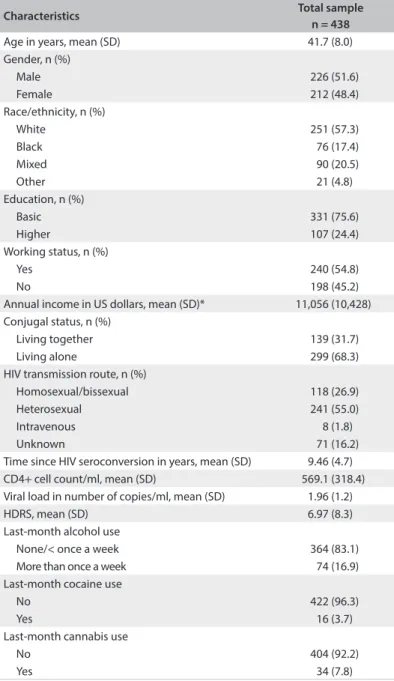
he 438 patients included in the study were predomi-nantly white (n = 251; 57.3%) and living alone (n = 299; 68.3%). he mean age was 41.7 years (standard deviation, SD ± 8.0) and the gender distribution was approximately equal (males: n = 226; 51.6%). Close to 75% of the sample had basic education and close to 25% had higher education. Almost 62% of the sam-ple (n = 240) were working, and the mean annual income of those who were currently working or receiving a pension was US$ 11,056 (SD: ± 10,428), ranging from US$ 1,283 to US$ 91,397. he mean length of time since becoming aware of being HIV infected was 9.46 years (SD: ± 4.7). he main form of HIV transmission was through heterosexual sexual inter-course (n = 241; 55%). Twenty-seven percent of the sample (n = 118) reported having become infected through homosex-ual/bisexual transmission, and 16% (n = 71) said that they did not know what their HIV transmission route was. he remain-ing 2% (n = 8) of the sample reported intravenous HIV trans-mission. No patient reported injection drug use.
he mean CD4 cell count was 569.1/ml (318.4). Mean log10 RNA copies/ml among the sample was 1.96 (SD: ± 1.2).
Over the preceding month, 364 patients (83.1%) reported no alcohol use or use less than once a week. Last-month alcohol use more than once a week was reported by 74 individuals (16.9%). Over the preceding month, almost 10% of the sample (n = 41) reported use of illicit drugs: 34 (7.8%) reported cannabis use, 16 (3.7%) cocaine use and 0.2% (n = 1) amphetamine use. Frequent recent use (more than once a week) of cannabis and cocaine were reported, respectively, by 5.1% (n = 22) and 1.4% (n = 6) of the sample. he mean score for the HDRS was 6.97 (SD: ± 8.3). Overall, 319 patients (72.8%) reported some pattern of adher-ence to ART. hree patients who reported past and recent non-adherence were included in the past non-adherent group (Table 1).
Past non-adherence
In comparison with patients who reported homosexual/bisexual HIV transmission, those who reported heterosexual transmission or an unknown route had a lower likelihood of being non-adher-ent (more than 50% and 90%, respectively). Past non-adhernon-adher-ent patients had lower CD4+ cell counts than adherents. Reports of last-month alcohol use more than once a week were mar-ginally associated with past non-adherence to ART (OR = 1.04; 95% CI: 0.63-1.72).
Last-week non-adherence
One hundred and sixteen patients (26.5%) reported hav-ing adhered to ART over the past week. Almost 80% of the
adherent patients had undetectable viral loads (Pearson chi-square value = 7.89; P = 0.005; OR = 1.94; 95% CI: 1.21-3.09). Recent non-adherence was signiicantly associated with younger age and higher numbers of HIV RNA copies, in comparison with recent adherent patients. Patients who reported recent non-adherence also showed higher HDRS scores than the adherent patients. Last-month alcohol use more than once a week was also marginally correlated with recent non-adherence. All the data on adherence, past non-adherence and recent non-adherence is pre-sented in Table 2.
Multiple regression results
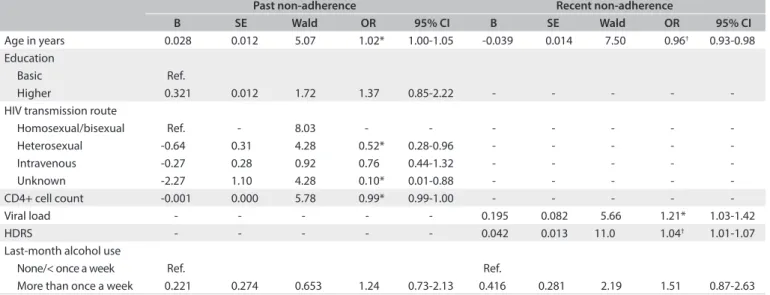
Past non-adherence to ART was independently predicted by older age and lower CD4+ cell count. Homosexual/bisexual transmission was also signiicantly and independently associated with non-adherence, in comparison with those who reported heterosexual and unknown transmission routes. For recent non-adherence to ART, the strongest independent predictors were younger age and higher HDRS scores. Recent non-adherence was also independently predicted by higher numbers of HIV RNA copies (Table 3).
DISCUSSION
In this sample of HIV individuals on ART, adherence was eval-uated as two patterns: over the past three months and over the past week, which were deined as treatment interruption and missed doses, respectively. he rate of recent non-adher-ence (26.4%) was close to what was observed by Nemes et al. (25%) in 322 healthcare clinics in Brazil,28 but lower than what was observed in other Brazilian studies (36.9% and 37.2%),21,22 with diferent methodologies. In a randomized controlled trial, the percentages of non-adherence measured by means of Medication Event Monitoring System (MEMS) caps ranged from 35.4% to 50.9%,29 which was similar to the results for past non-adherence in the present study.
he frequency of past non-adherence was almost twice the recent frequency. Since past adherence covered a longer time interval, this result was not unexpected. Additionally, the past and recent non-adherence results came from diferent individu-als, as shown by the correlation results, and it is probably correct to say that they came from diferent treatment behaviors.
Previous studies have shown that the higher the adherence is, the lower the likelihood of virological failure will be,30,31 as seen in the binary association, with almost twice the likelihood of having a detectable viral load among patients who missed doses. Since the viral load is a faster and more accurate method for signaling the clinical consequences of treatment failure32 than the CD4+ cell count, which may be related to other immunological varia-tions,33 it is possible that a recent non-adherence pattern will also have the same ability, compared with past non-adherence.
Table 1. Total sample characteristics at the HIV treatment center, in 2007
Characteristics Total sample
n = 438
Age in years, mean (SD) 41.7 (8.0) Gender, n (%)
Male 226 (51.6)
Female 212 (48.4) Race/ethnicity, n (%)
White 251 (57.3)
Black 76 (17.4)
Mixed 90 (20.5)
Other 21 (4.8)
Education, n (%)
Basic 331 (75.6)
Higher 107 (24.4) Working status, n (%)
Yes 240 (54.8)
No 198 (45.2)
Annual income in US dollars, mean (SD)* 11,056 (10,428) Conjugal status, n (%)
Living together 139 (31.7) Living alone 299 (68.3) HIV transmission route, n (%)
Homosexual/bissexual 118 (26.9) Heterosexual 241 (55.0) Intravenous 8 (1.8) Unknown 71 (16.2) Time since HIV seroconversion in years, mean (SD) 9.46 (4.7) CD4+ cell count/ml, mean (SD) 569.1 (318.4) Viral load in number of copies/ml, mean (SD) 1.96 (1.2) HDRS, mean (SD) 6.97 (8.3) Last-month alcohol use
None/< once a week 364 (83.1) More than once a week 74 (16.9) Last-month cocaine use
No 422 (96.3)
Yes 16 (3.7)
Last-month cannabis use
No 404 (92.2)
Yes 34 (7.8)
More importantly, since adherence does not provide a full explanation for the observed variations in treatment responses,34 it was observed that the efect of non-adherence, as a conse-quence of missed doses, was related to growing levels of depres-sive symptoms. his correlation is well known, but it has been suggested that some methodological issues concerning the time of recall, measurements of depression and past and present his-tory of depression act as misleading factors.35 In our study, HDRS was used to measure depression symptoms over the last week, and it is likely that measurements of both recent adherence and depressive symptoms would express a pattern of missed dose fre-quency, and would also be related to the detectable viral load.36
Along with the impact of depressive symptoms on the immune system, the inluence of alcohol and other drug use over the past month was not related to recent non-adherence to ART. Last-month alcohol use was measured as none/less than once a week or as more than once a week. his last measurement admits a range of patterns of consumption that might be acting as a con-founding factor. Nevertheless, previous studies have shown that adherence would be higher among alcohol users than among abstainers (or those who drank relatively less).37
Concerning younger age, some diiculties in taking medi-cation at weekends because of stigma,38 or due to alterations in these individuals’ regular schedules or involvement in other
Table 2. Bivariate associations between predictive variables and past and recent non-adherence to antiretroviral therapy at the HIV treatment center, in 2007
Characteristics
Adherents n = 119 (27.3%)
Past non-adherence n = 203 (46.3%)
Recent non-adherence n = 116 (26.4%)
n (%) n (%) Crude OR (95% CI) n (%) Crude OR (95% CI)
Age in years, mean (SD) 41.6 (7.3) 42.5 (8.6)* 1.06 (1.00-1.05)* 39.9 (7.3) 0.96 (0.93-0.99)* Gender, n (%)
Male 61 (53) 103 (45.6) Ref. 63 (27.9) Ref. Female 58 (48) 100 (47.2) 1.06 (0.73-1.55) 56 (26.4) 0.92 (0.60-1.41) Race/ethnicity, n (%)
White 71 (59.6) 115 (45.8) Ref. 70 (27.9) Ref. Black 20 (17) 36 (47.4) 0.76 (0.31-1.87) 17 (22.4) 0.79 (0.42-1.48) Mixed 22 (18.7) 41 (45.6) 0.81 (0.31-2.15) 27 (30.0) 1.13 (0.65-1.97) Other 6 (4.7) 11 (52.4) 0.76 (0.29-1.97) 5 (23.8) 0.80 (0.27-2.32) Education, n (%)
Basic 83 (70.2) 163 (49.2) Ref. 89 (26.9) Ref. Higher 36 (29.8) 40 (37.4) 0.61 (0.39-0.96)* 30 (28.0) 1.05 (0.65-1.72) Working status, n (%)
Yes 67 (56.1) 104 (43.3) Ref. 72 (30.0) Ref. No 52 (43.9) 99 (50.0) 1.30 (0.89-1.90) 47 (23.7) 0.72 (0.47-1.11) Annual income in US dollars, mean (SD) 9,485,0 (10,858.2) 8,012.5 (9,401.1) 1.00 (1.00-1.00) 8,009.1 (9,814.7) 1.00 (1.00-1.00) Conjugal status, n (%)
Living together 32 (26.9) 64 (46.0) Ref. 39 (28.1) Ref. Living alone 87 (73.1) 139 (46.5) 1.01 (0.68-1.52) 80 (26.8) 0.93 (0.59-1.46) HIV transmission route, n (%)
Homosexual/bisexual 37 (31) 46 (39.0) Ref. 38 (32.2) Ref. Heterosexual 61 (51.5) 115 (47.7) 0.46 (0.25-0.85)* 63 (26.1) 0.69 (0.41-1.16) Intravenous 4 (2.9) 1 (12.5) 0.66 (0.39-1.14) 2 (25.0) 0.98 (0.18-5.25) Unknown 17 (14.6) 41 (57.7) 0.10 (0.01-.89)* 16 (22.5) 0.53 (0.26-1.10) Time since HIV seroconversion in years, mean (SD) 9.45 (4.2) 9.6 (5.3) 1.01 (0.97-1.05) 9.39 (4.4) 0.99 (0.95-1.04) CD4+ cell count/ml, mean (SD) 615.9 (344.8) 527.5 (299.2)* 0.99 (0.99-1.00)* 544.3 (339.7) 1.00 (0.99-1.00) Viral load in number of copies/ml, mean (SD) 1.89 (1.18) 1.98 (1.29) 0.93 (0.79-1.10) 2.22 (1.42) 1.20 (1.00-1.43)* HDRS, mean (SD) 6.48 (8.2) 6.7 (8.1) 0.99 (0.97-1.02) 9.22 (9.0) 1.04 (1.01-1.06)* Last-month alcohol use, n (%)
None/< once 99 (83) 168 (46.2) Ref. 93 (25.5) Ref. More than once 20 (17) 35 (47.3) 1.047 (0.63-1.72)† 26 (35.1) 1.57 (0.92-2.68)†
Last-month cocaine use, n (%)
No 115 (97.1) 194 (46.0) Ref. 113 (26.8) Ref. Yes 4 (2.9) 9 (56.3) 1.51 (0.55-4.13) 6 (37.5) 1.64 (0.58-4.61) Last-month cannabis use, n (%)
No 109 (91.2) 190 (47.0) Ref. 107 (26.5) Ref. Yes 10 (8.8) 13 (38.2) 0.69 (0.34-1.43) 12 (35.3) 1.51 (0.72-3.16)
*P < 0.05, †P < 0.01. OR = odds ratio; CI = conidence interval; SD = standard deviation; US = United States; HDRS = Hamilton Depression Rating Scale;
activities, might lead to missing doses of ART. Additionally, the U-shape between age and depressive symptoms39 could have an exponential efect on adherence.
Past adherence or treatment interruption is more likely to be afected by recall errors than is recent adherence, which may be strengthened by the independent association of older age and unknown transmission route among non-adherent patients over this interval. However, multivariate analysis also showed the magnitude of the correlation of lower CD4+ count and het-erosexual transmission with treatment interruption. Taking into account the changes in the demographics of HIV infection in Brazil, with the growth of heterosexual transmission and increas-ing life expectancy,40 it is likely that such changes require shits in prevention and care.41
Because the period used to deine past adherence comprised a three-month interval, the CD4+ cell count results might have expressed prior conditions, and even previous virological eleva-tions. It is also possible that an age-related efect and the sparse-ness of preventive actions for heterosexual individuals might explain the joint efect of poor immune response.
Some limitations of the present study need to be discussed. Firstly, although self-reporting is afected in several ways by per-sonal diiculties, it is generally credible42 and correlates with clinical data,31 as seen in our study. As recommended by Simoni et al.,43 we proposed item standardization for the SMAQ, through applying the last two questions, which cover recent adherence. his allowed the patients to distinguish between missing doses and treatment interruption.
Additionally, the sample studied was not randomly selected from all HIV patients in Brazil, since the patients were selected from
a speciic center. Nevertheless, this study sample was not statistically diferent from the center population. Even so, further generalization is limited to similar populations.
hese results do not allow the extension of such indings to a clinical condition of major depression, which requires a full clinical evaluation, and presumably a speciic treatment. Notwithstanding this, our results emphasize that clinicians should integrate the delivery of clinical care, targeted interven-tions44 and counseling45,46 against depressive symptoms through regular appointments, in order to avoid poorer outcomes. hese indings should stimulate clinicians to evaluate depression when the patient is not complying with the treatment or is in a situa-tion of treatment failure.
Future research should replicate these indings using a stan-dardized clinical diagnosis of depression.
CONCLUSION
Our results show that depressive symptoms were related to the presence of patterns of missing doses, non-adherence to treat-ment and virological failure, which should be targeted by clini-cians through regular appointments.
REFERENCES
1. Bangsberg DR, Perry S, Charlebois ED, et al. Non-adherence to highly active antiretroviral therapy predicts progression to AIDS. AIDS. 2001;15(9):1181-3.
2. Wood E, Hogg RS, Yip B, et al. Efect of medication adherence on survival of HIV-infected adults who start highly active antiretroviral therapy when the CD4+ cell count is 0.200 to 0.350 x 10(9) cells/L. Ann Intern Med. 2003;139(10):810-6.
Table 3. Multiple logistic regression results for predictable variables and past and recent non-adherence to ART among patients at the HIV treatment center in 2007
Past non-adherence Recent non-adherence
B SE Wald OR 95% CI B SE Wald OR 95% CI
Age in years 0.028 0.012 5.07 1.02* 1.00-1.05 -0.039 0.014 7.50 0.96† 0.93-0.98
Education
Basic Ref.
Higher 0.321 0.012 1.72 1.37 0.85-2.22 - - - - -HIV transmission route
Homosexual/bisexual Ref. - 8.03 - - - -Heterosexual -0.64 0.31 4.28 0.52* 0.28-0.96 - - - - -Intravenous -0.27 0.28 0.92 0.76 0.44-1.32 - - - - -Unknown -2.27 1.10 4.28 0.10* 0.01-0.88 - - - - -CD4+ cell count -0.001 0.000 5.78 0.99* 0.99-1.00 - - - - -Viral load - - - 0.195 0.082 5.66 1.21* 1.03-1.42 HDRS - - - 0.042 0.013 11.0 1.04† 1.01-1.07
Last-month alcohol use
None/< once a week Ref. Ref.
More than once a week 0.221 0.274 0.653 1.24 0.73-2.13 0.416 0.281 2.19 1.51 0.87-2.63
*P < 0.05, †P < 0.01. OR = odds ratio; CI = conidence interval; HDRS = Hamilton Depression Rating Scale; HIV = human immunodeiciency virus. B = beta;
3. Fine RN, Becker Y, De Geest S, et al. Nonadherence consensus conference summary report. Am J Transplant. 2009;9(1):35-41. 4. Carrieri MP, Leport C, Protopopescu C, et al. Factors associated with
nonadherence to highly active antiretroviral therapy: a 5-year follow-up analysis with correction for the bias induced by missing data in the treatment maintenance phase. J Acquir Immune Deic Syndr. 2006;41(4):477-85.
5. Lucas GM, Griswold M, Gebo KA, et al. Illicit drug use and HIV-1 disease progression: a longitudinal study in the era of highly active antiretroviral therapy. Am J Epidemiol. 2006;163(5):412-20.
6. Palepu A, Raj A, Horton NJ, et al. Substance abuse treatment and risk behaviors among HIV-infected persons with alcohol problems. J Subst Abuse Treat. 2005;28(1):3-9.
7. Hinkin CH, Barclay TR, Castellon SA, et al. Drug use and medication adherence among HIV-1 infected individuals. AIDS Behav. 2007;11(2):185-94.
8. Bouhnik AD, Préau M, Vincent E, et al. Depression and clinical progression in HIV-infected drug users treated with highly active antiretroviral therapy. Antivir Ther. 2005;10(1):53-61.
9. Ciesla JA, Roberts JE. Meta-analysis of the relationship between HIV infection and risk for depressive disorders. Am J Psychiatry. 2001;158(5):725-30.
10. Friedman H, Pross S, Klein TW. Addictive drugs and their relationship with infectious diseases. FEMS Immunol Med Microbiol. 2006;47(3):330-42.
11. Leserman J. Role of depression, stress, and trauma in HIV disease progression. Psychosom Med. 2008;70(5):539-45.
12. Klinkenberg WD, Sacks S; HIV/AIDS Treatment Adherence, Health Outcomes and Cost Study Group. Mental disorders and drug abuse in persons living with HIV/AIDS. AIDS Care. 2004;16 Suppl 1:S22-42. 13. National Institutes of Health. Oice of AIDS Research. Advisory
Council, United States. Public Health Service. Guidelines for the use of antiretroviral agents in HIV-1-infected adults and adolescents. Available from: http://aidsinfo.nih.gov/contentiles/lvguidelines/ adultandadolescentgl.pdf. Accessed in 2014 (Jan 28).
14. Liu H, Golin CE, Miller LG, et al. A comparison study of multiple measures of adherence to HIV protease inhibitors. Ann Intern Med. 2001;134(10):968-77.
15. Carrieri P, Cailleton V, Le Moing V, et al. The dynamic of adherence to highly active antiretroviral therapy: results from the French National APROCO cohort. J Acquir Immune Deic Syndr. 2001;28(3):232-9. 16. Knobel H, Urbina O, González A, et al. Impact of diferent patterns of
nonadherence on the outcome of highly active antiretroviral therapy in patients with long-term follow-up. HIV Med. 2009;10(6):364-9. 17. Villes V, Spire B, Lewden C, et al. The efect of depressive symptoms at
ART initiation on HIV clinical progression and mortality: implications in clinical practice. Antivir Ther. 2007;12(7):1067-74.
18. Brigido LF, Rodrigues R, Casseb J, et al. Impact of adherence to antiretroviral therapy in HIV-1-infected patients at a university public service in Brazil. AIDS Patient Care STDS. 2001;15(11):587-93.
19. Melchior R, Nemes MIB, Alencar TMD, Buchalla CM. Desaios da adesão ao tratamento de pessoas vivendo com HIV/Aids no Brasil [Challenges of treatment adherence by people living with HIV/AIDS in Brazil]. Rev Saude Publica. 2007;41(supl 2):87-93.
20. Silva MCF, Ximenes RAA, Miranda Filho DB, et al. Fatores preditivos de não-adesão à terapia antiretroviral [Risk-factors for non-adherence to antiretroviral therapy]. Rev Inst Med Trop São Paulo. 2009;51(3):135-9.
21. Bonolo Pde F, Machado CJ, César CC, Ceccato MD, Guimarães MD. Vulnerability and non-adherence to antiretroviral therapy among HIV patients, Minas Gerais State, Brazil. Cad Saude Publica. 2008;24(11):2603-13.
22. Campos LN, Guimarães MD, Remien RH. Anxiety and depression symptoms as risk factors for non-adherence to antiretroviral therapy in Brazil. AIDS Behav. 2010;14(2):289-99.
23. Malta M, Magnanini MM, Strathdee SA, Bastos FI. Adherence to antiretroviral therapy among HIV-infected drug users: a meta-analysis. AIDS Behav. 2010;14(4):731-47.
24. Paz LC, Pereira GF, Pinto VM, et al. Nova deinição de casos de síilis congênita para ins de vigilância epidemiológica no Brasil, 2004 [New case deinition of congenital syphilis for epidemiological surveillance purposes in Brazil, 2004]. Rev Bras Enferm. 2005;58(4):486-7. 25. Folstein MF, Folstein SE, McHugh PR. “Mini-mental state”. A practical
method for grading the cognitive state of patients for the clinician. J Psychiatr Res. 1975;12(3):189-98.
26. Hamilton M. A rating scale for depression. J Neurol Neurosurg Psychiatry. 1960;23:56-62.
27. Knobel H, Alonso J, Casado JL, et al. Validation of a simpliied medication adherence questionnaire in a large cohort of HIV-infected patients: the GEEMA Study. AIDS. 2002;16(4):605-13. 28. Nemes MI, Alencar TM, Basso CR, et al. Assessment of outpatient
services for AIDS patients, Brazil: comparative study 2001/2007. Rev Saude Publica. 2013;47(1):137-46; discussion 146.
29. Basso CR, Helena ET, Caraciolo JM, Paiva V, Nemes MI. Exploring ART intake scenes in a human rights-based intervention to improve adherence: a randomized controlled trial. AIDS Behav. 2013;17(1):181-92.
30. Paterson DL, Swindells S, Mohr J, et al. Adherence to protease inhibitor therapy and outcomes in patients with HIV infection. Ann Intern Med. 2000;133(1):21-30.
31. Nieuwkerk PT, Oort FJ. Self-reported adherence to antiretroviral therapy for HIV-1 infection and virologic treatment response: a meta-analysis. J Acquir Immune Deic Syndr. 2005;38(4):445-8.
32. Nachega JB, Hislop M, Dowdy DW, et al. Adherence to nonnucleoside reverse transcriptase inhibitor-based HIV therapy and virologic outcomes. Ann Intern Med. 2007;146(8):564-73.
34. Azar MM, Springer SA, Meyer JP, Altice FL. A systematic review of the impact of alcohol use disorders on HIV treatment outcomes, adherence to antiretroviral therapy and health care utilization. Drug Alcohol Depend. 2010;112(3):178-93.
35. Springer SA, Dushaj A, Azar MM. The impact of DSM-IV mental disorders on adherence to combination antiretroviral therapy among adult persons living with HIV/AIDS: a systematic review. AIDS Behav. 2012;16(8):2119-43.
36. Catz SL, Kelly JA, Bogart LM, Benotsch EG, McAulife TL. Patterns, correlates, and barriers to medication adherence among persons prescribed new treatments for HIV disease. Health Psychol. 2000;19(2):124-33.
37. Hendershot CS, Stoner SA, Pantalone DW, Simoni JM. Alcohol use and antiretroviral adherence: review and meta-analysis. J Acquir Immune Deic Syndr. 2009;52(2):180-202.
38. Rao D, Feldman BJ, Fredericksen RJ, et al. A structural equation model of HIV-related stigma, depressive symptoms, and medication adherence. AIDS Behav. 2012;16(3):711-6.
39. Sutin AR, Terracciano A, Milaneschi Y, et al. The trajectory of depressive symptoms across the adult life span. JAMA Psychiatry. 2013;70(8):803-11.
40. Nakagawa F, May M, Phillips A. Life expectancy living with HIV: recent estimates and future implications. Curr Opin Infect Dis. 2013;26(1):17-25.
41. Hall HI, Espinoza L, Benbow N, Hu YW; Urban Areas HIV Surveillance Workgroup. Epidemiology of HIV infection in large urban areas in the United States. PloS One. 2010;5(9):e12756.
42. Bangsberg DR, Hecht FM, Clague H, et al. Provider assessment of adherence to HIV antiretroviral therapy. J Acquir Immune Deic Syndr. 2001;26(5):435-42.
43. Simoni JM, Kurth AE, Pearson CR, et al. Self-report measures of antiretroviral therapy adherence: A review with recommendations for HIV research and clinical management. AIDS Behav. 2006;10(3):227-45.
44. Amico KR, Orrell C. Antiretroviral therapy adherence support: recommendations and future directions. J Int Assoc Provid AIDS Care. 2013;12(2):128-37.
45. Fisher JD, Fisher WA, Cornman DH, et al. Clinician-delivered intervention during routine clinical care reduces unprotected sexual behavior among HIV-infected patients. J Acquir Immune Deic Syndr. 2006;41(1):44-52.
46. Gardner LI, Marks G, O’Daniels CM, et al. Implementation and evaluation of a clinic-based behavioral intervention: positive steps for patients with HIV. AIDS Patient Care STDS. 2008;22(8):627-35.
Sources of funding: This study was supported by the National STD/AIDS Program of the Ministry of Health (Convocation Notice no. 01/2005)
Conlict of interest: None
Date of irst submission: July 30, 2013
Last received: February 13, 2014
Accepted: February 17, 2014
Address for correspondence: Claudia Siqueira Tufano Ricardo Amaral
Universidade de São Paulo — Instituto de Psiquiatria
Programa do Grupo Interdisciplinar de Estudos de Álcool e Drogas (GREA) Rua Ovídio Pires de Campos, 785
São Paulo (SP) — Brasil CEP 05403-010