ABSTRACT
Title: The influence of leadership on CMC competences: The moderating role of task interdependence
Author: Isabelle Scheffler
The purpose of this thesis was to study the influence of certain leadership functions on three CMC competences, particularly when the team is highly task interdependent. A survey was conducted and answers were gathered from 106 individuals, who were members of 30 real life teams in total. Results show that the leader’s provision of feedback as well as support of social climate within a team show no influence on any CMC competence whereas the leader’s statement of a team mission shows significant positive influence on CMC knowledge. Additionally, results show that the leader’s encouragement of team self-management has a significant positive influence on all three CMC competences. The model with task interdependence as a moderator was only significant regarding two leadership functions (the provision of feedback and the support of social climate) in connection with one CMC competence, CMC motivation. For both, the moderator only had an influence for lower levels of itself.
Key-Words: Virtual teams, leadership function, CMC competence, task interdependence
RESUMO
Título da dissertação: The influence of leadership on CMC competences: The moderating role of task interdependence
Autora: Isabelle Scheffler
O propósito desta tese foi estudar a influência de certas funções de liderança em três competências de CMC, particularmente quando a equipa é altamente interdependente nas tarefas. Foi realizado um questionário e foram recolhidas as respostas de 106 indivíduos, no total, que eram membros de 30 equipas reais. Os resultados mostram que a disponibilização de feedback por parte do líder, assim como o seu apoio de um clima social na equipa mostram não ter influência em nenhumas competências de CMC, enquanto que a afirmação de uma missão de equipa por parte do líder mostra ter uma influência positiva significante no conhecimento de CMC. Adicionalmente, os resultados mostram que o encorajamento de autogestão da equipa por parte do líder tem uma influência positiva significante nas três competências de CMC. O modelo com interdependência de tarefa como moderador foi apenas significante relativamente a duas funções de liderança (a disponibilização de feedback e o apoio de um clima social) em conexão com uma competência CMC. Em ambos, o moderador apenas teve influência para níveis baixos do mesmo.
Palavras-chave: Equipas virtuais, Função de liderança, Competência de CMC, Interdependência de tarefa
ACKNOWLEDGMENT
First, I would like to thank my thesis supervisor Patrícia Costa for her constant support, outstanding commitment, and immediate responses for any need or concern, always providing a clear direction during the whole process of writing my master thesis. This work would have been much harder without your guidance and motivation in the seminar.
Further, I would like to thank my personal virtual team “Team Stuart” from Queen’s University in Canada for being an inspiration in writing this thesis.
I would like to acknowledge and thank my parents Claudia and André for their never-ending support not only during this master thesis or the whole double-degree program but in my everyday life and especially during the past six year. Without your guidance, strong support, and help in any matter, I would not be where I am today. Thanks for always inspiring me and giving me everything you have.
TABLE OF CONTENT
ABSTRACT ... 1 RESUMO ... 2 ACKNOWLEDGMENT ... 3 LIST OF TABLES ... 5 LIST OF FIGURES ... 6 1. Introduction ... 7 2. Literature Review ... 8 2.1 Teams ... 8 2.2 Virtual Teams ... 10 2.3 Computer-Mediated Communication Competence ... 13 2.4 Leadership ... 15 2.4.1 Feedback ... 16 2.4.2 Social Climate ... 18 2.4.3 Mission Statement ... 20 2.4.4 Team Self-Management ... 20 2.5 Task Interdependence as a moderator ... 22 3. Methodology ... 25 3.1 Sample ... 25 3.2 Measures ... 25 3.3 Results ... 27 4. Discussion ... 34 4.1 Practical Implications, Limitations and further Suggestions ... 36 5. Conclusion ... 39 REFERENCES ... 40 APPENDICES ... 47LIST OF TABLES
Table 1 Reliability, Means, and SDs of CMC competence scale and subscales ... 26
Table 2 Correlations between all variables, means, standard deviations, and Rwg(j) values ... 28
Table 3 Moderation analysis results H3a ... 29
Table 4 Moderation analysis results H4d ... 30
Table 5 Moderation analysis results H4e ... 30
Table 6 Moderation analysis results H4f ... 30
Table 7 Moderation analysis results H1c ... 30
Table 8 Moderation analysis results H2c ... 30
LIST OF FIGURES
Figure 1 Team Basics (Katzenbach and Smith, 1993) ... 9
Figure 2 Virtual Team’s Risks and Forces (Brake, 2008) ... 12
Figure 3 Moderation Model ... 24
Figure 4 Interaction Plot for H1c ... 31
1. Introduction
In today’s hypercompetitive and increasingly globalized business world, companies expand internationally, broadening their businesses to countries all over the globe. In order to do so both effectively and successfully, the establishment of virtual teams becomes more and more the norm (Cheshin et al., 2013). This is also due to the continuous emergence of new communication channels that facilitate the sharing of information and/or the rate of interaction amongst team members (Cheshin et al., 2013). Virtual teams can be characterized by their number of multiple different nationalities and a communication with each other that is mostly computer-mediated. On the one hand, the diversity within virtual teams is likely to increase its potential, whereas on the other hand team members are exposed to different views, opinions, languages, cultural visions, time zones, and communication preferences, which can be difficult to manage and to supervise.
My interest in virtual teams arose through my Master studies at the Smith School of Business at Queen’s University in Kingston, Ontario, Canada. The Master in International Business program has a high focus on international teamwork, assigning each student to a multicultural virtual team as of day one. The virtual teams are supervised by an external, formal leader. My personal virtual team consists of a Russian, an Indian, a Chinese, a Canadian, and me, a German team member. As one might expect, the high degree of diversity leads to cultural clashes, diverse visions, opinions and work approaches. Having worked with each other face-to-face during our first semester at Queen’s has established a certain degree of trust and team cohesion that helps us facing upcoming challenges during our last semester of the International Business Program, being spread all over the world. Now, we not only have to deal with the above-mentioned challenges but also with the use of computer-mediated-communication (CMC) tools, different time zones, and diverse expectations.
Thus, I have a high degree of personal interest in how leadership influences three main competences in computer-mediated communication suggested by Spitzberg (2006), given that the team’s interaction is highly task interdependent. The questions that arise and will be further discussed are: How does the leader influence team members’ competence in using CMC? Are there any specific functions that are more relevant than others? Does task interdependence play a role as a moderator?
More detailed evaluation will take place in the following literature review (Section 2) and the survey analysis presented in Section 3.
2. Literature Review
This chapter provides an overview on existing theories on virtual teams, team leadership, computer-mediated communication competences, and task interdependence. It includes definitions of the keywords and their connection.
2.1 Teams
Companies focus more and more on the establishment of teams throughout various departments, bearing in mind the proven positive aspects teamwork comes along with (Salas, Sims and Burke, 2005). Martin and Bal’s (2015) survey conducted among high-level managers, found that 91% of the participants agreed with the following statement: “teams are central to organizational success”. Teams in general, team members’ exchange of knowledge and thoughts, and task interdependence within teams, are known to have the potential to increase productivity, creativity, to add knowledge (Jehn and Mannix, 2001) and ideas more than any individual team member could (Salas, Sims and Burke, 2005). Additionally, teams can improve the team members’ overall motivation and commitment (Salas, Sims and Burke, 2005).
For a better understanding of the core of this Master thesis, the starting point is the characterization of a team. Having a look at the current definition of teams in the Oxford dictionary, teams are defined very broadly as “a group of players forming one side in a competitive game or sport” or further as “two or more people working together”. Dyer (1984) and Salas et al. (1992) continue this definition by defining a team as two or more individuals, having specified roles and interacting adaptively, dynamically and interdependently toward a shared and valued goal. Further, Aubert & Kelsey (2003) define the word team as a group that consists of a small number of people who possess complementary skills and who share the commitment of a common purpose, a certain set of goals and an approach for which they hold each other equally accountable. Cohen & Bailey (1997) further define a team as “a collection of individuals who are interdependent in their tasks, who share responsibility for outcomes, who see themselves and who are seen by others as an intact social entity embedded in one or more larger social systems (for example, business unit or the corporation), and who manage their relationships across organizational boundaries” (p. 241). Katzenbach & Smith (1993) go deeper in the definition of a “real team”, stating that a team needs to have the following basics to be successful (see figure 1).
Smith (1993) state that high-performance teams are rare as individuals need to overcome “a natural resistance to moving beyond individual roles and accountability” (p. 3). Additionally, the authors state that teams that are high in performance require a high personal commitment of each team member, which is hard to control.
Due to the emerged requirements of today’s globalized business world and with the aim of making teamwork more successful and valuable, traditional teams have evolved into virtual teams. This extension of teamwork is described in the following section.
2.2 Virtual Teams
Advancements in information technology and in computer-mediated communication means, combined with an adapted approach to the design of jobs, have increased the number of people working away from their company’s site, making it possible for organizations to build teams being existent of members who can be dispersed all over the world (Aubert and Kelsey, 2003). This type of team composition is called a “Virtual Team”. A survey by the Society for Human Resource Management (2012) found that around 66 per cent of companies with multinational operations employ virtual teams, with the number expected to grow. Given the advancements in technology and communication tools, it is hardly surprising that many researchers focused their research on virtual teams over the past years (Gilson et al., 2015), resulting in a proliferation of definitions (Martins, Gilson and Maynard, 2004). The following part will give an overview on the current definitions of virtual teams as well as on the corresponding up- and downsides.
Comparable to any other “normal” team, virtual teams are also characterized by the composition of a group of people “performing interdependent tasks with a common purpose who are mutually accountable for their results and possess complementary expertise”, with members coming from the same or different organizations (Aubert and Kelsey, 2003). However, dissimilar to conventional teams, virtual teams work together, independent of the team members’ current location and thereby in disregard of different time zones, overcoming the lack of direct personal interaction by making use of advanced computer-mediated communication tools (Lipnack and Stamps, 1999; Geister, Konradt and Hertel, 2006). Townsend, DeMarie and Hendrickson (1998) specify this definition by stating that one characteristic of a virtual team is the fact that the team primarily interacts through a combination of computer-mediated communication tools (e.g. telephone, video conferencing,
e-mail, or online chats) with no or minimal interaction face-to-face (Malhotra, Majchrzak and Rosen, 2007).
A supporting, more formal, definition is provided by Kelsey (1999) who describes virtual teams as “a boundary-less network organization form where a temporary team is assembled on an as-needed basis for the duration of a task and staffed by members who are separated by geographic distance and who use computer-mediated communications as their primary form of communication and interpersonal contact” (p. 104). These characteristics make it possible for companies to build a team based on the best task-related individuals and to do so without considering the team members physical and organizational locations, having the goal of enhancing the quality of decision-making (Martins, Gilson and Maynard, 2004). Furthermore, the authors state that virtual teams come with an effective structural mechanism for managing increased costs (Aubert and Kelsey, 2003), travel, time, and coordination that come with getting together a virtual team’s members who can be dispersed in three ways: geographically, temporally, and functionally (Martins, Gilson and Maynard, 2004).
Jones, Ouyng and Pace (2005) further describe a virtual team as
“a team with members that are geographically distributed across more than one location. Virtual teams can include geographically dispersed teams, where team members live and work in different locations/states/countries from each other; teams with telecommuters, teams formed horizontally across vertical organizations (project teams, task forces, etc.); or teams formed across different companies” (p. 189).
The analysis of definitions of virtual teams has shown that the core of the definitions of various authors stays similar, only showing small variations in the specifics (Martins, Gilson and Maynard, 2004). The focus of these definitions is the performance of interdependent tasks with a common goal in mind, although working from different geographic locations and relying on the advancement in computer-mediated communication tools to overcome a couple of boundaries. Martins, Gilson and Maynard (2004) state that the most noted boundaries within definitions are geography and time, with the first one being mentioned having led researchers to shift light on “global virtual teams”.
Given the fact that the nature of virtual teams allows companies to assemble teams independent of geographic location, team members are often dispersed all over the world (Gilson et al., 2015). During the last decade, organizations have expanded their businesses and services to new markets, realizing shrinking global boundaries and therefore the advantage of employees working together from any location (Pinjani, 2007). However, the emergence of virtual teams does not bring only advantages to organizations. Kayworth and Leidner (2002) state that virtual teams are more complex in comparison to traditional teams and thereby rely on Solomon (1995):
“The fundamentals of global team success aren’t very different from the practices that work for domestic work teams. But there are more variables. Overlay cultural behavior and expectations on the roles of communication, team leadership and group dynamics, and you immediately understand. Moreover, there are logistics to overcome: challenges inherent in working in different time zones, lots of travel, and busy conflicting schedules” (p. 50).
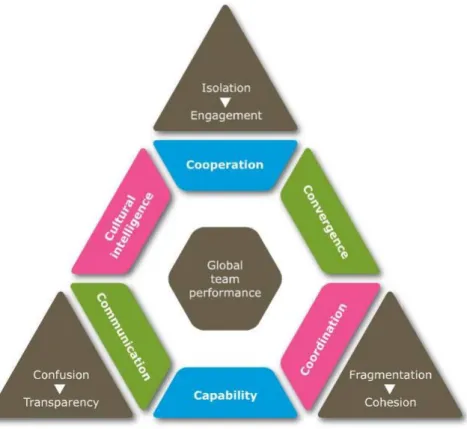
Brake (2008) identified three main risks that virtual teams are confronted with (see figure 2). Likewise, he defined six forces which are crucial for virtual teams to develop to overcome these risks.
Figure 2 Virtual Team’s Risks and Forces (Brake, 2008)
One of virtual teams’ main goals is to reach engagement within the team. Brake (2008) defines engagement as all team members being equally involved and committed to the team’s work outcome. He further states that this, however, can only be reached when teams overcome isolation, the primary obstacle members are facing. Reasons for isolation can be limited interaction and/or the non-existence of trust and team identity within the team. The establishment and maintenance of trust within virtual teams is stressed as a crucial base for successful virtual teams, especially since virtual team members never or rarely see each other face-to-face. As their primary way of communication is based on technology, virtual teams must develop confidence that they can rely on and trust each other when working together (Brake, 2008). Furthermore, establishing trust helps overcoming the lack of having informal communications during times off work, e.g. during lunch/dinner or on the corridor where
“normal” teams typically build social relationships and share personal information (Greenberg, Greenberg and Antonucci, 2007).
The two other main threats that virtual teams are facing are fragmentation and confusion. These two may come along with focus drift and “virtual distance” of which the latter can be grouped into three different types: physical, operational and cultural distance (Ferrazzi, 2014).
With the aim of overcoming these dangers, virtual teams must focus on the development of core values, norms, and a shared mission. A report on virtual teams released in 2016 by RW3 CultureWizard, an internationally operating consultancy specified in cultural management, revealed that virtual teams are even more global and culturally diverse than ever before (Solomon, 2016). Here, it has to be ensured that diversity within the team is understood, appreciated, and leveraged by each team member (Malhotra, Majchrzak and Rosen, 2007). Additionally, Brake (2008) stresses the importance of having leaders who encourage and motivate, and who take special care of the above-mentioned threats.
Special focus must rely on the creation of a shared virtual workspace in order to be able to exchange knowledge and information, and to keep each other updated (Brake, 2008) since virtual teams only communicate via technology.
2.3 Computer-Mediated Communication Competence
In order to effectively meet the need for flexibility in organizations, using new information technologies that generate promising solutions and opportunities is vital (Cohen and Rico, 2004).
Computer-mediated communication (CMC) competence is a term developed by Spitzberg (2006) and defines the competences and effectiveness of an individual in using CMC. The author describes three main aspects of CMC, namely CMC motivation, CMC knowledge, and CMC skills, which are thought to correlate with their parallels in face-to-face communication (skills such as composure, coordination, attentiveness). In defining this term, Spitzberg (2006) relies on work done by Ring and colleagues (Ring, Braginsky and Braginsky, 1966; Ring et al., 1967; Ring and Wallston, 1968) who made use of a “dramaturgical metaphor for conceptualizing an interactant’s (i.e. “actor’s”) performance quality“ (Spitzberg, 2006, p. 637). Therefore, an actor would need to be motivated to perform well, but that motivation would be insufficient if the actor lacks knowledge of the script which is to be played. Further, even an actor’s possession of motivation and knowledge does not lead to a competent action unless the actor is skilled in acting. With the aim of developing
his conceptualization of CMC competences, Spitzberg (2006) made use of this broad conceptual model of competence which is based on motivation, knowledge, and skills of the individual.
CMC motivation captures the range of constructs that engage an individual to assess CMC positively such as willingness to adopt new communication technologies, satisfaction, gratification, and positive attitudes toward such technologies. CMC motivation can be negative or positive. Individuals possessing positive CMC motivation reflect characteristics such as comfort and confidence in using CMC, whereas individuals with negative CMC motivation show anxiety, shyness, apathy or even disinterest in using CMC. Formally, the author defines CMC motivation as “the ratio of approach to avoidance attitudes, beliefs, and values in a given CMC context”, suggesting that motivation plays a crucial role in the prediction of the individual’s use and success in using CMC technologies (Spitzberg, 2006, p. 640).
CMC knowledge is formally defined “as the cognitive comprehension of content and procedural processes involved in conducting appropriate and effective interaction in the computer-mediated context” (p. 641). Hence, an individual with a high amount of CMC knowledge shows understanding of the topics, rules, concepts, etc. within a communication (content knowledge) as well as comprehension of how this knowledge can be applied (procedural knowledge). Individuals may increase their knowledge in using CMC through experience and repeated interaction with CMC as well as through the use of online information-seeking strategies (Ramirez et al., 2002), performing goal-oriented tactics to establish knowledge.
CMC skills are defined as “the repeatable, goal-oriented behavioral tactics and routines that people employ in the service of their motivation and knowledge” (Spitzberg, 2006, p. 638). In 2002, Spitzberg and Cupach identified 100 distinct skills in the communication competence literatures, ultimately reducing these to four basic skill clusters: attentiveness (i.e., displaying concern for, interest in, and attention to the other person or persons in the interaction), composure (i.e., displaying assertiveness, confidence, being in control), coordination (i.e., displaying deft management of timing, initiation and closure of conversations, topic management, etc.), and expressiveness (i.e., displaying vividness and animation in verbal and nonverbal expression). A couple of studies have acknowledged that these four pillars can be counted as the bases of effective communication, and therefore a person possessing high CMC competence should be able to adapt these skills into the CMC context. For example, Castellá et. al (2000) found that individuals used their expressiveness
skills in CMC, using emoticons and humor and thus adapting their messages to be more informal. Additionally, individuals responded more politely to emails with cues of politeness, adapting to the sender and thus, showing interest and concern (Bunz and Campbell, 2004).
With the aim of working effectively as a virtual team and making full use of its potential benefits, the possession of CMC competences is of great importance. Nevertheless, having teams that work and communicate via CMC tools rather than communicating within a natural context, i.e. face-to-face, poses challenges that need to be tackled. A team’s leader may play an important role in dealing potential obstacles that arise through the communication via CMC, focusing on specific leadership functions.
2.4 Leadership
The trend toward virtual teams demands team members to collaborate across time zones and great distances. However, not only team members face these challenges, but also the leaders of physically dispersed teams (Geister, Konradt and Hertel, 2006). Thus, there has been a recent inquiry regarding the role and nature of team leadership in virtual settings (Kayworth and Leidner, 2002), requiring many team leaders to enhance their abilities and skills to successfully do their job (Katzenbach and Smith, 1993). Team leaders need to focus on both increasing productivity within the team and improving satisfaction amongst the individuals of the team. Katzenbach and Smith (1993) state that effective team leaders understand that they are not the center of the team, not making every key decision or assigning every job, but that believing “in the purpose of the team and the team itself can lead the team toward higher performance” (p. 83).
Past research highlights the importance of team leadership’s influence on the effectiveness of small-group decision making (Fjermestad and Hiltz, 1999). Furthermore, Hiltz and Turoff (1985) and Turoff et al. (1993) shed light on the vital aspect of team leaders in globally dispersed teams especially ones that are communicating via computer-mediated communication tools to achieve a shared organizational goal.
Teamwork shows characteristics of recurring cycles of mutually dependent interaction among team members (Kozlowski et al., 1996; Morgeson and Hofmann, 1999). These cycles can be separated into two distinctive phases, i.e. transition and action phase (Marks, Mathieu and Zaccaro, 2001), through which teams repeatedly go, and through which collective team actions are established over time (Morgeson, DeRue and Karam, 2010). Whereas the transition phase prioritizes activities of planning and evaluating, the action phase focuses on
activities that lead to the actual accomplishment of team goals. A leader’s function within the first phase focuses on e.g. composing the team and structuring tasks, whereas a leader e.g. challenges the team and manages team boundaries within the second phase. Within these two team lifecycle phases, teams are exposed to scores of challenges and obstacles that need to be overcome. Additionally, distinctive needs that arise through these challenges must be satisfied to accomplish the team’s goals. Needs that arise through the transition phase include e.g. goal setting or the development of a shared understanding, whereas needs arising through the action phase include e.g. the monitoring of team behavior and team output (Marks, Mathieu and Zaccaro, 2001; Morgeson, DeRue and Karam, 2010). Further, interpersonal needs, such as the management of emotions and conflicts or the motivation of team members, that arise during both team cycle phases must be satisfied (Edmondson, 1999; Marks, Mathieu and Zaccaro, 2001). Hence, effectiveness of team leaders is often assessed based on their orientation around team need satisfaction (Morgeson, DeRue and Karam, 2010) and on their functions within the two team process phases, both with the final aim of maximizing team effectiveness.
In this case, the focus relies on two functions of the transition phase, i.e. defining/stating the mission and providing feedback, and on two functions of the action phase, supporting social climate and encouraging self-management. We posit that these leadership functions will influence the degree of certain CMC competences, as developed below.
2.4.1 Feedback
Feedback is defined as providing information to an individual with the aim of increasing the individual’s performance. There are two main types of feedback, i.e. outcome feedback that focuses on giving information on performance outcomes and process feedback that focuses on giving information on the way a job is performed (Geister, Konradt and Hertel, 2006). Additionally, one distinguishes between the feedback recipients and the feedback source. Feedback can be received by an individual or by a team and can come from supervisors (top-down), subordinates (bottom-up), peers (horizontal), or from combined sources (multisource feedback) (Geister, Konradt and Hertel, 2006).
Many researchers have focused on the effects and consequences of individual feedback, still lacking extensive, integrated work on feedback provided in (virtual) teams, especially given by a leader. Several works have identified that there might be a discrepancy
between feedback given within a group and feedback given individually (Barr and Conlon, 1994).
At the individual level, the effects of feedback are extensively studied and well known to improve task performance and learning (Locke and Latham, 1990). Bartram and Roe (2008) point out multiple purposes feedback can have: it provides information when people move away from initially set goals, helps in adjusting to new goals, guides activity, promotes critical reflection on the tasks and situations to shed light on new insights and approaches, and it brings resulting outcomes of the activity or process into focus (Gabelica et al., 2012). Additionally, feedback motivates, enhances effective behaviors, and likewise reduces or even stops ineffective behavior (London and Breaugh, 2004). It has shown to have a greater impact, the more specific it is, and that performance sometimes decreases as soon as the extent to which feedback is given is lowered (Ammons, 1956).
Feedback in teams focuses on the transfer of information to teams or individual team members whereas actions, events, performance, processes, or behaviors are reflected (Gabelica et al., 2012). “Through feedback, a group may obtain information about the quantity and quality of its output as well as knowledge about the effectiveness of the methods used to achieve desired levels of performance” (Nadler, 1979, p. 309), serving as an error detection device and therefore as a stimulus to start problem identification and solution. Existing research has shown that feedback can be a powerful tool to enhance team learning and thus, a team’s overall performance (Kozlowski and Ilgen, 2006; London and Sessa, 2006). It is important in any learning process and achievement (Boud, 2000; Hattie and Timperley, 2007) and is known to determine individual behavior (Kluger and DeNisi, 1996). Teams depend on feedback as they monitor and regulate themselves with the purpose of completing their tasks effectively. London and Sessa (2006) stress the importance of feedback as teams might be able to change but not to learn when lacking feedback. Nadler (1979) found that team-level performance and process feedback was more effective when, amongst other things, the team members’ task was interdependent. Comparing individual-level with team-level feedback, Alvero et al. (2001) found that the degree of improved performance was higher when feedback was given on a team-level. In addition, team-level feedback has shown to result in improved attitudes toward the team (Nadler, 1979) as well as to more cooperation and less interpersonal strain amongst team members (Zander and Wolfe, 1964).
There has been support for a beneficial effect of feedback on virtual teams. Outcome feedback given by a team leader to team members has proofed to be important for team performance (Duarte and Snyder, 2001). Detailed team-level feedback is beneficial and
essential in terms of establishing and maintaining trust and, thus, high performance (Jarvenpaa and Leidner, 1999). Geister et al. (2006) rely on the media richness theory (Daft and Lengel, 1986) and argue that virtual teams mostly benefit from team process feedback as they overcome the disadvantages of CMC tools when feedback is provided. Due to the characteristics of CMC tools, i.e. having less team-related contents but more task-related ones (Chidambaram, 1996), members of virtual teams face the insecurity of not knowing whether their team colleagues are satisfied with their interaction. Providing team process feedback showed to have a positive influence on both team well-being and participation within the team (Zumbach et al., 2002).
Given the above-mentioned effects of feedback on individuals and on (virtual) teams, the following hypothesis arises:
H1: The more the leader of the team provides feedback on how well team members communicate using CMC tools, the more the team members will develop (a.) CMC knowledge and (b.) CMC motivation.
2.4.2 Social Climate
Social climate within a team (team climate) can be defined as an implicit frame that shapes an individual’s perception, attitude and behavior within the context of a group (Seibert, Silver and Randolph, 2004; Xue, Bradley and Liang, 2011). For a long time, team climate has been known for being one of the most crucial sources of social influence, affecting individual behavior within a team (Hülsheger, Anderson and Salgado, 2009).
Extant research has examined the effects of having a positive social climate within an organization, or work groups and teams. However, research on social climate within virtual teams is scarce. Thus, the existing findings on the effects of social climate are aggregated and used as a base for this work’s research.
Anderson & West (1998) and Schneider & Reichers (1983) found that the way members of groups at work perceive the group’s climate has a crucial effect on their behavior and their interactions, reflecting the group members’ cognitive representation of the group environment (Schneider and Reichers, 1983; Anderson and West, 1998). Further, the authors claim that a group climate that allows for open communication or relationships that are based on trust within the group may lead to changed characteristics of self-efficacy among members as it allows for experimenting with new ways of approaching things or for practicing new skills without fear of appraisal (Anderson and West, 1998; Edmondson, 1999). Further, self-efficacy has shown to be a significant predictor of behavioral choices with regard to setting
goals, devoting effort to a certain task, and to the degree of actual performance (Choi, Price and Vinokur, 2003). Building on this, Choi, Price & Vinokur (2003) found that members who have a positive perception of the group may see the group as a psychologically safe place for exploring and practicing new skills. Furthermore, individuals working within a team that is characterized by trust and a nonthreatening interpersonal climate show a higher degree of new ideas as they are not fearing a negative judgment by their members (West, 1990). Having established a psychological safety within the team helps to enhance the team learning as it encourages individuals within a team to discuss mistakes openly, look for feedback, ask questions, and reflect on different views (Edmondson, 1999).
Establishing and maintaining a positive social climate is a function leaders should be keen on focusing, as it is known to be essential for adequate levels of team cohesion and team unity which further is empirically linked to group effectiveness (Keller, 1986; Kayworth and Leidner, 2002). In addition, a social climate within a team where individuals support, help, cooperate, and socialize with each other, enhances the degree of innovation within a team (Amabile et al., 1996).
Pirola-Merlo et al. (2002) found that there was a negative impact on a team’s social climate when the team faced obstacles. However, this negative effect was counterbalanced by the leader adopting more transformational and facilitative styles, thus, showing that a team leader’s functions can strongly influence a team’s climate.
Team climate has also shown to have a significant influence on team members’ perceptions, beliefs, and use of technology (Liang et al., 2010). The authors suggest that the existence of an eligible social climate within a team can lead to encouraged sharing of knowledge. Working in a virtual team demands members and leaders to heavily adapt to and rely on computer-mediated communication tools although they might not be used to it or there might be a huge gap of motivation, knowledge, and skills to use CMC technologies. Past research on information systems and work teams suggests that individuals who feel social influence from their proximal social networks, especially from their teams at work, are more likely to align their usage of CMC technologies with the overall objectives of the organization (Sewell, 1998; Kirsch et al., 2002; Kohli and Kettinger, 2004). Further, Sykes et al. (2009) found that a desirable social climate including peer support within social networks can help overcoming knowledge barriers to complex technology use, and influence individuals’ overall usage of systems. Hence,
H2: The more the leader supports the social climate, the more team members will develop (a.) CMC motivation and (b.) CMC knowledge.
2.4.3 Mission Statement
“An effective team mission statement defines who the team is, what the team does, and why” (Emery, 1996, p. 51). It should serve as a description of individual commitment and characteristics of belonging to the team, focusing on shared expectations of membership. Ireland and Hitt (1992) have defined an effective corporate mission statement which can be adapted to team level. Therefore, a mission statement serves as a description of a team’s unique purpose and its scope of operations, embodying a team’s soul.
Emery (1996) points out that a well stated and meaningful team mission is hard to develop and to establish as there is the challenge of articulating the reason of existence of the team while providing principles for the team’s efforts. However, having created a mission statement can be desirable for a team because of the following reasons: it fosters the connection of team members and their individual identification with the overall team; it helps in daily decision making as it provides boundaries; it articulates for what reasons the team exists, therefore helping the team deal with unknown situations; it serves as a guideline for team and individual performance, stressing desired goals that need to be achieved and required competencies that are needed in this sense of accomplishment. Additionally, mission statements can be motivational, lead direction, provide character, and often be inspirational (Ireland and Hitt, 1992), having influence on a team’s effectiveness (Shea and Guzzo, 1987). Using an established mission statement can support shared values, common objectives, foster teamwork as well as emotional commitment (Mullane, 2002). Hence,
H3: The more the leader states the mission within a team, the more team members will develop the CMC skill coordination.
2.4.4 Team Self-Management
Self-management can be defined as “the active control by employees over their work and environment and themselves that results in productive goal-oriented behaviors” (Cohen, Chang and Ledford, 1997, p. 278).
“A self-managing team (…) has authority and accountability for (…) executing and managing the work - but within a structure and toward purposes set by others” (Ruth Wageman, 2001, p. 559). Teams with a high degree of self-management are considered to be independent, working on group tasks with high autonomy and identity while making personnel or other kind of decisions on their own (Cohen, Chang and Ledford, 1997). It is further characterized by working collaboratively and interdependently to define approaches on how to solve problems (Uhl-Bien and Graen, 1998). However, these characteristics do not
imply the absence of a formal leader, indeed authors stress the importance of leadership regarding the success or failure of self-managing teams (Manz and Sims, 1986; Wellins and Byham, 1991). Lawler (1986) stresses that the lack of an external leader is one of the main reasons for self-managing teams to fail or be unsuccessful.
The role of a leader, whose goal it is to encourage team self-management, is to enhance employees’ self-control to be able to successfully manage team activities with less reliance on organizational controls (Cohen, Chang and Ledford, 1997). The leader’s encouragement of team self-management is defined as a “supportive and indirect form of team leadership where the team is encouraged to manage itself, and in many cases, to perform its own leadership functions” (Morgeson, DeRue and Karam, 2010, p. 22) and was first identified by Manz and Sims (1980). The authors based their theory of substituting formal leadership by team self-management on behavioral theories of self-control (Thoresen and Mahoney, 1974) and on social learning theory (Bandura, 1977), thereby suggesting that a team may become more adaptable and resilient when team members are encouraged to solve any kind of problems on their own. Further, they point out that team individuals reach this stage not because of relying on a team leader’s expertise but because of their reliance on their own capabilities and resources (Manz and Sims, 1980), thereby, positively influencing team members’ satisfaction and self-rated effectiveness (Cohen, Chang and Ledford, 1997). Further, these authors found that the leader’s function of encouraging team self-management can contribute to improvements in team members’ perceived quality of work which they based on three main items: satisfaction with growth needs, with social needs, and with the overall group. Team self-management can increase team members’ degree of responsibility and ownership (Tata and Sameer, 2004), which has shown to be positively connected to intrinsic motivation (Deci, Connell and Ryan, 1989) and effort (Manz, 1992b), which further improves employees’ willingness to engage in job-related tasks (Manz, 1992a). Moreover, self-management in teams can directly influence team effectiveness as it increases rapidness and accuracy of solving problems due to assigned decision-making authority (Tata and Sameer, 2004). Hence,
H4: The more the leader encourages self-management within a team, the more members will develop (a.) CMC motivation, (b.), CMC knowledge, and (c.) CMC skills.
2.5 Task Interdependence as a moderator
Participating in a team involves cooperation with various team members, requiring individuals to work under a given degree of interdependence to attain their goals (Campion, Medsker and Higgs, 1993).
Campion, Medsker and Higgs (1993) distinguish three types of interdependence being relevant for teams: goal interdependence, outcome interdependence, and task interdependence. Research has shown that these three types of interdependence are positively related to overall team effectiveness and motivation of team members in face-to-face teams (Campion, Medsker and Higgs, 1993; R. Wageman, 2001) as well as in virtual teams (Hertel, Konradt and Orlikowski, 2004). The authors characterize goal interdependence by the extent to which teams follow clearly defined common goals and mission, having individual goals being linked to the overall group goals. Outcome interdependence is defined as the way individual rewards are linked to total team performance. Finally, task interdependence is characterized by the interaction and dependence among group members. Team members work closely together, constantly coordinate their activities, with their individual work having strong implications on one another’s process (Hertel, Konradt and Orlikowski, 2004). Thus, interdependence in the task implies the degree to which each team member needs to rely on other members of the team in terms of information and material search or support in order to effectively do their job (Somech, Desivilya and Lidogoster, 2009).
In this study, we will focus on task interdependence. The general idea of this approach is that task interdependence within a virtual team moderates the influence leadership functions might have on CMC competences.
As a consequence of the nature of task interdependence, i.e. individual work’s strong implication on other team members and the team as a whole, individuals should feel increasing social pressure, understanding that their personal efforts highly influence the team’s performance (Hertel, Konradt and Orlikowski, 2004). Researchers found that individuals increase their personal efforts when believing that their own poor performance hampers others (Hertel, Kerr and Messé, 2000). Similar thoughts and behaviors can be expected in virtual teams. Thus, high task interdependence within a virtual team should increase the team members’ overall motivation and the team’s overall effectiveness.
Past research has shown contradictory findings regarding the effects of task interdependence on team behavior. On the one hand, researchers found that a high degree of task interdependence and thus intensive interactions within the team creates more conflict opportunities (e.g. Jehn, 1995). Additionally, teams that are high in task interdependence
show potential use of competitive strategies to acquire power (Schopler, 1987; Van Der Vegt, Van De Vliert and Oosterhof, 2003). On the other hand, researchers found that a high degree of task interdependence and thus intensive interaction amongst team members provides an incentive to collaborate (Lam and Chin, 2004). Moreover, the intensity in interdependence leads to increased communication, support, and influence within a team, thus, better collective planning to coordinate the integration of tasks (Gundlach, Zivnuska and Stoner, 2006; Somech, Desivilya and Lidogoster, 2009). These findings of increased communication imply that virtual teams that are high in task interdependence need to use CMC tools more often and more intensive to achieve their set goals. This, in turn, will leverage team members’ motivation to work with CMC tools as well as their perceived need of getting to know how to use them. Thus, task interdependence will be a contextual variable which might influence the relationship between all four leadership functions and all three CMC competences. Therefore, we suggest that (see figure 3):
H1c: The more the leader gives feedback on team members’ CMC usage, the more team members will develop CMC motivation, particularly when the team is highly interdependent.
H2c: The more the leader supports social climate, the more team members will develop CMC motivation, particularly when the team is highly interdependent.
H3a: The more the leader states the mission within a team, the more team members will develop CMC knowledge, particularly when the team is highly interdependent.
H4d: The more the leader encourages self-management within a team, the more the team members will develop CMC motivation, particularly when the team is highly interdependent.
H4e: The more the leader encourages self-management within a team, the more the team members will develop CMC knowledge, particularly when the team is highly interdependent.
H4f: The more the leader encourages self-management within a team, the more the team members will develop CMC skills, particularly when the team is highly interdependent.
3. Methodology
3.1 Sample
The questionnaire was answered by a total number of 106 participants. The final questions of the questionnaire were implemented to identify the demographics of the participants of which several observations can be made:
The final sample has 44% female and 54% male respondents. Two per cent of the respondents did not specify their gender. The age range lies between 21 to 29 years with one outlier of 56 years (M = 24.3). The participants come from a wide variety of countries with the most coming from Germany (34%), followed by Canada (11.3%), France (8.5%), China (8.5%), Portugal (7.5%), Italy, India and Other (5.7%), Belgium and South America (4.7%), and Russia (3.8%). Most respondents stated to have a Bachelor’s degree (68%), whereas the remaining 32% hold a Master’s degree. 31% were team leaders whereas 69% were regular team members. The majority of respondents are students (86%), followed by employed (10.4%) and un/self-employed individuals (3.6%). As the questionnaire was distributed among students within my Master of International Business (MIB) program at Queen’s University in Canada, participants mostly study or work in Management (64%), followed by Marketing, Consulting, Auditing, and other sectors.
3.2 Measures
To determine the relationship between certain leadership functions and certain CMC competences, as well as the moderating role of task interdependence on that relationship, a survey at Católica Lisbon School of Business and Economics was created. With the aim of ensuring the confidentiality of all participants’ responses, the survey was developed with the help of a self-administered electronic questionnaire, associated with Qualtrics. The language of the survey was English only. The study was addressed to team members by either email or private chats on social media channels, distributing individual questionnaire links for each team. Every participant answered the questions individually and anonymously.
The composition and setup of the questionnaire can be found in the appendix. It covers three variables in total: CMC competence, task interdependence, and team leadership, which were all relevant for this study. Hence, the raised data within the questionnaire can be classified in the following variables:
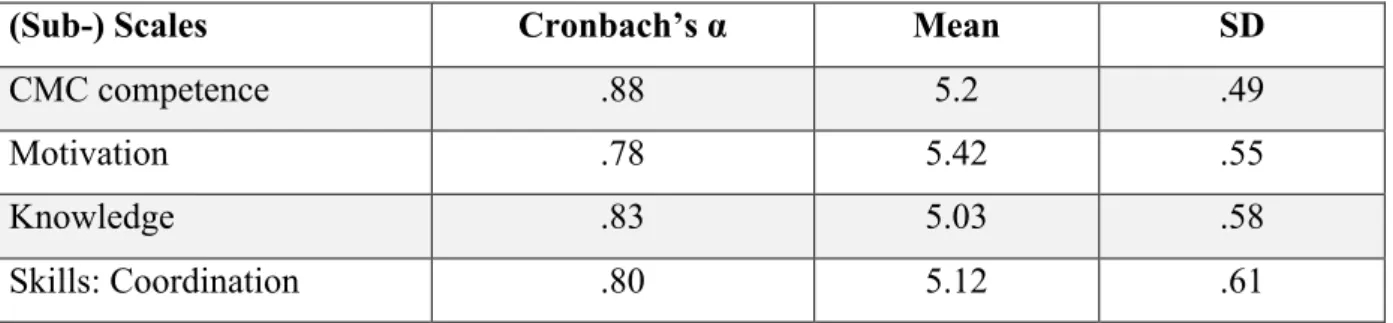
CMC competence was measured using a 14-item measure of CMC competences on a 7-point scale (see appendix for items and scale anchors). The items covered motivation (e.g. “I am very motivated to use computers to communicate with others”), knowledge (e.g. “I am very knowledgeable about how to communicate through computers”), and one specific skill, i.e. coordination (e.g. “I manage the give and take of CMC interactions skillfully”) (Spitzberg, 2006). This scale showed a good reliability (Cronbach’s α = .88). This implies that 88% of the variability in scores represents the construct of interest and 12% is considered as random measured error (M = 5.2, SD = 0.49).
(Sub-) Scales Cronbach’s α Mean SD
CMC competence .88 5.2 .49
Motivation .78 5.42 .55
Knowledge .83 5.03 .58
Skills: Coordination .80 5.12 .61
Table 1 Reliability, Means, and SDs of CMC competence scale and subscales
Task Interdependence was measured by using Campion, Medsker and Higgs’ (1993) Likert-type scale, consisting of three items (“I cannot accomplish my tasks without information or materials from other members of my team”). The questions were rated on a 7-point scale ranging from 1-7 with 1 indicating “Strongly disagree”, 7 indicating “Strongly agree”, and 4 indicating “Neither agree nor disagree”. The items cover the extent to which participants feels that their behavior and their tasks are connected and interdependent to their team members. Estimated reliability (Cronbach’s α) was .84, which indicates that 84% of the variability in scores represents the construct of interest and 16% is considered as random measured error. (M = 5.5, SD = .70).
Team Leadership was evaluated based on Morgeson, DeRue and Karam’s (2009) Likert-type scale. Instead of using every item, only 20 from transition and action phase were included. These items belong to four main subdivisions of the above-mentioned team phases, namely “Provides feedback” (“Provides positive feedback when the team communicates will via CMC”), “Defines the mission” (“Ensures the team has a clear direction”), “Supports social climate” (“Does things to make it pleasant to be a team member”), and “Encourages team self-management” (“Encourages the team to solve its own problems”). To effectively examine the desired research questions, only one item was adapted from “Provides positive feedback when the team performs well” to “Provides positive feedback when the team communicates
well via CMC.” Again, a 7-point scale was used with 1 indicating “Strongly disagree”, as the lowest level of team leadership function, 7 indicating “Strongly agree”, and 4 indicating “Neither agree nor disagree”. The overall scale showed a reliability of α = .82 (M = 5.7, SD = .38). The subscale feedback showed a reliability of α = .76 (M = 5.65; SD = .63), mission a reliability of α = .83 (M = 5.71; SD = .42), social climate a reliability of α = .81 (M = 5.71; SD = .47), and team self-management a reliability of α = .80 (M = 5.51; SD = .48).
The demographic variable Education was used as a control variable in all analyses. It showed no significant values in the correlations, thus, regression analyses, and also not in the moderations tested using process.
Cronbach’s alpha was applied as an estimate to test established measurement constructs for reliability and internal consistency. Values >.7 are defined to ensure internal consistency of scales (Tavakol and Dennick, 2011). All scales und subscales used showed satisfying Cronbach’s alpha values (from .76 to .88) as mentioned in the respective parts above.
Although the questionnaire was taken individually, the individual answers of each team were aggregated to the team level, as this is our level of analysis. To prove that there is a high level of agreement in a teams’ individual answers and thus to justify the team level aggregation, the index of interrater agreement (Rwg (j)) was calculated for each team for each scale and subscale (see table 2).
3.3 Results
The collected data were analyzed using the SPSS Statistics Software 24. The analysis for H1 to H4 was based on the conduction of a regression analysis. The moderation hypotheses were tested using Process Macro by Andrew F. Hayes.
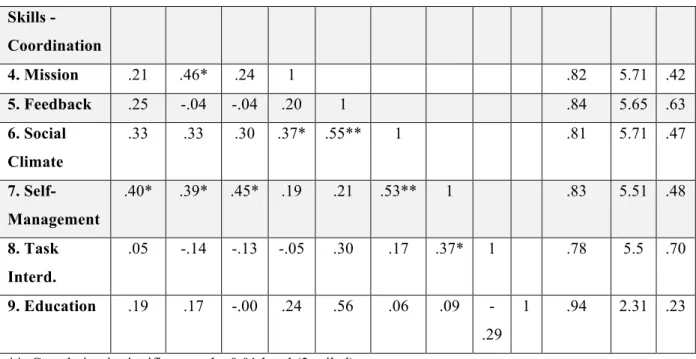
The following table shows the correlations between all variables as well as means, standard deviations and Rwg(j) values of all variables:
1. 2. 3. 4. 5. 6. 7. 8. 9. Rwg(j) M SD 1.CMC Motivation 1 .76 5.42 .55 2. CMC Knowledge .52** 1 .70 5.03 .58 3. CMC .47** .67** 1 .71 5.12 .61
Skills - Coordination 4. Mission .21 .46* .24 1 .82 5.71 .42 5. Feedback .25 -.04 -.04 .20 1 .84 5.65 .63 6. Social Climate .33 .33 .30 .37* .55** 1 .81 5.71 .47 7. Self-Management .40* .39* .45* .19 .21 .53** 1 .83 5.51 .48 8. Task Interd. .05 -.14 -.13 -.05 .30 .17 .37* 1 .78 5.5 .70 9. Education .19 .17 -.00 .24 .56 .06 .09 -.29 1 .94 2.31 .23
**. Correlation is significant at the 0.01 level (2-tailed). *. Correlation is significant at the 0.05 level (2-tailed).
Table 2 Correlations between all variables, means, standard deviations, and Rwg(j) values
From the table above, it can be concluded that both leadership functions of supporting social climate and providing feedback within a team show no significant correlation with any CMC competence. However, the two leadership functions of defining the mission and encouraging team self-management within a team show one or more significant, positive correlation(s) with one or more CMC competence(s). Stating the mission shows a positive, significant correlation with CMC knowledge (r=.464, p<.05), whereas encouraging self-management shows positive, significant correlations with all three CMC competences: CMC motivation (r=.401, p<.05), CMC knowledge (r=.388, p<.05), and CMC skills, i.e. coordination (r=.452, p<.05).
Hypotheses H1 and H2 were therefore not further tested, using regression analysis. Hypotheses H3 and H4 were tested with simple regressions of the dependent variables CMC motivation (H4a), CMC knowledge (H3 and H4b), and CMC skills (H4c) on the independent variables mission statement (H3) and self-management (H4).
For hypothesis H3 with CMC knowledge as dependent variable and mission definition as independent variable, the model has a good quality (R=.464). The value of R2 is .216, meaning that the leadership function of defining the mission within a team accounts for 22% of the variation in CMC knowledge (Field, 2009). Further, this shows that defining the mission predicts CMC knowledge positively and significantly (ß=.464, p<.05). Therefore, H3 was supported.
For hypothesis H4a with CMC motivation as dependent variable and team self-management as independent variable, the model shows a good quality (R=.401). The value of R2 is .160, meaning that the leadership function of encouraging team self-management accounts for 16% of the variation in CMC motivation (Field, 2009). Further, this shows that encouraging team self-management predicts CMC motivation positively and significantly (ß=.401, p<.05). Therefore, H4a was supported.
For hypothesis H4b with CMC knowledge as dependent variable and team self-management as independent variable, the model shows a good quality (R=.388). The value of R2 is .151, meaning that the leadership function of encouraging team self-management accounts for 15% of the variation in CMC knowledge (Field, 2009). Further, this shows that encouraging team self-management predicts CMC knowledge positively and significantly (ß=.388, p<.05). Therefore, H4b was supported.
For hypothesis H4c with CMC skills, i.e. coordination as dependent variable and team self-management as independent variable, the model shows a good quality (R=.452). The value of R2 is .204, meaning that the leadership function of encouraging team self-management accounts for 15% of the variation in CMC skills, i.e. coordination (Field, 2009). Further, this shows that encouraging team self-management predicts CMC skills positively and significantly (ß=.452, p<.05). Therefore, H4c was supported.
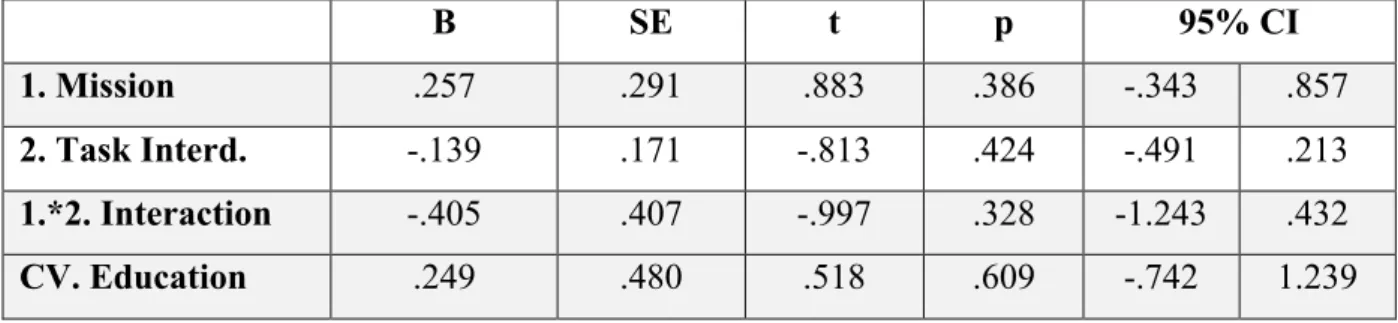
To analyze the moderation hypotheses H1c, H2c, H3a, and H4d, e, f, the Process Macro by Andrew F. Hayes was downloaded and used. Hypotheses H3a, and H4d, e, f showed no significant influence of the moderator task interdependence (see table 3 et seqq.). Thus, these hypotheses were not supported.
B SE t p 95% CI
1. Mission .257 .291 .883 .386 -.343 .857
2. Task Interd. -.139 .171 -.813 .424 -.491 .213
1.*2. Interaction -.405 .407 -.997 .328 -1.243 .432
CV. Education .249 .480 .518 .609 -.742 1.239
Table 3 Moderation analysis results H3a
B SE t p 95% CI
1. Self-Man. .514 .217 2.365 .026 -.066 .962
2. Task Interd. -.088 .151 -.582 .566 -.398 .223
CV. Education .283 .453 .625 .538 -.651 1.217
Table 4 Moderation analysis results H4d
B SE t p 95% CI
1. Self-Man. .620 .224 2.765 .011 -.158 1.082
2. Task Interd. -.271 .155 -1.740 .094 -.591 .049
1.*2. Interaction -.162 .299 -.539 .594 -.778 .455
CV. Education .058 .470 .123 .903 -.913 1.029
Table 5 Moderation analysis results H4e
B SE t p 95% CI
1. Self-Man. .724 .222 3.255 .003 .266 1.182
2. Task Interd. -.311 .154 -2.014 .055 -.628 .007
1.*2. Interaction .351 .297 -1.183 .248 -.260 .962
CV. Education -.444 .458 -.970 .342 -1.389 .501
Table 6 Moderation analysis results H4f
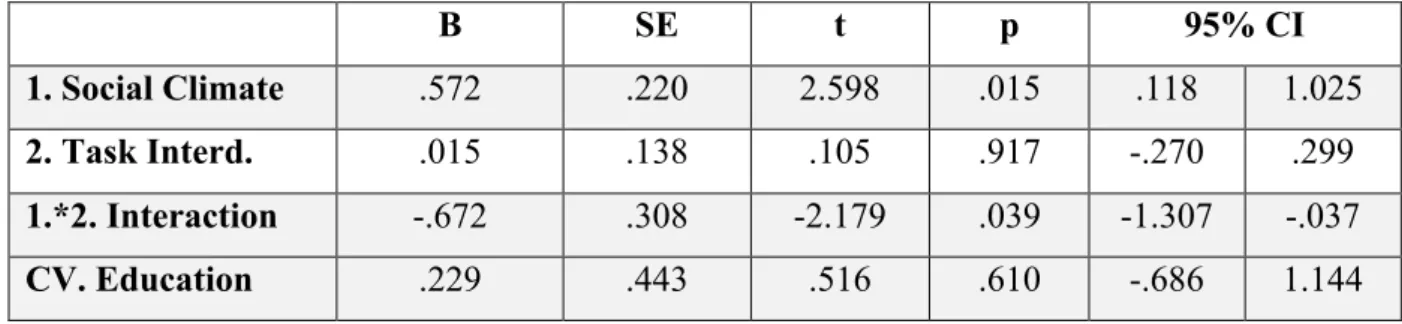
Hypotheses H1c and H2c showed a significant influence of the tested moderator for lower levels of task interdependence and were thus not supported. The results are summarized in table 7 and 8 below:
B SE t p 95% CI
1. Feedback .469 .183 2.561 .017 .092 .846
2. Task Interd. -.143 .149 -.958 .347 -.449 .164
1.*2. Interaction -.537 .209 -2.564 .017 -.968 -.1057
CV. Education .356 .430 .829 .415 -.531 1.243
Table 7 Moderation analysis results H1c
B SE t p 95% CI
1. Social Climate .572 .220 2.598 .015 .118 1.025
2. Task Interd. .015 .138 .105 .917 -.270 .299
1.*2. Interaction -.672 .308 -2.179 .039 -1.307 -.037
CV. Education .229 .443 .516 .610 -.686 1.144
For these two hypotheses, the variables were plotted (see figures 3 and 4), using a downloaded excel macro file created by Dawson (2006).
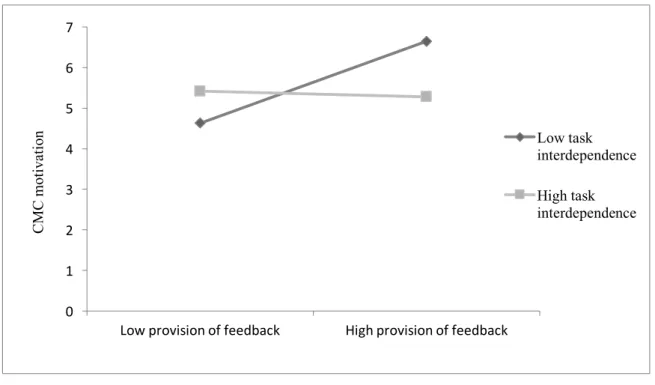
Examination of the interaction plot for H1c showed that the relationship between feedback and CMC motivation is moderated by task interdependence. However, only for lower levels of task interdependence (see figure 4).
Figure 4 Interaction Plot for H1c
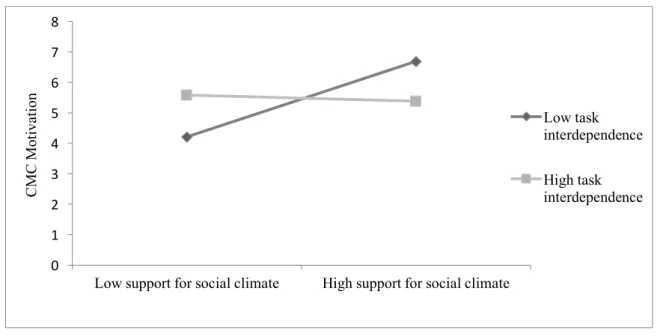
Examination of the interaction plot for H2c showed that the relationship between social climate and CMC motivation is moderated by task interdependence. However, only for lower levels of the moderator (see figure 5).
0 1 2 3 4 5 6 7 Low provision of feedback High provision of feedback C M C m ot iva ti on Low task interdependence High task interdependence
Figure 5 Interaction Plot for H2c
Hence, the following overview of the (non-) support of hypotheses arises:
Hypotheses
Support
H1. The more the leader of the team provides feedback on how well team members
communicate using CMC tools, the more the team members will develop (a.) CMC knowledge and (b.) CMC motivation.
Not supported
H1c: The more the leader gives feedback on team members’ CMC usage, the more team
members will develop CMC motivation, particularly when the team is highly interdependent.
Not supported
H2. The more the leader supports the social climate, the more team members will develop
(a.) CMC motivation and (b.) CMC knowledge.
Not supported
H2c: The more the leader supports social climate, the more team members will develop
CMC motivation, particularly when the team is highly interdependent.
Not supported
H3. The more the leader states the mission within a team, the more team members will
develop the CMC knowledge.
Supported
H3a. The more the leader states the mission within a team, the more team members will
develop the CMC knowledge, particularly when the team is highly interdependent.
Not supported
H4a. The more the leader encourages self-management within a team, the more team
members will develop CMC motivation.
Supported
H4b. The more the leader encourages self-management within a team, the more team
members will develop CMC knowledge.
Supported
H4c. The more the leader encourages self-management within a team, the more team
members will develop CMC skills.
Supported
H4d. The more the leader encourages self-management within a team, the more team
members will develop CMC motivation, particularly when the team is highly
Not supported 0 1 2 3 4 5 6 7 8
Low support for social climate High support for social climate
C M C M ot iva ti on Low task interdependence High task interdependence
interdependent.
H4e. The more the leader encourages self-management within a team, the more team
members will develop CMC knowledge, particularly when the team is highly interdependent.
Not supported
H4f. The more the leader encourages self-management within a team, the more team
members will develop CMC skills, particularly when the team is highly interdependent.
Not supported
4. Discussion
This study examines the effects of four different leadership functions upon three CMC competences under consideration of task interdependence as a moderator. For two leadership functions, i.e. the leader provides feedback as well as supports the social climate within a team, there was no significant support found in the statistical analysis, suggesting that these leadership functions show no influence on the particular CMC competences considered. However, for two leadership functions, i.e. the leader states the mission as well as encourages team self-management, there was significant support in the hypotheses (H3; H4a; H4b; H4c) found.
The lack of influence of a team’s social climate is contradictory to past research findings on the effects of social climate within teams, where it was found to - amongst other effects - encourage team members to experiment with new ways of approaching things (Anderson and West, 1998; Edmondson, 1999), thereby enhancing the degree of innovation (Amabile et al., 1996), and support open communication in which feedback and views are shared (Edmondson, 1999), being a psychologically safe place for team members (Choi, Price and Vinokur, 2003). Furthermore, it goes against Liang et al’s (2010) finding of social climate having a significant influence on team member’s use of technology and likewise encouraged sharing of knowledge. However, as research on social climate in virtual teams is still scare, these existing findings were based on traditional teams and taken as a base for this study on virtual teams. The given result of supporting the social climate within virtual teams having no influence on CMC competences might be because virtual team members do not feel the necessity of having a positive social climate to complete a task. Most of the times virtual teams are set up to accomplish a certain goal, being established for a finite period, thus, team members might have the accomplishment of the defined goal in mind rather than bonding with their peers. Additionally, it might be hard for virtual teams to effectively set up a good team climate without seeing each other face-to-face and only via CMC tools which are characterized by having less team-related contents but more task-related ones (Chidambaram, 1996).
Likewise, to the contradictory results found in the support of social climate, the provision of feedback shows no influence on any CMC competence too. It goes against researchers’ findings of feedback - being provided in virtual teams - having a positive effect on the usage of CMC tools (Geister, Konradt and Hertel, 2006) and on showing increased participation within the team (Zumbach et al., 2002). Possible reasons for this result could be
the impersonal atmosphere that many virtual teams are facing when communicating via CMC competences and thus, there might be the possibility of team members’ indifference of feedback. Additionally, as the teams that participated within this study have a formal, external leader, team members might feel that the leader is not able to provide correct feedback as he/she communicates with the team only occasionally. Here, the idea comes to mind whether feedback would influence CMC competences if it was provided immediately by team members themselves as they might be the ones to do so the most accurately.
In line with initial thoughts on a mission statement’s influence on CMC knowledge within a team, there was support found in H3 (ß=.464; p<.05). Hence, past research findings of a mission statement e.g. stressing desired goals and required competencies to achieve a desired goal (Emery, 1996) were underlined.
Likewise, hypotheses H4a (ß=.401; p<.05), H4b (ß=.388; p<.05), and H4c (ß=.452; p<.05) were supported, thus, suggesting that a leader’s encouragement of team self-management has a significant, positive influence on each of the three CMC competences. This result might be strongly influenced by the fact that the leader of the virtual teams that participated in the survey is an external leader who is not actively engaged into team members’ work. Further, virtual teams are lacking direct face-to-face supervision, hence, there is a natural need of self-management within the team with the aim of accomplishing the desired goal.
Regarding the moderating effect of task interdependence, there was no significant influence within 4 hypotheses (H3a; H4d; H4e; H4f) found.
For H1c there was a significant moderating role of low levels of task interdependence in the relationship between the provision of feedback and CMC motivation found. However, this result was found in the opposite direction than expected: lower levels of task interdependence lead to a significant influence on the relationship between the provision of feedback and CMC motivation. Thus, when team members are less dependent on each other, a leader’s provision of feedback positively influences team members’ motivation to use CMC tools. This might be the case as individuals might perceive that the given feedback is solely assessing their own, individual performance, thus, they feel personally approached and might have higher motivation to enhance their competences.
Likewise, for H2c there was a significant moderating role of low levels of task interdependence in the relationship between the support of social climate and CMC motivation found. Simultaneously to H1c, the moderating effect was found in the opposite direction than expected: lower levels of task interdependence lead to a significant influence on