Knowledge and attitudes towards dementia
in a sample of medical residents from a
university-hospital in São Paulo, Brazil
Alessandro Ferrari Jacinto1, Paulo José Fortes Villas Boas1, Vânia Ferreira de Sá Mayoral2, Vanessa de Albuquerque Citero3
ABSTRACT. An estimated 61% of the 24.3 million people diagnosed with dementia worldwide live in underdeveloped countries, including Brazil, where a public healthcare system covers the majority of the population. This care is usually provided by General Practitioners (GP) and in Brazil many doctors recently graduated from medical school and residents of different medical specialties practice as GPs. Objective: The aim of this study was to describe the knowledge and attitudes about dementia in a sample of Brazilian medical residents from a university-hospital in São Paulo, Brazil.
Methods: A total of 152 Brazilian medical residents participated in the study. Participants answered a “Knowledge Quiz” (KQ) and “Attitude Quiz” (AQ) about dementia issues, transculturally adapted for use in Brazilian physicians. A descriptive analysis of the correct answers on knowledge and of the attitude aspects was performed. Results: The medical residents showed poor knowledge (<50%) about dementia prevalence and incidence and a good knowledge on disease management and diagnosis. Participants tended to be optimistic about caring for demented patients. Conclusion:
In this study, it is likely that the physicians’ good knowledge about dementia issues is the reason for their optimism dealing with demented patients.
Key words: health knowledge, attitudes, general practitioners, aged, dementia.
CONHECIMENTOS E ATITUDES SOBRE DEMÊNCIA POR PARTE DE UMA AMOSTRA DE RESIDENTES DE UM HOSPITAL UNIVERSITÁRIO DE SÃO PAULO, BRASIL
RESUMO. Estima-se que 61% dos 24,3 milhões de pessoas diagnosticadas com demência no mundo vivem em países subdesenvolvidos, incluindo o Brasil, onde o sistema público de saúde (SUS) abrange a maioria da população. Os atendimentos médicos no SUS são realizados, habitualmente, por médicos generalistas. No Brasil, muitos médicos, logo após a graduação e residentes de diferentes especialidades médicas trabalham como médicos generalistas. Objetivo:
O objetivo deste estudo foi descrever o conhecimento e as atitudes sobre demência em uma amostra de médicos residentes brasileiros de um hospital universitário em São Paulo, Brasil. Métodos: 152 médicos residentes participaram do estudo respondendo a um instrumento sobre conhecimentos e atitudes sobre demências que havia sido adaptado transculturalmente para ser usado no Brasil. Uma análise descritiva das respostas corretas sobre conhecimentos e atitudes foi realizada. Resultados: Os médicos residentes mostraram pouco conhecimento (<50%) sobre a prevalência e incidência de demência e maior conhecimento em gerenciamento e diagnóstico. Os profissionais tenderam a ser otimistas sobre como cuidar de pacientes com demência. Conclusão: Neste estudo, provavelmente, o bom conhecimento sobre algumas questões de demência é a razão para esses médicos sentirem-se mais otimistas com o cuidado aos pacientes com demência.
Palavras-chave: conhecimento, atitude, clínicos gerais, idoso, demência.
INTRODUCTION
T
he prevalence of dementia in Brazil hasincreased with the rapid aging of its
popu-lation.1 An estimated 61% of the 24.3 million
people diagnosed with dementia worldwide live in underdeveloped countries.2
This study was conducted at the Psychiatry Department, Escola Paulista de Medicina – UNIFESP, São Paulo SP, Brazil.
1MD, PhD Associate Professor, Internal Medicine Department, Faculdade de Medicina de Botucatu – UNESP, Botucatu SP, Brazil. 2MD Geriatrician, Internal Medicine
Department, Faculdade de Medicina de Botucatu – UNESP, Botucatu SP, Brazil. 3MD, PhD Psychiatrist, Psychiatry Department, Escola Paulista de Medicina –
UNIFESP, São Paulo SP, Brazil.
Alessandro Ferrari Jacinto. Rua Cabo Antonio Trovão, 374 – 18609-350 Botucatu SP – Brazil. E-mail: [email protected]
Disclosure: The authors report no conflits of interest.
Received October 02, 2015. Accepted in final form December 04, 2015.
Brazil has a public healthcare system that covers the majority of its population. Most older people in Brazil are cared for by General Practitioners (GP) who play an important role in the diagnosis and treatment of diseases prevalent in this population, such as dementia.3
However, GPs often overlook cognitive impairment (CI) in older people, especially during its early stages.4-7
he lack of CI detection by GPs has been studied in sev-eral countries but in Brazil only one study has published data on this issue.8 It is unclear whether early detection
of dementia improves patient outcomes, although spe-cialist medical societies recommend dementia screening as part of the global geriatric assessment.9,10
In Brazil, many doctors shortly after medical school graduation and residents of diferent medical specialties practice as general practitioners. his situation raises an important question: are these professionals suiciently prepared to deal with demented older patients?
he aim of this study was to describe the knowledge and the attitudes about dementia in a sample of Brazilian residents from a university-hospital in São Paulo, Brazil.
METHODS
his cross-sectional study was run in March 2014. he convenience sample comprised irst-year medical resi-dents from residence programs of the Escola Paulista
de Medicina, Universidade Federal de São Paulo,Brazil
(UNIFESP), a Brazilian public university. All 152 medical residents who attended the “Welcome session” for new residents were included in the study (comprising 32% of the total 471 irst-year residents).
he setting for this study was chosen for two reasons. First, many residents had recently graduated from medi-cal school (less than three months), allowing the obten-tion of informaobten-tion about undergraduate teaching on dementia. Second, irrespective of residence programs, many residents were about to practice as GPs in the Bra-zilian public and private health systems for extra income, since their residence scholarships were insuicient for an adequate standard of living in the relatively expen-sive city of São Paulo. Many residents choose to work as GPs for a couple of years after graduating from Medical School, before joining residency programs later.11
he physicians were assessed by an instrument that included a “Knowledge Quiz” and an “Attitude Quiz” about dementia issues previously used with UK general practitioners in the study by Turner et al.12 he
Knowl-edge Quiz (KQ) has 14 tests with ive possible multiple choice answers, including “I don’t know”, only one of which is correct. his questionnaire has three domains about dementia epidemiology, diagnosis and
manage-ment. he Attitude Quiz (AQ) contains 10 statements conveying physicians’ thoughts on the management of demented patients graded on a 5-point Likert-type scale (from “strongly agree” to “strongly disagree”). he KQ and AQ were translated, back-translated and culturally adapted for use in Brazil, where this process has been
described elsewhere.13 he sample of residents also
answered a semi-structured questionnaire regarding sev-eral aspects of dementia teaching during undergraduate medical training.
his project was approved by the Research Ethics Committee of the Escola Paulista de Medicina, Universi-dade Federal de São Paulo, Brazil.
Statistical analysis. Descriptive analyses were performed for all variables.
RESULTS
Physicians’ mean age was 26 (±2.2) years. Forty-eight subjects (31.6%) were starting residence programs at the same medical school where they graduated (UNIFESP) while the remaining doctors were from 57 other Brazilian medical schools; 74 (48.1%) doctors had grad-uated within the last year. Sixty-one medical residents (40.8%) were from programs related to care of dementia patients (Neurology, Geriatrics, Psychiatry and Internal Medicine). he other medical residents were from surgery programs and other clinical subspecialties.
Table 1 shows the results of the doctors’ opinions on characteristics regarding dementia teaching. Of the 152 residents assessed, 79(52%) stated they received some training on dementia during medical school.
Table 1. Frequency of doctors’ answers on dementia teaching during
medical school
N %
There was dementia teaching during medical school
Yes
Theoretical only Theoretical and practical
79 22 57
52.0 14.5 37.5
No 69 40.1
Missing 4 2.6
Attended extra-curricular course on dementia during medical school
Yes 7 4.6
No 141 92.8
Missing 4 2.6
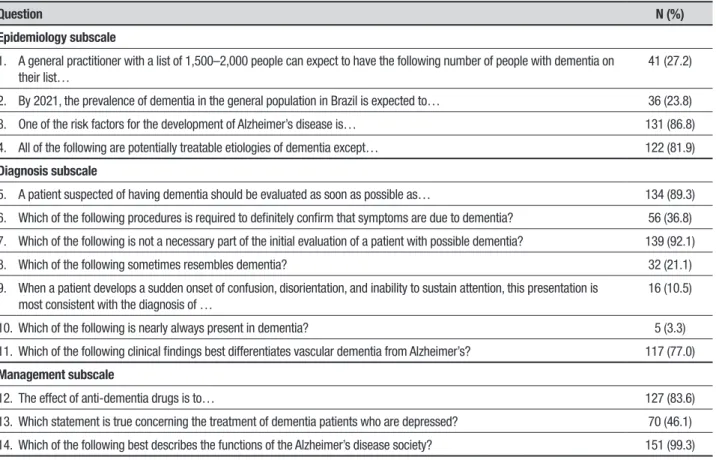
Table 2 shows the distribution of the correct answers on the Knowledge Quiz. With regard to epidemiology, diagnosis and management sub scales, 54.9, 58.7 and 76.3% of the sample, respectively, answered the ques-tions correctly. On the epidemiology subscale, the two questions about prevalence and incidence aspects (Ques-tions 1 and 2) had a low percentage of right answers but a good level of knowledge on etiology and risk factors of dementia (Questions 3 and 4) was exhibited by the medi-cal residents (over 80% correct). he diagnostic subsmedi-cale has 3 questions about diagnostic evaluation (Questions 5, 6 and 7) and a high percentage of correct answers on two of these was noted. he other four questions from this subscale concern symptoms of the disease, and knowledge about this was low. On the management subscale, the medical residents showed a high level of knowledge of antidementia drugs but had diiculty in treating dementia and depression as comorbidities.
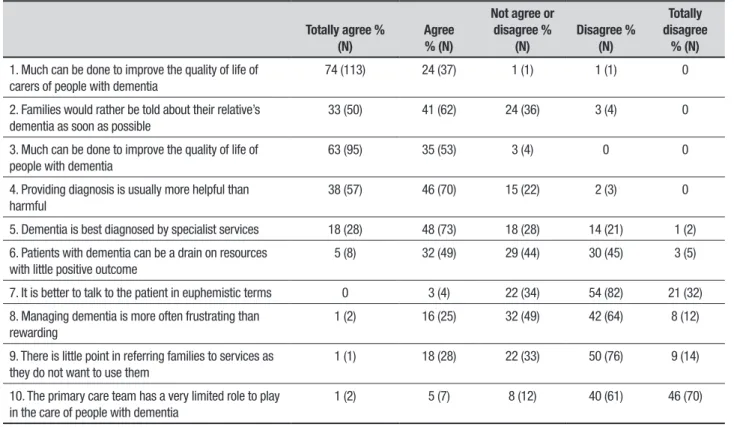
Table 3 shows the distribution of the attitudes of the medical residents about treating demented patients. On 9 out of the 10 questions, attitudes toward dementia in older patients was optimistic: medical doctors felt able to help both patient and caregiver in primary care. By con-trast, on the 5th statement (“dementia is best diagnosed
by specialist services”), 66% of the residents agreed that a specialized service is better than primary care for diag-nosing dementia.
DISCUSSION
Although designed to assess attitudes toward and knowledge of dementia in General Practitioners from the United Kingdom, these instruments seemed adequate for the same purpose among Brazilian physi-cians, providing a basic assessment of the topics.
In Brazil, the medical doctors were more conident managing and diagnosing dementia than understanding the epidemiologic issues about the disease. Considering the setting of a primary care delivery service, the medical residents showed good performance for patient care and good knowledge. It seems that recently graduated phy-sicians are being adequately prepared to deal with this important condition. he comorbidity between depres-sion and dementia is a prevalent aspect requiring more emphasis during medical training.
It is likely that the good knowledge about demen-tia is the reason for medical doctors’ optimism dealing with demented patients in primary care. Considering that 60% of the study sample comprised medical
resi-Table 2. Distribution of correct answers on the Knowledge Quiz.
Question N (%)
Epidemiology subscale
1. A general practitioner with a list of 1,500–2,000 people can expect to have the following number of people with dementia on their list…
41 (27.2)
2. By 2021, the prevalence of dementia in the general population in Brazil is expected to… 36 (23.8)
3. One of the risk factors for the development of Alzheimer’s disease is… 131 (86.8)
4. All of the following are potentially treatable etiologies of dementia except… 122 (81.9)
Diagnosis subscale
5. A patient suspected of having dementia should be evaluated as soon as possible as… 134 (89.3)
6. Which of the following procedures is required to definitely confirm that symptoms are due to dementia? 56 (36.8)
7. Which of the following is not a necessary part of the initial evaluation of a patient with possible dementia? 139 (92.1)
8. Which of the following sometimes resembles dementia? 32 (21.1)
9. When a patient develops a sudden onset of confusion, disorientation, and inability to sustain attention, this presentation is most consistent with the diagnosis of …
16 (10.5)
10. Which of the following is nearly always present in dementia? 5 (3.3)
11. Which of the following clinical findings best differentiates vascular dementia from Alzheimer’s? 117 (77.0)
Management subscale
12. The effect of anti-dementia drugs is to… 127 (83.6)
13. Which statement is true concerning the treatment of dementia patients who are depressed? 70 (46.1)
dents from programs not related to the care of dementia patients, these optimistic attitudes may relect a good foundation on the issue during medical school.
In the United Kingdom, akin to Brazil, General Prac-titioners are responsible for treating the majority of people diagnosed with dementia, representing a prime example of a public health care system strongly centered
on primary care.14 he UK National Dementia Strategy
has highlighted gaps in the knowledge and skills of pri-mary care professionals regarding the care of patients with dementia.15 Tullo et al., after applying a
question-naire about teaching and learning on dementia to 23 of the UK’s 31 medical schools, found a lack of consensus
among medical schools on how to teach dementia.16
In Brazil, as is the case for most countries world-wide, there is scant information on the education given to medical students about dementia during medical school.17,18 One report from a survey applied in a public
medical school showed that 61.7% of the medical stu-dents received no training in Geriatrics.19 Another study
showed that 42% of Brazilian medical schools provided teaching in Geriatrics.20
his study has several limitations. Since only one
sample of residents from a single university-hospital was analyzed, it was not possible to glean a clear picture of dementia teaching in the numerous Brazilian medi-cal schools. Considering the diferences found between Brazilian and British doctors’ attitudes, no further con-clusions can be drawn since these two populations dif-fer in many aspects, such as graduation time and age, besides the type of medical education received during their careers.
In conclusion, this study revealed important aspects regarding dementia issues and can serve as a basis for further discussions about dementia teaching in Brazil.
Acknowledgements. We extend our thanks to Steve Ilife for allowing us to culturally adapt the “Knowledge Quiz and the Attitudes Quiz” for use in Brazil and also for revising the article.
Author contributions. Alessandro Ferrari Jacinto and Vanessa de Albuquerque Citero participated in the study design, obtained the data and wrote the manuscript. Paulo José Fortes Villas Bôas and Vania Ferreira de Sá Mayoral revised the paper.
Table 3. Distribution of answers on the Attitude Quiz.
Totally agree % (N)
Agree % (N)
Not agree or disagree %
(N)
Disagree % (N)
Totally disagree
% (N)
1. Much can be done to improve the quality of life of carers of people with dementia
74 (113) 24 (37) 1 (1) 1 (1) 0
2. Families would rather be told about their relative’s dementia as soon as possible
33 (50) 41 (62) 24 (36) 3 (4) 0
3. Much can be done to improve the quality of life of people with dementia
63 (95) 35 (53) 3 (4) 0 0
4. Providing diagnosis is usually more helpful than harmful
38 (57) 46 (70) 15 (22) 2 (3) 0
5. Dementia is best diagnosed by specialist services 18 (28) 48 (73) 18 (28) 14 (21) 1 (2)
6. Patients with dementia can be a drain on resources with little positive outcome
5 (8) 32 (49) 29 (44) 30 (45) 3 (5)
7. It is better to talk to the patient in euphemistic terms 0 3 (4) 22 (34) 54 (82) 21 (32)
8. Managing dementia is more often frustrating than rewarding
1 (2) 16 (25) 32 (49) 42 (64) 8 (12)
9. There is little point in referring families to services as they do not want to use them
1 (1) 18 (28) 22 (33) 50 (76) 9 (14)
10. The primary care team has a very limited role to play in the care of people with dementia
REFERENCES
1. Rizzi L, Rosset I, Roriz-Cruz M. Global epidemiology of dementia: Alzheimer’s and vascular types. Biomed Res Int 2014;2014:908915. 2. Ferri CP, Prince M, Brayne C, et al. Global prevalence of dementia: a
Delphi consensus study. Lancet 2005;366(9503):112-17.
3. World Health Organization. (2006). Genebra. Neurological Disor-ders: public health challenges. Available from: http://www.who.int/ mental_health/neurology/neurodiso/en/
4. Finkel SI. Cognitive screening in the primary care setting: the role of physicians at the first point entry. Geriatrics 2003;58:43-44.
5. Gifford DR, Cummings JL. Rating dementia screening tests: methodo-logic standards to rate their performance. Neurology 1999;52:224-227. 6. Lorentz WJ, Scanian JM. Brief screening tests for dementia. Can J
Psychiatry 2002;47:723-733.
7. Valcour VG, Masaki H, Curb JD, Blanchette PL. The detection of dementia in the primary care setting. Arch Int Med 2000;160:2964-2968. 8. Jacinto AF, Brucki SMD, Porto CS, Martins MA, Nitrini R. Detection of
cognitive impairment in the elderly by general internists in Brazil. Clinics 2011;66:1379-1384.
9. Lin JS, O’Connor E, Rossom RC, Perdue LA, Eckstrom E. Screening for cognitive impairment in older adults: a systematic review for the US Preventive Services Task Force. An Int Med 2013;159:601-612. 10. Borson S, Frank L, Bayley PJ, et al. Improving dementia care: The role
of screening and detection of cognitive impairment. Alzheimers Dement 2013;9:151-159.
11. Acompanhe o dia a dia de residentes de medicina em São Paulo. (2010). Entre os ensinamentos dessa fase da carreira está descobrir que não são super-heróis. Available from: http://vejasp.abril.com.br/materia/
acompanhe-dia-dia-de-residentes-de-medicina-em-sao-paulo. [Citado 07 Dezembro 2010].
12. Turner S, Iliffe S, Downs M, et al. General practitioners’ knowledge, confi-dence and attitudes in the diagnosis and management of dementia. Age Ageing 2004;33:461-467.
13. Jacinto AF, Oliveria EC, Citero VA. Brazilian transcultural adaptation of an instrument on physicians’ knowledge and attitudes towards dementia. Dement Neuropsychol 2015;9:245-250.
14. National Health System. (2015). Available from: http://www.england.nhs. uk/. [cited 2015 January].
15. Department of Health, London 2009. Living well with dementia: A National Dementia Strategy. Available from: https://www.gov.uk/ government/uploads/system/uploads/attachment_data/file/168220/ dh_094051.pdf [Citado 03 February 2009].
16. Tullo ES, Gordon AL. Teaching and learning about dementia in UK medical schools: a national survey. BMC Geriatrics 2013;13:29. 17. Tsolaki M, Papaliagkas V, Anogianakis G, et al. European Alzheimer
Disease Consortium: Consensus statement on dementia education and training in Europe. J Nutr Health Ageing 2010;14:131-135.
18. Keller I, Makipaa A, Kalenscher T, Kalache A. A global survey on geriat-rics in the medical curriculum. 2002. Geneva, World Health Organization. 19. Tavares DMS, Ribeiro KB, Silva CC, Montanholi LL. Ensino de geron-tologia e geriatria: uma necessidade para os acadêmicos da área de saúde da universidade federal do triângulo mineiro. Cienc Cuid Saude 2008;7:537-545.