Hemoglobinopathies in newborns
from Salvador, Bahia, Northeast Brazil
Hemoglobinopatias em recém-nascidos
de Salvador, Bahia, Nordeste do Brasil
1 Centro de Pesquisas Gonçalo Moniz, Fundação Oswaldo Cruz, Salvador, Brasil. 2 Faculdade de Farmácia, Universidade Federal da Bahia, Salvador, Brasil. 3 Faculdade Medicina, Universidade Federal da Bahia, Salvador, Brasil.
Correspondence M. S. Gonçalves Laboratório de Patologia e Biologia Molecular, Centro de Pesquisas Gonçalo Moniz, Fundação Oswaldo Cruz. Rua Waldemar Falcão 121, Salvador, BA
40295-001, Brasil. [email protected]
Elisângela Vitória Adorno 1 Fábio David Couto 1 José Pereira de Moura Neto 1 Joelma Figueiredo Menezes 2 Marco Rêgo 3
Mitermayer Galvão dos Reis 1 Marilda Souza Gonçalves 1,2
Abstract
Hemoglobinopathies are hereditary disorders of the hemoglobin molecule with a high preva-lence worldwide. Brazil has a prevapreva-lence of 0.1 to 0.3% of newborns with sickle cell anemia and 20.0 to 25.0% of heterozygous α2thalassemia among African Brazilians. In the present study, we investigated the presence of variant hemo-globins and α23.7 Kband α24.2 Kbthalassemia in newborns from Salvador, Bahia, Brazil. Samples of umbilical cord blood from a total of 590 new-borns were analyzed, of which 57 (9.8%) were FAS; 36 (6.5%) FAC; one (0.2%) SF; and five (0.9%) FSC. One hundred fourteen (22.2%) new-borns had α23.7 Kbthalassemia, of whom 101 (19.7%) were heterozygous and 13 (2.5%) ho-mozygous, showing statistical significance for hematological data between newborns with normal αgenes and α23.7 Kbthalassemia carri-ers. The α24.2 Kbthalassemia was not found. Fre-quencies found in the present study confirm that hemoglobinopathies are a public health problem in Brazil, emphasizing the need for neonatal screening and genetic counseling pro-grams.
Hemoglobinopathies; Sickle Cell Anemia; Tha-lassemia; Newborn Infant
Introduction
Hemoglobinopathies are genetic globin gene disorders, characterized by the presence of vari-ant hemoglobin and a decrease or absence of globin chain synthesis, known as thalassemia 1,2.
Hemoglobin S is the most common variant hemoglobin, and results from a single amino acid substitution of valine for glutamic acid at the sixth position of the β-globin chain; sickle cell anemia carriers are characterized by ho-mozygosity of S hemoglobin. The hemoglobin S gene has a high frequency among Africans and African descendents, as well as in India, Greece, and the United States 3. Primary
stud-ies in Brazil revealed a high prevalence of he-moglobin disorders. The sickle cell trait (AS) was reported in 6.6% of blacks in the State of São Paulo, in Southeast Brazil 4. When the study
was extended to the general population, fre-quencies of 2.7% of AS and 0.09% of sickle cell disease (0.07 % HbSS and 0.02% HbSC) were observed. These frequencies varied widely ac-cording to the degree of racial admixture in the different regions of the country. In the South of Brazil, a frequency of 1.2% of HbS gene was shown among newborns 5. On the other hand,
in the Northeast, frequencies of 5.1% of sickle cell trait (FAS) and 0.2% with sickle cell disease (FSC) were reported among newborns in the State of Pernambuco 6and the State of Bahia,
to 15.7%, according to the population group studied 7.
Hemoglobin C (HbC) is a variant hemoglobin in which lysine replaces glutamic acid at the sixth amino acid position of the β-globin chain
2. HbC has a prevalence of 3% among
African-Americans and about 1-3% among Puerto Ri-cans 8,9. In Brazil, HbC is the second most
com-mon variant hemoglobin and has been found around 2.2% to 5.2% when the heterozygous genotype (AC) has been considered in Bahia 7.
Thalassemia syndromes are found world-wide, especially α- and β-thalassemia 10,11. In
Southeast Brazil, a frequency of 1.3% of β -tha-lassemia trait and 0.1% of β-thalassemia major was reported for the general population 12,
while α2-thalassemia by a 3.7 kb DNA deletion
(α23.7Kb-thalessemia) varied from 20.0% to 25.0%
in black populations 13, and Borges et al. 14
found 49.9% of α-thalassemia in adult outpa-tients seen at the University of Campinas Hos-pital with microcytosis and hypochromia with-out anemia. In the Northeast, α23.7Kb
-tha-lessemia was investigated in 106 pregnant women with AC and AA hemoglobin pattern, showing a 21.7% heterozygous and 0.9% ho-mozygous rate for this alteration 15.
The Consensus Conference Panel convened by the National Institutes of Health (United States) in 1987 recommended newborn screen-ing for hemoglobinopathies in order to de-crease morbidity and mortality associated with sickle cell disease. Streptococcus pneumoniaeis a common cause of death in sickle cell patients and the early diagnosis of sickle cell disease could alert clinicians to potential clinical com-plications of the disease and allow prompt clin-ical care and prophylactic therapy with vac-cines and antibiotics 16,17.
In Brazil, not all States have consolidated neonatal screening programs for hemoglo-binopathies, despite a ruling mandating them by the Ministry of Health in June 2001 (Portaria GM/MS 822 – Diário Oficial da União 2001; 7 jun). The sickle cell disease screening program in Minas Gerais State was considered a model for South America by Serjeant 18. This program
found 3.2% of screened babies with sickle cell trait, 1.3% heterozygous for HbC, and 0.08% with sickle cell disease. Other States have de-veloped excellent newborn screening pro-grams, such as Bahia, Pernambuco, Maranhão, the Federal District (Brasília), São Paulo, Rio de Janeiro, Espírito Santo, Santa Catarina, Paraná, Mato Grosso do Sul, and Rio Grande do Sul
(Technical Advisory Group on Neonatal Screen-ing, Ministry of Health, Brazil). In California (United States), a newborn hemoglobinopathy screening program evaluated two million new-borns and found 492 with sickle cell disease, while 290 had hemoglobinopathy SS, 143 SC, and 47 Sβ+thalassemia 19. The screening
pro-grams’ implementation is an important step for increasing survival, reducing hospitaliza-tion, and minimizing expenses associated with sickle cell disease 20,21. Based on the high
fre-quency of hemoglobinopathies in Salvador, Bahia, Brazil, we investigated the presence of variant hemoglobin and α23.7 Kband α24.2 Kb
thalassemias among newborns babies in order to identify potential associations between he-moglobin abnormalities and hematological characteristics.
Material and methods
Casuistic
From February to June 2000, a cross-sectional epidemiological study analyzed 590 neonates delivered by vaginal birth at the Tsylla Balbino Maternity Clinic located in Salvador, Bahia, Brazil. Information about newborns and gesta-tional age was obtained from mothers by a questionnaire and patient records.
Newborns with gestational age less than thir-ty-eight weeks were considered premature 22.
Racial composition was determined by obser-vation of facial characteristics and color of mam-millae and scrotum 23.
Samples
Umbilical cord blood samples were collected by midwives under supervision of maternity clinic physician staff. After clamping, blood was drawn into a Vacutainer tube (Becton-Dick-inson – Corkeysville, Maryland, United States) containing EDTA and transported to the Pathol-ogy and Molecular BiolPathol-ogy Laboratory, Gonça-lo Moniz Research Center, Oswaldo Cruz Foun-dation (FIOCRUZ). Hematological analysis was performed by automated cell counter (Coulter T-890 – Coulter Corporation, Florida, United States) and DNA was isolated from leukocytes (GFXTMGenomic Blood DNA Purification KIT –
Hemoglobin profile
Hemoglobin profile was analyzed by High Per-formance Liquid Chromatography – HPLC Vari-ant Hemoglobin Testing System (Bio-Rad Lab-oratories – California, United States). HPLC analyses were interpreted by comparing peak retention times with those obtained for the AFCS control, utilizing the sickle cell kit for he-moglobin screening in newborns.
α2-Thalassemia
The -α23.7Kband -α24.2deletions were identified
by polymerase chain reaction (PCR), using spe-cific primers and reaction conditions as previ-ously described 24.
Statistical analysis
The statistical analyses were conducted in the Epi Info software, version 6.04. Statistical sig-nificance was established at P≤0.05.
Ethical considerations
The study was approved by the Institutional Review Board/Ethics Committee of the Gonça-lo Moniz Research Center, FIOCRUZ, after the newborn’s parent or guardian had signed the informed consent form.
Results
The Tsylla Balbino Maternity Clinic is the largest public maternity ward in Salvador. During the study period, 2,958 children were born and 590 newborns (19.9% of total birth cohort) were analyzed, after statistical sample calculation. Of those analyzed, 63 (10.8%) had premature
delivery and 523 (89.2%) had normal gestation-al age; 296 (51.3%) were femgestation-ale and 281 (48.7%) male. Racial composition was determined for 578 babies: 98 (17.0%) were classified as white, 309 (53.4%) as mulatto, and 171 (29.6%) as black. Mean weight was 3.152 kg (± 0.530).
Hematological data and hemoglobin profiles
Hemoglobin profiles were determined in 581 of the 590 newborns: 480 (82.6%) had the normal profile FA, and 101 (17.4%) presented variant hemoglobins, of which 57 (9.8%) were heterozy-gous for HbS (FAS), and 38 (6.5%) were het-erozygous for HbC (FAC). One (0.2%) baby was homozygous for HbS (FS) and five (0.9%) were double heterozygous for HbS and HbC (FSC).
There was no statistical difference in the gestational ages of newborns with respect to normal and variant hemoglobin patterns. The racial distribution and hemoglobin types of 502 newborns are shown in Table 1. Of the 47 newborns found to have the FAS pattern, 24 (51.1%) were mulatto, 15 (31.9%) were black, and eight (17.0%) were white.
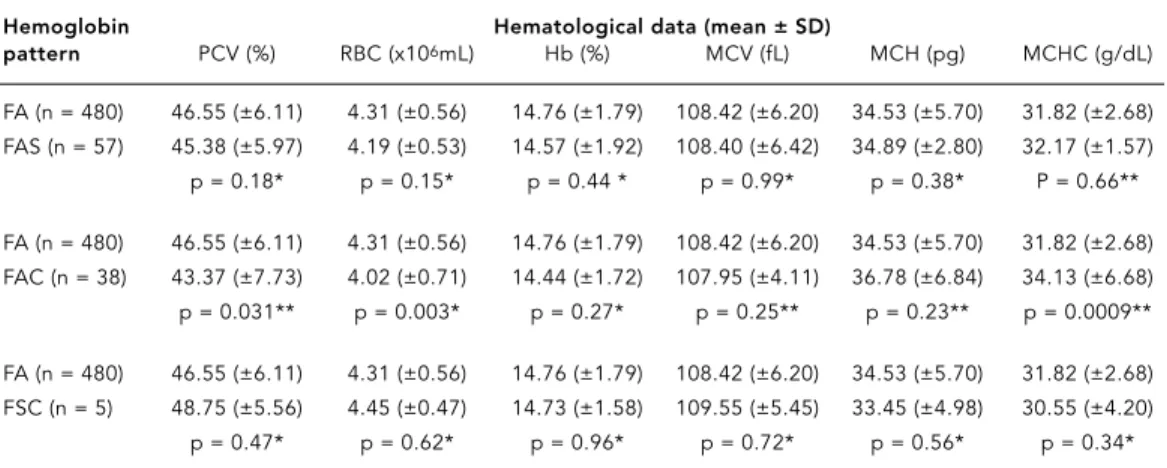
Newborns with normal and variant hemo-globin had statistically similar hematological characteristics, except for the FA and FAC groups, which were statistically different for PVC, RBC, and MCHC values, with p-values of 0.031, 0.003, and 0.0009, respectively (Table 2).
α2thalassemia analyses
Of the 590 newborns, 514 were analyzed for α2
thalassemia: 400 (77.8%) had normal α-genes (αα/αα) and 101 (19.7%) were heterozygous (α/αα) and 13 (2.5%) homozygous (-α/α-) for the α23.7Kbdeletion. There was no statistical
dif-ference between presence of α23.7Kbthalassemia
and premature delivery.
Table 1
Ethnic characteristics and hemoglobin frequencies in newborns from the Tsylla Balbino Maternity Clinic. Salvador, Bahia, Brazil.
Racial group Hemoglobin profile
FA FAS FAC FSC FS
n % n % n % n % n %
White (n = 86) 76 18.2 8 17.0 2 6.0 – – – –
Mulatto (n = 274) 227 54.4 24 51.1 19 57.6 3 75.0 – – Black (n = 142) 114 27.4 15 31.9 12 36.4 1 25.0 1 100.0
Among the 114 newborns identified as α23.7Kb
thalassemia carriers, 21 (18.4%) were whites, 57 (50.0%) were mulattos, and 36 (31.6%) blacks. Table 3 shows the statistical analysis of hema-tological parameters of newborns with normal
α-genes and α23.7Kbthalassemia carriers.
Analysis of hemoglobin profiles and pres-ence of α23.7Kbthalassemia was performed on
451 of 590 newborns. Of the 377 newborns with FA pattern, 295 (78.2%) had normal α-genes, 72 (19.1%) were heterozygous, and ten (2.7%) ho-mozygous.
Of the 43 newborns with FAS profile, 32 (74.4%) had normal α-genes, nine (20.9%) were
heterozygous, and two (4.7%) were homozy-gous; of the 27 newborns with pattern FAC, 22 (81.5%) had normal α-genes and five (18.5%) were heterozygous; among the four newborns with FSC pattern, three (75.0%) had normal α -genes and one (25.0%) was heterozygous for
α23.7Kbthalassemia. The newborn with FS
pat-tern had normal α-genes.
Table 4 shows the hematological data from newborns with normal and variant hemoglo-bin genotypes, as well as for α23.7Kbthalassemia
carriers.
There was no statistical difference in the hematological characteristics of newborns with
Table 2
Hematological data and hemoglobin profile among newborns from the Tsylla Balbino Maternity Clinic. Salvador, Bahia, Brazil.
Hemoglobin Hematological data (mean ± SD)
pattern PCV (%) RBC (x106mL) Hb (%) MCV (fL) MCH (pg) MCHC (g/dL)
FA (n = 480) 46.55 (±6.11) 4.31 (±0.56) 14.76 (±1.79) 108.42 (±6.20) 34.53 (±5.70) 31.82 (±2.68) FAS (n = 57) 45.38 (±5.97) 4.19 (±0.53) 14.57 (±1.92) 108.40 (±6.42) 34.89 (±2.80) 32.17 (±1.57) p = 0.18* p = 0.15* p = 0.44 * p = 0.99* p = 0.38* P = 0.66**
FA (n = 480) 46.55 (±6.11) 4.31 (±0.56) 14.76 (±1.79) 108.42 (±6.20) 34.53 (±5.70) 31.82 (±2.68) FAC (n = 38) 43.37 (±7.73) 4.02 (±0.71) 14.44 (±1.72) 107.95 (±4.11) 36.78 (±6.84) 34.13 (±6.68) p = 0.031** p = 0.003* p = 0.27* p = 0.25** p = 0.23** p = 0.0009**
FA (n = 480) 46.55 (±6.11) 4.31 (±0.56) 14.76 (±1.79) 108.42 (±6.20) 34.53 (±5.70) 31.82 (±2.68) FSC (n = 5) 48.75 (±5.56) 4.45 (±0.47) 14.73 (±1.58) 109.55 (±5.45) 33.45 (±4.98) 30.55 (±4.20) p = 0.47* p = 0.62* p = 0.96* p = 0.72* p = 0.56* p = 0.34*
* ANOVA; ** Kruskal-Wallis H.
PCV = Packed cell volume; RBC = Red blood cells; Hb = Hemoglobin; MCV = Mean cell volume; MCH = Mean cell hemoglobin; MCHC = Mean cell hemoglobin concentration.
Table 3
Hematological data and αgenes status among newborns from the Tsylla Balbino Maternity Clinic. Salvador, Bahia, Brazil.
Hematological data Normal α-genes -α23.7Kbthalassemia carriers P-value
(mean ± SD) (n = 400) (n = 114)
PCV (%) 46.98 (± 5.97) 44.90 (± 6.72) 0.002*
RBC (x 106/mL) 4.26 (± 0.54) 4.41 (± 0.65) 0.002**
Hb (g/dL) 14.09 (± 1.69) 14.26 (± 1.72) 0.00009*
MCV (fL) 110.23 (± 4.43) 102.78 (± 6.25) < 0.00001** MCH (pg) 35.36 (± 3.78) 32.64 (± 3.49) < 0.00001**
MCHC (g/dL) 32.10 (± 3.14) 31.76 (± 2.87) 0.30*
* ANOVA; ** Kruskal-Wallis H.
FA and FSC hemoglobin profile and thalassemia
α23.7Kbcarriers.
Discussion
The frequencies of variant hemoglobin found in this study (Hb FAS 9.8%; Hb FAC 6.5%; FS 0.2%, and FSC 0.9%) are the highest described in Brazil. The high frequencies of variant he-moglobin are probably due to the high rate of racial admixture in the Bahian population, with a strong African gene component introduced by the African slave trade in Brazil. Further-more, the Tsylla Balbino Maternity ward serves the majority of low-income women in Salva-dor, who are almost exclusively blacks or mu-lattos 23. Among the newborns analyzed, only
six (5 FSC and 1 FS) required special care, rep-resenting the symptomatic group that can de-velop severe clinical conditions and need early treatment. The 47 newborns identified as FAS displayed a racial distribution of 17.0% whites, 53.4% mulattos and 29.6% blacks. These varia-tions of racial distribution of hemoglobin S among the newborns groups highlight the need for universal neonatal hemoglobinopathy screen-ing in the Brazilian population. The compari-son of hematological data among newborns with HbC and those with normal hemoglobin showed statistical significance for PVC, RBC, and MCHC due to increased blood viscosity, demonstrating the influence of HbC on hema-tological parameters 8,9.
The high frequencies of α23.7Kbthalassemia
(heterozygous 19.7%; homozygous 2.5%) are similar to those found in previous studies con-ducted in Brazilian populations 11. The
pres-ence of α23.7Kbthalassemia was not associated
with premature delivery. However, van der Dijs et al. 25speculated that the presence of α
2
tha-lassemia could decrease the capacity to extract oxygen from maternal circulation and could thus be a contributing factor to early delivery of newborn α2thalassemia carriers. Newborns
with FAS and FAC pattern, such as the babies heterozygous for α23.7Kbthalassemia, did not
present symptoms of severe anemia. However, they still need genetic counseling 26.
We did not identify any newborns with
α24.2Kbthalassemia in our study, suggesting
that this type of thalassemia is rare or absent in Bahia. The frequency of α23.7Kb thalassemia
among FAS newborns (20.9% of which were heterozygous and 4.7% of which were homozy-gous) could be beneficial for these S hemoglo-bin carriers and for the sickle cell anemia pa-tients in Bahia. The α2 thalassemia is
consid-ered a beneficial factor, since this condition is associated with less severe clinical manifesta-tions among sickle cell disease carriers 8,9. It
decreases MCHC and the rate of hemolysis, re-sulting in higher Hb, PCV, and RBC values. Therefore, some complications such as leg ul-cers, renal pathology, and strokes become less frequent. However, the frequency of other com-plications such as osteonecrosis and retinopa-thy may be increased 27.
The comparison of hematological data among newborns with α-normal genes and those with α23.7Kbthalassemia showed
statisti-cal differences in all hematologistatisti-cal parameters analyzed, except for MCHC. The hematological analysis of newborns with FA and FAS hemo-globin groups and α23.7Kbthalassemia carriers
showed statistically significant differences in RBC and MCH; the comparison of the FA and FAC groups and α23.7Kb thalassemia carriers
Table 4
Hematological data and hemoglobin profile among newborns with α23.7Kbthalassemia from the Tsylla Balbino Maternity Clinic. Salvador, Bahia, Brazil.
Hemoglobin Hematological data (mean ± SD)
pattern PVC RBC (x106/mL) Hb (%) MCV (fL) MCH (pg) MCHC (g/dL)
FA (n = 82) 45.47 (± 5.96) 4.51 (±0.55) 14.38 (±1.47) 102.09 (±6.39) 32.08 (±2.67) 31.41 (±1.67) FAS (n = 11) 41.99 (± 8.15) 4.04 (±0.82) 13.63 (±2.41) 104.41 (±4.18) 34.16 (±4.03) 32.66 (±3.16) p = 0.09* p = 0.01* p = 0.47** p = 0.25* p = 0.03* p = 0.29**
FA (n = 82) 45.47 (±5.96) 4.51 (±0.55) 14.38 (±1.47) 102.09 (±6.37) 32.08 (±2.67) 31.41 (±1.67) FAC (n = 5) 39.10 (±11.79) 3.75 (±10.9) 13.56 (±2.30) 103.92 (±4.01) 39.09 (±9.30) 36.66 (±10.15)
p = 0.11** p = 0.11** p = 0.25* p = 0.53* p = 0.031** p = 0.018**
showed significant differences in MCH and MCHC. The hematological differences found between newborns with normal α-genes and
α23.7Kbthalassemia carriers could be
intensi-fied by the presence of variant hemoglobins. Furthermore, differentiation within the Bahian pediatric population needs to be developed in order to determine whether the presence of
α23.7Kbthalassemia could be responsible for
in-tensifying the hematological pattern of
ane-mia, especially in child with iron deficiency, avoiding erroneous therapy.
In Bahia, the presence of hemoglobino-pathies is a public health problem, and the ear-ly diagnosis of variant hemoglobin carriers pro-vides an opportunity for counseling and early clinical follow-up of the child, both of which contribute to reduce child morbidity and mor-tality rates.
Acknowledgments
We wish to thank all the parents for allowing their newborns to participate in the study, Dr. Edeltrudes do Espírito do Santo (head of the Tsylla Balbino Ma-ternity Clinic), the clinical staff who helped with sam-ple collection, and Craig Milroy and Fabíola Nasci-mento da Conceição, who reviewed the English ver-sion of this article.
Contributors
E. V. Adorno participated in the blood sample collec-tion in the hospital, hemoglobin analysis, DNA ex-traction, molecular analysis, and drafting of the man-uscript. F. D. Couto, J. F. Menezes and J. P. Moura Neto participated in the blood sample collection in the hospital, hemoglobin analysis, and DNA extraction. M. Rego participated in the statistical analysis. M. G. Reis participated in the interpretation of the results and drafting and revision of the manuscript. M. S. Gonçalves supervised the laboratory analysis, inter-pretation of the results, and drafting and revision of the manuscript.
Resumo
Hemoglobinopatias são alterações hereditárias na molécula de hemoglobina com prevalência mundial elevada. O Brasil apresenta prevalência de 0,1 a 0,3% para recém-nascidos com anemia falciforme e fre-qüência de 20,0 a 25,0% para a ocorrência de hete-rozigotos da talassemia α2entre indivíduos afro-des-cendentes. O presente estudo investigou a presença de hemoglobinas variantes e talassemia α23.7Kbe α24.2Kb em recém-nascidos de Salvador, Bahia, Brasil. Anali-samos o sangue do cordão umbilical de 590 recém-nascidos, sendo 57 (9,8%) com padrão FAS; 36 (6,5%) FAC; um (0,2%) SF e cinco (0,9%) FSC. Cento e catorze (22,2%) apresentaram talassemia α23.7Kb, dos quais 101 (19,7%) foram heterozigotos e 13 (2,5%) homozi-gotos, mostrando significância estatística para os da-dos hematológicos entre recém-nascida-dos com genes α
normais e portadores de talassemia α23.7Kb. A talas-semia α24.2Kbnão foi encontrada. As freqüências des-critas neste trabalho confirmam que as hemoglobi-nopatias são um problema de Saúde Pública no Bra-sil, enfatizando a importância dos programas de tria-gem neonatal e aconselhamento genético.
References
1. Weatherall DJ, Provan AB. Red cells I: inherited anaemias. Lancet 2000; 355:1169-75.
2. Bunn HF. Sickle hemoglobin and other hemoglo-bin mutants. In: Stamatoyannopoulos G, Nien-huis AW, Majerus PW, Varnus H, editors. The mol-ecular basis of blood diseases. Philadelphia: WB Saunders Co.; 1994. p. 207-56.
3. Embury SH. Sickle cell disease. In: Hoffman R, Benz Jr. EJ, Shattil EJ, Furie B, Cohen HJ, Silber-stein LE, editors. Hematology. New York: Churchill Livingstone; 1995. p. 611-40.
4. Ramalho AS, Jorge RN, Oliveira JA, Pedreira DA. Hemoglobina S em recém-nascidos brasileiros. J Pediatr 1976; 41:9-10.
5. Daudt LE, Zechmaister D, Portal L, Camargo Neto E, Silla LMR, Giugliani R. Triagem neonatal para hemoglobinopatias: um estudo piloto em Porto Alegre, Rio Grande do Sul, Brasil. Cad Saúde Pú-blica 2002; 18:833-41.
6. Bandeira FMGC, Leal MC, Souza RR, Furtado VC, Gomes YM, Marques NM. Características de re-cém-nascidos portadores de hemoglobina “S” detectados através de triagem em sangue de cor-dão umbilical. J Pediatr (Rio J) 1999; 75:167-71. 7. Azevêdo ES, Alves AFP, Silva MCBO, Souza MGF,
Lima AMVMD, Azevêdo WC. Distribution of ab-normal hemoglobins and glucose-6-phosphate dehydrogenase variants in 1200 school children of Bahia, Brazil. Am J Phys Anthropol 1980; 53:509-12.
8. Lukens JN. The abnormal hemoglobins: general principles. In: Lee CW, Foster J, Lukens J, Paraskevas F, Greer JP, Rodgers GM, editors. Win-trobe’s Clinical Hematology. Baltimore: Williams & Wilkins; 1999. p. 1329-45.
9. Lukens JN. Thalassemia and related disorders: quantitative disorders of hemoglobin synthesis. In: Lee CW, Foster J, Lukens J, Paraskevas F, Greer JP, Rodgers GM, editors. Wintrobe’s Clinical Hema-tology. Baltimore: Williams & Wilkins; 1999. p. 1405-48.
10. Steinberg MH, Embury SH. α-Thalassemia in blacks: genetic and clinical aspects and interac-tions with the sickle hemoglobin gene. Blood 1986; 68:985-90.
11. Wenning MRSC, Kimura EM, Costa FF, Saad STO, Gervásio S, De Jorge SB, et al. α-Globin genes: thalassemic and structural alterations in a Brazil-ian population. Braz J Med Biol Res 2000; 33: 1041-5.
12. Ramalho AS, Silva RBP, Teixeira RC, Compri MB. Hemoglobin screening: response of a Brazilian community to optional programs. Cad Saúde Pú-blica 1999; 15:591-5.
13. Sonati MF, Farah SB, Ramalho AS, Costa FF. High prevalence of alpha-thalassemia in a black popu-lation of Brazil. Hemoglobin 1991; 15:309-11.
14. Borges E, Wenning MRSC, Kimura EM, Gervásio SA, Costa FF, Sonati MF. High prevalence of al-pha-thalassemia among individuals with micro-cytosis and hypochromia without anemia. Braz J Med Biol Res 2001; 34:759-62.
15. Couto FD, Albuquerque AB, Adorno EV, Moura Neto JP, Abbehusen LF, Oliveira JL, et al. Alpha-thalassemia 2, 3.7 Kb deletion and hemoglobin AC heterozygosity in pregnancy: a molecular and hematological analysis. Clin Lab Haematol 2003; 25:29-34.
16. Vichinsky E, Hurst D, Earles A. Newborn screen-ing for sickle cell disease: effect on mortality. Pe-diatrics 1988; 81:749-55.
17. Joiner CH. Universal newborn screening for he-moglobinopathies. J Pediatr 2000; 136:145-6. 18. Serjeant GR. Screening for sickle-cell disease in
Brazil. Lancet 2000; 356:168-9.
19. Shafer FE, Lorey F, Cunningham GC, Klumpp C, Vinckinsky E, Lubin B. Newborn screening for sickle cell disease: 4 years of experience from Cal-ifornia’s newborn screening program. J Pediatr Hematol Oncol 1996; 8:36-41.
20. Bardakdjian-Michau J. Neonatal detection of sick-le cell disease. J Gynecol Obstet Biol Reprod (Paris) 2003; 3232 (1 Suppl):1S61-4.
21. Bardakdjian-Michau J, Guilloud-Batailie M, Maier-Redelsperger M, Elion J, Girot R, Feingold J, et al. Decreased morbidity in homozygous sickle cell disease detected at birth. Hemoglobin 2002; 26: 211-7.
22. Diniz EMA. Manual de neonatologia. Rio de Ja-neiro: Revinter; 1994.
23. Azevêdo ES. Subgroup studies of black admixture within a mixed population of Bahia, Brazil. Ann Human Genet 1980; 44:55-60.
24. Dodé C, Krishnamoorthy R, Lamb J, Rochete J. Rapid analysis of alpha 3.7 thalassemia and alpha alpha alpha anti 3.7 triplication by enzymatic am-plification analysis. Br J Haematol 1993; 83:105-11.
25. van der Dijs FPL, van den Berg GA, Scherner JG, Muskiet FD, Landman H, Muskiet FAJ. Screening cord blood for hemoglobinopathies and tha-lassemia by HPLC. Clin Chem 1992; 38:1864-9. 26. Adams RJ, Kutlar A, McKie V, Carl E, Nichols FT,
Liu JC, et al. Alpha thalassemia and stroke risk in sickle cell anemia. Am J Hematol 1994; 45:279-82. 27. Ramalho AS, Magna LA, Paiva-e-Silva RB. A por-taria no822/01 do Ministério da Saúde e as
pecu-liaridades das hemoglobinopatias em saúde pú-blica no Brasil. Cad Saúde Púpú-blica 2003; 19:1195-9.
Submitted on 28/May/2003