Evaluation of Standard API Casing Connections and Parametric API Buttress Improvement
by Finite Element Analysis
Rodrigo Rangel Porcaroa*, Luiz Cláudio Cândidoa, Vicente Braz Trindadea, Geraldo Lucio de Fariaa,
Leonardo Barbosa Godefroida
Received: October 9, 2015; Revised: June 6, 2016; Accepted: November 20, 2016
Threaded and coupled connections generally present a non-uniform stress distribution, which is
related to the higher stifness of the box when compared to the pin. The non-uniform stress distribution can contribute to fatigue cracks and other failure modes in high pressure oil wells. An API 5CT P110 steel obtained from a seamless pipe was mechanically characterized. FEA models were carried out to investigate and compare two API casing connections under make-up torque and tensile eforts. A parametric study was performed using numerical models to determine the inluence of some geometric features on the behavior of the API Buttress threaded connection. The API Buttress connection supported higher tensile loads than the API Short Round, however both standard connections showed high stress concentration in the last engaged thread and a non-uniform stress distribution. The manufacturing of grooves at the irst and the last engaged threads proved to be an eicient way to reduce the stress concentration of Buttress casing connection and could be an alternative to the development of new products.
Keywords: Threaded Connections, Thread Parametric Study, API Thread Geometry, API 5CT Steel
* e-mail: [email protected]
1. Introduction
Casing strings for oil and gas exploration and production are generally formed by threads. The use of threaded connection instead of welding is justiied by the major
productivity and the reversibility of the threaded connections1.
Dynamic loading is common in connection service
conditions. Aiming to maintain their integrity they are generally preloaded, for example, by the use of tapered threads. The combination of preload, tensile, internal and external pressure and, in some cases bending, can result in a complex stress state2,3,4.
Proprietary connections have been developed by companies
to ensure the integrity of the strings in applications as high-deep oil wells or to improve some character of the basic
API standard. The premium connections, for example, are generally developed by modiications of some geometric
parameters to reduce the stress concentration factor, support
higher make-up torque or ensure sealing capacity3-6.
Many researchers have been reported that the API casing
connections shows a stress concentration in the region of the last engaged thread and a non-uniform stress distribution that can result in fatigue cracks and other failure modes2-6.
The stress concentration is related to the higher stifness of the coupling (box) when compared to the tube (pin)
and some proprietary connections have been developed by
geometric changes in the box aiming to promotes a better
stress distribution over the threads. Most of the information
related to the development of proprietary connections is protected by commercial interests and are not available in
the open literature. However, a review in patents show how
premium connections have been developed6-10.
In this work, a steel API 5CT grade P110 obtained
from a seamless pipe was characterized by mechanical
tests. The properties of the steel were used to simulate two types of API threaded and coupled connections, API Short Round and API Buttress, both with diameter 13 3/8 in. Finite Element Analysis was used to simulate
the problem in the software Ansys® Workbench® version
14.5. Both connections were submitted to tensile stresses
and the jump-out (which is the separation tendency
between pin and box) was evaluated, as well as the stress concentration factor.
A parametric study was applied to the base connection
API Buttress to evaluate how some geometric modiications can inluence the connection integrity and the stress concentration factor. This parametric study was based in
a patent review6-10.
The obtained results help to understand how proprietary
casing connections are developed and why the Standard API connections are not applied in high pressure oil wells and deep water. Besides, the optimized load distribution obtained in a grooved API Buttress connection has never
been related in the technical literature and could be an
alternative to the development of new products.
a Rede Temática em Engenharia de Materiais – REDEMAT, Departamento de Engenharia Metalúrgica e
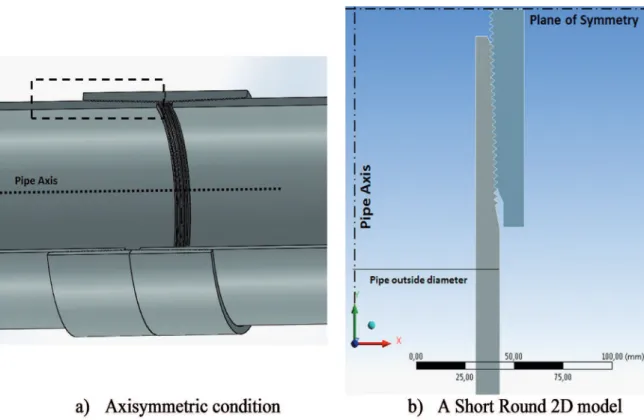
types13. The models were 2D axisymmetric, as can be seen in
Figure 1. Figure 1-a shows an API Casing connection model
with symmetry related to the coupling middle and the pipe
axis, Figure 1-b shows a resultant 2D axisymmetric model. All geometric parameters used in the API Buttress and API Short Round connections were based on the API 5B and API 5CT speciications. The pipe length was the same suggested by API 5C514 and assure that border efects are
negligible.
The modeling of the steel plasticity was possible by the application of the multilinear isotropic hardening model,
available in Ansys software. The obtained parameters in
the tensile test were converted to truly stress-strain curve, as suggested in the Ansys reference documentation15, and
applied as boundary condition.
Aiming to simulate the thread contacts, a Coulombian friction coeicient µ = 0.12 was used. This value was deined
in accordance with a preview work2.
High order elements were used to mesh the model and a mesh reinement evaluation was performed. Figure 2 presents the obtained discretization for the proposed system. The global mesh size is 3mm and the reinement applied to the thread lanks is indicated in Table 2. The structural error
stabilization and the stress concentration factor at the last
engaged thread of a Short Round connection were used to deine the mesh size reinement.
As can be seen in Table 2, a local reinement of 0.08mm
is enough to the problem, because the structural error was stable and the stress concentration factor is close to the reported in the literature for this connection model2.
The structural simulation was carried out in two diferent stages: (i) make-up torque, (ii) make-up plus axial tensile stress at the connection. The make-up torque that results of
the tapered threads cannot be modeled directly in the 2D
models. The thick cylinder theory with an initial interference
Table 1: Chemical speciications of the API 5CT grade P110 steel(wt%).
Grade C Mn Mo Cr Ni Cu P S Si
Min. Max. Min. Max. Min. Max. Min. Max. Max. Max. Max. Max. Max.
P110 - - - 0.030e 0.030e
-e For EW Grade P110, the phosphorus content shall be 0.020 % maximum and the sulfur content 0.010 % maximum.
Table 3 presents make-up torques evaluated in both API connections (input data in the current models) and presents the evaluated simulation outputs.
The calculus of the stress distribution in the connections under tractive conditions was the second stage of the
simulations, as shown in Figure 4. At this simulation stage, the make-up torque was considered simultaneously with a crescent tractive stress applied to the pipe (point B in Figure 4). The axial displacement of all nodes are zero on the middle symmetry plane of the coupling (point A in Figure 4) and their radial displacements are free.
The values of tensile stress simulated in both connections
are shown in Table 4.
After the standard API connection evaluations, a parametric study based on a patent review was performed. API Buttress
connection was chosen as base to the parametric study and the
proposed modiications were based on patents that aim to obtain a better stress distribution in tubular threaded connections. The irst modiication was the decreasing of box wall thickness in order to decrease its stifness, as Figure 5 presents.
The second modiication was applied on the threads and
was based in a patent that was not applied to any commercial product yet10. The patent claims that an additional groove in
the threads crests at the irst and last engaged threads regions reduces the thread stifness, transferring partially the load to the subsequent threads, improving the load distribution over the connection. In this study, the grooves presence was simulated in the Buttress connection and the obtained results were compared to the standardized API connection in order to evaluate its performance.
3. Results and Discussion
Figure 1: CAD models of the treaded connections (a) API Casing connection and symmetry related to the coupling middle and the pipe
axis; (b) 2D axisymmetric model.
Figure 2: Mesh reinement study.
Table 2: Mesh reinement study.
Local
reinement (mm)
Number of elements
Maximum
structural
error (mJ)
Maximum stress concentration (Tensile =
100MPa)
0.05 50391 2.32 7.08
0.08 28401 2.74 7.05
0.1 21395 2.85 6.95
0.2 10239 10.84 6.88
0.3 7168 23.93 6.46
Figure 3: Initial interference it related to make-up torque of the
tapered threads.
values in mechanical tests and in chemical analysis were in
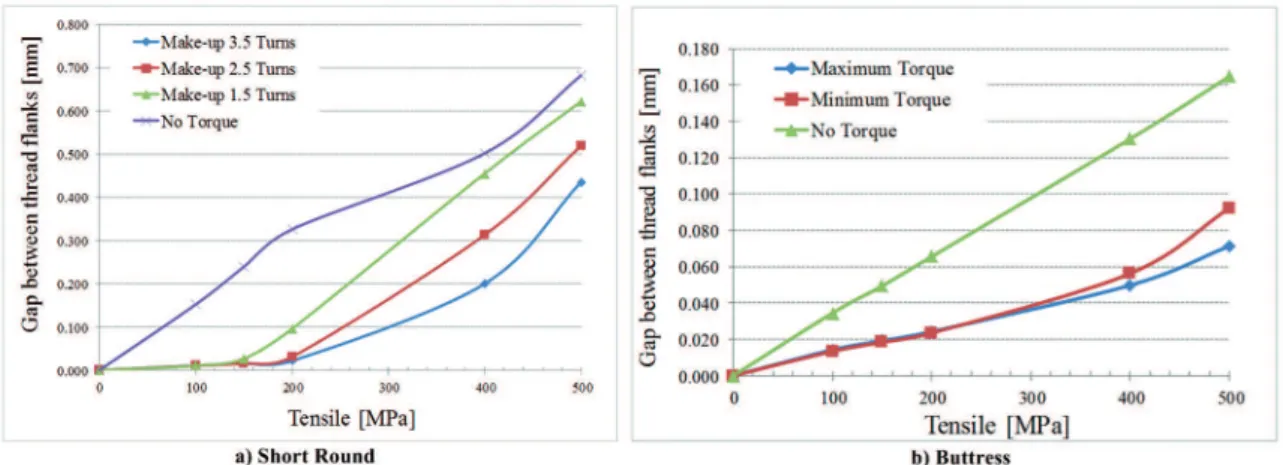
accordance with API 5CT ranges for the P110 steel grade. The jump-out of the connections is shown in Figure 6-a and Figure 6-b as functions of make-up torque and tensile stress, for API Short Round and API Buttress, respectively.
The jump-out is a failure mode of the threaded connections
with the formation of a gap between the thread lanks and can promotes the total separation of the casing string. As can be seen in Figure 6, the make-up torque had great inluence in the resistance to jump-out of the standard connections. It is also possible to observe that the API Buttress connection had higher jump-out resistance than API Short Round. A
previous work18 also found that the API Buttress casing
connection has higher jump-out resistance than API Round when subjected to axial tensile stress.
Assanelli et al.19 used inite element analysis to evaluate
Figure 4: Axisymmetric condition and the boundary conditions of
the second stage of the simulation: make-up torque plus crescent tensile stress applied in B. Point A is the symmetry plane with axial displacement set to zero (Y direction).
Table 4: Tensile stresses applied to the connections and evaluated
output values.
Connection Tensile Stress (MPa)
Comparative
answers or
Simulation Output Values Short
Round
100 150 200 400 500
Stresvs
distribution
Stress
concentration Jump-out
Buttress
Figure 5: Geometrical modiications used in the parametric study.
Table 5: Mechanical properties of API 5CT grade P110 steel.
Tensile Tests Charpy Impact Tests
Sample Yield Strenght (MPa) Tensile Strenght (MPa) Individual values at 0°C (J)
1 881 960 90 84 88
2 878 957 82 90 84
3 880 949 82 76 80
Average 880 955 84
Standard Deviation 2 6 5
up in numerical models of tapered threaded and coupled
connections.
The distribution of load lank reaction over the threads in the Short Round API connection is shown in Figure 7 as an answer of tensile stress and maximum make-up torque.
As can be seen, the load distribution is non-uniform and the
last engaged thread (lank 1) concentrated load and can be a
fatigue cracking site if the connection is subjected to cyclic
loading. The result of load distribution in the API Round
connection was very similar to a previous numerical work16,
in which the authors also found that the three irst load lanks concentrates most of the load when an 9 5/8 in. P110 API Round connection was subjected to axial tensile stress.
The distribution of reaction load over the load lanks of the Buttress connection is shown in Figure 8 as an answer of tensile stress and maximum make-up torque. As can be seen, the load of the API Buttress connection is non-uniform, but the load proile is better than that seen in the Short Round connection. The load distribution over the lanks of the Buttress connection was similar to reported in20 for
a premium connection with Buttress threads 5 ½ in., API 5CT L80, including the small load supported by the central lanks and higher load over the irst and last engaged threads.
The results of jump-out and load distribution over the
threads help to explain why the API Buttress connection is applied in severe conditions in place of the API Short
Figure 6: Results of Jump-out tendency of API standard threaded connections as function of make-up torque and tensile stress.
Figure 7: Results of load distribution over the lanks of API Short
Round casing connection.
Figure 8: Results of load distribution over the lanks of API Buttress
casing connection.
The axial stress in the API connections when subjected to 500MPa tensile stress and maximum make-up torque is shown in Figure 9. The analysis of the results shown in Figure 9 leads to conclusion that the API Buttress connection has a better stress distribution proile than the API Short Round,
but both connections have a high stress concentration in the
region of the last engaged thread.
The stress concentration obtained as maximum axial tensile divided by applied tensile stress in both Standard API connections
when subjected to diferent tensile is shown in Table 6. The API Buttress connection shows lower stress concentration than the API Short Round,which is attributed to the trapezoidal shape of the API Buttress thread and its limited thread height2.
The lower jump-out resistance of the API Short Round
and the higher stress concentration is related to its triangular thread form (that develops radial forces when subjected to
tensile stress) and its reduced cross section of the unengaged
thread section of the pin2,18.
3.1 Parametric Study
The results of the reaction load distribution over the thread
lanks of a Standard API Buttress connection is compared to modiied connections with box wall thickness reduction in Figure 10-a, the boundary condition is the maximum torque plus 200MPa tensile stress. As can be seen, the box wall thickness reduction was ineicient in reducing stress
concentration, once the stress concentration was just switched
from the two irst threads of the pin to the three last, while the central threads (threads 4 to 19) still support low loads.
Another result that conirms the ineiciency of the box
wall reduction is the impact in the jump-out resistance of the
modiied connections showed in Figure 10-b. The bigger the
wall thickness reduction, the smaller the jump-out resistance
of the modiied Buttress connection.
The results of reaction load distribution at the thread
lanks, obtained by the model with grooves in the irst and in the last engaged threads, are shown in Figure 11. A comparison between standardized API Buttress connection when subjected to maximum make-up torque and 200MPa
tensile stress and the proposed connection in the same condition
Figure 9: Axial stress distribution on the API connections as a result of maximum make-up torque and 500MPa tensile.
Table 6: Stress concentration in API Short Round and Buttress obtained in diferent tensile stress.
Connection Tensile stress (MPa)
100 150 200 400 500
Axial stress concentration (-)
Short Round 7.73 6.99 5.70 3.35 2.95
Buttress 6.90 6.46 4.79 2.90 2.38
resulted in a better load distribution over the connection
without signiicant lost in jump-out resistance (Figure 11-b).
The improvement of the load distribution over the threads
in the grooved modiied API Buttress, with no inluence in
the jump-out resistance, are in accordance with the original and no applied patent10 and could be a good alternative to
the development of new products.
4 . Conclusions
• The make-up torque is an important variable to be considered in the modeling of tapered threaded
Figure 10: Results of reaction load distribution in standard and modiied Buttress connections and jump-out tendency. Boundary conditions:
a) Maximum make-up torque plus 200MPa tensile stress; b) Maximum make-up torque plus crescent tensile stress.
Figure 11: Results of reaction load distribution and jump-out of the modiied (grooved) connection compared to the standard API Buttress
connection. Boundary conditions: a) maximum make-up torque plus 200MPa tensile stress; b) maximum make-up torque plus crescent tensile stress.
• Both standard API casing connections have non uniform load distribution over the threads, but
the stress concentration of the API Short Round is higher than the API Buttress.
• The reduction of wall thickness of the box of API
Buttress connection in order to minimize its stifness was ineicient in decreasing stress concentration,
once the stress concentration was not reduced and
the jump-out tendency increased.
• The modiication of the API Buttress casing connection
by the confection of grooves in the last and irst engaged threads was efective in promoting better load distribution over the thread lanks and reducing the stress concentration factor. The simulated
grooves did not change the jump-out resistance of the connection and could be an alternative to the
development of improved Buttress connections.
5. Acknowledgements
The authors would like to thank the Brazilian Research Agencies CAPES and CNPq for the inancial support and the scholarship.
6. References
1. Bourgoyne AT, Chenevert ME, Millheim K, Young FS Jr. Applied Drilling Engineering. SPE Textbook Series. Vol. 2. Richardson:
Society of Petroleum Engineers; 1986. 502 p.
2. van Wittenberghe J. Experimental analysis and modelling of the fatigue behaviour of threaded pipe connections. [Dissertation].
Ghent: Ghent University; 2011. 287 p.
tubing string. United States patent US 2992613. 1961 Jul 18.
8. De Lange RW, Evans ME, inventors; Grant Prideco LP, assignee.
Threaded and coupled connection for improved fatigue resistance.
United States patent US 6609735 B1. 2003 Ago 26. 9. Verdillon L, inventor; Vallourec Mannesmann Oil and Gas France,
Sumitomo Metal Industries Ltd, assignee. Fatigue-resistant threaded bevelled tubular element. United States patent US
6752436B1. 2004 Jun 22.
10. Noel T, Roussie G, inventors; Vallourec Mannesmann Oil and Gas France, Sumitomo Metal Industries Ltd, assignee. Fatigue-resistant threaded component for a tubular threaded joint.
United States patent, US 7513534B2. 2009 Apr 7.
11. American Petroleum Institute. Speciication for Casing and Tubing. API Speciication 5CT. 9th ed. Washington: American Petroleum Institute; 2011.
16. Chen S, Li Q, Zhang Yi, Qi A. Finite element analysis of tooth load distribution on P-110S conic threaded connections. International Journal of Pressure Vessels and Piping. 2011;88(2-3):88-93.
17. Dvorkin EN, Toscano RG. Finite element models in the steel industry. Part II: analyses of tubular products performance.
Computers & Structures. 2003;81(8-11):575-594.
18. Xie J, Tao G. Analysis of Casing Connections Subjected to Thermal Cycle Loading. In: 2010 Simulia Customer Conference;
2010 May 25-27; Providence, Rhode Island, USA.
19. Assanelli AP, Xu Q, Benedetto F, Johnson DH, Dvorkin EN. Numerical/Experimental Analysis of an API 8-Round Connection.
Journal of Energy Resourches Technology. 1997;119(2):81-88.