Arq Neuropsiquiatr 2001;59(3-B):725-728
TICS AND TOURETTE SYNDROME
Clinical evaluation of 44 cases
Hélio A.G. Teive
1, Francisco M.B. Germiniani
2,
Marcus V. Della Coletta
2, Lineu César Werneck
3ABSTRACT We evaluated 44 patients with tics and Tourettes syndrome (TS) emphasising the age of onset of symptoms, sex, classification and localization of tics, associated symptoms and signs and comorbidities. Thirty-three patients (75.2%) had TS defined criteria whereas 10 (22.7%) had chronic motor and/or vocal tics. Simple motor tics were found in 43 cases (97.7%), mainly affecting the eyes (43.2%), mouth (43.2%), face (34.1%). Simple vocal tics occurred in 33 (75%). Coprolalia was found in just 6 cases (13.6%) and copropraxia in just 2 (4.5%). Obsessive compulsive disorder and/or symptoms were found in 26 cases (59.1%) and attention deficit in 17 (38.6%). Eighteen patients (40.9%) had other disorders, such as alcoholism, tabagism, drug abuse, affective disorders, anxiety, sleep and learning disorders. The data obtained are similar to those found by other authors. We highlight the low frequency of coprolalia, as well as the associated neuropsychiatric disorders.
KEY WORDS: Tourettes Syndrome, obsessive compulsive disorder, attention deficit disorder.
Tiques e síndrome de Tourette: avaliação clínica de 44 casos
RESUMO Avaliamos 44 pacientes com tiques e síndrome de Tourette (ST), enfatizando a idade de início dos sintomas, sexo, classificação e localização dos tiques, sinais e sintomas associados e presença de comorbidades. Trinta e três pacientes (75,2%) tinham TS definida, ao passo que 10 (22,7%) tinham tiques motores e/ou vocais crônicos. Tiques motores simples foram encontrados em 43 casos (97,7%), principalmente envolvendo os olhos (43,2%), boca (43,2%), face (34,1%). Tiques vocais simples ocorreram em 33 (75%). Coprolalia estava presente em apenas 6 casos (13,6%) e copropraxia em apenas 2 (4,5%). Sintomas e/ou transtorno obsessivo-compulsivo foi encontrado em 26 casos (59,1%) e déficit de atenção em 17 (38,6%). Dezoito pacientes (40,9%) tinham outras desordens, tais como alcoolismo, tabagismo, abuso de drogas. Os dados encontrados são semelhantes àqueles encontrados por outros autores. Nós enfatizamos a baixa incidência de coprolalia, assim como a presença de transtornos neuropsiquiátricos associados.
PALAVRAS-CHAVE: síndrome de Tourette, transtorno obssessivo-compulsivo, déficit de atenção.
Movement Disorders Unit, Division of Neurology, Department of Internal Medicine, Hospital de Clinicas, Federal University of Paraná, Curitiba PR, Brazil: 1Assistant Professor of Neurology; 2Resident of Neurology; 3Chief of Neurological Service.
Received 18 january 2001, received in final form 30 April 2001. Accepted 10 May 2001.
Dr. Hélio A.G. Teive - Hospital de Clínicas UFPR - Rua General Carneiro 181/ 12ºandar - 80060-090 Curitiba PR, Brasil. FAX: 41 244 5060. E-mail: [email protected]
Georges Gilles de La Tourette first described Tou-rettes Syndrome (TS) in 1885 as a nervous affecti-on characterised by lack of motor coordinatiaffecti-on ac-companied by echolalia and coprolalia; later Char-cot named the condition as Tourettes Syndrome1-3.
Tics are fast, repetitive and stereotyped involuntary movements of individual muscle groups. Tic disor-ders are commonly categorised according to age of onset, duration of symptoms, severity of symptoms and findings of vocal and/or motor tics4-10.
Chief among the tic disorders is TS, which is the most severe and is frequently accompanied by neu-ropsychiatric disorders such as obsessive compulsive disorder (OCD), attention deficit disorder with or wi-thout hyperactivity (ADHA) and others4,6,8,9,11,12.
Transitory tic disorder: Tics usually start while
726 Arq Neuropsiquiatr 2001;59(3-B)
definition, relapsing episodes of transitory tics can occur for several years.
Chronic Tic Disorder: It can be differentiated from transitory tic disorder not only by the persistence of symptoms for several years, but also by its clinical per-sistent features. Chronic tics can remain unchanged for years. Blinking and facial movements are two examples of tics found in chronic tic disorder.
Tourette Syndrome: According to the Diagnostic
and Statistical Manual of Mental Disorders (DSM-IV) its defined by: a) multiple motor tics and one or more vocal tics; b) tics occur several times a day, al-most every day or intermittently for one year or more (there cannot be a period free of tics longer than 3 months); c) the disorder causes discomfort and se-vere social and work compromise; d) onset of tics must occur before the patient is 18 years-old and e) the disorder is not due to the use of drugs nor to another disease.
Chronic Motor/Vocal Tics Disorder: The patient
presents with several chronic motor (or vocal) tics. The diagnostic criteria are the same as those for TS, except for a): either simple or multiple motor tics, or vocal tics (they cant be found at the same time)4,10,13-15.
The aim of our study was to perform a clinical eva-luation of 44 patients with either TS or other tic dis-order and to see whether there were other co-mor-bid disorders.
METHOD
We retrospectively reviewed the files of 44 outpatients from the Movement Disorder Service of the Hospital de
Clínicas da Universidade Federal do Paraná. Age of onset, sex, classification and localisation of tics, associated signs and symptoms, concomitant OCD, ADHA and other neuro-psychiatric disorders were evaluated. Classification of all disorders followed the guidelines of the DSM-IV6.
RESULTS
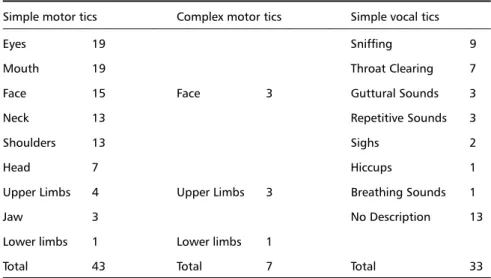
The patients age ranged from 3 to 60 years (mean age of 13.5 years at the time of our evaluation). 75% (n=33) of all patients fulfilled the diagnostic criteria for TS, 22.7% (n=10) for Chronic Motor/Vocal Tics and 2.3% (n=1) for transitory tics. Sixty-three percent (n=28) of our patients were male and 36.4% (n=16) were female. Most patients had onset of symptoms in the first or second decade (prior to ten years in 56.8 % and from 10 to 20 in 15.9%). Seven percent had onset of symptoms after twenty years and 20% could not recall when they first manifested their symptoms. Simple motor tics could be found in 97.7% (n=43), complex motor tics in 15.9% (n=7) and simple vo-cal tics in 75% (n=33) of our cases. Simple motor tics had a distribution that compromised mostly the head and upper limbs. Thus, nineteen patients had eyes tics, tics involving the mouth muscles were found in 19 patients, 15 had facial tics other than eye or mouth tics, neck and shoulders tics were found in 13 patients each, 7 patients had head tics, 4 had distal upper limbs tics (hands only), 3 had tics of the lower limbs and one patient had jaw tics (Table 1). Com-plex motor tics occurred in fewer patients, with the following distribution: upper limbs in 3 patients, facial tics in another three and lower limbs in one (Table 1).
Simple vocal tics comprised a complex and var-ied group of tics. Nine patients presented with
sniff-Table 1. Types and distribution of tics.
Simple motor tics Complex motor tics Simple vocal tics
Eyes 19 Sniffing 9
Mouth 19 Throat Clearing 7
Face 15 Face 3 Guttural Sounds 3
Neck 13 Repetitive Sounds 3
Shoulders 13 Sighs 2
Head 7 Hiccups 1
Upper Limbs 4 Upper Limbs 3 Breathing Sounds 1
Jaw 3 No Description 13
Lower limbs 1 Lower limbs 1
Arq Neuropsiquiatr 2001;59(3-B) 727
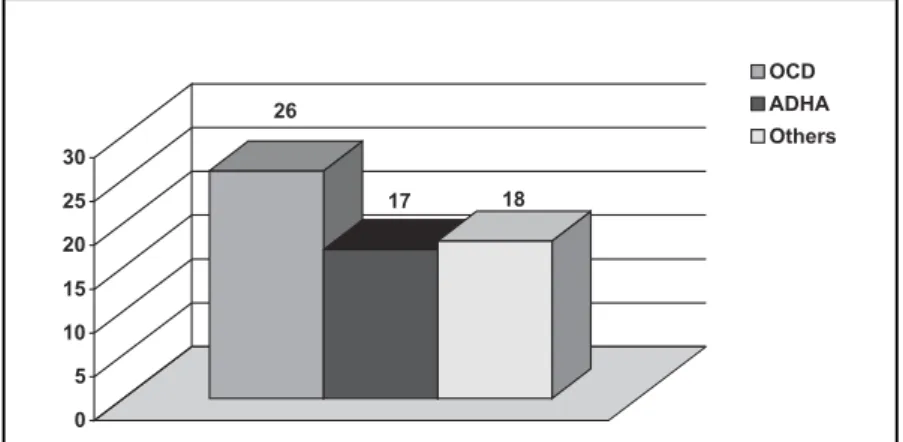
ing sounds, 7 with throat clearing sounds, 3 with guttural sounds, 2 with sighs, one with hiccups and one with breathing sounds. Three patients had re-petitive sounds that were hard to classify and 13 had no clear description of their simple vocal tics. Only 13.6% (n=6) of patients had coprolalia (Table 1). Obsessive Compulsive symptoms/disorder was observed in 59.1% (n=26) and ADHA in 38.6% (n=17) as seen in Figure 1. Other disorders (affecti-ve disorders, anxiety disorder, alcoholism, smoking, sleep disorders and learning disorder) were found in 40.9% (n=18) (Fig 2).
DISCUSSION
We evaluated the files of 44 patients and classi-fied the patients according to the diagnostic criteria found in the DSM-IV. Seventy-five percent of all pa-tients fulfilled the criteria for TS while 22.7% had chronic motor/vocal tics. Onset of symptoms prior to the patients being 20 years old could be found in 72.7% of our patients, a result similar to those found in other studies2,7,8,14,16,17.
We were more flexible than other authors and classified patients as having TS as long as they were younger than 20 when they had the onset of their symptoms. This criterion was based on the fact that some authors propose a limit age of onset before the patient is 21 years old, instead of 18, which is the usual time of onset of tics in both TS and chronic motor/vocal tics2,6-9,13-15,17.
In our group the male/female ratio was 1.75:1 (the ratio is usually 3 or 4 men for every woman).
Simple and complex motor tics occurred more commonly in the upper segment, while simple vocal tics could be found in 75% (n=33). Similar results were found in other studies, such as the Tolosa and Bayes, cited by Lees and Tolosa7 and by Cardoso et
al.17. In that study the authors found that blinking,
grimacing and shoulder elevation were the most com-mon motor tics. The types of simple vocal tics found in their study were mostly sniffing, throat clearing and grunting sounds17.
Even tough it is the mostly well-known symptom
Fig 1. TS Associated disorders.
728 Arq Neuropsiquiatr 2001;59(3-B)
of TS (see original description), coprolalia is found in only a minority of patients (5 to 30%). In our study coprolalia was rather uncommon (13.6%, n=6) and was not an obligatory criterion for the diagnosis of TS. In their study, Cardoso et al. found 9 patients (28%) out of 32 with coprolalia17. Only two of our
patients (4.5%) had copropraxia and none had echo-lalia, ecopraxia or palilalia.
Coprophenomena occurred in about one third of the patients in the series by Shapiro et al.2, but are
much rarer in Japanese patients with TS according to Lees. This is probably due to the extreme cour-tesy and decorum of the Japanese culture7.
Ever since Gilles de La Tourette first described it, a clear association between tics and obsessive-com-pulsive symptoms is usually found. In our group 59.1% of TS patients had OCD (or obsessive-compulsive symptoms), which is similar to the rates found in the literature (28% to 67%)2,4,7,8,11,12,15,17. Even though
ADHA affects up to 50 or 80% of TS patients4,7-9,11,15,16,
in our group it could only be found in 38.6%, prob-ably due to the small size of our study population. Another study with a group of Brazilian patients had an incidence of 63% for ADHD and 44% for OCD17.
TS and other tic disorders seem to be part of the same phenomenological continuum, and some clini-cal features of tics, OCD and ADHA can occur in any given person during childhood as part of the nor-mal development18,19. In addition, other studies
high-light the role of both genetic and environmental fac-tors in the genesis of tic disorders7-9,13-15,18,20,21.
The data found in our study are similar to the findings of other authors worldwide. We highlight the low occurrence of coprolalia in our patients and em-phasise the concomitant neuropsychiatric disorders.
REFERENCES
1. Gilles de La Tourette G. Étude sur une affection nerveuse caracterisée par l’incordination motrice accompagnée d’echolalie et coprolalie. Arch Neurol 1885;9:19-42,158-200.
2. Shapiro AK, Shapiro ES, Young JG, Feinberg TE. In Gilles de La Tourette syndrome. 2.Ed. NewYork: Raven Press, 1988:127-193.
3. Lees AJ, de La Tourette G. The man and his time. Rev Neurol 1986; 142:808-816.
4. Fahn S. Motor and Vocal Tics. In Kurla R (ed). Handbook of Tourette’s syndrome and related tic and behavioral disorders. New York: Marcel Dekker, 1993:3-16.
5. Jankovic J. Phenomenology and classification of tics: Tourette’s syn-drome. Neurol Clin N Am 1997;15:267-275.
6. American Psychiatric Association.Diagnostic and Statistical Manual of Mental Disorders- DSM-IV. Washington: American Psychiatric Asso-ciation, 1994.
7. Lees AJ, Tolosa E. Tics. In Jankovic J, Tolosa E (eds). Parkinson’s dis-ease and movement disorders. 2.Ed. Baltimore: Willians & Wilkins, 1993:329-335.
8. Tolosa E, Jankovic J. Ticsand Tourette’s syndrome. In Tolosa E, Jankovic J (eds). Parkinson’s disease and movement disorders. 3.Ed. Baltimore: Willians & Wilkins, 1998:491-512.
9. Weiner WJ, Lang AE. Gilles de la Tourette’s syndrome. In Weiner WJ, Lang AE (eds). Movement disorders: a comprehensive survey. New York: Futura Publishing, 1989:532-568.
10. Teive HAG. Tiques e syndrome de Tourette: definições básicas, classificações e critérios diagnósticos atuais. Rev Bras Neurol 1998;34: 163-167. 11. Comings DE, Comings BG. Comorbid behavioral disorders. In Kurlan
R (ed). Handbook of Tourette’s syndrome and related tic and behav-ioral disorders. New York: Marcel Dekker, 1993:111-147.
12. George SM, Trimble MR, Ring AH, Robertson MM. Obsessions in ob-sessive-compulsive disorder with and without Gilles de La Tourette’s syndrome. Am J Psychiatry 1993;150:98-102.
13. Bruun RD, Cohen DJ, Leckman JF. Guide to the diagnosis and treat-ment of Tourette syndrome. Harvard: Edu 1997;22:43.
14. Singer H S. Tic disorders. Pediatric Annals 1993;22:22-29.
15. Leckman JF, Peterson BS, Pauls DL, Cohen DJ. Tic disorders. Psychiatr Clin N Am 1997;20:839-861.
16. Dodick D, Adler CH. Tourette’s syndrome. Current approaches to rec-ognition and management. Postgraduate Medicina 1992;5:299-308. 17. Cardoso F, Veado C C M, Oliveira J T. A Brazilian cohort of patients with
Tourette’s syndrome. J Neurol Neurosurg Psychiatry 1996;60:209-212. 18. Kurlan R. Hypothesis II: Tourette’s syndrome is part of a clinical spec-trum that includes normal brain development. Arch Neurol 1994; 51:1145-1149.
19. Mattos JP, Rosso ALZ. Tiques e síndrome de Giles de la Tourette. Arq Neuropsiquiatr 1995;53:141-146.
20. Hanna PA, Janjua FN, Contant CF, Jankovic J. Bilineal transmission in Tourette’s syndrome. Neurology 1999;53:813-818.