Implementation of the presence of companions
during hospital admission for childbirth: data
from the
Birth in Brazil
national survey
Implementação da presença de acompanhantes
durante a internação para o parto: dados da
pesquisa nacional
Nascer no Brasil
Implementación de la presencia de acompañantes
durante el internamiento para el parto: datos de
la encuesta nacional
Nacer en Brasil
1 Faculdade de Saúde Pública, Universidade de São Paulo, São Paulo, Brasil. 2 Departamento de Saúde Pública, Universidade Federal de Santa Catarina, Florianópolis, Brasil. 3 Instituto de Pesquisa Clínica Evandro Chagas, Fundação Oswaldo Cruz, Rio de Janeiro, Brasil.
4 Agência Nacional de Saúde Suplementar, Rio de Janeiro, Brasil.
5 Instituto Nacional de Saúde da Mulher, da Criança e do Adolescente Fernandes Figueira, Fundação Oswaldo Cruz, Rio de Janeiro, Brasil. 6 Escola de Artes Ciências e Humanidades, Universidade de São Paulo, São Paulo, Brasil.
7 Secretaria Municipal de Saúde Belo Horizonte, Belo Horizonte, Brasil. 8 Pró-Reitoria de Ensino e Graduação, Universidade Federal de Mato Grosso, Cuiabá, Brasil. 9 Plymouth University Peninsula Schools of Medicine and Dentistry, Plymouth, U.K. 10 Division of Women's Health, King's College London, London, U.K.
Correspondence C. S. G. Diniz
Departamento de Saúde Materno-Infantil, Faculdade de Saúde Pública, Universidade de São Paulo. Av. Dr. Arnaldo 455, 2o andar, São Paulo, SP
01246-904, Brasil. [email protected]
Carmen Simone Grilo Diniz 1 Eleonora d'Orsi 2
Rosa Maria Soares Madeira Domingues 3 Jacqueline Alves Torres 4
Marcos Augusto Bastos Dias 5 Camilla A. Schneck 6
Sônia Lansky 7
Neuma Zamariano Fanaia Teixeira 8 Susanna Rance 9
Jane Sandall 10
Abstract
Robust evidence of the benefits of continuous support during childbirth led to the recommen-dation that it should be offered for all women. In Brazil, it has been guaranteed by law since 2005, but scarce data on implementation is available. We aimed to estimate the frequency and associ-ated socio-demographic, obstetric and institu-tional predictors of women having companion-ship during childbirth in the Birth in Brazil sur-vey. Descriptive statistical analysis was done for the characterization of companions (at different moments of hospital stay), maternal and insti-tutional factors; associations were investigated in bivariate and multivariate models. We found that 24.5% of women had no companion at all, 18.8% had continuous companionship and 56.7% had partial companionship. Independent predictors of having no or partial companion-ship at birth were: lower income and education, brown color of skin, using the public sector, mul-tiparity, and vaginal delivery. Implementation of companionship was associated with having an appropriate environment, and clear institution-al rules about women’s rights to companionship.
Medical Chaperones; Midwifery; Maternal and Child Health; Parturition
Resumo
As evidências sobre os benefícios do apoio con-tínuo durante o parto levou à recomendação de que este apoio deve ser oferecido a todas as mulheres. No Brasil, ele é garantido por lei des-de 2005, mas os dados sobre sua implementação são escassos. Nosso objetivo foi estimar a fre- quência e fatores sociodemográficos, obstétricos e institucionais associados à presença de acom-panhantes durante o parto na pesquisa Nascer no Brasil. Foi feita análise estatística descritiva para a caracterização dos acompanhantes (em diferentes momentos do tempo da internação), fatores maternos e institucionais; as associações foram investigadas em modelos bi e multivaria-da. Vimos que 24,5% das mulheres não tiveram acompanhante algum, 18,8% tinham compa-nhia contínua, 56,7% tiveram acompanha-mento parcial. Preditores independentes de não ter algum, ou parcial, foram: menor renda e escolaridade, cor parda da pele, usar o setor público, multiparidade e parto vaginal. A im-plementação do acompanhante foi associada com ambiência adequada, e regras institucio-nais claras sobre os direitos das mulheres ao acompanhante.
Introduction
There are few human experiences that compare with the physical, psychological and social inten-sity of labor and birth, and that are the same time so challenging and transformative 1,2. Far beyond its physiological aspects, childbirth is a socially and historically shaped event, with wide cultural and geographic variability 3.
The care that a woman receives during labor and delivery, like the quality of the experience of birth itself, are markers of the woman’s and baby’s place in social hierarchies, including dimensions such as social class, race/ethnicity, health status, marital status, physical ability, sexual respectabil-ity, and others 4.
Care in childbirth depends on the availability and affordability of health services, on women’s access to information and support from their so-cial networks 5, on what kind of health providers predominate the birth market 6, and also on the services’ understanding of what is appropriate care for the particular population of women that they assist 3,4. In many countries, religious influ-ences on health care and the notion that suffering in childbirth is a legitimate penalty that women should endure for having sex, contribute to a cul-ture of neglect of maternal rights and wellbeing, to the absence of privacy or comfort measures during labor and birth, to the liberal use of invasive inter-ventions 4,7, and sometimes to overt hostility and
abuse, especially for women at the bottom end of social hierarchies 4,7,8,9,10.
The way care is organized, in terms of mode of delivery, can be shaped by providers’ and women’s gendered beliefs of what is expected from women in relation to birth. These beliefs may contribute to the growing number of c-sections, particularly with the association of vaginal birth with “non-feminine” behavior, such as loss of control, messi-ness, leakimessi-ness, indignity and vulgarity 11; and also with the belief that vaginal birth implies a form of genital deformation, conflicting with the appro-priate function of the vagina, which would be to provide heterosexual pleasure 11,12. These negative beliefs contribute to the idea that childbirth is a disgusting and shameful event that should not be witnessed by anyone other than those strictly nec-essary at that moment 7,12.
When hospital birth was established as the rule by health programs in industrialized coun-tries in the mid-20th Century, for the first time in history most women started to deliver without the presence of a person familiar to them 2,7. This has been the usual situation in many countries for decades, as the presence of relatives was usually prohibited in institutional births 13. In Brazil this was also the rule, and a part of medical and
nurs-ing trainnurs-ing. In his influential book, De Rezende et al. 14 (p. 233) recommended: “The family members of the laboring woman, who anxiously go to the maternity wards in great numbers, should be kept distant”.
Providers tend to underestimate the impor-tance of the experience of childbirth and focus mainly on its outcomes, such as morbidity and mortality, but even for healthy women giving birth to healthy babies, the experience of childbirth is powerful and long-lasting, with consequences for women’s physical and mental health, self-image, relationship with the baby, partner and family
1,2,5,15. Although some women report the experi-ence of labor and birth as an empowering, ecstatic or even orgasmic event 16, for most women, the experience of childbirth can be stressful and pain-ful. Causes of stress and anxiety include lack of fa-miliarity with providers, hospital environment and routines, pain and discomfort (from birth itself or from interventions), worry and uncertainty about what is happening to them, problems of commu-nication, lack of empathy, rude treatment, and loneliness 2,10,15.
In the 1990s, as a result of women’s activism and of the emergence of evidence-based health-care, a worldwide movement started to document the emotional and health benefits, and high ma-ternal satisfaction, with continuous presence and support during childbirth. Groups of researchers and activists in favor of companionship in several countries organized clinical trials to randomize women with and without companions. These trials and the subsequent systematic reviews of them, built the gold-standard evidence documenting the many maternal and neonatal positive health outcomes of this simple intervention. That led to the international recommendation by the World Health Organization (WHO) in the 1990s, that “continuous support during labour has clinically meaningful benefits for women and infants and no known harm, and that all women should have sup-port throughout labor and birth” 17 (p. 2).
accom-plished by encouraging mobility and effective use of gravity, supporting women to adopt their pre-ferred positions and recommending specific posi-tions for specific situaposi-tions 13.
The latest systematic review of continuous support on childbirth (2011) shows that women allocated to this intervention were more likely to have a spontaneous vaginal birth and less likely to have intrapartum analgesia or to report dissatisfac-tion; their labors were shorter, they were less likely to have a caesarean or instrumental vaginal birth, regional analgesia or a baby with a low 5-minute Apgar score 13. In addition, subgroup analyses sug-gested that continuous support was most effec-tive when provided by someone who was neither part of the hospital staff nor the woman’s social network, and its effects were even stronger in set-tings in which epidural analgesia was not routinely available 13. Having a companion improves
wom-en’s safety in childbirth, since it promotes womwom-en’s ability to speak up about their needs, which can be particularly valuable in cases of serious compli-cations, helping women to be heard when urgent care is needed 18. Having a companion can be con-sidered an indicator of safety, quality of care, and respect for women’s rights in maternal care 19.
In Brazil, the evidence of the first systematic review on support in labor (1996) was used to propose the first laws about the right to compan-ions at birth in the 1990s, such as those adopted in São Paulo, Rio de Janeiro, and Santa Catarina
20,21,22. In 2005, a national law which applies to all women in public and private services (n. 11,108
23) affirmed the right of all women to have a com-panion of their choice during antenatal care, and during all stages of hospital stay for birth, includ-ing labour, delivery and post-partum periods. Social movements promoting the humanization of childbirth and male enhanced participation in fatherhood led to new public policies involving men, including the fathers’ antenatal care pro-grams and campaigns to promote their presence in childbirth 24,25.
Although companionship in birth is an official maternal health policy of the Brazilian Ministry of Health, known as the Rede Cegonha, the pace and extent of implementation is unknown, since until recently no national data on companionship were available in the Brazilian Health Informatics De-partment (DATASUS). Our hypothesis is that there is an increase in the incorporation of the presence of companions during hospital stay, but this is un-equal and related to ability to pay; and women who are at the bottom of the social hierarchy – poorer, less educated, non-white, having vaginal births, and delivering in services that refuse to implement the law, are more frequently deprived of the ben-efits of companionship during birth.
The aim of this paper is to analyze the imple-mentation of accompaniment during hospital admission, labor, delivery and postpartum, in the Brazilian public, mixed and private sectors; to identify who is the companion; and the maternal, institutional and environmental factors (privacy, type of beds, accommodations), associated with the presence of companions in those sectors.
Methods
Birth in Brazil is a national hospital-based study of postnatal women and their newborn, conducted from February 2011 to October 2012.
The study sample was selected in three stag-es. The first was composed of hospitals with 500 or more births/year stratified by the five country regions, location (state capital or not), and type of hospital (private, public or both). The second was composed of days (minimum of seven days in each hospital) and the third composed of postna-tal women. In each of the 266 hospipostna-tals sampled, 90 postnatal women were interviewed, totaling 23,940 subjects. More information about the sam-ple design is detailed in Vasconcellos et al. 26.
In the first wave of the study, interviews were conducted with postnatal women during hospi-talization and data extracted from the medical re-cords of the mother and newborn and antenatal notes photographed. Follow-up telephone inter-views were conducted before six months and at twelve months after birth to address maternal and newborn outcomes. Detailed information about data collection is reported in do Carmo Leal et al. 27.
insur-ance policy, were classified as “private source of payment”.
Covariates of the health service structure in-cluded: if the service had any accommodation for the companion (at least a chair), the place that the woman stayed during labor (surgical the-ater, obstetric center, room, infirmary), if it was a training hospital, if it was accredited as a Baby-friendly Hospital, if it was accredited as a Galba de Araújo (best practices award) hospital, if the hospital had a clear policy of respecting the law (companions allowed during all periods of child-birth care), if privacy during care was present at all stages of care.
The presence of companions was assessed us-ing two instruments: medical records and face-to-face interviews. In the medical records, informa-tion on companionship was missing from 71.2% of the records, reflecting the limited importance given to this intervention, and the lack of service accountability to report whether or not it complied with the law. On the other hand, reporting on face-to-face interviews was very complete and reliable (0.2% missing), so this was the instrument used in this analysis. Women were asked (1) if they had a companion during their hospital stay; if not, why not; (2) who the companion was; (3) if the com-panion was the one chosen by them; (4) if they considered that having a companion during birth was helpful, and to what extent, (5) if the compan-ion was present during all stages of their hospital stay, including (a) admission, (b) labor, (c) deliv-ery, (d) immediate post-partum/recovdeliv-ery, and e) rooming-in. We aimed to distinguish between “vis-it” (present in regular visiting hours) and compan-ion (during specific moments). Data on women´s socio-demographic and obstetric history were retrieved from medical records and face-to-face interviews. Data on institutional ambience and routines were retrieved from the hospital structure and process form.
The outcome variable in this study (5) “if the companion was present during all stages of her hospital stay” was later recoded with the alterna-tives: “no companionship at all”, for those who had a total absence of companions in every stage of hospital stay; “partial companionship” including women who had any companion in some stage of stay (admission or labor or delivery or immediate post-partum/recovery, or rooming-in, (this alter-native can also be called “partial absence”); and “continuous presence/companionship” for those who had companions according to what is defined in the Brazilian legislation (during all stages of hospital stay). To recode these variables, women who did not go into labor (elective cesareans) were excluded from the analysis of having “companion-ship during labor”.
A multinomial regression model 28 was fitted to estimate the odds ratio (OR) of each covariate on “no companion” and “partial companion” as compared with “continuous companionship”. In all analyses, we adopted a significance level of 5% considering the characteristics of the complex plane sampling: strata, conglomerate and weight-ing. The statistical program used was IBM SPSS, version 19.0 (IBM Corp., Armonk, USA).
This research was guided by Resolution n. 196/96 of the Brazilian National Health Council, which provides guidelines and standards of hu-man research under the research protocol CEP/ ENSP (n. 92/10). All directors of institutions and postpartum women signed an informed consent form.
Results
Table 1 shows the descriptive statistics for this sur-vey. All women were eligible for the questions on companionship during childbirth. Of them, 24.5% had no companion at all and 75.5% had some form of companionship during their hospital stay: 18.8% had continuous companionship and 56.7% had partial companionship.
Considering only women who had a com-panion at any stage, this was most frequently the woman’s partner (35.4%), followed by the mother (26.3%), sibling or friends. Doulas were present in 0.1% of cases. Of those women who had a com-panion, 92.8% of them were reported as being the one of the women’s choice.
Women were more frequently accompanied during admission (70.1%), but more rarely during labor (42.1%, considering only those women who went into labor). During the moment of delivery itself, 32.7% had a companion. In the immediate post-partum stage, 36.9% had a companion, and 61.3% in the post-partum apartment or rooming-in ward.
The vast majority of women considered that having a companion during labor and birth “was very helpful” or “helpful” for women in order to have a better and calmer birth experience (91.2% of valid responses); only 2.7% of the total sample thought it was not helpful and made the woman more anxious.
someone to stay with her” (18%), either because her partner had to stay with the other children, or for lack of a social support network, or because of “unexpected admission for birth”, in situations when the patient came by herself just for an ante-natal check and had an immediate indication for a cesarean. Some women who had been transferred from other services reported access obstacles such as “the ambulance did not allow bringing in the companion”.
There were variations in the lack of informa-tion about companionship received by women before labor, as women reported that they “did not know it was allowed”, “did not know it was allowed in vaginal births”, “did not know it was allowed for non-adolescents”. Only 5.7% of unaccompanied women (1.4% of the total number of women) said
that they were alone because they did not want to have any companion (data not shown in table).
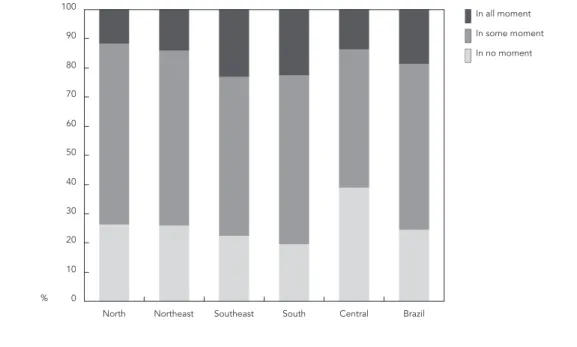
There was a large variation in terms of the im-plementation of accompaniment among regions: 23.1% and 22.6% of women had companionship according to the law in the Southeast and South regions (the best results), and only 11.7% in the North. The Central region had the worst results, with over 38.9% of women with no companionship at all (Figure 1).
Table 2 shows the bivariate analysis for the presence of companions according to maternal socio-demographic and obstetric characteris-tics. “Partial companionship” showed relatively little variation from the average of around 55%, with the relevant differences concentrated in the extremes (continuous companionship and
Table 1
Frequency distribution of companionship during hospital stay for childbirth. Brazil, 2011-2012.
n (N = 23,879) * %
Did you have a companion during childbirth?
No, at no moment of childbirth (total absence) 5,848 24.5 Yes, at some moment of childbirth (partial absence) 13,547 56.7 Yes, at all moments of childbirth (continuous presence) 4,470 18.8 Did you have a companion during your hospital stay?
Yes 18,148 75.5
Who was your companion? (N = 18,030) **
Partner/Father of child 8,453 35.4
Friend 1,051 4.4
Mother 6,280 26.3
Sibling 2,197 9.2
Doula 24 0.1
Other person 4,561 19.1
Was this companion the one of your choice? **
Yes 16,841 92.8
Moments of companionship
Before/During admission 16,739 70.1
During labor in the hospital *** 10,053 42.1
During childbirth (delivery) 7,808 32.7
Immediate post-partum in the surgical ward) 8,811 36.9 Rest of the hospital stay/postpartum/rooming-in 14,638 61.3
How was your experience of having a companion during childbirth? #
It very much helped me to have a better, calmer birth 14,231 84.5 It helped a bit to have a better, calmer birth 1,128 6.7 It is indifferent, neither helps nor hinders 960 5.7
It did not help, I got more nervous 455 2.7
* All values were corrected by the sample weights; ** Only for women who had a companion; *** Only for women who went into labor;
no companion at all). Women more frequently had no companionship if they had had a vaginal birth, lived in the Central region, had lower in-comes, fewer years of education, were black or brown, multiparous and used the public system.
Women’s form of payment for childbirth care was highly associated with having or not having any companion: while in the public sector 29.5% had no companion, in the private sector it was 4.7%. Women’s marital status and the kind of pro-vider were not statistically different in the odds of companionship; maternal age was not significant in this bivariate analysis.
We investigated the role of hospital structure and processes in their association with the pres-ence of companions in a bivariate analysis (Table 3). As expected, the services which allowed wom-en to have companions throughout the hospital stay, which had minimal accommodation facilities (such as chairs for all companions), who provid-ed minimal privacy for women during their stay, those accredited “Baby-Friendly Hospitals” and those services which received the Galba de Araújo award for humanized services, were less associ-ated with having “no companionship” and more with “continuous companionship”. Having a high risk unit, a Pregnant Woman Support House, if the service was a training hospital, the place where the
birth occurred, and type of provider were not as-sociated with companionship. We found that in services where the health manager says that all women have the right to have a companion during all her hospital stay, only 32.5% of women report having one. If a woman wants to have a compan-ion according to the law, and had someone to stay with her, the safest places to go are the Galba de Araújo accredited hospitals, with 46.2% of women accompanied according to the interviews.
Table 4 presents the comparison between “continuous companionship”, as the reference, and having “no companion” (total absence of companions) in the first block, and “partial com-panion” (partial absence of companions) in the second block. The maternal factors associated with having higher chances of total absence of companions were: vaginal delivery (OR = 1.6), liv-ing in the Central region (OR = 5.0), social class (OR = 2.8 for D + E and OR = 1.8 for class C), mater-nal education (OR = 1.8 for up to 11 years), ethnic-ity (OR = 1.3 for brown), multiparethnic-ity (OR = 1.6) and use of the public sector (OR = 13.3). The factors of the hospital structure associated with higher chances of total absence of companions were: not having a chair for the companion (OR = 3.4) or only for some beds (OR = 2.0), not having a policy of allowing companions (OR = 4.1), not being a Baby-
Figure 1
Frequency distribution by regions of companionship during hospital stay for childbirth. Brazil, 2011-2012.
0 %
10 20 30 40 50 60 70 80 90 100
In all moment
In some moment
In no moment
Table 2
Companionship during different moments of hospital stay for childbirth according to maternal factors. Brazil, 2011-2012.
Had a companion p-value
At no moment (total absence)
(24.5%)
At some moment (partial absence)
(56.8%)
At all moments (continuous presence)
(18.7%)
Kind of birth
Vaginal 30.8 48.6 20.6 < 0.001
Cesarean 18.7 64.3 17.0
Region of residence
North 26.3 62.0 11.7 0.010
Northeast 25.9 60.0 14.1
Southeast 22.4 54.5 23.1
South 19.5 57.9 22.6
Central 38.9 47.4 13.7
Income score
A+B 12.9 57.5 29.7 < 0.001
C 25.8 56.8 17.4
D+E 33.8 55.9 10.3
Maternal age (years)
≤ 19 25.1 57.4 17.5 0.054
20-34 24.7 56.8 18.5
≥ 35 22.3 55.3 22.4
Maternal education (years)
Up to 7 32.7 54.1 13.3 < 0.001
8-11 25.3 56.7 18.0
12 or more 11.3 60.8 27.9
Skin color
White 18.9 57.7 23.4 < 0.001
Black 33.0 50.0 16.9
Brown 26.6 57.2 16.2
Marital status
Without partner 25.7 55.9 18.4 0.354
With partner 24.2 56.9 18.8
Parity
Primiparous 19.8 59.2 20.9 < 0.001
Multiparous 28.6 54.6 16.8
Source of payment
Private 4.7 62.2 33.1 < 0.001
Public 29.5 55.4 15.1
Provider that assisted birth
Doctor 32.4 52.5 15.1 0.249
Nurse/Midwife 25.3 47.5 27.2
Friendly Hospital (OR = 2.3), not having a Galba Araújo award (OR = 4.1) and having never applied for this award (OR = 3.9).
The maternal factors related to having higher chances of having a companion only at some point (partial absence) were: vaginal delivery
to the structure of the hospital associated with higher odds of partial absence of a companion were: not having a policy of allowing companions (OR = 2.3), not being a Baby Friendly Hospital (OR = 1.8), not having a Galba Araújo award (OR = 2.9) and having never applied for this award (OR = 2.7).
Discussion
In this survey, approximately one quarter of wom-en had no companion at all, less than one in five had continuous companionship, and 55.2% had partial companionship. The woman’s partner was present in one in four births in the total sample,
Table 3
Companionship during different moments of hospital stay for childbirth according to hospital structure and processes. Brazil, 2011-2012.
Had a companion p-value
At no moment (total absence)
(24.5%)
At some moment (partial absence)
(56.8%)
At all moments (continuous presence)
(18.7%)
The hospital has a high risk unit or pregnant women support home
No 29.0 55.3 15.7 0.193
Yes, its own unit 22.8 53.3 23.9
Uses other service’s unit 37.1 57.8 5.1
Service has a chair for the companion
No 45.3 47.9 6.8 < 0.001
Yes, for some beds 35.3 53.0 11.7
Yes, for all beds 17.9 58.9 23.1
Place that women stay during labor and birth
Obstetric center 28.0 53.8 18.2 0.770
Surgical theater 27.6 57.7 14.7
Room, infirmary 25.9 61.9 12.2
Others 30.0 53.8 16.1
Hospital is a teaching service
Yes 28.0 53.3 18.7 0.053
No 28.0 61.1 10.9
Baby-friendly hospital
Yes 23.0 52.4 24.6 0.009
No 30.1 58.2 11.7
In accreditation process 34.8 48.7 16.5
Galba de Araújo awarded hospital
Yes 14.5 39.2 46.2 < 0.001
No 29.3 56.9 13.8
In accreditation process 16.8 47.9 35.3
Service policy of allowing companions at all times
Yes 13.1 54.3 32.6 < 0.001
No 34.5 55.8 9.8
Privacy for the companion at all times
Yes 6.5 70.6 22.8 0.025
and in 35.4% of the births when women had any companions. Women with lower incomes and those who were less educated, black or brown, and who used the public sector had fewer com-panions at any moment of birth. The vast majority of women reported that having a companion was
very helpful or helpful. Of those women who did not have a companion, this was mostly because of hospital prohibition; only 1.4% of the total number of women did not want to have a companion.
Implementation was associated with change in institutional culture and rules, such as having
Table 4
Multinomial regression model for companionship during admission for childbirth *, according to maternal and hospital characteristics.
At no moment (total absence) At some moment (partial absence)
OR 95%CI OR 95%CI
Cesarean section (Ref.: Yes)
No 1.58 1.25-2.00 2.51 2.00-3.14
Region (Ref.: Southeast)
North 1.15 0.50-2.63 1.54 0.80-2.94
Northeast 0.96 0.52-1.78 1.36 0.90-2.05
South 1.22 0.59-2.51 1.36 0.83-2.23
Central 5.04 2.19-11.56 2.09 1.16-3.77
Income score (Ref.: A+B)
C 1.81 1.53-2.13 1.53 1.30-1.79
D+E 2.83 2.00-4.00 2.20 1.54-3.13
Maternal age (Ref.: 12-19 years)
20-34 1.30 1.00-1.68 1.11 0.09-1.34
35 or more 1.19 0.87-1.63 0.96 0.76-1.22
Maternal education (Ref.: More than 11 years)
Up to 7 1.86 1.40-2.47 1.23 0.98-1.53
8-11 1.84 1.42-2.40 1.25 1.03-1.52
Skin color (Ref.: White)
Black 1.36 0.96-1.95 0.99 0.79-1.25
Brown 1.27 1.04-1.56 1.20 1.02-1.41
Parity (Ref. Primiparous)
Multiparous 1.65 1.43-1.90 1.18 1.04-1.34
Source of payment (Ref.: Private)
Public 13.36 7.96-22.42 3.16 2.30-4.34
Chair for the companion? (Ref.: Yes, for all beds)
No 3.42 1.78-6.57 1.40 0.82-2.38
Yes, for some beds 1.99 1.09-3.63 1.13 0.68-1.88
Teaching hospital? (Ref.: Yes)
No 0.95 0.56-1.62 1.02 0.70-1.49
Companions allowed at all times during birth (Ref.: Yes)
No 4.13 2.42-7.04 2.26 1.56-3.27
Privacy for mother and companion (Ref.: Yes)
No 0.92 0.34-2.48 0.59 0.35-1.02
Baby-friendly hospital (Ref.: Yes)
No 2.36 1.35-4.12 1.80 1.12-2.88
In accreditation process 1.29 0.64-2.61 0.91 0.51-1.60
Galba de Araújo award (best practices hospital) (Ref.: Yes)
No 4.15 1.79-9.64 2.90 1.59-5.27
In accreditation process 3.88 1.56-9.68 2.68 1.48-4.87
95%CI: 95% confidence interval; OR: odds ratio; Ref.: reference.
a clear policy allowing companions for all women at all stages of care, environment and changes in facilities such as having chairs for all companions. The quality of information in medical records was poor, and asking women about their experience was a reliable source of information, which helped to compensate for these deficiencies.
In another analysis in the Birth in Brazil survey, focusing on women’s satisfaction 29, with regard to women’s experience of abusive treatment during childbirth care, it was found that women who went into labor reported a higher incidence of physi-cal, verbal or psychological violence, compared with those who did not go into labor. They found that the presence of a companion significantly in-hibited the occurrence of all forms of violence for women attending publicly funded care. That is, if a woman had a companion present, she was less vulnerable to violence, even in a public service and going into labor.
Qualitative studies about public services show that women know that there is a right to compan-ionship, but they do not trust that services will respect their right, and fear confrontation and re-taliation during their hospital stay if they insist on having a companion, based on the reports of the many obstacles they hear about from the experi-ences of relatives and friends 30,31.
Qualitative research about the experience of companions in the private sector shows that even respondents who said that they were “present in all stages of the hospital stay”, also reported that they were present at “some moment of each stage”, not necessarily during “all times in that stage”. For example, companions were with the woman at ad-mission, but had to separate from her when she was filling in papers; they then stayed for part of labor, and at the moment of birth, most partners were not allowed to stay with the woman until the very moment of delivery itself, usually left the room with the newborn, so women would stay without a companion during the rest of the surgery, and then most women stayed alone for most of the im-mediate postpartum period. In qualitative studies, the immediate postpartum period was considered by some women who had cesareans as the worst part of the experience of childbirth, as they find themselves alone and helpless in a separate room with no news about the baby, and not being able to move or search for help because they were under the effects of analgesia 30,32. This can be the
real-ity of those who had the best outcomes in this re-search, classified as “continuous companionship”. Qualitative studies indicate that the role of companions in Brazil can be very different from the active, helping-hand birth partner envisioned in other settings and clinical trials, since gener-ally male companions have their potential
contri-butions very restricted 31,32. In vaginal birth, they are frequently only allowed to stay still beside the woman’s head, are openly advised not to see the stretching of the vagina, the delivery itself or su-tures, or the expelling of the afterbirth, because of the risk of losing sexual interest for the birthing woman; these commands are often made in front of the birthing woman 11,12,19,31. This can partly ex-plain why there are more companions in cesarean sections, when those constraints related to notions of women’s decency and shame are prevented by an ordained, de-genitalized birth.
Even in such contexts, where little active par-ticipation is expected or admitted from compan-ions – as from women themselves – this passive presence is highly valued, even if just as a witness of this life-changing moment. In our research, al-most all women found this presence very helpful and thought that it contributed to making birth a better, calmer experience. In another analysis of the Birth in Brazil survey, women who had com-panions reported more satisfaction with care, received better information and felt more re-spected by providers, as well as feeling more protected from any form of violence during the experience 29.
Fifteen years after the first official initiatives to promote companionship for all women during labor and birth in Brazil in the 1990s, there are ad-vances to celebrate, but much to be improved, es-pecially in terms of equity. There is a clear increase in companionship in both public and private sec-tors, if compared with the first national data avail-able, the Brazilian National Survey of Demography andHealth (PNDS 2006) 27. With data from births
between 2001 and 2005, this survey showed that only 16% of women had any companion, 9% in the public sector, 32% in the private. However the way the question was asked in the PNDS (“Did you have a companion during childbirth?”) does not make it clear if this referred to any moment of the hospital stay for birth, or during delivery itself. The recent initiative of the Stork Network ombudsman will help to provide real time information on im-plementation of companionship and other poli-cies to improve maternity care.
Unfortunately, the ambivalent wording of Law n. 11,108/05 in practice is interpreted as if doc-tors and services have the authority to violate the law. There are no sanctions if health authorities or providers refuse to allow a companion, justify-ing their disregard of these rights based on their “medical autonomy”, or on the lack of privacy on the wards, or that they did not have time to ad-just to the new legislation 33. This can hardly be
women´s rights contribute to the low and incom-plete implementation rates.
Some local experiences in Brazil show that it is possible to ensure women’s rights during child-birth as a public policy. In the city of Belo Hori-zonte, the capital of Minas Gerais State, this was guaranteed – before and differently from the Na-tional Law for all women – in the public (Brazilian Unified National Health System – SUS) and private sectors. This is an example of the power of the po-litical will of local policy-makers: differently from the rest of the country, in Belo Horizonte, women in the public sector had more access to compan-ionship during all the period of hospital stay for birth than those in the private sector, ranging from 75% (at the university hospital) to 98.3% (at a Birth Center) while in the private sector, these levels of implementation have not been achieved 34.
One limitation of this study is that as the in-strument used did not allow the identification of women who gave birth paid by direct disburse-ment, it is possible that some women had their delivery assisted in mixed health care facilities and were classified as having a public source of payment, despite having paid for their delivery care. However, as these women had very simi-lar socioeconomic characteristics to women at-tending public hospitals, it is likely that misclas-sification occurred in a few cases. As it is a non-differential misclassification with respect to the outcomes studied, it is expected that there has been attenuation of the magnitude of the ob-served associations.
Conclusions
Continuous support in labor and birth is a safe, highly effective intervention in improving mater-nal and neonatal outcomes, with high matermater-nal satisfaction rates, very low cost, and it is a formal right of Brazilian childbearing women, as estab-lished by Law n. 11,108/05. Although there are advances to be celebrated in implementing this policy, such as a slow but consistent improve-ment in the presence of companions since the latest national data were taken, most women in
Brazil cannot count on having a companion dur-ing labor or delivery.
This study shows that having the continuous presence of a companion during delivery in most settings is still a privilege for women with higher in-come and education, who are white, pay a private provider and have a cesarean. The resistance to the implementation of companions for all women during all moments of childbirth, and to the pro-motion of a woman-friendly birth environment, confirms the social movements’ complaint that there is a conflict of interest in the organization of childbirth care, aimed at “worsening birth to sell c-sections” 35: if a better experience of childbirth were possible, less women would comply to hav-ing a C-section just to feel protected from violence, loneliness and indignity. At the same time, imple-mentation depends on the political will of health authorities and service managers, in the pub-lic and private sectors, to change the traditional culture of neglect with women’s wellbeing, safety and comfort during childbirth. This includes the authority and the negotiation skills to promote a culture of respect of women’s rights, overcoming providers’ resistance to change discriminatory cul-ture and routines.
Companionship can be considered a marker of safety and quality of care, and also an indicator of the incorporation of several of the SUS principles, such as integrality (comprehensiveness) of health care, universality, equity, and humanization. If companionship in childbirth is to be implement-ed as a universal, equitative health policy, regular information on the presence of companionship should be part of service protocols and provider training, including the accountability for those services who refuse to protect and fulfill women’s rights.
Resumen
La evidencia de los beneficios del apoyo continuo du-rante el parto llevó a la recomendación de que fuera ofrecido a todas las mujeres. En Brasil, se les garantiza a las mujeres por ley desde 2005, pero hay escasos datos sobre su aplicación. El objetivo fue estimar la frecuen-cia y factores asofrecuen-ciados (socio-demográficas, obstétricos e institucionales) de las mujeres que tienen acompa-ñantes durante el parto en la encuesta Nacer en Brasil. Una vez realizado el análisis estadístico descriptivo para la caracterización de los acompañantes (en dife-rentes momentos del parto), factores maternos e insti-tucionales; las asociaciones investigaron los modelos bivariados y multivariados. El 24,5% de las mujeres no tenía ningún acompañante, el 18.7% tenían acompa-ñantes continuos y el 56,7% los tenía parcialmente. Pre-dictores independientes de no tener acompañantes o te-nerlos parcialmente fueron: bajos ingresos y educación, color moreno de piel, usar el sector público de sanidad, la multiparidad y el parto vaginal. La implementación de acompañantes se asoció con un ambiente adecuado, y normas institucionales claras sobre los derechos de las mujeres al acompañante.
Chaperones Médicos; Tocología; Salud Materno- Infantil; Parto
Contributors
C. S. G. Diniz collaborated in the study design and study coordination, proposed the data analysis and wrote the draft of the paper. E. d’Orsi, R. M. S. M. Domingues, J. A. Torres, M. A. B. Dias, C. A. Schneck, S. Lansky, N. Z. F. Teixeira, S. Rance and J. Sandall collaborated in the study design and study coordination, in data analysis and reviewed the final draft of the paper.
Acknowledgments
To regional and state coordinators, supervisors, inter-viewers and crew of the study and the mothers who par-ticipated and made this study possible. We also thank Arthur Schlithz for his help in the statistical analysis. São Paulo Research Foundation (Fapesp) for C. S. G. Diniz research fellowships (process 2011/18534).
Funding
References
1. Hofmeyr GJ, Nikodem VC, Wolman WL, Chalmers BE, Kramer T. Companionship to modify the clinical birth environment: effects on progress and percep-tions of labour, and breastfeeding. Br J Obstet Gyn-aecol 1991; 98:756-64.
2. Kitzinger S. A experiência de dar à luz. São Paulo: Editora Martins Fontes; 1987.
3. Jordan B, Davis-Floyd R. Birth in four cultures: a crosscultural investigation of childbirth in Yucatan, Holland, Sweden, and the United States. Prospect Heights: Waveland Press; 1993.
4. Mattar LD, Diniz CSG. Hierarquias reprodutivas: maternidade e desigualdades no exercício de direi-tos humanos pelas mulheres. Interface Comun Saú-de, Educ 2012; 40:107-19.
5. Enkin M, Keirse M, Neilson J, Crowther C, Duley L, Hodnett E, et al. Guia para atenção efetiva na gra-videz e no parto. Rio de Janeiro: Editora Guanabara Koogan; 2005.
6. Reiger KM. “Knights” or “knaves”? Public policy, professional power, and reforming maternity ser-vices. Health Care Women Int 2010; 32:2-22. 7. Rich AC. Of woman born: motherhood as
experi-ence and institution. London: Virago; 1986. 8. de Aguiar JM, d’Oliveira AFPL. Violência
institucio-nal em maternidades públicas sob a ótica das usuá-rias. Interface Comun Saúde Educ 2011; 15:79-91. 9. Venturi Jr. G, Aguiar JM, Hotimsky SN. A violência
institucional no parto em maternidades brasileiras. In: Venturi Jr. G, Godinho T, organizadores. Mulhe-res brasileiras e gênero nos espaços público e priva-do: uma década de mudanças na opinião pública. v. 1. São Paulo: Editora Fundação Perseu Abramo/Ser-viço Social do Comércio – São Paulo; 2013. p. 47-61. 10. Bowser D, Hill K. Exploring evidence for disrespect
and abuse in facility-based childbirth. Boston: USAID-TRAction Project, Harvard School of Public Health; 2010.
11. Malacrida C, Boulton T. Women’s perceptions of childbirth “choices” competing discourses of moth-erhood, sexuality, and selflessness. Gend Soc 2012; 26:748-72.
12. Diniz SG, Chacham AS. “The cut above” and “the cut below”: the abuse of caesareans and episiotomy in São Paulo, Brazil. Reprod Health Matters 2004; 12:100-10.
13. Hodnett ED, Gates S, Hofmeyr GJ, Sakala C, Weston J. Continuous support for women during childbirth. Cochrane Database Syst Rev 2011; (2):CD003766. 14. De Rezende J, Martinez AR, Ferreira A. Obstetrícia.
Rio de Janeiro: Editora Guanabara Koogan; 1991. 15. Simkin P. Just another day in a woman’s life?
Wom-en’s long-term perceptions of their first birth experi-ence. Part I. Birth 2007; 18:203-10.
16. Hotelling BA. From psychoprophylactic to orgasmic birth. J Perinat Educ 2009; 18:45.
17. World Health Organization. Care in normal birth: a practical guide. Geneva: World Health Organization; 1996.
18. Diniz S. Materno-infantilism, feminism and mater-nal health policy in Brazil. Reprod Health Matters 2012; 20:125-32.
19. Rance S, McCourt C, Rayment J, Mackintosh N, Carter W, Watson K, et al. Women’s safety alerts in maternity care: is speaking up enough? BMJ Qual Saf 2013; 22:348-55.
20. Domingues RMSM, Santos EM, Leal MC. Aspectos da satisfação das mulheres com a assistência ao parto: contribuição para o debate. Cad Saúde Públi-ca 2004; 20 Suppl 1:S52-62.
21. Brüggemann OM, Osis MJD, Parpinelli MA. Apoio no nascimento: percepções de profissionais e acompanhantes escolhidos pela mulher. Rev Saúde Pública 2007; 41:44-52.
22. Diniz SG, Bick D, Bastos MH, Riesco ML. Empower-ing women in Brazil. Lancet 2007; 370:1596-8. 23. Brasil. Lei nº 11.108. Altera a Lei no 8.080, de 19 de
setembro de 1990, para garantir às parturientes o direito à presença de acompanhante durante o trabalho de parto, parto e pós-parto imediato, no âmbito do Sistema Único de Saúde – SUS. Diário Oficial da União 2005; 8 abr.
24. Área Técnica de Saúde do Homem, Departamen-to de Ações Programáticas Estratégicas, Secretaria de Atenção à Saúde, Ministério da Saúde. Política nacional de atenção integral à saúde do homem: princípios e diretrizes. Brasília: Ministério da Saúde; 2009.
25. Lyra J, Medrado B, Azevedo M, Valente M. A impor-tância do homem na humanização do parto: refle-xões e ações pelo direito de ser acompanhante. In: Kalckman S, Batista LE, Castro CM, Lago TG, Souza SR, organizadores. Nascer com equidade: humani-zação do parto e do nascimento: questões raciais/ cor e de gênero. São Paulo: Instituto de Saúde; 2010. p. 155-74.
26. Vasconcellos MTL, Silva PLN, Pereira APE, Schilithz AOC, Souza Junior PRB, Szwarcwald CL. Desenho da Amostra Nascer no Brasil: Pesquisa Nacional so-bre Parto e Nascimento. Cad Saúde Pública 2014; 30 Suppl:S49-58.
27. do Carmo Leal M, da Silva AA, Dias MA, da Gama SG, Rattner D, Moreira ME, et al. Birth in Brazil: na-tional survey into labour and birth. Reprod Health 2012; 9:15.
28. Hosmer DW, Lemeshow S, Sturdivant RX. Applied logistic regression. 3rd Ed. New York: Wiley; 2013. 29. d’Orsi E, Brüggemann OM, Diniz CSG, Aguiar JM,
Gusman CR, Torres JA, et al. Desigualdades sociais e satisfação das mulheres com o atendimento ao par-to no Brasil: estudo nacional de base hospitalar. Cad Saúde Pública 2014; 30 Suppl:S154-68.
31. Franzon AC. Pai e acompanhante de parto: perspec-tivas dos homens sobre o processo reprodutivo e a assistência obstétrica [Dissertação de Mestrado]. São Paulo: Faculdade de Saúde Pública, Universida-de Universida-de São Paulo; 2013.
32. Lino HC. O bem-estar no parto sob o ponto de vista das pacientes e profissionais na assistência obstétri-ca [Dissertação de Mestrado]. São Paulo: Faculdade de Saúde Pública, Universidade de São Paulo; 2010. 33. Diniz SG. Gênero, saúde materna e o paradoxo
pe-rinatal. Rev Bras Crescimento Desenvolv Hum 2009; 19:313-26.
34. Lansky S. Gestão da qualidade e da integralidade do cuidado em saúde para a mulher e a criança no SUS-BH: a experiência da comissão perinatal. Tem-pus – Actas de Saúde Coletiva 2010; 4(4). http://www. tempusactas.unb.br/index.php/tempus/article/ view/846.
35. Diniz SG, d’Oliveira AFPL, Lansky S. Equity and women’s health services for contraception, abor-tion, and childbirth in Brazil. Reprod Health Matters 2012; 20:94-101.
Submitted on 16/Jul/2013